Gratitude

Click here to listen to the audio recording of this 10-minute message. Or watch the YouTube video. Or read the text summary below.

Too often in my life, and perhaps in yours also, I ask God for something, but when that prayer is answered, I don’t thank God for it. In part, this is because I don’t notice the change, I don’t see the answer. And in part, it is because I don’t connect my prayer to God’s answer – I see the change as something natural and ordinary.

Luke provides us with a narrative about answered prayer and gratitude in Luke 17:11-19. Ten lepers call out to Jesus for pity or mercy. Jesus says to them, “Go, show yourselves to the priests”. That’s all Jesus says. He doesn’t do anything or saying else. But as the lepers obey Jesus, they are cleansed. Luke writes, “As they went, they were cleansed.”

This ‘as they went’ points to the quiet, unobtrusive actions of God. Miracles can happen as we are going about our everyday life. God’s work is often not dramatic and sensational – it is quiet, ordinary and easy to miss. Indeed, it seems only one of the ten lepers recognised that he had been cleansed: “he saw he was healed”.

This one comes back to Jesus, praising God (loudly), throws himself at Jesus’ feet and gives thanks to him. This one gives thanks! Jesus says to him, “Rise and go; your faith has made you well.” Indeed, his faith and Jesus healing ability had already made him well, while he was walking to the priests.

What, then, was the benefit of gratitude in this man? And what is the benefit of gratitude for us?

Because of his gratitude, this man gets an opportunity that none of the other nine got – to spend time with Jesus, and not at a distance as they were at the start of the story, but right at his feet. He gets to speak with Jesus. He gets some one-on-one time with Jesus.

When we are grateful for God’s work in our lives, we have two opportunities to engage with God: first at the beginning when we ask for God’s help, and then again later on when we give thanks. This double time with Jesus is the greatest gift of all – far greater than the answered prayer that we experienced.
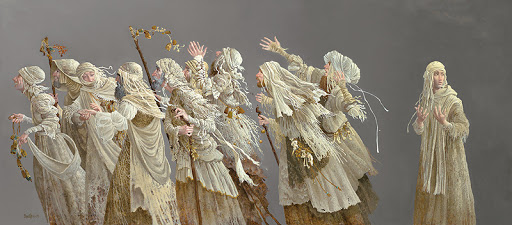
Ten lepers by James C. Christensen, from http://www.greenwichworkshop.com/details/default.asp?p=1969&c=30&a=&t=1&page=2&detailtype=prints

Invitation to the Wedding Banquet

Click here to listen to the audio recording of this 13-minute message. Or watch the sermon on Facebook (sermon starts at 19:26) or read the text summary below.

Matthew 25:1-13 tells the story of 10 young women who were waiting to meet the bridegroom. They all brought their oil lamps with them, knowing it might be a bit of a wait, but only half of them had the sense to bring extra oil. They all fell asleep waiting, but when the groom arrived, they woke up. The five without extra oil realised that their lamps were going to go out soon and asked the ones with extra to share with them. The wise, mean girls said no – go buy yourself some. The girls with the extra oil went into the wedding banquet, but by the time the other girls got back from buying more oil, the door had closed and they were turned away.

This parable – quite strong in its wording – is narrated during the week leading up to Jesus’ crucifixion. Chapters 24 and 25 focus on the end times, and the preceding three chapters have some strongly worded messages. Chapter 22 has another story about a wedding banquet, which ends “Many are invited, but few are chosen” – meaning, few actually will attend the banquet.

Three lessons we can take out of Jesus’ parable:

  1. Come to the banquet! The banquet is the party of parties. The bridegroom is none other than Jesus himself. It is a great celebration and we want to be there! God invites us all to attend – it’s an open and free invitation. We just have to accept the invite and pitch up.
  2. Be prepared! Half the girls came without extra oil. They really didn’t think anything through. They seized the opportunity for the party, but did nothing to get ready for it. We are urged to be prepared for the party, which we can do by pitching into the preparations. We can work in God’s Kingdom. We can exercise our ministry. We can give of our time and money. We can come to church and build the fellowship. In short, we can stewards ourselves, our communion, our things and our world.
  3. Wake up! All the girls fell asleep. Not just the foolish five, but all of them. Indeed, there are several stories of Jesus’ disciples falling asleep: In Luke 9:28-36, the disciples fell asleep before Jesus’ transfiguration; and in Matthew 26:36-46, the disciples repeatedly fell asleep as Jesus prayed in the Garden of Gethsemane. The absence of church during Covid may have made us similarly ‘sleepy’. We are out of the practice of coming to church, participating in worship, fellowship together. We’ve become dozy. It is time to wake up and to build up these muscles again!

Jesus invites us to a fabulous celebration – the wedding banquet. Let’s be sure to be prepared and be awake, so we don’t miss out!

Featured image from http://3.bp.blogspot.com/-R3zlsxfJV1E/TqtbWlWSagI/AAAAAAAAAKg/l3_WDC3LuDs/s320/parable-of-the-banquet.jpg

Stewarding our world

Click here to listen to the audio version of this 12-minute message. Or watch the YouTube video below. Or read the text summary that follows.

Father almighty
we offer ourselves to you as a living sacrifice in Jesus Christ our Lord.
Send us out into the world in the power of the Holy Spirit
To live and work to your praise and glory.

We end each Eucharist service with this prayer. It is the endpoint of the entire service of communion. We do come to be filled, restored and healed; we do come to worship and praise God; we do come for fellowship; we do come to learn; and we do come to celebrate the Eucharist. But the purpose of all of this is to equip and fill us to go out into the world and serve the Lord.

The church is a refuelling station, in which we are filled up and restored, so that we can go out and do God’s work in the world.

Today is the fourth and last Sunday in our stewardship programme.

  1. In the first week, we considered stewarding ourselves;
  2. then stewarding our communion (our church fellowship);
  3. and last week, stewarding our things, particularly our money.
  4. Today, we reflect on what it means to steward the world.

Genesis 2 presents the narrative of God’s creation of humanity. God then placed the man he had created in the Garden of Eden and commissioned him to ‘tend and care for it’; that is, to steward the world. We continue to carry this commission.

Stewarding the world includes a focus on the planet – the earth itself – with all its natural resources: the sky, the oceans, the water, the land, the minerals, the renewable and non-renewable energy resources. We are commissioned to take care of the earth (and indeed the cosmos) – not to exploit, plunder, rape and destroy. ‘Tend and care’ are gentle, kind, caring, nurturing words, to describe the relationship we ought to have to the world around us.

In addition, stewarding the world includes a focus on its people – on all of humankind – regardless of anything (religion, race, gender, politics, nationality, sexual orientation, gender identity, age, disability, and so on). We are to be Christ’s presence among humanity – his hands, his feet, his eyes, his mouth, his heart (as Saint Teresa of Ávila may have written – see video below). It is unfortunate that many Christians see their Christ-like presence in the world as reduced just to fighting against two issues: human sexuality and abortion. While these are important topics to engage, Jesus’ own presence in the world focused pervasively on fighting for love, kindness, justice, inclusion. To steward the people of this world is to imitate Christ’s engagement with humankind.

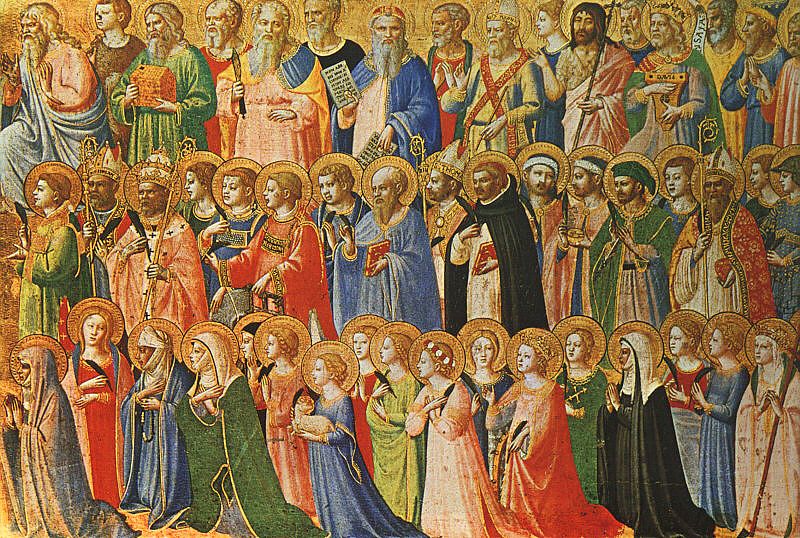
Appropriately, today is All Saints Day, the day on which we commemorate and celebrate the lives of the saints. My church is named after St Stephen, who is described in Acts 6-7. Carrying his name, we in our parish are invited to adopt Stephen as a model or example for our lives. Stephen was a young deacon, whose ministry lasted less than a year. A deacon is a servant, who works out in the community, helping the poor and marginalised. Stephen is described as being “full of faith and of the Holy Spirit”. He was a bold preacher, delivering the longest sermon in the book of Acts. It resulted in his murder, at the age of 29. As he died, his last words were to forgive those who stoned him.

Stephen is a shining example of stewarding the world. He was a servant to the people of God and to people seeking God.

Let us each take up our own role, in our own place, in our own way, using our own Spirit-given gifts, to love and serve the world.

Go in peace to love and serve the Lord
In the name of Christ.
Amen

Painting of the saints by Fra Angelico (in the 1400s) from https://en.wikipedia.org/wiki/All_Saints%27_Day
https://www.youtube.com/watch?v=w7ymxW3rndk

Stewarding our things

Click here to listen to the audio recording of this 20-minute message. Or watch the YouTube video below. Or read the text summary after that.

Today is our third Sunday in our four-part series on stewardship. We have already reflected on stewarding ourselves and stewarding our communion (our church fellowship). Today, we reflect on stewarding our things. By ‘things’ I mean all the things we have or own – our house, our car, our furniture, the space in the place we live, our books, our garden, and our money.

I’m going to focus on our money in this message, because money is in many ways a proxy for all our things – most of our things were purchased with money. But also, money is needed for the church to to be church and to grow – there are real costs associated with operating a church – salaries, rent, water and lights, supplies, and so on. So, we do have to think about the real costs of serving the communion (the local church) and of building God’s Kingdom (the mission).

In 2 Corinthians 8 and 9, Paul writes an extended passage about giving. The context is that the church in Corinth had promised to give Paul some money towards the spreading of the Gospel, but had not actually paid it over. So Paul tries in this passage to persuade them to pay it over, not out of obligation, but freely. This makes this passage quite relevant for the modern church, as we also need money from our members, but want members to give freely.

There are four primary themes about giving in this extended passage:

GIVE WHAT YOU CAN, ACCORDING TO YOUR MEANS

8:3 For I testify that they gave as much as they were able…

8:11 …[give] according to your means.

8:12 For … the gift is acceptable according to what one has, not according to what one does not have.

GIVE FREELY, BY YOUR OWN WILL

8:3-4 …they gave …even beyond their ability. Entirely on their own, they urgently pleaded with us for the privilege of sharing in this service to the Lord’s people.

8:8 I am not commanding you…

8:10 Last year you were the first not only to give but also to have the desire to do so.

8:12 For if the willingness is there, the gift is acceptable

9:7 Each of you should give what you have decided in your heart to give, not reluctantly or under compulsion

GIVE GENEROUSLY, SO IT’S UNCOMFORTABLE

8:2 In the midst of a very severe trial, their overflowing joy and their extreme poverty welled up in rich generosity.

8:5 And they exceeded our expectations: They gave themselves first of all to the Lord, and then by the will of God also to us.

8:7 Since you excel in everything… see that you also excel in this grace of giving.

9:5-7 So I thought it necessary to … finish the arrangements for the generous gift you had promised. Then it will be ready as a generous gift, not as one grudgingly given. Remember this: Whoever sows sparingly will also reap sparingly, and whoever sows generously will also reap generously… God loves a cheerful giver.

GIVE, AND YOU WILL RECEIVE

9:8 And God is able to bless you abundantly, so that in all things at all times, having all that you need, you will abound in every good work.

9:10-11 Now he who supplies seed to the sower and bread for food will also supply and increase your store of seed and will enlarge the harvest of your righteousness. You will be enriched in every way so that you can be generous on every occasion, and through us your generosity will result in thanksgiving to God.

Perhaps the most striking verse in these chapters is an extract from 2 Corinthians 8:7, “see that you also excel in this grace of giving”. Grace in Greek is charis which means a gift (like the gifts of the Spirit). Paul views giving as a gift, a privilege, an opportunity and something that God enables us to do.

As we come closer to the time when we make a commitment to contribute financially to the work of the church, I pray that God will stimulate in you this sense of the opportunity and gift of giving, and that you will be able to give freely and generously, according to your means.

Features image from:
https://elements.envato.com/coins-in-hand-hands-counting-a-few-euro-coins-a-ha-Z47B9H6

Our Father

Click here to listen to the audio recording of this 10-minute message. Or watch the YouTube video below, or read the text summary thereafter.

Luke 11:1-4 presents us the brief, well-known passage about Jesus teaching his disciples to pray using an earlier form of the Lord’s Prayer. He says,

When you pray, say,
‘Father…’

I’m stopping at this first word, because it represents a profound revelation and revolution in our understanding of God. In the First Testament of the Hebrew people, God was regarded as all powerful, fearsome, remote, almost terrifying. God was seldom referred to as ‘Father’, except when he was spoken of as being, for example, the Father of Abraham, Isaac and Jacob, or the Father of Israel. And God refers to himself as a father in a handful of passages. But people never prayed to or spoke to him directly as ‘Father’.

Jesus, by contrasts, shows himself engaging with God as his personal father, in an intimate, authentic, comfortable, loving way. In his prayers, he calls God ‘Father’. He reveals God in a new light – as approachable, caring, accessible. And he shows that God is interested in our daily lives, in the little things we experience and also in the big challenges we face.

And so, when he teaches his disciples how to pray, his first word is ‘Father’. We could almost stop just there with the Lord’s Prayer because that on its own is a radical transformation of our relationship with God. A one-word prayer – “Father” – is a great prayer!

Not everyone has good associations with ‘father’, however. Some of us have been abused by our fathers, abandoned by them, treated harshly by them. Some don’t know our fathers. Some would never share anything personal with our fathers. So, thinking of God as our ‘father’ might not be meaningful or helpful to everyone; indeed, it might raise a host of painful memories and feelings.

But let us remember that God is not a man and not an actual biological father. Rather, Jesus refers to God as father to reflect a relationship that for him was meaningful. We could think of God as parent (which is often how I refer to God in public prayer) or as mother or caregiver. And let us also consider that there could be healing for our woundedness when we experience a heavenly parent who is consistent, fair, engaged, loving, kind, protective, empowering and sincere, particularly if we have not experienced this with our human parents.

I encourage you today to enter into a more intimate and honest engagement with God in your prayers – both in your formal prayers when you sit down for the purpose of praying or saying a daily office, and in your informal prayers, muttered to God as you drive or worry about something or are grateful for something. God desires to have a parental relationship with us, in which we can rest in his arms and tell him everything that is on our heart, without fear or hesitation.

And so we pray:

Our father in heaven
hallowed be your name
your kingdom come
your will be done on earth as in heaven.
Give us today our daily bread.
Forgive us our sins, as we forgive those who sin against us.
Save us from the time of trial and deliver us from evil.
For the kingdom, the power, and glory are yours
now and for ever. Amen

Featured image from https://valourdigest.com/7-things-a-son-needs-from-his-father/

Relying on Christ

Click here to listen to the audio recording of this 8-minute message. Or watch the YouTube message below, or read the short text summary thereafter.

In Philippians 3:4b-15a, Paul shares his own experience of faith and in so doing holds up a mirror for us to reflect thoughtfully on our experience of faith. So often our faith gets caught up with our human activity – all the things we do to express our faith – prayer, giving, righteousness, attending church and so on.

But Paul says these things are comparatively worthless (garbage!) compared to faith that is reliant on Christ. Paul is not saying that we should abandon such things, but that by comparison with a faith that relies entirely on Christ, these things should not be central.

This passage is one of a few where Paul really opens his heart to us and shares his own faith journey, and so rather than preaching for long on the passage, I encourage you primarily to read, hear and digest the inspired words of the Apostle Paul.

Featured image from https://za.pinterest.com/pin/117938083965411553/

Forgiveness

Click here to listen to the audio recording of this 13-minute message. Or watch the YouTube video below, or read the text summary after that.

Today we are reading from Matthew 18, which has a series of parables and teachings about the life of the church, culminating in a teaching on forgiveness. The central verse is, perhaps, v22, where, in response to Peter’s question, “Lord, how many times shall I forgive my brother or sister who sins against me? Up to seven times?” Jesus answers, “I tell you, not seven times, but seventy-seven times” (or 70 time 7 times).

The whole chapter speaks about relationships between us and our brothers and sisters in the church:

  • First Jesus  reminds us that greatness is relative, and that if we want to be great, we need to be like little children. (Mat 18:1-5)
  • He then cautions us to avoid doing anything that might cause others (“little ones”) to stumble. Indeed, he goes as far to say that we should mutilate ourselves, rather than cause someone to stumble. (Mat 18:6-9)
  • Then we get the parable of the wandering sheep. A shepherd as 100 sheep and one goes missing. He leaves the 99 to seek out the one. Jesus emphasises the great joy in heaven resulting from the rescue of the one, and refers to them again as ‘little ones’. This passage speaks about love seeking – God is always seeking us out, even just the one, even just a ‘little one’. God is seeking – we need to be seeking. (Mat 18:10-14)
  • Then we have a teaching about how to handle sin in the church – when our sister or brother sins. Jesus presents a nuanced series of challenges – first you go on your own, then you take one or two people with you (again quietly and personally), then you inform the church (presumably the leadership) and they go (again quietly and personally) to challenge the person, and finally, says Jesus, we “treat them as you would a pagan or a tax collector”. We might think Jesus means to cast them out, to excommunicate them. But Jesus’ encounters with pagan Romans (Luke 7:1-10) and tax collectors (Luke 19:1-10) are to engage with them, not to cast them out. Love challenges and confronts, but in a way that embraces rather than rejects. (Mat 18:15-20)
  • Finally, we have the parable of the unmerciful servant, where a servant owes his king a lot of money, but cannot pay it back. He begs for mercy and the kind cancels his debt. The servant meets someone who owes him a few bucks, demands payment and when he cannot pay, he casts him into jail. The king is outraged at his lack of mercy, given that he had cancelled the far larger debt of the servant, and has him cast into jail. Love forgives, and is willing to forgive greatly and repeatedly. (Mat 18:21-35)
  • The passage ends with a warning, “Thus also my heavenly Father will do to every single one of you who does not forgive your brother or sister, and forgive from the bottom of your heart” (v35). Through these very strong and threatening words, Jesus is conveying the central importance of forgiveness. We have been forgiven much; should we not also forgive others?

Jesus teaching in this chapter presents a picture of a health church and of healthy human relationships – we do not look down on anyone; we are considerate of others and avoid causing them harm; we value the group but we also value the individual, even seemingly unimportant individuals; we challenge wrongdoing, but in a way that embraces and restores; and we forgive those who do wrong against us, again and again, in the same way that God forgives us, again and again. If we could do all this – in the power of Holy Spirit – what a church we would have!

2020.08.13_Forgiveness-scaled-e1582229617204

Featured image from https://www.practicalrecovery.com/prblog/how-to-forgive/

Gender, by God

Click here to listen to the audio of this 35-minute message. Or watch the YouTube video below, or read the text summary after that. This is a longer-than-usual message, because this is such an important topic, that is so seldom spoken about. So, while 35 minutes is quite a long time, I urge you to set aside some time – particularly today, Women’s Day – to listen to this message.

Today – 9 August – is Women’s Day in South Africa. It’s a day when we celebrate women. But it is also a day when we confront the profound and relentless violence against and subordination of women in our society. The church must, on this day, give particular attention to its role in perpetuating, supporting and even advancing such patriarchal and misogynistic views and behaviours. My own church – the Anglican Church of Southern African – must take responsibility for our role in advancing violence against and oppression of women. And men, like me, must do the same.

So, in this message, I unpack four passages of the Bible – three in the Genesis creation story and one in the writings of Paul – that are often used to support patriarchy. I invite you to read the texts and see what they actually say and to critique how they have been used. Of course, the Bible was written in patriarchal times by people who held patriarchal views. But we are invited to read through their views to see the mind of God on the issues of gender inequality in the world.

This is an important and substantial topic, hence this is a rather lengthy message. I urge you to engage with it, as I think it will help to lay a foundation for thinking about gender relations in the world, in the church, in the workplace and in our homes.

  1. Genesis 1:27-28 tells us that both women and men are equally created in God’s image. It also tells us that they were both – as a couple, as a partnership – given authority to rule over the earth. There is no hint that the man is more created in God’s image than the woman, that he is important or more powerful than the woman. The man is not given dominion over the woman; instead both the woman and the man are given conjoint dominion over everything else. This is a picture of unity, equality and power-sharing between man and woman – a picture that is very much at odds with how life is lived in many homes today.
  2. Genesis 2:18-23 is part of the second creation story, where God recognises that it is not good for man to be alone and decides to create a ‘helper’ for him. Initially, God looks among the animals, but realising that none of these will do, God creates woman. The word ‘helper’ is often used to imply woman’s supportive, helping, subordinate role. But in v18 God recognises that man is somehow inadequate or deficient – unable to be alone – he is incomplete and needs a partner to make him whole. Therefore God creates a woman. The woman is there to help him be a whole person – this is by no means a subordinate role.
  3. Moreover, she is created from his rib, suggesting that they are equal – they stand side-by-side, joined at the rib – the midpoint between the head and the foot. God did not take Adam’s toe and create Eve’s collarbone so that Adam could stand on her head! Instead, they are created as the same, as equal, as partners. It reaffirms Genesis 1 – they are equal partners.
  4. Genesis 3:16-19 tells of God’s cursing of man and woman for their sin. v16 has a line that says “and he [your husband] will rule over you”. Many male theologians and scholars and ministers have used this verse to construct a theology that God’s divine plan for human relations post-fall is that men (husbands) exercise authority over women (wives). This is a profound perversion of the scriptures, because this is just one line out of several lines of curses, including that women will experience pain in childbirth (which humanity has constantly worked to reduce and to reduce maternal mortality).
  5. In addition to hers, there is a lengthy curse against the man (72 words to the man, compared with just 31 to the woman – the man’s curse is more than double the length of the woman’s!). God says that he will suffer and struggle to produce crops from the earth. And yet men have never accepted this as God’s divine plan for them! Men have worked, since they left Eden, to ease the burden of producing crops, through the use of slaves, animals, machines, genetic modification and most recently artificial intelligence. If the curse against men is not part of God’s divine order, why is the curse against women? It is simply patriarchy and misogyny at work!
  6. Overall, the creation story across Genesis 1-3, there is an overriding narrative of equality between woman and man. Even in the fall, both woman and man eat the apple and both woman and man are cursed. Everything is equal, parallel. Indeed, if there was any hint of gender inequality, it would be in favour of woman – she was God’s second attempt at creating a human (we are usually better the second time round) and her curse is shorter than man’s. But indeed, the dominant and pervasive narrative is one of equality and partnership between gender. This is God’s vision for gender.
  7. So, we do need to look also at the New Testament, and particularly to the writings of Paul. It is true that Paul was raised in a patriarchal society and household. He is certainly a patriarch and probably also a misogynist. He does write that men are the head over women, that women must be silent in church, etc. He clearly writes about male domination over women. This is how he was raised. There are, however, NO passages where Paul advocates or endorses, even tacitly, violence against women or the oppression of women. And just because Paul was a patriarch, does not mean God is a patriarch.
  8. Paul grapples with gender issues. He writes “there is neither male nor female, for you are all one in Christ” (Galatians 3:28). He has some sense that in God’s eyes, there is no gender; but in his own thinking, he still sees and supports gender inequality. What we seem to be seeing in Paul’s writings is a developing insight into God’s view on gender equality, emerging and receding.
  9. 1 Corinthians 7:2b-5 presents to us a profoundly egalitarian view of gender relationships from the pen of Paul. It shows a perfect equality between women and men, equal exercising of power over one’s body, equal self-giving of oneself to one’s partner. It is an image of a very modern marriage. It is completely out of step with the traditional passages we quote from Paul on ‘wives must submit to their husbands’. If men are going to quote Paul on gender, let us quote ALL of Paul on gender, and recognise that here is a man whose views on gender are uneven. And this unevenness is best explained as Paul’s growing understanding of God’s view of gender equality.

In light of these challenges about God’s views – and Scriptures views – on gender equality, I suggest two principles that should inform and shape how we interpret scripture:

  1. First, we need to look at the whole of scripture when we formulate a position on something, like gender relations. We need to look at the whole body, and we need to understand the underlying mind of God, which we see most clearly expressed in the mind of Christ, which we best gain insight into in the Gospel narratives.
  2. Second, we need to separate custom from teaching, description from prescription. Just before the Bible writers believed the earth was flat and that the sky was a bowl over the earth, does not mean that the earth is actually flat and that there is actually a bowl in the sky. Even though they express this view in the Bible, e.g., in the Psalms, does not mean it is true or that God believes this. We are inclined to bring our cultural beliefs and impose them onto scripture – gender is a good example of this. Instead, we are required to bring God’s mind, expressed in the scriptures, and use these to sanctify and transform society. When it comes to gender, we impose our preconceived patriarchal beliefs on scripture, even though scripture advocates a far more egalitarian view on gender.

2020.08.09_St. Praxedes and Paul

Featured image of St Praxedes and St Paul, presented as equal co-workers for Christ, in the Basilica Santa Prassede, Rome, from here

Eternity just here

Click here to listen to the audio recording of this 10-minute message. Or watch the YouTube video below, or read the text summary that follow.

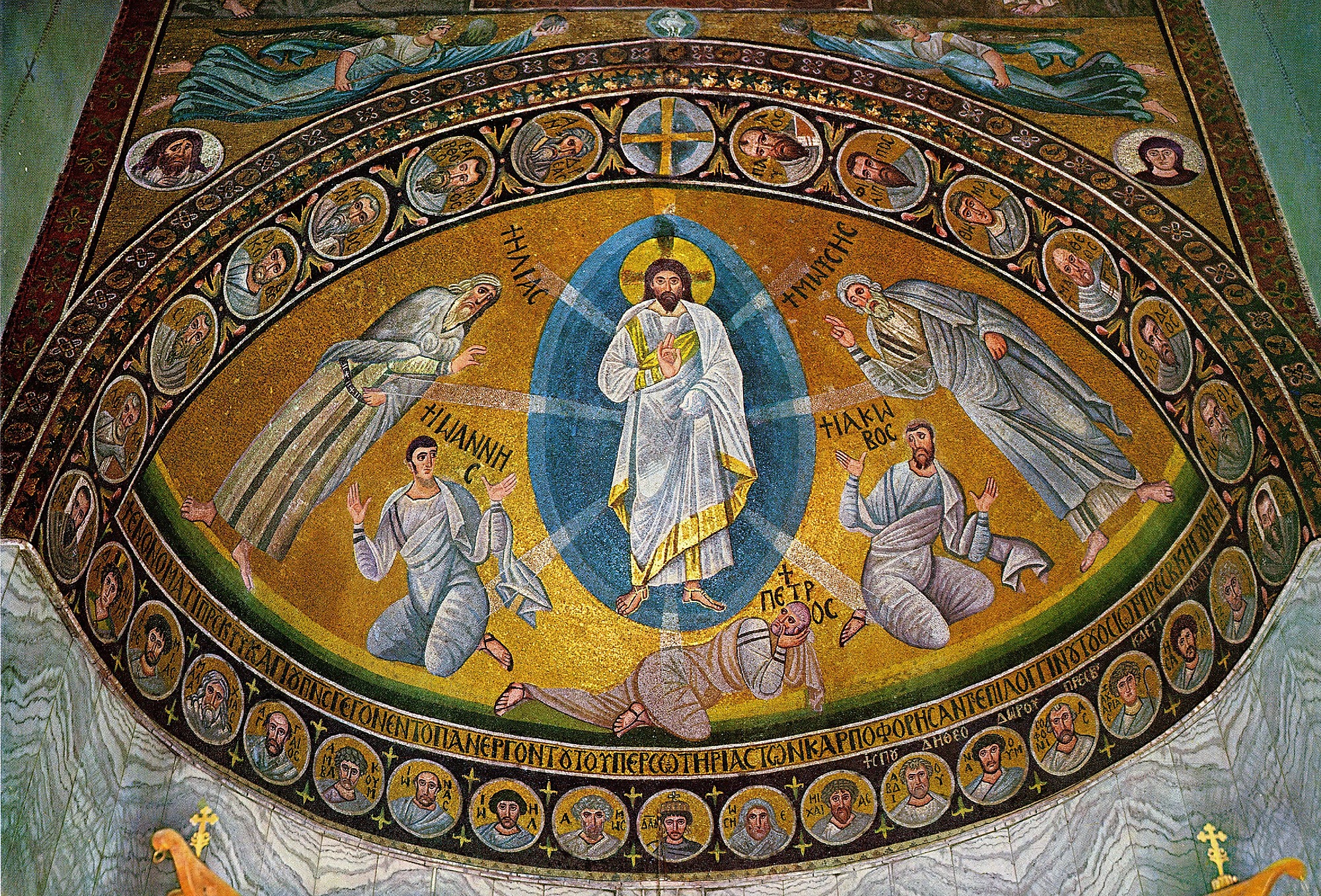
Jesus goes up the mountain with Peter, James and John to pray (Luke 9:28-31). While he prays, the appearance of his face changes and his clothes become as bright as a lightning flash. And he is seen talking with Moses and Elijah, the great heroes of the Jewish community.

The boundary that separates the ordinary, daily, lived world that we inhabit from the world of the divine, of eternity, of spiritual beings, of God – that boundary is momentarily breached. It is like a dividing curtain has been pulled aside and we are given a glimpse into heaven itself.

These two worlds – the earthly finite world and the heavenly eternal world – are always touching, pressed right up against each other. Indeed, there are people crossing over from one to the other every minute, as they die.

The materialistic world view – that we believe in only what we can see and touch, measure and weigh – has become so prominent in the world today. Many people have given up any belief in a spiritual realm, in an afterlife, in God.

Luke tells us that Peter and his companions were very sleepy, but that when they became fully awake, they saw his glory (Luke 9:32). He emphasises this because we all know that when we sleep and dream, anything is possible. The rules of this material world do not apply when we are asleep. Had the disciples been ‘sleepy’ when they saw Jesus transfigure, we could put their story down to them just dreaming. But Luke emphasises this – they were fully awake – all of their critical, rational faculties, all of their empirical senses were fully active when they saw the glory of Jesus revealed.

How wonderful it would be if we were all fully awake so that we too could perceive the eternal that is just here.

2020.08.06_Saint_Catherines_TransfigurationFeatured image of the apse mosaic of the Transfiguration scene from St. Catherine monastery in Sinai, available here. This is the oldest known image of the transfiguration, dating to AD 565-6.

Visit this website to learn more about this piece of art, as well as other artists’ depictions of the transfiguration: http://tamedcynic.org/the-transfiguration-through-art/

Jesus’ heart

Click here to listen to the audio of this 15-minute message. Or watch the YouTube video below, or read the short summary thereafter.

Today we focus on the Jesus’ feeding of the 5,000 in Matthew 14:13-21. This is the ONLY miracle story to appear in ALL four Gospel accounts. It is clearly an important story for the Gospel writers. Perhaps something about it exemplifies Jesus and his ministry.

Usually, we focus on the miracle of the feeding, but today I invite you to focus on what we learn about Jesus’ heart. And Jesus’ heart reflects God’s heart. Here are five important things we learn about Jesus, that are relevant for each of us today:

  1. Jesus feels. The story opens with Jesus hearing of the execution of John – his cousin, friend and prophet. And he feels distressed about John’s death, he feels emotions, his heart is soft and responsive. So he withdraws, privately to a solitary place. Jesus grieves and feels. He is not unmoved.
  2. Jesus’ heart goes out. Even though Jesus tries to get away to be alone, crowds of people – thousands of people – follow him on foot. And instead of being irritated with them, he has compassion on them, his heart goes out to them. As he sees us and our difficulties, his heart softens, his heart fills with care.
  3. Jesus heals. As his heart fills with compassion, Jesus moves into action and heals people of their illness. The Greek word for ‘ill’ in v14 is used nowhere else in the New Testament. It is best translated ‘wretchedness’, meaning unhappy, broken-hearted, poor, downtrodden, ill. Jesus makes people whole, he restores them.
  4. Jesus embraces. The disciples want to send the crowds away, as they sent away children, lepers and others who wanted to speak to Jesus. But Jesus refuses. Instead, he instructs the disciples to feed the crowds, and invites the people to sit down on the grass. Jesus is crowd-centred, other-centred, generous, inclusive.
  5. Jesus multiplies. Jesus takes the tiny supplies of 5 loaves and 2 fish, and multiplies them to feed thousands. He is able to see through the smallness of what we offer, to the enormous good that God can do through them. He has eyes of faith that sees the potential of the tiny to do great work.

As continue to grapple through Covid, and the many challenges it presents to us, let us look into, let us gaze upon the heart of Christ – he who feels, whose heart goes out, who heals, who embraces and includes, and who multiplies. This same Christ is present for us today. Let us look for him and sit down with him and be fed by him.

2020.08.02_Jesus_heart2

Featured image: Sacred Heart of Jesus by Joseph Fanelli (Oil on Linen) 1993 from here