Stewarding our world

Click here to listen to the audio version of this 12-minute message. Or watch the YouTube video below. Or read the text summary that follows.

Father almighty
we offer ourselves to you as a living sacrifice in Jesus Christ our Lord.
Send us out into the world in the power of the Holy Spirit
To live and work to your praise and glory.

We end each Eucharist service with this prayer. It is the endpoint of the entire service of communion. We do come to be filled, restored and healed; we do come to worship and praise God; we do come for fellowship; we do come to learn; and we do come to celebrate the Eucharist. But the purpose of all of this is to equip and fill us to go out into the world and serve the Lord.

The church is a refuelling station, in which we are filled up and restored, so that we can go out and do God’s work in the world.

Today is the fourth and last Sunday in our stewardship programme.

  1. In the first week, we considered stewarding ourselves;
  2. then stewarding our communion (our church fellowship);
  3. and last week, stewarding our things, particularly our money.
  4. Today, we reflect on what it means to steward the world.

Genesis 2 presents the narrative of God’s creation of humanity. God then placed the man he had created in the Garden of Eden and commissioned him to ‘tend and care for it’; that is, to steward the world. We continue to carry this commission.

Stewarding the world includes a focus on the planet – the earth itself – with all its natural resources: the sky, the oceans, the water, the land, the minerals, the renewable and non-renewable energy resources. We are commissioned to take care of the earth (and indeed the cosmos) – not to exploit, plunder, rape and destroy. ‘Tend and care’ are gentle, kind, caring, nurturing words, to describe the relationship we ought to have to the world around us.

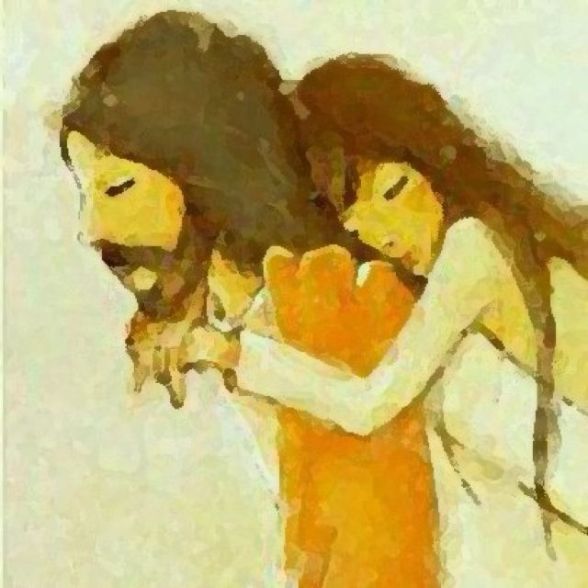
In addition, stewarding the world includes a focus on its people – on all of humankind – regardless of anything (religion, race, gender, politics, nationality, sexual orientation, gender identity, age, disability, and so on). We are to be Christ’s presence among humanity – his hands, his feet, his eyes, his mouth, his heart (as Saint Teresa of Ávila may have written – see video below). It is unfortunate that many Christians see their Christ-like presence in the world as reduced just to fighting against two issues: human sexuality and abortion. While these are important topics to engage, Jesus’ own presence in the world focused pervasively on fighting for love, kindness, justice, inclusion. To steward the people of this world is to imitate Christ’s engagement with humankind.

Appropriately, today is All Saints Day, the day on which we commemorate and celebrate the lives of the saints. My church is named after St Stephen, who is described in Acts 6-7. Carrying his name, we in our parish are invited to adopt Stephen as a model or example for our lives. Stephen was a young deacon, whose ministry lasted less than a year. A deacon is a servant, who works out in the community, helping the poor and marginalised. Stephen is described as being “full of faith and of the Holy Spirit”. He was a bold preacher, delivering the longest sermon in the book of Acts. It resulted in his murder, at the age of 29. As he died, his last words were to forgive those who stoned him.

Stephen is a shining example of stewarding the world. He was a servant to the people of God and to people seeking God.

Let us each take up our own role, in our own place, in our own way, using our own Spirit-given gifts, to love and serve the world.

Go in peace to love and serve the Lord
In the name of Christ.
Amen
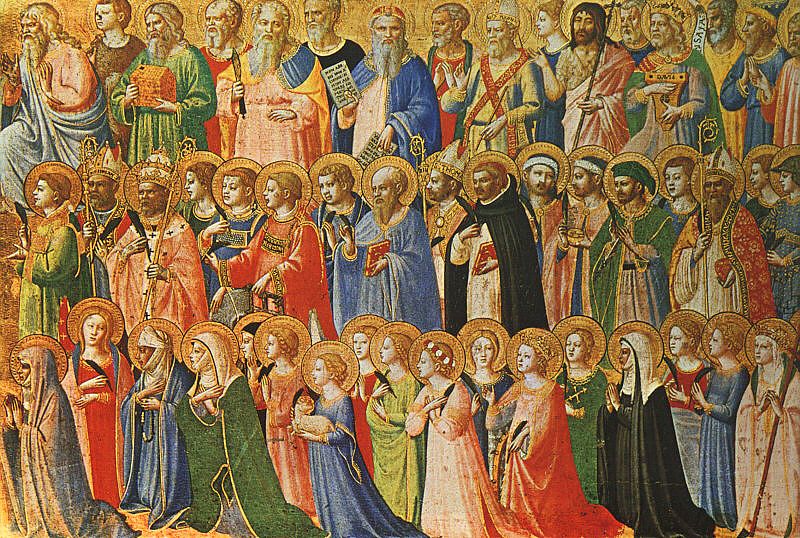
Painting of the saints by Fra Angelico (in the 1400s) from https://en.wikipedia.org/wiki/All_Saints%27_Day
https://www.youtube.com/watch?v=w7ymxW3rndk

Eternal perspective

Click here to listen to the audio of this 11-minute message. Or watch the YouTube video below. Or read the text summary after that.

The ‘reversal of fortunes‘ is one of the central themes in Luke’s Gospel of Christ. The reversal involves a switching around of power and privilege in society. We think of Mary’s, “He has brought down rulers from their thrones but has lifted up the humble” and, “he has filled the hungry with goo things but has sent the rich away empty” from Mary’s song in Luke 1:46-55. And of Jesus’ manifesto in Luke 4:16-21 (though the reversal is less clear), where he says, “he has anointed me to proclaim good news to the poor. He has sent me to proclaim freedom for the prisoners and recovery of sight for the blind, to set the oppressed free.” And Jesus’ famous, “There are those who are last who will be first, and first who will be last” in Luke 13:30. Indeed, there are numerous examples in Luke’s Gospel.

But this reversal of fortunes is demonstrated most unequivocally and powerfully in Jesus’ death and subsequent resurrection in Luke 22-24. When all seems lost – when the worst imaginable outcome occurs – we still remember Jesus’ words that he would rise on the third day. And indeed he does! What was intended as an annihilation of the Son of God and indeed of God’s entire plan for the salvation of humankind, turns into the absolute accomplishment of that plan!

Thanks be to God for the reversal of fortunes!

Our reading for today is Luke 6:20-21:

Looking at his disciples, he said:

Blessed are you who are poor,
for yours is the kingdom of God.
Blessed are you who hunger now,
for you will be satisfied.
Blessed are you who weep now,
for you will laugh.

We see again the reversal of fortunes in this passage (mirrored in the woes that Jesus proclaims in Luke 6:24-25 a couple of verses later):

  • Poor > yours is the Kingdom of God
  • Hunger > satisfied
  • Weep > laugh

But what is additionally striking in this passage is the emphasis on time. Particularly in the second and third blessings, Jesus contrasts ‘now’ with the future “you will”. This suggests that what is true now, will not be true for always. While in the first sentence, the phrases are both in the present tense – “are” and “is” – which suggests that the future improvement to our lot can be tasted now already.

It seems that there is folding in of time in Jesus’ understanding of human life. Past, present and future are not as differentiated for God as they are for us humans. For God – being outside of time and space – past, present and future all co-exist. But for us – being bound within time and space – Jesus’ message here is that the reversal of fortune – from struggle to contentment – is something sure and guaranteed that we can look forward to, and even enjoy in moments right now.

All of this points us towards adopting an eternal perspective in which we are encouraged to look at the world and our life circumstance, not just as it is right now, but as it is within the context of out eternal existence. This life, with its challenges and troubles, is not all there is. Indeed, this physical life is but a blink in the life we can continue to enjoy in the presence of God for eternity.

And much can change between now and then. The reversal of fortunes principle continues to emphasise that God will set right what is wrong in the world. And that whatever suffering or oppression or poverty we experience at this time, will not last forever. It will switch. God will set all things right.

As we continue through our stewardship programme, and particularly this week as reflect on how we steward our things and especially our money, let us hold this eternal perspective and the reversal of fortunes in mind. What we do now, has an impact on the future. Our giving of our hearts to Christ now will bring a return on investment, sooner or later. Giving generously now may be uncomfortable, but will repeat rewards that are greatly to be desired.

Featured image from https://latterdaysaintinsights.byu.edu/en/divine-discontent-an-invitation-to-improve/

Our Father

Click here to listen to the audio recording of this 10-minute message. Or watch the YouTube video below, or read the text summary thereafter.

Luke 11:1-4 presents us the brief, well-known passage about Jesus teaching his disciples to pray using an earlier form of the Lord’s Prayer. He says,

When you pray, say,
‘Father…’

I’m stopping at this first word, because it represents a profound revelation and revolution in our understanding of God. In the First Testament of the Hebrew people, God was regarded as all powerful, fearsome, remote, almost terrifying. God was seldom referred to as ‘Father’, except when he was spoken of as being, for example, the Father of Abraham, Isaac and Jacob, or the Father of Israel. And God refers to himself as a father in a handful of passages. But people never prayed to or spoke to him directly as ‘Father’.

Jesus, by contrasts, shows himself engaging with God as his personal father, in an intimate, authentic, comfortable, loving way. In his prayers, he calls God ‘Father’. He reveals God in a new light – as approachable, caring, accessible. And he shows that God is interested in our daily lives, in the little things we experience and also in the big challenges we face.

And so, when he teaches his disciples how to pray, his first word is ‘Father’. We could almost stop just there with the Lord’s Prayer because that on its own is a radical transformation of our relationship with God. A one-word prayer – “Father” – is a great prayer!

Not everyone has good associations with ‘father’, however. Some of us have been abused by our fathers, abandoned by them, treated harshly by them. Some don’t know our fathers. Some would never share anything personal with our fathers. So, thinking of God as our ‘father’ might not be meaningful or helpful to everyone; indeed, it might raise a host of painful memories and feelings.

But let us remember that God is not a man and not an actual biological father. Rather, Jesus refers to God as father to reflect a relationship that for him was meaningful. We could think of God as parent (which is often how I refer to God in public prayer) or as mother or caregiver. And let us also consider that there could be healing for our woundedness when we experience a heavenly parent who is consistent, fair, engaged, loving, kind, protective, empowering and sincere, particularly if we have not experienced this with our human parents.

I encourage you today to enter into a more intimate and honest engagement with God in your prayers – both in your formal prayers when you sit down for the purpose of praying or saying a daily office, and in your informal prayers, muttered to God as you drive or worry about something or are grateful for something. God desires to have a parental relationship with us, in which we can rest in his arms and tell him everything that is on our heart, without fear or hesitation.

And so we pray:

Our father in heaven
hallowed be your name
your kingdom come
your will be done on earth as in heaven.
Give us today our daily bread.
Forgive us our sins, as we forgive those who sin against us.
Save us from the time of trial and deliver us from evil.
For the kingdom, the power, and glory are yours
now and for ever. Amen

Featured image from https://valourdigest.com/7-things-a-son-needs-from-his-father/

Relying on Christ

Click here to listen to the audio recording of this 8-minute message. Or watch the YouTube message below, or read the short text summary thereafter.

In Philippians 3:4b-15a, Paul shares his own experience of faith and in so doing holds up a mirror for us to reflect thoughtfully on our experience of faith. So often our faith gets caught up with our human activity – all the things we do to express our faith – prayer, giving, righteousness, attending church and so on.

But Paul says these things are comparatively worthless (garbage!) compared to faith that is reliant on Christ. Paul is not saying that we should abandon such things, but that by comparison with a faith that relies entirely on Christ, these things should not be central.

This passage is one of a few where Paul really opens his heart to us and shares his own faith journey, and so rather than preaching for long on the passage, I encourage you primarily to read, hear and digest the inspired words of the Apostle Paul.

Featured image from https://za.pinterest.com/pin/117938083965411553/

Church discipline

Click here to listen to the audio recording of this 22-minute message. Or watch the YouTube video below or read the text summary that follows.

Matthew 18:15-20 speaks about church discipline. Jesus provides us with both principles for church discipline and some practical steps that can be followed.

Principles

This specific passage is located within the larger narrative of Matthew chapter 18:

  1. Jesus starts by advocating for humility; a warning particularly to those who think they are important people in the church, including church leaders (Matthew 18:1-5).
  2. Jesus says we should be considerate of our sisters and brothers, not causing people to stumble while we stand on our rights (Matthew 18:6-13).
  3. Jesus tells the parable about the lost sheep – the shepherd leaves (and even risks) the 99, while he goes in search of the one (Matthew 18:10-14).
  4. Then we have today’s passage on church discipline (Matthew 18:15-20).
  5. Immediately after that, we have Peter asking how many times he should forgive a sister or brother who sins against him. Seven times? (which to Peter probably felt very generous!) But Jesus, says, no! 70 times 7. And goes on to the parable of the unmerciful servant who was forgiven much (as we all are forgiven very much by God) but was unwilling to forgive another person a little (Matthew 18:21-35).

In combination, this chapter strongly emphasizes relationships of love. Love that is humble and little, love that is considerate, love that see the individual as of inestimable value, love that forgives and forgives, love that recognized how we have been blessed and seeks to pass it on.

This is the context within which Matthew wants us to hear Jesus’ words about church discipline.

While we are instructed to challenge or confront sin – Jesus says, “Go! And point out their fault” – nevertheless, the way in which we do it, our purpose, our understanding of ourselves in this challenging role and our understanding the person being confronted, are all to be shaped by the deep love, consideration, valuing and forgiving that Jesus has presented to us in this chapter.

Practice

Perhaps the first thing to recognize in practice is that we are all sinners, so this is a case of one sinner confronting another sinner. This is not a situation of the righteous confronting the sinner. “For all have sinned and fall short of the glory of God” (Romans 3:23). The steps are really quite sensible:

  1. Go directly to the person whose sin you have become aware of and point it out to them. Have a conversation with them, according to the principles set out above. And hopefully they will be able to hear you and the prompting of Holy Spirit and repent. (In the sermon, I share an example where I was the one being confronted regarding my own sin against another person in the church.
  2. But if they don’t listen, go again with another one or two people, and try again. These other people are witnesses and may see that actually you are in the wrong in your assessment of the situation. They provide a third perspective.
  3. But if the person still does not listen, then bring it to ‘the church’, by which Matthew probably mean the whole church, though perhaps today it would be better to bring it to the church leaders or elders. This is now a more formal and confrontational situation
  4. But if the person still does not listen, then “treat them as you would a pagan or a tax collector”.

This final step appears to suggest excommunication or ‘shunning’, though Jesus does not make explicit what he means. There certainly are other passages in the Second Testament that make provision for casting someone out of the church community. However, when we look at how Jesus treats pagans and tax collectors, we see that he reaches out to them, engages them, works to reconcile them and save them:

  • The Canaanite woman in Matthew 15:21-28 was a pagan. Jesus engaged with her when she approached him, proclaimed her faith to be incredible, and healed her daughter from demon possession.
  • Zacchaeus in Luke 19:1-10 was a tax collector. Jesus initiated dialogue with him, invited himself to his house to share a meal with him, and concludes by saying, “Today salvation has come to this house, because this man, too, is a son of Abraham. For the Son of Man came to seek and to save the lost.”

Regarding both pagans and tax collectors, we Jesus working to reconcile, restore, include, forgive, save. Combining these examples of Jesus’ actual behaviour with pagans and tax collectors, and in light of the words just before this passage – “your Father in heaven is not willing that any one of these little ones should perish” (Mat 18:14) – and the words just after it – “[forgive] not seven times, but seventy-seven times” (Mat 18:22) – we should conclude that the fourth step in Jesus’ practice guidelines is not about excommunication, but rather about persistent attempts to challenge and restore.

Paul summarises this very neatly in Galatians 6:1:

Brothers and sisters, if someone is caught in a sin, you who live by the Spirit [meaning we need check our own faith and conduct before we step in to confront someone else] should restore that person [not dump on them, not humiliate or belittle them, not shame them, not cast them out] gently [with kindness, consideration, sensitivity and above all, authentic love]. But watch yourselves, or you also may be tempted [be humble, watch out for pride, arrogance of complacency, because you might easily be the one caught in a sin next week].

Live light

Click here to listen to the audio of this 13-minute message. Or watch the YouTube video below, or read the text summary after that.

Matthew 16:21-28 is sandwiched between two remarkable narratives of Jesus’ revelation. Just before (Matthew 16:13-20), Peter recognises Jesus as the Messiah, the Son of God, and is praised by Jesus for his insight and promised a great future in the Kingdom of God. Just after (Matthew 17:1-13), Peter sees the transfiguration, where Jesus shucks off his human form and reveals himself as God the Son. In between these two remarkable stories, Jesus rebukes Peter strongly, “Get behind me, Satan! You are a stumbling block to me; you do not have in mind the concerns of God, but merely human concerns” (v23). It is quite a fascinating narrative sequence!

We learn something about Jesus’ view of life and death from this passage. Just before Jesus rebuke of Peter, he was explaining that he would soon die and then be raised to life again (v21). Peter could not accept such crazy talk about death, particularly after everything that had just happened. After the rebuke, Jesus continues by explaining that if we cling to the life we have in this world, we risk losing our life in the world to come: “What good will it be,” he asks, “for someone to gain the whole world, yet forfeit their soul?” (v26).

While Jesus clearly makes the most of this life and enjoys it – we see him living life to the full and remember how much he achieved in just 33 or so years of life and probably just three year of ministry – he reminds us that this is not all there is. There is a far greater, longer and more fulfilling life awaiting those who belief – life eternal.

We are encouraged not to cling too tightly to this life, but to hold this life lightly, much as we might hold a baby bird who has fallen out of its nest. Don’t squeeze it!

Our faith tells us about an eternal life that we will enjoy with God and those who died in faith. But too often Christians live as if they have no faith – we are afraid of dying and we cling to this life as if it is all there is.

Let us rather enjoy this life – live it to the full – while also not being afraid of death and looking forward to the eternal life that is still to come.

Featured image from https://za.pinterest.com/pin/79305643409374403/

Who do you say I am?

Click here to listen to the audio of this 16-minute message. Or watch the YouTube video below, or read the text summary after that.

In Matthew 16:15, Jesus asks his disciples, “But what about you? Who do you say I am?” This is arguably the most central question of our faith as Christians. We are, after all, Christians. We are followers of Christ. Who Christ is – this person we follow, this person whose name defines our faith -is thus of central importance.

Jesus first asked, in Matthew 16:13, “Who do people say the Son of Man is?” and the disciples run off a list of names: “John the Baptist, Elijah, Jeremiah or one of the prophets.” These are all great prophets, and in some ways Jesus is the preeminent prophet. A prophet reveals God’s mind to us, opens up the truth of God to us. And certainly Jesus does do that. But they stop short. Jesus is so much more than ‘just’ a prophet.

So, if your answer to Jesus’ question is things like (for me) – my friend, my brother, my healer, my whole-maker, my teacher, my example, my comforter, my safe space, and so on – these are right (they are certainly not wrong!), but they don’t go far enough.

This is the only place in Matthew’s Gospel where Jesus engages in discussion about himself. He is doing identity work here – discussing who he is with his disciples. This takes place in chapter 16 of a 28-chapter book. So, it appears in the second half of the Gospel. Jesus is half-way through his journey with his disciples, and only now does he ask who they say he is. This is meaningful.

As Christians, particularly evangelical Christians, we tend to have an expectation that people must make a statement of faith in Christ as a prerequisite for conversion. But here, Jesus has allowed his disciples to walk alongside him and witness his life and his engagement with the world for a long time. And only now, much later, does he ask for a statement of faith.

The understanding of who Jesus is is not the prerequisite for faith, but the result of the journey of faith.

I converted to Christianity at age 16. At that moment, on the evening of 21 October 1984, I really didn’t know who Christ was. All I knew was that God was calling me and I had to respond to his call. It was only over years of journeying with him, through all the ups and downs of faith, that my understanding of who he is and of who he is for me has become clearer. And I anticipate in the following decades of my life, this understanding will continue to mature and deepen.

Peter’s answer, after having walked with Christ, is strong and certain: “You are the Messiah, the Son of the living God.” In the Greek, the phrasing is, “You are the Christ, the Son of the God, of the Living One”. There were, in Peter’s time, as in our time, many Gods. He feels the need to qualify who he is referring to when he says ‘God’. He is not referring to just any God, but to the God who is alive, the Living God.

It is important for us to incorporate into our experience of who Christ is for us the insight that he is the Christ, the Messiah, the Anointed One, the Son of God, God the Son, the Logos, a member of the triune Godhead, the one who has been present since before time and will continue to present after time itself has ended. This is who Jesus is!

But what about you?
Who do you say I am?

Wrestling Jesus

Click here to listen to the audio of this 31-minute message. Or watch the YouTube video below, or read the text summary after that. I’m sorry this message is so long, but today’s reading is a seriously difficult passage and requires careful work. I do encourage you to watch the video and learn some profound lessons about Jesus and about faith.

Our reading today is from Matthew 15:21-28. The following translation is by Frederick Dale Bruner, in his commentary on Matthew. I’m using this because he keeps closely to the sentence structure in the Greek, which I will show is important for making sense of this passage:

21. And Jesus left there and withdrew into the territory of Tyre and Sidon.
22. And look! a Canaanite woman from that region approached and was crying out, “Have mercy on me, Lord, Son of David; my daughter is horribly possessed by a demon!”
23. But he did not respond to her with a single word.
And his disciples came up to him and repeatedly asked him, “Get rid of her, will you; she keeps screaming at us!”
24. But he responded and said, “I was not sent to anyone except to the lost sheep of the house of Israel.”
25. But she came up, bowed down worshipfully before him, and said, “Lord, help me!”
26. But he responded and said, “It is not good to take the children’s bread and throw it to the dogs.”
27. But she said, “Oh yes, Lord! Yet even the house dogs get to eat the scraps that fall from their masters’ table.”
28. Then Jesus responded and said to her, “O woman, your faith is terrific; let it be done for you exactly as you want.” And her daughter was healed that very moment.

This is such a difficult passage, because Jesus expresses what appears to be deeply disrespectful, pejorative, discriminatory, xenophobic, racist views towards the Canaanite woman. In our contemporary society, which is so riddled with racism and hostility to all who are other (including immigrants, LGBTQI+, women, etc.). It reads like (what we would today call) hate speech.

So, I have titled this message Wrestling Jesus because there are three layers of wrestling taking place here.

First, I and we have to wrestle with Jesus. His words are very hard to understand and swallow. We have to engage honestly, thoughtfully, carefully with Jesus words. We have to avoid sanitising his words, while also making sense of his words.

Second, I suggest what we are reading is Jesus wrestling with himself. I suggest what we reading is like a Shakespearean soliloquy, in which Jesus speaks out loud his internal grappling or wrestling. I’ve done some colour coding to emphasise the structure:

  1. All of the sentences (except the last) start with ‘and’ or ‘but’. I suggest that what this does is to suspend time, to create a pocket of timelessness in which something can emerge. This continues until the last verse which finally has a ‘then’ – and then the story moves forward. We have a similar event in John 8:1-11, where Jesus kneels down and doodles in the same, while the men accuse the woman of adultery.
  2. Jesus’ name is not mentioned except in the first and last verse. In the middle verses it is just ‘he’. This depersonalisation contributes to the timelessness of the narrative.
  3. In two of the three ‘responded and said’, we are not told who he responded to. It is not clear who he is speaking to. It seems he may be just speaking, to himself; saying out loud what he is thinking in his mind.
  4. v24 suggests that Jesus’ wrestling is between his mission to the people of Israel (and they would subsequently have the mission of bringing the Gospel to the nations) and the needs of this individual woman in front of him who is not an Israelite.
  5. v26 has the terrible words that seems to say that Canaanites are dogs. In my view and that of some commentators, this is a well-known racist expression that was commonly used in those days, much as we have racist expressions for groups of people today. That Jesus would say these words in the presence of this woman is hard to swallow – it is painful and anti-pastoral. But perhaps Jesus is saying out loud what people say about women like her. And perhaps this is his wrestling.
  6. What he seems to come to through all this is that PEOPLE ARE MORE IMPORTANT THAN MISSION (or law or religion or sexual orientation or politics or nationality, etc, etc, etc.). PEOPLE MATTER! Jesus seems to learn this from her.
  7. And then, in the final verse, we get a Then! Now time starts again and the story moves forward. “Then Jesus responded and said to her.” This is the first time he speaks to her directly. Everything before this, I suggest, is soliloquy. He is wrestling with his role and he learns from her what is most important, that people matter.

We see Jesus grow and learn. We see him rediscovering the truth that people matter. More than anything – including our theology, doctrine, denomination, politics, nationality, race, sexual orientation – people matter!

Third, the Canaanite woman wrestles with Jesus. She has a great need – her daughter is horribly possessed by a demon – and she is desperate for Jesus’ help. Even though she is not Jewish, she recognises who he is: Lord (the Messiahs, the Christ), Son of David (the culmination of Jewish prophecy about the line of David). Her faith, perhaps fuelled by her desperation, helps her to hear between the lines.

  • After her first appeal to him in v22, Jesus does not respond. He is silent. What she hears is not a disinterest, but “He’s not chased me away. He’s still here. I still have a chance.” And so she persists.
  • The disciples want Jesus to send her away, but Jesus says that he was sent to the house of Israel. What she hears is not that she is not part of the house of Israel, but that he has not said ‘no’ to her. There is still a chance. And so he persists. She grovels in front of him and cries out, “Lord, help me!”
  • Then Jesus quotes this racist expression. What she hears is not that she is trash, but that she can be a pet dog at his table, who is eligible to eat the scraps that fall from it. There is still a chance. And so she persists. She takes ownership of the label ‘dog’.
  • Now she is brilliant! She takes the expression that Jesus spoke out loud and turns it to her advantage. She turns his words against him. She wrestles him to the ground. She makes it impossible for him to say ‘No’.
  • Then Jesus responded and said to her, “O woman, your faith is terrific!” He sees her, speaks to her, recognises her, acknowledges her, yields to her. He uses the word ‘you‘ or ‘your‘ three times in v28. He recognises her as a person who matters, and he gives her what she has asked for with such faith and tenacity.

This woman teaches us to never, never, never give up prayer. Pray without ceasing. Do not lose hope. Wrestle God to the ground until he gives you what you are asking for.

Featured image: The Canaanite Woman, from the Très Riches Heurers du Duc de Berry. The Conde Museum, Chantilly. Downloaded from https://www.friendsjournal.org/woman-refused-take-no-answer/

Gender, by God

Click here to listen to the audio of this 35-minute message. Or watch the YouTube video below, or read the text summary after that. This is a longer-than-usual message, because this is such an important topic, that is so seldom spoken about. So, while 35 minutes is quite a long time, I urge you to set aside some time – particularly today, Women’s Day – to listen to this message.

Today – 9 August – is Women’s Day in South Africa. It’s a day when we celebrate women. But it is also a day when we confront the profound and relentless violence against and subordination of women in our society. The church must, on this day, give particular attention to its role in perpetuating, supporting and even advancing such patriarchal and misogynistic views and behaviours. My own church – the Anglican Church of Southern African – must take responsibility for our role in advancing violence against and oppression of women. And men, like me, must do the same.

So, in this message, I unpack four passages of the Bible – three in the Genesis creation story and one in the writings of Paul – that are often used to support patriarchy. I invite you to read the texts and see what they actually say and to critique how they have been used. Of course, the Bible was written in patriarchal times by people who held patriarchal views. But we are invited to read through their views to see the mind of God on the issues of gender inequality in the world.

This is an important and substantial topic, hence this is a rather lengthy message. I urge you to engage with it, as I think it will help to lay a foundation for thinking about gender relations in the world, in the church, in the workplace and in our homes.

  1. Genesis 1:27-28 tells us that both women and men are equally created in God’s image. It also tells us that they were both – as a couple, as a partnership – given authority to rule over the earth. There is no hint that the man is more created in God’s image than the woman, that he is important or more powerful than the woman. The man is not given dominion over the woman; instead both the woman and the man are given conjoint dominion over everything else. This is a picture of unity, equality and power-sharing between man and woman – a picture that is very much at odds with how life is lived in many homes today.
  2. Genesis 2:18-23 is part of the second creation story, where God recognises that it is not good for man to be alone and decides to create a ‘helper’ for him. Initially, God looks among the animals, but realising that none of these will do, God creates woman. The word ‘helper’ is often used to imply woman’s supportive, helping, subordinate role. But in v18 God recognises that man is somehow inadequate or deficient – unable to be alone – he is incomplete and needs a partner to make him whole. Therefore God creates a woman. The woman is there to help him be a whole person – this is by no means a subordinate role.
  3. Moreover, she is created from his rib, suggesting that they are equal – they stand side-by-side, joined at the rib – the midpoint between the head and the foot. God did not take Adam’s toe and create Eve’s collarbone so that Adam could stand on her head! Instead, they are created as the same, as equal, as partners. It reaffirms Genesis 1 – they are equal partners.
  4. Genesis 3:16-19 tells of God’s cursing of man and woman for their sin. v16 has a line that says “and he [your husband] will rule over you”. Many male theologians and scholars and ministers have used this verse to construct a theology that God’s divine plan for human relations post-fall is that men (husbands) exercise authority over women (wives). This is a profound perversion of the scriptures, because this is just one line out of several lines of curses, including that women will experience pain in childbirth (which humanity has constantly worked to reduce and to reduce maternal mortality).
  5. In addition to hers, there is a lengthy curse against the man (72 words to the man, compared with just 31 to the woman – the man’s curse is more than double the length of the woman’s!). God says that he will suffer and struggle to produce crops from the earth. And yet men have never accepted this as God’s divine plan for them! Men have worked, since they left Eden, to ease the burden of producing crops, through the use of slaves, animals, machines, genetic modification and most recently artificial intelligence. If the curse against men is not part of God’s divine order, why is the curse against women? It is simply patriarchy and misogyny at work!
  6. Overall, the creation story across Genesis 1-3, there is an overriding narrative of equality between woman and man. Even in the fall, both woman and man eat the apple and both woman and man are cursed. Everything is equal, parallel. Indeed, if there was any hint of gender inequality, it would be in favour of woman – she was God’s second attempt at creating a human (we are usually better the second time round) and her curse is shorter than man’s. But indeed, the dominant and pervasive narrative is one of equality and partnership between gender. This is God’s vision for gender.
  7. So, we do need to look also at the New Testament, and particularly to the writings of Paul. It is true that Paul was raised in a patriarchal society and household. He is certainly a patriarch and probably also a misogynist. He does write that men are the head over women, that women must be silent in church, etc. He clearly writes about male domination over women. This is how he was raised. There are, however, NO passages where Paul advocates or endorses, even tacitly, violence against women or the oppression of women. And just because Paul was a patriarch, does not mean God is a patriarch.
  8. Paul grapples with gender issues. He writes “there is neither male nor female, for you are all one in Christ” (Galatians 3:28). He has some sense that in God’s eyes, there is no gender; but in his own thinking, he still sees and supports gender inequality. What we seem to be seeing in Paul’s writings is a developing insight into God’s view on gender equality, emerging and receding.
  9. 1 Corinthians 7:2b-5 presents to us a profoundly egalitarian view of gender relationships from the pen of Paul. It shows a perfect equality between women and men, equal exercising of power over one’s body, equal self-giving of oneself to one’s partner. It is an image of a very modern marriage. It is completely out of step with the traditional passages we quote from Paul on ‘wives must submit to their husbands’. If men are going to quote Paul on gender, let us quote ALL of Paul on gender, and recognise that here is a man whose views on gender are uneven. And this unevenness is best explained as Paul’s growing understanding of God’s view of gender equality.

In light of these challenges about God’s views – and Scriptures views – on gender equality, I suggest two principles that should inform and shape how we interpret scripture:

  1. First, we need to look at the whole of scripture when we formulate a position on something, like gender relations. We need to look at the whole body, and we need to understand the underlying mind of God, which we see most clearly expressed in the mind of Christ, which we best gain insight into in the Gospel narratives.
  2. Second, we need to separate custom from teaching, description from prescription. Just before the Bible writers believed the earth was flat and that the sky was a bowl over the earth, does not mean that the earth is actually flat and that there is actually a bowl in the sky. Even though they express this view in the Bible, e.g., in the Psalms, does not mean it is true or that God believes this. We are inclined to bring our cultural beliefs and impose them onto scripture – gender is a good example of this. Instead, we are required to bring God’s mind, expressed in the scriptures, and use these to sanctify and transform society. When it comes to gender, we impose our preconceived patriarchal beliefs on scripture, even though scripture advocates a far more egalitarian view on gender.

2020.08.09_St. Praxedes and Paul

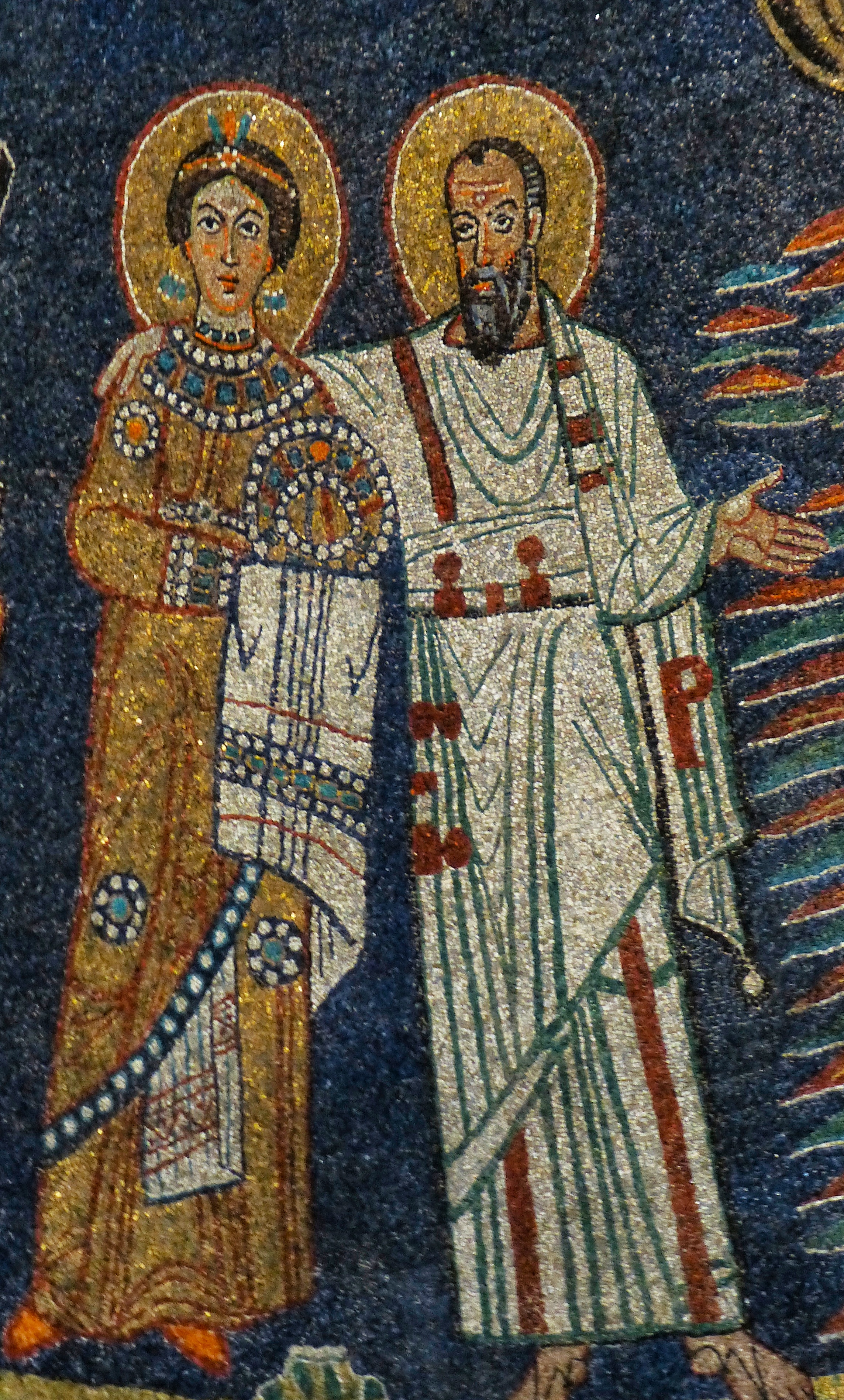
Featured image of St Praxedes and St Paul, presented as equal co-workers for Christ, in the Basilica Santa Prassede, Rome, from here

Eternity just here

Click here to listen to the audio recording of this 10-minute message. Or watch the YouTube video below, or read the text summary that follow.

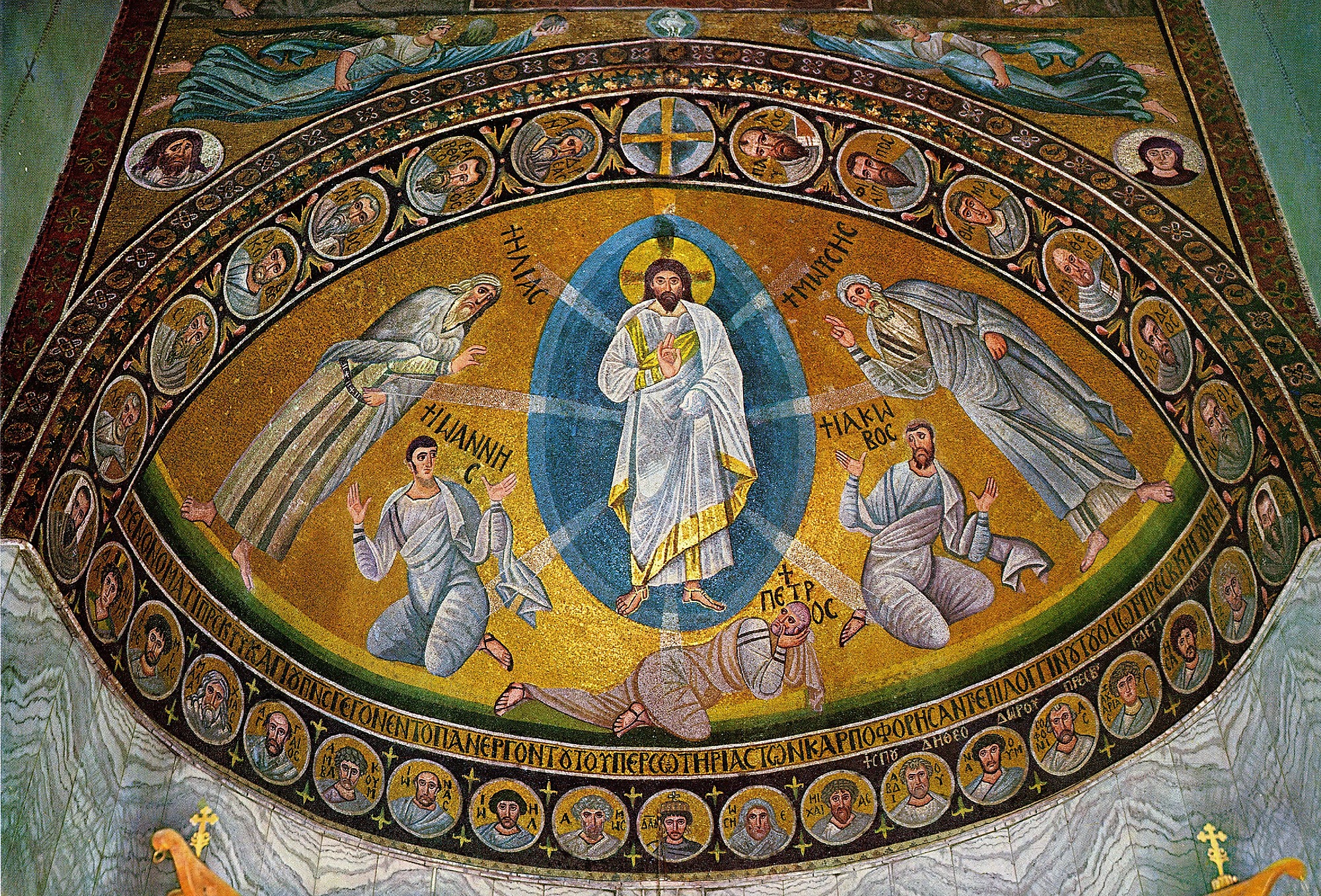
Jesus goes up the mountain with Peter, James and John to pray (Luke 9:28-31). While he prays, the appearance of his face changes and his clothes become as bright as a lightning flash. And he is seen talking with Moses and Elijah, the great heroes of the Jewish community.

The boundary that separates the ordinary, daily, lived world that we inhabit from the world of the divine, of eternity, of spiritual beings, of God – that boundary is momentarily breached. It is like a dividing curtain has been pulled aside and we are given a glimpse into heaven itself.

These two worlds – the earthly finite world and the heavenly eternal world – are always touching, pressed right up against each other. Indeed, there are people crossing over from one to the other every minute, as they die.

The materialistic world view – that we believe in only what we can see and touch, measure and weigh – has become so prominent in the world today. Many people have given up any belief in a spiritual realm, in an afterlife, in God.

Luke tells us that Peter and his companions were very sleepy, but that when they became fully awake, they saw his glory (Luke 9:32). He emphasises this because we all know that when we sleep and dream, anything is possible. The rules of this material world do not apply when we are asleep. Had the disciples been ‘sleepy’ when they saw Jesus transfigure, we could put their story down to them just dreaming. But Luke emphasises this – they were fully awake – all of their critical, rational faculties, all of their empirical senses were fully active when they saw the glory of Jesus revealed.

How wonderful it would be if we were all fully awake so that we too could perceive the eternal that is just here.

2020.08.06_Saint_Catherines_TransfigurationFeatured image of the apse mosaic of the Transfiguration scene from St. Catherine monastery in Sinai, available here. This is the oldest known image of the transfiguration, dating to AD 565-6.

Visit this website to learn more about this piece of art, as well as other artists’ depictions of the transfiguration: http://tamedcynic.org/the-transfiguration-through-art/