To be saved

Click here to listen to this 19-minute message.

Our Gospel reading for today is the rather curious passage from Luke 20:27-38, which involves a convoluted story about a woman who was married and remarried to seven brothers in succession, with the hope that one of them would impregnate her. The question asked of Jesus by the Sadducees was which of them would be her husband at the resurrection. It is a rather awful story, filled with patriarchal beliefs about women, marriage and child bearing.

I did not feel God leading me to preach on this passage today.

However, the point of the story is of interest. Jesus affirms that there IS a resurrection, that there is an afterlife, and that it will be wonderful. And this affirmation of Jesus – that life does not simply end when our bodies die – prompts us to think about salvation and what it means to be saved.

For that, we turn to our Second Testament reading: 2 Thessalonians 2:13-17 (I’ve bolded some of the key words):

13 But we ought always to thank God for you, brothers and sisters loved by the Lord, because God chose you as firstfruits to be saved through the sanctifying work of the Spirit and through belief in the truth. 14 He called you to this through our gospel, that you might share in the glory of our Lord Jesus Christ.

15 So then, brothers and sisters, stand firm and hold fast to the teachings[b] we passed on to you, whether by word of mouth or by letter.

16 May our Lord Jesus Christ himself and God our Father, who loved us and by his grace gave us eternal encouragement and good hope, 17 encourage your hearts and strengthen you in every good deed and word.

What do we learn about salvation from this passage?

  • First, God chose us – God called us. Salvation is always God’s initiative. And God chooses and calls every person into fellowship with God. God’s mission is to reconcile the WHOLE world to God’s self, under the headship of Christ (Ephesians 1:9-14). When God calls us, God calls us by name. It is personal. God wants YOU personally. It is not just that God wants to save everyone, like some anonymous conglomerate of humanity. No! It is that God’s has chosen YOU personally, by name, and called you to be in fellowship with God, to be saved.
  • Second, we are saved through two main actions (according to this passage):
    • First, we are saved through the sanctifying work of the Spirit. When God calls us, Holy Spirit comes and resides in us. Spirit makes a home in our hearts, comes and lives inside of us (1 Corinthians 6:19). God works to transform us into the image of Christ, from the inside out, through the sanctifying work of the Spirit.
    • Second, we are saved through our belief in the truth. And what is this truth? Jesus Christ is truth (John 14:6; John 8:31-32). We can do nothing to attain salvation; salvation is in its entirety the result of Christ’s work, through creation, his incarnation, his ministry, his death, his resurrection and his ascension to the right hand of God. We can’t add to this. All we can do is respond to the truth of it. And ‘to believe in’ something or someone is much the same as ‘to trust in’ someone or even better, ‘to entrust ourselves’ to someone. We entrust ourselves into the truth of Jesus.
  • Third, the result of this salvation is that we get to share in the glory of our Lord Jesus Christ. It is not so much that we become glorious, but that we bask in the radiance of God’s glory. We can be confident that when we die, we enter into the enjoyable and wonderful presence of God. Jesus spoke about this in our earlier reading (Luke 20:36): “they can no longer die; for they are like the angels. They are God’s children, since they are children of the resurrection.”
  • Finally, because of all of this, we are encouraged to stand firm and hold fast to our faith. Sometimes, maybe often, our faith is frail and feeble. Sometimes life gets on top of us. Sometimes we succumb to sin. Sometimes pain, suffering and illness burden us. Sometimes evil in the world – violence, hatred, exclusion, oppression, poverty and injustice – overwhelm us. In these times, especially, God calls us, urges us, to stand firm in and to hold fast to Christ.

In Paul’s final words in this brief passage, he offers a blessing. I liked this blessing so much, we read it four times during the service, twice as a blessing, with my hand outstretched. I again stretch out my hands to you in blessing, saying:

May our Lord Jesus Christ himself and God our Father, who loved us and by his grace gave us eternal encouragement and good hope, encourage your hearts and strengthen you in every good deed and word.

2019.11.10_To_be_Saved

Christianity made simple

Click here to listen to this 22-minute message.

The theme I was allocated for today’s sermon was ‘Make it simple’. Make it simple! What a theme!! I’m good at making things complex, nuanced and sophisticated; not at making the complex and (ultimately) unknowable simple.

So I start this message by sharing my testimony of how I became a Christian on 21 October 1984.

I then use the four readings allocated for today to pull out two main themes:

  1. Psalm 116 uses the phrase “I call on the name of the Lord” four times, emphasising that in response to both the highs and lows of life, we are to choose to call on God’s name.
  2. Joshua, in Joshua 24:14-18, calls people to choose this day who they will follow: God or not God.
  3. In Ephesians 4:25-5:1, Paul exhorts Christians to “be kind and compassionate” to other people and to “walk in the way of love”.
  4. And in Luke 6:27-36, Jesus says, “to you who are listening I say: Love”. This is always his command and call, the most basic command that he gives and the one that he gives most frequently. This time, he ups the ante by calling us to ‘love our enemies’, because loving those who love us is something everyone does. We who follow Christ, however, are called to more than that.

Together, these readings present to us a very simple (albeit not easy) approach to Christianity:

Choose God

Choose love

It is really as simple as that. And while these sound like two things, they are in fact one, because God is love (1 John 4:8). So, in truth, at its simplest level, being a Christian means:

Choose the God of love

Let it be so.

2019.09.29_wales-71892

Shrewd Christian

Our reading for today (Luke 16:1-9) has to be one of the oddest of Jesus’ parables. Here it is in full:

“There was a rich man whose manager was accused of wasting his possessions. So he called him in and asked him, ‘What is this I hear about you? Give an account of your management, because you cannot be manager any longer.’

“The manager said to himself, ‘What shall I do now? My master is taking away my job. I’m not strong enough to dig, and I’m ashamed to beg— I know what I’ll do so that, when I lose my job here, people will welcome me into their houses.’

“So he called in each one of his master’s debtors. He asked the first, ‘How much do you owe my master?’ “‘Three thousand liters of olive oil,’ he replied. “The manager told him, ‘Take your bill, sit down quickly, and make it fifteen hundred.’

“Then he asked the second, ‘And how much do you owe?’ “‘Thirty tons of wheat,’ he replied. “He told him, ‘Take your bill and make it twenty-four.’

“The master commended the dishonest manager because he had acted shrewdly. For the people of this world are more shrewd in dealing with their own kind than are the people of the light. I tell you, use worldly wealth to gain friends for yourselves, so that when it is gone, you will be welcomed into eternal dwellings.

Instead of preaching a sermon on this topic, I engaged a few of the parishioners in enacting the scene. This service took place at Irene Homes for intellectually disabled women, a ministry setting that brings me great joy. The ladies participated wholeheartedly in the acting out the story, as you can see in the video taken by someone in the congregation.


The moral of the story is that we should use what we have in life (what Jesus refers to as ‘worldly wealth’) to build positive relationships with people and to invest in the development of the world. While the people we invest in might not open their homes to us, as the dishonest manager in Jesus’ story hoped. But God will open his eternal home to us. And that’s a worthwhile investment!

Who am I?

Click here to listen to this 23-minute message.

Today we ask the question, Who am I? Or more specifically, What is my identity as a Christian? This is the first of five themes in a series on stewardship, where we reflect on our role in taking care of God’s business in the world.

In this audio message, I make the following points:

  1. In John 15:1-10, the passage where Jesus says he is the vine and we are the branches, 11 times Jesus uses the term ‘remain’ (or ‘abide’ in the old Authorised Version): “Remain in me … and you will bear much fruit“. Here Jesus calls us to be rooted into him, to remain grafted into him. We recognise that without him, we can do nothing. So we depend on him.
  2. In the same passage, Jesus also speaks of remaining in us: “Remain in me as I remain in you“. This suggests an interdependence between God and us, in which God binds himself to humanity. We this most strongly evident in four moments in cosmic history: creation, covenant, incarnation and Pentecost. In each of these, God in some way limits himself or enters into agreement with humanity, binding himself and his work to us.
  3. Psalm 23 reminds us that God is both the source of our life (“The Lord is my shepherd, I lack nothing”) and its destination (“Surely your goodness and love will follow me all the days of my life, and I will dwell in the house of the Lord forever”). In John 14:6, Jesus similarly emphasises that he is the way and the truth and the life. In other words, he is everything – there is nothing in our lives that falls outside of our connection to Christ.
  4. Our interdependence with God is rooted in our relationship with God. Sometimes the church gives us rules or procedures or recipes we’re supposed to follow in our relationship with God. But this relationship is like any other relationship in our life. It is unique, personal and authentic. It is different for each of us, because, though God is the same person, each of us different, so his relationship to each of us different. God meets us right where we are. Whatever you find works for you in your relationship with God, do more of that.
  5. As much as our interdependence with God is rooted in our relationship with God, it is also rooted in our relationships with each other. God did not create a single person (Adam or Eve); God created a couple (two people in loving relationship with each other), and immediately mandated them to procreate and become a family. 1 Peter 2:9-10 similarly emphasises that we are a community of people in relationship with other people: “a chosen people, a royal priesthood, a holy nation, God’s special possession … the people of God”. So, we have to invest not only in ourselves and our relationship with God, but also in our relationships in the church (however you want to define that) and the work of the church.
  6. Finally, our readings today call for decisiveness. Moses, speaking just before the nation of Israel crosses into the promised land, calls them to a decision (Deuteronomy 30:19-20): “This day I … set before you life and death, blessings and curses. Now choose! Choose life! … For the Lord is your life”.

Image may contain: 1 person

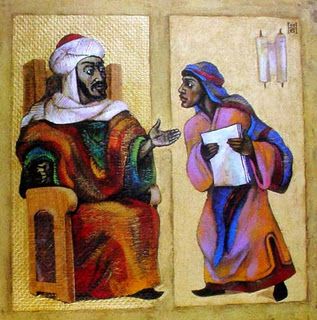
This banner, hanging at St Stephen’s Anglican Church, Lyttleton, created by Eleanor Jappie.

Featured image from here.

Not peace, but division

Click here to listen to this 18-minute message.

Jesus says, in Luke 12:49-53:

“I have come to bring fire on the earth, and how I wish it were already kindled! But I have a baptism to undergo, and what constraint I am under until it is completed! Do you think I came to bring peace on earth? No, I tell you, but division. From now on there will be five in one family divided against each other, three against two and two against three. They will be divided, father against son and son against father, mother against daughter and daughter against mother, mother-in-law against daughter-in-law and daughter-in-law against mother-in-law.”

This is a challenging passage because it seems so contrary to what Jesus appears to stand for: love, peace, reconciliation, forgiveness. How do we make sense of this?

We start by testing out whether Jesus really did not come to bring peace on earth. We locate this specific passage within the broader narrative of his life and ministry. When we do that, we find that Jesus definitely did come to bring peace on earth. Here it is from Luke’s version of the Gospel:

Prophesies about his ministry

End of Song of Zechariah:  “to shine on those living in darkness and in the shadow of death, to guide our feet into the path of peace.” (Lk 1:79)

Angels proclaiming the birth of Christ:  “Glory to God in the highest, and on earth  peace to men on whom his favor rests.” (Lk 2:14)

Jesus’ actual ministry

To the sinful woman who anointed his feet:  ‘Jesus said to the woman, “Your faith has saved you; go in peace”.’ (Lk 7:50)

To the bleeding woman:  ‘Then he said to her, “Daughter, your faith has healed you. Go in peace”.’ (Lk 8:48)

To the disciples after his resurrection:  ‘While they were still talking about this, Jesus himself stood among them and said to them, “Peace be with you”.’ (Lk 24:36)

Jesus’ instructions to his disciples

To the 72 followers:  “When you enter a house, first say, ‘Peace to this house.’ If a man of peace is there, your peace will rest on him; if not, it will return to you.” (Lk 10:5-6)

It is hard to read all of this from Luke’s Gospel and conclude that Jesus did not come to bring peace on earth. Then what does he mean when he says, “Do you think I came to bring peace on earth? No, I tell you, but division.”

I suggest that Luke 12:49-50 informs us that to accomplish his mission (to bring peace on earth), Jesus must first go through a great confrontation and that this informs us that peace-building brings him into conflict with the forces of darkness, with Satan and his minions. And the Luke 12:51-53 informs us that peace-building can bring conflict even within the family home; and thus also in churches, communities, workplaces and nations.

I provide three examples of this, from my experiences in church, the ‘secular’ workplace and the nation. In each case, standing up for the values of Christ’s kingdom values – love, dignity, respect, compassion, human development, social justice, peace, etc. – has the potential to bring about conflict and division. The values of the Kingdom of God are contrary to all the values of the kingdom of darkness and to the path of sin. Small wonder, then, that championing these values brings about conflict and division. 

What I take from this passage is that there is need for us to stand up for Kingdom values. This is part of peacebuilding. But standing up for peace may well lead us towards conflict and division. Let us not be too scared by this.

2019.08.18_Peace dove

Featured image from https://images.app.goo.gl/WcNWwMLn4eci585V7

Faith journey

Click here to listen to this 19-minute message..

How is your faith life? How are you doing in your relationship with God?

We are all on a journey of faith. Luke presents it to us like this in Luke 9:51-62 and Paul does so in Galatians 5:13-25. Journeys are typically not straight forward lines. They go up and down and round about. Journeys are messy. And our journey of faith is no different. My own journey looks more like a bowl of spaghetti than a box of spaghetti!

In this message, I unpack three facets of this journey from our two readings for today:

  1. Jesus is quite chilled about our journey. He adopts a ‘take it or leave it’ stance. He desires us to journey with him, but he will not force or coerce us.
  2. Jesus is quite demanding about our journey. He wants a total commitment from us. He has high expectations of us.
  3. Holy Spirit journeys with us, enabling us, strengthening and filling us. We are not on this journey alone. We live with, are led by and keep in step with the Spirit.

On this day, and during this coming week, I’d love you to reflect more deeply and deliberately on our faith journey with God.

2019.06.30.road

Featured image from here.

Discomfort zone

Click here to listen to this 18-minute message.

Most of us like to remain within our comfort zones. They are, by definition, comfortable. So, we tend to stay within our comfort zone.

In Galatians 3:23-29, Paul explains that while we were formerly imprisoned by Law, we are now set free from such bondage. We’re set free by Christ, who brought a new kind of faith. We are now clothed with Christ. The result of this, is the breakdown of divisions among us: race (Jew and Gentile), class (slave and free) and gender (male and female). Elsewhere, Paul describes this as the destruction of a barrier, a “dividing wall of hostility” (Ephesians 2:14-16). We are made into one people. A diverse people.

As Christians, we are thus freed up to cross the boundaries that divide us. Choosing to cross boundaries is not easy for most of us. We tend to stay without our comfort zone. And that zone is typically populated by people who are similar to us. Engaging authentically with people who are of a different race, class or gender pushes us into a discomfort zone. Christ has freed us to step into these discomfort zones.

Indeed, we are mandated to step into our discomfort zones, because this is exactly what Jesus did. Again and again! Luke’s Gospel is particularly attentive to the ways Jesus deliberately and consciously – sometimes even flagrantly! – stepped over the boundaries that divide, placing himself and others in their discomfort zones.

A great example of this is Luke 8:26-39. Here Jesus crosses into gentile territory and engages a profoundly demon-possessed man, who is naked, uncontrollable and living wild among the tombs. In numerous ways, this man takes Jesus into his discomfort zone; Jesus breaks several Jewish taboos to be with this man. It is in this this context of discomfort that Jesus heals him, saves him, transforms him. When the community sees the man again, he is clothed, sitting at Jesus’ feet and in his right mind. Jesus does this reconciling work in his discomfort zone.

And this pushes the people of that region into their discomfort zone. They are afraid; overcome with fear. They beg Jesus to leave. They want their discomfort removed, and that means getting rid of Jesus. So Jesus leaves. He leaves them in their comfort zone. Separated from the loving presence of Christ.

But the man himself begs to follow Jesus. However, Jesus sends him back into his discomfort zone, back into the community from which he has long been feared and excluded. Jesus commissions him to be a missionary – perhaps the first gentile missionary to the gentiles! And it is into this zone of discomfort that the man goes, telling everyone what Jesus had done for him.

God wants us to step out of our comfort zones and into discomfort zones. God knows this is not easy. But God also knows that it is in these places that healing, transformation and reconciliation take place. So, what are your discomfort zones? And what can you do to cross into them deliberately?

2019.06.23_Statues-The-Divide-Northern-Ireland

Featured image called “Hands Across the Divide” in Derry, Northern Ireland. From http://www.bbcamerica.com/anglophenia/2013/11/snapshot-18-photos-of-u-k-statues

Trinitarian relationship

Click here to listen to this 18-minute message.

The concept and doctrine of the Trinity is enough to give anyone a headache. And the various metaphors people use to make it easier to grasp all fall short of adequately capturing this doctrine. But in this message I suggest that the evidence for a triune (three-in-one) God provided in the scriptures lead us to a fairly simple but important conceptualisation of the Trinity, viz. God is about relationship.

Father, Son and Holy Spirit have co-existed from before the creation of time and space. They have been in eternal relationship with one another from before the beginning. This relationship between the three is so intense, so powerful, so intimate, so harmonious, that they are in fact one being, one God. This relationship is one of perfect love. Only love can weld three persons together into one being.

If relationship is so central to the being of God, then relationship should be central to us also. We are created in God’s image, and that image is relationship. So, our relationships should be important to us, vitally important to us. We are most like God when we are in relationships that reflect the love we find between Father, Son and Spirit.

This plays out at the macro level, in relations between people of a different race, ethnic group, gender, sexual orientation, socio-economic status, religion, denomination, and so on. In South Africa, we have been well-schooled in othering and diminishing those who are different from us. There is no place in God’s Kingdom for such othering.

This plays out also at the micro level, in our relationships with our parents, siblings, spouse, children, friends, co-workers, neighbours and fellow Christians. How are we doing with these?

Today – Trinity Sunday – we need to reflect critically on our relationships with others and repent from the ways in which our relationships are broken. We need to hold before us the model of the triune God and strive to become related to others like Father, Son and Spirit are related to each other.

2019.06.16_Trinitarian_Relationship

Featured image from: https://pixels.com/featured/celtic-triquetra-or-trinity-knot-symbol-3-joan-stratton.html

Christ has no body but yours

Click here to listen to this 16-minute message.

Today’s reading (John 14:23-29) speaks to us about the centrality of relationships in the Christian journey of faith.

First, we learn that relationship is central to God’s self. This passage is steeped in Trinitarian language: the sense that God, while one being, comprises three persons.

  1. John 14:23 “My Father will love them, and we will come to them and make our home with them.” This verse is unique in that it is the only passage where Jesus uses first person plural language to refer to himself and the Father operating as a unit. Jesus talks about himself and the Father as two distinct persons, working together.
  2. John 14:24 These words you hear are not my own; they belong to the Father who sent me.” Here, Jesus emphasises the unity of his words and the Father’s words. The Father and the Son speak from one mouth. It echoes John 14:10, where Jesus says, “Don’t you believe that I am in the Father, and that the Father is in me?The words I say to you I do not speak on my own authority. Rather, it is the Father, living in me, who is doing his work.”
  3. John 14:26 “…the Holy Spirit, whom the Father will send in my name, will teach you all things and will remind you of everything I have said to you.” Here, Jesus mentions all three persons of the Trinity (Father, Son and Holy Spirit), operating in unity with one another.

God the Father, God the Son and God the Holy Spirit are in eternal and loving relationship with one another, so powerful that they are one being. Although the doctrine of the Trinity is not explicitly taught in Scripture, it is (for the vast majority of Christians) the most inevitable way of reconciling the oneness and the threeness of God that the Scriptures present to us. And this passage from John is one of those that does so strongly.

If nothing else, and perhaps most importantly, we learn from this that relationship is central to God and to God’s experience of God’s self. And if relationships are important to God, they must surely be important to us also.

Second, we learn that relationship is central to God’s mission on earth. Jesus message in John 14:23 is a response to a question from Judas, one of his disciples, “But, Lord, why do you intend to show yourself to us [only] and not to the world?” Judas was concerned that the good news that Jesus was telling the disciples about was not going to be heard by everyone. His was a question about mission.

And Jesus answer is that God the Father and God the Son will come to the disciples (and by extension to all Christians) and make their home in us. This means that God’s showing of God’s self to the world will be through us. As God resides in us, we reveal God to the world.

This is an extension of the incarnation. When God the Son came into the world as a human, in the form of Jesus of Nazareth, he was available to the world as just one man, with all the limitations of a single human. But when Jesus returned to the Father at his ascension, he sent Holy Spirit who fills up every Christian. Moreover, the Father and Son also come to dwell in us. In this way, Christ is incarnated in the world through the Body of Christ, the church, that is, through the community of believers. We are Christ’s body on earth.

Thus, God continues to work through God’s relationship with each of us and our relationships with everyone in our social environment – those at church, those in our families, those in our workplaces and play spaces, those in our communities, those we meet in passing as we shop, travel and live.

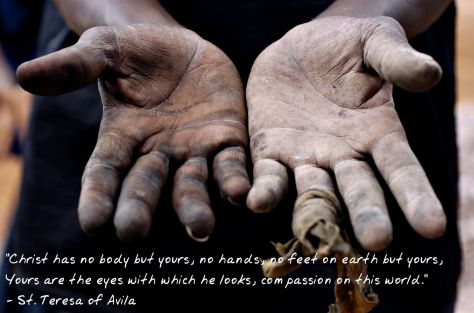
This reminds me of the prayer of St Teresa of Avila, who lived in the 1500s:

Christ has no body but yours,
No hands, no feet on earth but yours,
Yours are the eyes with which he looks
Compassion on this world,
Yours are the feet with which he walks to do good,
Yours are the hands, with which he blesses all the world.
Yours are the hands, yours are the feet,
Yours are the eyes, you are his body.
Christ has no body now on earth but yours.

I end this message by singing John Michael Talbot’s arrangement of this prayer.

(Note: This sermon was preached at a home for women with intellectual disabilities.)

Here are two beautiful performances of this prayer. Music by David Ogden.


2019.05.26_Christ_has_no_body

Link to featured image.

Love one another

Click here to listen to this 16-minute message.

I have been redeployed from the church I’ve attended for over 20 years (St Martin-in-the-Fields) to a new church, not too far away (St Stephens, Lyttelton) as part of my curacy. Today was the first time I have preached to this new parish, so it was a good opportunity to lay down what is most important to my faith and that what is most prominent in my preaching. And it is this:

God is most essentially and completely LOVE. The three persons of the Godhead (Father, Son and Spirit) have been in eternal relationship with one another since before the creation of time and space. It is the profound love between these three persons that makes the one being. God created time and space out of a fullness of love. God created humanity out of a generosity of love, to be shared. And God’s actions throughout human history embody and describe love. Love that is fierce, generous, extravagant, radically inclusive, steadfast and unshakable.

Today’s reading from John 13:34-35 sets out Jesus’ command to us:

A new command I give you: Love one another. As I have loved you, so you must love one another. By this everyone will know that you are my disciples, if you love one another.

In this message, I provide the context in which Jesus delivered this message – a context that represents on the crisis points in his ministry, characterised by betrayal, denial and isolation.

And I set out what is ‘new’ about old command to love, viz. the source of our capacity to love and the missional impact of our love for one another.

Let the love of God be the centre of your life.

2019.05.19_love-one-another-400x400

Link to featured image