Christianity made simple

Click here to listen to this 22-minute message.

The theme I was allocated for today’s sermon was ‘Make it simple’. Make it simple! What a theme!! I’m good at making things complex, nuanced and sophisticated; not at making the complex and (ultimately) unknowable simple.

So I start this message by sharing my testimony of how I became a Christian on 21 October 1984.

I then use the four readings allocated for today to pull out two main themes:

  1. Psalm 116 uses the phrase “I call on the name of the Lord” four times, emphasising that in response to both the highs and lows of life, we are to choose to call on God’s name.
  2. Joshua, in Joshua 24:14-18, calls people to choose this day who they will follow: God or not God.
  3. In Ephesians 4:25-5:1, Paul exhorts Christians to “be kind and compassionate” to other people and to “walk in the way of love”.
  4. And in Luke 6:27-36, Jesus says, “to you who are listening I say: Love”. This is always his command and call, the most basic command that he gives and the one that he gives most frequently. This time, he ups the ante by calling us to ‘love our enemies’, because loving those who love us is something everyone does. We who follow Christ, however, are called to more than that.

Together, these readings present to us a very simple (albeit not easy) approach to Christianity:

Choose God

Choose love

It is really as simple as that. And while these sound like two things, they are in fact one, because God is love (1 John 4:8). So, in truth, at its simplest level, being a Christian means:

Choose the God of love

Let it be so.

2019.09.29_wales-71892

Who am I?

Click here to listen to this 23-minute message.

Today we ask the question, Who am I? Or more specifically, What is my identity as a Christian? This is the first of five themes in a series on stewardship, where we reflect on our role in taking care of God’s business in the world.

In this audio message, I make the following points:

  1. In John 15:1-10, the passage where Jesus says he is the vine and we are the branches, 11 times Jesus uses the term ‘remain’ (or ‘abide’ in the old Authorised Version): “Remain in me … and you will bear much fruit“. Here Jesus calls us to be rooted into him, to remain grafted into him. We recognise that without him, we can do nothing. So we depend on him.
  2. In the same passage, Jesus also speaks of remaining in us: “Remain in me as I remain in you“. This suggests an interdependence between God and us, in which God binds himself to humanity. We this most strongly evident in four moments in cosmic history: creation, covenant, incarnation and Pentecost. In each of these, God in some way limits himself or enters into agreement with humanity, binding himself and his work to us.
  3. Psalm 23 reminds us that God is both the source of our life (“The Lord is my shepherd, I lack nothing”) and its destination (“Surely your goodness and love will follow me all the days of my life, and I will dwell in the house of the Lord forever”). In John 14:6, Jesus similarly emphasises that he is the way and the truth and the life. In other words, he is everything – there is nothing in our lives that falls outside of our connection to Christ.
  4. Our interdependence with God is rooted in our relationship with God. Sometimes the church gives us rules or procedures or recipes we’re supposed to follow in our relationship with God. But this relationship is like any other relationship in our life. It is unique, personal and authentic. It is different for each of us, because, though God is the same person, each of us different, so his relationship to each of us different. God meets us right where we are. Whatever you find works for you in your relationship with God, do more of that.
  5. As much as our interdependence with God is rooted in our relationship with God, it is also rooted in our relationships with each other. God did not create a single person (Adam or Eve); God created a couple (two people in loving relationship with each other), and immediately mandated them to procreate and become a family. 1 Peter 2:9-10 similarly emphasises that we are a community of people in relationship with other people: “a chosen people, a royal priesthood, a holy nation, God’s special possession … the people of God”. So, we have to invest not only in ourselves and our relationship with God, but also in our relationships in the church (however you want to define that) and the work of the church.
  6. Finally, our readings today call for decisiveness. Moses, speaking just before the nation of Israel crosses into the promised land, calls them to a decision (Deuteronomy 30:19-20): “This day I … set before you life and death, blessings and curses. Now choose! Choose life! … For the Lord is your life”.

Image may contain: 1 person

This banner, hanging at St Stephen’s Anglican Church, Lyttleton, created by Eleanor Jappie.

Featured image from here.

Poverty

Click here to listen to this 24-minute message.

Poverty is one of the great challenges facing South Africa today, with unemployment rates above 25% for the population as a whole and around 55% for young adults, and with poverty still running along racial and gender lines (StatsSA). It is a challenge for the country and for the church. It is a challenge we try to deal with in our mission to the world, and it is a challenge we try to deal with among ourselves. Many of us are ourselves struggling with poverty.

What is it that God expects of us regarding poverty?
And how do we do something about poverty, when we ourselves are poor? 

Luke 12 presents to us Jesus’ perspective on poverty, which is essentially that we should not worry. “Don’t be afraid, little flock”, he says. “Do not worry”. “Do not be afraid”. He regales us with analogies of ravens, sparrows, flowers and hairs on our head. Analogies that speak of God’s provision, God’s providence, God’s care. “You are worth far more than many sparrows”.

How does Jesus expect us to ‘not worry’ about things that are so worrisome? Are we simply to sing the “Don’t worry, be happy” song? or Hakuna Matata?

Jesus reveals in Luke 12 that not worrying about poverty (or any other life challenge) is not about switching off to poverty or denying reality. Rather, it about seeing a more powerful reality that lies beyond the present; a world that lies beyond this present world. He invites us to recognise that there is a world to come that is more important than this one and more enduring. It is not that this world, this life, is unimportant! Clearly, from Jesus’ behaviour and teaching, we know that this life and its challenges are important. But there is an even more important world to come. And it our investment into that world that really matters, that counts in the short and long run.

Our capacity see that world rests in faith. It is “by faith” that we see that world. Faith is the central topic of Hebrews 11. The writer reminds us that “faith is confidence in what we hope for and assurance about what we do not see” (Heb 11:1). Paul similarly writes, “we live by faith, not by sight” (2 Cor 5:7). In this chapter from Hebrews, the writer uses the phrase “by faith” 21 times to emphasise that the legacy we inherit from our biblical ancestors is one of faith. While we typically want an instant return on our faith investment, our ancestors were willing to wait generations for the return:

All these people were still living by faith when they died. They did not receive the things promised; they only saw them and welcomed them from a distance, admitting that they were foreigners and strangers on earth (Heb 11:13).

Abraham was able to see the future through God’s eyes. He heard and believed God’s promise that he would become the father of many nations (Genesis 12:2, 15:5 and 22:17), even though he did not see this for himself in his lifetime. He could see it because he could see through God’s eyes. Through the eyes of faith. It is these eyes that we need to be able to see the world beyond this one, to see God’s provision in the midst of hardship, to see God’s promises fulfilled even if not yet. These are the eyes of faith. These are the eyes of God.

And so Jesus says,

Sell your possessions and give to the poor. Provide purses for yourselves that will not wear out, a treasure in heaven that will never fail, where no thief comes near and no moth destroys. For where your treasure is, there your heart will be also (Luke 12:33-34).

This is a message not just for those with money (though we, especially, should heed it), but also for those without (think of the story of the widow’s mite in Luke 21:1-4). This what God calls his people to:

Learn to do right; seek justice. Defend the oppressed. Take up the cause of the fatherless. Plead the case of the widow (Isaiah 1:17).

It starts at home, within the church community:

All the believers were one in heart and mind. No one claimed that any of their possessions was their own, but they shared everything they had. …And God’s grace was so powerfully at work in them all that there were no needy persons among them. For from time to time those who owned land or houses sold them, brought the money from the sales and put it at the apostles’ feet, and it was distributed to anyone who had need (Acts 4:32-35).

Featured image from: https://images.app.goo.gl/iy3XkCppMMj5g2QG9

Fatherhood

Click here to listen to this 20-minute message.

This is quite a personal message about my experiences of both human fathers and God our Father. I’ve had three human fathers or father figures, who have not quite satisfied my fatherly needs as a child. In two of them, this was by omissions: with my biological father not being there and with my step father not being emotionally available and responsive. In the third case, with a father figure (not one of my actual fathers), this was by commission: through exploiting and abusing me.

Like many people, I exited my childhood with father-related disappointments and scars.

Becoming a Christian and thinking of God as my ‘Father’ was a big step for me. Luke 11:1-13 provides a remarkable account of Jesus’ experience of God as his Father and as our heavenly Father also. There are three key things we learn from this passage about God as Father, which contrast with my own less-than-ideal experiences of human fatherhood:

  1. While human fathers sometimes leave or abandon us, our heavenly Father, will never leave us. Jesus speaks about his relationship with God as something steadfast and certain. There is no sense that God might disappear. He is eternally “Our Father” (Luke 11:2). Hebrews 13:5 says “God has said, ‘Never will I leave you; never will I forsake you’.” And 1 Corinthians 13:7-8a says, “[Love] always protects, always trusts, always hopes, always perseveres. Love never fails.” God is Love and is absolutely steadfastly present with us.
  2. While human fathers sometimes are emotionally disconnected and absent, even though they’re physically there, our heavenly Father is always emotionally engaged and responsive to us. Luke 11:5-10 presents the story of a human friend who might grudgingly provide help because of friendship or even just to get rid of you. Jesus contrasts this friend who is reluctantly and ungraciously helpful with our heavenly Father who is always willing to respond to our needs and to take care of us: “Ask and it will be given to you; seek and you will find; knock and the door will be opened to you.
  3. While human fathers sometimes neglect, abuse, exploit and harm their children, our heavenly Father gives his children only good things. In Luke 11:11-13, Jesus asks incredulously if earthly fathers would, when asked for something good and simple by their children, give them something dangerous, like a snake or scorpion. The implied answer is, “No, of course they would not!” But we know that, in fact, human fathers do sometimes hurt their children. But in stark contrast to them, Jesus says, “how much more will your Father in heaven give the Holy Spirit to those who ask him!” Holy Spirit is the best thing that Jesus can imagine, and it is the Spirit that he says God gives to anyone who asks for something good.

Many of us have experienced less than perfect fathers. I myself am a far less than perfect father to my own son! (One day he might preach a similar sermon about me.) But in God our Father, we find a perfect father, who is always present, always fully engaged emotionally, always responsive to our needs and giving us only good, never bad. There is healing in this relationship with God our Father.

And this healing can also help us with our own father-wounds to forgive our fathers. Many fathers have done the best that they can with their own limitations and woundedness. Many did not intentionally harm their children. As we experience greater completeness in our relationship with God our father, we can begin to release our human fathers from their own limitations.

2019.07.28_Black-Dad-and-Son

Featured image from https://www.watchtheyard.com/list/childrens-books-for-african-american-boys/

Doing mission

Click here to listen to this 23-minute message.

Our Gospel reading for today is Luke 10:1-11, 16-20. It is the story of Jesus sending out 72 of his followers (having previously sent out the 12 disciples at the start of Luke 9) to do missionary work. It’s an important narrative, because it provides insight into Jesus’ teaching and training of his followers in missionary work. In this recording, I do an almost verse-by-verse Bible study of the passage, to tease out what happens, what Jesus says and how Luke conveys Jesus’ teachings to us.

I start by disclosing that I am a useless evangelist. I was trained in and did cold-calling as a university student, while a member of Campus Crusade for Christ. But, being a naturally shy and introverted person, walking up to strangers to share the Gospel with them was the hardest thing in the world for me.

I wrap up with three main points (RAP):

  1. Our Responsibility. We are responsible to be faithful to God, to make God known in the world. But we are not responsible for how people respond to us. Our responsibility is to lay a foundation and prepare the way for Holy Spirit to continue Christ’s work in the life of other people.
  2. Our Attitude. We are invited to enter the lives of others with an attitude of peace – to be calm, quiet, respectful and deferential. And we are invited to accommodate them and their ways, not to impose ourselves on them. Paul writes at length about this in 1 Corinthians 9:19-23.
  3. Our Presence. We are assured (and reassured) that since Christ dwells in us – has taken up residence in us – wherever we are, Christ is. And wherever Christ is, the Kingdom of God is (since Christ is King of the Kingdom of God). Thus, merely being among people who do not know God brings the Kingdom of God near to them. This, ultimately, is what Jesus emphasises to his followers (Luke 10:8-11):

“When you enter a town and are welcomed, … tell them, ‘The kingdom of God has come near to you. But when you enter a town and are not welcomed, go into its streets and say … be sure of this: The kingdom of God has come near.”

Whether we realise or intend it or not, the truth is that we are always Christ’s ambassadors. We are always revealing Christ to the world. We are always preparing the way for Christ’s coming. We are always doing mission. But we could be doing mission in a way that better aligns with Jesus’ teaching on mission and that does indeed prepare the way for him.

2019.07.07_Mosaic of Jesus Christ in Florence Baptistry

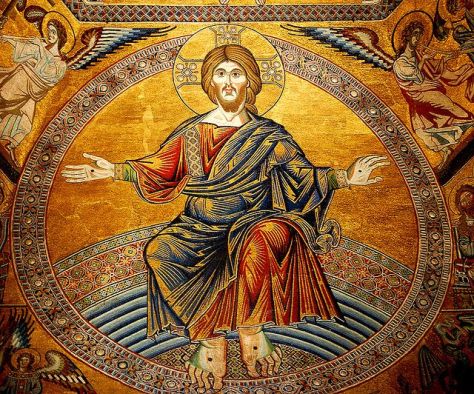
Featured image is a 13th century mosaic of Jesus Christ from the ceiling of the Baptistry across from the Duomo (Santa Maria del Fiore) in Florence. https://www.flickr.com/photos/bbmaui/719415433/

Faith journey

Click here to listen to this 19-minute message..

How is your faith life? How are you doing in your relationship with God?

We are all on a journey of faith. Luke presents it to us like this in Luke 9:51-62 and Paul does so in Galatians 5:13-25. Journeys are typically not straight forward lines. They go up and down and round about. Journeys are messy. And our journey of faith is no different. My own journey looks more like a bowl of spaghetti than a box of spaghetti!

In this message, I unpack three facets of this journey from our two readings for today:

  1. Jesus is quite chilled about our journey. He adopts a ‘take it or leave it’ stance. He desires us to journey with him, but he will not force or coerce us.
  2. Jesus is quite demanding about our journey. He wants a total commitment from us. He has high expectations of us.
  3. Holy Spirit journeys with us, enabling us, strengthening and filling us. We are not on this journey alone. We live with, are led by and keep in step with the Spirit.

On this day, and during this coming week, I’d love you to reflect more deeply and deliberately on our faith journey with God.

2019.06.30.road

Featured image from here.

Trinitarian relationship

Click here to listen to this 18-minute message.

The concept and doctrine of the Trinity is enough to give anyone a headache. And the various metaphors people use to make it easier to grasp all fall short of adequately capturing this doctrine. But in this message I suggest that the evidence for a triune (three-in-one) God provided in the scriptures lead us to a fairly simple but important conceptualisation of the Trinity, viz. God is about relationship.

Father, Son and Holy Spirit have co-existed from before the creation of time and space. They have been in eternal relationship with one another from before the beginning. This relationship between the three is so intense, so powerful, so intimate, so harmonious, that they are in fact one being, one God. This relationship is one of perfect love. Only love can weld three persons together into one being.

If relationship is so central to the being of God, then relationship should be central to us also. We are created in God’s image, and that image is relationship. So, our relationships should be important to us, vitally important to us. We are most like God when we are in relationships that reflect the love we find between Father, Son and Spirit.

This plays out at the macro level, in relations between people of a different race, ethnic group, gender, sexual orientation, socio-economic status, religion, denomination, and so on. In South Africa, we have been well-schooled in othering and diminishing those who are different from us. There is no place in God’s Kingdom for such othering.

This plays out also at the micro level, in our relationships with our parents, siblings, spouse, children, friends, co-workers, neighbours and fellow Christians. How are we doing with these?

Today – Trinity Sunday – we need to reflect critically on our relationships with others and repent from the ways in which our relationships are broken. We need to hold before us the model of the triune God and strive to become related to others like Father, Son and Spirit are related to each other.

2019.06.16_Trinitarian_Relationship

Featured image from: https://pixels.com/featured/celtic-triquetra-or-trinity-knot-symbol-3-joan-stratton.html

Christ has no body but yours

Click here to listen to this 16-minute message.

Today’s reading (John 14:23-29) speaks to us about the centrality of relationships in the Christian journey of faith.

First, we learn that relationship is central to God’s self. This passage is steeped in Trinitarian language: the sense that God, while one being, comprises three persons.

  1. John 14:23 “My Father will love them, and we will come to them and make our home with them.” This verse is unique in that it is the only passage where Jesus uses first person plural language to refer to himself and the Father operating as a unit. Jesus talks about himself and the Father as two distinct persons, working together.
  2. John 14:24 These words you hear are not my own; they belong to the Father who sent me.” Here, Jesus emphasises the unity of his words and the Father’s words. The Father and the Son speak from one mouth. It echoes John 14:10, where Jesus says, “Don’t you believe that I am in the Father, and that the Father is in me?The words I say to you I do not speak on my own authority. Rather, it is the Father, living in me, who is doing his work.”
  3. John 14:26 “…the Holy Spirit, whom the Father will send in my name, will teach you all things and will remind you of everything I have said to you.” Here, Jesus mentions all three persons of the Trinity (Father, Son and Holy Spirit), operating in unity with one another.

God the Father, God the Son and God the Holy Spirit are in eternal and loving relationship with one another, so powerful that they are one being. Although the doctrine of the Trinity is not explicitly taught in Scripture, it is (for the vast majority of Christians) the most inevitable way of reconciling the oneness and the threeness of God that the Scriptures present to us. And this passage from John is one of those that does so strongly.

If nothing else, and perhaps most importantly, we learn from this that relationship is central to God and to God’s experience of God’s self. And if relationships are important to God, they must surely be important to us also.

Second, we learn that relationship is central to God’s mission on earth. Jesus message in John 14:23 is a response to a question from Judas, one of his disciples, “But, Lord, why do you intend to show yourself to us [only] and not to the world?” Judas was concerned that the good news that Jesus was telling the disciples about was not going to be heard by everyone. His was a question about mission.

And Jesus answer is that God the Father and God the Son will come to the disciples (and by extension to all Christians) and make their home in us. This means that God’s showing of God’s self to the world will be through us. As God resides in us, we reveal God to the world.

This is an extension of the incarnation. When God the Son came into the world as a human, in the form of Jesus of Nazareth, he was available to the world as just one man, with all the limitations of a single human. But when Jesus returned to the Father at his ascension, he sent Holy Spirit who fills up every Christian. Moreover, the Father and Son also come to dwell in us. In this way, Christ is incarnated in the world through the Body of Christ, the church, that is, through the community of believers. We are Christ’s body on earth.

Thus, God continues to work through God’s relationship with each of us and our relationships with everyone in our social environment – those at church, those in our families, those in our workplaces and play spaces, those in our communities, those we meet in passing as we shop, travel and live.

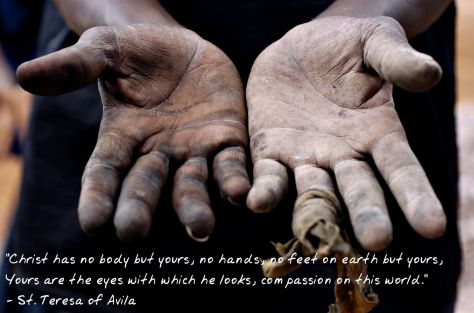
This reminds me of the prayer of St Teresa of Avila, who lived in the 1500s:

Christ has no body but yours,
No hands, no feet on earth but yours,
Yours are the eyes with which he looks
Compassion on this world,
Yours are the feet with which he walks to do good,
Yours are the hands, with which he blesses all the world.
Yours are the hands, yours are the feet,
Yours are the eyes, you are his body.
Christ has no body now on earth but yours.

I end this message by singing John Michael Talbot’s arrangement of this prayer.

(Note: This sermon was preached at a home for women with intellectual disabilities.)

Here are two beautiful performances of this prayer. Music by David Ogden.


2019.05.26_Christ_has_no_body

Link to featured image.

Love one another

Click here to listen to this 16-minute message.

I have been redeployed from the church I’ve attended for over 20 years (St Martin-in-the-Fields) to a new church, not too far away (St Stephens, Lyttelton) as part of my curacy. Today was the first time I have preached to this new parish, so it was a good opportunity to lay down what is most important to my faith and that what is most prominent in my preaching. And it is this:

God is most essentially and completely LOVE. The three persons of the Godhead (Father, Son and Spirit) have been in eternal relationship with one another since before the creation of time and space. It is the profound love between these three persons that makes the one being. God created time and space out of a fullness of love. God created humanity out of a generosity of love, to be shared. And God’s actions throughout human history embody and describe love. Love that is fierce, generous, extravagant, radically inclusive, steadfast and unshakable.

Today’s reading from John 13:34-35 sets out Jesus’ command to us:

A new command I give you: Love one another. As I have loved you, so you must love one another. By this everyone will know that you are my disciples, if you love one another.

In this message, I provide the context in which Jesus delivered this message – a context that represents on the crisis points in his ministry, characterised by betrayal, denial and isolation.

And I set out what is ‘new’ about old command to love, viz. the source of our capacity to love and the missional impact of our love for one another.

Let the love of God be the centre of your life.

2019.05.19_love-one-another-400x400

Link to featured image

Death and devotion

Click here to listen to this 21-minute message.

We draw closer and closer to the cross on this Lenten journey. Next Sunday is Palm Sunday, and then it is Holy Week, leading to Good Friday when we sit at the foot of the cross and watch Jesus die, and then we wait despairingly yet expectantly through Silent Saturday, until Easter morning when our Lord rises from the dead. Morbid though this may sound, this is indeed a time of death and devotion.

Mary, the sister of Lazarus, pours very expensive perfume (Nard) on Jesus’ feet and wipes them with her hair (John 12:1-8). A parallel story is found in Mark 14:1-9. This narrative raises multiple messages, but two have resonated strongly with me this weekend: death and devotion.

Death

This story is soaked with death. The previous chapter (John 11) told us of Lazarus’ death, how he was laid in a tomb for four days, and how Jesus then raised him from the dead. This same Lazarus now sits around the table with Jesus, eating a meal! Mary’s use of Nard to anoint Jesus’ feet suggests burial preparation, as if Jesus has already died and is being embalmed. In the next passage, Jesus makes his triumphal donkey entry into Jerusalem, signalling the start of Holy Week – Jesus’ final walk to the cross. He talks at some length about his impending death. In chapter 13, Jesus washes his disciples feet, a kind of replication of Mary’s act (but with water, not perfume). Jesus shares his ‘last supper’ with the disciples. From here on, Jesus speaks almost only to his closest friends and family. There are no further public sermons. He retreats from the world, as he prepares to die, entering a quiet, reflective space.

We, as part of his closest friends and family, are invited in these last days of Lent to be present with Christ as he walks towards death. 

Devotion

Mary anoints Jesus’ feet. She does not wash them with water to cleanse them, as was typically done for guests, by servants. Nor does she rub oil into his feet to protect them from the dry, dusty roads, as would be done with an important guest, also by servants. Instead, Mary – one of Jesus’ hosts – pours expensive perfume over them. Nard came from the high mountains in India, particularly the Himalayas. It had a sweet and earthy fragrance, that lasted a long time. It was very expensive, and stored in alabaster jars to preserve the fragrance. Mary’s pouring out of this perfume is extravagant. Some suggest that this jar of Nard was her entire dowry. It is an excess of perfume, much like the wine that Jesus created at another banquet (in Cana) was excessive and extravagant.

She washes his feet with her hair. Jewish women treated their hair with modesty, typically covering it for all except their husbands. To let it loose would be seen by some as immoral. It certainly was profoundly intimate; she could have used a cloth, but instead used her hair.

We must imagine Jesus reclining – there were no chairs. So Mary must be on her knees, bowed low over Jesus’ feet, her face almost on his feet, so that her hair can wrap around them to dry them. It is intimate and devoted, a pouring out of her innermost being on Jesus’ feet.

We, like Mary, are invited in these last days of Lent to devote ourselves utterly to Christ as he walks towards the cross.

Death and devotion

Jesus’ response to those who reprimand Mary for being so wasteful poignantly ties together death and devotion. He makes two main points:

  1. He is soon going to die.
    “Leave her alone,” Jesus replied. “It was intended that she should save this perfume for the day of my burial” (John 12:7).
    “Leave her alone. Why are you bothering her? She has done a beautiful thing to me… She did what she could. She poured perfume on my body beforehand to prepare for my burial” (Mark 14:6 & 8).
  2. Before he dies, we may devote ourselves to him.
    “You will always have the poor among you, but you will not always have me” (John 12:8).
    The poor you will always have with you, and you can help them any time you want. But you will not always have me” (Mark 14:7).

We, like they, are invited in these last days of Lent to set aside our day to day responsibilities and to make ourselves available to be with Christ.

2019.04.07_mary-anoints-jesus-feet

Featured image from https://www.gloriadei.ca/blog/worship-june-12