He ascended into heaven

Click here to listen to the audio of this 13-minute message. Or watch the YouTube video below, or read the text summary thereafter.

Ascension day is one of those days that Christians can easily miss – it takes place mid-week (on a Thursday) and is not a public holiday in most countries. And many would be hard pressed to give a good account of why the ascension is important. Fortunately, there are several online blogs that speak to the meaning of Christ’s ascension, e.g.,

But I find that the reasons many give are really descriptions of what Jesus does after his ascension – such as sitting at God’s right hand and sending Holy Spirit to us – rather than explanations of the ascension itself. Luke includes a narrative of the ascension both at the end of his Gospel narrative (Luke 24:50-51) and at the start of his sequel about the Apostles (Acts 1:9-10). Clearly, Luke thought the ascension was important.

Let me offer a way of thinking about the theological and practical significance of the ascension.

Let’s go back to the incarnation. In the incarnation God inserted God’s self into human nature at the conception. We can almost thinking that God integrated divine DNA into human DNA to create a new entity – a God-man – Jesus Christ. Orthodox theologians see the incarnation as central to salvation. God redeems and transforms human nature. (Click here to listen to a sermon where I set out the centrality of the incarnation in more detail.)

Let me suggest that in the ascension there is a similar but inverse process. As Jesus ascends to the Father, and as the triune God (Father, Son and Holy Spirit) is reunited in the ascension, God the Son brings with him some aspect of human nature, including his body, which is woven into the being of God.

What is the evidence for this? Perhaps most importantly, Luke emphasises in both narratives that Jesus ascended bodily, much as he rose bodily. When Jesus rises from dead, he rises with his body – he does not leave it behind and rise as a spiritual being. Of course, his body has been transformed – it has both physical and spiritual qualities. But the BODY is important. We affirm this in the Apostle’s Creed: “I believe … in the resurrection of the body”.

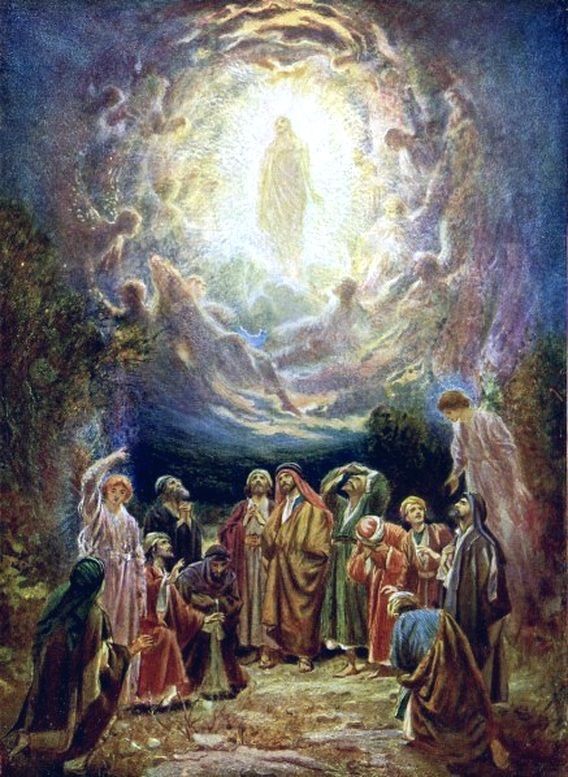
So too, in the ascension, Jesus rises with his body – he does not slough off his body, to release his spirit, which rises up to heaven. He ascends with his body. The disciples are described as “looking intently up into the sky as he was going” (Acts 1:10). It seems certain that Jesus physically rose up into the sky until he disappeared in the clouds.

Let me suggest, cautiously, that before the incarnation God did not have first-hand experience of what it is like to be a human being. God is spirit; God transcends time and space. But in the incarnation, God becomes a human being, with all of its limitations. God the Son experiences the joys and the pain of being human. He experiences friendship. He experiences betrayal, torture and death. When God the Son ascends bodily, these experiences are woven into the being of the triune God. God no longer just imagines what human life is like; God now truly and experientially knows what it is like to be human, with all its ups and down.

What this theology offers us in our daily life, is a deep assurance that God really knows what human life is like and what suffering feels like. God is not watching ‘from a distance’ (as Bette Midler so nicely sings). Rather, God is deeply immersed in our human experiences. So, when you are going through dark times, we can be sure that God is fully present with us in the darkness, experiencing them with us, sharing our pain and distress.

God is immediately available and fully experiences all we go through.
2020.05.21_WilliamHole_Ascension

Featured image: Jesus ascending into heaven by William Brassey Hole (1846-1917)

Holy Spirit – Our true friend

Click here to listen to the audio of this 16-minute message. Or watch the YouTube below, or read the summary text thereafter.

Our reading for today (John 14:16-20) prepares us to celebrate Pentecost in two weeks’ time. Jesus teaches about Holy Spirit who will come and continue his work among us. We learn several important things about Holy Spirit from this brief passage, including:

  1. The Greek word ‘paraclete’ is directly translated as ‘the one called alongside’ or ‘the one called to come alongside’
  2. ‘Paraclete’ is translated in various ways: comforter, counsellor, advocate, encourager, etc.
  3. Frederick Dale Bruner (in his commentary on John) and Eugene Peterson (in his Bible translation, ‘The Message‘) translate paraclete as ‘friend’ or ‘true friend‘. A friend is one who draws alongside us, who comforts and encourages us, who challenges us, and who stands up (or advocates) for us when people trash-talk us.
  4. Jesus describes this true friend as a gift from God to us.
  5. Jesus describes Holy Spirit as another friend. By implication, Jesus is the disciples current friend; Holy Spirit will come as another friend. There is continuity between Jesus and Holy Spirit.
  6. Holy Spirit is a person, not a force or a thing. I try to give practical expression to this in my spiritual life in three main ways:
    • I drop the definite article ‘the’ from ‘the Holy Spirit’. Instead, I speak and think about ‘Holy Spirit’ as a name, like Jesus is a name. We don’t refer to Jesus as ‘the Jesus’ because Jesus is his name; we say ‘the Messiah’ because Messiah is a title of description. I use ‘Holy Spirit’ as a name, since we have no other name for him.
    • I use personal pronouns and avoid ever referring to Holy Spirit as ‘it’ or using ‘which’. These are impersonal, depersonalised words. I try to use the same words I use when speaking about Jesus or God the Father.
    • I refer to Holy Spirit as ‘she’. Not because I think of her as a woman, as female or as feminine. But because God is no more male than God is female. God transcends or incorporates all genders. Since we can’t refer (easily) to the Father or the Son with female pronouns, I choose to use female pronouns for Holy Spirit. If we could evolve the English language to be less gendered, we’d use gender-inclusive or gender-neutral language for God. (I appreciate that many will not appreciate or agree with me. That’s fine. We will learn a lot more about Holy Spirit on That Day.)
  7. We, unlike those who do not believe, can both see and know Holy Spirit. For everyone else, Spirit is invisible and unknowable. But for us who believe, she can be both seen and known. She dwells within each of us as individuals. And she takes up residence among us collectively, as communities of faith. We are united by Spirit, even when we are physically apart.

As we journey closer to Pentecost on 31 May 2020, let become increasingly mindful or receptive to the presence of Holy Spirit in our personal and collective lives and celebrate this precious gift that God has given us.

2020.05.17_HolySpirit_Hahlbohm

Featured image: ‘Holy Spirit’ by Danny Hahlbohm, http://www.inspired-art.com/gallery_9_10/Holy_Spirit.html


Love & Justice

Click here to listen the audio recording of this 12-minute message. Or watch the YouTube video below, or read the text summary after that.

Even though I emphasise God’s love as the central essence of God’s being, we see God behaving in angry, wrathful and violent ways. How are we to make sense of this? This message defines justice as follows

Justice is God’s love working to protect those who are vulnerable

As much as God stands up against those who harm God’s loved-ones, God also reaches out a hand of reconciliation, rooted in repentance and contrition. And God desires reconciliation between people, rooted in forgiveness. We call this restorative justice – love and justice.

Featured image adapted from https://metro.co.uk/2015/03/05/this-is-the-real-reason-why-people-shake-hands-5089999/

Jesus at the centre

Click here to listen the audio of this 13-minute message. Or watch the YouTube video of the message below, or read the text summary after that.

John 14:6-11 is located immediately after the Last Supper and the washing of the disciples’ feet, as well as Jesus’ prediction of Judas’ and Peter’s betrayals. John 14 starts a four-chapter long sermon – Jesus’ final words to his disciples before his death.

In the opening of this section, Jesus presents himself as at the centre of our faith. He says to Peter, “You [already] believe in God [the Father]; [I now invite you to] believe also in me” (John 14:1). To believe in the Father is to believe in the Son. He goes on famously to say, “I am the way and the truth and the life. No one comes to the Father except through me” (John 14:6). Jesus places himself at the centre of our relationship with God the Father. It is through him that we encounter God. Jesus is the centre.

But lest we think that Jesus is setting himself up as the mediator between us and God, he goes even further, audaciously, to say that he and the Father are one. “If you really know me, you will not know my Father as well … Anyone who has seen me has seen the Father … Don’t you believe that I am in the Father and that the Father is is in me? … I am in the Father and the Father is in me” (John 14:7-11). And just a few chapters earlier, Jesus had said, “I and the Father are one” (John 10:30).

Jesus is not merely a path to God. He is God. He is God the Son. He is locked into the Father and the Father is locked into him. In the very following passage (John 14:15-27), Jesus speaks about Holy Spirit, the third person of the Trinity, who will come to continue the work of the Father and the Son, once the Son has returned to the Father. When we relate to Jesus, we are relating to God, because Jesus is God.

Ultimately, sensing that Philip and the other disciples are grappling to grasp these complex and elusive concepts, Jesus says, “At least believe on the evidence of the works themselves” (John 14:11): You have heard me teaching. You have seen me heal people, raise the dead, feed thousands. You have witnessed me reaching out to women, tax collectors, lepers, prostitutes, menstruating women, disabled people, Samaritans and Gentiles. You have heard me speak truth to power and challenge rigid interpretations of the law. You have heard me proclaim a new Law that supersedes the Law of Moses.

What you are seeing is God at work among you!

Jesus must be at the centre of our personal and collective faith. The things of the church are helpful and perhaps even important. Jesus does not do away with them. But they must not be at the centre.

Jesus – the person Jesus – is the only one worthy of being at the centre.

He is our friend, our brother, our teacher, our healer, our saviour, our Lord, our very God.

2020.05.10_6059765012_d7fafb9504_b

Featured image is the ‘glory window’ of the Thanksgiving Chapel in Dallas, Texas.

Being Church – Being Loved

Click here to listen to the audio of this 13-minute message. Or watch the YouTube recording below, or read the text after that.

In 1 Thessalonians 2:17-20, we read about Paul’s deep love for the church at Thessalonica, which he had planted, but which he was unable to visit. Much as we are as a result of COVID, Paul was physically separated from his church, and he was really missing them. Paul expresses intense emotions about his parish – he felt ‘orphaned’, he felt ‘separated’, he felt ‘intense longing’ to see them and he ‘made every effort’ to visit.

Paul says that Satan was blocking his way from visiting. Today we should consider that Satan is blocking our ability to meet together, through the agency of the Coronavirus. This virus – a tiny thing – is blocking our ability to meet together.

But, says, Paul, he is separated ‘in person, not in thought’, that is, physically, but not psychologically, socially, emotionally or spiritually. We can and do remain connected to each other, through our relational bonds and through our common fellowship with Christ.

Throughout this passage, Paul shows the heart of a pastor, who loves his parish and longs to be present with them. And so, while we are physically separated from each other, let us remember that we have a pastor called Jesus Christ, who loves us and is in fact present among us through Holy Spirit, and that we are in fact connected with each other through the love of God.

Featured photo from St Stephens Anglican Church, Lyttleton, South Africa

To work

Click here to listen to this 15-minute message. Or watch the YouTube video below, or read the summary text that follows.

One of the impacts of COVID-19 has been to dramatically increase unemployment rates. We see this in both the developed world (e.g., the USA) and the developing world (e.g., South Africa). By ‘work’ I don’t necessarily mean employment (in the sense of being employed and paid by someone else) or even to have a job (in the sense of doing something that generates an income). ‘Work’ includes productive activities, such as volunteering or raising a family. So, I am using ‘work’ in an inclusive and flexible way.

Our current challenging context should prompt us to think about work from a Christian perspective. I suggest three key points about work.

  1. We were created to work. The creation story in Genesis 1:28 and 2:15 emphasises work. God created humankind to work. Specifically, to work as labourers, gardeners, farm workers. Work is thus bound up in the DNA of humanity, and when we cannot work, this can create difficulties for us. This is part of the threat of the COVID lockdowns – it is not good for people not to work.
  2. Work is about caring for (stewarding) the things of God. Genesis 2:15 emphasises that Adam was placed into the garden (probably the Garden of Eden, which can be thought of as the jewel of God’s natural creation) to tend and work it. We often refer to this as ‘stewardship’ – that the things of God are entrusted to us to (on loan) to care for. And to make productive. The garden is intended to be a well-cared for, creative and productive space.
  3. We work for God, not people. In Ephesians 6:7, Paul says to workers, “Serve wholeheartedly, as if you were serving the Lord, not people.” To be a Christian at work is not so much to publicise your faith, to hold prayer meetings or to evangelise, as much as it is to do your job with the exceptional devotion and energy that comes form working for God.

I encourage us to think about work at this present time and to:

  1. Consider how we help people who are out of work to have work.
  2. Do our own work – if we are blessed to be able to work – as if for God.

There is so much more I want to say about Christian perspectives on work! One day I will write a book!

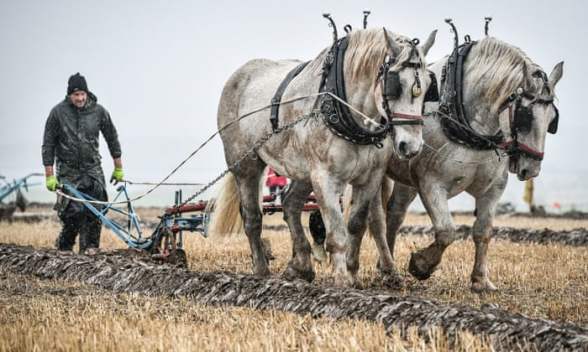
Featured image from: https://www.theguardian.com/environment/2018/nov/23/world-ploughing-championships-no-till-farming

Journey with Jesus

Click here to listen to the audio of this 12-minute message. Click watch the video below, or read the text thereafter.

Between Easter and Pentecost we focus on people’s encounters with the risen Christ. Last week we reflected on Thomas’ encounter with Jesus some days after the resurrection. Today, in Luke 24: 13-35, we reflect on the two disciples who met Jesus while they were travelling from Jerusalem to Emmaus. They don’t realise that it was Jesus until the very end. Their journey has three phases:

  1. They initially fellowship with Jesus, sharing their story of Jesus with this stranger and commiserating about his untimely death.
  2. Then Jesus teaches them about the Christ, drawing on the whole of the First Testament, explaining who the Messiah was prophesied to be and how these prophecies were fulfilled in the Christ. But still, they did not recognise Jesus.
  3. Finally, they shared a meal with Jesus – they broke bread together. And as Jesus, took, blessed (or gave thanks), broke and gave the break to them, their eyes were opened and they finally recognised him.

In hindsight, they realised that they had encountered Jesus: “Were not our hearts burning within us while he talked with us on the road and opened the Scriptures to us?” (Luke 24:32)

Ultimately, it is in the taking, thanking, breaking and giving that they recognise Jesus. This is what Jesus did in Luke 9:16, when he fed the five thousand. And also just a few days before at the Last Supper in Luke 22:19. This celebration of the Eucharist (Lord’s Supper, Communion, Mass, Divine Liturgy) was the clincher, following fellowship and teaching, that reveals Christ to them.

This narrative follows the same pattern of the early church in Acts 2:42: “They devoted themselves to the apostles’ teaching and to fellowship, to the breaking of bread and to prayer.” Now, our passage in Luke 24 doesn’t mention prayer, but prayer is (essentially) talking with and listening to Jesus. Prayer is just conversation with God. And this is what the two disciples were doing, even though they did not realise it, during the long walk from Jerusalem to Emmaus, as they journeyed with Jesus: they were talking with God.

2020.04.26_EmausDecepcionAAlegria

Featured image Emmaus Road, by Chinese artist He Qi. https://alfayomega.es/106963/emaus-de-la-decepcion-a-la-alegria

For God so loved

Click here to listen to the audio of this 13-minute message. Or watch the YouTube video below, or read the summary text thereafter.

John 3:16 may be the most recognisable and widely-known verse in the Christian Bible:

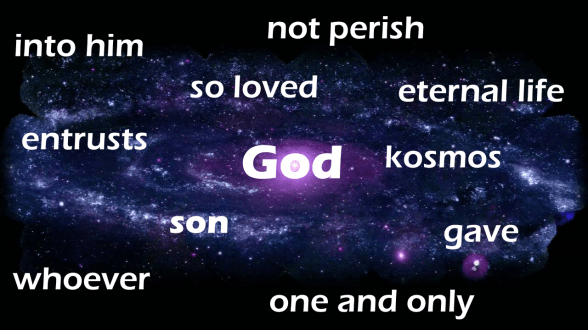
For God so loved the world that he gave his one and only Son, that whoever believes in him shall not perish but have eternal life. (NIV)

For God so loved the world, that he gave his only begotten Son, that whosoever believeth in him should not perish, but have everlasting life. (KJV)

Let’s break this verse down into its parts:

  • For God – It all starts with God, like in Genesis 1:1 “In the beginning, God…”
  • so loved – This is the first use of ‘love’ in John’s Gospel, and it becomes a central word in his writing. This points to the extent of God’s love – God loved so much – extravagant, risky, inclusive, radical, transformative, saturating!
  • the world (kosmos) – God’s love is radically inclusive. God loves the whole world. In Greek, the kosmos. There is no-one and no-thing that is beyond the extravagant love of God.
  • that he gave – Out of this infinite love, God gives. He gives his Son. But this is not a giving, like one might give someone a cracker – the cracker is passive and is merely given. Here, God gives his Son, who is active – the Son participates in the giving, chooses to be given, gives himself.
  • his one and only Son, – God the Father gives God the Son, enabled by God the Spirit. The Son is God’s one and only, God’s beloved, God’s own heart. This is the profound self-giving of God’s self to the world.
  • that whoever – Jesus has already said God loves “the world”, which is radically inclusive of the entire collective of creation. Now Jesus brings this inclusivity down to the individual – whoever or whosoever. The Son gives himself to every individual– to you Martha, to you Stephen, to you Bongani, to you…
  • believes in him – The Greek for ‘believe’ can equally be translated ‘trust’. Believe too easily becomes ‘cognitive assent’, too easily becomes affirming a list of propositional statements about the Son. But Jesus wants more than just this – he wants us to trust him, to put our trust in him, to entrust ourselves to him. The ‘in’ in Greek is actually ‘into’, so we can confidently say, “whoever entrusts themselves into him”.
  • should not perish – Although we will all die, sooner or later, we shall not all perish or be destroyed. We have little choice about dying, but we do have a choice about perishing.
  • but have everlasting life. – And that choice is Life, with a capital L. The everlastingness of Life is not just about it continuing for a long time (eternal), but also to the quality of the Life, which can be enjoyed at this very moment. Jesus offers us Life: Life everlasting, Life abundant, Life to the fullest, Life eternal, Life in relationship with God.

For God so loved the world that he gave his one and only Son, that whoever believes in him shall not perish but have eternal life.

2020.04.22_John316Featured background image of the Andromeda Galaxy, M31, from https://www.youtube.com/watch?v=HWxBTHVhc3I
Seeking Jesus

Click here to listen to the audio of this 11-minute message. Or watch the YouTube video below. Or read the summary text thereafter.

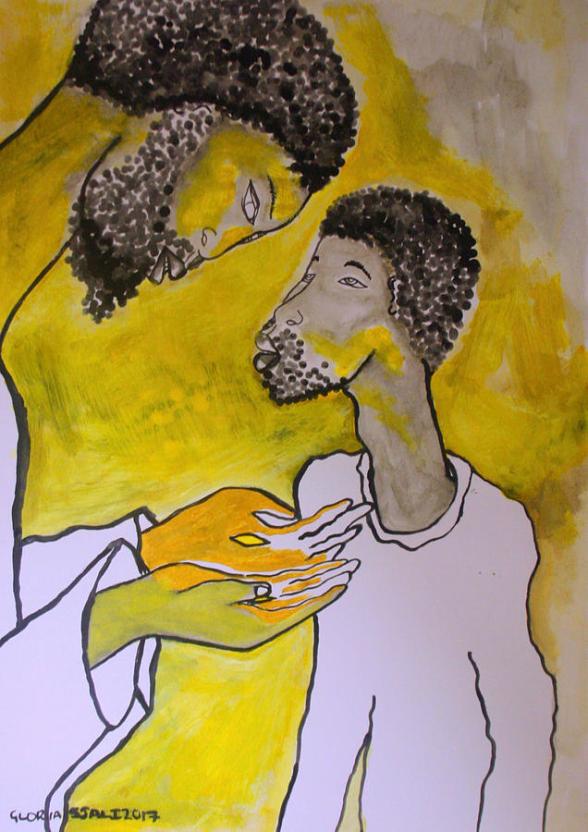
The story of Thomas’ encounter with the risen Jesus in John 20:24-29 is one of my favourites and Thomas is the disciple with whom I identity the most. Thomas is unfairly labelled a doubter. He did not doubt Jesus. He doubted his friends – the other disciples. He wanted to see and experience Jesus first hand. He was unwilling to take on a second-hand faith. He wanted to know Jesus for himself. And so Jesus appears to him and invites him to see and touch his hands and the hole in his side.

It seems Thomas does not in fact touch Jesus, but immediately experiences a surge of faith and cries out, “My Lord and my God!” In effect, he falls on his face and covers his eyes because he knows that he is in the presence of God the Son.

This reminds me of the story of Job, who was a man blessed by God, a man who had everything. For whatever reason, he then loses everything. He goes into a kind of ‘lockdown’, where he loses his possessions, his family, his health, his well-being, his freedom. Two of his friends join him in his despair and provide comfort for a few days and then engage in a lengthy debate with him to persuade him that his faith must be insufficient. God would not punish a righteous man – he must have done something wrong. But Job persists that he is righteous and wants to meet with God to present his case.

And then in Job 38, God appears and over the course of four chapters presents his credentials to Job, much as Jesus presented his credentials (the holes in his hands and side) to Thomas. God meets Job in his unhappiness and questioning.

In Job 42:1-6, Job’s response to encountering God is to throw himself down and cover his eyes – “I despise myself and repent in dust and ashes”. But before that he proclaims his faith: “My ears had heard of you, but now my eyes have seen you!” Job had had a second-hand faith – what he had heard from others or from the scriptures. But now, God had appeared to him in person, and his eyes had not see him. And recognises that he is in the presence of God the Father.

God eagerly desires to engage you in your faith, as he does me in mine. And God also eagerly desires to engage you in your doubt, as he does me in mine. God is not turned away by uncertainty, by questions, by doubt or by the need for ‘evidence’. Instead, God turns towards us and engages us. Let us continue to seek Jesus, for this is exactly what he wants from us: Seek him and you shall find him.

2020.04.19_thomas-sees-jesus-wounds-gloria-ssali

Featured image: ‘Thomas Sees Jesus Wounds’ by Gloria Ssali, https://fineartamerica.com/featured/thomas-sees-jesus-wounds-gloria-ssali.html

God’s great forgiveness

Click here to listen to the audio of this 6-minute message. Or watch the YouTube video below, or read the text that follows after that.

The Lord is Risen! He is Risen Indeed!! Alleluia!!!

During this past week, we have confronted the dark side of humanity and of ourselves. We have recognised that it is our sin – each of ours – that contributed to Christ’s death. Humanity, in its arrogance, attempted to murder God the Son! What greater sin can there be? One might imagine that a God of justice would wipe the earth clean.

Instead, God forgives humanity. God returns to us the very Son that we murdered! What greater forgiveness can there be? All the rest of our sins are caught up in God’s great forgiveness of this greatest of all sins. All God asks of us to acknowledge our sin – Father, I am sorry; please forgive me. God says “Yes!” to humanity. God says “Yes!” to maintaining and enabling fellowship with each of us.

Moreover, Christ’s triumph over death, he rising from the grave to new life, is God’s “Yes!” to life and “No!” to death. Particularly during the COVID-19 plague, which has already taken the lives of over 100,000 people, we are in need of this reassurance that God has already triumphed over death. COVID-19 will do its worst, but it will die, and humankind will live. God will triumph over death.

Almighty God,
this night explodes with the radiance of the risen Christ;
set us ablaze with the power of your love
and propel us into the world
to live and proclaim the gospel of the living Lord;
who lives and reigns with you and the Holy Spirit,
one God, now and for ever.
Amen

2020.04.12_El_Greco_-_The_Resurrection_-_WGA10530

Painting of The Resurrection, by El Greco, 1597-1600. From here.

Featured image: Resurrection of Christ, by Raphael, 1499–1502. From here.

Painting in the YouTube video: Resurrection of Christ, by Rottenhammer (1564–1625)