Into the light

Click here to watch the video of this sermon. It is a visually driven message so good to watch if you can. The Gospel reading starts at about 17 minutes, and the sermon starts at about 35 minutes and lasts 22 minutes.

https://fb.watch/4zbbA1Fosv/

Today is the Tuesday of Holy Week. We continue with John 12, focusing today on vv 20-36. I preached on this just a few days ago – a message titled Following Jesus, which you can access here. Tonight I want to focus on just the last two verses of this passage:

Then Jesus told them, “You are going to have the light just a little while longer. Walk while you have the light, before darkness overtakes you. Whoever walks in the dark does not know where they are going. Believe in the light while you have the light, so that you may become children of light.” When he had finished speaking, Jesus left and hid himself from them.

In these two verses, Jesus uses the word ‘light’ five times in reference to himself. This reinforces yesterday’s sermon, Light in the centre, where I emphasized in a drawing that Jesus is the light at the centre of all of life’s complications, and that the centre light is where we most want and need to be.

Jesus stresses in tonight’s passage that the light is surrounded by darkness and at risk of being overtaken by darkness and that the light will not be with us for long – just a little while. We get the sense that the Light of Christ is precious and to be embraced. Light is something beautiful, wonderful, fragile, exceptional and desirable. We want the light!

And then Jesus gives us three instructions:

  • Believe in the light. Jesus is himself the light (John 1:4-9 and John 14:6), so to believe in the light is to believe in Christ.
  • Walk in the light. Jesus says he is the way and the light (John 14:6). We want to walk in the light, not in the dark. In the dark we get hurt and lost, but in the light, we cannot put a foot wrong.
  • Become children of light. Paul writes, “Now if we are children, then we are heirs—heirs of God and co-heirs with Christ” (Romans 8:17). This adoption as children of God, children of light, is an incarnation of the Spirit of God into us, as God makes our bodies a temple for Holy Spirit.

As we journey out of church into the darkness, and we journey through the various darknesses in the world around us (rape, abuse, racism, social exclusion, poverty, Covid, xenophobia, and so the list goes), let us believe in the light, walk in the light and become children of light. When we do that, we become God’s light-filled presence in a world that is much in need of light.

Light in the centre

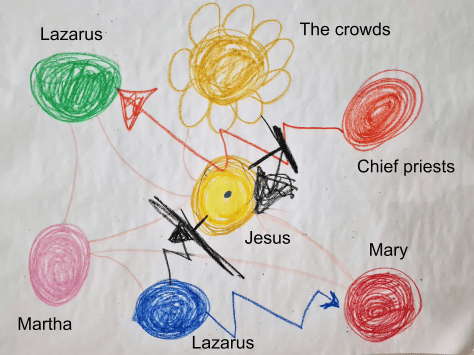
Today is the Monday of Holy Week. We read the story (John 12:1-11) of a dinner party hosted by Lazarus (whom Jesus had raised from the dead) and his sisters, Mary and Martha. During the dinner, Mary anoints Jesus’ feet with extremely expensive perfume and is reprimanded by Judas, who wants the money for himself. Meanwhile, crowds gather around the house, not only to see Jesus, but also to see Lazarus – the man back from the dead. And the chief priests plot to kill Lazarus, because his resurrection was adding to Jesus’ popularity.

In the midst of all this turmoil, Jesus is a quiet, strong, protective, light-filled centre. It is towards and into this centre that we should move when life’s challenges build up around us.

I invite you to watch the reading of the Gospel from John 12:1-11, which starts at about 14 minutes into the service. And the sermon starts at about 22 minutes and runs for about 23 minutes. This is a visual sermon, mapped out on a flipchart, so you really do need to watch it and not just listen to it. May you place yourself in the centre of Christ, in his light and peace – the best place to be!

Watch the video by clicking here: https://fb.watch/4xReFll03A/

Passion of Christ (according to Mark)

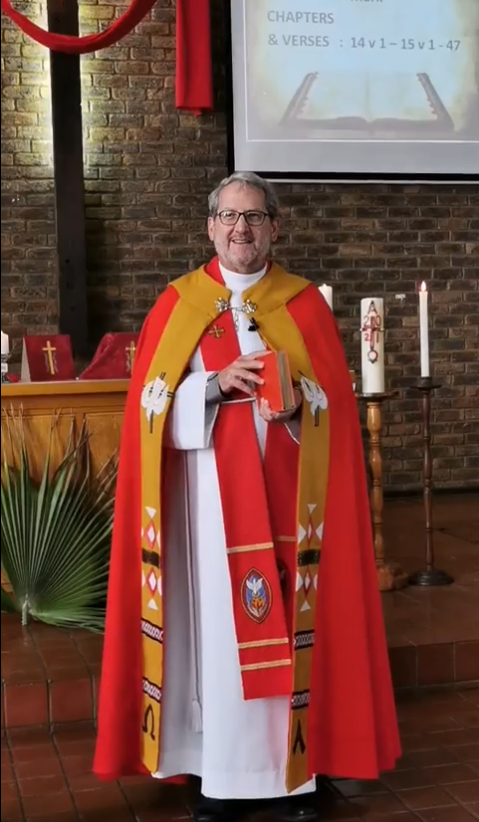
Today, instead of a sermon, we listened to a reading of the Passion of Christ, from Mark chapters 14 and 15, using the JB Phillips translation. You can listen to the audio recording of the reading here. Or you can watch the video of the reading on Facebook here (the reading starts at 30 minutes). The reading takes 27 minutes.

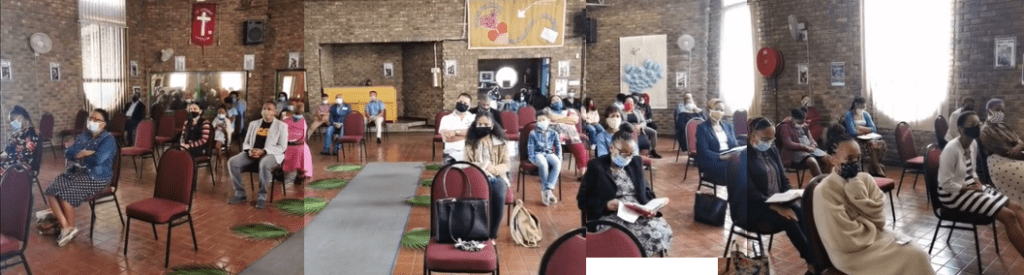
Below are a few photos of me reading and a composite photo of our in-house congregation.

Following Jesus

Click here to listen to the audio recording of this 16-minute message. Or watch the video on Facebook (message starts at about 20 minutes). Or read the text summary below.

John 12:23-28 narrates Jesus’ thoughts about his journey towards the cross.

Regarding his own death he shares:

  • Jesus describes his crucifixion as his “glorification”. He recognises that his journey to and through the cross will culminate in his glorification. So he ironically uses these terms interchangeably.
  • Jesus makes sense of his journey through the metaphor of ‘one for many’: if a single seed refuses to die, it remains one seed; but if it dies, it produces many seeds. In other words, through the the death of one man (himself) there is life for many (salvation of humankind).
  • Jesus is genuinely troubled, disturbed, in dread of this path that he has been called to follow. The journey to the cross is not easy for him. He wishes there could be an easier route. Let us not be glib in our perception of Jesus’ mission.
  • Yet he resolves himself to his mission, his reason for coming and to the glory of God.

In the midst of this narrative, Jesus calls us to follow this same path:

  • If we want to serve him, he says, we must follow him and be where he is. And where he is at that moment is on the journey towards the cross. That is where we must follow him.
  • For sure, when we follow him, there will be glory – just as for him. Our Father will honour us if we serve Christ. But that is in the future. For now, we are called to a present path of suffering.
  • He cautions us to not hang tightly to this life, to be in love with this life. If we do, we will lose it. Rather, we must almost hate this life, by comparison, and rather invest in the life that is yet to come.
  • Many churches are teaching that Jesus’ desire for us is for our wealth, happiness, success, possessions and power. But there is no hint of such teaching from Jesus in John 12. Rather, we are to spurn such trappings of this life, and journey with him on his path.

During these last days of Lent, Jesus is calling us to journey alongside him towards the cross. Let us immerse ourselves in his journey. Let us walk close beside him. Let us accept the path of humility, service, laying ourselves down, suffering and dying to self and to this life.

Featured image by David Byrne, from http://monolandscapes.net/portfolio/cross-road

One with God

Click here to listen to the audio recording of this 6-minute message. Or watch the YouTube video below.

In John 5, Jesus is accused of considering himself “equal with God”. And in his response (in verses 19-23), instead of defending himself, Jesus actually confirms the charge:

Jesus gave them this answer: “Very truly I tell you, the Son can do nothing by himself; he can do only what he sees his Father doing, because whatever the Father does the Son also does. For the Father loves the Son and shows him all he does. Yes, and he will show him even greater works than these, so that you will be amazed. For just as the Father raises the dead and gives them life, even so the Son gives life to whom he is pleased to give it. Moreover, the Father judges no one, but has entrusted all judgment to the Son, that all may honor the Son just as they honor the Father. Whoever does not honor the Son does not honor the Father, who sent him.

Jesus considers himself one with God – he and his father are one. They are equal, one being, even though he clearly shows that they are not the same person – for example, the Father does not judge; that role is given to the Son. But there is a closeness and alignment of purpose and desire between Father and Son (and also Holy Spirit) that leads us to the doctrine of the Trinity.

Given close unity between Father and Son, we also should strive to be one with God – to act in accordance with God’s will, to align our desires and intentions with God’s, to adopt as our own God’s values and priorities. Jesus is our example for all life. Let us become one with God.

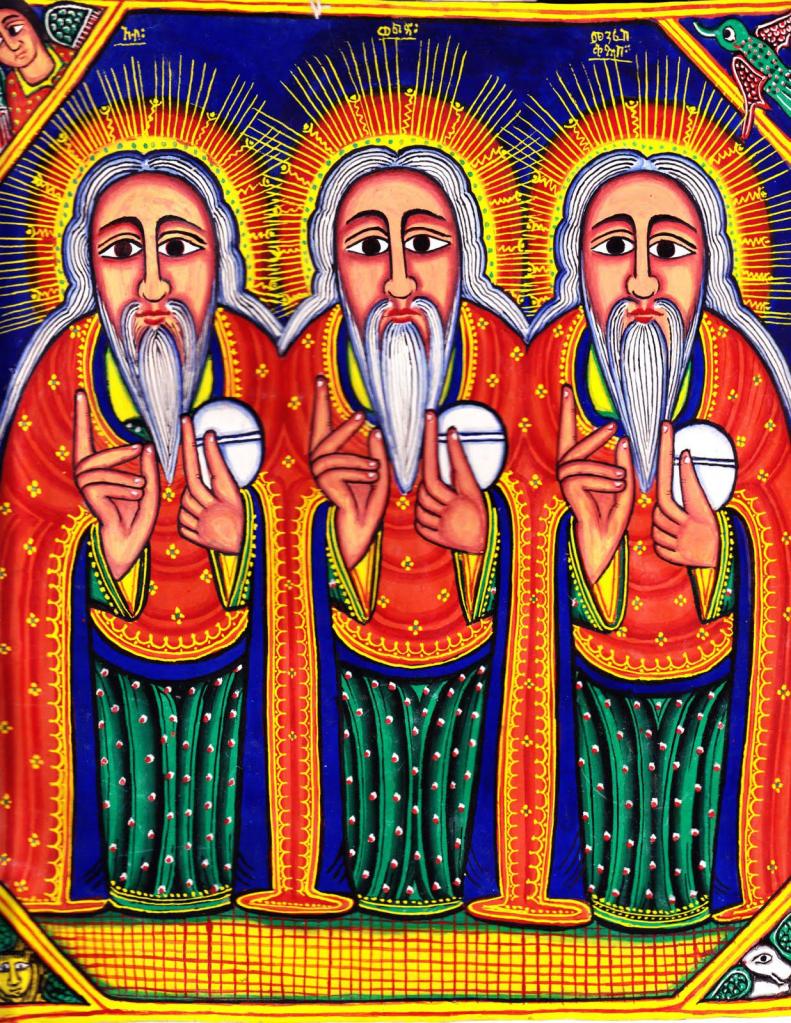
Featured image of an Ethiopian icon of the Trinity
from https://www.reddit.com/r/OrthodoxChristianity/comments/jgjbqe/ethiopian_orthodox_icon_of_the_holy_trinity/

God’s open arms

Click here to listen to the audio recording of this 15-minute message. Or watch the video on Facebook here (the message starts at about 27 minutes). This message is strongly visual, so I recommend you watch the Facebook video rather than listen to the audio, though you’ll need to turn the sound up a bit.

God has always been working for our salvation and continues to do so today. This work culminates the life, death and resurrection of Christ, hence Jesus says we need to be born again. This salvation work is motivated by God’s great love, kindness, mercy and grace towards us (Ephesians 2: 1-10). Even though we were dead in our transgressions and sins – deserving of God’s wrath – God does everything to save us. Jesus himself says, “For God so loved the world that he gave his one and only Son, that whoever believes in him shall not perish but have eternal life. For God did not send his Son into the world to condemn the world, but to save the world through him” (John 3:14-21).

  • God’s stance towards you is always open armed – always.
  • God is always open towards you even if you don’t believe in him – always.
  • God is always moving towards you – always.
  • God is always turned towards you, even when you turn away from him – always.
  • God is always turned towards you, even when you sin – always.
  • God always reorientates himself towards you as you move through life – always.
  • God is always positively disposed towards you – always.
  • God always loves you – always.
  • God is always kind towards you – always.
  • God is always full of grace and mercy towards you – always.
  • God is always hoping you will respond to him – always.
Featured image from https://www.thebalancesmb.com/christ-the-redeemer-construction-facts-844362

Thirst for God

Click here to listen to the audio recording of this 11-minute message. Or watch the YouTube video below. Or read the short text summary after that.

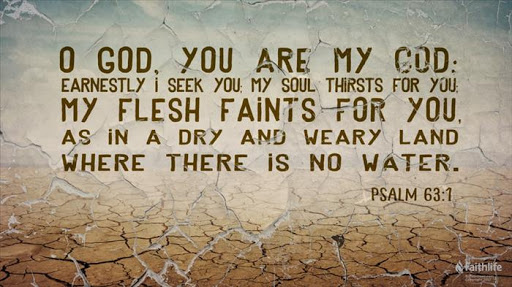
Psalm 63 is a wonderful psalm calling us to a deeper dependence and reliance on God, much like thirsting for God.

You, God, are my God, earnestly I seek you; I thirst for you, my whole being longs for you, in a dry and parched land where there is no water.

In this first section, David describes his deep longing for God as a thirsting after God. He was actually out in the desert and was probably actually thirsty. Our need for God needs to be more like a thirst. We think of the opening verses of Psalm 42, “As the deer pants for streams of water, so my soul pants for you, my God. My soul thirsts for God, for the living God. “

I have seen you in the sanctuary and beheld your power and your glory. Because your love is better than life, my lips will glorify you. I will praise you as long as I live, and in your name I will lift up my hands. I will be fully satisfied as with the richest of foods; with singing lips my mouth will praise you.

In the midst of his thirst, David remembers a time when he has seen God, encountered God. We have those moments in our lives, sometimes only a handful – moments where we know for sure that God is real, present, engaged. These are touchstones that we take up and hold when we are going through difficult times.

On my bed I remember you; I think of you through the watches of the night. Because you are my help, I sing in the shadow of your wings. I cling to you; your right hand upholds me.

And then, David lies on his bed and ruminates on God. Often, when we’re stressed, we lie on our bed and ruminate about our worries and problems. But instead, David thinks about God. Notice how every phrase has the word ‘you’ or ‘your’ in it – David immerses his thoughts in God, calling to him from his bed.

Those who want to kill me will be destroyed; they will go down to the depths of the earth. They will be given over to the sword and become food for jackals. But the king will rejoice in God; all who swear by God will glory in him, while the mouths of liars will be silenced.

And finally, relying on his thirst and his previous experiences of God, David reaches a resolution of knowing, for certain, that God is on his side; as God is on your side. God will draw alongside you. God will take care of you. God will protect you. God will lead you through.

This morning, in the midst of whatever difficulties we are facing, we are encouraged to nurture our thirst for God and to recall and hold fast to those moments where we know we have been in God’s presence.

Married to God

Click here to listen to the audio recording of this 12-minute message. Or watch the video recording on YouTube. Or read the text summary that follows.

We can liken our relationship with God to a marriage. There are many passages in scripture that do this. God’s covenant with us is much the same as a marriage covenant or contract. When we reflect on this similarity, we can imagine the very best of what a marriage can be as reflecting a good relationship with God.

However, as in marriage, people sometimes commit adultery against God. We go off to other gods to have our needs met. We seek fulfilment outside of the marriage. Indeed, we can think of all of our sin (not only sexual sin) as adultery in our marriage to God. We read about this in Jeremiah 3:6-10:

During the reign of King Josiah, the LORD said to me, “Have you seen what faithless Israel has done? She has gone up on every high hill and under every spreading tree and has committed adultery there. I thought that after she had done all this she would return to me but she did not, and her unfaithful sister Judah saw it. I gave faithless Israel her certificate of divorce and sent her away because of all her adulteries. Yet I saw that her unfaithful sister Judah had no fear; she also went out and committed adultery. Because Israel’s immorality mattered so little to her, she defiled the land and committed adultery with stone and wood. In spite of all this, her unfaithful sister Judah did not return to me with all her heart, but only in pretense,” declares the LORD.

Here, both Israel and Judah sought fulfilment from other Gods, which the Lord describes as adultery. And although Judah did return God, it was not whole-hearted, but only in pretence – a charade. God knows the inner working of our hearts. A sham marriage is no marriage at all.

The result of this adultery and half-hearted fakery is that God divorces her. It is hard to imagine a worse fate than to be divorced by God!

But God’s capacity forgive and reach out is infinite. God says in Jeremiah 3:11-14a:

The LORD said to me, “… Go, proclaim this message toward the north: “ ‘Return, faithless Israel,’ declares the LORD, ‘I will frown on you no longer, for I am faithful,’ declares the LORD, ‘I will not be angry forever. Only acknowledge your guilt— you have rebelled against the LORD your God, you have scattered your favors to foreign gods under every spreading tree, and have not obeyed me,’ ” declares the LORD. “Return, faithless people,” declares the LORD, “for I am your husband. I will choose you…”

We read a similar story in Hosea, in which God instructs Hosea to marry an adulterous and promiscuous wife. Hosea obeys and, of course, it goes badly. But then God instructs Hosea to reconcile with his wife:

The LORD said to me, “Go, show your love to your wife again, though she is loved by another man and is an adulteress. Love her as the LORD loves the Israelites, though they turn to other gods and love the sacred raisin cakes.” So I bought her for fifteen shekels of silver and about a homer and a lethek of barley. Then I told her, “You are to live with me many days; you must not be a prostitute or be intimate with any man, and I will behave the same way toward you.” (Hosea 3:1-3)

As we continue our journey through Lent, nurturing on our relationship with God and repenting of our sin, let us renew our marriage vows with God and to live as a faithful, monogamous and whole-hearted spouse.

Featured image from: https://iglesiatijuana.org/web/wp-content/uploads/2018/08/Marriage.jpg

A long story of God’s salvation

Click here to listen to the audio recording of today’s 17-minute message. Or watch the video on Facebook here (the message starts at about 25 minutes). Or read the short summary below.

Our Old Testament readings over Lent provide us with highlighted of the long story of God’s salvation of humanity. I thought that today we should look at all of these readings – the five Old Testament Sunday Lent readings, and today’s New Testament reading.

I summarise the development of God’s work for salvation as follows:

  1. God’s unconditional covenant with humanity
    • Genesis 9 (God’s rainbow covenant)
    • ‘Covenant’ is mentioned seven times
    • God promises never to destroy humanity with a flood
    • The rainbow reminds God of this covenant God has made with us
    • This covenant is entirely God’s doing and initiative, and unconditional for all humanity
  2. God’s everlasting covenant, plus circumcision
    • Genesis 17 (God’s covenant of circumcision)
    • ‘Covenant’ is mentioned 10 times
    • In three of these God says the covenant is everlasting
    • However, now the covenant has conditions:
    • Abraham must walk before God faithfully and blamelessly (v1), and
    • Males must be circumcised.
    • Males who are not circumcised fall outside God’s covenant (v14)
  3. God’s external law, which humanity must obey
    • Exodus 20 (God’s 10 commandments)
    • God now sets external laws by which we must abide
    • Now the responsibility for maintaining a right relationship with God is entirely humanity’s
    • Paul’s problem with this approach is that we inevitably break the law and thus fall out of favour with God
    • The solution of the Law alienates us from God
  4. Punishment for sin, but grace for salvation
    • Numbers 21 (God’s bronze snake)
    • But now we see a shift in God’s engagement with humanity
    • Still, law is important, and those who sin were bitten by poisonous snakes
    • But God instructs Moses to make a bronze snake which is lifted up
    • Those who look to this snake are saved/healed
    • This is a sign of grace – we look to God and God saves
    • The is a foreshadowing of the cross – we look up to Jesus on the cross, who saves
  5. God’s internal law; God’s choice to forgive
    • Jeremiah 31 (God’s law written on our hearts)
    • God says he is now setting out a new law that replaces the old – we see God shifting
    • This new law is written in our hearts – not on tablets or paper
    • And God chooses to forgive, out of God’s own initiative (v34b)
  6. Christ wins once-for-all salvation through faith
    • Romans 2-4 (God’s salvation by grace through faith)
    • Now, after Christ, salvation is by grace – it is won by Christ for us
    • We can add nothing to the salvation he has made possible
    • God chooses to forgive us, and indeed has already forgiven us and our descendants already – this is grace (a free gift)
    • We receive this grace through faith – we simply open our hearts and receive what is already available to us
    • We don’t earn our salvation – Christ has already done that – we merely receive it

There are three summary messages from today’s teaching:

  1. God has always been working for our salvation, since the creation – and continues to do so today
  2. God’s ways of working with humanity shift over time – God is not a stone – God is a person who adjusts their style of interacting with us
  3. Christ has fully accomplished our salvation – we can and need add nothing to it – we are invited merely to receive it
Featured image from https://davidjeremiah.blog/wp-content/uploads/2018/04/an-assurance-of-salvation-verse-to-know-by-heart.jpg

Seeing Christ’s Glory

Click here to listen to the audio recording of this 17-minute message. Or watch the video on Facebook (the message starts at about 30 minutes).

This message is about Christ’s transfiguration – Christ’s revelation of himself as God the Son – and what that means for us in our own daily faith experience.

Featured image from: https://40f93c092a06bdd40795-f58a4750184218be29248bb3aca19e8f.ssl.cf2.rackcdn.com/uploaded/t/0e6988835_1518390420_tajemnicerozancatransfiguration-11.jpg