Desperate times

Click here to listen to the audio recording of this 25-minute message. Or watch the video on Facebook here (the message starts at about 35 minutes – unfortunately the volume on the video is very soft).

There are times in our life when things are desperate. These two years of Covid, and the losses, restrictions and challenges it has brought us, have given us additional reasons to feel desperate. There are times when life is exceptionally hard and we feel that the world is pitted against us – that even God is pitted against us.

Psalm 22 knows something about this:

1 My God, my God, why have you forsaken me? Why are you so far from saving me, so far from my cries of anguish? 2 My God, I cry out by day, but you do not answer, by night, but I find no rest. 6 But I am a worm and not a man, scorned by everyone, despised by the people. 7 All who see me mock me; they hurl insults, shaking their heads. 8 “He trusts in the Lord,” they say, “let the Lord rescue him. Let him deliver him, since he delights in him.” 14 I am poured out like water, and all my bones are out of joint. My heart has turned to wax; it has melted within me. 15 My mouth is dried up like a potsherd, and my tongue sticks to the roof of my mouth; you lay me in the dust of death.

Jesus uses this Psalm to express his desperation and despair as he hangs dying on the cross. He feels God-forsaken, utterly desolate. Where is God in all of this? Why am I abandoned?

The Psalmist shows a flicker of faith – just a flicker, though:

9 Yet you brought me out of the womb; you made me trust in you, even at my mother’s breast. 10 From birth I was cast on you; from my mother’s womb you have been my God.

And he cries out with a desperate, but muted plea:

11 Do not be far from me, for trouble is near and there is no one to help.

Job knows something about desperate times, having lost everything, despite being a righteous man of deep faith. He loses everything – everything – and grapples to make sense of what feels like God’s abandonment of him. Instead of imploding in despair like the Psalmist above, Job explodes outwards in anger and wants to confront God (Job 23):

2 “Even today my complaint is bitter; his hand is heavy in spite of my groaning. 3 If only I knew where to find him; if only I could go to his dwelling! 4 I would state my case before him and fill my mouth with arguments. 5 I would find out what he would answer me, and consider what he would say to me.

Job pushes towards God, seeking confrontation, to put his case to God, to demand to know why God would let him struggle like this. Job is desperate, and his desperation evokes anger and outrage at God.

Yet God makes himself unfindable:

8 “But if I go to the east, he is not there; if I go to the west, I do not find him. 9 When he is at work in the north, I do not see him; when he turns to the south, I catch no glimpse of him.

How frustrating it is when the person we want to confront is unavailable, inaccessible. God disappears and Job is left both desperate and angry, with nowhere to vent his anger. And yet, Job is also afraid of God – God is dangerous, and a confrontation with God could be a disaster for Job:

13 “But he stands alone, and who can oppose him? He does whatever he pleases. 14 He carries out his decree against me, and many such plans he still has in store. 15 That is why I am terrified before him; when I think of all this, I fear him. 16 God has made my heart faint; the Almighty has terrified me.

In the end, Job does not offer up a muted plea like the Psalmist. Instead, he shakes his fist at God:

17 Yet I am not silenced by the darkness, by the thick darkness that covers my face.

23 “How hard it is for the rich to enter the kingdom of God! 24 … Children, how hard it is to enter the kingdom of God! 25 It is easier for a camel to go through the eye of a needle than for someone who is rich to enter the kingdom of God.”

The disciples also experience similar desperate times with Jesus. While we think and teach about Jesus as always available, receptive and loving, sometimes he is not. We know the story in Mark 10 of a young man who rushes up to Jesus, falling on his knees and asking what he must do to inherit eternal life. Jesus seems, from the get-go, to treat him harshly, eventually telling him to give away everything he has, and the young man is crestfallen and “went away sad”. Jesus then turns to the disciples and says:

The disciples are amazed and shocked – presumably at both Jesus’ response to the earnest young man and Jesus’ words about how impossible it is to saved. Peter cries out in desperation:

26 Who then can be saved? [and] 28 But we have left everything to follow you!

You can hear Peter’s despair. He has left everything – family, work, home, community, his place in society, everything – to follow Jesus, and now Jesus says that it is impossible for man to be saved and how hard it will be for anyone to be saved. It seems to Peter and the disciples that everything they have sacrificed is for nothing.

This is a low point for Peter. He hits rock bottom as it seems to him that he has lost everything. His sense of purpose is fracturing.

Sometimes, we find ourselves in similar places to the Psalmist, to Job and to Peter. Our world seems to be falling apart, the challenges of life pile up and seem unduly heavy, God seems to have abandoned us, where is he to be found?, we feel alone and desperate. It as this lowest point that transformation can come.

Peter missed something that Mark noticed. In Mark 10:21a, Mark writes, “Jesus looked at him [the rich young man] and love him.” Jesus looked at him and he loved him. Jesus looked at her and he loved her. Jesus looked at me and he loved me. Jesus looks at you and he loves you.

The writer of Hebrews helps us understand that a fundamental change occurs in the life of God, through Christ’s experience here on earth. Before the incarnation, God could see what human life was like, but could not feel what it was like. But with Jesus’ coming into this world in human form, God now knew first hard what human desperation feels like. Hebrews 4

14 Therefore, since we have a great high priest who has ascended into heaven, Jesus the Son of God, let us hold firmly to the faith we profess. 15 For we do not have a high priest who is unable to empathize with our weaknesses, but we have one who has been tempted in every way, just as we are—yet he did not sin.

And because Jesus understands fully what it is like to be human, and because he truly understands what it is like to be desperate, and because he loves us utterly and to the very end, the writer to the Hebrews invites us to come to God:

16 Let us then approach God’s throne of grace with confidence, so that we may receive mercy and find grace to help us in our time of need.

We can come to the throne of God, not with a muted plea, not with anger, not in desperation, but in confidence, knowing that at that throne we will find grace and mercy to help us in our time of need. We can be confident to wrestle with God, to plead with God, to challenge God, to lean into God. Because he love us and because he knows first hand how hard this life can be. Jesus (in Mark 10:29-31) does not promise an easy life – he promises both reward and persecution.

But he does promise that we can always have direct access to the throne of grace and mercy. Such is the love the Father has for us. God is always accessible, always nearby, always connected, always empathic, always in the midst of adversity with us.


Featured image from https://www.cdc.gov/nceh/features/hurricanepreparedness/index.html

Stewardship 4: A generously-giving church

Click here to listen to the audio recording of this 23-minute message. Or watch the video recording on Facebook (the message starts at about 27 minutes).

If you want to skip the sermon and just watch the unscripted enacted “parable of giving back to God” with 13-year-old Zachary, watch the video below. Zachary blew us all away with his 50/50 deal!

This is the fourth in our series on stewardship, in which we are concentrating on what it means to be a church – the church of Christ. In the first week, we reflected on what it means to be a God-focused (or Christ-centred) church. In week two, we reflected on being a people-driven church. Last week, we considered the role of the clergy in a people-driven, God-focused church: a clergy-supported church. And today, we consider what it means to be a generous church, or a generously giving church.

Can we accept the following core principle? Everything that exists was made by God, comes from God and belongs to God. Everything: the cosmos, the earth, the plants and animals, water and air, life itself, and we ourselves. You and me. Even the things we have made as humans originate with God – we made them from materials that come from God’s creation, using the intellect and the capacity for learning that God gave us, made by people, whom God created. Everything comes from God and belongs to God.

Including our money.

We may feel that we’ve earned our money, worked hard for it, deserve it and that it belongs to us. These are not untrue. But again, our capacity work, to learn to do our work and do it well, and the things we work with, and the self that is you who is doing the work – all of these were created by God, come from God and belong to God. Therefore, our money also is God’s. All of it.

It is a common misperception among Christians that our money belong to us, since we worked for it, earned it. This is neither true nor correct. We have to challenge this misperception many of us hold. This is vital to our being able to properly think about the money that we earn.

If we think of all the money we have as coming from God, then the small percentage of this money that we give to the work of God in and through the church, is really a blessing, because the large percentage of the money that we get to keep for our own use is a gift from God. A grace.

God invites us each to give proportionate to what we have. Traditionally, this would be ten percent of what you earn (gross or net – you decide). You could choose to give more than 10% or less than 10%, as you feel led. But having 10% in mind is a good point of departure to reflect critically on your attitude to and practice of giving.

The bottom line is that we – and you – have to give to God’s work.

It really is not optional. Everything you have is from God, and God expects you to give at least some small portion of that back to him. But God really doesn’t want you to do it grudgingly or sulkily, like a chore or unpleasant task. No! God loves a cheerful giver. God loves us to give out of gratitude for all we have already received from God, out of thankfulness, out of joy and out of the privilege to participate in God’s work in the world.

At our church, St Stephen’s Lyttelton, we’ll be doing our dedicated giving pledge next Sunday (3 October). During the coming week, give serious thought to how much of the money God has entrusted to you you will give back into God’s kingdom.

Featured image from https://news-ca.churchofjesuschrist.org/media/orig/tithing.jpg

Stewardship 2: A people-driven church

Click here to listen to the audio recording of this 18-minute message. Or watch the video recording on Facebook (the message starts at 41 minutes).

This is the second in our series on stewardship, in which we are concentrating on what it means to be a church – the church of Christ. Last week, we reflected on what it means to be a God-focused (or Christ-centred) church. Today, we reflect on being a people-driven church.

What is a church?

Imagine a congregation that is without a minister. Will they still be ‘a church’? Yes, for sure! A community of the faithful, even if they are just a few, is a ‘church’.

Now imagine a minister without a congregation. Perhaps even a minister with a church building. Will she or he still be ‘a church’? No, they won’t. A single person, even a minister, does not constitute a church. They will be simply a Christian person in fellowship with God.

Fundamentally, ‘the church’ is defined by its people. It is the people who constitute a ‘church’, not the minister or priest. All too often, however, ministers think that they are the church. And all too often, parishioners thing the minister is the church. We here this particularly when parishioners use phrases like, “We’re here to support our priest” or “Our pastor will decide what we should do”.

Priesthood of all believers

1 Peter 2:4-10 provides us with solid teaching on what it means to be church, particular versus 4-5 and 9-10. Here Peter describes the church with the following images:

  • you are like living stones
  • you are being built into a spiritual house (or a temple of the Spirit)
  • you are a holy priesthood
  • you offer spiritual sacrifices acceptable to God through Jesus Christ
  • you are a chosen people
  • you are a royal priesthood
  • you are a holy nation
  • you are God’s special possession
  • you are to declare the praises of him who called you out of darkness into his wonderful light
  • you are the people of God (though previously you were not a people of God)
  • you have received mercy (though once you had not received mercy)

Martin Luther summarised this as “the priesthood of all believers”, drawing on the phrases ‘holy priesthood’ and ‘royal priesthood’ above. In the first Testament, priests were appointed to mediate between the Jewish people and God. They offered prayers and sacrifices on behalf of the people. Only the High Priest could enter the Holy of Holies. Only priests could engage God, not the people.

But with the coming of Jesus, who became our great High Priest (Hebrews 4:14-16), we have direct access to God through Christ. Jesus opened a direct pathway for all Christians to God. The writer of Hebrews says therefore, “Let us then approach God’s throne of grace with confidence.” Jesus is the only one mediate between Christians and God – no priest can or should try to do this.

Moreover, we, collectively – all the people of God – the whole church – are called to mediate God to the rest of humanity, but witnessing to Jesus Christ. This is mission, and it is the mission of every believer.

One body of Christ

And so, we the church are called to be one people, one body, the body of Christ. Diverse for sure. But united in our shared relationship with God. There is thus no male nor female, no black nor white, no rich nor poor, no South African nor foreigner, no educated nor uneducated, no young nor old, no priest nor parishioner. We are all part of the Body of Christ (1 Corinthians 12:27) – every single one of us – and every part is vitally important – and every part must do its part.

Therefore, I say, a church is all about its people and must be driven by its people. We must be a people-driven church. It is all about YOU, not about the minister (we’ll talk about the role of the minister next week). Church is not like watching a movie, where you recline in a comfy chair with popcorn and cooldrink, while watching other professionals act things out on a screen. No! You are the actors and you must play your part in life and work of the church. It is all about you! You are the church. You drive the church.

Featured image from https://i.international.la-croix.com/0x0/prod/uploads/news/2020/04/1587575852.jpg

Christianity made simple

Click here to listen to this 22-minute message.

The theme I was allocated for today’s sermon was ‘Make it simple’. Make it simple! What a theme!! I’m good at making things complex, nuanced and sophisticated; not at making the complex and (ultimately) unknowable simple.

So I start this message by sharing my testimony of how I became a Christian on 21 October 1984.

I then use the four readings allocated for today to pull out two main themes:

  1. Psalm 116 uses the phrase “I call on the name of the Lord” four times, emphasising that in response to both the highs and lows of life, we are to choose to call on God’s name.
  2. Joshua, in Joshua 24:14-18, calls people to choose this day who they will follow: God or not God.
  3. In Ephesians 4:25-5:1, Paul exhorts Christians to “be kind and compassionate” to other people and to “walk in the way of love”.
  4. And in Luke 6:27-36, Jesus says, “to you who are listening I say: Love”. This is always his command and call, the most basic command that he gives and the one that he gives most frequently. This time, he ups the ante by calling us to ‘love our enemies’, because loving those who love us is something everyone does. We who follow Christ, however, are called to more than that.

Together, these readings present to us a very simple (albeit not easy) approach to Christianity:

Choose God

Choose love

It is really as simple as that. And while these sound like two things, they are in fact one, because God is love (1 John 4:8). So, in truth, at its simplest level, being a Christian means:

Choose the God of love

Let it be so.

2019.09.29_wales-71892

I am Judas

Click here to listen to this 10-minute message.

The story of Christ’s crucifixion confronts us with the dark-side of humanity. Having coming back from a visit to Rwanda last week, where I visited the genocide memorial in Kigali, where close to 300,000 victims of the 1994 genocide are buried, this potential for darkness and evil is especially prominent in my mind. We each need to own up to the role that we played in the murder of Jesus Christ – a man who had nothing but immense love for the world.

Judas Iscariot is arguably the most tragic character in the Bible (John 13:21-32). He walked with Jesus for three years, but ended up betraying him into the hands of the Jewish and Roman authorities for just a few coins. Too late, he recognised the horror of what he had done and attempted to repent and undo his evil deed. In despair he took his life.

We cannot blame Judas for Christ’s death, because we too betray Jesus and we too contribute to his death. And so, I suggest that we need to say “I am Judas” in recognition of our partnership in the execution of the Son of God. (I have adapted the ‘Je suis Charlie’ icon that was created after the terrorist attack on Charlie Hebdo newspaper in 2015 – ‘Je suis Judas’.)

But , where Judas approached the religious leaders for forgiveness, we should rather approach Jesus, whose capacity for forgiveness is eternal. And where Judas was unable to forgive himself, we need to accept Jesus’ forgiveness and allow ourselves to be set free from sin and guilt. Thus, we can also say, “I am not Judas” (‘Je ne suis pas Judas’).

What the Gospel Says about Decoloniality

Click here to listen to this 24-minute message.

Decolonisation and decoloniality are huge topics in contemporary South Africa, demanding that we engage with the legacy of centuries of oppression of African people by Dutch and British colonial powers and the Apartheid government. The question I explore in this message is what the Gospel has to say for Christians about decoloniality, that is, about living in a post-colonial society.

Matthew 22:15-22 is a well-known passage where Jesus says that we must “give to Ceasar what is Ceasar’s”. It has often be used to say we must support the government of the day. It is one of the most political narratives in the Gospel texts, and forces us to engage with political issues.

This narrative took place against the first century backdrop of the Jewish people being under the oppressive colonial rule of Rome. A key part of Rome’s rule was a tax, called Census, that every Jewish person had to pay simply for having the audacity to be born Jewish. It was a deeply humiliating, subjugating and repugnant tax for Jewish people.

The tax was paid with a silver coin that had Tiberius Ceasar’s portrait engraved on it. Such an engraving was idolatrous to many Jewish people at that time, because it conflicted with the second commandment. And the inscription on the coin effectively said that Tiberius was the ‘son of God’ and ‘high priest’. Paying a ‘sin tax’ for being Jewish with such a coin was outrageous.

In this message I break open some important points that Jesus makes to determine what he really thought about how Jews at that time should live under colonial rule. These thoughts are useful for Christians today who live under a colonial government or under the rule of an oppressive or corrupt state, as well as those, like us in South African, who live in a post-colonial society, coming to grips with the present legacy of colonisation and coloniality.

This is a chewy message, requiring a close reading of the Gospel text, and careful application in its original and present day contexts. I hope that you may take the time to listen to this podcast and to engage with these thoughts.

Depths of Stewardship

Click here to listen to this 16-minute message.

Stewardship or dedicated giving is an important dimension of the life of most churches and most Christians. It is about pledging to invest our time, our abilities, our resources and our finances into the work of God through the local church. Stewardship, however, runs the risk of becoming an administrative process of ticking off some boxes to settle our dues with our church, without really touching us or the world at a deeper level.

In this message, I draw on two verses from the Gospels – Matthew 21:33-34 – and show how this text points us to a far deeper and broader understanding of the importance of stewardship:

“Listen to another parable: There was a landowner who planted a vineyard. He put a wall around it, dug a winepress in it and built a watchtower. Then he rented the vineyard to some farmers and moved to another place. When the harvest time approached, he sent his servants to the tenants to collect his fruit.”

  • First, this passage echoes the creation narrative in Genesis 1, where we find God creating a world and placing people in it, with the task of taking care of that world, which is an expression of the love and being of God. This suggests that stewardship reaches right back into the very origins of humanity, and is rooted not just in some things we do, but in our identity. Being a steward (or gardener or farmer) is the foundational calling that God makes of all humanity. It means, among other things, that everything we do in life should champion and protect the environment.
  • Second, later in this parable (v43), Jesus reveals that the vineyard is, in fact, the Kingdom of God, which is the world under the loving rule of Christ, who reconciles all things together to himself. We, as his followers, are called to bring out the fruit of the Kingdom of God, or the fruit of the Gospel. This means, among other things, that everything we do should help to bring into being God’s Kingdom values, such as love, justice, mercy, equity, relationships, integrity and grace.

Stewardship, then, is not just about signing up to help make tea or work in a soup kitchen, nor is it just about pledging to donate money to the church on a monthly basis. It is an expression of our identity as people created to take care of creation and as people striving to transform the world into the Kingdom of God, through every breath we take, from rising until sleeping. In so doing, we let God’s will be done here on earth as it is in heaven.

Resurrection Church

Click her to listen to this 25-minute message.

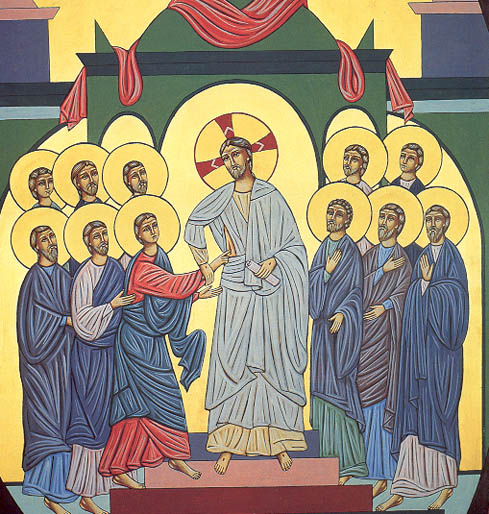
On the evening of that first Easter Sunday, Jesus appeared to the disciples (excluding Judas and Thomas) in the upper room, where he showed them his wounded hands and feet. John describes this in John 20:19-23. This narrative is followed by the story of Jesus’ engagement with Thomas. And John ends the chapter with a reflection on his version of the Gospel – that he has selected from the numerous stories about Jesus these few, whose purpose it to facilitate our belief in Jesus, so that we may enjoy the fullness of Life.

John’s purpose in the John 20 narrative is to guide the church towards the end of the first century to be a resurrection church – a church that is centred on the risen Christ, empowered by Holy Spirit and focused on Christ’s work of forgiveness and reconciliation. But this is hard when you are 60 or more years away from the living Christ Jesus. Because of this distance in time (most of the eye witnesses had passed on) John’s message is of particular relevance for us who live two thousand years distant.

This is quite a long sermon for me and our parish – sorry about that! But I hope it moves quite briskly and provides some food for thought about a fascinating and rich passage in the Gospel narrative. To assist with the denseness of the message, I provided my congregation with a slip of paper with the nine points (yes, nine!) written down. Here they are:

  1. This is the start of Sunday worship for Christians – resurrection Sunday.
  2. Jesus’ body is still physical, but also transformed – it does not conform to the laws of nature.
  3. Christ stands in the middle of us, and is the centre focus of Christian life and worship.
  4. Jesus’ presence bring peace (Shalom) and is his central message.
  5. Jesus’ transformed body retains the wounds in his hands and side, and are assimilated into the triune Godhead at the ascension, so that there is now woundedness within the being of God.
  6. Jesus commissions his disciples (including us) to be his presence in the world – when people see us, they should see Christ.
  7. Jesus imparts Holy Spirit to us – we have Holy Spirit in us, not as power and gifts, but as the relational presence of God within us.
  8. We are given the ministry of forgiveness, which Paul calls the ministry of reconciliation.
  9. All of this culminates in a statement of faith – a creed – ‘My Lord and my God’.

Seeing from the Cross

Click here to listen to this 18-minute message.

Today is Good Friday – a poorly named day in my view. It should be Dark Friday. The Passion Week is transformed to good on Easter Sunday, but not before. There is nothing good about Friday. But my opinion is unlikely to change centuries of tradition!

Today, at my Anglican community church in Irene, South Africa, we participate in a three-hour service, from 12pm to 3pm – the hours that Jesus hung on the cross. It is a kind of vigil, like the women who kept watch as Jesus hung there. It is one of the best attended services at our church, and most people stay the full time. Today, we used the Seven Last Words of Christ to structure our service. The priest, deacon and lay ministers shared the preaching. I preached on the passage from John 19:25-27, where Jesus says “Woman, behold! Your son. … Behold! Your mother.” (my translation).

The central thing that stands out for me is that Jesus SEES his mother and his friend (thought to be John, the disciple). And seeing them and their need, he invites them to SEE each other (the Greek for ‘behold’, or ‘here’ in other translations, means ‘Look!’ or ‘See!’). So, in this sermon I suggest four layers of meaning:

  1. The passage foregrounds the humanity, dignity and worth of women, as central to the story. We need to stand against patriarchy, violence against women, the silencing and marginalisation of women, the exploitation of girl children.
  2. The passage speaks about Jesus’ commitment to family and to intimate relationships. We need to invest in these relationships, in the domestic, because this is of interest to God.
  3. The passage suggests the great potential of the church to recreate the world. We should examine our own churches, asking if we are really doing what God wants us to, are we being who God wants us to be?
  4. The passage advances God’s concern and love for the whole of humanity. God sees us, knows us, recognises us, loves us, champions us, cries for us. And we should also.

Wishing you a blessed and joyful Easter 2016.
Adrian

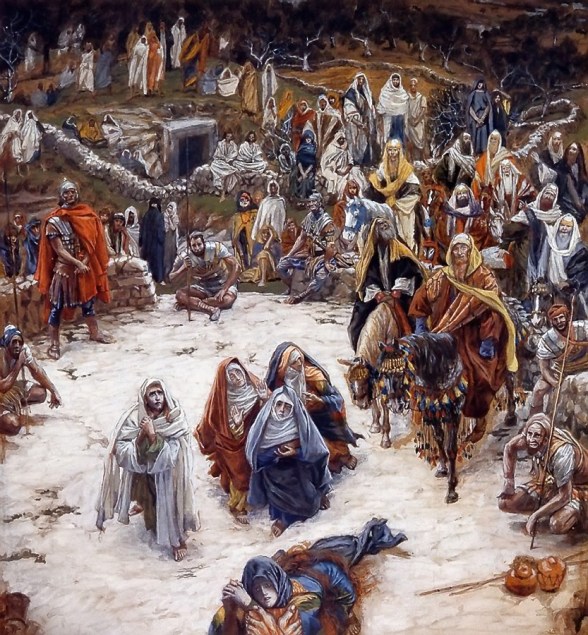
P.S. I struggled to find a picture that depicts what Jesus would have seen from the cross. The arts are almost entirely focused on Jesus on the cross – rightly so. But I found this one by James Tissot, a French painter, painted in c. 1890. For those receiving this by email, you won’t see the featured image for each of my sermons. Follow the link to my blog to see them.

When the World goes Mad

Click here to listen to this 16-minute message.

Sometimes, the world seems to be going mad. On the morning of the day I preached this sermon, two terrorist attacks in Brussels left 31 or so people dead. IS claimed responsibility. Attacks like these, like the multiple attacks in Paris in 2015, make us afraid and want to withdraw from the world. Fear sets in. Muslims and Arabs seem dangerous. The world seems a threatening place.

In South Africa, we face increasingly racialised discourse, from all sides of the political and racial spectrum. Some people are calling for doing away with reconciliation and an increasing emphasis on racial identity and distinctiveness. These conversations elicit fear and uncertainty, prompting us to withdraw from each other into our safe comfort zones.

Jesus also experienced a world going mad. As religious leaders becoming increasingly threatened by him, his actions and his popularity, they set up traps to discredit and marginalise him. They plot to kill him. Indeed, they succeed in murdering him.

But through all this madness, Jesus does not withdraw, he is not cowed by fear, he does not avoid. Instead, Jesus continues to engage, to move towards, to step across boundaries. From where does he get this confidence in the face of considerable odds? He gets it from a confidence that his authority comes from heaven, from God. He knows that he is living out God’s will for him – to reconcile all things together within God’s family.

And so he remains steadfast. As we also need to remain steadfast. To not be cowed or afraid or marginalised. But to continue to live out the faith that we have inherited. A faith that hopes and trusts in a powerful God. A faith that engages and connects. A faith that steps across boundaries and embraces. A faith that loves.

Mark 11:27-33