Watch the video below of this 42-minute message. Yes, much longer than usual! I’m sorry about that, but it is – I think – worth the time, as a close reading of John 20:19-29 sheds to much light on Jesus’ character, his relationship with the disciples and his work as the Son of God. My notes are available below the video
Verses 19, 26 Both times Jesus “stood right in the middle of them”
Christ is the centre – not the priest, Bible, APB – only the person Christ
Christ-centred church
1, 19, 26 Easter Sunday morning – Jesus appears to Mary
Easter Sunday evening – Jesus appears in the upper room
Following Sunday (today) – Jesus appears again, to Thomas
19, 21, 26 Peace be with you – Shalom alechem x3
Easter Sunday – Christ made peace between us and God
Forgiveness of sins – done, paid for, wiped clean, forgotten, cast the deep
Everything is good. It’s all okay
Easter is the Great Forgiveness!
20 He showed them his hands and side
Emphasis on bodily resurrection, reconnected to his people
Not just some spiritual, esoteric thing
He is fully embodied, albeit with some unusual capacities
20 He could have come back healed, but doesn’t. Why?
His identification with us, solidarity with our pain & suffering
He remains the suffering servant of Isaiah 53 (4-5):
He took up our pain and bore our suffering. He was pierced for our transgressions, he was crushed for our iniquities, the punishment that brought us peace was on him, and by his wounds we are healed.
20 The disciples were overjoyed – full of joy
Joy (chara) & grace/gift (charis) – joy is a gift of God – because Jesus is back
21 “As the father has sent me, I am sending you”
We are to continue God’s work. We are sent, just as Christ was sent
Jn 3:16/7 “God so loved the world that he gave [sent] his one and only Son … For God did not send his Son to condemn the world, but to save it”
Every Christian is sent – not just clergy or evangelists
22 He breathed on them, “Receive the Holy Spirit”
Hebrew for spirit & breath are both? Ruach
Gen 1:2: Spirit of God hovering
22 Gen 2:7: “Then the Lord God formed a man from the dust of the ground and breathed into his nostrils the breath of life, and the man became a living being”
To receive Jesus’ breath & Holy Spirit is to be made a new living being
22 To receive Jesus’ breath & Holy Spirit is a grace/gift (charis)
As the Spirit/breath was active in the creation of earth and humanity
2 Cor 5:17: “If anyone is in Christ, they are a new creation. The old has passed away, the new has come.”
22 Holy Spirit poured out on Pentecost: Easter Season is from Easter Sunday to Pentecost
23Forgive anyone’s sin
The gift of HS is not so much miraculous signs, etc.
Instead the central commission – sending – is to forgive
And to warn that to not repent = no forgiveness
The Great Forgiveness!
24Thomas was not with the disciples when Jesus came.
Where was he? He should have been in church! We should be in church!
27 Touch, see
V20. Jesus showed them his hands and side.
Thomas wants what the others got – to see. But also to touch
Our Eucharist is a see and touch moment
– receive the body of Christ broken for you (not receive this bread)
– receive the blood of Christ (not receive this wine)
Not clear if Thomas did actually touch: “Thomas answered and said…”
Perhaps seeing and the invitation to touch was enough for him
27 Stop doubting and believe. Be a believer!!
Accept the small and periodic signs of God and believe into him
28My Lord and my God!
Hebrew: Yahweh & Elohim – names for God
Greek: Kyrie & Theos – names for God
The only place in the Gospels where Jesus is referred to as God – A profound statement of faith – perhaps the most
Today we celebrate St Stephen, after whom our church is named. It is our church’s patronal festival, our birthday.
Stephen was a young man, appointed a deacon in the early church. He appears only in Acts 6 and 7, but in those few pages, he makes a remarkable impression and impact. He is the first Christian martyr – stoned to death because he challenged the Jew people’s lack of faith in Jesus Christ.
While we walk primarily in the footsteps of Jesus Christ – he is God incarnate, our teacher and our Lord and saviour – we give heed also to the example of Stephen, and seek to continue his legacy in our parish community today.
Our readings centre on Acts, omitting Stephen’s long, but very impressive and persuasive sermon. This are supported by a reading from 2 Chronicles, where Zechariah (an earlier Zechariah – not the father of John the Baptist) is stoned to death for speaking God’s Word. Psalm 31, which includes the words that both Jesus and Stephen speak as they died. And John 6, which is the ordinary reading for today, from Jesus’ long sermon on the Bread of Life. I have tabulated these three people, because there are significant and meaningful similarities between them, that speak to all Christians, and especially those who are members of a church named after St Stephen:
Topic
Zechariah
Jesus
Stephen
Reading
2 Chronicles 24:17-22
John 6:24-35
Acts 6:8-10 & 7:54-60
Holy Spirit
Spirit of God came on him
Baptised by John and the Holy Spirit descended on him
Full of Holy Spirit, faith, grace and power
Care for the poor
–
Fed 5000 men (plus women and children) with bread and fish
Oversaw the daily distribution of food
Challenges with the people
They were chasing after other Gods
They just wanted food and miracles
Wanted quiet conformity with the past
Challenging the people
Why do you disobey the Lord’s commands?
Do not work for food that spoils
You stiff necked people! Your hearts are uncircumcised! You always resist the Holy Spirit! Was there ever a prophet your ancestors did not persecute?
Consequences for God’s messengers
Stoned to death
Crucified
Stoned to death
Their final words
May the Lord see this and call you to account.
Father, forgive them, for they know not what they are doing.
Lord, do not hold this sin against them.
Final prayer
–
Father, into your hands I commit my Spirit (in Luke)
Lord Jesus, receive my spirit (Psalm 31:5)
So, what do we take from this, and particularly from Stephen, into our daily lives?
We must take our faith seriously – it is costly, important and even worth dying for.
We must care for the poor, hungry and marginalised.
We must seek the infilling of Holy Spirit, who equips us for life and ministry.
We must seek after the things of God, and not after the things of this world.
We must forgive those who hurt even, even to death.
Our First Testament readings today (2 Samuel 7 and Psalm 89) speak of the chosenness of King David and by extension of the Jewish people, the people of Israel. God affirms that he gives a place of safety to the people of Israel and that David’s throne and kingdom are forever.
Two days ago (19 July 2024), the UN’s International Court of Justice, declared Israel’s occupation of the West Bank, East Jerusalem and the Gaza Strip as illegal and called on Israel it withdraw its occupation and all settlers living there and to pay reparations for the harm done to Palestinian people. Prime Minister Benjamin Netanyahu responded: “The Jewish people are not occupiers in their own land — not in our eternal capital Jerusalem, not in the land of our ancestors in Judea and Samaria. No false decision in The Hague will distort this historical truth, just as the legality of Israeli settlement in all the territories of our homeland cannot be contested.”
Netanyahu’s response harks back to these First Testament promises, though neglects several other important First Testament principles. First, a crucial First Testament theology and principle is hospitality. God is hospitable – inviting humanity to share in God’s work in the world and coming to meet with God’s people and journey with them. God expects Israel to be hospitable to other peoples. Deuteronomy is explicit that foreigners should be treated as if they were Israel’s own. There should be no discrimination.
Second, God uses other nations to discipline Israel through the First Testament. The people Israel turn away from God towards other gods; God sends enemy forces to disrupt Israel; Israel repents and turns back to God; peace between God and Israel is restored. This is a pattern repeated over and over in the historical books of the First Testament.
If Israel’s First Testament status as ‘chosen’ is still valid, surely all the other aspects of its relationship with God should be valid also.
Of course, there are many different views on Israel and Palestine. The situation is complex and feelings are hot!
And then, as we move into the Second Testament, there is a shift again. There is Jesus’ radical inclusivity, which I’ve spoken about frequently. Paul, in Ephesians 2, writes about the exclusion from Gentiles from Israel, but how Christ has destroyed the dividing wall of hostility between Jews and Gentiles, and made us one person, through Christ’s body on the cross. There is now peace for us all. And in Galatians 3, Paul says that in Christ there is neither Jew nor Gentile, slave nor free, male nor female. For we are all one in Christ Jesus. God’s desire is for a united humanity, centred on Christ.
But the world is a messed-up place. Such conflicts all over – not just in the Middle East, but between Democrats and Republicans in the USA, ethnic groups in many countries in Africa, Muslims and Hindus in India, Europeans and refugees in Europe, and the list goes on. We are a fractured race, seriously out of step with God’s desire for humanity.
We can probably do little to nothing to solve the challenges in the Middle East and elsewhere, but there are some things we can do to contribute to a shift in the world. First, we can ensure that we are inclusive and diverse, that we treat every person as God’s creation, much loved and blessed, and ensure that racism, sexism and other -isms are wiped out of our interactions. Second, we can pray, and pray some more, because prayers for unity and harmony and mutual respect and love are fully aligned with God’s vision for humanity and so this surely must be a prayer that God will answer.
King David Playing the Harp (1622) by Gerard van Honthorst
1 Great is the Lord, and most worthy of praise, in the city of our God, his holy mountain.
2 Beautiful in its loftiness, the joy of the whole earth, like the heights of Zaphon is Mount Zion, the city of the Great King. 3 God is in her citadels; he has shown himself to be her fortress.
4 When the kings joined forces, when they advanced together, 5 they saw her and were astounded; they fled in terror. 6 Trembling seized them there, pain like that of a woman in labor. 7 You destroyed them like ships of Tarshish shattered by an east wind.
8 As we have heard, so we have seen in the city of the Lord Almighty, in the city of our God: God makes her secure forever.
9 Within your temple, O God, we meditate on your unfailing love. 10 Like your name, O God, your praise reaches to the ends of the earth; your right hand is filled with righteousness. 11 Mount Zion rejoices, the villages of Judah are glad because of your judgments.
12 Walk about Zion, go around her, count her towers, 13 consider well her ramparts, view her citadels, that you may tell of them to the next generation.
14 For this God is our God for ever and ever; he will be our guide even to the end.
Psalm 48 centres on Zion – God’s sanctuary, the temple, the City of our God, the Holy Mountain, the fortress. I will refer to Zion as God’s sanctuary from here on.
God’s sanctuary is inhabited by God, the Lord, the Lord Almighty, the Great King.
God’s sanctuary is a feminine space – the feminine pronoun ‘her’ is used eight times to emphasise the feminine character of the sanctuary. It is something like a womb – a safe, protective, nourishing and nurturing space. The enemies of God experienced pain like that of a woman in labour, but for those who dwell in the sanctuary, it is a womb.
God’s sanctuary is a place of refuge and safety – a sanctuary.
In God’s sanctuary, there is beauty, joy, security, meditation, unfailing love, God’s right hand, righteousness, rejoicing, gladness, our guide, God, for ever and ever.
God’s sanctuary is the place we are invited to enter: Walk about Zion, go around her, count her towers, consider well her ramparts, view her citadels.
God’s sanctuary is where we can retreat when things get on top of us, when we feel pressured or burdened, when we are worried or distressed, when we’re afraid, when we need replenishing, when our faith founders, when life’s adversities are too much, when we are alone. The sanctuary is God’s place, God’s grace.
The transfiguration of Christ, which is reported in Mark 9 (our reading for today), Matthew 17 and Luke 9 (all with very similar content), is a remarkable story. I wish I had been there with Peter, James and John, to see this for myself! What a beautiful and transcendent experience. And also how terrifying and mind bending. No wonder the disciples were rendered virtually unconscious. We read this passage every year and get a sermon on it every year. What more can be said?
This year, I spent time reading the texts on either side of the transfiguration narrative, and found that these passages also were congruent across the synoptic Gospels (Matthew, Mark and Luke). What struck me the most was how difficult and dark these passages were. The transfiguration is just a brief moment of light – brilliant, blinding, cosmic light – within a much darker narrative.
Before the transfiguration, we read about Peter declaring Jesus to be the Messiah (v29), Jesus telling the disciples that he will soon be killed (v31), Peter rebuking Jesus for saying this (v32), Jesus rebuking Peter and uttering these dreadful words – “Get behind me Satan!” (v33, reported also in Matthew, but not Luke) and Jesus explaining the cost of discipleship and the way of the cross (v34). Wow, dark material indeed!
After the transfiguration, the dark material continues. Jesus and the three disciples find a major argument going on among the people because the disciples were unable to cast out a demon (v18), Jesus gets angry asking, “You unbelieving generation, how long shall I stay with you?” (v19) (or “how long must I put up with you?” in Matthew). And then Jesus repeats his message that he will soon be killed (v31).
These passages before and after the transfiguration are in such stark contrast with the transfiguration itself. In the midst of dark, difficult, conflictual narrative is this brief blinding moment of Christ’s glory as God the Son. But it is so short lived – the three disciples come crashing back into a challenging world.
This contrast reminds me of our Palm Sunday services in our (Anglican) tradition. We start our service outside in red, with crosses and candles and incense and palm branches, shouting “Hosanna! Blessed is he who comes in the name of the Lord!”, processing around the church and into the road singing “All glory, laud and honour!” Such an exciting and happy time. And then our reading for the day is the whole of the passion narrative (from the last supper to Jesus’ burial). This contrast in tone (from joy to despair) is stark and shocking.
We ought not to think that we are promised a happy joyful, prosperous, wealthy, healthy life, even though some churches do teach this. We do not find it in the scriptures – it is not in the life of Jesus, it is not in Jesus’ teachings and it is not in the transfiguration narrative. Instead, we are invited to grapple with faith, discipleship, health, death, effectiveness and power. And within this real but difficult life, there are moments of light, joy and peace.
This is not to say that we should wallow in depression or succumb to despair and hopelessness. No! Certainly not! Rather, we need to face and confront depression, despair, hopelessness and all the other challenges we face in life. We walk in faith, trusting in God’s abiding presence, even in the darkness. We call on him for life, for salvation, and to offer thanks. We journey through the challenges of life, knowing that God is on our side.
To help us with this, I encourage you to read Psalm 116. And if life is sitting heavily on you, I encourage you read it multiple times each day, as a prayer for protection and God’s sustaining presence. Here it is:
1 I love the Lord, for he heard my voice; he heard my cry for mercy. 2 Because he turned his ear to me, I will call on him as long as I live.
3 The cords of death entangled me, the anguish of the grave came over me; I was overcome by distress and sorrow. 4 Then I called on the name of the Lord: “Lord, save me!”
5 The Lord is gracious and righteous; our God is full of compassion. 6 The Lord protects the unwary; when I was brought low, he saved me.
7 Return to your rest, my soul, for the Lord has been good to you.
8 For you, Lord, have delivered me from death, my eyes from tears, my feet from stumbling, 9 that I may walk before the Lord in the land of the living.
10 I trusted in the Lord when I said, “I am greatly afflicted”; 11 in my alarm I said, “Everyone is a liar.”
12 What shall I return to the Lord for all his goodness to me?
13 I will lift up the cup of salvation and call on the name of the Lord. 14 I will fulfill my vows to the Lord in the presence of all his people.
15 Precious in the sight of the Lord is the death of his faithful servants. 16 Truly I am your servant, Lord; I serve you just as my mother did; you have freed me from my chains.
17 I will sacrifice a thank offering to you and call on the name of the Lord. 18 I will fulfill my vows to the Lord in the presence of all his people, 19 in the courts of the house of the Lord— in your midst, Jerusalem.
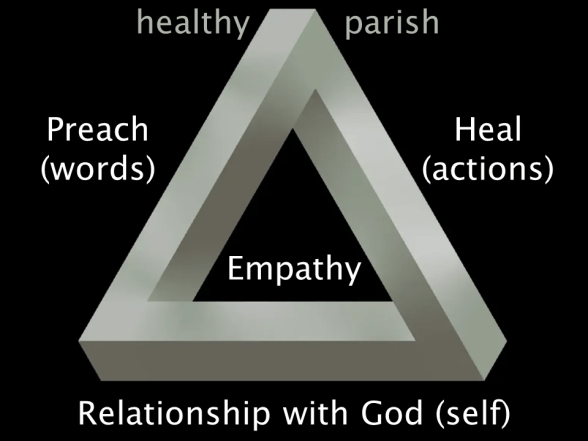
This sermon (preached a week ago on 4 February 2024) is about a healthy parish – what makes for healthy parish life. It emerges, in part, in light of various churches failing to uphold core values around clergy integrity and sexual relations. A model for a healthy church is presented, based on the readings that were set for today in the Revised Common Lectionary, viz. Isaiah 40:21-31, Psalm 147:1-11, 1 Corinthians 9:6-23 and Mark 1:29-39.
Jesus is always our model for everything to do with Christian living, including corporate or collective Christian living – the church. This model is influenced by the readings above and also by how Jesus lived his life, related to God and people, and exercised his ministry.
1. Personal relationship with God
The foundation of a healthy church – and the foundation the triangle above – is each member’s personal relationship with God. Our collective well-being rests on the aggregate of each individual person’s health relationship with God. In Mark 1:35, Jesus leaves his ministry to spend time in his personal relationship with God – he does so repeatedly, even though there are so many people waiting for his healing ministry and teaching. If a personal relationship with God is important to Jesus – who is God, the second person of the Holy Trinity – how much more important should it be to each of us.
When you fly on an airplane, you will be told that, in the event of cabin decompression, oxygen masks will drop down from above your seat. And you will be told to put your OWN mask on FIRST, before helping others (including your children). This is an apt illustration of the need for each of us to see to our personal relationship with God. I, as priest, must ensure the robustness and depth of my relationship with God.
2. Preach words
In 1 Cor 9:16-18, Paul refers to his preaching as central and as God-given. In Mark 1:38-39, Jesus says he needs to go to other villages to “preach there also”. He goes on to say, “That is why I have come”. Preaching words is important to build people’s faith.
But for a health church, I suggest we translate preaching as our words. Too often our words are harsh, judgmental, critical and gossipy. Such words break down, alienate, diminish and harm. There is no place for such words in a healthy church.
Our words should heal and create. Psalm 147:4 says, God “determines the number of stars and calls them each by name”, while Isaiah 40:26 reiterates, “Lift up your eyes and look to the heavens: who created all these? He who brings out the starry host one by one and calls forth each of them by name. … not one of them is missing”. These verses indicate how the words of God bring stars into being, as he names and calls them. Similarly, our words – whether good or bad – can call things into being.
Therefore, our words should be deliberately encouraging, edifying, building up, loving. Last year, we spent the whole of Lent reflecting on Jesus’ command to “love one another”, where we teased this out in detail.
3. Heal through actions
Mark 1:29-34 and 39 say, “…[Jesus] went to her, took her hand and helped her us. The fever left her … Jesus healed many who had various diseases. He also drove out many demons … So he travelled throughout Galilee … driving out demons.” Isaiah 40:29-31 says, “He gives strength to the weary and increases the power of the weak. Even youths grow tired and weary, and young men stumble and fall, but those who hope in the Lord will renew their strength. They will soar on wings like eagles; they will run and not grow weary, they will walk and not be faint.” Psalm 147: 2-3, 8-9, says, “The Lord builds up Jerusalem; the gathers the exiles of Israel. He heals the broken-hearted and binds up their wounds. … He covers the sky with clouds; he supplies the earth with rain and makes grass grow on the hills. He provides food for the cattle and for the young ravens when they call.”
These words are all of healing actions. How we behave impacts the health of a church. When we exclude, abandon or just do nothing, we harm the church. We break it down and weaken it. Rather, we should engage in actions that build up a health community. We can do this by simply showing up, instead of being absent. And through simple acts, like cooking a family a meal when they’re going through a hard time, giving someone a call or sending them a message, helping to clean up. In our tradition, we share the peace during the service – we can make sure we greet all the people around us, instead of rushing off to chat with our friends and ignoring a visitor.
4. Empathy
I have placed ’empathy’ at the centre of the graphic of a healthy church, even though the word ’empathy’ does not appear in the Bible. But the concept is there, for example in 1 Corinthians 9:19-23, Paul writes:
19 Though I am free and belong to no one, I have made myself a slave to everyone, to win as many as possible. 20 To the Jews I became like a Jew, to win the Jews. To those under the law I became like one under the law (though I myself am not under the law), so as to win those under the law. 21 To those not having the law I became like one not having the law (though I am not free from God’s law but am under Christ’s law), so as to win those not having the law. 22 To the weak I became weak, to win the weak. I have become all things to all people so that by all possible means I might save some. 23 I do all this for the sake of the gospel, that I may share in its blessings.
Here Paul steps into the shoes of others, in order to understand them from inside, in order to share the Gospel in a way that makes sense to them. This effort to feel with others is core to empathy.
We see this profoundly in Jesus. Until Jesus was conceived, God had no first-hand understanding of what being human was like. God was not a man, and didn’t have personal experience of being human. But when Jesus incarnated in Mary’s womb and was born like any other human, God got a first-hand experience of being human – God discovered empathy for the human condition.
Too often, however, we jump to negative conclusions, without first exercising empathy. We assume the worst of people, rather than considering other less judgmental reasons for their behaviour. For example, if we don’t see someone for a few weeks we assume they have lost their faith or reneged on their responsibilities, when in fact they might be ill. Instead, let us rather assume the best – if we’re going to make an factless assumption, let’s make a positive one rather than a negative one, until the facts suggest otherwise.
A church that is grounded in personal relationships with God, that speak and act in ways that build up and encourage, and that chooses to empathise with each other, is likely to be a healthy community. This is the kind of community or body that God desires for us. It takes some effort on each person’s part. Working together, we can build a healthy church centred on God.
Psalm 119:105 is a key text for Christian living: “Your word is a lamp for my feet, and a light on my path.” Not only does this verse point us to Scripture – the Word of God – as the source of light in life, but it also tells us something important about how God reveals Godself to us: in small increments.
We think of a lamp or light as a torch, providing a beam of light to shine up a path to see ahead to where we’re going. But the lamp the Psalmist writes about creates just a puddle of light around us – enough to see only the next step. To translate this verse into contemporary times, think of pointing your flashlight down at your feet rather than beaming ahead several meters.
Today’s world is premised on knowing the future and planning strategically and systematically. This is not bad – I do this all the time. But it is not the way God engages with humanity. God points us to a destination but typically does not provide us with the steps.
Let’s look, for example, at the story of Abraham and his descendants. In Genesis 12, God promises that he will make Abraham into a great nation and a blessing to all people. This promise is renewed several times over Abraham’s life. But he has his first child, Isaac, only around the age of 100 years! That’s a long time to wait for the most critical next step to becoming a great nation.
Then Isaac married only at age 40 and had his first son, Esau, at 60. And after Esau sold his birthright to Jacob, Jacob only had his first son, Reuben, at around 80 years. (Making up for lost time, Jacob had his other 11 sons within about half as many years!)
The point here is that there was little sign of God’s promise fulfilled across three generations from God’s promise to Abraham, covering perhaps 200 years. Where are the descents as many as stars in the sky and sand on the seashores? Abraham was given a destination, but he saw only a few steps of this over a very long time. Yet, throughout this time, Abraham was renowned for his deep faith that God was working out God’s purposes in him.
My journey to ordination is not as dramatic as Abraham’s, but it too was long in coming. I became a Christian at age 16, in 1984. Soon after, I began to feel a calling to become a minister. Though it persisted, I ignored it for nearly 20 years. In 2004, the call appeared again with an irresistible insistence. The following year, I started my BTh at TEEC and was licensed to preach. 12 years later, after much adversity, I was ordained deacon and the next year priest. Three years later, in 2021, I was appointed Rector at St Stephen’s. In total, the journey took around 35 years. That’s quite a long time to be journeying towards the fulfilment of a call to pastor a congregation. I knew the destination, but God took God’s good time to make it happen.
Jesus’ parable in Matthew 13 about the seeds sown in different soils tells a similar story. The fruitful crop emerged from seeds scattered on good earth. These seeds had to grow deep roots in healthy, nutritious soil to produce an abundant harvest. It takes time. Plant radishes if you want something quick, though most of us don’t like how they taste! Those who grow fruit trees or olives will know that farming is a long-term investment.
The lesson from these three readings (Genesis, Psalms and Matthew) seems to be that while we may have insight into God’s will for us, for our destination, the path from here to there is often long and opaque. We have to trust God – to trust his Word – that he will do what he says. But we should not expect quick answers.
Romans 8 reminds us that our minds must be governed by the Spirit and that we live in the realm of the Spirit. We do not live on the internet superhighway. We live our lives in the eternal life space of God. And that means being patient and faithful while God takes God’s good time to work out God’s purpose in our lives.
And so, dear ones, as we surrender the whole of ourselves to God, I encourage you to be patient with God and to have faith in God. Give God the space to do what God does best. Remember that the Lord says, “I know the plans I have for you, plans to prosper you and not to harm you, plans to give you hope and a future” (Jeremiah 29:11).
During Lent, it is customary for us to fast. It is not a rule or a requirement – you should decide for yourself whether you will fast. And you should also decide for yourself what you will fast from. In this message, I offer seven basic principles of fasting.
1. Fasting is an important spiritual discipline, backed up by plenty of Biblical precedent. Jesus himself fasts in the Gospels, and of course his ministry started with a 40-day fast in the wilderness. But although Jesus does fast and does provide guidance on fasting, he does not instruct or command us to fast.
2. Fasting is between you and God. It has nothing to do with anyone else. Jesus says in Matthew 6 that we should fast in secret, hidden in a closet, even putting on makeup so that it does not look as if we are fasting. It is a private matter between you and God.
3. How you fast and what you fastfrom is between you and God. There are no clear rules in the Bible about how fasting should be done. There are diverse examples of fasting in the Bible, but no specific singular pattern that is set down. There is thus flexibility in how fasting takes place – prayerfully figure out for yourself what will be helpful.
4. There are no dire consequences to breaking your fast. I am not encouraging you to break your fast, nor to be flippant about fasting. But I am saying that if you break your fast, it is just like any other sin you might commit. Sometimes we make fasting into such a big thing, that if we slip and break our fast, it seems like the end of the world. It is not the end of the world. It is simply sin.
5. Breaking your fast is an opportunity for learning. Again, I’m not encouraging you to break your fast or to be negligent in your fasting. But it is probably true that most of us break our fast from time to time. Breaking one’s fast is, arguably, a ‘small’ sin – it’s not in the same league as adultery or murder. It thus gives us a valuable opportunity to practice repentance (saying ‘sorry’ to God) and asking for forgiveness – and then for receiving God’s forgiveness. And then getting back to your fasting. For me, the moments of breaking my fast, repenting and accepting God’s forgiveness are among the most spiritually enriching moments of fasting.
6. Fasting is primarily about the heart, not the action. When we fast from chocolate, for example, we are not giving up something sinful – chocolate is not a sin. Most things we fast from are not sin. The reason for this is that the point of fasting is less about giving up sin (since we should be doing that already all the time!) but about giving up something. It is the impact of giving up something that is at the heart of fasting. It is what happens in our heart, in our faith, in our relationships with God that makes fasting meaningful. Joel 2:12-14 stresses this with the words, “Rend your hearts and not your garments”:
“Even now,” declares the LORD, “return to me with all your heart, with fasting and weeping and mourning.” Rend your heart and not your garments. Return to the LORD your God, for he is gracious and compassionate, slow to anger and abounding in love, and he relents from sending calamity. Who knows? He may turn and relent and leave behind a blessing— grain offerings and drink offerings for the LORD your God.
7. Fasting should be paired with charity. We are called to give generously while we fast. In practice, we could calculate the cash value of the things we are giving up and then give that cash to God’s work in the church or a charity or directly to people in need. This is stated particularly clearly in Isaiah 58:3-7:
‘Why have we fasted,’ they say, ‘and you have not seen it? Why have we humbled ourselves, and you have not noticed?’ “Yet on the day of your fasting, you do as you please and exploit all your workers. Your fasting ends in quarreling and strife, and in striking each other with wicked fists. You cannot fast as you do today and expect your voice to be heard on high. Is this the kind of fast I have chosen, only a day for people to humble themselves? Is it only for bowing one’s head like a reed and for lying in sackcloth and ashes? Is that what you call a fast, a day acceptable to the LORD? “Is not this the kind of fasting I have chosen: to loose the chains of injustice and untie the cords of the yoke, to set the oppressed free and break every yoke? Is it not to share your food with the hungry and to provide the poor wanderer with shelter— when you see the naked, to clothe them, and not to turn away from your own flesh and blood?
I wish you God’s richest blessings during your Lenten fast this year.
Today we celebrated All Souls, also known as the Commemoration of the Faithful Departed. In fact, it should be celebrated on 2 November, but we moved it today, since it’s Sunday. It is the day on which remember all those whom we have loved and lost – parent, family, friends, and others who have died. Later in the service we came up to light candles to remember and appreciate them.
Strictly, the ‘faithful departed’ mean those who died in the faith. But what about those who died outside the faith? What happens to them? And, indeed, what happens to the faithful departed? In this message, I try to explain the main teachings in the scriptures about what happens to us after we die. The truth is that the Bible presents rather mixed and even contradictory accounts of this, which can leave us a bit confused. Perhaps because no-one who has died, has come back to explain what happens. But what we can rely on in all this, is the grace and love of God, whose heart is open to humanity.
Psalm 130: 3-4 says, “If you, Lord, kept a record of sins, Lord, who could stand? But with you there is forgiveness , so that we can, with reverence, serve you.” And late, the same Psalm encourages us to “put your hope in the Lord, for with the lord is unfailing love and with him is full redemption”.
So, what happens to those die in the faith?
There are some verses that say our spirit goes immediately into the presence of God. Luke 23 tells of Jesus hanging on cross and saying to the one criminal hanging next to him, “Truly I tell you, today you will be with me in paradise.” Today means today – not sometime in the future, but this very day. 2 Corinthians 5:8 is also thought to say that we transition immediately into the presence of God.
But other passages suggest we go to sleep for a period, until the last day. 1 Thessalonians 4:13-15 speaks three times about believers who were asleep – all those who died before Christ’s second coming would remain asleep, until he returned and woke them up with a the trumpet call of God.
Either way, it seems that our bodies will be resurrected only on the last day, when Christ returns – the second coming. Whether you’ve been cremated, or long buried and decomposed, or recently buried, God seems able to raise up our bodies. 1 Thessalonians 4:16 speaks about this, as well as several other passages about the resurrection, e.g., 1 Corinthians 15:12-58.
And will the faithful departed then be judged? John 5:24 and 29 say ‘no’: “Very truly I tell you, whoever hears my word and believes him who sent me has eternal life and will not be judged, but has crossed from death to life … Those who have what is good will rise to live”. But 2 Corinthians 5:9-10 say ‘yes’: “So we make it our goal to please [God], whether we are home in the body or away from it. For we must all appear before the judgement seat of Christ, so that each of us may receive what is due to us for the things done while in the body, whether good or bad.”
It’s all a bit confusing! Although we may not know the specifics of the mechanisms of what happens after we die, we can surely rest assured that we will experience the love, grace and forgiveness of God.
And what, then, about those who die without faith in Christ? What happens to them?
In John 3:36, Jesus is pretty blunt: “Whoever rejects the Son will not see life, for God’s wrath remains on them.”
And John 5:29 reinforces this: “Those who have done what is evil will rise to be condemned.”
Again, in Luke 13:27, Jesus speaks about the narrow gate through which few will get, and the door closing and the owner saying, “I don’t know you! Away from me!”
It seems then that there is no hope for the ‘unfaithful’ departed. But, we must remember the repeated messages through the entire Bible about God’s great, extravagant and all-embracing love. This gives us hope, that maybe somehow God will find a way to win over the hearts of all or at least many people who died outside of faith.
For example, Lamentation 3:31-33 says, “For no-one is cast off by the Lord for ever. Though he brings grief, he will show compassion, so great is his unfailing love. For he does not willingly bring affliction or grief to anyone.” This points us to the heart of God, which seeks good for every person.
Col 1:17-20 also speaks of God’s desire to save every person: “He is before all things, and in him all things hold together. And he is the head of the body, the church; he is the beginning and the firstborn from among the dead, so that in everything he might have the supremacy. For God was pleased to have all his fullness dwell in him, and through him to reconcile to himself all things, whether things on earth or things in heaven, by making peace through his blood, shed on the cross.”
And similarly in Ephesians 1:9-10 tells us that the mystery of God’s will is “to bring unity to all things iun heave and on earth under Christ”.
Since Christ died for the sins of the whole world, and not just for the sins of the faithful, universal salvation is at least a possibility. God’s love is radically inclusive, not exclusionary, and so there is the possibility that all could be saved. But God does not force himself on people – we have the right reject God. But it is perhaps hard to imagine unbelievers encountering the God of love face to face and denying his existence or rejecting his offer of a relationship. His love is almost irresitable.
And so, we try to win over those who do not believe, through our witness, our words and our prayers. And we continue to pray for those who have died outside the faith, that God will make a way for them to find salvation. We don’t have to understand how – that’s God’s business. But we can pray and hope and trust in the expansive and extravagant love of God.
Today’s Gospel presents us with some of the most baffling words from Jesus:
“Do you think I came to bring peace on earth? No, I tell you, but division. From now on there will be five in one family divided against each other, three against two and two against three. They will be divided, father against son and son against father, mother against daughter and daughter against mother, mother-in-law against daughter-in-law and daughter-in-law against mother-in-law” (Luke 12:49-58).
It is hard to reconcile such divisive, anti-peace language with the Jesus who repeatedly says, “Peace be with you” and “Love one another as I have loved you”. It may be helpful to differentiate between prescriptive statements and descriptive statements. A prescriptive statement is an instruction or command, such as, “Love your neighbour as yourself”. In such statements, Jesus is telling us the desire and intention of God for us. A descriptive statement, on the other hand, merely describes what is, without necessarily defining it as good or desirable.
This passage from Luke is phrased as a descriptive statement. Jesus is not prescribing the absence of peace or the presence of division – he is rather describing how things will be. His later critique in Luke 12:56, “How is it that you don’t know how to interpret this present time?”, suggests that the entire passage is a description of how things will be and a challenge to our faith to make sense of such divisions.
Last week, Rev Marti addressed the topic of faith in some detail. Her sermon was beautiful and encouraging. Remember Jesus’ words in Luke 12:32, “Do not be afraid, little flock, for your Father has been pleased to give you the kingdom”. She commented on how lovely it is to be a little lamb in God’s little flock. Today, we continue to reflect on faith, but faith that is tested; faith that is under pressure; faith that must stand in the gap.
So, let’s go back to our First Testament readings to see how these may help us make better sense of our Luke passage.
Isaiah 5:1-7
Isaiah 5 pens with a story of a beautiful and very much-loved vineyard in vv1-2. It could easily have been found in Song of Songs – it is quite sensual. But all too soon, in v7, there is deep disappointment in God, as he looks for justice, but sees only bloodshed; looks for righteousness, but hears only cries of distress. How is it possible to go from something so beautiful to something so dreadful in just a couple of verses? God laments in v4, “What more could have been done for my vineyard than I have done for it? When I looked for good grapes, why did it yield only bad?” God is baffled by the capacity of the people of Israel and Judah to transform something so good into something so bad. Consequently, God destroys and tramples the beloved vineyard, he makes it a wasteland, uncultivated, dry and desolate.
This passage presents us with a sobering example of the failure of faith. What God has desired – what he expects of his faithful people – is social justice and righteousness. This is the prescription or command of God. But when we fail to live up to this expectation – when we become faithless – God is grieved, and the consequence can be destruction. The destruction is described, not prescribed – it is the natural result of our turning from God.
Psalm 80
Psalm 80 could have been written by Isaiah – the narratives have so many similarities. vv8-11 describe a beautiful vineyard, tended and cared for, sheltered and protected. This is followed immediately by a lament (vv12-13). Here the lament is not from God, but rather from God’s people: “Why have you broken down its walls so that all who pass by pick its grapes?” As in Isaiah, God destroys the vineyard, but now it is the people who lament. And in contrast to the Isaiah passage, there is now a turning back to God, asking for reconciliation. In vv14 & 19 they say: “Return to us, God Almighty! Look down from heaven and see! Watch over this vine. … Restore us, Lord God Almighty; make your face shine on us, that we may be saved.”
And in their prayer for restoration, they prophecy about the coming Messiah. In v15 they say, “Watch over this vine, the root your right hand has planted, the son you have raised up for yourself.” And in v17, “Let your hand rest on the man at your right hand, the son of man you have raised up for yourself.” Who is this son, this man at God’s right hand, this raised-up son of man, if not Christ? Here we see a restoration of the faith of the people, as they give voice to the prescription of God – that we entrust ourselves to God and to his anointed son.
In this narrative, God’s destruction of the vineyard, though terrible, gives rise to new faith. It reminds me of the fires over the mountains in Cape Town. They are destructive and devastating. But out of the fire, new fynbos and protea grow. Many of you may have seen, driving over Ou Kaapse Weg for example, the new green-green shoots of life emerging out of the blackened ground. The destructive fire, as hard as it is, is tied up with the new life that emerges from the ashes.
Hebrews 11:29-12:2
And then we pick up in Hebrews 11 where we left off last week – a reminder of the many ways faith has persevered through difficult times in the First Testament. Despite the many adversities they face, there are people of faith who come through these fires – Rahab, Gideon, Barak, Samson, Jephthah, David, Samuel and many others. The writer of Hebrews even points out in v39 that many of them never saw the fruit of their faith – for example, Abraham was promised, but never saw, the great nation that would flow from him; and Moses never crossed into the promised land, despite all his faithful efforts in leading his people out of Egypt and through the wilderness.
And now for us, who come after Christ’s incarnation, life, death, resurrection and ascension, how much more are we able to be people of faith. As Hebrews 12:1-2 says, given this legacy of people of such faith and everything that Christ has done for us, we must “run with perseverance the race marked out for us, fixing our eyes on Jesus, the pioneer and perfecter of faith.” Jesus himself scorns the shame of the cross, because he has deep faith that it is through such testing and trials that God’s Will will be accomplished.
Luke 12:49-58
So, let us then return to today’s Gospel reading. What does Jesus mean when he says, “Do you think I came to bring peace on earth? No, I tell you, but division.” Jesus is not prescribing division, but describing it. Division is, strangely, a consequence of faith! Jesus did not come to make human life comfortable and easy. We are not playing nicey-nicey. No! On the contrary (as a member of our parish said so well yesterday in Morning Prayer), Jesus is a revolutionary! He came to disrupt the corruption, hypocrisy, injustice, violence and exploitation of this world. Throughout the Gospels we see Jesus standing against such evils. His vision for humanity and for the whole of creation is magnificent and prescriptive – we must live up to the ideals of God.
But when we live up to God’s ideals of love, social justice, radical inclusivity, forgiveness, reconciliation, tolerance and righteousness, we will inevitably create conflict. Indeed, let me say that we should inevitably create conflict. This is not a prescription, but a description of the inevitable. Revolution is not nice! It causes division.
We can think of many contemporary examples of such division and the absence of peace, as a result of diverse issues in the world. For example, let’s consider the continuing question of the place of LGBTQI+ people in the church – their membership, their ministry, their marriage, their ordination. This is such a divisive topic for Christians. Many years of discussion in the Anglican church have brought little common ground.
At the Lambeth conference over the past couple of weeks – the Anglican communion’s global meeting – the Archbishop of Canterbury proposed a kind of live-and-let-live compromise for everyone: each country decides what they believe is right and good. Is this a solution? I’m sorry, but I don’t think so. Does it bring peace and unity? No, I doubt it; it might even achieve the opposite.
My own view on this is that when we place sexual morality or our views of gender ahead of radically inclusive love, then we have strayed far off the path that Jesus walked. I am firmly convinced that the pattern of life that Jesus established leads inevitably to the inclusion of members of the LGBTQI+ community in the life, sacraments and ministry of the church, even if one believes that homosexual acts are wrong. But many of you here today may disagree with me and this may lead to a lack of peace between us, perhaps even disunity. So be it.
And of course, there may be many other issues we could fall out over: the conflict between Palestine and Israel; our stand on abortion; global warming; our affiliation to political parties in South Africa. The opportunities for conflict and discord are numerous.
I suggest, though, that what we are learning from Jesus in Luke 12 is that such tensions are inevitable and tolerable. They may be uncomfortable. And we pray that they do not tear us apart. But they are not fundamentally wrong or bad. After all, Jesus himself says, “I came to bring division”.
But towards the end of this passage, Jesus makes some important points about divisive issues in the Christian community. In Luke 12:54-56, he criticises people for being able to interpret the signs in the sky and the earth, such as predicting the weather, but being unable to interpret the signs of the “present time”. It is as if Jesus is saying, “Look! Wake up! Open your eyes! Wragtig julle!” We cannot control the weather, but we can discern and shape human behaviour and its impact on the world.
For example, the eight women who were recently gang raped by dozens of men in Krugersdorp. How can we allow this continue? What is wrong with us in this country that we have the highest rate of rape in the world? What are we doing about it?
And Jesus goes on immediately in vv57-58 to urge us to think for ourselves about what is right and what is wrong. And to make reconciliation our aim, rather than to be adversarial. His prescription for Christian living, even in complex times, is clearly stated here – think about what is right and do reconciliation.
The tensions between peace and division, and the handling of complex ethical and moral questions are complex. How do we then go about discerning what is right and wrong in the world, and interpreting the signs of this age? How can we be revolutionary, as Christ was, while also working for peace and unity, as Christ did? Let me suggest two central principles that may help us navigate these challenging paths**:
The primacy of love. If there is one thing that stands out so strongly in all of Jesus’ teachings and actions, that we cannot deny it and still call ourselves Christian, it is the priority that Jesus gives to love. I refer to his love as ‘radically inclusive love’, because Jesus never turns people away on the basis of gender, ethnicity or race, religion or morality. He may criticise people’s behaviour, but he always reaches out in love and includes them in his loving presence. Love is the most important!
God’s preferential option for the poor. Quoting Wikipedia, God’s option for the poor “refers to a trend throughout the Bible, of preference being given to the well-being of the poor and powerless of society in the teachings and commands of God as well as the prophets and other righteous people.” We see this particularly in Jesus’ ministry and especially in Luke’s Gospel. In practice, this means that “through our words, prayers and deeds we must show solidarity with, and compassion for, the poor.” It implies that we do take sides, and that we take sides with the ‘poor’. (‘Poor’ is defined inclusively to refer not only to those who are economically poor, but also those who are marginalised, oppressed, discriminated against, lacking voice, and so on).
In conclusion, we persevere in our faith in God in a complex world by engaging thoughtfully and critically with the world around us. We protect and build the vineyard that God has entrusted into our care. We work for social justice and righteousness. We disagree and might even divide. We trust in God, that even out of these fallouts, new life and new faith will emerge. And we work to engage collectively in reading the signs of the times according to the key principles and values Jesus sets out for us.









 Reflections of God's Love