Below is a video of this 19-minute message about God’s persistence in offering salvation to each one of us.
Throughout the scriptures, God is reaching out to humanity with the offer of salvation. Isaiah 55 is filled with words of invitation from God. Joshua 5 links the liberation of the Israelites from slavery with the first Passover meal in the promised land. 2 Corinthians 5 has Paul telling us, that if anyone is in Christ, that person is a new creation – the old has gone, the new is here! And Luke 15 tells the remarkable story of the prodigal son – or perhaps it is the story of the forgiving father, who welcomes back his wayward son. The father runs down the road to embrace him and celebrate his return. The prodigal son is saved, thanks to the generosity of his father.
Watch the video recording of today’s 16-minute message here at YouTube.
We focus a lot on Jesus’ love, generosity, healing, and forgiveness – and so we should. But emphasising these gentle qualities of Jesus can sometimes lead us to diminish him – gentle Jesus, meek and mild. The transfiguration, in Luke 9, reminds the disciples and us that Jesus is the Son of God, a divine being, creator of all that is, and our God. It is a sober reminder that we are accountable to God, who is both demanding of holiness and generous with forgiveness. We must live in that space between these two qualities of Jesus Christ.
Watch the video recording of last Sunday’s 18-minute message (23 February 2025) here at YouTube.
Jesus calls us to love our enemies, and goes on to give crazy examples of this, that almost no-one would follow. We are reminded that God loved us even while we were his enemies, and that he even died for us. That takes loving to a whole new level of abnormality. Not easy! Let’s be abnormal! Let’s love abnormally.
Today we celebrate Christ’s baptism, which inaugurates his ministry. John the Baptist had been preaching a Gospel of repentance for the forgiveness of sin, made tangible through baptism. And Jesus came to him to be baptised, even though Jesus was without sin.
As Jesus comes up out of the water, the heavens open and the Spirit of God descends on Jesus in the form of a dove, and the voice of God is heard saying, “You are my Son, whom I love; with you I am well pleased.” This is the only place in the Bible where Father, Son and Holy Spirit are tangibly present at the same time. This is an expression of the Epiphany, which is the season we’re currently in – Epiphany being all about God’s revelation of God’s self to the world. And this scene is certainly a great revelation of the triune God!
We could also think about this moment as an incarnation not only of Christ himself, but of all three persons of the Trinity – Jesus is there in the flesh, the Holy Spirit comes in bodily form like a dove, and God’s voice is audible to human ears (sound waves moving through the air). Father, Son and Spirit all materialise in the human world in that brief moment. This conveys the sense that the triune God works together for the salvation of humankind.
In our service, I invited three people to create a tableaux of the Father, the Spirit and the Son, similar to the paintings of Jesus’ baptism (see picture below). They are standing with their arms outstretched in love. This is an image of the triune God: three persons working in perfect harmony to pour out God’s love and salvation on humanity.
This expression of the triune God is flooded with love. Today’s first testament reading from Isaiah 43:1-7 contains these words from God: I created you, I have redeemed you, I have summoned you by name, I will be with you, I love you, I am with you, I will bring you, I will gather you, I formed you, I made you. And in Luke 3:22, we hear God saying, “You are my son, whom I love; with you I am well pleased”. We hear in these words the great enduring love that God has for his son and for us. And this is expressed through the incarnation and through the epiphany. It reminds us that love is the central characteristic of God – the foundation on which God engages within the triune Godhead and on which God engages with us.
We are encouraged, therefore, to rest into the great and generous love that God lavishes on us, which we see so clearly in the baptism of Christ.
From back to front: Father, Spirit, Son – replicating the painting below of Jesus’ baptismJuan Fernández Navarrete: The Baptism of Christ (c1567)
Epiphany, which we celebrate today, centres on revelation of Christ to the world, and in particular to the Gentiles (those who are not Jewish). Our key text is in Matthew 2:1-12, where we learn about the magi (wise men or kings) who came from the East (possibly Persia, now Iran). Seeing a star in the sky they studied it and concluded that a king had been born in Bethlehem. They followed the light, which is a keyword in today’s message. Even though Jesus’ ministry was primarily to the Jews, the magi represent everyone else – the Gentiles, and they are among those few who recognised and followed the light of Christ. The opening verses of John 1 emphasise Christ as the light and life of the world.
In Ephesians 3:1-11, Paul shares his experience of Christ and his calling to the Gentiles – the other disciples had focused mostly on sharing the Gospel with the Jews. Paul emphasises that while God’s will and working in human history had been restricted to the Jews, now God’s will and working were being made available to everyone. This is a breaking open of the ‘people of God’ as God throws open the doors and invites everyone in.
Isaiah had already had a sense of all this, as found in Isaiah 60:1-5. In the first two verses, God writes about his own light that is shone upon us:
Arise, shine, for your light has come, and the glory of the Lord rises upon you. See, darkness covers the earth and thick darkness is over the peoples, but the Lord rises upon you and his glory appears over you.
In these opening verses it is clear that the ‘you’ refers to the people and that the ‘light’ is God’s light.
But in the following three verses, there is a shift:
Nations will come to your light, and kings to the brightness of your dawn. Lift up your eyes and look about you: All assemble and come to you; your sons come from afar, and your daughters are carried on the hip. Then you will look and be radiant, your heart will throb and swell with joy; the wealth on the seas will be brought to you, to you the riches of the nations will come.
Here, the words you and your still to the people. But now God says that the light is theirs. It is no longer the Light of God that rises, but the people’s light. And people will come to this light – to the light of God shining out of us. We are the light of God – we are given the light of God and called to reveal this light to the people, so they may come to believe in God.
Today is the last Sunday in Advent, a few days before Christmas. During this Advent season, we’ve been reflecting on Christ’s coming into the world, both 2000 years ago and one day in the future. We’ve also reflected on John the Baptist, and the prophets before him, who prophesied Christ’s coming in the past and his coming again one day. And we’ve reflected on Christ’s birth in our hearts this Christmas, 2024.
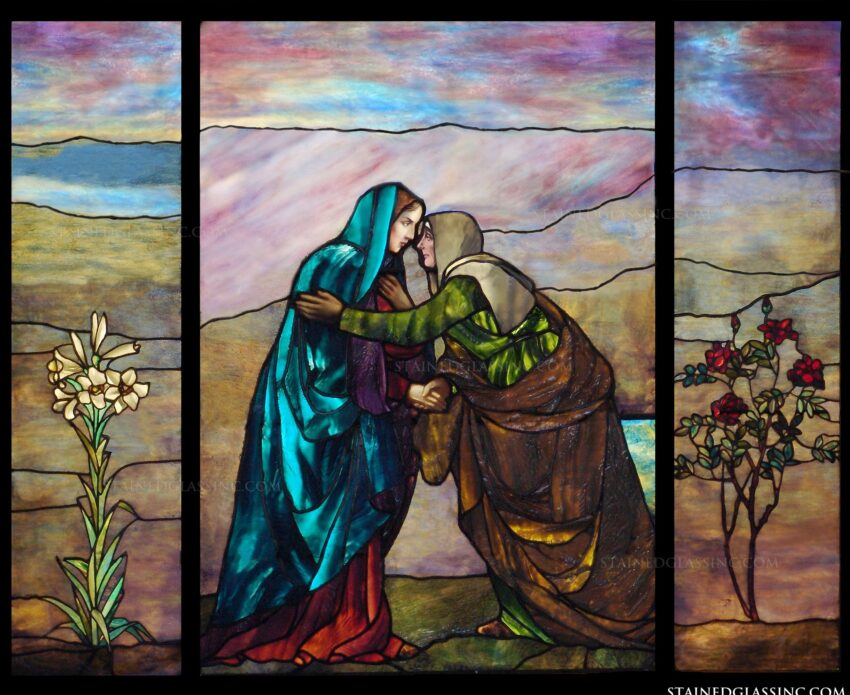
Today, as we bring Advent to a close, we read about Mary’s and Elizabeth’s pregnancies, and about what they and the prophets thought about the kind of person the Messiah would be. Although he came as an infant, he was set to turn the world upside down. God’s emerging into humanity was a profound change for the universe – disruptive, outrageous and exciting. Watch the 18-minute video of today’s message, and let’s be challenged by the readings from Micah 5, Hebrews 10 and Luke 1.
Almighty and everlasting God, whose will it is to restore all things in your well-beloved Son, the King of kings and Lord of lords: Mercifully grant that the peoples of the earth, divided and enslaved by sin, may be freed and brought together under his most gracious rule; who lives and reigns with you and the Holy Spirit, one God, now and forever. Amen.
Christ the King – festival established only in 1925, first celebrated in 1926 – less than 100yr ago
A response to growing secularism and atheism after WWI, & growth of fascism, all of which we see even more today
During a time when secular national leadership was not functioning, it was helpful to remember that Christ is the ultimate King, over all nations. King of kings. Rev: “the ruler of the kings of the earth”
In 1969, Pope Paul changed name to “Our Lord Jesus Christ, King of the Universe”
We still call it ‘Christ the King’
Jesus Christ is our personal Lord and saviour – our king, whose throne is in our hearts
He is also creator of & King over the universe.
He is King over both sacred and secular parts of the world – the church, and the world.
We should not be too afraid to speak his kingliness – He is king!
But while Jesus walked this earth, he kept his kingship hidden until the end of his life. He says to Pilate J18: “You say that I am a king”
He came as a servant, not as a Royal, Monarch, President, Dictator.
“I was born and came into the world to testify to the truth” > God
2 Sam 23:3-4 – God said to David: lead in righteousness = in right relationship with God and with people – a beautiful thing
All too often, standing up for Jesus centres on morality – homosexuality, abortion, marriage, etc
And Pope Pius’ original thinking for this festival was that individuals and states must submit to the rule of the Saviour – “the Empire of Our Lord”. He almost wanted a Theocracy.
But what Jesus stood up for was the poor, the excluded, the marginalised, the vulnerable.
His Good News was one of a social order in which power was flat, and people were cared for, reversal of fortunes.
This is not what we typically think of as ‘kingship’.
He sets for us a model for leadership and power
We lead through service – to work for the best for those whom we lead, even if by sacrifice
We exercise power to protect, not to dominate
Often link CtK to Christ as the Good Shepherd
Servant leadership is the closest model to Jesus’ leadership
To ensure the wellbeing and flourishing of every person under our leadership
To remove obstacles and challenges, so people can move forward unencumbered
To set an example of what we want from them, rather than demanding but not living it
Most Gracious God, who in Jesus of Nazareth showed us an alternative to the kings, queens and emperors of history, help us to revere and emulate Jesus’ leadership: To love, and to seek justice for all people. Help us to recognize the true grandeur and life-changing power based in loving you and all of our neighbors. In Christ Jesus, with you and the Holy Spirit, may we co-create a world ruled not through domination, but in that radical and all-powerful compassion and love. Amen.
We are journeying through Stewardship Month, when we reflect on what God has entrusted to us and how we give back to God from what he has blessed us. Two weeks ago, we focused on the Old Testament principle of tithing (10%) and not withholding from God what is God’s (Leviticus 27:30-34). The tithe is no longer obligatory, under God’s grace, but it remains a good benchmark or point of departure for our giving. Then last Sunday, Rev Ronald focused on the parable of the rich man who hoarded his wealth for his future (Luke 12:13-21). He was called a ‘fool’ by God, for thinking that he had control over his future. Our true security lies in our relationship with God. We are stewards of God’s riches, and we reap what we sow.
On this third week, we focus on New Testament principles of sacrificial giving – a development on the Old Testament principle of tithing. First, Psalm 89 draws our focus to the fact that everything is made by God, comes from God and belongs to God. The psalmist says (v11), “The heavens are yours, and yours also the earth; you founded the world and all that is in it.” We may feel that our possessions are ours, that our salaries are ours, that the assets that we’ve accumulated are ours. But the Psalmist reminds us, as we see throughout the scriptures, that everything belongs to God. This is our first principle (albeit from the First Testament) – everything is God’s, it is just on loan to us.
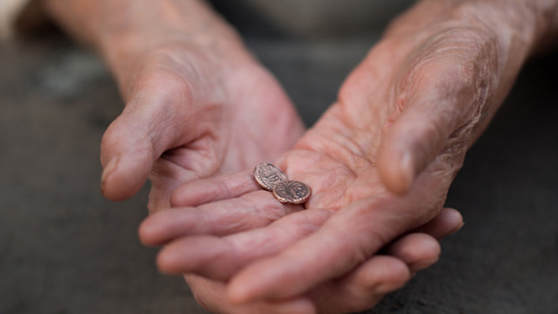
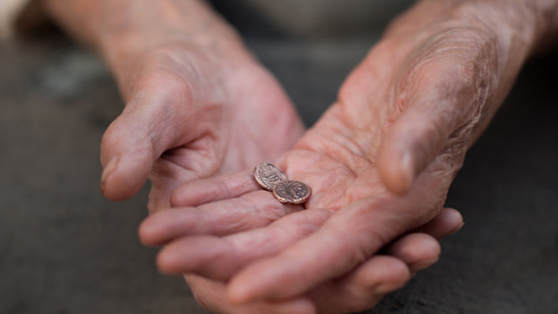
Second, in Luke 21:1-4, Jesus reflects on witnessing an older woman who put a tiny amount of money into the temple offering. Even though her gift was very small, he praised her for giving generously out of the little she had. This echoes the principle of tithing – it is less about the absolute amount that we give and more about the percentage of what we give. This is the second New Testament – give a percentage of your income to God.
The third principle is this: to give to the collective. Acts 4:32-37 tells us about the early church, just after Pentecost. Because they saw what God had done for them, they gave of their wealth to the church. Some even sold land or houses, and gave the proceeds to the church, so that there was enough cash in the church to cover costs and give to those in need. We think of this as an early form of Christian socialism – that you put your giving into the church collective, as a form of redistribution of wealth, the third principle.
The fourth principle comes from 2 Corinthians 8:1-15. Paul cites the church in Macedonia as an example of sacrificial giving. It would be great is St Stephen’s could stand as such an example – and in fact, in previous years we have done just that, such as financially supporting the building of St Timothy’s in the Reeds, and helping all the parishes in our Archdeaconry with finances in 2021, after COVID-19 impacted parishes severely.
Paul notes that the church was going through a “very severe trial” (v2), but even they were generous in their giving. This giving was based on both “their overwhelming joy and their extreme poverty”. Now the joy bit makes sense, right? But the extreme poverty seems out of sync – if we fact extreme poverty, we should give less, right? But in fact the Macedonian church gave more! Paul links back to our second principle – “they gave as much as they were able” (v3) but also highlights that they gave “even beyond their ability”. This is how the Old Testament principle of tithing 10% is transformed into giving even ‘more than we are able’. Paul also notes that they did this “entirely on their own” (v3). Indeed, they even “urgently pleaded” for the “privilege of sharing” (v4).
Paul uses the Macedonian church as an example for the Corinthian church and invites the Corinthians to act like the Macedonians (v7). Now it is important to remember that this was not a command, but rather an invitation (v8). Our giving must come from the sincerity of our love – he complements the Corinthians for being not only the first to give, but also to be the first “to have the desire to do so” (v10). We are not commanded, but invited. He writes, “If the willingness [to give] is there, [then] the gift is acceptable, according to what one has, not according to what one does not have” (v12). So, the fourth principle is giving willingly according to our means.
So here we have four principles that should guide the decisions that we make for 2025 regarding our financial giving:
Everything we have belongs to God.
We should focus on the percentage of our possessions we give, not the actual amount.
We should prioritise giving to the local church.
We should give willingly and eagerly and joyfully, according to our means.
Today is the fifth and last Sunday that we spend in John chapter 6. It has been a long and challenging 5 weeks. Next week, we go back to our journey through Mark’s gospel.
The setting of much of John 6, from after the feeding of the 5000 and Jesus walking on the water, is in a synagogue in Capernaum. In v59 we read, “Jesus said this while teaching the synagogue of Capernaum.” So, where did this teaching start? It started in v26, where, in the two verses before we read, that the crowds “got into the boats and went to Capernaum in search of Jesus. When they found him on the other side of the lake [in Capernaum], they asked him ‘Rabbi, when did you get here?'” and so the long teaching on the bread of life starts. John 6:25-71 all takes place in the synagogue at Capernaum.
This is not coincidental. While we can find Christ anywhere, he chooses to meet us in synagogues, in churches, in the midst of the people of God. We read this in John 18:20, where, before the high priest, Jesus says, “I always taught in the synagogues or at the temple, where all the Jews come together. I said nothing in secret.” Here is Jesus affirming that he consistently taught in the centre of the synagogues, in the midst of God’s people. And in Matthew 18:20, Jesus says, “For when two or three gather in my name, there I am with them” or ‘in the midst of them’. (I have to smile at the similarity between John 18:20 and Matthew 18:20!) And in most Anglican churches, we read the Gospel in the centre of the church, not from the front, because Christ, the Word, is central to the people of God. The Word is in the midst of us.
Christ is our centre, and we congregate around him.
But, Jesus’ word is hard. Last week, we chewed through a difficult passage about eating Jesus’ flesh and drinking his blood. His teaching is challenging and hard to understand. As a result, MANY of his disciples or followers fell away and left. They could not swallow his message. It was easier – so they thought – to move on and find an easier teaching elsewhere.
Jesus seems disappointed and sad at their leaving, because he turns to his 12 disciples, and says to them, rather than asking them, “You don’t want to leave too, do you.” He hopes and trusts that his people will remain with him.
Jesus’ himself says in v63, “The words I have spoken to you – they are full of the Spirit and and of life!” One thinks of God’s Word ringing out in Genesis 1, calling the universe into being through his word. And we think of John 1, “In the beginning was the Word, and the Word was with God, and the Word was God. He was with God in the beginning.” Christ does not merely speak words; he IS The Word!
And the 12 disciples know and understand this, because they have spent so much time sitting with Christ in their midst. And so Peter says, “Lord, to whom shall we go? YOU have the words of eternal life. We have come to believe and to know that you are the Holy One of God.” Jesus, as the Word of God that creates the world and as the Bread that comes down from heaven and gives life to the world, we feast on his word and bread. We hear the Gospel preached and we participate in the Eucharist. It is here, in this church community, that we find divine food, life and hope.
We must remain clustered around the centre, where Christ is. Let us not drift away to the edges, and then slip out into the darkness. We need to remain in the centre, where Christ, our light and life is. We need to remain in the centre and our church friends need to remain in the centre. Let us not drift away. And let us call back those who have. For Jesus has Spirit and Life – away from the centre, we are cold and lost.









 Reflections of God's Love