Click here to listen to this 6-minute message. Or watch the video below. Or read the brief summary below the video.
As we move through the days of Holy Week, the set readings become increasingly somber and serious. We are progressing closer and closer towards Jesus’ death on Good Friday. Today’s reading is John 13:21-32, which tells of Jesus’ betrayal by Judas. In verse 21, John writes,
Jesus was troubled in spirit and testified, “Very truly I tell you, one of you is going to betray me”.
The disciples immediately say to each other, “Surely not I! Who could he be referring to?” Jesus says,
“It is the one to whom I will give this piece of bread when I have dipped it in the dish.”
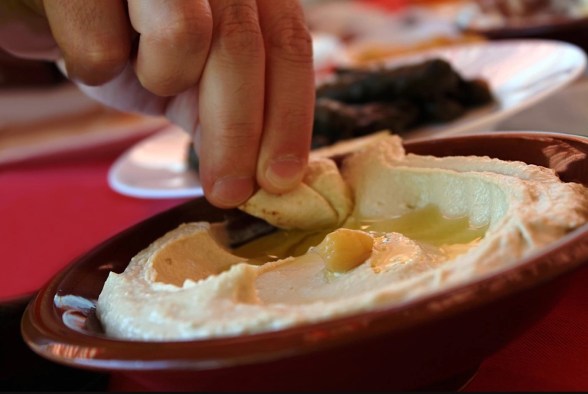
He dips the bread into a dish and hands it to Judas. I imagine Judas, who was indeed planning to betray Jesus, looking at the piece of dipped bread in Jesus’ hand and wondering what to do. I imagine his thoughts racing, prevaricating – do I or don’t I?
He takes the bread from Jesus and eats it. I chooses betrayal. And so, Jesus’ path to the cross is set in motion.
This passage challenges us to recognise that each of us is also complicit in Jesus’ betrayal. Judas acts on behalf of me and of you. Our sin does not have a be dramatic or public; it can include the little things that we do and also the things we neglect to do. We each have helped pave the way to the cross.
We are thus called to repentance during these days of Lent and particularly over the coming few days. Let us pray Psalm 51:
1 Have mercy on me, O God, according to your unfailing love;
according to your great compassion blot out my transgressions.
2 Wash away all my iniquity and cleanse me from my sin.
3 For I know my transgressions, and my sin is always before me.
4 Against you, you only, have I sinned and done what is evil in your sight;
so you are right in your verdict and justified when you judge.
5 Surely I was sinful at birth, sinful from the time my mother conceived me.
6 Yet you desired faithfulness even in the womb; you taught me wisdom in that secret place.
7 Cleanse me with hyssop, and I will be clean; wash me, and I will be whiter than snow.
8 Let me hear joy and gladness; let the bones you have crushed rejoice.
9 Hide your face from my sins and blot out all my iniquity.
10 Create in me a pure heart, O God, and renew a steadfast spirit within me.
11 Do not cast me from your presence or take your Holy Spirit from me.
12 Restore to me the joy of your salvation and grant me a willing spirit, to sustain me.
13 Then I will teach transgressors your ways, so that sinners will turn back to you.
14 Deliver me from the guilt of bloodshed, O God, you who are God my Savior,
and my tongue will sing of your righteousness.
15 Open my lips, Lord, and my mouth will declare your praise.
16 You do not delight in sacrifice, or I would bring it; you do not take pleasure in burnt offerings.
17 My sacrifice, O God, is a broken spirit; a broken and contrite heart you, God, will not despise.
John 12:21 tells us about a group of Greek seekers who come to Philip saying, “Sir, we would like to see Jesus”. And so begins a story of one person introducing another person to Jesus, in a chain of people seeking to see Jesus.
Today is the first Monday in Holy Week. The video below is a very brief (5-minute) reflection on our Gospel reading for today: John 12:1-11. Mary, the sister of Martha and Lazarus, anoints Jesus’ feet with an expensive perfume called Nard. Judas reprimands her for wasting money that should rather be given to the poor. But Jesus speaks up for her saying that she has done a good thing for Jesus, who will be with them for just a little while, while the poor will always be with us. This narrative reminds us of the need for all of us to pour ourselves out for others, like Mary did with her perfume and Jesus did with is life.
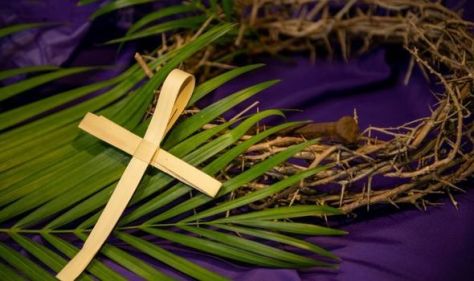
Today is Palm Sunday. Many churches on this day will start their service outside with the blessing of palm crosses and then process around the church or community, shouting or singing: “Hosanna to the Son of David! Blessed is he who comes in the name of the Lord! Hosanna in the highest heaven!” (Matthew 21:1-11). This is commemorate Jesus’ triumphal entry into Jerusalem on the back of donkey or colt and people’s recognition that he is king or messiah.
In today’s message, I suggest three main lessons we can learn from Jesus’ experience of suffering and challenge in life:
Jesus does not rush towards suffering. He does not revel in it. Christianity has tended to glorify suffering, often encouraging people (such as women in abusive marriages) to endure their suffering as their sharing in the suffering of Christ. However, Jesus is not a masochist. He does not relish or rush towards or celebrate suffering. During this passion week, he appears to appreciate the recognition of the crowd as he enters Jerusalem, he enjoys supper with his friends and he spends time in prayer with his Father – he enjoys life. Of course, we do suffer, and some suffer more than others. But Jesus does not appear to enjoy or celebrate suffering.
However, Jesus also does not run away from or avoid suffering. Instead, he moves into difficult places, and in the passion narrative, he walks towards his inevitable suffering and death. Jesus is a realist. He is not naive. He does not avoid difficulty; instead, he faces the truth. And he speaks the truth, challenging injustice, exclusion and poverty. He calls people out when they lie. He champions integrity. He faces the world as it is, without sugar-coating anything.
Yet, Jesus is an idealist. Despite knowing that he will soon die, he continues to believe that God can use his suffering and death for good. He persists in believing that God can redeem humanity and the cosmos. He insists that people can participate in this salvific work of God. He remains steadfastly optimistic, hopeful and confident about the future.
There are many people whose example we can follow during difficult times, including this time of the Coronavirus and the lockdown that many countries are experiencing. I think Jesus provides a good, balanced and sensible example for us. Blessings.
I preached this message on 1 December 2019, the first Sunday in Advent, but did not have a chance at that time to publish it. I thought today would be a good day to post it, given that so many people in South Africa and globally are staying away from church to promote physical distancing during the Coronavirus (COVID-19) crisis. In the recording, I apply the message to Aids and violence against women and against children. But in this blog, I apply it to the Coronavirus.
This message draws on Matthew 24:36-44, where Jesus speaks about That Day when he will return – one day still in the future (as of writing this blog!). Jesus’ teaching in his passage tells us two main things:
First, God does not want us to know when he will return again.
Indeed, he explains that NO-ONE knows. Not even the angels. Not even the Son of Man! If God wanted us to know, God would have told us. Or at very least, God would have told the Son. This means for us:
We need to stop worrying about when he is going to come back and should stop believing people who think they’ve worked out the date.
We need to believe and accept that Jesus WILL return. One day, perhaps not in our lifetime, or perhaps tonight, he will return.
Second, Jesus’ return will be unexpected.
Whenever it is that he returns, we will be caught off guard. Jesus uses the story of Noah and the flood as an example – in those days, life was just going on as usual. There were no signs to warn anyone of the flood, until the day the flood started – then it came unexpectedly. This means for us:
“Therefore, keep watch” – stay awake, be alert – so that when Jesus comes, we will awake to see him.
And keep watch not for the signs, but rather for Jesus himself. It is for Jesus we need to keep a lookout.
Coronavirus
During this time of the Coronavirus – as we watch the death toll rise by the hundreds day by day, and as we experience countries closing borders, hear of people stopping work, see the empty streets – we may think that these are the signs of the end times.
But no! Jesus’ teaching in Matthew 24 clearly indicates that because we might think these are the signs, he will not be coming back now. If we are expecting him to return, he is not returning.
There are many things we may learn from Coronavirus, but it is not about the End Times. Rather, it is about the present times. What may we learn?
We may learn how reversable the negative impact of humanity on the environment might be.
We may learn how important human relationships are, while we have to keep away from each other.
We may recognise the vulnerability of certain groups of people, such as those in precarious employment, older persons and single parents.
We may learn that we are not really in control of the planet and that nature can, if it wants, profoundly disrupt human society.
These are not lessons for the End Times. Rather, they are lessons for the present time and for life after the Coronavirus. Just imagine how stupid we’d have to be to exit the Coronavirus crisis and revert to our former ways of living. How dumb would be? I don’t believe God has sent this virus to punish or teach us. But I do believe God desires us to learn something important from this virus.
The summary of this message:
Live your life in such a way that, when you are surprised by Christ’s return, you will be ready for him!
Lent, which kicks off on Ash Wednesday (26 February this year), is usually associated with fasting, and this, together with prayer and giving to the needy, is the topic of the first half of Matthew 6 (part of Jesus’ Sermon on the Mount). In this passage Jesus differentiates between fasting that is done for public approval and fasting that is done in secret and for God. It is this latter fasting (and prayer and giving to others) that Jesus esteems. It is this fasting, done in secret, that Jesus says “your Father, who sees what is done in secret, will reward you.” And we know that this reward is eternal, in heaven, as this is where Jesus encourages us to store up our treasures.
For those of you who are fasting during this Lent, I encourage you to fast for yourself and for God, and keep your fasting secret and hidden. It is in this fast of the heart that we allow ourselves to experience discomfort and difficulty. And this reminds us of the discomfort and difficulty Jesus faced as he journeyed towards the cross.
Are you wise or foolish?
Are you smart or stupid?
Are you sensible or a moron?
These are the questions Jesus implicitly asks of his followers in Matthew 7:24-27:
24 “Therefore everyone who hears these words of mine and puts them into practice is like a wise woman who built her house on the rock.25 The rain came down, the streams rose, and the winds blew and beat against that house; yet it did not fall, because it had its foundation on the rock.26 But everyone who hears these words of mine and does not put them into practice is like a foolish man who built his house on sand.27 The rain came down, the streams rose, and the winds blew and beat against that house, and it fell with a great crash.”
This passage draws to a close Jesus’ lengthy Sermon on the Mount, which covers the whole of chapters 5, 6 and 7 in Matthew’s version of the Gospel. In his sermon, Jesus covers a wide range of topics about ethical and Godly living in the world, speaking to the hidden inner thoughts of our hearts, to the public actions we display to the world and to the prayers that we offer to God. It is, arguably, a crucial distillation of Jesus’ wisdom teaching.
And at the end of this long sermon, he says (in effect), “All of you who have heard my words? Don’t think that merely hearing them makes you wise or smart or prudent or sensible or thoughtful. No! In fact, you are foolish, stupid or a moron if you hear what I’ve said and don’t act on it. To be wise, is to put what I have said into practice.”
(At this service, we were observing Education Sunday, and after the service people were also invited to sign up to participate in the life of the church – music, tea, men’s fellowship, etc. So, I spend some time applying this point that Jesus makes to those of us who are educators and to all Christians who attend church.)
In short, don’t be stupid!
Personal note: This year year marks my 30th year as a social worker, my 13th year as a university educator, my 3rd year as an Anglican clergy person and my 13th real birthday (I was born on 29 February). A year of threes! I give thanks to God for all of the opportunities God has given me to do God’s work in the world through various intersecting ministries. It has been an amazing journey so far, and I look forward the years ahead. I am at your service, Lord.
This message is a call for us to see and look at Jesus, the Lamb of God. And to point him out others. This was the mission of John the Baptist, and it as much ours today.
We are still in the period of Epiphany, where we focus on the manifestation or revealing of Jesus Christ as the Son of God, as God’s Chosen One. Our reading for this Sunday is John 1:29-37:
29 The next day John saw Jesus coming toward him and said, “Look, the Lamb of God, who takes away the sin of the world!30 This is the one I meant when I said, ‘A man who comes after me has surpassed me because he was before me.’31 I myself did not know him, but the reason I came baptizing with water was that he might be revealed to Israel.”
32 Then John gave this testimony: “I saw the Spirit come down from heaven as a dove and remain on him.33 And I myself did not know him, but the one who sent me to baptize with water told me, ‘The man on whom you see the Spirit come down and remain is the one who will baptize with the Holy Spirit.’34 I have seen and I testify that this is God’s Chosen One [or Son].”
35 The next day John was there again with two of his disciples.36 When he saw Jesus passing by, he said, “Look, the Lamb of God!” 37 When the two disciples heard him say this, they followed Jesus.
Bruner, who has written a wonderful (1200 page) commentary on John, translates some of these verses differently, emphasising the use of present and continuous tenses in the original Greek, notably:
29 The next day John sees Jesus coming toward him, and he says, “Look! The Lamb of the God, the One who is taking away the sin of the world!
36 And John looked intently at Jesus as Jesus is walking by and he says, “Look! The Lamb of God!”
I focus on these two verses in this message, as I have felt God speaking to me particularly insistently this week about verse 29. And I make five points:
John sees Jesus coming and walking towards him. Jesus is always coming towards us, even if we are moving away from him. His trajectory is always in our direction.
Look! John twice says, “Look!”. I like Bruner’s addition of the exclamation mark, as it emphasises that this is a call, an imperative. John wants us to stop drifting through life blindly. Or from being so focused on other things that we don’t notice Christ coming towards us. So he calls out, in excitement, perhaps even in alarm, “Look! Look out!”
Jesus is taking away the sin of the world. This is a pretty packed little sentence:
John speaks about ‘sin‘, not ‘sins’. It is the condition of being sinful that Jesus takes away, rather than the individual sinful acts that we do.
John says that Jesus ‘is taking‘, emphasising that this is a continuous activity, that has already begun, is presently happening and will continue to happen in the future. While Jesus’ death on and resurrection from the cross are surely pivotal in salvation, God has been saving humanity through the Son from the time of the fall, throughout the First Testament, through Jesus’ incarnation, life and ministry, through his death, resurrection and ascension, by the outpouring of Holy Spirit, and continuing to today and into the future. The Son of God has been and continues to be in the business of taking away sin.
It is the sin ‘of the world‘ (the ‘cosmos’) that Jesus takes away, not just the sin of those who repent, those who believe, those who are members of certain churches or religions, those who adhere to certain church rules or doctrine. Scripture abounds with verses that reinforce that salvation is for and of the whole world (the cosmos). It is a radical inclusion of the entire created order – the cosmos!
Salvation is thus possible for all, but we have to take hold of it. That’s why John keeps saying, “Look!”, and why we are told in verse 37 that John’s disciples leave John to follow Jesus. Jesus is the Lamb of God who is taking away the sin of the world. In the Eucharist or Mass, we celebrate and re-member this great work of God the Son.
And finally, we, like John and his disciples, and like Jesus’ disciples (about whose calling we learn in the rest of John 1), are invited to continue John’s ministry of pointing people to Jesus. We remind people that Christ is coming towards them. We call them to ‘Look!’ We point them not to our denomination, our pastors, our worship, ourselves; but towards Christ himself. And we show through our lives, our inclusivity, our radical love and our walking towards others that he is indeed taking away the sins of the world .
Today we celebrate the Feast of the Epiphany (which actually takes place on 6 January tomorrow). ‘Epiphany’ means ‘manifestation’ or ‘revelation’. Something is revealed and made known to us. What is this thing? Let me answer in thee steps.
1. Jesus is the light
Our key reading for today, from Matthew 2:1-12, about the visit of the Magi to the young Jesus, refers repeatedly to the star that the Magi see, interpret and follow. It is a light that they see that reveals the coming of a King, a saviour, and the follow it:
1-2 After Jesus was born in Bethlehem in Judea, during the time of King Herod, Magi from the east came to Jerusalem and asked, “Where is the one who has been born king of the Jews? We saw his star when it rose and have come to worship him.”
7 Then Herod called the Magi secretly and found out from them the exact time the star had appeared.
9-10 After they had heard the king, they went on their way, and the star they had seen when it rose went ahead of them until it stopped over the place where the child was. When they saw the star, they were overjoyed.
John 1:1-9 tells a similar story about John’s cosmology of Christ as the incarnate light:
1-3 In the beginning was the Word, and the Word was with God, and the Word was God. He was with God in the beginning. Through him all things were made; without him nothing was made that has been made.
4-5 In him was life, and that life was the light of all mankind. The lightshines in the darkness, and the darkness has not overcome it.
6-9 There was a man sent from God whose name was John. He came as a witness to testify concerning that light, so that through him all might believe. He himself was not the light; he came only as a witness to the light. The true light that gives light to everyone was coming into the world.
The prophecies of old also speak to the coming of light into the world, as we see in Isaiah 9:2:
2 The people walking in darkness have seen a great light;
on those living in the land of deep darkness a light has dawned.
Simeon, a righteous, devout and Spirit-filled man of God, prophesies similarly over the infant Jesus when he was brought to the temple for a blessing, in Luke 2:29-32:
30-32 “For my eyes have seen your salvation,
which you have prepared in the sight of all nations:
a light for revelation to the Gentiles,
and the glory of your people Israel.”
While all of these references to the light refer to Jesus as the light, Jesus himself refers to us as the light, in Matthew 4:14-16:
14-16 “You are the light of the world. A town built on a hill cannot be hidden. Neither do people light a lamp and put it under a bowl. Instead they put it on its stand, and it gives light to everyone in the house. In the same way, let your light shine before others, that they may see your good deeds and glorify your Father in heaven.”
So, the narrative of Jesus being the Light is compelling. But what does it mean? What is he the light of?
2. Jesus is the light of God
Central to our (Western Church, i.e., Protestant and Catholic) understanding of the Epiphany, is that Jesus is revealed as the Son of God, as the Anointed One, as the Messiah, as God in the flesh. This leads us to the concept of the incarnation, which is foundational to everything we understand of Christ and his work among us. (Click here to listen to a previous message I’ve preached on the incarnation or hereand hereto read reflections on the incarnation and the kenotic U.) The incarnation is the idea that God emptied God’s self, pouring himself out to become smaller and smaller, more and more finite and situated, into a single cell, into an embryo.
For our friends in the Eastern Orthodox churches, however, Epiphany focuses not on the Magi but on the Baptism of Christ, where the revelation is not just about Christ, but about the Trinity: Father, Son and Holy Spirit. So, in essence, Epiphany lead us to a manifestation of the Triune God, made visible in the light that Jesus Christ brings into the darkest of places.
(If you are listening to this message, you might like to watch this video during this section of my sermon. It was playing on the screen while I presented it. Be patient – it takes several seconds before you’ll see anything. And be at peace – it was designed to be a subtle visual cue in the background, not a wildly exciting video.)
So, who is this light for?
3. Jesus is the light of the world
The importance of the Magi is that they were not Jews. They came from a long way away (for those days) – Persia (now Iran) or Yemen (where the ingredients for Frankincense and Myrrh are produced and a conduit of gold from Africa to the Middle East). Wherever they came from, their symbolic significance is that they were Gentiles, and thus represent everyone else who is not part of the ‘inner circle’.
In Jesus time, and even in the early church, this meant those who were not Jewish. The fact that Gentiles were among the first to worship Jesus (let’s not forget the shepherds, who represent rural, blue collar workers) indicates that the Gospel is for them also.
Today this means that the Gospel is for the LGBTQI+ community, for Muslims, Hindus, Buddhists, atheists and agnostics. For the smart and not so smart. For the morally good and for the morally bad. For young and old, black and white, rich and poor. For everyone. No person is excluded from the great project of God to redeem humanity, as we read in many passages of the Bible, e.g.,
God made known to us the mystery of his will according to his good pleasure, which he purposed in Christ,to be put into effect when the times reach their fulfillment—to bring unity to all things in heaven and on earth under Christ. (Ephesians 1:9-10)
In him was life, and that life was the light of all mankind. (John 1:4)
For my eyes have seen your salvation, which you have prepared in the sight of all nations. (Luke 2:30-31)
Jesus certainly did. The closer he got to the cross, the more the leaders of his time circled him, plotted against him, slandered him, entrapped him. By the time Judas became willing to betray him, Jesus had scores of vultures circling him. Our reading for today, from Luke 21:5-19, comes at just this time in his life. In it, Jesus speaks about the future – both the near future of the time of the destruction of the Jewish (second) temple, which would take place about 40 years later in AD70, and the distant eschatological future of the End Times, when Jesus prepares to return. In both times, followers of Christ will suffer persecution. They will be beleaguered.
Even though we are probably not living in the End Times, we as Christians may already have experience of being beleaguered. Sometimes we become beleaguered in our workplace, when we stand up for Kingdom values: integrity, honesty, fairness, justice, inclusion and vulnerability. Or in families, someone who converts from the family’s faith into the Christian faith may be ostracized, even expelled and cut off. Churches are attacked and people at workshop are killed, as in Sri Lanka on Easter Day 2019. Even within the church, people can become beleaguered by leaders who are threatened by their vision, their Spirit-filledness, their willingness to ask for change and their desire for greater inclusion. Much as the church ought to be a place of sanctuary and community, it can become a place of persecution and exclusion.
In Luke 21:5-19, Jesus presents four words of advice – words of wisdom – for those of us in such situations.
Know that God knows. Sometimes, when we are under such pressure, we feel alone and abandoned. But Jesus emphasizes that God knows and is mindful of our situation. In v9 he says, “When you hear of wars and uprisings, do not be frightened. These things must happen first, but the end will not come right away.” In other words, since God knows what is still to come, such as the destruction of the Temple, God also knows your situation. God knows. God cares. God is present. God is in control. Psalm 121 reminds us that “he who watches over you will not slumber; indeed, he who watches over Israel will neither slumber nor sleep.”
Persecution is an opportunity for witness. He says in v13, “And so you will bear testimony to me.” While we are being persecuted and beleaguered, witness might not be uppermost on our minds, but Jesus says that this is the time to embody Kingdom values. But our capacity to witness is not something we do alone – no! He emphasizes that we need not stress about what we will say as witnesses (v14), because “I will give you words and wisdom that none of your adversaries will be able to resist or contradict.” We see such inspiration particularly in the life and death of St Stephen, in Acts 6 and 7.
God protects his own. With God at our side, we have God’s protection: “But not a hair of your head will perish” (v18). Jesus appears to contradict himself here, because just two verses earlier he said, “they will put some of you to death“. We get some clarity about this from another passage that also speaks about the hair on our head, Luke 12:4-7, where he says, “The very hairs of your head are all numbered.” This follows a passage in which Jesus distinguishes between the death of the body and a more permanent death (which he there refers to as being thrown into hell). Jesus wants us to understand that to die does not mean to perish. Our bodies may suffer and even die, but we do not perish – those who are in Christ continue to live in the presence of God. (See my previous sermon on this passage in Luke 12.) So, yes, may may suffer when we are beleaguered and persecuted, but God protects us when it counts most.
We are called to endure. Jesus concludes this passage saying, “Stand firm, and you will win life.” We are called to stand firm, to endure, to persevere, to be resolute, to hold the faith and (in South African idiom) to vasbyt (literally, to bite tightly). Paul says something similar in Ephesians 6:13, “Therefore put on the full armor of God, so that when the day of evil comes, you may be able to stand your ground, and after you have done everything, to stand.” This endurance is more than just standing still; it is about continuing to do God’s work. In Luke 8:15, in the parable about the seeds the fell on different types of ground, Jesus says, “But the seed on good soil stands for those with a noble and good heart, who hear the word, retain it, and by persevering produce a crop.”
Jesus never promises us an easy life, despite what many pastors and churches preach. Indeed, if anything, Jesus promises us that life will be difficult. But he provides us with the reassurance that God knows what we are going through and is present and in control, and that God will protect us, and ultimately whatever happens we will fall into his arms. He calls us to use these opportunities to witness to his values and Kingdom, and he calls us to stand firm and to produce good fruits, not matter what is going on around us.
If you are in such beleaguered circumstances, please know that I do not aim to diminish your suffering – not at all. Rather, I hope to encourage you with the words of Jesus, who suffered much, that God is right there with you and holding you through it all.







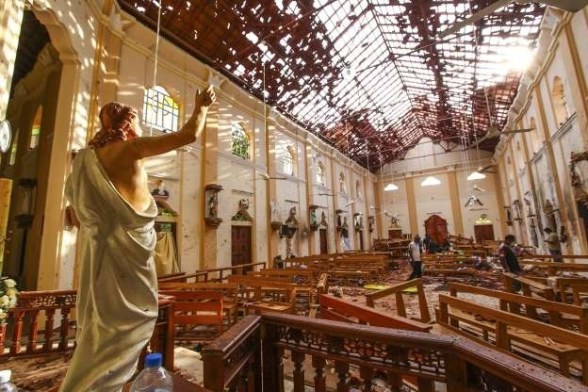
 Featured photo of St. Sebastian’s Church in Negombo, Sri Lanka, which was bombed on Easter Day, 21 April 2019. May the souls of those who died rest in peace in God’s loving embrace. From
  Reflections of God's Love