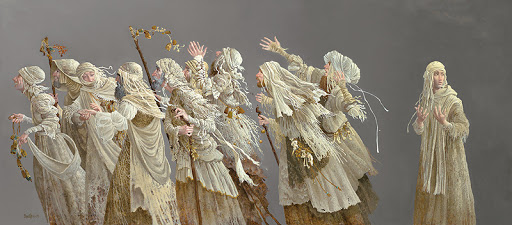
What kind of people are we?

Click here to listen to the audio of this 18-minute message (best sound quality). Or watch the video on Facebook (the sermon starts at 25 minutes). Or read the text summary below.

Today, the central question I am asking is, What kind of people are we?

Or phrased differently, What kind of people ought we to be?

John the Baptist was the last in the line of First Testament prophets. He, like those who came before him, pointed the way to Messiah, the Christ, who appeared as Jesus of Nazareth. Mark 1:1-8 introduces John to us, telling that he came as a messenger in advance of the coming of Jesus, the Son of God, to prepare the way for the Lord.

John did this preparation by preaching a baptism of repentance for the forgiveness of sins. This was his clear message. And instead of pointing to himself or puffing himself up, he continually pointed to the one who was still to come, saying:

After me comes the one more powerful than I, the straps of whose sandals I am not worthy to stoop down and untie. I baptize you with water, but he will baptize you with the Holy Spirit. (Mark 1:7-8)

When John was a new-born, his father Zechariah said much the same about him in Luke 1:67-79. After eight verses about the coming Messiah, Zechariah finally gets to his own son, and in just four verses proclaims his mission:

And you, my child, will be called a prophet of the Most High; for you will go on before the Lord to prepare the way for him, to give his people the knowledge of salvation through the forgiveness of their sins, because of the tender mercy of our God, by which the rising sun will come to us from heaven to shine on those living in darkness and in the shadow of death, to guide our feet into the path of peace. (Luke 1:76-79)

And all of this was prophesied hundreds of years before by Isaiah in chapter 40:1-5. where he says:

Comfort, comfort my people, says your God. Speak tenderly to Jerusalem, and proclaim to her that her hard service has been completed, that her sin has been paid for, that she has received from the LORD’s hand double for all her sins. A voice of one calling: “In the wilderness prepare the way for the LORD; make straight in the desert a highway for our God. Every valley shall be raised up, every mountain and hill made low; the rough ground shall become level, the rugged places a plain. And the glory of the LORD will be revealed, and all people will see it together. For the mouth of the LORD has spoken.” (Isaiah 40:1-5)

All of these passages have this in common:

John prepared the way for the coming of Jesus by preaching repentance, forgiveness and comfort

John came, Jesus followed and John died. And then Jesus died, rose again and ascended to heaven.

We are now waiting for him to return. And while we wait:

We are to prepare the way for the second coming of Jesus by preaching repentance, forgiveness and comfort

So, as we prepare for Jesus’ return, we need to consider who we are pointing to and what message we are proclaiming through our actions and words. In 2 Peter 3:11, Peter asks this penetrating question, “What kind of people ought you to be?” He asks this in the context of second coming of Christ Jesus. Given that he is coming back soon,

What kind of people ought we to be?

We at my parish, St Stephens in Lyttelton, South Africa, are currently conducting a survey among our parishioners about what kind of church we are and what kind of church we aspire to be. One of the questions we asked was, “What qualities, values or characteristics you would like St Stephen’s to embody?” We’re still busy with the survey, but here is what we’ve learned so far:

  • God focus:
    • Focus on God, honour God’s commandments, serve God
    • Prayer, spirituality, faith, hope, wisdom
  • Relational focus:
    • Love, care, kindness, compassion, tolerance
    • Friendliness, companionship, good relationships
    • Sense of community, collaboration
    • Honesty, authenticity
    • Equality for all
    • Family values

These qualities, values or characteristics align well with Paul’s encouragement in Philippians 4:8:

Whatever is true, whatever is noble, whatever is right, whatever is pure, whatever is lovely, whatever is admirable—if anything is excellent or praiseworthy—think about such things.

A church that embodied these kinds of values and qualities would surely be a church people would want to attend, and would surely help to prepare the way for the Lord’s return, and would surely be pleasing to God.

Let us be this kind of church!

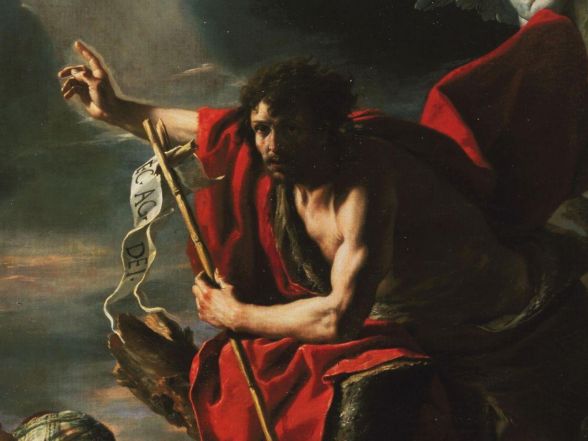
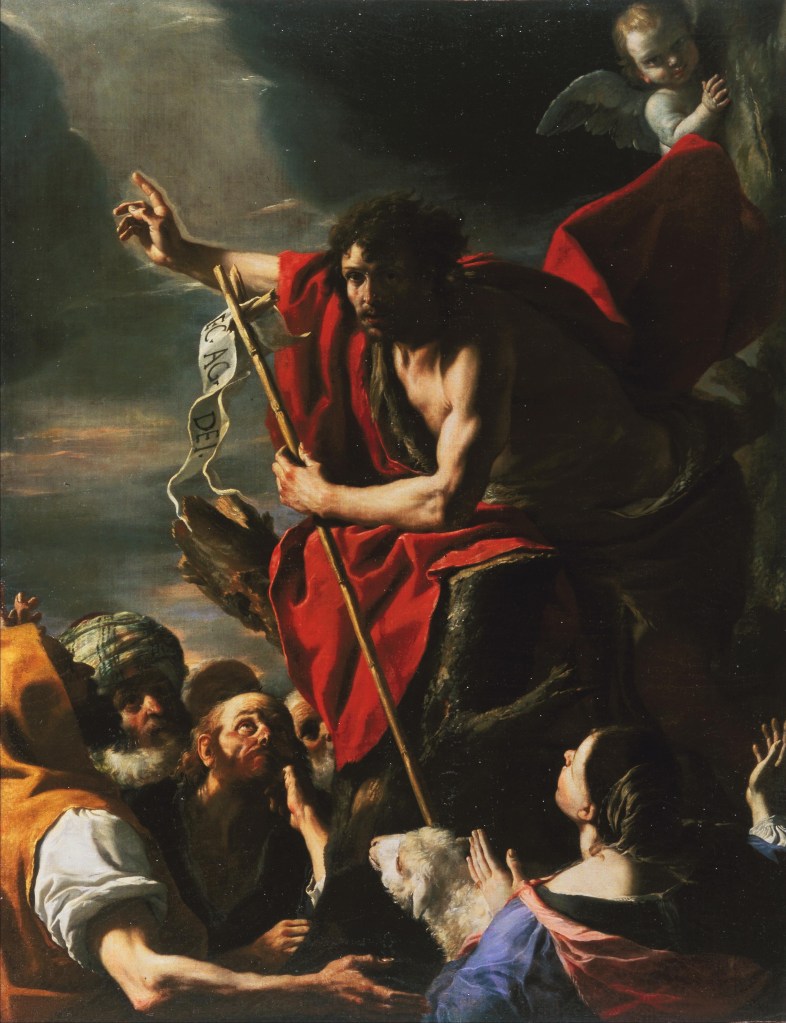
Featured image: St. John the Baptist Preaching, c. 1665, by Mattia Preti

Kindness

Click here to listen to the audio recording of this 9-minute message. Or watch the YouTube video. Or read the text summary afterwards.

We live in a world that seems to be increasingly self-centred, selfish, self-serving, self-obsessed. A world that seems often harsh, intolerant, judgmental, hostile and exclusionary. We are seeing a growth in nationalism – people putting their country’s needs first and subordinating or even rejecting the needs of the global community. Perhaps the world has always been this way. But it seems to me to be a growing trend over the past several years.

What do we as Christians do in such context?

When we want to know how to be behave in the world, the best place to go is to the Gospel narratives, to see how Jesus behaved. And to hear how Jesus spoke – not just his teachings, but what he said to people informally and how he spoke to and engaged with people.

In Matthew 15 we find the story of Jesus feeding the four thousand with a few fish and loaves of bread. The story starts with Jesus healing people of a wide array of afflictions, leaving the crowds amazed. But in the middle of this story is a profound verse that ties the entire story together:

Jesus called his disciples to him and said, “I have compassion for these people; they have already been with me three days and have nothing to eat. I do not want to send them away hungry, or they may collapse on the way.” 

What we see here in Jesus is kindness. He is kind. We could say ‘compassionate’ and that would be correct. But ‘kind’ is a much simpler, shorter word. It is the word a child is likely to use.

If we scan through the pages of the Gospels, we will see more and more examples of Jesus being kind. He is thoughtful, considerate, sensitive, responsive, engaged, attentive, slow, open, willing, touchy, generous. in a word: kind.

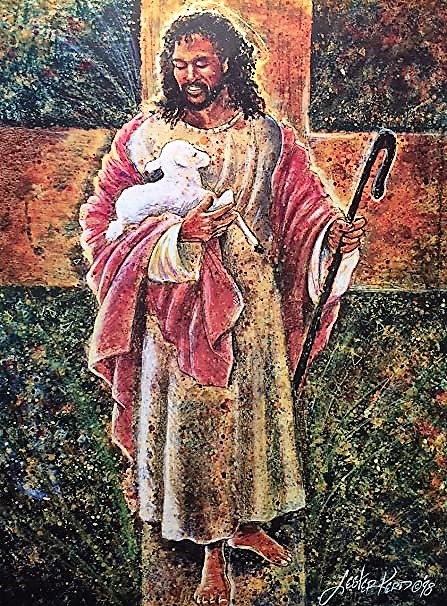
Psalm 23 is also a set reading for today: The Lord is my shepherd. The shepherd also is kind. Indeed, there are numerous passages in the first and second testaments about shepherds who care for and protect their sheep, who seek lost sheep, who bind up and heal injured sheep, who fight off wild animals. These images of shepherding are images of kindness.

Jesus was kind – let us be kind.

Painting by Lester Kern,
from https://www.amazon.com/He-Walks-Me-Religious-Unframed/dp/B011O9Q2MA

Rend the heavens and come down

Click here to listen to the audio recording of this 17-minute message. Or watch the Facebook video (the sermon starts at about 24:30). Or read the text summary that follows below.

Today is the first Sunday in Advent, a season in which we look forward to the coming of Christ into the world – historically 2,000 years ago (which we celebrate at Christmas), in this very moment (Christ is continually coming into the world) and one day in the near or distant future (when Christ comes again). Today we reflect on the last of these – Jesus’ second coming.

Our reading is Isaiah 64:1-9, which opens with these powerful words, “Oh, that you would rend the heavens and come down!” While this sounds like a joyful call for Christ to return, the passage is filled with caution and a call for critical self-reflection.

Let me summarise the flow of thought. Initially, there is a call for Christ to come down, to make the mountains tremble, to set fire to the world, to cause the nations to quake and to make his name known to his enemies. This passage seems to work from the assumption that there are clear enemies of God, and implicitly that we are in the right:

Oh, that you would rend the heavens and come down, that the mountains would tremble before you! As when fire sets twigs ablaze and causes water to boil, come down to make your name known to your enemies and cause the nations to quake before you! For when you did awesome things that we did not expect, you came down, and the mountains trembled before you. (Isaiah 64:1-3)

Second, there is a similarly smug and self-satisfied view that God is inevitably on our side – that we are right, and everyone else is wrong, because we wait for Christ, we gladly do right, and we remember his ways. There is a complacency that we are right and thus God is for us – a complacency that easy slides into arrogance – an arrogance that easily slides into hatred and judgement of everyone else:

Since ancient times no-one has heard, no ear has perceived, no eye has seen any God besides you, who acts on behalf of those who wait for him. You come to the help of those who gladly do right, who remember your ways. (Isaiah 64:4-5a)

But third, it seems that Isaiah pauses and reflects. He becomes self-critical, as he writes, “But…” That ‘but’ initiates a series of recognitions that there is little difference between ‘us’ and ‘them’. He faces up to our continued sin, our uncleanness, that even the best we do is like filthy rags, that we are shrivelled like a leaf, that the wind of our sins will sweep us away, and that we neglect to call on God’s name or to strive towards him. Isaiah recognises that, as a result, God hides his face from us and gives us over to our sin. And so he says, “How then can we be saved?”:

But when we continued to sin against them, you were angry. How then can we be saved? All of us have become like one who is unclean, and all our righteous acts are like filthy rags; we all shrivel up like a leaf, and like the wind our sins sweep us away. No-one calls on your name or strives to lay hold of you; for you have hidden your face from us and have given us over to our sins. (Isaiah 64:5b-7)

And then, out of this stepping down, stepping back, looking within, critically self-reflecting, challenging himself and his religious community, Isaiah comes to some important realisations. He starts the next passage with, “Yet”, signalling that he has recognised something new. He discovers afresh that God is our father and we all are his children. That God is the potter and we are but clay in his hands. That God is merciful and does not store up anger against his children. That God sees us as we pray. And that we all are God’s people, all the work of his hand.

This last line is perhaps the most the important of all – having started by dividing the world into right and wrong, good and bad, saved and lost; and then realising that we also are wrong, bad and lost – he realises that God is for everyone. God desires to save everyone. God longs to reconcile with all of us. And that we can be reconciled only through the work of Christ, not by us being ‘more right’ than anyone else:

Yet you, LORD, are our Father. We are the clay, you are the potter; we are all the work of your hand. Do not be angry beyond measure, LORD; do not remember our sins for ever. Oh, look upon us we pray, for we are all your people. (Isaiah 64:8-9)

As much as we long for Christ to return – for the rending of the heavens and the coming down of Christ – let us recognise that we are little different from anyone else. We are as dependent on Christ for our salvation as anyone else, because we are as sinful as anyone else. That when we become smug about our salvation or about how spiritual or righteous we think we are, we are actually moving away from God, not towards him.

And so let us be cautious, humble, critically self-reflective and watchful. As Jesus says at the end of Mark 13:24-37,

“What I say to you, I say to everyone: ‘Watch!'”

Featured image from https://wp-media.patheos.com/blogs/sites/333/2019/12/aurora-borealis-69221_640.jpg

Turn to Christ’s right

Click here to listen to the audio recording of this 21-minute message. Or click here to watch the video on Facebook (start play at about 18:10 to watch just the sermon).

Today is the Festival of Christ the King – the last Sunday of the church’s annual calendar and the day on which we celebrate Christ as the King of the Universe.

There are numerous passages in the Bible that present Christ as not just a great teacher, healer and prophet, but also as the King of the Kingdom of God, as the King of Universe, as the Cosmic Christ, For example, Matthew 25:31, Ephesians 1:20-22, Philippians 2:9-11 and Colossians 1:15-19.

Our primary readings for today are Matthew 25:31-46 and Ezekiel 34:1-24. Both readings focus on Christ as King – Ezekiel in the form of a prophecy and Matthew in Jesus’ own words about the return of the Son of Man. And both passages tell us the same thing about what Christ will do when he returns:

Christ will separate humanity

Christ will divide us in two groups: those on his right who will inherit eternal life and those on his left who will go away to eternal punishment. This splitting of the world into two distinct groups is hard for us to grasp and accept, but this is what the passages say.

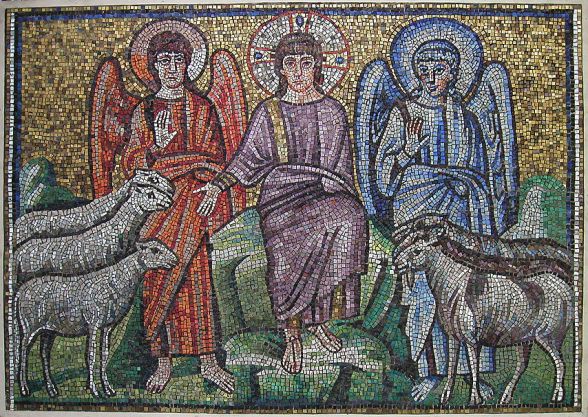
Matthew divides the world into the sheep on Christ’s right and goats on Christ’s left. Ezekiel prophesies two further divisions. First, the sheep on the right and neglectful shepherds on the left. And second, a dividing of the sheep into the lean sheep on the right and the fat sheep on the left.

This separation that the Son of God will create leaves:

  • Sheep (lean/thin sheep) on the right
  • Goats, neglectful shepherds and fat sheep on the left

Surely, we want to be on Christ’s right!

Our passages give us clear, detailed reasons for this separation, which show that we have a great deal of control over which group we may be assigned to in future.

Matthew 25 makes it clear that the division is not based on our belief in Jesus as the Son of God, of our adherence to Christian doctrine, our participation in Church, our tithing, etc. No! Instead, the separation is based on kindness to those who are vulnerable. That’s it. Such a simple thing, it might seem. Just kindness. Compassion. Caring. The sheep who go to the right hand of Christ as those who care for the hungry, the thirsty, the naked, the ill and the imprisoned. Jesus says, “Whatever you did for one of the least of these brothers and sisters of mine, you did for me” (Mat 25:40).

Ezekiel 34’s first separation is the shepherds from the sheep. The shepherds here are the leaders of Israel. In our time, the shepherds are the pastors of the church – ministers, priests, clergy – as well as lay leaders – wardens, councillors, elders, ministry leaders. God’s charge against the shepherds was that they did not take care of their flock. They were neglectful, so that the flocks became vulnerable to wild animals. Even worse, the shepherds were eating the sheep entrusted into their care! Thus the Lord says, “I am against the shepherds and will hold them accountable for my flock” (Ez 34:10). Stated positively, the separation here is based on caring for the flock, specifically by those into whose care the flock has been placed, i.e. church leaders.

And Ezekiel 34’s second separation is a separation within the flock of sheep – the fat from the lean. This is not a commentary on body size! Instead, the fat sheep are those members of a church who inflate themselves at the expense of others. The Lord says, “You [the fat sheep] shove with flank and shoulder, butting all the weak [lean] sheep with your horns until you have driven them away” (Ez 34:21). The separation is based on bullying, criticising and breaking down each other in a church. Stated positively, the separation here is based on caring for each other within the flock.

How then do we turn to Christ’s right?

We as individuals – and we as a church community (for my congregation, it is the parish of St Stephen’s in Lyttelton) – can and should live our lives in such a way that we keep turning to Christ’s right, turning to the right, turning to Christ’s right. And we can do that on a day-to-day basis by showing kindness and compassion to those who are going through hard times, by caring for the God’s people if we hold positions of leadership in the church, and by treating each other kindly within the church community.

It’s kind of simple really!

Keep turning to Christ’s right

Early 20th Century reproduction of a 6th century mosaic, from https://www.metmuseum.org/art/collection/search/466573

Gratitude

Click here to listen to the audio recording of this 10-minute message. Or watch the YouTube video. Or read the text summary below.

Too often in my life, and perhaps in yours also, I ask God for something, but when that prayer is answered, I don’t thank God for it. In part, this is because I don’t notice the change, I don’t see the answer. And in part, it is because I don’t connect my prayer to God’s answer – I see the change as something natural and ordinary.

Luke provides us with a narrative about answered prayer and gratitude in Luke 17:11-19. Ten lepers call out to Jesus for pity or mercy. Jesus says to them, “Go, show yourselves to the priests”. That’s all Jesus says. He doesn’t do anything or saying else. But as the lepers obey Jesus, they are cleansed. Luke writes, “As they went, they were cleansed.”

This ‘as they went’ points to the quiet, unobtrusive actions of God. Miracles can happen as we are going about our everyday life. God’s work is often not dramatic and sensational – it is quiet, ordinary and easy to miss. Indeed, it seems only one of the ten lepers recognised that he had been cleansed: “he saw he was healed”.

This one comes back to Jesus, praising God (loudly), throws himself at Jesus’ feet and gives thanks to him. This one gives thanks! Jesus says to him, “Rise and go; your faith has made you well.” Indeed, his faith and Jesus healing ability had already made him well, while he was walking to the priests.

What, then, was the benefit of gratitude in this man? And what is the benefit of gratitude for us?

Because of his gratitude, this man gets an opportunity that none of the other nine got – to spend time with Jesus, and not at a distance as they were at the start of the story, but right at his feet. He gets to speak with Jesus. He gets some one-on-one time with Jesus.

When we are grateful for God’s work in our lives, we have two opportunities to engage with God: first at the beginning when we ask for God’s help, and then again later on when we give thanks. This double time with Jesus is the greatest gift of all – far greater than the answered prayer that we experienced.

Ten lepers by James C. Christensen, from http://www.greenwichworkshop.com/details/default.asp?p=1969&c=30&a=&t=1&page=2&detailtype=prints

Invitation to the Wedding Banquet

Click here to listen to the audio recording of this 13-minute message. Or watch the sermon on Facebook (sermon starts at 19:26) or read the text summary below.

Matthew 25:1-13 tells the story of 10 young women who were waiting to meet the bridegroom. They all brought their oil lamps with them, knowing it might be a bit of a wait, but only half of them had the sense to bring extra oil. They all fell asleep waiting, but when the groom arrived, they woke up. The five without extra oil realised that their lamps were going to go out soon and asked the ones with extra to share with them. The wise, mean girls said no – go buy yourself some. The girls with the extra oil went into the wedding banquet, but by the time the other girls got back from buying more oil, the door had closed and they were turned away.

This parable – quite strong in its wording – is narrated during the week leading up to Jesus’ crucifixion. Chapters 24 and 25 focus on the end times, and the preceding three chapters have some strongly worded messages. Chapter 22 has another story about a wedding banquet, which ends “Many are invited, but few are chosen” – meaning, few actually will attend the banquet.

Three lessons we can take out of Jesus’ parable:

  1. Come to the banquet! The banquet is the party of parties. The bridegroom is none other than Jesus himself. It is a great celebration and we want to be there! God invites us all to attend – it’s an open and free invitation. We just have to accept the invite and pitch up.
  2. Be prepared! Half the girls came without extra oil. They really didn’t think anything through. They seized the opportunity for the party, but did nothing to get ready for it. We are urged to be prepared for the party, which we can do by pitching into the preparations. We can work in God’s Kingdom. We can exercise our ministry. We can give of our time and money. We can come to church and build the fellowship. In short, we can stewards ourselves, our communion, our things and our world.
  3. Wake up! All the girls fell asleep. Not just the foolish five, but all of them. Indeed, there are several stories of Jesus’ disciples falling asleep: In Luke 9:28-36, the disciples fell asleep before Jesus’ transfiguration; and in Matthew 26:36-46, the disciples repeatedly fell asleep as Jesus prayed in the Garden of Gethsemane. The absence of church during Covid may have made us similarly ‘sleepy’. We are out of the practice of coming to church, participating in worship, fellowship together. We’ve become dozy. It is time to wake up and to build up these muscles again!

Jesus invites us to a fabulous celebration – the wedding banquet. Let’s be sure to be prepared and be awake, so we don’t miss out!

Featured image from http://3.bp.blogspot.com/-R3zlsxfJV1E/TqtbWlWSagI/AAAAAAAAAKg/l3_WDC3LuDs/s320/parable-of-the-banquet.jpg

Stewarding our world

Click here to listen to the audio version of this 12-minute message. Or watch the YouTube video below. Or read the text summary that follows.

Father almighty
we offer ourselves to you as a living sacrifice in Jesus Christ our Lord.
Send us out into the world in the power of the Holy Spirit
To live and work to your praise and glory.

We end each Eucharist service with this prayer. It is the endpoint of the entire service of communion. We do come to be filled, restored and healed; we do come to worship and praise God; we do come for fellowship; we do come to learn; and we do come to celebrate the Eucharist. But the purpose of all of this is to equip and fill us to go out into the world and serve the Lord.

The church is a refuelling station, in which we are filled up and restored, so that we can go out and do God’s work in the world.

Today is the fourth and last Sunday in our stewardship programme.

  1. In the first week, we considered stewarding ourselves;
  2. then stewarding our communion (our church fellowship);
  3. and last week, stewarding our things, particularly our money.
  4. Today, we reflect on what it means to steward the world.

Genesis 2 presents the narrative of God’s creation of humanity. God then placed the man he had created in the Garden of Eden and commissioned him to ‘tend and care for it’; that is, to steward the world. We continue to carry this commission.

Stewarding the world includes a focus on the planet – the earth itself – with all its natural resources: the sky, the oceans, the water, the land, the minerals, the renewable and non-renewable energy resources. We are commissioned to take care of the earth (and indeed the cosmos) – not to exploit, plunder, rape and destroy. ‘Tend and care’ are gentle, kind, caring, nurturing words, to describe the relationship we ought to have to the world around us.

In addition, stewarding the world includes a focus on its people – on all of humankind – regardless of anything (religion, race, gender, politics, nationality, sexual orientation, gender identity, age, disability, and so on). We are to be Christ’s presence among humanity – his hands, his feet, his eyes, his mouth, his heart (as Saint Teresa of Ávila may have written – see video below). It is unfortunate that many Christians see their Christ-like presence in the world as reduced just to fighting against two issues: human sexuality and abortion. While these are important topics to engage, Jesus’ own presence in the world focused pervasively on fighting for love, kindness, justice, inclusion. To steward the people of this world is to imitate Christ’s engagement with humankind.

Appropriately, today is All Saints Day, the day on which we commemorate and celebrate the lives of the saints. My church is named after St Stephen, who is described in Acts 6-7. Carrying his name, we in our parish are invited to adopt Stephen as a model or example for our lives. Stephen was a young deacon, whose ministry lasted less than a year. A deacon is a servant, who works out in the community, helping the poor and marginalised. Stephen is described as being “full of faith and of the Holy Spirit”. He was a bold preacher, delivering the longest sermon in the book of Acts. It resulted in his murder, at the age of 29. As he died, his last words were to forgive those who stoned him.

Stephen is a shining example of stewarding the world. He was a servant to the people of God and to people seeking God.

Let us each take up our own role, in our own place, in our own way, using our own Spirit-given gifts, to love and serve the world.

Go in peace to love and serve the Lord
In the name of Christ.
Amen

Painting of the saints by Fra Angelico (in the 1400s) from https://en.wikipedia.org/wiki/All_Saints%27_Day
https://www.youtube.com/watch?v=w7ymxW3rndk

Eternal perspective

Click here to listen to the audio of this 11-minute message. Or watch the YouTube video below. Or read the text summary after that.

The ‘reversal of fortunes‘ is one of the central themes in Luke’s Gospel of Christ. The reversal involves a switching around of power and privilege in society. We think of Mary’s, “He has brought down rulers from their thrones but has lifted up the humble” and, “he has filled the hungry with goo things but has sent the rich away empty” from Mary’s song in Luke 1:46-55. And of Jesus’ manifesto in Luke 4:16-21 (though the reversal is less clear), where he says, “he has anointed me to proclaim good news to the poor. He has sent me to proclaim freedom for the prisoners and recovery of sight for the blind, to set the oppressed free.” And Jesus’ famous, “There are those who are last who will be first, and first who will be last” in Luke 13:30. Indeed, there are numerous examples in Luke’s Gospel.

But this reversal of fortunes is demonstrated most unequivocally and powerfully in Jesus’ death and subsequent resurrection in Luke 22-24. When all seems lost – when the worst imaginable outcome occurs – we still remember Jesus’ words that he would rise on the third day. And indeed he does! What was intended as an annihilation of the Son of God and indeed of God’s entire plan for the salvation of humankind, turns into the absolute accomplishment of that plan!

Thanks be to God for the reversal of fortunes!

Our reading for today is Luke 6:20-21:

Looking at his disciples, he said:

Blessed are you who are poor,
for yours is the kingdom of God.
Blessed are you who hunger now,
for you will be satisfied.
Blessed are you who weep now,
for you will laugh.

We see again the reversal of fortunes in this passage (mirrored in the woes that Jesus proclaims in Luke 6:24-25 a couple of verses later):

  • Poor > yours is the Kingdom of God
  • Hunger > satisfied
  • Weep > laugh

But what is additionally striking in this passage is the emphasis on time. Particularly in the second and third blessings, Jesus contrasts ‘now’ with the future “you will”. This suggests that what is true now, will not be true for always. While in the first sentence, the phrases are both in the present tense – “are” and “is” – which suggests that the future improvement to our lot can be tasted now already.

It seems that there is folding in of time in Jesus’ understanding of human life. Past, present and future are not as differentiated for God as they are for us humans. For God – being outside of time and space – past, present and future all co-exist. But for us – being bound within time and space – Jesus’ message here is that the reversal of fortune – from struggle to contentment – is something sure and guaranteed that we can look forward to, and even enjoy in moments right now.

All of this points us towards adopting an eternal perspective in which we are encouraged to look at the world and our life circumstance, not just as it is right now, but as it is within the context of out eternal existence. This life, with its challenges and troubles, is not all there is. Indeed, this physical life is but a blink in the life we can continue to enjoy in the presence of God for eternity.

And much can change between now and then. The reversal of fortunes principle continues to emphasise that God will set right what is wrong in the world. And that whatever suffering or oppression or poverty we experience at this time, will not last forever. It will switch. God will set all things right.

As we continue through our stewardship programme, and particularly this week as reflect on how we steward our things and especially our money, let us hold this eternal perspective and the reversal of fortunes in mind. What we do now, has an impact on the future. Our giving of our hearts to Christ now will bring a return on investment, sooner or later. Giving generously now may be uncomfortable, but will repeat rewards that are greatly to be desired.

Featured image from https://latterdaysaintinsights.byu.edu/en/divine-discontent-an-invitation-to-improve/

Our Father

Click here to listen to the audio recording of this 10-minute message. Or watch the YouTube video below, or read the text summary thereafter.

Luke 11:1-4 presents us the brief, well-known passage about Jesus teaching his disciples to pray using an earlier form of the Lord’s Prayer. He says,

When you pray, say,
‘Father…’

I’m stopping at this first word, because it represents a profound revelation and revolution in our understanding of God. In the First Testament of the Hebrew people, God was regarded as all powerful, fearsome, remote, almost terrifying. God was seldom referred to as ‘Father’, except when he was spoken of as being, for example, the Father of Abraham, Isaac and Jacob, or the Father of Israel. And God refers to himself as a father in a handful of passages. But people never prayed to or spoke to him directly as ‘Father’.

Jesus, by contrasts, shows himself engaging with God as his personal father, in an intimate, authentic, comfortable, loving way. In his prayers, he calls God ‘Father’. He reveals God in a new light – as approachable, caring, accessible. And he shows that God is interested in our daily lives, in the little things we experience and also in the big challenges we face.

And so, when he teaches his disciples how to pray, his first word is ‘Father’. We could almost stop just there with the Lord’s Prayer because that on its own is a radical transformation of our relationship with God. A one-word prayer – “Father” – is a great prayer!

Not everyone has good associations with ‘father’, however. Some of us have been abused by our fathers, abandoned by them, treated harshly by them. Some don’t know our fathers. Some would never share anything personal with our fathers. So, thinking of God as our ‘father’ might not be meaningful or helpful to everyone; indeed, it might raise a host of painful memories and feelings.

But let us remember that God is not a man and not an actual biological father. Rather, Jesus refers to God as father to reflect a relationship that for him was meaningful. We could think of God as parent (which is often how I refer to God in public prayer) or as mother or caregiver. And let us also consider that there could be healing for our woundedness when we experience a heavenly parent who is consistent, fair, engaged, loving, kind, protective, empowering and sincere, particularly if we have not experienced this with our human parents.

I encourage you today to enter into a more intimate and honest engagement with God in your prayers – both in your formal prayers when you sit down for the purpose of praying or saying a daily office, and in your informal prayers, muttered to God as you drive or worry about something or are grateful for something. God desires to have a parental relationship with us, in which we can rest in his arms and tell him everything that is on our heart, without fear or hesitation.

And so we pray:

Our father in heaven
hallowed be your name
your kingdom come
your will be done on earth as in heaven.
Give us today our daily bread.
Forgive us our sins, as we forgive those who sin against us.
Save us from the time of trial and deliver us from evil.
For the kingdom, the power, and glory are yours
now and for ever. Amen

Featured image from https://valourdigest.com/7-things-a-son-needs-from-his-father/

Relying on Christ

Click here to listen to the audio recording of this 8-minute message. Or watch the YouTube message below, or read the short text summary thereafter.

In Philippians 3:4b-15a, Paul shares his own experience of faith and in so doing holds up a mirror for us to reflect thoughtfully on our experience of faith. So often our faith gets caught up with our human activity – all the things we do to express our faith – prayer, giving, righteousness, attending church and so on.

But Paul says these things are comparatively worthless (garbage!) compared to faith that is reliant on Christ. Paul is not saying that we should abandon such things, but that by comparison with a faith that relies entirely on Christ, these things should not be central.

This passage is one of a few where Paul really opens his heart to us and shares his own faith journey, and so rather than preaching for long on the passage, I encourage you primarily to read, hear and digest the inspired words of the Apostle Paul.

Featured image from https://za.pinterest.com/pin/117938083965411553/