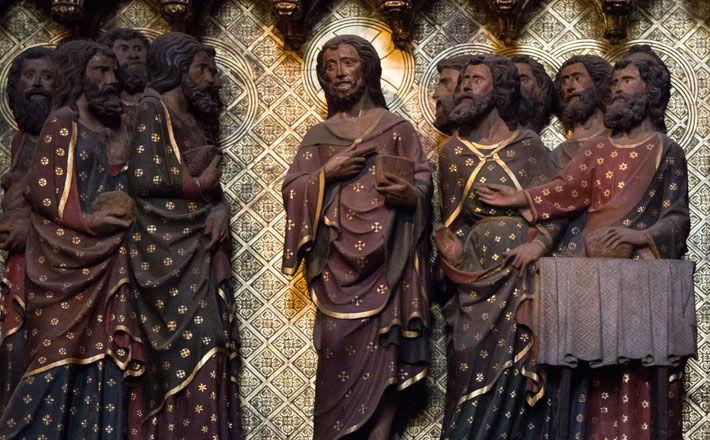
In John 10:11-18, Jesus strives to convey to us the depth of his love for and connection with us, and his desire and expectation that we should love one another. This passage is part of a larger set of “I am” statements related to Jesus being a shepherd – the good shepherd. Central to this message is this:
Jesus knows you. Jesus loves you.
I encourage you to hear these words and to take them to heart. In our service, I gave each person a paperclip, and asked them hold and fiddle with it during the sermon. A paperclip is used to hold things together, and today’s message is about Jesus holding us to himself and to each other.
Twice, Jesus says that he is the good shepherd – not just a shepherd, but the good shepherd (vv 11 & 14)
Jesus emphasises, “I know my sheep”. We are not merely a mass of sheep in a large flock. He knows each one of us. Indeed, Jesus says that he knows us and we know him “just as the Father knows me and I know the Father” (vv 14-15).
Four times, Jesus says that he lays down his life for his sheep – for you (vv 11, 15, 17 & 18). This points to the extravagance and not-withholding nature of Jesus love. Indeed John says (in 1 John 3:16): “This is how we know what love is: Jesus Christ laid down his life for us.”
It is hard to ignore these words of affirmation and extravagant love from Jesus. His love for you is immeasurable.
In the middle of this passage, Jesus says something a little different (v16):
I have other sheep that are not of this sheepfold. I must bring them also. They too will listen to my voice, and there shall be one flock and one shepherd.
Outside of this verse, there is a sense that Jesus loves only me. But v16 suggests not only that Jesus loves you, but also that he loves completely different groups from you. And the words, “I must bring them also”, are extremely strong in the Greek, conveying the sense that, “I absolutely have to bring them also”.
We should also note the sequence that Jesus presents: [In the present] I have other sheep [and now] I must bring them [and then in the future] they too will listen to my voice [and then after that] there shall be one flock with one shepherd. While these sheep do not yet know Jesus’ voice, Jesus still regards them as “his sheep” (“I have other sheep…”), and he loves them.
Who might these ‘other sheep’ be? The possibility that Jesus engages other groups outside of our group, outside of our congregation, outside of our denomination and even outside of the Christian faith, is tantalizing. But even if we do not go that far, think of those in your group, in your flock, that you dislike, those you think are not living an adequate Christian life, those you think are not adequately committed, those you think don’t believe correctly, those you think should rather leave your group.
Perhaps these people are sheep in Jesus’ other sheepfold. If so, Jesus loves them just as he loves you. And who are we not to love them, since Jesus loves them? Every sheep is loved by Jesus. And he is the Good Shepherd, who brings them into his fold. And so should we.
In Luke 24:13-35, we have the story of the two disciples who are walking to Emmaus and who encounter a stranger, who we later learn is the resurrected Jesus. They did not recognise him, despite having a long conversation. It was only as they sat down for a meal that “their eyes were opened and they recognised him” (v31), and immediately Jesus disappeared. They saw Jesus, but they did not recognise him.
In our reading set for today (Luke 24:36-48), Jesus meets the disciples in a room, and although they see him and recognise him, they do not believe him. They have moved a little further than the previous two disciples, but they have not moved to a place of belief or faith: seeing is not always believing. In response, Jesus – patient as ever with the disciples’ slowness – presents a series of evidence to prove to them that he is indeed risen from the dead and not a ghost:
v38 – Jesus asks why they are troubled and why they doubt. He confronts their lack of belief and faith. But still they do not believe.
v39-40 – Jesus invited them to look, to touch, to see. He shows them his hands and his feet, so they can get physical evidence of his wounded body. But still they do not believe.
v41-43 – So Jesus asks if they have any fish. Not because he is hungry, but to prove that he is not a ghost, but a physical being, who can eat food. But still they do not believe.
44-47 – So Jesus tells them about the scriptures – the Law of Moses, the Prophets and the Psalms – which all prophecy everything that has happened to Jesus. But still they do not believe.
48 – So Jesus reminds them that they are first-hand witnesses of everything that Jesus did – healings, forgiveness, raising people from the dead – they saw a lot and they themselves did some of these miracles in his name. But still they do not believe.
50-51 – And then, finally, he blesses them and ascends in front of them up into heaven.
And then they believed! They worshipped him and returned to Jerusalem with great joy.
Sjoe, they were really SLOW! Slow to recognise him. Slow to believe in him. Slow to put their faith in him.
Perhaps we also are slow. Perhaps we also fail to recognise Jesus’ actions in our lives and in the lives of those around us. Or perhaps we see them, but don’t believe them. Or we believe them, but we don’t put our faith in him. In the recording of the sermon I share an experience of my own slowness to believe, to illustrate my own slowness.
Fortunately – thanks be to God – Jesus is supremely patient. And he is willing to provide us with evidence and to persuade us (this also is part of my testimony in the recording). I encourage you, therefore, to make a choice to see God’s hand at work in your life. To accept that it may be possible – even likely – that God is present with you, even when you don’t perceive God. That God is working in you, even when you don’t recognise that. That God loves you, even when you may feel unloved.
Today’s message is about second-hand faith, meaning faith that rests on other people’s experiences of God, rather than on our own. 1 John 1: 1-4 presents such a faith. John emphasises his and the other disciples’ first-hand experience of Jesus, using words like see, looked, appeared, heard and touched a total of nine times in just a few verses. And he concludes by saying that we must believe him, and through believing him, who knows God, we get close to God. We are given a second-hand faith. Most of us don’t want a second-hand faith! We want our own, first-hand faith!
John 20:19-25 has a similar narrative. The disciples – minus Judas, who was not there – have a first-hand encounter with the risen Christ, who shows them his hands and his side. When Thomas joins them later, they say, “We have seen the Lord!” and expect that Thomas will be satisfied with this second-hand account. But Thomas says, “Unless I see the nail marks in his hands and put my finger where the nails were, and put my hand into his side, I will not believe.” Thomas wants simply what everyone wants – he wants to know first-hand that Jesus is risen. He wants to see and to touch. And Jesus meets this need.
We also want a first-hand faith. We want to know for sure and for ourselves that Jesus exists. We want to see him. We want to touch him. Where can we get such first-hand experiences? Three places: (1) We get them from the Scripture, where we read first-hand accounts of others and have confidence that their testimony is true. We can tag these accounts for future reference. (2) We rely on what others in our community tell us about God’s grace and working, and have confidence that their testimony is true. We can tag these accounts also for future reference.
(3) And we rely on our own experiences of God working in our own lives. We may not have many such experiences of our own, and they may not be particularly spectacular. But they are first-hand – they are OUR experiences and we KNOW them. These are the experiences we need to recover and treasure. We can tag them, because they are our first-hand encounters with God. They are the touchstones or reference points that we turn to when our faith gets shaky.
Today, we focus on the Decalogue, or Ten Commandments, from Exodus 20:1-17. In the church where I became a Christian, a reformed evangelical church, we had the Decalogue up on the walls at the front of the church – they were presented as the most important verses of Scripture and central to our faith.
Four of the commands are about our relationship with God – essentially, it is supposed to be an exclusive relationship (“no other Gods but me”) – a 100% commitment to God, to Yahweh. And six of the commands are about our relationships with people – essentially, they are supposed to be ethical relationships – we are to treat people well.
In the First Testament, the Decalogue was written on stone tablets, but the very finger of God. But the later prophets, Ezekiel (11:19 & 36:26) and Jeremiah (31:33), wrote about having hearts of flesh instead of hearts of stone, and of God writing God’s law on our hearts.
We see this fleshy version of the Decalogue most powerfully in Christ’s incarnation – God come to dwell among us in human form. And Jesus, when asked about the Decalogue, distills them into just two: Love God and love your neighbour. These align well with what I wrote about – to be exclusive with God and ethical with people. But what is particularly emphasised in Jesus’ summary, and not obvious from the Decalogue, is love. (In Exodus 20, love appears only in verse 6, as an explanation of God’s jealous love for God’s people.)
If I were still at the church where I became a Christian, I’d be advocating for removing the Decalogue – the First Covenant Law – and replacing it with Jesus’ Great Commandment – the distillation of the Second Covenant, which is rooted in freedom and love.
That brings us to our gospel reading for today (John 2:13-22), where Jesus clears out the template. In Matthew, Mark and Luke, this story is narrated during Holy Week, on or after Palm Sunday, and as being the trigger for Jesus’ arrest and crucifixion. It is the culmination of Jesus’ offensiveness to the Jewish priests and leaders. But in John’s gospel, it comes as Jesus’ second act, right at the start of his ministry – following immediately on the wedding at Cana. The wedding story, with its extravagant and exceptional wine, is a story of freedom, generosity and abundance – the abundant life that John writes about so much. While the clearing of the template story is about God’s demand for our exclusivity and ethics.
Here, at the start of his ministry, Jesus acts out the requirements of the Great Commandment. Firstly, God’s house is being used in unholy ways. The things of God (the animal sacrifices) are being sold and bought. There is no place for such unGodly things in the very house of God. The exclusive relationship with God that is required by the Decalogue and by the Great Commandment, is being violated. And in addition, the people – the worshippers – are being exploited, having to pay to exchange currencies, to purchase animals for sacrifice. This is not ethical, not loving.
Jesus clears the template as a demonstration of the Great Commandment – Love God, Love your neighbour!
These standards that Jesus sets for us are impossibly high. I, certainly, fail again and again at these two seemingly simple commands. I stray from my exclusive relationship with God, and I fail to love others as myself.
Thanks be to God, Jesus bridges the gap between the high ideals and our broken efforts. He connects us to God, and his faithfulness transcends our fickleness. He strength transcends our frailty. He maintains the bond of fellowship between us and God and each other, even when we inevitably fail.
And so, as we continue our pilgrimage through Lent, let us continue to turn back to Jesus, and recommit ourselves to the Great Commandment: love God, love others or be exclusive with God and ethical with others.
The transfiguration of Christ, which is reported in Mark 9 (our reading for today), Matthew 17 and Luke 9 (all with very similar content), is a remarkable story. I wish I had been there with Peter, James and John, to see this for myself! What a beautiful and transcendent experience. And also how terrifying and mind bending. No wonder the disciples were rendered virtually unconscious. We read this passage every year and get a sermon on it every year. What more can be said?
This year, I spent time reading the texts on either side of the transfiguration narrative, and found that these passages also were congruent across the synoptic Gospels (Matthew, Mark and Luke). What struck me the most was how difficult and dark these passages were. The transfiguration is just a brief moment of light – brilliant, blinding, cosmic light – within a much darker narrative.
Before the transfiguration, we read about Peter declaring Jesus to be the Messiah (v29), Jesus telling the disciples that he will soon be killed (v31), Peter rebuking Jesus for saying this (v32), Jesus rebuking Peter and uttering these dreadful words – “Get behind me Satan!” (v33, reported also in Matthew, but not Luke) and Jesus explaining the cost of discipleship and the way of the cross (v34). Wow, dark material indeed!
After the transfiguration, the dark material continues. Jesus and the three disciples find a major argument going on among the people because the disciples were unable to cast out a demon (v18), Jesus gets angry asking, “You unbelieving generation, how long shall I stay with you?” (v19) (or “how long must I put up with you?” in Matthew). And then Jesus repeats his message that he will soon be killed (v31).
These passages before and after the transfiguration are in such stark contrast with the transfiguration itself. In the midst of dark, difficult, conflictual narrative is this brief blinding moment of Christ’s glory as God the Son. But it is so short lived – the three disciples come crashing back into a challenging world.
This contrast reminds me of our Palm Sunday services in our (Anglican) tradition. We start our service outside in red, with crosses and candles and incense and palm branches, shouting “Hosanna! Blessed is he who comes in the name of the Lord!”, processing around the church and into the road singing “All glory, laud and honour!” Such an exciting and happy time. And then our reading for the day is the whole of the passion narrative (from the last supper to Jesus’ burial). This contrast in tone (from joy to despair) is stark and shocking.
We ought not to think that we are promised a happy joyful, prosperous, wealthy, healthy life, even though some churches do teach this. We do not find it in the scriptures – it is not in the life of Jesus, it is not in Jesus’ teachings and it is not in the transfiguration narrative. Instead, we are invited to grapple with faith, discipleship, health, death, effectiveness and power. And within this real but difficult life, there are moments of light, joy and peace.
This is not to say that we should wallow in depression or succumb to despair and hopelessness. No! Certainly not! Rather, we need to face and confront depression, despair, hopelessness and all the other challenges we face in life. We walk in faith, trusting in God’s abiding presence, even in the darkness. We call on him for life, for salvation, and to offer thanks. We journey through the challenges of life, knowing that God is on our side.
To help us with this, I encourage you to read Psalm 116. And if life is sitting heavily on you, I encourage you read it multiple times each day, as a prayer for protection and God’s sustaining presence. Here it is:
1 I love the Lord, for he heard my voice; he heard my cry for mercy. 2 Because he turned his ear to me, I will call on him as long as I live.
3 The cords of death entangled me, the anguish of the grave came over me; I was overcome by distress and sorrow. 4 Then I called on the name of the Lord: “Lord, save me!”
5 The Lord is gracious and righteous; our God is full of compassion. 6 The Lord protects the unwary; when I was brought low, he saved me.
7 Return to your rest, my soul, for the Lord has been good to you.
8 For you, Lord, have delivered me from death, my eyes from tears, my feet from stumbling, 9 that I may walk before the Lord in the land of the living.
10 I trusted in the Lord when I said, “I am greatly afflicted”; 11 in my alarm I said, “Everyone is a liar.”
12 What shall I return to the Lord for all his goodness to me?
13 I will lift up the cup of salvation and call on the name of the Lord. 14 I will fulfill my vows to the Lord in the presence of all his people.
15 Precious in the sight of the Lord is the death of his faithful servants. 16 Truly I am your servant, Lord; I serve you just as my mother did; you have freed me from my chains.
17 I will sacrifice a thank offering to you and call on the name of the Lord. 18 I will fulfill my vows to the Lord in the presence of all his people, 19 in the courts of the house of the Lord— in your midst, Jerusalem.
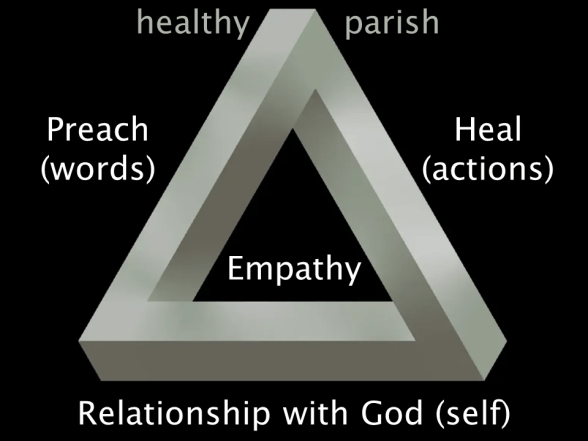
This sermon (preached a week ago on 4 February 2024) is about a healthy parish – what makes for healthy parish life. It emerges, in part, in light of various churches failing to uphold core values around clergy integrity and sexual relations. A model for a healthy church is presented, based on the readings that were set for today in the Revised Common Lectionary, viz. Isaiah 40:21-31, Psalm 147:1-11, 1 Corinthians 9:6-23 and Mark 1:29-39.
Jesus is always our model for everything to do with Christian living, including corporate or collective Christian living – the church. This model is influenced by the readings above and also by how Jesus lived his life, related to God and people, and exercised his ministry.
1. Personal relationship with God
The foundation of a healthy church – and the foundation the triangle above – is each member’s personal relationship with God. Our collective well-being rests on the aggregate of each individual person’s health relationship with God. In Mark 1:35, Jesus leaves his ministry to spend time in his personal relationship with God – he does so repeatedly, even though there are so many people waiting for his healing ministry and teaching. If a personal relationship with God is important to Jesus – who is God, the second person of the Holy Trinity – how much more important should it be to each of us.
When you fly on an airplane, you will be told that, in the event of cabin decompression, oxygen masks will drop down from above your seat. And you will be told to put your OWN mask on FIRST, before helping others (including your children). This is an apt illustration of the need for each of us to see to our personal relationship with God. I, as priest, must ensure the robustness and depth of my relationship with God.
2. Preach words
In 1 Cor 9:16-18, Paul refers to his preaching as central and as God-given. In Mark 1:38-39, Jesus says he needs to go to other villages to “preach there also”. He goes on to say, “That is why I have come”. Preaching words is important to build people’s faith.
But for a health church, I suggest we translate preaching as our words. Too often our words are harsh, judgmental, critical and gossipy. Such words break down, alienate, diminish and harm. There is no place for such words in a healthy church.
Our words should heal and create. Psalm 147:4 says, God “determines the number of stars and calls them each by name”, while Isaiah 40:26 reiterates, “Lift up your eyes and look to the heavens: who created all these? He who brings out the starry host one by one and calls forth each of them by name. … not one of them is missing”. These verses indicate how the words of God bring stars into being, as he names and calls them. Similarly, our words – whether good or bad – can call things into being.
Therefore, our words should be deliberately encouraging, edifying, building up, loving. Last year, we spent the whole of Lent reflecting on Jesus’ command to “love one another”, where we teased this out in detail.
3. Heal through actions
Mark 1:29-34 and 39 say, “…[Jesus] went to her, took her hand and helped her us. The fever left her … Jesus healed many who had various diseases. He also drove out many demons … So he travelled throughout Galilee … driving out demons.” Isaiah 40:29-31 says, “He gives strength to the weary and increases the power of the weak. Even youths grow tired and weary, and young men stumble and fall, but those who hope in the Lord will renew their strength. They will soar on wings like eagles; they will run and not grow weary, they will walk and not be faint.” Psalm 147: 2-3, 8-9, says, “The Lord builds up Jerusalem; the gathers the exiles of Israel. He heals the broken-hearted and binds up their wounds. … He covers the sky with clouds; he supplies the earth with rain and makes grass grow on the hills. He provides food for the cattle and for the young ravens when they call.”
These words are all of healing actions. How we behave impacts the health of a church. When we exclude, abandon or just do nothing, we harm the church. We break it down and weaken it. Rather, we should engage in actions that build up a health community. We can do this by simply showing up, instead of being absent. And through simple acts, like cooking a family a meal when they’re going through a hard time, giving someone a call or sending them a message, helping to clean up. In our tradition, we share the peace during the service – we can make sure we greet all the people around us, instead of rushing off to chat with our friends and ignoring a visitor.
4. Empathy
I have placed ’empathy’ at the centre of the graphic of a healthy church, even though the word ’empathy’ does not appear in the Bible. But the concept is there, for example in 1 Corinthians 9:19-23, Paul writes:
19 Though I am free and belong to no one, I have made myself a slave to everyone, to win as many as possible. 20 To the Jews I became like a Jew, to win the Jews. To those under the law I became like one under the law (though I myself am not under the law), so as to win those under the law. 21 To those not having the law I became like one not having the law (though I am not free from God’s law but am under Christ’s law), so as to win those not having the law. 22 To the weak I became weak, to win the weak. I have become all things to all people so that by all possible means I might save some. 23 I do all this for the sake of the gospel, that I may share in its blessings.
Here Paul steps into the shoes of others, in order to understand them from inside, in order to share the Gospel in a way that makes sense to them. This effort to feel with others is core to empathy.
We see this profoundly in Jesus. Until Jesus was conceived, God had no first-hand understanding of what being human was like. God was not a man, and didn’t have personal experience of being human. But when Jesus incarnated in Mary’s womb and was born like any other human, God got a first-hand experience of being human – God discovered empathy for the human condition.
Too often, however, we jump to negative conclusions, without first exercising empathy. We assume the worst of people, rather than considering other less judgmental reasons for their behaviour. For example, if we don’t see someone for a few weeks we assume they have lost their faith or reneged on their responsibilities, when in fact they might be ill. Instead, let us rather assume the best – if we’re going to make an factless assumption, let’s make a positive one rather than a negative one, until the facts suggest otherwise.
A church that is grounded in personal relationships with God, that speak and act in ways that build up and encourage, and that chooses to empathise with each other, is likely to be a healthy community. This is the kind of community or body that God desires for us. It takes some effort on each person’s part. Working together, we can build a healthy church centred on God.
This message is not so much a sermon, but rather a ‘talk’, about mental health. It emerges from Mark 1:21-28, where Jesus exorcises a demon and makes a ‘madman’ well. In Jesus’ time, most manifestations of psychological problems would have been interpreted in spiritual terms – a demon was at work. Today, there would be a tendency to define those same manifestations as psychosis, using psychiatric, medical terminology. Perhaps both have some truth.
The human has long been understood as a tripartite being, comprising body, mind (or soul) and spirit. This implies a sense separateness within a person, where these three parts operate separately:
But rather, these three parts are closely interacting, with the body and mind influencing each other, the mind and the spirit influencing each other, and the spirit and the body influencing each other – far more integrated and whole, something like this:
However, despite this integration, when someone presents with a physical (body) problem, like cancer or diabetes, we’d all cluster around and support that person. But if they present with depression, or anxiety or schizophrenia, we would tend avoid them, to speculate, to judge, to question their faith, and so on. We generally treat psychological problems differently from physical problems, even though they are interconnected. Psychological challenges tend to be stigmatised, even today.
The interconnection or integration I’m talking about is nicely illustrated in the Greek word sózó, which means both healing and salvation. In our New Testament English translations, most of the words ‘heal’ and ‘save’ are the same in the Greek. To be spiritually saved is tantamount to being physically (or psychologically) healed. For example, the woman who had been bleeding for years (Luke 8:43-48) was sózó – she was both healed and saved, and she was also restored into a harmonious place within her society (which stigmatised menstrual blood). Many English translations say she was was ‘made whole’ – that’s a good translation!
At this point in my message, I related my own experiences with depression, brought on a combination of genetic and environmental factors, that had me in psychotherapy for many years, on antidepressant medication for several years, and in a psychiatric hospital for a month. I am not going to type this up here. It is in the recording, and I’d rather you hear my story verbally than in writing. It is not essential to this message, but it does provide a first-hand account of mental illness, and recovery, and continual working on maintaining my mental health – I think of myself as a depressive in remission. This starts at about 27 minutes into the video recording and about 6 minutes into the audio.
In my recovery, two books were very meaningful to me, and might be to you:
I hope that this talk about mental health and my personal sharing about my own depression will be helpful to you in a few ways:
I hope this helps to destigmatise mental illness, because although I have had quite severe mental illness through many years of my life, I have also done quite well in life and feel that my life is good and meaningful. If you find yourself struggling with mental illness or struggle, I hope you will be less judgmental towards yourself and your symptoms, and more open and kind to yourself. And similarly towards others.
I hope this helps you become more self-aware and to self-care more. Jesus commands us to love God and to love our neighbour as you love yourself (Matthew 22:39). This last phrase is not a commandment, as such. There is a tendency among Bible scholars to assume that all people love themselves, even too much. But in my practice, many do not love themselves; people suffer from low self-esteem and even self-loathing. We should love ourselves more – like putting on the oxygen masks in the aeroplane before you help others.
I hope this helps you to pray and read the Bible more. These practices are about creating space for God to be present in us, and for us to experience God’s presence. John writes about the desire that we should experience life, and life abundantly (John 10:10)! Psalm 23 speaks of a table, a feast, prepared for us.
I hope this encourages you to seek help when you are suffering from mental health challenges. You can do this by asking your priest or minister for prayer and anointing – this part of the contribution that the church can offer you, in line with James 5:14-16. You can do this also by seeking therapy from a psychologist or clinical social worker. And you can to this by seeking medication from your GP or a psychiatrist.
I ended this talk with a 2-minute prayer for those who have listened to this message, and I encourage you to listen to or watch this prayer. It start a little after 47 minutes into the video and a little before 27 minutes into the audio recording.
Mary, the mother of Jesus, had a difficult start to her pregnancy – she was young (probably about 13) and unmarried (only betrothed). Many of us may have become parents in less than ideal circumstances, and so we can feel with her the challenges she faced, when the angel Gabriel comes and informs her that she will become the mother of Son of God (Luke 1:26-38).
In reflecting on this well-known passage, three things stand out for me afresh:
First, Mary had a community of people around her, who loved and supported her. First, Joseph, the man (probably a boy, really, aged perhaps 14 or 15) who she was engaged to. He could so easily have spurned her, but instead, he remains steadfast at her side and protects her from judgmental neighbours. He was accepting, loving and faithful in ways that are quite extraordinary. Although we know little about Joseph, he sounds like a great father.
In addition, Mary’s aunt, Elizabeth, and her husband Zechariah. They were very old and Elizabeth had not borne a child. They too were vital sources of support for Mary, and in the following passage we read about Mary’s visit to Elizabeth.
This human community of support is important for all of us. We all need people in our orbit who care, love, accept, cherish, nourish, empower, advocate, challenge and enable. We need this at home, and we need it in the church.
Second, Mary did not go from ‘zero to hero’ in one leap. She was ‘greatly troubled’ by Gabriel’s message, so much so that the angel had to reassure her: Do not be afraid, Mary. And after Gabriel’s pitch to her, Mary asks questions of Gabriel, “How will this be since I am a virgin?” Gabriel is fully willing to engage her uncertainty, her fear, her incredulity and her questions.
This is in contrast to Gabriel’s response to Zechariah, who in v18 says something similar to Gabriel: “How can I be sure of this? I am an old man and my white is well on in years.” Zechariah’s words are not unlike Mary’s, but Gabriel responds strongly, asserting his authority, and silencing Zechariah until after John’s birth.
After some discussion with Gabriel, Mary come to a place of acceptance, or rather of acquiescence, “I am the Lord’s servant. May your word to me be fulfilled.” I have selected the word ‘acquiescence’ because I think it best captures Mary’s initial response. Acquiescence can be defined as “the reluctant acceptance of something without protest.” It is almost a resignation, similar to the Arabic “Inshallah”, which means “if God wills”, and implies that if God wills, it will happen whether we want it to or not. We surrender to God’s will.
We need also to learn to hear God’s voice speaking into our lives, to engage with God about God’s will, and to make decisions to acquiesce to God’s will. In other words, to trust in God.
Third, this passage shows forth a long-held principle (dating back to Genesis 1) of God choosing to partner with humans. Almost always there is a co-working between God and people to accomplish God’s aims. In this passage (v31), we get a series of things Mary will do: You will conceive. You will give birth to a son. You are to call him Jesus. And (v32-33), we get a series of things God will do: Jesus will be great, Jesus will be called the Son of the Most High, God will give him the throne of his father David, Jesus will reign over Jacob’s descendants for ever, Jesus’ kingdom will never end.
This plan that Gabriel brings to Mary involves a partnership between Mary and God. Without the partnership, the plan is impossible. And so it is with much of God’s work in the world – God chooses to limit God’s self by working with imperfect and limited human beings. This is God’s modus operandi.
In conclusion, let us follow Mary’s example, and that of Joseph, Elizabeth and Zechariah, and partnering with each other and with God, to accomplish those things that God desires in this world.
The Annunciation, fresco by Fra Angelico, 1438–45, San Marco, Florence
Today (Sunday 10 December) is the Second Sunday in Advent, a season in which we remember and celebrate Christ’s first coming into the work and prepare ourselves for his second coming into the world.
Two key themes emerge from our readings: repentance and redemption.
Central to our preparation for Christ’s coming is repentance of sin:
Mark 1 speaks of John’s ministry of a call to prepare for Christ’s coming, to a baptism of repentance of sin, and to confession,
Isaiah 40 speaks of the sins of the people of Israel,
Psalm 85 refers to our iniquity and sin, and warns us of God’s wrath and anger, and
2 Peter 3 calls us to repentance and warns of the possibility of us perishing.
Repentance is an important part of our lives as followers of Christ. The Greek word for repentance means to turn around – a 180 degree about turn. In repentance, we turn away from sin and towards God. It is a reorientation of ourselves in relation to God and sin. This is the most important work we can do during Advent, as we prepare for Christ.
Repentance leads to restoration. Through repentance, we are stored into our fellowship with God and experience the blessings of God in our lives:
Mark 1 speaks of John’s baptism of repentance leading to God’s forgiveness of our sins,
Isaiah 40 uses the most wonderful language, starting with “comfort, comfort my people”, tenderly, our hard service is complete, sin is paid for, valleys will be raised up and mountains made low, rough ground becomes levels and rugged places a plain, we all (humans) will see God’s glory and restoration, and God will tenderly gather, carry and lead us,
Psalm 85 says that God will restore us again and revive is again, That we will be together in righteousness and peace, that righteousness and peace will kiss, that faithfulness will spring up while righteousness will look down, and that God will give us what is good, and
2 Peter 3 speaks of God’s patience with us, of a new heaven and earth, of us becoming spotless, blameless and at peace with God, and that God’s patience means our salvation.
These wonderful words of restoration are the fruit of repentance. As we turn 180 degrees away from sin and towards God, something most of us have to do daily (even hourly or minutely!), God forgives and restores. This is the great gift of God’s son – Jesus comes into our world to forgive and restore.
Today’s reading is Matthew 20:1-16. It is the story about a landowner who hires people to work in his field, starting from early in the morning (perhaps 5am) until 5pm in the evening. He promises the first a denarius – a generous day’s wage; and he promises the later workers a ‘fair’ wage. He comes out himself even late in the day and asks people why they are standing around doing nothing, and they say, because no-one has hired them, and so he hires them, knowing that humans were created to work – God’s first commands to Adam and Eve are to work in the garden and take care of the earth. This is the first grace: we are invited to work with God.
Evening comes and the landowner calls the workers together and pays everyone the same – a denarius. The workers who started early are understandably unhappy. But this is not a story about labour and economics. It is a story about grace. God’s grace is abundantly given to all of us, whether we start early or late, whether we do much or little. Think of the thief on the cross beside Jesus in Luke 23 – he could do nothing on that cross, yet he entered into Christ’s paradise. The landowner asks the disgruntled workers if they are envious that he is generous – do you envy my grace? Grace if fundamentally unfair. This is the second grace: we ALL get what we do NOT deserve.
Fix your eyes on Jesus. Be amazed by grace.
Just last night, my wife Trina shared with me this video of ‘Amazing Grace’ sung differently by Dan Vasc. It fits so perfectly, I cannot help but conclude it was God’s prompting.






 Reflections of God's Love