Decalogue

Click here to listen to the audio recording of this 16-minute message. Or watch the video here on Facebook (the message starts 24 minutes into the recording). Or read the text summary below.

Today, we focus on the Decalogue, or Ten Commandments, from Exodus 20:1-17. In the church where I became a Christian, a reformed evangelical church, we had the Decalogue up on the walls at the front of the church – they were presented as the most important verses of Scripture and central to our faith.

Four of the commands are about our relationship with God – essentially, it is supposed to be an exclusive relationship (“no other Gods but me”) – a 100% commitment to God, to Yahweh. And six of the commands are about our relationships with people – essentially, they are supposed to be ethical relationships – we are to treat people well.

In the First Testament, the Decalogue was written on stone tablets, but the very finger of God. But the later prophets, Ezekiel (11:19 & 36:26) and Jeremiah (31:33), wrote about having hearts of flesh instead of hearts of stone, and of God writing God’s law on our hearts.

We see this fleshy version of the Decalogue most powerfully in Christ’s incarnation – God come to dwell among us in human form. And Jesus, when asked about the Decalogue, distills them into just two: Love God and love your neighbour. These align well with what I wrote about – to be exclusive with God and ethical with people. But what is particularly emphasised in Jesus’ summary, and not obvious from the Decalogue, is love. (In Exodus 20, love appears only in verse 6, as an explanation of God’s jealous love for God’s people.)

If I were still at the church where I became a Christian, I’d be advocating for removing the Decalogue – the First Covenant Law – and replacing it with Jesus’ Great Commandment – the distillation of the Second Covenant, which is rooted in freedom and love.

That brings us to our gospel reading for today (John 2:13-22), where Jesus clears out the template. In Matthew, Mark and Luke, this story is narrated during Holy Week, on or after Palm Sunday, and as being the trigger for Jesus’ arrest and crucifixion. It is the culmination of Jesus’ offensiveness to the Jewish priests and leaders. But in John’s gospel, it comes as Jesus’ second act, right at the start of his ministry – following immediately on the wedding at Cana. The wedding story, with its extravagant and exceptional wine, is a story of freedom, generosity and abundance – the abundant life that John writes about so much. While the clearing of the template story is about God’s demand for our exclusivity and ethics.

Here, at the start of his ministry, Jesus acts out the requirements of the Great Commandment. Firstly, God’s house is being used in unholy ways. The things of God (the animal sacrifices) are being sold and bought. There is no place for such unGodly things in the very house of God. The exclusive relationship with God that is required by the Decalogue and by the Great Commandment, is being violated. And in addition, the people – the worshippers – are being exploited, having to pay to exchange currencies, to purchase animals for sacrifice. This is not ethical, not loving.

Jesus clears the template as a demonstration of the Great Commandment – Love God, Love your neighbour!

These standards that Jesus sets for us are impossibly high. I, certainly, fail again and again at these two seemingly simple commands. I stray from my exclusive relationship with God, and I fail to love others as myself.

Thanks be to God, Jesus bridges the gap between the high ideals and our broken efforts. He connects us to God, and his faithfulness transcends our fickleness. He strength transcends our frailty. He maintains the bond of fellowship between us and God and each other, even when we inevitably fail.

And so, as we continue our pilgrimage through Lent, let us continue to turn back to Jesus, and recommit ourselves to the Great Commandment: love God, love others or be exclusive with God and ethical with others.

Picture downloaded from https://www.thecatholictelegraph.com/wp-content/uploads/2018/06/ten-commandments.jpg
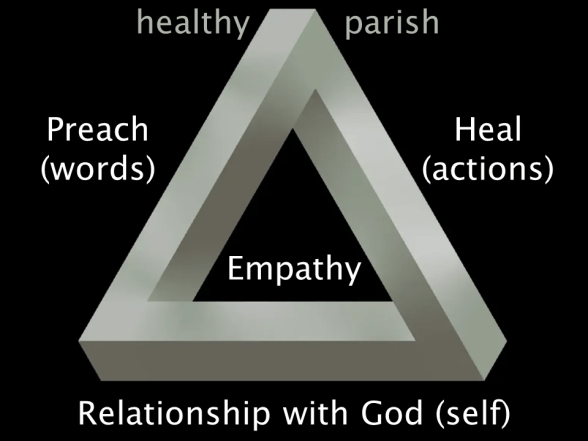
Healthy church

Click here to listen to the audio recording of this 30-minute message (yes, again a bit longer than usual). Or watch the video here on Facebook (the message starts 24 minutes into the recording). Or read the text summary below.

This sermon (preached a week ago on 4 February 2024) is about a healthy parish – what makes for healthy parish life. It emerges, in part, in light of various churches failing to uphold core values around clergy integrity and sexual relations. A model for a healthy church is presented, based on the readings that were set for today in the Revised Common Lectionary, viz. Isaiah 40:21-31, Psalm 147:1-11, 1 Corinthians 9:6-23 and Mark 1:29-39.

Jesus is always our model for everything to do with Christian living, including corporate or collective Christian living – the church. This model is influenced by the readings above and also by how Jesus lived his life, related to God and people, and exercised his ministry.

1. Personal relationship with God

The foundation of a healthy church – and the foundation the triangle above – is each member’s personal relationship with God. Our collective well-being rests on the aggregate of each individual person’s health relationship with God. In Mark 1:35, Jesus leaves his ministry to spend time in his personal relationship with God – he does so repeatedly, even though there are so many people waiting for his healing ministry and teaching. If a personal relationship with God is important to Jesus – who is God, the second person of the Holy Trinity – how much more important should it be to each of us.

When you fly on an airplane, you will be told that, in the event of cabin decompression, oxygen masks will drop down from above your seat. And you will be told to put your OWN mask on FIRST, before helping others (including your children). This is an apt illustration of the need for each of us to see to our personal relationship with God. I, as priest, must ensure the robustness and depth of my relationship with God.

2. Preach words

In 1 Cor 9:16-18, Paul refers to his preaching as central and as God-given. In Mark 1:38-39, Jesus says he needs to go to other villages to “preach there also”. He goes on to say, “That is why I have come”. Preaching words is important to build people’s faith.

But for a health church, I suggest we translate preaching as our words. Too often our words are harsh, judgmental, critical and gossipy. Such words break down, alienate, diminish and harm. There is no place for such words in a healthy church.

Our words should heal and create. Psalm 147:4 says, God “determines the number of stars and calls them each by name”, while Isaiah 40:26 reiterates, “Lift up your eyes and look to the heavens: who created all these? He who brings out the starry host one by one and calls forth each of them by name. … not one of them is missing”. These verses indicate how the words of God bring stars into being, as he names and calls them. Similarly, our words – whether good or bad – can call things into being.

Therefore, our words should be deliberately encouraging, edifying, building up, loving. Last year, we spent the whole of Lent reflecting on Jesus’ command to “love one another”, where we teased this out in detail.

3. Heal through actions

Mark 1:29-34 and 39 say, “…[Jesus] went to her, took her hand and helped her us. The fever left her … Jesus healed many who had various diseases. He also drove out many demons … So he travelled throughout Galilee … driving out demons.” Isaiah 40:29-31 says, “He gives strength to the weary and increases the power of the weak. Even youths grow tired and weary, and young men stumble and fall, but those who hope in the Lord will renew their strength. They will soar on wings like eagles; they will run and not grow weary, they will walk and not be faint.” Psalm 147: 2-3, 8-9, says, “The Lord builds up Jerusalem; the gathers the exiles of Israel. He heals the broken-hearted and binds up their wounds. … He covers the sky with clouds; he supplies the earth with rain and makes grass grow on the hills. He provides food for the cattle and for the young ravens when they call.”

These words are all of healing actions. How we behave impacts the health of a church. When we exclude, abandon or just do nothing, we harm the church. We break it down and weaken it. Rather, we should engage in actions that build up a health community. We can do this by simply showing up, instead of being absent. And through simple acts, like cooking a family a meal when they’re going through a hard time, giving someone a call or sending them a message, helping to clean up. In our tradition, we share the peace during the service – we can make sure we greet all the people around us, instead of rushing off to chat with our friends and ignoring a visitor.

4. Empathy

I have placed ’empathy’ at the centre of the graphic of a healthy church, even though the word ’empathy’ does not appear in the Bible. But the concept is there, for example in 1 Corinthians 9:19-23, Paul writes:

19 Though I am free and belong to no one, I have made myself a slave to everyone, to win as many as possible. 20 To the Jews I became like a Jew, to win the Jews. To those under the law I became like one under the law (though I myself am not under the law), so as to win those under the law. 21 To those not having the law I became like one not having the law (though I am not free from God’s law but am under Christ’s law), so as to win those not having the law. 22 To the weak I became weak, to win the weak. I have become all things to all people so that by all possible means I might save some. 23 I do all this for the sake of the gospel, that I may share in its blessings.

Here Paul steps into the shoes of others, in order to understand them from inside, in order to share the Gospel in a way that makes sense to them. This effort to feel with others is core to empathy.

We see this profoundly in Jesus. Until Jesus was conceived, God had no first-hand understanding of what being human was like. God was not a man, and didn’t have personal experience of being human. But when Jesus incarnated in Mary’s womb and was born like any other human, God got a first-hand experience of being human – God discovered empathy for the human condition.

Too often, however, we jump to negative conclusions, without first exercising empathy. We assume the worst of people, rather than considering other less judgmental reasons for their behaviour. For example, if we don’t see someone for a few weeks we assume they have lost their faith or reneged on their responsibilities, when in fact they might be ill. Instead, let us rather assume the best – if we’re going to make an factless assumption, let’s make a positive one rather than a negative one, until the facts suggest otherwise.

A church that is grounded in personal relationships with God, that speak and act in ways that build up and encourage, and that chooses to empathise with each other, is likely to be a healthy community. This is the kind of community or body that God desires for us. It takes some effort on each person’s part. Working together, we can build a healthy church centred on God.

Grace amazing

Today’s reading is Matthew 20:1-16. It is the story about a landowner who hires people to work in his field, starting from early in the morning (perhaps 5am) until 5pm in the evening. He promises the first a denarius – a generous day’s wage; and he promises the later workers a ‘fair’ wage. He comes out himself even late in the day and asks people why they are standing around doing nothing, and they say, because no-one has hired them, and so he hires them, knowing that humans were created to work – God’s first commands to Adam and Eve are to work in the garden and take care of the earth. This is the first grace: we are invited to work with God.

Evening comes and the landowner calls the workers together and pays everyone the same – a denarius. The workers who started early are understandably unhappy. But this is not a story about labour and economics. It is a story about grace. God’s grace is abundantly given to all of us, whether we start early or late, whether we do much or little. Think of the thief on the cross beside Jesus in Luke 23 – he could do nothing on that cross, yet he entered into Christ’s paradise. The landowner asks the disgruntled workers if they are envious that he is generous – do you envy my grace? Grace if fundamentally unfair. This is the second grace: we ALL get what we do NOT deserve.

Fix your eyes on Jesus. Be amazed by grace.

Just last night, my wife Trina shared with me this video of ‘Amazing Grace’ sung differently by Dan Vasc. It fits so perfectly, I cannot help but conclude it was God’s prompting.

Eternal consequences of care

Today’s Gospel reading is from Matthew 18:15-20. It speaks about Jesus’ call for us to be engaged with one another, and particularly about church discipline. But in this short 7-minute message, I invite a focus on two key points.

First, that Jesus wants us to be meaningfully engaged with each other in the church and to speak into each other’s lives. In other words, to care about each other.

Second, that what we do in this life has eternal consequences. Our caring engagement with others can bind them in ongoing sin or difficulties, or loose them through forgiveness and reconciliation.

We are urged to engage with one another, to be honest with one another and to pray for and with one another. I hope you will find this short message both encouraging and challenging.

(This video was recorded just outside my front door in Boone, North Carolina, with the mountain “Howards Knob” in the background. This message originally went out on 16 August 2023.)

Following the new wine

Click here to watch the video of this 28-minute message on Facebook (the message starts about 29 minutes into the recording). Note that this is an active sermon – worth watching, rather than just reading. I don’t have an audio recording of this message. Or read the text summary below.

Matthew 9 tells the story of Jesus calling Matthew: “As Jesus went on from there, he saw a man named Matthew sitting at the tax collector’s booth. “Follow me,” he told him, and Matthew got up and followed him.” And Genesis 12 tells the story of God calling Abram: “Go from your country, your people and your father’s household to the land I will show you.” Go! Follow me! These calls have nuclear power to move people – Matthew got up and followed Jesus, Abram packed and moved into the unknown.

Jesus is calling you and me today – Follow me! Go! – but to where? Where do we go? Where do we follow?

Matthew 9:16-17 gives us invaluable insights into what Jesus calls us to, in the metaphor of new wine in new wineskins:

“No one sews a patch of unshrunk cloth on an old garment, for the patch will pull away from the garment, making the tear worse. Neither do people pour new wine into old wineskins. If they do, the skins will burst; the wine will run out and the wineskins will be ruined. No, they pour new wine into new wineskins, and both are preserved.”

Although the metaphor is a bit obscure, at very least we can take from this that there are challenges in mixing the old and new. Jesus leans strongly in favour of the ‘new’ – new wine and new wineskins are what we’re after. A few verses earlier (v13) he gives another clue about where we are following him to, when he quotes Hosea, “I desire mercy, not sacrifice”. Mercy represents love for people, while sacrifice represents religion. Jesus is saying – indeed God is saying – I don’t want your religion, I want your love for people. This is the ‘new’ teaching – or rather an old teaching renewed – that Jesus gives us. And the whole of Matthew 9 illustrates this with examples.

Come along with me – follow me! – as we briefly consider the seven stories that illustrate following the new wine in Matthew 9:

  1. The chapter opens with a paralysed man, brought to Jesus by his faith-filled friends. Jesus sees their faith and says, “Take heart, son; your sins are forgiven.” The teachers of the law are outraged by Jesus’ presumption of having authority to forgive sins – they’re not interested in the man, only in their theology. Jesus responds strongly and heals the man as evidence of his authority to proclaim forgiveness of sins. Jesus’ love for this physically and spiritually broken man takes precedence over the teachers’ petty theology.
  2. In verses 10-13, Jesus attends a party hosted by Matthew, who is now following Jesus. Matthew’s friends are tax collectors and sinners – ‘bad people’. The Pharisees – another religious group – are disgusted and ask Jesus’ disciples, “Why does your teacher eat with tax collectors and sinners?” They are not concerned with the humanity of Matthew and his fallen friends – they are concerned only with religious piety and ‘rightness’. They dehumanise these broken people. Jesus confronts them, “It is not the healthy who need a doctor, but those who are ill… For I have not come to call he righteous, but sinners.” Jesus’ love for sinners, for bad people, takes priority over everything.
  3. In verses 14-17, while still at the same dinner party, the disciples of John the Baptist come and ask Jesus, “How is that we and the Pharisees fast often, but your disciples do not fast?” Their use of ‘often’ (we fast often) betrays the religious pride. Their interest is in religious observance and spiritual discipline. But Jesus dismisses their concerns, asking “How can the guests of the bridegroom mourn while he is with them?” He has little interest in fasting or other religious piety – he is more interested in spending time engaging with people. It is in this immediate context that he speaks about new wine – he is not interested in religious and theological precision and rightness; he is much more interested in human relationships, fellowship, compassion and love.
  4. In verses 20-22, while still at the same party, a synagogue leader tells Jesus that his daughter has died and asks if Jesus can come and help. Jesus leaves immediately, as his compassion for this young girls outweighs his fellowship with Matthew and his friends. On the way to the house, a woman who has been bleeding (menstruating) heavily for 12 years touches his cloak and is healed by Jesus’ power. Her faith is strong: “If I only touch his cloak, I will be healed.” Jesus stops and speaks with her, he proclaims healing and wholeness and salvation. We imagine he took hold of her hand as he lifted her up onto her feet. While in the other stories there are crowds of noisy people around, here there is silence. Men and women keep menstruation quiet and private – it is not public. And in those days, women were considered unclean during their period. For Jesus to engage, speak, touch her was to make him unclean. He didn’t care about that – he cared just for her.
  5. Reaching the house of the synagogue leader, there is a noisy crowd outside. They mock Jesus when he says the girl is just sleeping. He goes up to her room and takes her by the hand. Touching a dead person makes one unclean, but Jesus doesn’t care about that – he cares only for the girl. She is revived and gets up.
  6. Briefly, Jesus continues on his way and heals two blind people, “According to your faith let it be done to you”. He sternly warns them not to tell anyone about him healing them. He is not interested in recognition – he cares only about their sight.
  7. And then he encounters a demon-possessed man (perhaps today a schizophrenic). He drives out the demon. The Pharisees cannot recognise Jesus’ compassion for this man’s wholeness and well-being; they say, “It is by the prince of demons that he drives out demons”.

Jesus quoted Hosea, “I desire mercy, not sacrifice”. Jesus tells about the new wine – his people-centred gospel of love and inclusion – that is incompatible with the old wineskins of religiosity, piety, self-righteousness. He is all about people: “I have not come to call the righteous, but sinners”.

So, as we follow Jesus, as we answer his call to ‘Go!’, we must put people before religion, relationships before theology, acceptance before judgement, inclusion before exclusion, love before judgment. This is the new wine of Jesus’ Gospel that should be poured into the new wineskins of our hearts and churches.

Featured image from https://www.wholelifechallenge.com/weekly-challenge-8-reach/

Loving encouragement

Click here to listen to the audio recording of this 24-minute message. Or watch the video here on Facebook (the message starts about 36 minutes into the recording). Or read the text summary below.

Over this Lenten period, we have focused on Jesus’ repeated command to love one another, to love each other, as he has loved us. In the first week, we focused on the ‘primacy of love’ – that this command is central to Jesus’ teaching, practice and expectations of us. Love is not just something Jesus does, it is who he is. Indeed, it is who God is! It is the essential identity of God, who has existed in loving fellowship within the Trinity, since before the beginning of time and space. And thus, love is to be the defining identity of ourselves, individually and collectively, as Christ’s followers.

In the second week, we unpacked the qualities of this love, things like sincerity, goodness, brotherliness, humility, gentleness, patience, bearing, forgiving, depth, sympathy, compassion, humility and hospitality. Many of these qualities suggest that we make ourselves smaller and less important, less dogmatic and opinionated, as we make space for others.

In the third week, we moved towards the dark side of love – what does the failure of love look like. We recognized that it is often when we are dogmatic, opinionated, rigid and arrogant that our behaviour and disposition towards others becomes unloving. In Jesus’ book, being ‘right’ is far less important than being good, kind, inclusive, generous and patient.

And then in the fourth week, last week, we reflected on love expressed as acceptance and unity. Acceptance implies being willing to make space for people who are different to us (in race, culture, gender, language, etc.) and with whom we have different views (on politics, theology, practises, etc.). Acceptance does not require us to agree, but to tolerate and listen to other ways of being. Unity implies that, even in the midst of difference, we work together as a unit towards common goals. In this, Christ is our head – he sets our path for us, and we, as bits of his body, cooperate towards his vision.

This week is the last week of our Lent programme, and we focus on loving encouragement. We are invited to think about how we build one another up in faith and competence and confidence, to each play our part in the body of Christ. It is about affirming each other. That affirmation often involves recognising what someone brings to our collective, appreciating it and encouraging its expression. It is also about recognising when someone is struggling with life and reach out to them with compassion, care and support.

Let’s start in Ezekiel 37 – the story of the valley of dry bones. The people of God are feeling dried up, dusty, hopeless, cut off, scorned and dead. It is then God’s breath that brings them to life. God twice says, “I will make breath enter you and you will come to life” (Ez 37: 5&6). But although the bones came together, “there was no breath in them.” And so God calls on Ezekiel to prophesy to the breath: “Come, breath, from the four winds and breathe into these slain, that they may live”. And Ezekiel writes, “So I prophesied as he commanded me, and breath entered them; and they came to life and stoop up on their feet” (Ez 37:9-10).

The Hebrew word for ‘breath’ is ruach, and can also be translated spirit. It’s the word used in Genesis 1:2, “The Spirit of God was hovering over the waters”. So this word ‘ruach’ can be mean’s God’s breath, our breath and the Holy Spirit – indeed all of these! It is God’s breath, with which he speaks, that enters the dry bones, empowered by the Holy Spirit, bringing them to life. Ruach brings the dead to life, brings them out of their graves!

Just as Jesus brings forth Lazarus from the grave, by his word, his breath, his ruach: “Lazarus! Come out!” (John 11:43). And out he came!

When we speak loving to each other, we are using our breath, and speaking with the Spirit of God who dwells in us – it is our ruach that can bring life to those around us. A kind, gentle, affirming, encouraging word can go along way to bring new life to someone who is feeling dried out.

Our psalm for today, Psalm 130, reads like the cry of those dead people in the valley of death in Ezekiel. You can imagine them crying out with these words, “Out of the depths I cry to you, Lord. Lord, hear my voice. Let your ears be attentive to my cry for mercy” (Psalm 130:1-2).

This Psalm speaks more to those who need encouragement, than to those who offer it. There is a call to those of us who are feeling dry and tired and dead to wait on God, to trust in God, to kindle some faith that there is forgiveness and mercy, hope and redemption. We need to call out to God: Lord, hear my voice! And in v5 we hear again the breath of God: “In his word I put my hope” – it is as God’s speak that we find our hope. When are needing encouragement, we need to allow ourselves to yearn for God, to turn to him for refreshment, to seek his life-giving spirit.

So, loving encouragement has two main sides: first, we are invited to be attentive to the needs of those sitting around us here in church and to speak words of life and encouragement to them. And second, when we are feeling dried up and frail, we need to speak up and call on God and on those around us for God’s Spirit, God’s love, God’s mercy, God’s restoration. In so doing, we stand in the light, love and breath of God – we are encompassed around by his Spirit, we receive life and find our place in the Body of Christ.

So, as we close today, let me read to you the words of encouragement that Paul speaks to the church in Thessalonica when they were feeling stuck in darkness: 1 Thes 5: 4-11, 14b-24:

But you, brothers and sisters, are not in darkness so that this day should surprise you like a thief. You are all children of the light and children of the day. We do not belong to the night or to the darkness. So then, let us not be like others, who are asleep, but let us be awake and sober. For those who sleep, sleep at night, and those who get drunk, get drunk at night. But since we belong to the day, let us be sober, putting on faith and love as a breastplate, and the hope of salvation as a helmet. For God did not appoint us to suffer wrath but to receive salvation through our Lord Jesus Christ. He died for us so that, whether we are awake or asleep, we may live together with him. Therefore encourage one another and build each other up, just as in fact you are doing. … And we urge you, brothers and sisters, …encourage the disheartened, help the weak, be patient with everyone. Make sure that nobody pays back wrong for wrong, but always strive to do what is good for each other and for everyone else. Rejoice always, pray continually, give thanks in all circumstances; for this is God’s will for you in Christ Jesus. Do not quench the Spirit. Do not treat prophecies with contempt but test them all; hold on to what is good, reject every kind of evil. May God himself, the God of peace, sanctify you through and through. May your whole spirit, soul and body be kept blameless at the coming of our Lord Jesus Christ. The one who calls you is faithful, and he will do it.

Featured image from https://c1.wallpaperflare.com/preview/127/129/189/park-park-at-night-streetlight-light-ray.jpg

Love through acceptance and unity

Click here to listen to the audio recording of this 22-minute message. Or watch the video here on Facebook (the message starts about 24 minutes into the recording). Or read the text summary below.

During this Lent 2023, we are reflecting on Christ’s repeated command to “love one another“. (Remember that ‘one another’ and ‘each other’ refers to our brothers and sisters in Christ, that is, our local and global congregation. This is not to say that we don’t need to love people outside the church! No!! But it is true that Jesus emphasises the love we have for one another within the church, because it is by this that people will know that we are his disciples and will become curious to find out more about this Jesus.)

This week we focus in on the many passages that describe this love that we have for one another as being characterised by acceptance and unity.

In John 17:20-26 Jesus emphasises this unity. In John 17, Jesus prays for his disciples and then for all believers, including us in the future who came to believe through their message. He prays “that all of them may be one”, and again “that they may be one”, and then clarifies that he’s praying that we (Christians) may be one “as we are one” – that is, as Christ and the Father are one. That is the quality of oneness that Jesus wants us to experience with each other! The same kind of oneness that the Father, Son and Spirit experience within the Holy Trinity. And so Jesus continues to pray “that they may be brought to complete unity” – not just any old unity, not just grudging agreement or apathetic compliance, but complete unity. Jesus has very high expectations for the kind of closeness and harmony he wants us to experience among each other in the church.

And he then says, “Then the world will know that you sent me and have loved them even as you have loved me.” Sjoe, that’s a big ‘THEN’! It means that our oneness, our unitedness, is a condition for our witness. In other words, if we are fractured, splintered, out of touch with each other, unloving and critical towards each other, all these things – then we cannot be Christ’s witness to the world. Remember what Jesus said just a few chapters earlier: “A new command I give you: Love one another. As I have loved you, so you must love one another. By this everyone will know that you are my disciples, if you love one another” (John 13:34-35). It cannot be clearer than that, can it? We have to be unified, we have to be one. It is Jesus’ core command.

So, how is the church doing? I leave you to reflect on how your own local church community is doing in relation to unity and oneness. But when we look more broadly at my denomination - the global Anglican Communion - like many denominations, eish, we are doing badly. Our church is on the brink of fracturing right now, over different views of sexuality and gender, and particularly over what defines a marriage. I think there is nothing wrong with different views on things - difference can be refreshing and difference is built into the New Testament image of the church (as we'll soon see). But when different views become hostile dogmatism, toxic judgement and name calling (like 'apostacy' and 'blasphemy' and 'heresy'), then we have totally lost what Jesus has called us to - to unity and oneness. Such dogmatic stances are a recipe for disaster.

But let us continue to unpack what the Scriptures have to say about love as acceptance and unity. In Ephesians 4:1-16, Paul picks up on Jesus’ words about the love that the Father has for him being in us, and that he may be in us just as the Father is in him. This is the language of interpenetration – that we are bound up together as one, as a body, where all the parts are interconnected. This image of the church as the Body of Christ is most fully developed in 1 Corinthians 12. This chapter is so well known that I’m not going to talk about it here, but it is a great chapter to read again in this context.

In Ephesians 4, though, Paul writes repeatedly about oneness. In verses 4-6 he uses ‘one’ seven times! “There is one body and one Spirit, just as you were called to one hope when you were called; one Lord, one faith, one baptism; one God and Father of all, who is over all and through all and in all.” (Those last words are again about interpenetration, aren’t they?) This oneness of the church community is strongly emphasised in Paul’s thinking.

But he quickly goes on to speak about the diversity of the church community: “So Christ himself gave the apostles, the prophets, the evangelists, the pastors and teachers, to equip his people for works of service” (Eph 4:11-12). Here we have extensive diversity – different gifts, abilities and roles – a kaleidoscope of difference.

Paul deftly hold these apparent opposites – oneness and diversity – together. In v12 he says that all these parts of the body are “held together by every supporting ligament”, that Christ “is the head” that helps us walk in the same direction” (v15), which enables the “the body of Christ [to] be build up until we all reach unity in the faith” (v12-13), that we must “make every effort to keep the unity of the Spirit through the bond of peace” (v3) and that this requires us to “be completely humble and gentle, patient, bearing with one another in love” (v2). All this language speaks of intention, commitment and effort towards unity – it won’t just fall out of the sky – we have to work at it. We have to work at love.

When it comes to the things of the church and to the witness of the church to the world, Jesus and Paul repeatedly emphasise both our diversity and our unity. But UNITY or ONENESS is always the overriding message. And LOVE is the key, essential and only strong-enough force to bridge the gap between unity and diversity. We must love one another, we must accept each other and be united, we must become one body, we must celebrate and accept differences – this is Christ’s repeated command: acceptance and unity.

Featured image from: https://godisabrowngirltoo.com/category/speak-the-truth/

The primacy of love

Click here to listen to the audio recording of this 14-minute message. Or watch the video here (the message starts about 26 minutes into the recording). Or read the text summary below.

This sermon is the first in a series of five on the Lent theme, “Love one another”. This theme is part of a larger theme on ‘Identity’, which our Diocese is focusing on this year – who are we as Christians, as the church? Within this broad theme of Identity, our parish is focusing on Jesus’ command to ‘Love one another’. And today, our particular focus is on the primacy of love.

Our Gospel reading for today (John 15: 1-17) has a strong emphasis on remaining in Christ as he remains in his Father and in us, and on remaining in Christ’s love, as he remains in his Father’s love. This passage ends with, “This is my command: Love each other!” (John 15:17). It echoes an earlier passage (John 13:34) where he says, “A new command I give you: love one another”. This is a repeat of his Great Commandment (Matthew 22, Mark 12 and Luke 13): to love God with all you have, and to love your neighbour as yourself.

About this Great Commandment, Jesus says, hang all the law and the prophets. Gal 5:14 echoes this, “The entire law Is summed up in a single command: love your neighbour as yourself.” And Romans 13:9 similarly says, All the commands and “whatever other command there may be are summed up in this one command: Love your neighbour as yourself. … Therefore love is the fulfilment of the law.” You can hear that this command is repeated again and again across the New Testament.

In addition to the command to love one another, there are dozens of other passages in the New Testament that speak about ‘one another’ or ‘each other’ and they all seem to refer to our relationships with people within the church – with other Christians, in the household of faith. There is supposed to be a special bond of love among Christians. As Jesus says in John 13:35, “By this [love that you have for one another], everyone will know that you are my disciples, if you love one another”. We are what Paul later describes as the Body of Christ in 1 Corinthians 23.

The big question is: Are we exemplifying this kind of love for one another here in our church?

This love that Jesus talks about incessantly is more than just behaviours; it is our very identity. Deut 6:6-9 unpacks how the great command of God, to love God with all your heart and with all your soul and with all your strength, is to become the very fabric of life: “The commandments that I give you today are to be on your hearts. Impress them on your children. Talk about them when you sit at home and why you walk along the road, when lie down and when you get up. Tie them as symbols on your hands and bind them on your foreheads. Write them on the doorframes of your houses and on your gates.”

You can hear from this how central the Great Commandment is to God. It is a summation of the entire law, because it is the primary value of God. In Jesus, the command to love each other is the summation of God’s revelation to humanity and his central and persistent message. This love for each other reflects the very heart of God. We are called to develop a culture of love – a pattern of living that is deeply embedded in our habitual practices as a community. Our love for one another here in the church should be so engrained that we barely think about it.

There is a lot of caring in this church, but I think we are not yet living up to Jesus’ example and expectations. During this Lent we want to immerse ourselves in this central teaching of Jesus and this central value of God. Let us become deliberately conscious and mindful of how we interact with each other, and purposefully work to be more loving and more caring towards each other.

Featured image, “Love One Another”, by Emma Taylor, from https://www.emmapaints.com/shop/ski5coarmeyb8vhyk7uo4b0prs6wmq

Principles of fasting

Click here to listen to the 16-minute audio message on principles of fasting, or read the written summary below.

During Lent, it is customary for us to fast. It is not a rule or a requirement – you should decide for yourself whether you will fast. And you should also decide for yourself what you will fast from. In this message, I offer seven basic principles of fasting.

1. Fasting is an important spiritual discipline, backed up by plenty of Biblical precedent. Jesus himself fasts in the Gospels, and of course his ministry started with a 40-day fast in the wilderness. But although Jesus does fast and does provide guidance on fasting, he does not instruct or command us to fast.

2. Fasting is between you and God. It has nothing to do with anyone else. Jesus says in Matthew 6 that we should fast in secret, hidden in a closet, even putting on makeup so that it does not look as if we are fasting. It is a private matter between you and God.

3. How you fast and what you fast from is between you and God. There are no clear rules in the Bible about how fasting should be done. There are diverse examples of fasting in the Bible, but no specific singular pattern that is set down. There is thus flexibility in how fasting takes place – prayerfully figure out for yourself what will be helpful.

4. There are no dire consequences to breaking your fast. I am not encouraging you to break your fast, nor to be flippant about fasting. But I am saying that if you break your fast, it is just like any other sin you might commit. Sometimes we make fasting into such a big thing, that if we slip and break our fast, it seems like the end of the world. It is not the end of the world. It is simply sin.

5. Breaking your fast is an opportunity for learning. Again, I’m not encouraging you to break your fast or to be negligent in your fasting. But it is probably true that most of us break our fast from time to time. Breaking one’s fast is, arguably, a ‘small’ sin – it’s not in the same league as adultery or murder. It thus gives us a valuable opportunity to practice repentance (saying ‘sorry’ to God) and asking for forgiveness – and then for receiving God’s forgiveness. And then getting back to your fasting. For me, the moments of breaking my fast, repenting and accepting God’s forgiveness are among the most spiritually enriching moments of fasting.

6. Fasting is primarily about the heart, not the action. When we fast from chocolate, for example, we are not giving up something sinful – chocolate is not a sin. Most things we fast from are not sin. The reason for this is that the point of fasting is less about giving up sin (since we should be doing that already all the time!) but about giving up something. It is the impact of giving up something that is at the heart of fasting. It is what happens in our heart, in our faith, in our relationships with God that makes fasting meaningful. Joel 2:12-14 stresses this with the words, “Rend your hearts and not your garments”:

“Even now,” declares the LORD, “return to me with all your heart, with fasting and weeping and mourning.” Rend your heart and not your garments. Return to the LORD your God, for he is gracious and compassionate, slow to anger and abounding in love, and he relents from sending calamity. Who knows? He may turn and relent and leave behind a blessing— grain offerings and drink offerings for the LORD your God.

7. Fasting should be paired with charity. We are called to give generously while we fast. In practice, we could calculate the cash value of the things we are giving up and then give that cash to God’s work in the church or a charity or directly to people in need. This is stated particularly clearly in Isaiah 58:3-7:

‘Why have we fasted,’ they say, ‘and you have not seen it? Why have we humbled ourselves, and you have not noticed?’ “Yet on the day of your fasting, you do as you please and exploit all your workers. Your fasting ends in quarreling and strife, and in striking each other with wicked fists. You cannot fast as you do today and expect your voice to be heard on high. Is this the kind of fast I have chosen, only a day for people to humble themselves? Is it only for bowing one’s head like a reed and for lying in sackcloth and ashes? Is that what you call a fast, a day acceptable to the LORD? “Is not this the kind of fasting I have chosen: to loose the chains of injustice and untie the cords of the yoke, to set the oppressed free and break every yoke? Is it not to share your food with the hungry and to provide the poor wanderer with shelter— when you see the naked, to clothe them, and not to turn away from your own flesh and blood?

I wish you God’s richest blessings during your Lenten fast this year.

Feature image from https://www.nurtured-wellness.com/wp/wp-content/uploads/2018/06/Fasting.jpg

God, the Bible, the Church and Sexuality

Click here to listen to the audio recording of this 34-minute message. Or watch the video of the message here on Facebook (the message starts about 23 minutes into the recording). Or download my fairly detailed sermon notes (not a full-text transcript) in MS Word.

Today’s set of compelling readings from Micah 6:8, Psalm 15:1-3, Matthew 5:3-10 and 1 Corinthians 1:27-28, point us to the heart of a God who is concerned for those who are marginalised, vilified and outcast. They also emphasise that our responsibility as Christians is to be merciful, kind, humble, inclusive and generous.

In light of these readings, today’s message addresses the complex and controversial topic of sexuality in the church, particularly homosexuality. This is a topic that has been long ignored and more recent has lead to deep divisions within the the church between those who are against and those who are for (or at least tolerant of) gay relationships. Many gay Christians feel deeply rejected by the church – not just for what they do sexually, but for who they are – for their very being, their humanity, which is experienced to be under attack by Christians and the church.

In today’s message, I endeavour to the following, which I encourage you to watch, listen to or read, using the links provided at the top of today’s blog.

  • Some clarification of terminologies, particularly the difference between gender identity (who I see myself as being in terms of gender – traditionally male or female) and sexuality (who I have sexually or romantically attracted to – traditionally heterosexual or homosexual). Both of these terms have become increasingly diverse and nuanced in recent years.
  • Developing an understanding of how the Scriptures were authored within particular historical and cultural contexts that differ vastly from contemporary society.
  • I address five broad points of discussion in this message:
    • The belief of many Christians that heterosexuality is God’s only legitimate sexual orientation. I’ll show that this is not true.
    • The belief of many Christians that the Bible does not anywhere say that gay relationships are okay. I’ll show that this is not entirely true.
    • The belief of many Christians that the Bible condemns homosexual relationships as an abomination. I’ll show that this is not true.
    • The point that among the numerous laws in the Bible, some Christians draw on preconceived cultural beliefs to justify their condemnation of homosexual relationships.
    • And the primary of love that is presented in Jesus Christ’s teachings and his example of radical inclusivity.
  • Based on the above discussion points, I draw 4 key conclusions:
    • In human relationships, God is most interested in the quality of our love.
    • God is not interested in the sex or gender of the person we love.
    • Marriage is sacred, a divine joining together, and must be protected.
    • Marriage (defined as a sacred joining together or union) is not restricted to a man and a woman.
  • And in light of this I hope that my parish and your church community would aspire to:
    • emulate Jesus’ example of radical inclusivity, diversity and love
    • create a church space where people of various sexual orientations feel welcome, accepted and loved
    • focus on and champion the quality of love in human relationships.

I do appreciate that the views of Christians on the subject of homosexuality vary widely, and that there are many that will view my understandings and interpretations of the Scriptures as false and heretical. Our views on this subject can be deeply divisive. Nevertheless, I take Jesus’ lived life (how he behaved with people he encountered) and Jesus’ spoken teachings about what is most important to God as the central guides to make sense of the rest of Scripture. He is God incarnate – he is the perfect reflection of who God is. He himself says, “Whoever has seen me has seen the Father” (John 14:9). I follow him.