Are you wise or foolish?

Click here to listen to this 12-minutes message.

This message is short and punchy.

Are you wise or foolish?
Are you smart or stupid?
Are you sensible or a moron?

These are the questions Jesus implicitly asks of his followers in Matthew 7:24-27:

24 “Therefore everyone who hears these words of mine and puts them into practice is like a wise woman who built her house on the rock. 25 The rain came down, the streams rose, and the winds blew and beat against that house; yet it did not fall, because it had its foundation on the rock. 26 But everyone who hears these words of mine and does not put them into practice is like a foolish man who built his house on sand. 27 The rain came down, the streams rose, and the winds blew and beat against that house, and it fell with a great crash.”

This passage draws to a close Jesus’ lengthy Sermon on the Mount, which covers the whole of chapters 5, 6 and 7 in Matthew’s version of the Gospel. In his sermon, Jesus covers a wide range of topics about ethical and Godly living in the world, speaking to the hidden inner thoughts of our hearts, to the public actions we display to the world and to the prayers that we offer to God. It is, arguably, a crucial distillation of Jesus’ wisdom teaching.

And at the end of this long sermon, he says (in effect), “All of you who have heard my words? Don’t think that merely hearing them makes you wise or smart or prudent or sensible or thoughtful. No! In fact, you are foolish, stupid or a moron if you hear what I’ve said and don’t act on it. To be wise, is to put what I have said into practice.”

(At this service, we were observing Education Sunday, and after the service people were also invited to sign up to participate in the life of the church – music, tea, men’s fellowship, etc. So, I spend some time applying this point that Jesus makes to those of us who are educators and to all Christians who attend church.)

In short, don’t be stupid!

Personal note: This year year marks my 30th year as a social worker, my 13th year as a university educator, my 3rd year as an Anglican clergy person and my 13th real birthday (I was born on 29 February). A year of threes! I give thanks to God for all of the opportunities God has given me to do God’s work in the world through various intersecting ministries. It has been an amazing journey so far, and I look forward the years ahead. I am at your service, Lord.

2020.02.02_Lighthouse_storm

Featured image from https://sunvalleycc.wordpress.com/2015/08/13/build-your-house-on-the-rock/

Look! The Lamb of God

Click here to listen to this 23-minute message.

This message is a call for us to see and look at Jesus, the Lamb of God. And to point him out others. This was the mission of John the Baptist, and it as much ours today.

We are still in the period of Epiphany, where we focus on the manifestation or revealing of Jesus Christ as the Son of God, as God’s Chosen One. Our reading for this Sunday is John 1:29-37:

29 The next day John saw Jesus coming toward him and said, “Look, the Lamb of God, who takes away the sin of the world! 30 This is the one I meant when I said, ‘A man who comes after me has surpassed me because he was before me.’ 31 I myself did not know him, but the reason I came baptizing with water was that he might be revealed to Israel.”

32 Then John gave this testimony: “I saw the Spirit come down from heaven as a dove and remain on him. 33 And I myself did not know him, but the one who sent me to baptize with water told me, ‘The man on whom you see the Spirit come down and remain is the one who will baptize with the Holy Spirit.’ 34 I have seen and I testify that this is God’s Chosen One [or Son].”

35 The next day John was there again with two of his disciples. 36 When he saw Jesus passing by, he said, “Look, the Lamb of God!” 37 When the two disciples heard him say this, they followed Jesus.

Bruner, who has written a wonderful (1200 page) commentary on John, translates some of these verses differently, emphasising the use of present and continuous tenses in the original Greek, notably:

29 The next day John sees Jesus coming toward him, and he says, “Look! The Lamb of the God, the One who is taking away the sin of the world!

36 And John looked intently at Jesus as Jesus is walking by and he says, “Look! The Lamb of God!” 

I focus on these two verses in this message, as I have felt God speaking to me particularly insistently this week about verse 29. And I make five points:

  1. John sees Jesus coming and walking towards him. Jesus is always coming towards us, even if we are moving away from him. His trajectory is always in our direction.
  2. Look! John twice says, “Look!”. I like Bruner’s addition of the exclamation mark, as it emphasises that this is a call, an imperative. John wants us to stop drifting through life blindly. Or from being so focused on other things that we don’t notice Christ coming towards us. So he calls out, in excitement, perhaps even in alarm, “Look! Look out!”
  3. Jesus is taking away the sin of the world. This is a pretty packed little sentence:
    • John speaks about ‘sin‘, not ‘sins’. It is the condition of being sinful that Jesus takes away, rather than the individual sinful acts that we do.
    • John says that Jesus ‘is taking‘, emphasising that this is a continuous activity, that has already begun, is presently happening and will continue to happen in the future. While Jesus’ death on and resurrection from the cross are surely pivotal in salvation, God has been saving humanity through the Son from the time of the fall, throughout the First Testament, through Jesus’ incarnation, life and ministry, through his death, resurrection and ascension, by the outpouring of Holy Spirit, and continuing to today and into the future. The Son of God has been and continues to be in the business of taking away sin.
    • It is the sin ‘of the world‘ (the ‘cosmos’) that Jesus takes away, not just the sin of those who repent, those who believe, those who are members of certain churches or religions, those who adhere to certain church rules or doctrine. Scripture abounds with verses that reinforce that salvation is for and of the whole world (the cosmos). It is a radical inclusion of the entire created order – the cosmos!
  4. Salvation is thus possible for all, but we have to take hold of it. That’s why John keeps saying, “Look!”, and why we are told in verse 37 that John’s disciples leave John to follow Jesus. Jesus is the Lamb of God who is taking away the sin of the world. In the Eucharist or Mass, we celebrate and re-member this great work of God the Son.
  5. And finally, we, like John and his disciples, and like Jesus’ disciples (about whose calling we learn in the rest of John 1), are invited to continue John’s ministry of pointing people to Jesus. We remind people that Christ is coming towards them. We call them to ‘Look!’ We point them not to our denomination, our pastors, our worship, ourselves; but towards Christ himself. And we show through our lives, our inclusivity, our radical love and our walking towards others that he is indeed taking away the sins of the world .

2020.01.19-Lamb of God

Featured image: Saint John the Baptist Bearing Witness, by Annibale Carracci, ca. 1600, downloaded from: https://www.metmuseum.org/art/collection/search/438813

To be saved

Click here to listen to this 19-minute message.

Our Gospel reading for today is the rather curious passage from Luke 20:27-38, which involves a convoluted story about a woman who was married and remarried to seven brothers in succession, with the hope that one of them would impregnate her. The question asked of Jesus by the Sadducees was which of them would be her husband at the resurrection. It is a rather awful story, filled with patriarchal beliefs about women, marriage and child bearing.

I did not feel God leading me to preach on this passage today.

However, the point of the story is of interest. Jesus affirms that there IS a resurrection, that there is an afterlife, and that it will be wonderful. And this affirmation of Jesus – that life does not simply end when our bodies die – prompts us to think about salvation and what it means to be saved.

For that, we turn to our Second Testament reading: 2 Thessalonians 2:13-17 (I’ve bolded some of the key words):

13 But we ought always to thank God for you, brothers and sisters loved by the Lord, because God chose you as firstfruits to be saved through the sanctifying work of the Spirit and through belief in the truth. 14 He called you to this through our gospel, that you might share in the glory of our Lord Jesus Christ.

15 So then, brothers and sisters, stand firm and hold fast to the teachings[b] we passed on to you, whether by word of mouth or by letter.

16 May our Lord Jesus Christ himself and God our Father, who loved us and by his grace gave us eternal encouragement and good hope, 17 encourage your hearts and strengthen you in every good deed and word.

What do we learn about salvation from this passage?

  • First, God chose us – God called us. Salvation is always God’s initiative. And God chooses and calls every person into fellowship with God. God’s mission is to reconcile the WHOLE world to God’s self, under the headship of Christ (Ephesians 1:9-14). When God calls us, God calls us by name. It is personal. God wants YOU personally. It is not just that God wants to save everyone, like some anonymous conglomerate of humanity. No! It is that God’s has chosen YOU personally, by name, and called you to be in fellowship with God, to be saved.
  • Second, we are saved through two main actions (according to this passage):
    • First, we are saved through the sanctifying work of the Spirit. When God calls us, Holy Spirit comes and resides in us. Spirit makes a home in our hearts, comes and lives inside of us (1 Corinthians 6:19). God works to transform us into the image of Christ, from the inside out, through the sanctifying work of the Spirit.
    • Second, we are saved through our belief in the truth. And what is this truth? Jesus Christ is truth (John 14:6; John 8:31-32). We can do nothing to attain salvation; salvation is in its entirety the result of Christ’s work, through creation, his incarnation, his ministry, his death, his resurrection and his ascension to the right hand of God. We can’t add to this. All we can do is respond to the truth of it. And ‘to believe in’ something or someone is much the same as ‘to trust in’ someone or even better, ‘to entrust ourselves’ to someone. We entrust ourselves into the truth of Jesus.
  • Third, the result of this salvation is that we get to share in the glory of our Lord Jesus Christ. It is not so much that we become glorious, but that we bask in the radiance of God’s glory. We can be confident that when we die, we enter into the enjoyable and wonderful presence of God. Jesus spoke about this in our earlier reading (Luke 20:36): “they can no longer die; for they are like the angels. They are God’s children, since they are children of the resurrection.”
  • Finally, because of all of this, we are encouraged to stand firm and hold fast to our faith. Sometimes, maybe often, our faith is frail and feeble. Sometimes life gets on top of us. Sometimes we succumb to sin. Sometimes pain, suffering and illness burden us. Sometimes evil in the world – violence, hatred, exclusion, oppression, poverty and injustice – overwhelm us. In these times, especially, God calls us, urges us, to stand firm in and to hold fast to Christ.

In Paul’s final words in this brief passage, he offers a blessing. I liked this blessing so much, we read it four times during the service, twice as a blessing, with my hand outstretched. I again stretch out my hands to you in blessing, saying:

May our Lord Jesus Christ himself and God our Father, who loved us and by his grace gave us eternal encouragement and good hope, encourage your hearts and strengthen you in every good deed and word.

2019.11.10_To_be_Saved

Christianity made simple

Click here to listen to this 22-minute message.

The theme I was allocated for today’s sermon was ‘Make it simple’. Make it simple! What a theme!! I’m good at making things complex, nuanced and sophisticated; not at making the complex and (ultimately) unknowable simple.

So I start this message by sharing my testimony of how I became a Christian on 21 October 1984.

I then use the four readings allocated for today to pull out two main themes:

  1. Psalm 116 uses the phrase “I call on the name of the Lord” four times, emphasising that in response to both the highs and lows of life, we are to choose to call on God’s name.
  2. Joshua, in Joshua 24:14-18, calls people to choose this day who they will follow: God or not God.
  3. In Ephesians 4:25-5:1, Paul exhorts Christians to “be kind and compassionate” to other people and to “walk in the way of love”.
  4. And in Luke 6:27-36, Jesus says, “to you who are listening I say: Love”. This is always his command and call, the most basic command that he gives and the one that he gives most frequently. This time, he ups the ante by calling us to ‘love our enemies’, because loving those who love us is something everyone does. We who follow Christ, however, are called to more than that.

Together, these readings present to us a very simple (albeit not easy) approach to Christianity:

Choose God

Choose love

It is really as simple as that. And while these sound like two things, they are in fact one, because God is love (1 John 4:8). So, in truth, at its simplest level, being a Christian means:

Choose the God of love

Let it be so.

2019.09.29_wales-71892

Shrewd Christian

Our reading for today (Luke 16:1-9) has to be one of the oddest of Jesus’ parables. Here it is in full:

“There was a rich man whose manager was accused of wasting his possessions. So he called him in and asked him, ‘What is this I hear about you? Give an account of your management, because you cannot be manager any longer.’

“The manager said to himself, ‘What shall I do now? My master is taking away my job. I’m not strong enough to dig, and I’m ashamed to beg— I know what I’ll do so that, when I lose my job here, people will welcome me into their houses.’

“So he called in each one of his master’s debtors. He asked the first, ‘How much do you owe my master?’ “‘Three thousand liters of olive oil,’ he replied. “The manager told him, ‘Take your bill, sit down quickly, and make it fifteen hundred.’

“Then he asked the second, ‘And how much do you owe?’ “‘Thirty tons of wheat,’ he replied. “He told him, ‘Take your bill and make it twenty-four.’

“The master commended the dishonest manager because he had acted shrewdly. For the people of this world are more shrewd in dealing with their own kind than are the people of the light. I tell you, use worldly wealth to gain friends for yourselves, so that when it is gone, you will be welcomed into eternal dwellings.

Instead of preaching a sermon on this topic, I engaged a few of the parishioners in enacting the scene. This service took place at Irene Homes for intellectually disabled women, a ministry setting that brings me great joy. The ladies participated wholeheartedly in the acting out the story, as you can see in the video taken by someone in the congregation.


The moral of the story is that we should use what we have in life (what Jesus refers to as ‘worldly wealth’) to build positive relationships with people and to invest in the development of the world. While the people we invest in might not open their homes to us, as the dishonest manager in Jesus’ story hoped. But God will open his eternal home to us. And that’s a worthwhile investment!

Who am I?

Click here to listen to this 23-minute message.

Today we ask the question, Who am I? Or more specifically, What is my identity as a Christian? This is the first of five themes in a series on stewardship, where we reflect on our role in taking care of God’s business in the world.

In this audio message, I make the following points:

  1. In John 15:1-10, the passage where Jesus says he is the vine and we are the branches, 11 times Jesus uses the term ‘remain’ (or ‘abide’ in the old Authorised Version): “Remain in me … and you will bear much fruit“. Here Jesus calls us to be rooted into him, to remain grafted into him. We recognise that without him, we can do nothing. So we depend on him.
  2. In the same passage, Jesus also speaks of remaining in us: “Remain in me as I remain in you“. This suggests an interdependence between God and us, in which God binds himself to humanity. We this most strongly evident in four moments in cosmic history: creation, covenant, incarnation and Pentecost. In each of these, God in some way limits himself or enters into agreement with humanity, binding himself and his work to us.
  3. Psalm 23 reminds us that God is both the source of our life (“The Lord is my shepherd, I lack nothing”) and its destination (“Surely your goodness and love will follow me all the days of my life, and I will dwell in the house of the Lord forever”). In John 14:6, Jesus similarly emphasises that he is the way and the truth and the life. In other words, he is everything – there is nothing in our lives that falls outside of our connection to Christ.
  4. Our interdependence with God is rooted in our relationship with God. Sometimes the church gives us rules or procedures or recipes we’re supposed to follow in our relationship with God. But this relationship is like any other relationship in our life. It is unique, personal and authentic. It is different for each of us, because, though God is the same person, each of us different, so his relationship to each of us different. God meets us right where we are. Whatever you find works for you in your relationship with God, do more of that.
  5. As much as our interdependence with God is rooted in our relationship with God, it is also rooted in our relationships with each other. God did not create a single person (Adam or Eve); God created a couple (two people in loving relationship with each other), and immediately mandated them to procreate and become a family. 1 Peter 2:9-10 similarly emphasises that we are a community of people in relationship with other people: “a chosen people, a royal priesthood, a holy nation, God’s special possession … the people of God”. So, we have to invest not only in ourselves and our relationship with God, but also in our relationships in the church (however you want to define that) and the work of the church.
  6. Finally, our readings today call for decisiveness. Moses, speaking just before the nation of Israel crosses into the promised land, calls them to a decision (Deuteronomy 30:19-20): “This day I … set before you life and death, blessings and curses. Now choose! Choose life! … For the Lord is your life”.

Image may contain: 1 person

This banner, hanging at St Stephen’s Anglican Church, Lyttleton, created by Eleanor Jappie.

Featured image from here.

On death

Click here to listen to this 17-minute message.

(This sermon was preached on 25 August. I was away at the time, so unable to load it until now.)

The week leading up to this sermon was quite a challenge. A dear colleague of ours, Prof Tessa Hochfeld, was killed in a freak biking accident the previous weekend. During the week leading up to this sermon, I attended her funeral and lead a memorial service for her at our university. Tessa was one of those rare human beings – brilliant, compassionate, humble and rooted in social justice. Her death shook us all and was uppermost in mind during the week. So, it was inevitable that the question of death should become the topic of this sermon.

As it turned out, in the week after the sermon, another colleague of ours, Dr Memory Mathe, was brutally murdered, along with her domestic helper, Ms Pretty Moyo, by men who wanted her car. We buried Memory yesterday.

In addition, a spate of femicides in South Africa have led to a rising tide of anger, particularly among women, leading to demonstrations around the country. Uyinene Mrwetyana, a university student, was lured into a post office where she was raped and murdered. She also was buried yesterday. Death in all its forms has been prominent in our thoughts.

Death is not a comfortable topic for most people. We tend to shy away from it. We regard talking or thinking about death as morbid. We often shield children entirely from death. When an older person talks about dying, we often tell them to ‘buck up’. And when they are on their deathbed, we sometimes do more than we should to prolong their life, no matter how poor its quality, no matter their own wishes. Most of us appear to suffer from thanatophobia – the fear of death.

Christians are by no means exempted from this fear!

I have long thought that if Christians cannot talk openly about death, who can? We, of all people, should be able to look death in the eye and, while not welcoming it, not be afraid it.

In this message, I grapple with Biblical views on death. In simplistic terms, the scriptures present two views of death: death as bad and death as good. I walk us through these views and suggest a way forward for us as Christians to engage with death holistically.

I dedicate the message to Tessa Hochfeld and to Memory Mathe, Pretty Moyo, Uyinene Mrwetyana and other women who have died at the hands of men.

2019.08.25_Yellow_Jesus

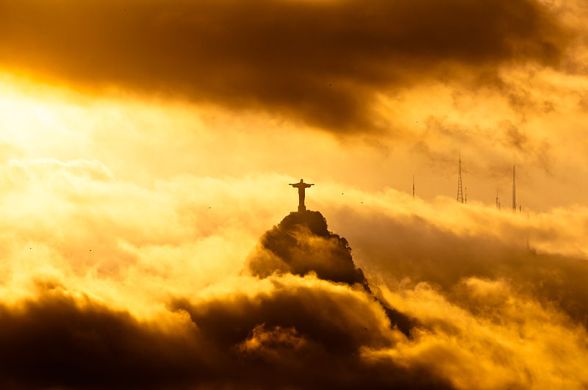
Feature image from https://commons.wikimedia.org/wiki/File:Jesus_in_Clouds_by_Sunset_2.jpg

Not peace, but division

Click here to listen to this 18-minute message.

Jesus says, in Luke 12:49-53:

“I have come to bring fire on the earth, and how I wish it were already kindled! But I have a baptism to undergo, and what constraint I am under until it is completed! Do you think I came to bring peace on earth? No, I tell you, but division. From now on there will be five in one family divided against each other, three against two and two against three. They will be divided, father against son and son against father, mother against daughter and daughter against mother, mother-in-law against daughter-in-law and daughter-in-law against mother-in-law.”

This is a challenging passage because it seems so contrary to what Jesus appears to stand for: love, peace, reconciliation, forgiveness. How do we make sense of this?

We start by testing out whether Jesus really did not come to bring peace on earth. We locate this specific passage within the broader narrative of his life and ministry. When we do that, we find that Jesus definitely did come to bring peace on earth. Here it is from Luke’s version of the Gospel:

Prophesies about his ministry

End of Song of Zechariah:  “to shine on those living in darkness and in the shadow of death, to guide our feet into the path of peace.” (Lk 1:79)

Angels proclaiming the birth of Christ:  “Glory to God in the highest, and on earth  peace to men on whom his favor rests.” (Lk 2:14)

Jesus’ actual ministry

To the sinful woman who anointed his feet:  ‘Jesus said to the woman, “Your faith has saved you; go in peace”.’ (Lk 7:50)

To the bleeding woman:  ‘Then he said to her, “Daughter, your faith has healed you. Go in peace”.’ (Lk 8:48)

To the disciples after his resurrection:  ‘While they were still talking about this, Jesus himself stood among them and said to them, “Peace be with you”.’ (Lk 24:36)

Jesus’ instructions to his disciples

To the 72 followers:  “When you enter a house, first say, ‘Peace to this house.’ If a man of peace is there, your peace will rest on him; if not, it will return to you.” (Lk 10:5-6)

It is hard to read all of this from Luke’s Gospel and conclude that Jesus did not come to bring peace on earth. Then what does he mean when he says, “Do you think I came to bring peace on earth? No, I tell you, but division.”

I suggest that Luke 12:49-50 informs us that to accomplish his mission (to bring peace on earth), Jesus must first go through a great confrontation and that this informs us that peace-building brings him into conflict with the forces of darkness, with Satan and his minions. And the Luke 12:51-53 informs us that peace-building can bring conflict even within the family home; and thus also in churches, communities, workplaces and nations.

I provide three examples of this, from my experiences in church, the ‘secular’ workplace and the nation. In each case, standing up for the values of Christ’s kingdom values – love, dignity, respect, compassion, human development, social justice, peace, etc. – has the potential to bring about conflict and division. The values of the Kingdom of God are contrary to all the values of the kingdom of darkness and to the path of sin. Small wonder, then, that championing these values brings about conflict and division. 

What I take from this passage is that there is need for us to stand up for Kingdom values. This is part of peacebuilding. But standing up for peace may well lead us towards conflict and division. Let us not be too scared by this.

2019.08.18_Peace dove

Featured image from https://images.app.goo.gl/WcNWwMLn4eci585V7

Poverty

Click here to listen to this 24-minute message.

Poverty is one of the great challenges facing South Africa today, with unemployment rates above 25% for the population as a whole and around 55% for young adults, and with poverty still running along racial and gender lines (StatsSA). It is a challenge for the country and for the church. It is a challenge we try to deal with in our mission to the world, and it is a challenge we try to deal with among ourselves. Many of us are ourselves struggling with poverty.

What is it that God expects of us regarding poverty?
And how do we do something about poverty, when we ourselves are poor? 

Luke 12 presents to us Jesus’ perspective on poverty, which is essentially that we should not worry. “Don’t be afraid, little flock”, he says. “Do not worry”. “Do not be afraid”. He regales us with analogies of ravens, sparrows, flowers and hairs on our head. Analogies that speak of God’s provision, God’s providence, God’s care. “You are worth far more than many sparrows”.

How does Jesus expect us to ‘not worry’ about things that are so worrisome? Are we simply to sing the “Don’t worry, be happy” song? or Hakuna Matata?

Jesus reveals in Luke 12 that not worrying about poverty (or any other life challenge) is not about switching off to poverty or denying reality. Rather, it about seeing a more powerful reality that lies beyond the present; a world that lies beyond this present world. He invites us to recognise that there is a world to come that is more important than this one and more enduring. It is not that this world, this life, is unimportant! Clearly, from Jesus’ behaviour and teaching, we know that this life and its challenges are important. But there is an even more important world to come. And it our investment into that world that really matters, that counts in the short and long run.

Our capacity see that world rests in faith. It is “by faith” that we see that world. Faith is the central topic of Hebrews 11. The writer reminds us that “faith is confidence in what we hope for and assurance about what we do not see” (Heb 11:1). Paul similarly writes, “we live by faith, not by sight” (2 Cor 5:7). In this chapter from Hebrews, the writer uses the phrase “by faith” 21 times to emphasise that the legacy we inherit from our biblical ancestors is one of faith. While we typically want an instant return on our faith investment, our ancestors were willing to wait generations for the return:

All these people were still living by faith when they died. They did not receive the things promised; they only saw them and welcomed them from a distance, admitting that they were foreigners and strangers on earth (Heb 11:13).

Abraham was able to see the future through God’s eyes. He heard and believed God’s promise that he would become the father of many nations (Genesis 12:2, 15:5 and 22:17), even though he did not see this for himself in his lifetime. He could see it because he could see through God’s eyes. Through the eyes of faith. It is these eyes that we need to be able to see the world beyond this one, to see God’s provision in the midst of hardship, to see God’s promises fulfilled even if not yet. These are the eyes of faith. These are the eyes of God.

And so Jesus says,

Sell your possessions and give to the poor. Provide purses for yourselves that will not wear out, a treasure in heaven that will never fail, where no thief comes near and no moth destroys. For where your treasure is, there your heart will be also (Luke 12:33-34).

This is a message not just for those with money (though we, especially, should heed it), but also for those without (think of the story of the widow’s mite in Luke 21:1-4). This what God calls his people to:

Learn to do right; seek justice. Defend the oppressed. Take up the cause of the fatherless. Plead the case of the widow (Isaiah 1:17).

It starts at home, within the church community:

All the believers were one in heart and mind. No one claimed that any of their possessions was their own, but they shared everything they had. …And God’s grace was so powerfully at work in them all that there were no needy persons among them. For from time to time those who owned land or houses sold them, brought the money from the sales and put it at the apostles’ feet, and it was distributed to anyone who had need (Acts 4:32-35).

Featured image from: https://images.app.goo.gl/iy3XkCppMMj5g2QG9

Doing mission

Click here to listen to this 23-minute message.

Our Gospel reading for today is Luke 10:1-11, 16-20. It is the story of Jesus sending out 72 of his followers (having previously sent out the 12 disciples at the start of Luke 9) to do missionary work. It’s an important narrative, because it provides insight into Jesus’ teaching and training of his followers in missionary work. In this recording, I do an almost verse-by-verse Bible study of the passage, to tease out what happens, what Jesus says and how Luke conveys Jesus’ teachings to us.

I start by disclosing that I am a useless evangelist. I was trained in and did cold-calling as a university student, while a member of Campus Crusade for Christ. But, being a naturally shy and introverted person, walking up to strangers to share the Gospel with them was the hardest thing in the world for me.

I wrap up with three main points (RAP):

  1. Our Responsibility. We are responsible to be faithful to God, to make God known in the world. But we are not responsible for how people respond to us. Our responsibility is to lay a foundation and prepare the way for Holy Spirit to continue Christ’s work in the life of other people.
  2. Our Attitude. We are invited to enter the lives of others with an attitude of peace – to be calm, quiet, respectful and deferential. And we are invited to accommodate them and their ways, not to impose ourselves on them. Paul writes at length about this in 1 Corinthians 9:19-23.
  3. Our Presence. We are assured (and reassured) that since Christ dwells in us – has taken up residence in us – wherever we are, Christ is. And wherever Christ is, the Kingdom of God is (since Christ is King of the Kingdom of God). Thus, merely being among people who do not know God brings the Kingdom of God near to them. This, ultimately, is what Jesus emphasises to his followers (Luke 10:8-11):

“When you enter a town and are welcomed, … tell them, ‘The kingdom of God has come near to you. But when you enter a town and are not welcomed, go into its streets and say … be sure of this: The kingdom of God has come near.”

Whether we realise or intend it or not, the truth is that we are always Christ’s ambassadors. We are always revealing Christ to the world. We are always preparing the way for Christ’s coming. We are always doing mission. But we could be doing mission in a way that better aligns with Jesus’ teaching on mission and that does indeed prepare the way for him.

2019.07.07_Mosaic of Jesus Christ in Florence Baptistry

Featured image is a 13th century mosaic of Jesus Christ from the ceiling of the Baptistry across from the Duomo (Santa Maria del Fiore) in Florence. https://www.flickr.com/photos/bbmaui/719415433/