New Testament Sacrificial Giving

Click here to listen to the audio recording of this 30-minute message. Or watch the video here on Facebook (the message starts 24 minutes into the recording). Or read the text summary below.

We are journeying through Stewardship Month, when we reflect on what God has entrusted to us and how we give back to God from what he has blessed us. Two weeks ago, we focused on the Old Testament principle of tithing (10%) and not withholding from God what is God’s (Leviticus 27:30-34). The tithe is no longer obligatory, under God’s grace, but it remains a good benchmark or point of departure for our giving. Then last Sunday, Rev Ronald focused on the parable of the rich man who hoarded his wealth for his future (Luke 12:13-21). He was called a ‘fool’ by God, for thinking that he had control over his future. Our true security lies in our relationship with God. We are stewards of God’s riches, and we reap what we sow.

On this third week, we focus on New Testament principles of sacrificial giving – a development on the Old Testament principle of tithing. First, Psalm 89 draws our focus to the fact that everything is made by God, comes from God and belongs to God. The psalmist says (v11), “The heavens are yours, and yours also the earth; you founded the world and all that is in it.” We may feel that our possessions are ours, that our salaries are ours, that the assets that we’ve accumulated are ours. But the Psalmist reminds us, as we see throughout the scriptures, that everything belongs to God. This is our first principle (albeit from the First Testament) – everything is God’s, it is just on loan to us.

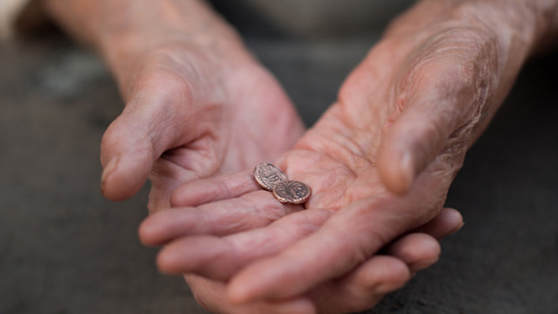
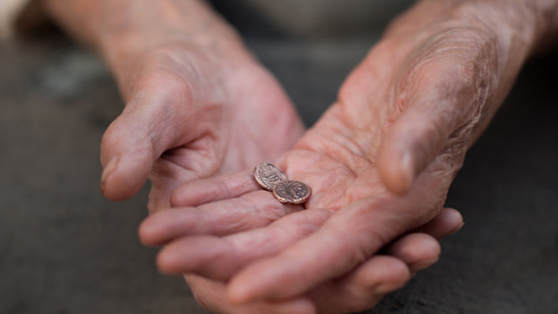
Second, in Luke 21:1-4, Jesus reflects on witnessing an older woman who put a tiny amount of money into the temple offering. Even though her gift was very small, he praised her for giving generously out of the little she had. This echoes the principle of tithing – it is less about the absolute amount that we give and more about the percentage of what we give. This is the second New Testament – give a percentage of your income to God.

The third principle is this: to give to the collective. Acts 4:32-37 tells us about the early church, just after Pentecost. Because they saw what God had done for them, they gave of their wealth to the church. Some even sold land or houses, and gave the proceeds to the church, so that there was enough cash in the church to cover costs and give to those in need. We think of this as an early form of Christian socialism – that you put your giving into the church collective, as a form of redistribution of wealth, the third principle.

The fourth principle comes from 2 Corinthians 8:1-15. Paul cites the church in Macedonia as an example of sacrificial giving. It would be great is St Stephen’s could stand as such an example – and in fact, in previous years we have done just that, such as financially supporting the building of St Timothy’s in the Reeds, and helping all the parishes in our Archdeaconry with finances in 2021, after COVID-19 impacted parishes severely.

Paul notes that the church was going through a “very severe trial” (v2), but even they were generous in their giving. This giving was based on both “their overwhelming joy and their extreme poverty”. Now the joy bit makes sense, right? But the extreme poverty seems out of sync – if we fact extreme poverty, we should give less, right? But in fact the Macedonian church gave more! Paul links back to our second principle – “they gave as much as they were able” (v3) but also highlights that they gave “even beyond their ability”. This is how the Old Testament principle of tithing 10% is transformed into giving even ‘more than we are able’. Paul also notes that they did this “entirely on their own” (v3). Indeed, they even “urgently pleaded” for the “privilege of sharing” (v4).

Paul uses the Macedonian church as an example for the Corinthian church and invites the Corinthians to act like the Macedonians (v7). Now it is important to remember that this was not a command, but rather an invitation (v8). Our giving must come from the sincerity of our love – he complements the Corinthians for being not only the first to give, but also to be the first “to have the desire to do so” (v10). We are not commanded, but invited. He writes, “If the willingness [to give] is there, [then] the gift is acceptable, according to what one has, not according to what one does not have” (v12). So, the fourth principle is giving willingly according to our means.

So here we have four principles that should guide the decisions that we make for 2025 regarding our financial giving:

  1. Everything we have belongs to God.
  2. We should focus on the percentage of our possessions we give, not the actual amount.
  3. We should prioritise giving to the local church.
  4. We should give willingly and eagerly and joyfully, according to our means.
Featured image from: https://www.reenactingtheway.com/uploads/1/5/2/9/15291334/published/the-widow-mite-hands.jpg?1543297730

The Grace of Giving

Click here to listen to the audio recording of this 25-minute message. Or watch the video here on Facebook (the message starts 28 minutes into the recording). Or read the text summary below.

Today, I’d like us to reflect on giving – financial giving. Before you run for the doors, give me a chance to put giving into context.

Our Old Testament reading today (2 Samuel 1:17-27) tells of the great love between David and Jonathan. It is a very tender reading, reminding us of our loving relationships with others, with family and with God. This theme of relationship runs through all our readings today.

Psalm 130 is an intimate song of love for and trust in God. “Out of the depths I cry to you, Lord” and “I wait for the Lord, my whole being waits, and in his word I put my hope” and “with the Lord is unfailing love”. This beautiful Psalm emphasises the deep loving relationship between us and God.

And Mark 5:21-43 tells of the woman who suffered from bleeding and had all but given up hope of healing. But she hears that Jesus is in the area and so she comes towards him, hiding from the people who would judge her, trusting and having faith that he can heal her, even if she touches just the hem of his robe. And as she is healed, Jesus lifts her up and honours her.

And Jesus does the same later in the same passage with the little girl who had died, “Little girl, I say to you, get up!” And she is brought back to health and life.

All of these readings emphasise the relationship of love, faith and trust between us and God and between us and each other.

It is in this context or relationship and faith that we come to 2 Corinthians 8:7-15, where Paul speaks about giving financially:

  • v7 – Paul writes about the “grace of giving” – grace meaning a gift (charis in the Greek, from which we get charismatic – spiritual gifts)
  • v8 – He emphasises that this is not a command to give – rather it is a grace to give
  • v8 – He uses words like sincerity and earnestness in relation to giving, to emphasise how personal giving is
  • v9 – Paul compares this with Jesus’ giving of himself for us – though he was rich, for our sake he became poor, so that through his poverty we might become rich – such a great act of generosity from Christ
  • v10 – He affirms the Corinthians not just for being the first to give, but particularly for being the first to have the desire to give – this desire or willingness or wanting to give is more important to him than the actual giving
  • v11 – He emphasises that we should give “according to our means” – the quantity of giving de-emphasised in favour of the “eager willingness” with which we give
  • v12 – Again, Paul emphasises our “willingness” to give – and again he emphasises giving “according to what one has, not according to what one does not have”
  • vv13-15 – And in the following passage he speaks at length about equality. He is interested in a redistribution of wealth – that those have more give to those who have less, so that everyone has enough. “The goal is equality” he says. Perhaps the modern word ‘equity’ is more appropriate – that each person has enough according to their needs, rather than that each person has the same. This is a foundation of Christian socialism, which brings us back to the focus on relationships – we live in fellowship with each other, connected to each other, and so if we have more than we need and someone else has less than they need, our inclination should be give some of what we have to them.
  • And Paul concludes, “The one who gathered much did not have too much, and the one who gathered little did not have too little”, quoting from the Israelites gathering manna in the desert in Exodus 16:18, which also says, “Everyone had gathered just as much as they needed”.

Giving financially may not come naturally to most of us – we want to hold on to, protect, save or spend what money we have. But the scriptures call us to be both sensible and generous, based on our relationships with God, the church and each other – relationships of love, faith and trust. I encourage you to reflect on this and consider whether you should revise your giving to God’s work.

Featured image from: https://www.forbes.com/sites/johnjennings/2022/04/30/top-tips-for-effective-charitable-giving/

Stewardship 4: A generously-giving church

Click here to listen to the audio recording of this 23-minute message. Or watch the video recording on Facebook (the message starts at about 27 minutes).

If you want to skip the sermon and just watch the unscripted enacted “parable of giving back to God” with 13-year-old Zachary, watch the video below. Zachary blew us all away with his 50/50 deal!

This is the fourth in our series on stewardship, in which we are concentrating on what it means to be a church – the church of Christ. In the first week, we reflected on what it means to be a God-focused (or Christ-centred) church. In week two, we reflected on being a people-driven church. Last week, we considered the role of the clergy in a people-driven, God-focused church: a clergy-supported church. And today, we consider what it means to be a generous church, or a generously giving church.

Can we accept the following core principle? Everything that exists was made by God, comes from God and belongs to God. Everything: the cosmos, the earth, the plants and animals, water and air, life itself, and we ourselves. You and me. Even the things we have made as humans originate with God – we made them from materials that come from God’s creation, using the intellect and the capacity for learning that God gave us, made by people, whom God created. Everything comes from God and belongs to God.

Including our money.

We may feel that we’ve earned our money, worked hard for it, deserve it and that it belongs to us. These are not untrue. But again, our capacity work, to learn to do our work and do it well, and the things we work with, and the self that is you who is doing the work – all of these were created by God, come from God and belong to God. Therefore, our money also is God’s. All of it.

It is a common misperception among Christians that our money belong to us, since we worked for it, earned it. This is neither true nor correct. We have to challenge this misperception many of us hold. This is vital to our being able to properly think about the money that we earn.

If we think of all the money we have as coming from God, then the small percentage of this money that we give to the work of God in and through the church, is really a blessing, because the large percentage of the money that we get to keep for our own use is a gift from God. A grace.

God invites us each to give proportionate to what we have. Traditionally, this would be ten percent of what you earn (gross or net – you decide). You could choose to give more than 10% or less than 10%, as you feel led. But having 10% in mind is a good point of departure to reflect critically on your attitude to and practice of giving.

The bottom line is that we – and you – have to give to God’s work.

It really is not optional. Everything you have is from God, and God expects you to give at least some small portion of that back to him. But God really doesn’t want you to do it grudgingly or sulkily, like a chore or unpleasant task. No! God loves a cheerful giver. God loves us to give out of gratitude for all we have already received from God, out of thankfulness, out of joy and out of the privilege to participate in God’s work in the world.

At our church, St Stephen’s Lyttelton, we’ll be doing our dedicated giving pledge next Sunday (3 October). During the coming week, give serious thought to how much of the money God has entrusted to you you will give back into God’s kingdom.

Featured image from https://news-ca.churchofjesuschrist.org/media/orig/tithing.jpg

Eternal perspective

Click here to listen to the audio of this 11-minute message. Or watch the YouTube video below. Or read the text summary after that.

The ‘reversal of fortunes‘ is one of the central themes in Luke’s Gospel of Christ. The reversal involves a switching around of power and privilege in society. We think of Mary’s, “He has brought down rulers from their thrones but has lifted up the humble” and, “he has filled the hungry with goo things but has sent the rich away empty” from Mary’s song in Luke 1:46-55. And of Jesus’ manifesto in Luke 4:16-21 (though the reversal is less clear), where he says, “he has anointed me to proclaim good news to the poor. He has sent me to proclaim freedom for the prisoners and recovery of sight for the blind, to set the oppressed free.” And Jesus’ famous, “There are those who are last who will be first, and first who will be last” in Luke 13:30. Indeed, there are numerous examples in Luke’s Gospel.

But this reversal of fortunes is demonstrated most unequivocally and powerfully in Jesus’ death and subsequent resurrection in Luke 22-24. When all seems lost – when the worst imaginable outcome occurs – we still remember Jesus’ words that he would rise on the third day. And indeed he does! What was intended as an annihilation of the Son of God and indeed of God’s entire plan for the salvation of humankind, turns into the absolute accomplishment of that plan!

Thanks be to God for the reversal of fortunes!

Our reading for today is Luke 6:20-21:

Looking at his disciples, he said:

Blessed are you who are poor,
for yours is the kingdom of God.
Blessed are you who hunger now,
for you will be satisfied.
Blessed are you who weep now,
for you will laugh.

We see again the reversal of fortunes in this passage (mirrored in the woes that Jesus proclaims in Luke 6:24-25 a couple of verses later):

  • Poor > yours is the Kingdom of God
  • Hunger > satisfied
  • Weep > laugh

But what is additionally striking in this passage is the emphasis on time. Particularly in the second and third blessings, Jesus contrasts ‘now’ with the future “you will”. This suggests that what is true now, will not be true for always. While in the first sentence, the phrases are both in the present tense – “are” and “is” – which suggests that the future improvement to our lot can be tasted now already.

It seems that there is folding in of time in Jesus’ understanding of human life. Past, present and future are not as differentiated for God as they are for us humans. For God – being outside of time and space – past, present and future all co-exist. But for us – being bound within time and space – Jesus’ message here is that the reversal of fortune – from struggle to contentment – is something sure and guaranteed that we can look forward to, and even enjoy in moments right now.

All of this points us towards adopting an eternal perspective in which we are encouraged to look at the world and our life circumstance, not just as it is right now, but as it is within the context of out eternal existence. This life, with its challenges and troubles, is not all there is. Indeed, this physical life is but a blink in the life we can continue to enjoy in the presence of God for eternity.

And much can change between now and then. The reversal of fortunes principle continues to emphasise that God will set right what is wrong in the world. And that whatever suffering or oppression or poverty we experience at this time, will not last forever. It will switch. God will set all things right.

As we continue through our stewardship programme, and particularly this week as reflect on how we steward our things and especially our money, let us hold this eternal perspective and the reversal of fortunes in mind. What we do now, has an impact on the future. Our giving of our hearts to Christ now will bring a return on investment, sooner or later. Giving generously now may be uncomfortable, but will repeat rewards that are greatly to be desired.

Featured image from https://latterdaysaintinsights.byu.edu/en/divine-discontent-an-invitation-to-improve/

Stewarding our things

Click here to listen to the audio recording of this 20-minute message. Or watch the YouTube video below. Or read the text summary after that.

Today is our third Sunday in our four-part series on stewardship. We have already reflected on stewarding ourselves and stewarding our communion (our church fellowship). Today, we reflect on stewarding our things. By ‘things’ I mean all the things we have or own – our house, our car, our furniture, the space in the place we live, our books, our garden, and our money.

I’m going to focus on our money in this message, because money is in many ways a proxy for all our things – most of our things were purchased with money. But also, money is needed for the church to to be church and to grow – there are real costs associated with operating a church – salaries, rent, water and lights, supplies, and so on. So, we do have to think about the real costs of serving the communion (the local church) and of building God’s Kingdom (the mission).

In 2 Corinthians 8 and 9, Paul writes an extended passage about giving. The context is that the church in Corinth had promised to give Paul some money towards the spreading of the Gospel, but had not actually paid it over. So Paul tries in this passage to persuade them to pay it over, not out of obligation, but freely. This makes this passage quite relevant for the modern church, as we also need money from our members, but want members to give freely.

There are four primary themes about giving in this extended passage:

GIVE WHAT YOU CAN, ACCORDING TO YOUR MEANS

8:3 For I testify that they gave as much as they were able…

8:11 …[give] according to your means.

8:12 For … the gift is acceptable according to what one has, not according to what one does not have.

GIVE FREELY, BY YOUR OWN WILL

8:3-4 …they gave …even beyond their ability. Entirely on their own, they urgently pleaded with us for the privilege of sharing in this service to the Lord’s people.

8:8 I am not commanding you…

8:10 Last year you were the first not only to give but also to have the desire to do so.

8:12 For if the willingness is there, the gift is acceptable

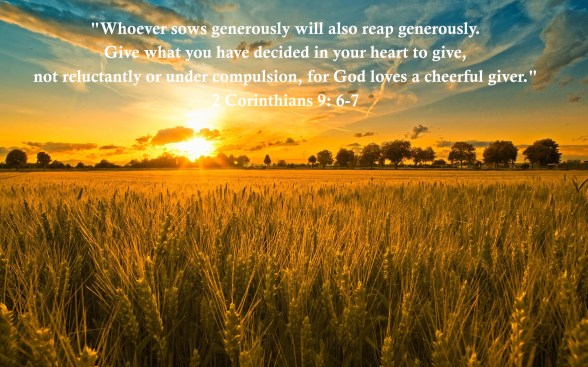
9:7 Each of you should give what you have decided in your heart to give, not reluctantly or under compulsion

GIVE GENEROUSLY, SO IT’S UNCOMFORTABLE

8:2 In the midst of a very severe trial, their overflowing joy and their extreme poverty welled up in rich generosity.

8:5 And they exceeded our expectations: They gave themselves first of all to the Lord, and then by the will of God also to us.

8:7 Since you excel in everything… see that you also excel in this grace of giving.

9:5-7 So I thought it necessary to … finish the arrangements for the generous gift you had promised. Then it will be ready as a generous gift, not as one grudgingly given. Remember this: Whoever sows sparingly will also reap sparingly, and whoever sows generously will also reap generously… God loves a cheerful giver.

GIVE, AND YOU WILL RECEIVE

9:8 And God is able to bless you abundantly, so that in all things at all times, having all that you need, you will abound in every good work.

9:10-11 Now he who supplies seed to the sower and bread for food will also supply and increase your store of seed and will enlarge the harvest of your righteousness. You will be enriched in every way so that you can be generous on every occasion, and through us your generosity will result in thanksgiving to God.

Perhaps the most striking verse in these chapters is an extract from 2 Corinthians 8:7, “see that you also excel in this grace of giving”. Grace in Greek is charis which means a gift (like the gifts of the Spirit). Paul views giving as a gift, a privilege, an opportunity and something that God enables us to do.

As we come closer to the time when we make a commitment to contribute financially to the work of the church, I pray that God will stimulate in you this sense of the opportunity and gift of giving, and that you will be able to give freely and generously, according to your means.

Features image from:
https://elements.envato.com/coins-in-hand-hands-counting-a-few-euro-coins-a-ha-Z47B9H6

He wants it all!

Click here to listen to the audio recording of this 10-minute message. Or watch the YouTube video below, or read the text summary after that.

In Luke 11:42-44, Jesus issues a series of ‘woes’ (or warnings) against the Pharisees, who were a group of highly religious, devout Jewish people. They were also religious leaders, so these woes are issued against both those who think of themselves as highly religious and against those who are occupy leadership positions in the church (including both clergy and laypeople).

Today, we focus on just Luke 11:42:

Woe to you Pharisees, because you give God a tenth of your mint, rue and all other kinds of garden herbs, but you neglect justice and the love of God. You should have practiced the latter without leaving the former undone.

Jesus draws a contrast between tithing (specifically tithing of food, but we can apply it equally to tithing of money) and justice (which can be considered the love of neighbour) and the love of God.

Jesus draws this contrast frequently in the Gospels. It is the contrast between the inner (heart) life and the outer (public) life. He repeatedly calls for alignment between these two, and he speaks out particularly harshly against those who emphasise the outer life and neglect the inner life.

The story of the widow’s mite in Luke 21:1-4 illustrates this very nicely:

As Jesus looked up, he saw the rich putting their gifts into the temple treasury. He also saw a poor widow put in two very small copper coins. “Truly I tell you,” he said, “this poor widow has put in more than all the others. All these people gave their gifts out of their wealth; but she out of her poverty put in all she had to live on.”

While outwardly, the rich gave more money than the widow, they gave only a tiny percent of what they had, while the little she gave was all she had. The percentage of what is given is more important than the absolute amount that is given. The motivation for giving is more important than the absolute amount given. The external appearance of the money is not important; rather, the inner heart out of which the money is given is what is important to Jesus.

Jesus also emphasises social justice in this passage, as well as love of God. In Luke 10:27, Jesus answers the question about what we must do to inherit eternal life with the Great Commandment:

“ ‘Love the Lord your God with all your heart and with all your soul and with all your strength and with all your mind’; and, ‘Love your neighbour as yourself.’”

This vertical and horizontal love is absolutely foundational to what it means to be an authentic Christian or follower of Christ. Jesus issues these woes against the Pharisees because they had neglected these fundamental expressions of authentic faith – they had neglected to love God and they had neglected social justice.

We would, however, be wrong to conclude that Jesus is saying the outward expression of faith is unimportant, and only the heart is important. NO! In fact, Jesus stresses that BOTH are important! He wraps up this verse:

You should have practiced the latter without leaving the former undone.

Tithing – giving of our material resources – remains important! He wants:

  • Social justice
  • Love of God
  • Our money

In short, Jesus wants it all!

Featured image from https://img3.goodfon.com/wallpaper/nbig/8/92/love-heart-romantic-tree.jpg

Poverty

Click here to listen to this 24-minute message.

Poverty is one of the great challenges facing South Africa today, with unemployment rates above 25% for the population as a whole and around 55% for young adults, and with poverty still running along racial and gender lines (StatsSA). It is a challenge for the country and for the church. It is a challenge we try to deal with in our mission to the world, and it is a challenge we try to deal with among ourselves. Many of us are ourselves struggling with poverty.

What is it that God expects of us regarding poverty?
And how do we do something about poverty, when we ourselves are poor? 

Luke 12 presents to us Jesus’ perspective on poverty, which is essentially that we should not worry. “Don’t be afraid, little flock”, he says. “Do not worry”. “Do not be afraid”. He regales us with analogies of ravens, sparrows, flowers and hairs on our head. Analogies that speak of God’s provision, God’s providence, God’s care. “You are worth far more than many sparrows”.

How does Jesus expect us to ‘not worry’ about things that are so worrisome? Are we simply to sing the “Don’t worry, be happy” song? or Hakuna Matata?

Jesus reveals in Luke 12 that not worrying about poverty (or any other life challenge) is not about switching off to poverty or denying reality. Rather, it about seeing a more powerful reality that lies beyond the present; a world that lies beyond this present world. He invites us to recognise that there is a world to come that is more important than this one and more enduring. It is not that this world, this life, is unimportant! Clearly, from Jesus’ behaviour and teaching, we know that this life and its challenges are important. But there is an even more important world to come. And it our investment into that world that really matters, that counts in the short and long run.

Our capacity see that world rests in faith. It is “by faith” that we see that world. Faith is the central topic of Hebrews 11. The writer reminds us that “faith is confidence in what we hope for and assurance about what we do not see” (Heb 11:1). Paul similarly writes, “we live by faith, not by sight” (2 Cor 5:7). In this chapter from Hebrews, the writer uses the phrase “by faith” 21 times to emphasise that the legacy we inherit from our biblical ancestors is one of faith. While we typically want an instant return on our faith investment, our ancestors were willing to wait generations for the return:

All these people were still living by faith when they died. They did not receive the things promised; they only saw them and welcomed them from a distance, admitting that they were foreigners and strangers on earth (Heb 11:13).

Abraham was able to see the future through God’s eyes. He heard and believed God’s promise that he would become the father of many nations (Genesis 12:2, 15:5 and 22:17), even though he did not see this for himself in his lifetime. He could see it because he could see through God’s eyes. Through the eyes of faith. It is these eyes that we need to be able to see the world beyond this one, to see God’s provision in the midst of hardship, to see God’s promises fulfilled even if not yet. These are the eyes of faith. These are the eyes of God.

And so Jesus says,

Sell your possessions and give to the poor. Provide purses for yourselves that will not wear out, a treasure in heaven that will never fail, where no thief comes near and no moth destroys. For where your treasure is, there your heart will be also (Luke 12:33-34).

This is a message not just for those with money (though we, especially, should heed it), but also for those without (think of the story of the widow’s mite in Luke 21:1-4). This what God calls his people to:

Learn to do right; seek justice. Defend the oppressed. Take up the cause of the fatherless. Plead the case of the widow (Isaiah 1:17).

It starts at home, within the church community:

All the believers were one in heart and mind. No one claimed that any of their possessions was their own, but they shared everything they had. …And God’s grace was so powerfully at work in them all that there were no needy persons among them. For from time to time those who owned land or houses sold them, brought the money from the sales and put it at the apostles’ feet, and it was distributed to anyone who had need (Acts 4:32-35).

Featured image from: https://images.app.goo.gl/iy3XkCppMMj5g2QG9

Tithing

Click here to listen to the podcast of this 25 minute sermon.

Money is a touchy subject for many Christians and particularly in some Christian denominations. In our church, our giving is extremely private – our financial contributions are known only to ourselves and one other person (the dedicated giving recorder, who keeps a record of monies received). So discussing money is sensitive.

In this sermon I map out four principles of money matters in the church, on the premise that our thinking about money is in need of transformation. Paul says that we need to be transformed by the renewing of our minds, so that we can test and approve God’s will. Finance is an area in need of transformative, sanctified thinking.

  • The first two principles speak to how we think about our own money:
    • Everything we have belongs to God
    • God has entrusted everything to our care and for our use.
  • The second two principles speak to how we think about giving:
    • Our giving should be in proportion to what we have
    • Our giving should emanate from our confidence in God’s trustworthiness

I advocate a particular position on the ten percent tithe that not everyone will agree with. As it is, tithing is hotly debated in the church. I think that my position is aligned with Jesus’ approach to Old Testament Law. Listen and see what you think.

When all is said and done, we have a unique opportunity to participate with God in God’s great work in the world. One of the ways of participating is through our financial giving. What a privilege to partner with God in the work of bringing into being God’s Kingdom on earth!

Love and peace
Adrian