Click here to listen to a reading of the Passion of Christ according to St Luke (22:14-23:56).

La passion du Christ
Painting by Gilles Catelin
Click here to listen to a reading of the Passion of Christ according to St Luke (22:14-23:56).
La passion du Christ
Painting by Gilles Catelin

Click here to listen to this 13-minute sermon.
One of the key themes of Easter is that God’s Will will not be thwarted. No matter what we raise against God’s Will – God’s Intentions – God will accomplish God’s Will. This comes into relief in today’s reading from John 11:45-57. It is a passage about the Jewish leaders’ sense of threat from the success of Jesus’ ministry, and their decision to eliminate him. Their concerns and actions are motivated by self-preservation, and they believe that eliminating Jesus will secure their future salvation.
Ironically, they could not be more correct, but not in the way they thought. Jesus’ death (the death of one person) did indeed make possible the salvation of the entire world – not just the Jewish nation, but indeed all people, everywhere, at all times, including both past and future.
God took their evil intent and incorporated it into God’s Will, to accomplish the great plan that God had already conceptualised at the dawn of time: to save the cosmos. God’s Will is glacial, moving inexorably towards its destination.
The Will of God will not be thwarted. We see this tenacity of God’s Will strikingly in Ezekiel 37:21-28, where God’s “will” is articulated 24 times in just 8 verses:
‘This is what the Sovereign Lord says: I will take the Israelites out of the nations where they have gone. I will gather them from all around and bring them back into their own land. 22 I will make them one nation in the land, on the mountains of Israel. There will be one king over all of them and they will never again be two nations or be divided into two kingdoms. 23 They will no longer defile themselves with their idols and vile images or with any of their offenses, for I will save them from all their sinful backsliding, and I will cleanse them. They will be my people, and I will be their God.
24 “‘My servant David will be king over them, and they will all have one shepherd. They will follow my laws and be careful to keep my decrees.25 They will live in the land I gave to my servant Jacob, the land where your ancestors lived. They and their children and their children’s children will live there forever, and David my servant will be their prince forever.26 I will make a covenant of peace with them; it will be an everlasting covenant. I will establish them and increase their numbers, and I will put my sanctuary among them forever. 27 My dwelling place will be with them; I will be their God, and they will be my people. 28 Then the nations will know that I the Lord make Israel holy, when my sanctuary is among them forever.’”
If God is able to accomplish so much when people are working against God, imagine what God can accomplish when people work with God! Today we are reminded of the remarkable opportunity to partner with God in implementing God’s Will, and in so doing, to be part of history-making.

Featured image of one of the glaciers in College Fjord in Alaska.
Click here to listen to this 21-minute message.
We all have, consciously or unconsciously, a hierarchy of people’s goodness to badness, of people’s worthiness of God’s loving attention or of salvation. Even if we believe in salvation through the work of Christ alone, we probably still can imagine people we think undeserving of eternal life.
This was the problem of the Pharisees in Jesus’ time. They were so focused on keeping God’s Law (see my related message on Jesus’ Law) that they could have nothing to do with people who were not righteous, people who were lower down on the hierarchy.
So when the Pharisees see Jesus hanging out with so called ‘sinners’ and tax collectors, they are horrified and mutter, “This man welcomes sinners and eats with them” (Luke 15:1-2). They regarded such behaviour as being absolutely at odds with being a Godly person.
This prompts Jesus to tell three parables, intended to reveal God’s soft heart for “sinners and tax collectors”, for the lost, and to challenge the Pharisees’ misalignment with the God they sincerely followed:
In this parable (commonly known as the parable of the prodigal son, ‘prodigal’ meaning financially wasteful) we meet a father and his two sons. The younger son asks for his inheritance up front, and then squanders it on wild living. Eventually he comes to his senses and, realising that his fathers servants live better than he is now living, returns to his father, acknowledges his sinfulness and asks to be hired as a servant. The father is overjoyed at the son’s return, hugs him, clothes him and throws a lavish party for him.
In most preaching about this parable, this is what we focus on. Rightly so, because it reveals the extravagantly loving heart of God, God’s willingness to reconcile with anyone who turns to God, God’s unconditional love. It exemplifies Jesus’ ministry, which is to find those who are disconnected from God, and welcome them back into fellowship with God. For example,
But actually, the narrative focus of the story is on the older son, whose attitude towards his wayward brother is the same as that of the Pharisees. Jesus wants the Pharisees (perhaps us also) to recognise themselves in the older son, whose attitude is so at odds with his father (who represents God, who in turn is represented by Jesus):
This is exactly what the Pharisees did to Jesus (as the father in the story) in his engagement with sinners and tax collectors (as the younger son in the story). They said to Jesus, “This man welcomes sinners and eats with them”, just as the father in the story welcomed his younger son and threw a feast for him.
The father, however, recognises that this older son is also, in his own way, lost. He has lost his sense of fellowship with his father. He does not share his father’s values and outlook on the world. He has dissociated himself from his father’s family. But the father says:
As children of God, we (like the Pharisees) are urged to adopt the heart of God, as evidenced in the behaviour of the father in this parable, and to welcome and eat with so called ‘sinners’.

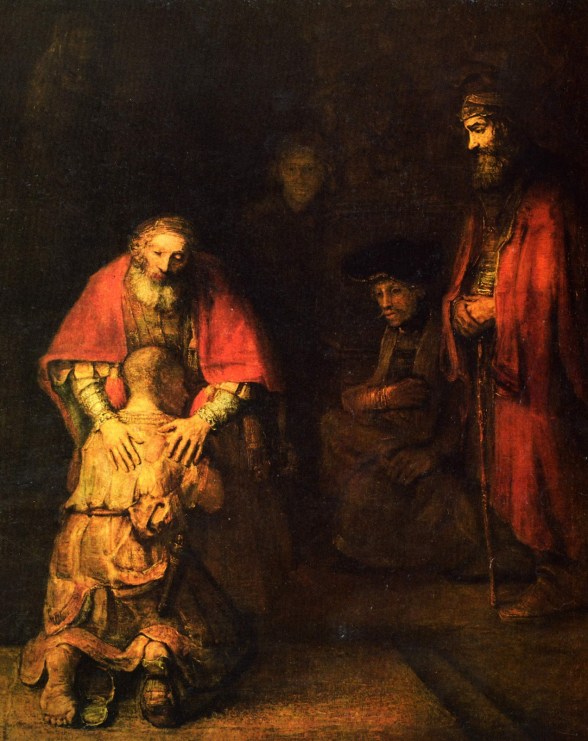
This painting by Rembrandt van Rijn is called ‘The Return of the Prodigal Son’ c.1662. The original hangs in the Hermitage in St. Petersburg. The older son is depicted on the right, in a red cloak, looking rather disapproving, and distanced from the father and younger son on the left.
Notice also the father’s hands – the one on the left is smaller and thinner than the one on the right. Most people think Rembrandt was endeavouring to depict both the fatherhood and motherhood of God.
Henri Nouwen has written a book about this narrative and painting called, ‘The return of the prodigal son’. You can read some of it here on Amazon. Read particularly pages 71 and following, about the older son. Or click here for a brief reflection on this painting.

Click here to listen to this 11-minute message.
God calls us to humility – in our relationship with God, and in our relationship with other people.
Luke 18:9-14 gives us the parable of the pharisee and tax collector, both at prayer.
Clearly, God calls us to humility – both in our relationship with God and in our relationship with people.
Of course, this ‘humility’ is not about self-denigration or having a poor self-esteem or negative self-image. Paul says clearly in Romans 12:3 that humility is about assessing our strengths and weaknesses honestly and accurately: “Do not think of yourself more highly than you ought, but rather think of yourself with sober judgment.”
In our other reading for today – Hosea 5:13-6:6 – there is a dialogue between God and Israel:
Clearly, God calls us to humility – both in our relationship with God and in our relationship with people.

Feature image ‘Kneeling in Prayer‘ by Nadine Rippelmeyer (2006)

Click here to listen to this 13-minute message.
In Matthew 5:17-20, Jesus presents (albeit very briefly) his most comprehensive teaching on his view of Law of Moses. He says that he has not come to abolish the law, that the dot on every i and the cross on every t is vital, that the Law has not passed away, and that we need to practice and teach it. Many commentators (naturally) read this to mean that the First Testament Law is as binding on Christians today as it was on the people of Israel in years between Moses and Christ.
However, when we look at Jesus’ teaching and behaviour, even just within Matthew’s Gospel, we see him repeatedly massaging the Law, challenging the Law, even brazenly disobeying the Law – certainly as the Law was understood by the Pharisees of his day. For example:
How do we reconcile Matthew 5’s apparently strict teaching with the rest of Jesus’ teaching and his daily behaviour? They do appear to be at odds with each other!
I suggest the following:
I end with a paraphrase of Matthew 5:17-20 by RT France (2007, pp. 190-191) in his commentary on Matthew’s Gospel:
“Do not suppose that I came to undermine the authority of the OT scriptures, and in particular the law of Moses. I did not come to set them aside but to bring into reality that to which they pointed forward. I tell you truly: the law, down to its smallest details, is as permanent as heaven and earth and will never lose its significance; on the contrary, all that is points forward to will in fact become a reality (and is now doing so in my ministry). So anyone who treats even the most insignificant of the commandments of the law as of no value and teaches other people to belittle them is an unworthy representative of the new regime, while anyone who takes them seriously in word and deed will be a true member of God’s kingdom.
“But do not imagine that simply keeping all those rules will bring salvation. For I tell you truly: it is only those whose righteousness of life goes far beyond the old policy of literal rulekeeping which the scribes and Pharisees represent who will prove to be God’s true people in this era of fulfillment.”


Click here to listen to this 18-minute sermon.
Today is the first Sunday in Lent, when we reflect on Jesus’ 40-day fast in the desert, and the way the devil tempted him during this time (Luke 4:1-13). Here’s the point I believe God wants us to hear from this passage today:
Jesus experienced this during his 40-day fast. We experience it when we fast. Fasting creates these intensified opportunities to turn to God. It is the gift of the fast.
How can we turn to God? Here are two ways:
Use the verse or prayer to remind you that you have made a commitment to God. Use it to help turn your focus towards God. Remind yourself that while breaking your fast may, actually, be trivial, remaining true to God is not.
Blessings as you journey through Lent.

Featured image from https://thewellarmedwoman.com/blog/fork-in-the-road/

Click here to listen to this 11-minute message.
Today is Ash Wednesday, the first day of Lent. Lent is the period of 40 days of fasting and prayer that leads up to Easter. It is a time of preparation for Calvary.
We have three key readings today:
In light of this, I make four key recommendations for prayer and fasting during Lent:
Finally, I recommend a prayerful reading of Psalm 51 (NRSV).
1 Have mercy on me, O God,
according to your steadfast love;
according to your abundant mercy
blot out my transgressions.
2 Wash me thoroughly from my iniquity,
and cleanse me from my sin.
3 For I know my transgressions,
and my sin is ever before me.
4 Against you, you alone, have I sinned,
and done what is evil in your sight,
so that you are justified in your sentence
and blameless when you pass judgement.
5 Indeed, I was born guilty,
a sinner when my mother conceived me.
6 You desire truth in the inward being;
therefore teach me wisdom in my secret heart.
7 Purge me with hyssop, and I shall be clean;
wash me, and I shall be whiter than snow.
8 Let me hear joy and gladness;
let the bones that you have crushed rejoice.
9 Hide your face from my sins,
and blot out all my iniquities.
10 Create in me a clean heart, O God,
and put a new and right spirit within me.
11 Do not cast [fling] me away from your presence,
and do not take your holy spirit from me.
12 Restore to me the joy of your salvation,
and sustain in me a willing spirit.
13 Then I will teach transgressors your ways,
and sinners will return to you.
14 Deliver me from bloodshed, O God,
O God of my salvation,
and my tongue will sing aloud of your deliverance.
15 O Lord, open my lips,
and my mouth will declare your praise.
16 For you have no delight in sacrifice;
if I were to give a burnt-offering, you would not be pleased.
17 The sacrifice acceptable to God is a broken spirit;
a broken and contrite heart, O God, you will not despise.
Or listen to Bach’s Cantata based on Psalm 51 (music adapted from Pergolesi’s Stabat Mater)
Featured image from https://www.catholiccompany.com/getfed/ash-wednesday-beginning-lent-5548

Click here to listen to this 20-minute message.
Put your feet in the sandals of the disciples. They hear Jesus’ call and leave everything to follow him. They witness amazing events: healings, exorcisms, resurrections and the feeding of thousands. And they hear new teachings, unlike anything they have heard before.
And at the point that Peter realises that Jesus is the Christ, Jesus starts talking about suffering and dying, and that his disciples must follow him on this path. Crazy talk! Things had been so great; now they were falling to pieces.
Our own faith journey is often like this. We go through periods where we feel deeply connected to God, and experience God’s working in and through our lives, and being a Christian seems wonderful. But then, like a cloud on a hot day, it vaporizes, and it feels like God is absent. Up and down, up and down.
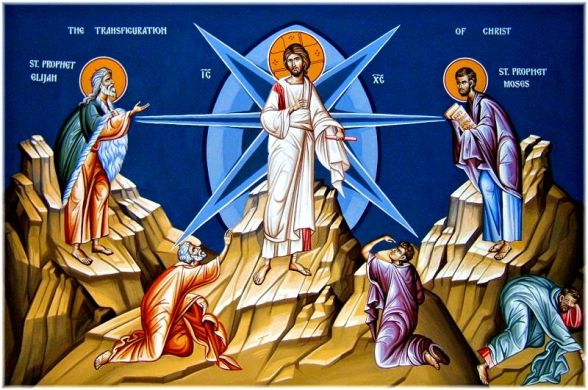
It was at a point like this, that the transfiguration takes place (John 9:28-36). Jesus takes Peter, James and John up a mountain, where he is transformed before their eyes. The appearance of his face changes, his clothes shine like a flash of lightening, they see his glory. It is as if the veil that separates our world from the heavenly realm was cracked open a little, and celestial light poured through. What a moment!
But, Peter’s attempt to hold on to it was thwarted, and soon the four of them trundle back down the mountain, and continue with the work of healing and teaching, spreading the good news of the Kingdom of God and – now they realise – journeying towards the cross. This mountain top experience served to strengthen them all for the coming challenges. It was not the destination; they had to come down the mountain.
In most churches around the world, this coming Wednesday (6 March 2019) is Ash Wednesday, the first day of Lent. Lent is a period of fasting and prayer that runs up to Easter. During this time, we immerse ourselves in the painful journey that Jesus takes, accompanied most of the way by his disciples, towards the cross. It is not an easy journey. The transfiguration, which we celebrated today, served to remind us that the one who is journeying towards that cross is not merely a great man, but the Son of God.
May God journey closely with you over this coming Lenten period.
Listen also to my 2012 message called “Pressing on to Glory”, based on the same passage

Click here to listen to this 17-minute message.
What do you believe? What do you hold to be true? How certain are you that these truths are in fact true? Are you open to the possibility that what you think is true might actually be incorrect? Are you open to possibility that other truths, that are different from your own, might be true? Or are you certain that you are right and they are wrong? In the pantheon of all that you believe is true, is there a central truth – a core truth – that you hold with the greatest certainty? That you’d be prepared to die for?
Truth is a big deal in contemporary society. We live in a post-modern era, where we regard truth as socially constructed, and where one person’s truth is acceptably another person’s fiction or even falsehood. It is a time of relative belief, of ‘live and let live’, of ‘each to their own’.
Yet, for many Christians, truth is absolute and unquestionable. What the Bible says – at least, what those passages that we choose to read – is absolutely true and must be imposed on others as being undoubtedly truly for all people everywhere.
The Apostle Paul presents what appears to be a core truth for himself in 1 Corinthians 15. It centres on the resurrection of Christ. He argues that Christ’s resurrection is so central, that if you don’t believe it, then everything else that you think you believe is flawed and futile.
I believe a lot of things about my faith strongly. For example, I believe that God created everything, that God is three distinct persons in one being, that Jesus Christ was the incarnation of God into the world, and that Jesus has uniquely facilitated the restoration of our relationship with God. But I’m not entirely certain how God created everything, whether God is just three persons or if there may yet be additional persons in the Godhead whom we’ve not yet met, or when and how the incarnation took place, and whether there is any limit on the reach of Christ’s reconciliation of people to God. I have thoughts on all of these, and I believe them quite strongly, but I’m open to the possibility – even the likelihood – that I may be wrong.
Yet, for me, I have an unshakable core belief that the heart of God is filled to overflowing with generous, extravagant, fierce love. This one core belief is the centre of my faith. I’m willing to lay down my life for that belief. And everything else that I believe emanates from that central truth. It is why I wrote the book Being God’s Beloved.


Click here to listen to this 17-minute message.
There are times in life where we are called upon to stand up for truth or justice, or simply to challenge someone in our family or workplace. Sometimes, we back off from these situations because it seems too intimidating. It is at times like this that we need courage – courage that comes from God.
Jeremiah 1:4-10 tells the story of such a time:
This three-fold pattern – commission, consternation, courage – is often true in our lives.
We see it also in Jesus’ ministry. In Luke 3:21-22, Jesus is commissioned at his baptism, when God the Holy Spirit fills him and God the Father speaks words of affirmation. In Luke 4:1-13, Jesus experiences (arguably) consternation, when he is tempted by Satan in the wilderness. And in Luke 4:17-27, Jesus displays courage by proclaiming his ministry manifesto and speaking truth to the people in the synagogue. Specifically, Jesus challenges their assumption that Jesus had come just for them, and argues that God had come for the whole world.
But let us not be obnoxious! Sometimes Christians can be self-righteous, harsh, uncaring and rude in the way we stand up for truth. Let us, rather, be the embodiment of love. 1 Corinthians 13 makes it perfectly clear that anything that we do that is not infused with love is worthless.
When the time comes for us to stand up to power, to challenge someone, to confront injustice in the world, let us remember that we (like Jeremiah) are commissioned to be Christ’s ambassadors and to work for the values of the Kingdom (e.g., love, justice, human dignity, compassion, community). And despite feeling consternated or fearful, let us take courage from knowing that God is with us and we are empowered by Holy Spirit, and let us speak up.

Featured image from: https://www.iamashcash.com/wp-content/uploads/2015/12/Managing-Up-3-420×420.jpg
 Reflections of God's Love
