Today is the last Sunday in Advent, a few days before Christmas. During this Advent season, we’ve been reflecting on Christ’s coming into the world, both 2000 years ago and one day in the future. We’ve also reflected on John the Baptist, and the prophets before him, who prophesied Christ’s coming in the past and his coming again one day. And we’ve reflected on Christ’s birth in our hearts this Christmas, 2024.
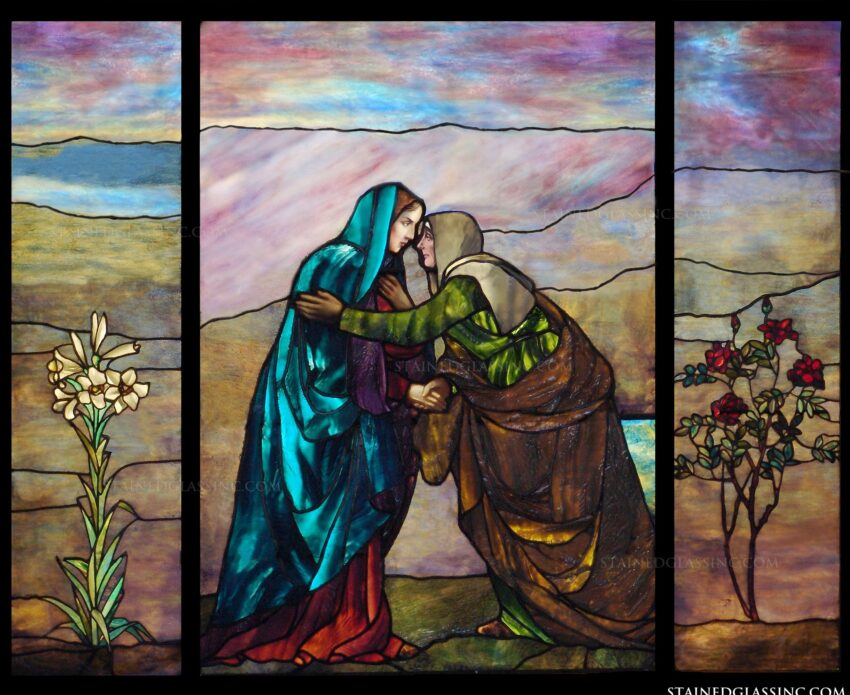
Today, as we bring Advent to a close, we read about Mary’s and Elizabeth’s pregnancies, and about what they and the prophets thought about the kind of person the Messiah would be. Although he came as an infant, he was set to turn the world upside down. God’s emerging into humanity was a profound change for the universe – disruptive, outrageous and exciting. Watch the 18-minute video of today’s message, and let’s be challenged by the readings from Micah 5, Hebrews 10 and Luke 1.
The ‘reversal of fortunes‘ is one of the central themes in Luke’s Gospel of Christ. The reversal involves a switching around of power and privilege in society. We think of Mary’s, “He has brought down rulers from their thrones but has lifted up the humble” and, “he has filled the hungry with goo things but has sent the rich away empty” from Mary’s song in Luke 1:46-55. And of Jesus’ manifesto in Luke 4:16-21 (though the reversal is less clear), where he says, “he has anointed me to proclaim good news to the poor. He has sent me to proclaim freedom for the prisoners and recovery of sight for the blind, to set the oppressed free.” And Jesus’ famous, “There are those who are last who will be first, and first who will be last” in Luke 13:30. Indeed, there are numerous examples in Luke’s Gospel.
But this reversal of fortunes is demonstrated most unequivocally and powerfully in Jesus’ death and subsequent resurrection in Luke 22-24. When all seems lost – when the worst imaginable outcome occurs – we still remember Jesus’ words that he would rise on the third day. And indeed he does! What was intended as an annihilation of the Son of God and indeed of God’s entire plan for the salvation of humankind, turns into the absolute accomplishment of that plan!
Blessed are you who are poor, for yours is the kingdom of God. Blessed are you who hunger now, for you will be satisfied. Blessed are you who weep now, for you will laugh.
We see again the reversal of fortunes in this passage (mirrored in the woes that Jesus proclaims in Luke 6:24-25 a couple of verses later):
Poor > yours is the Kingdom of God
Hunger > satisfied
Weep > laugh
But what is additionally striking in this passage is the emphasis on time. Particularly in the second and third blessings, Jesus contrasts ‘now’ with the future “you will”. This suggests that what is true now, will not be true for always. While in the first sentence, the phrases are both in the present tense – “are” and “is” – which suggests that the future improvement to our lot can be tasted now already.
It seems that there is folding in of time in Jesus’ understanding of human life. Past, present and future are not as differentiated for God as they are for us humans. For God – being outside of time and space – past, present and future all co-exist. But for us – being bound within time and space – Jesus’ message here is that the reversal of fortune – from struggle to contentment – is something sure and guaranteed that we can look forward to, and even enjoy in moments right now.
All of this points us towards adopting an eternal perspective in which we are encouraged to look at the world and our life circumstance, not just as it is right now, but as it is within the context of out eternal existence. This life, with its challenges and troubles, is not all there is. Indeed, this physical life is but a blink in the life we can continue to enjoy in the presence of God for eternity.
And much can change between now and then. The reversal of fortunes principle continues to emphasise that God will set right what is wrong in the world. And that whatever suffering or oppression or poverty we experience at this time, will not last forever. It will switch. God will set all things right.
As we continue through our stewardship programme, and particularly this week as reflect on how we steward our things and especially our money, let us hold this eternal perspective and the reversal of fortunes in mind. What we do now, has an impact on the future. Our giving of our hearts to Christ now will bring a return on investment, sooner or later. Giving generously now may be uncomfortable, but will repeat rewards that are greatly to be desired.
I appreciate that this topic will be controversial for many. I really encourage you to watch this message please and not just read it, particularly if you find the title problematic. At least, just listen to what I have to say, even if you decide you don’t agree with it.
But, very briefly, the main points are:
Jesus died for ALL of humanity – for the whole world – and would thus say, without equivocation, ‘All lives matter‘.
But Jesus would also confront us, saying that we do not live our lives as if all lives mattered.
Jesus’ ministry consistently and deliberately positions himself with those who are vulnerable, oppressed, poor, or marginalised: women, Samaritans, lepers, prostitutes, menstruating women, the dead.
Throughout his ministry – throughout the Gospels – Jesus enacts the message that Black lives matter, Women’s lives matter, Immigrants’ lives matter, Children’s lives matter, etc.
Jesus is not saying the lives of the poor matter more than other people’s lives; but that their lives do not matter less than other people’s lives.
In the new heaven and the new earth, all lives will actually matter in people’s lives experience. But in today’s society, this is not true. Today, all lives are not equal and not equally valued. And in this times, Jesus would be saying: Women’s lives matter, Children’s lives matter, Immigrant lives matter, LGBTQI lives matter, Black lives matter.



 Reflections of God's Love