In his prayer for his disciples, shortly before his arrest and execution, Jesus speaks about our relationship with the world (John 17:13-19). He says four things in rapid succession:
We are not of the world (we are not rooted in the world)
We are not to be taken out of the world
We are not of the world (we are not rooted in the world)
We are sent into the world
These four prepositions – of, out, of and into – set up Jesus’ expectations of us as his disciples.
We are not to be rooted in or ‘of’ the world. Just as Jesus is not of the world – he did not originate here and is not rooted into the world – we also are not of the world. Instead, “our citizenship is in heaven” (Philippians 3:20).
But, as much as we may wish then to be taken up out of this world, Jesus is explicit, “My prayer is not that you take them out of the world.” Instead, he prays, “As you sent me into the world, I have sent them into the world.” And to guide us regarding our place in the world he prays that we “too may be truly sanctified.”
Our values, ideas, aspirations and truths should all be shaped by and rooted in God’s world – in heaven. But we are commissioned to work in this world, to influence it with God’s values, to shape it into some resembling the Kingdom of Heaven that Jesus proclaims, and to be somewhat set apart or separated from the world.
It is like our head is at the top of a long stick figure, in heaven, while our feet and hands and hearts are here on earth, working out God’s plan for the salvation of the world.
Our Gospel reading for today is Luke 10:1-11, 16-20. It is the story of Jesus sending out 72 of his followers (having previously sent out the 12 disciples at the start of Luke 9) to do missionary work. It’s an important narrative, because it provides insight into Jesus’ teaching and training of his followers in missionary work. In this recording, I do an almost verse-by-verse Bible study of the passage, to tease out what happens, what Jesus says and how Luke conveys Jesus’ teachings to us.
I start by disclosing that I am a useless evangelist. I was trained in and did cold-calling as a university student, while a member of Campus Crusade for Christ. But, being a naturally shy and introverted person, walking up to strangers to share the Gospel with them was the hardest thing in the world for me.
I wrap up with three main points (RAP):
Our Responsibility. We are responsible to be faithful to God, to make God known in the world. But we are not responsible for how people respond to us. Our responsibility is to lay a foundation and prepare the way for Holy Spirit to continue Christ’s work in the life of other people.
Our Attitude. We are invited to enter the lives of others with an attitude of peace – to be calm, quiet, respectful and deferential. And we are invited to accommodate them and their ways, not to impose ourselves on them. Paul writes at length about this in 1 Corinthians 9:19-23.
Our Presence. We are assured (and reassured) that since Christ dwells in us – has taken up residence in us – wherever we are, Christ is. And wherever Christ is, the Kingdom of God is (since Christ is King of the Kingdom of God). Thus, merely being among people who do not know God brings the Kingdom of God near to them. This, ultimately, is what Jesus emphasises to his followers (Luke 10:8-11):
“When you enter a town and are welcomed, … tell them, ‘The kingdom of God has come near to you.’But when you enter a town and are not welcomed, go into its streets and say‘… be sure of this: The kingdom of God has come near’.”
Whether we realise or intend it or not, the truth is that we are always Christ’s ambassadors. We are always revealing Christ to the world. We are always preparing the way for Christ’s coming. We are always doing mission. But we could be doing mission in a way that better aligns with Jesus’ teaching on mission and that does indeed prepare the way for him.
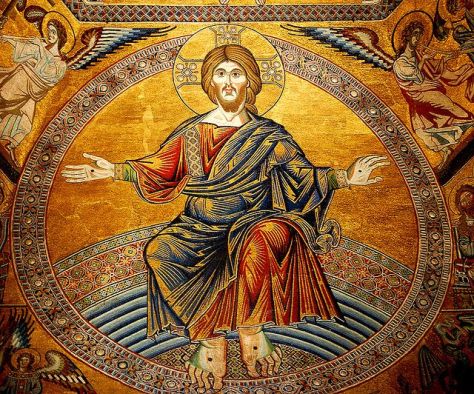
Featured image is a 13th century mosaic of Jesus Christ from the ceiling of the Baptistry across from the Duomo (Santa Maria del Fiore) in Florence. https://www.flickr.com/photos/bbmaui/719415433/
Today’s reading (John 14:23-29) speaks to us about the centrality of relationships in the Christian journey of faith.
First, we learn that relationship is central to God’s self. This passage is steeped in Trinitarian language: the sense that God, while one being, comprises three persons.
John 14:23“My Father will love them, and we will come to them and make our home with them.” This verse is unique in that it is the only passage where Jesus uses first person plural language to refer to himself and the Father operating as a unit. Jesus talks about himself and the Father as two distinct persons, working together.
John 14:24“These words you hear are not my own; they belong to the Father who sent me.” Here, Jesus emphasises the unity of his words and the Father’s words. The Father and the Son speak from one mouth. It echoes John 14:10, where Jesus says, “Don’t you believe that I am in the Father, and that the Father is in me?The words I say to you I do not speak on my own authority. Rather, it is the Father, living in me, who is doing his work.”
John 14:26“…the Holy Spirit, whom the Father will send in my name, will teach you all things and will remind you of everything I have said to you.” Here, Jesus mentions all three persons of the Trinity (Father, Son and Holy Spirit), operating in unity with one another.
God the Father, God the Son and God the Holy Spirit are in eternal and loving relationship with one another, so powerful that they are one being. Although the doctrine of the Trinity is not explicitly taught in Scripture, it is (for the vast majority of Christians) the most inevitable way of reconciling the oneness and the threeness of God that the Scriptures present to us. And this passage from John is one of those that does so strongly.
If nothing else, and perhaps most importantly, we learn from this that relationshipis central to God and to God’s experience of God’s self. And if relationships are important to God, they must surely be important to us also.
Second, we learn that relationship is central to God’s mission on earth. Jesus message in John 14:23 is a response to a question from Judas, one of his disciples, “But, Lord, why do you intend to show yourself to us [only] and not to the world?” Judas was concerned that the good news that Jesus was telling the disciples about was not going to be heard by everyone. His was a question about mission.
And Jesus answer is that God the Father and God the Son will come to the disciples (and by extension to all Christians) and make their home in us. This means that God’s showing of God’s self to the world will be through us. As God resides in us, we reveal God to the world.
This is an extension of the incarnation. When God the Son came into the world as a human, in the form of Jesus of Nazareth, he was available to the world as just one man, with all the limitations of a single human. But when Jesus returned to the Father at his ascension, he sent Holy Spirit who fills up every Christian. Moreover, the Father and Son also come to dwell in us. In this way, Christ is incarnated in the world through the Body of Christ, the church, that is, through the community of believers. We are Christ’s body on earth.
Thus, God continues to work through God’s relationship with each of us and our relationships with everyone in our social environment – those at church, those in our families, those in our workplaces and play spaces, those in our communities, those we meet in passing as we shop, travel and live.
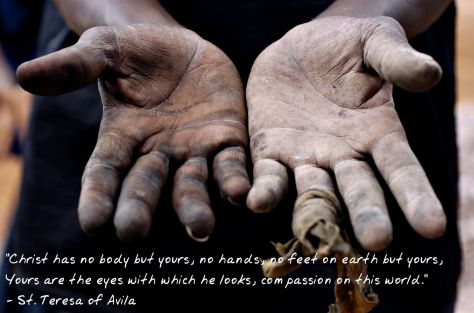
This reminds me of the prayer of St Teresa of Avila, who lived in the 1500s:
Christ has no body but yours,
No hands, no feet on earth but yours,
Yours are the eyes with which he looks
Compassion on this world,
Yours are the feet with which he walks to do good,
Yours are the hands, with which he blesses all the world.
Yours are the hands, yours are the feet,
Yours are the eyes, you are his body.
Christ has no body now on earth but yours.
I end this message by singing John Michael Talbot’s arrangement of this prayer.
(Note: This sermon was preached at a home for women with intellectual disabilities.)
Here are two beautiful performances of this prayer. Music by David Ogden.
I have been redeployed from the church I’ve attended for over 20 years (St Martin-in-the-Fields) to a new church, not too far away (St Stephens, Lyttelton) as part of my curacy. Today was the first time I have preached to this new parish, so it was a good opportunity to lay down what is most important to my faith and that what is most prominent in my preaching. And it is this:
God is most essentially and completely LOVE. The three persons of the Godhead (Father, Son and Spirit) have been in eternal relationship with one another since before the creation of time and space. It is the profound love between these three persons that makes the one being. God created time and space out of a fullness of love. God created humanity out of a generosity of love, to be shared. And God’s actions throughout human history embody and describe love. Love that is fierce, generous, extravagant, radically inclusive, steadfast and unshakable.
Today’s reading from John 13:34-35 sets out Jesus’ command to us:
A new command I give you: Love one another. As I have loved you, so you must love one another.By this everyone will know that you are my disciples, if you love one another.
In this message, I provide the context in which Jesus delivered this message – a context that represents on the crisis points in his ministry, characterised by betrayal, denial and isolation.
And I set out what is ‘new’ about old command to love, viz. the source of our capacity to love and the missional impact of our love for one another.
Luke 1presents a compelling narrative about two women and two unborn babies. It is a remarkable way to start a story. Four individuals who, in various ways, are at the margins of society – an old barren woman, a teenage girl barely out of childhood, a six-month old foetus and a newly-fertilised egg. This is hardly a group of individuals that one would think would change the course of global history!
Yet, it is this very group that God chooses to initiate God’s major intervention in human history. It points to a pattern that we see in much of God’s work among humans – radical inclusion. God seeks to draw unexpected people into the centre of God’s working, people who society might often think of as ‘less than’ or ‘other’. Often, it is not the powerful, influential, reputable, wealthy, intelligent or educated that God places in key roles. Rather, God often chooses the outcast, the downtrodden, the humble, those who recognise their limitations and those who feel they have little to offer.
In this sermon, I tease out some of the remarkable insights we gain into Elizabeth and Mary, and the unborn John and Jesus, that Luke presents to us in the opening chapter of his Gospel narrative. I show the many ways in which we see God’s grace working itself out in profound and striking ways among this unlikely group of individuals.
From this, we get the message that there is no-one with whom God does not want to work. Every person – every single individual – has a part to play in God’s great work to redeem the cosmos. There are no exceptions. No matter how insignificant or inadequate or unavailable you may perceive yourself to be, God has a place for you, a role for you. We have to trust that this is indeed true. We have to relinquish ourselves to participate. As Mary so gracefully says, “I am the Lord’s servant. May it be to me as you have said” (Luke 1:38).
Conversely, we have to accept that God chooses to work with people we may feel God should not be working with. We (humans) tend to be far less tolerant and gracious than God! It is important for us not to become an obstacle to others who seek to play their part in God’s work. Even when we feel they are not right for or up to the task. Who are we to interfere with God’s judgment on who is worthy of participating in God’s work?
God’s radical inclusion is presented to us in Luke’s gospel as a cornerstone of God’s means of working. Through Luke, we see marginalised people, particularly women, being brought into the centre of Jesus’ ministry and God’s mission. We as individual Christians, and as a collective Church, should be emulating this approach.
September each year is ‘stewardship month’ in the Anglican Church of Southern Africa, during which we focus intensively on the question of our contribution to God’s work in building the Kingdom of God in our midst. Traditionally, we focus on time, talents and treasures as the main focus areas of our contribution. This year, we’ve also focused on our stewardship of creation, particularly in response to the growing plastics threat.
This is the last of our stewardship messages this year, where I was led, by some difficult circumstances, to reflect on the meaning of stewardship. Using a set of six images, I show the multifacetedness of stewardship, and what it means to work as partners with God in transforming our world into the image of God. These images are:
The image of stewardship as parenthood emerged in a crisis with my son during this past week, where he was involved in a very serious car accident. Although he was not badly hurt, thankfully, his life was jeopardised, and this raised considerable distress for me as a parent. It led me to think of my role as parent as that of a steward of this young man, who is first and foremost God’s son, and only secondarily my son.
The image of stewardship as friendship emerged from John 15, where Jesus says that we are not servants, but friends; friends of Christ and friends of God. Friendship, I suggest, involves freedom, reciprocity (mutuality) and equality. And friendship is the ultimate foundation of stewardship.
It is against these images that I believe we are invited to be coworkers with Christ in his mission to redeem the cosmos.
The Gospel of Mark, chapter 6, verses 14-29, presents us with the grisly narrative of the beheading of John the Baptist, at the hands of Herod Antipas, on request of his step-daughter Salome, who was acting on instruction from her mother Herodias. It is a passage that is inserted abruptly in an unrelated narrative about Jesus’ disciples performing miracles and preaching the Gospel. What is the purpose of such a narrative?
In this message, I suggest it serves as a tale about power and corruption. And about our role in the face of such power and corruption. I make three points:
We need to avoid the entanglement of sin and guilt.
We need to recognise and speak truth to the power of the powerful.
We need to accept the cost of discipleship.
Christianity is not just about fellowship and singing choruses. It is not just about the love of God. It is also about challenging power and corruption in the world, about speaking truth to power. It is about championing Kingdom values, such as compassion, integrity, the intrinsic value of every person, equity, justice, the sacredness of the earth. It is about standing against oppression, exclusion, domination, exploitation, injustice and abuse. It is about accepting, even embracing, that speaking truth to power may have negative consequences for us. Christianity is serious business!
We live in a world that seems to be doing not very well. Globally and nationally we face many challenges. And many of us face personal challenges as well. These can wear us down, challenging our faith, leading us to wish we could escape all of it.
In such times, most of us look up. We look up toward heaven, towards God, and wish that God would fix things up. “I lift up my eyes to the hills,” says the Psalmist (121:1). Paul writes at length about this in 2 Corinthians 4:16 – 5:5. He reminds us that the world and the body we live in are transient – they last but a short time and then are done. So, he longs for a more permanent world – heaven – where we can dwell for eternity with God, and where we will be doing considerably better than we are now.
So, we look up for a better future. We look up for life after death. We look up for an eternal reward. We look up for justice. We look up for comfort and solace. We look up for hope and courage.
It is good for us to look up.
But God also calls us to look out. God is not in the business of escapism. God is not inviting us to run away from or ignore or avoid the difficulties that we are facing in this world. Rather, God wants us, calls us, to be a co-worker with God in bringing into being the Kingdom of God in our midst. This was the ministry of Jesus – “the Kingdom of God is near”. Looking out means to look around us, to look at the world as it is, to really see what’s going on. Jesus always had his eyes wide open and was looking out. In English, to ‘look out’ for someone also means to care for someone.
We hear this sentiment in the Song of Mary (Luke 1:46-55), when Mary begins to understand what God was doing through her, and the way she was participating in birthing the Son of God, who would order the world, turning tables, balancing books, righting wrongs. These were present things that Jesus would do, and Mary recognised that she was a participant in making this ministry possible. Mary was looking out at the world and seeing the role she and her son would play in confronting evil.
We hear this also in the Lord’s Prayer (Matthew 6:9-13), where Jesus prays not that we may escape to heaven, but rather that heaven will come to earth: “Your kingdom come, your will be done, on earth as it is in heaven”. The rest of the prayer is about present realities: daily food, forgiveness, reconciliation, holy living, protection. His is a looking out prayer, not a looking up prayer. This prayer is about looking out at the world as it is.
Looking up and looking out are important Biblical principles for Christian living. In South Africa, during the years of struggle against apartheid, the Anglican church (which I’m part of) applied this principles. Our church services – sacramental, liturgical – are designed to help us look up to a God who is majestic, powerful, compassionate, gracious. We come to church, into a beautiful service, to escape the ugliness of the world outside; we come to church to look up. But, the Anglican church was also instrumental in undermining and eventually toppling the apartheid government and its laws; our church was looking out. THIS is what church is meant to be: Looking up and looking out.
Yesterday (6 January) was the Feast of the Epiphany, also known as Three Kings Day, when we celebrate the Magi visiting the Christ Child. This festival is important for at least two reasons. First, the Magi recognise the infant Jesus to be the Son of God, the King of Kings, because Christ has been revealed to them as God incarnate. Second, the Magi, coming from the East, represent the Gentile, non-Jewish world, and thus the message of Jesus is seen as being relevant not only to the Jews but also to all of humanity. Thus Epiphany represents the Gospel of the Son of God, incarnate in Jesus, for the entire world.
Against this backdrop, I look at the recurring themes that emerge from the three passages set for today: Genesis 1:1-5 (the Creation), Mark 1:4-11 (the Baptism of Christ) and Acts 19:1-7 (Paul’s baptism of John’s disciples with the Holy Spirit). Two main themes arise from these readings.
First, they all speak to new beginnings: a new creation, recreation through baptism, Christ’s new ministry on earth and Paul’s new ministry building the gentile church. This is relevant to us, on this first Sunday of 2018, as we think about what we want to do and accomplish this year, and who we want to be as followers of Christ.
Second, they all speak to participative ministry. Creation takes place through the collaborative work of God the Father (Genesis 1), God the Son (John 1) and God the Holy Spirit (Genesis 1). Jesus’ baptism by John (and Paul’s baptism of John’s disciples) involves the Triune God. Jesus’ willingness to undergo a baptism of repentance (which he did not need, as he was sinless) is an indication of his desire to participate fully in humanity – he was not only the Son of God, but also a son of man – one of us. And Paul and John were invited to participate with God in their baptism of others.
In all these cases there is participation: God participating with godself within the Godhead; God inviting humans to participate in divine mission; humanity participating with God in ministry; and people participating with other people for ministry. In short, there is no ministry that we do alone. We are not alone. Never alone!
Harking back to the Epiphany, we are all invited to participate with God in his great plan to reconcile the whole world to himself – to spread the good news of Jesus Christ and the Kingdom of God to every person. We do this with whatever gifts and abilities God has given us, and also with our weaknesses and inadequacies. We do it by aligning our values with Christ’s values, through living out these values in our behaviour and relationships, and through sharing our faith with people around us. But we always do it with God, with each other in a community of faith. We are not alone in ministry. We minister in partnership.
‘Advent’ means ‘coming’ and is the time we remember God’s first coming into the world in the incarnation of Jesus Christ, as well as look forward to God’s second coming into the world when Christ returns to bring cosmic history to fulfillment (the second coming). Often, we think of Advent as a season in the Christian calendar – the four Sundays before Christmas. But let us rather think of it as a type of ministry or mission, which we see most fully expressed in the work of John the Baptist (Matthew 11:2-11).
This Advent Mission is particularly important in a world that seems to have gone made this year: in South Africa we experience profound loss of confidence in the integrity and ethics of our presidency; Trump was elected President of the USA, giving platform for racism, Islamophobia, homophobia and the exploitation of women; the Middle East continues to explode, with profound devastation in Aleppo, Syria; the president of the Philippines is promoting the unregulated execution of anyone involved in drugs; the president of South Korea has been impeached; the UK exited the EU; Europe is seeing a dramatic rise in right wing politics; HIV continues to threaten human development; and women continue to experience profound violence and degradation at the hands of patriarchal men. We live in an increasingly hate-filled world. More than ever, we are in need of Advent.
An Advent Mission means two main things:
First, we cultivate a vision for the cosmos that God envisaged at the time of creation and still envisages for one day in the future. This vision is expressed in wonderful poetry in Isaiah 35 and Psalm 146, and is shown in the life and ministry of Jesus in the Gospels. The Isaiah passage in particular contrasts the ecology of Israel (similar to the Karroo – beautiful but rather desolate) with that of Lebanon (similar to the Eastern Cape and KwaZulu-Natal coastlines – lush and verdant).
Second, we root ourselves in the present world, living out our faith in ways that contribute to the building of the Kingdom of God, while we wait for God’s return. James 5 points to three key things we should do while wait:
We should be patientand persevere, continuing to journey forward, living out our faith, being faithful, and putting one foot in front of the other as we journey through life with God.
We should not grumble against others. That is, we should be kind, considerate and caring, particularly towards those who are different from us, especially in a world characterised increasingly by hatred and intolerance for those who are ‘other’.
We should be hopeful, that God will do what God has said, that he will return, that he will restore, that he will reconcile the whole cosmos together in union under the headship of Christ.











 Reflections of God's Love