The disciples find themselves in a boat in the midst of a ferocious storm (Mark 4:35-41). They cry out to Jesus: “Don’t you care?” We sometimes find ourselves in a similar situation. The world seems to swirl around us, exploding, destabilising. We wish for a granite foundation, but instead we are in a boat in the storm; at sea. But the disciples learn three things in this experience:
Jesus is in the boat with them. He is not standing at a distance, watching. He is right with them in the boat, in the midst of the storm.
Jesus demonstrates that he has the power to subdue nature. He is more than able to overcome any adversity we may experience, to calm any storm we may experience.
Jesus reminds his disciples that they have experienced his capability in the past; and so should remember it in the present. “Do you still have so little faith?” he asks them.
When we are in the midst of the storm – as we are now with the third wave of Covid threatening to overwhelm us – we need to keep turning back to Jesus. He is the source of strength, healing and wholeness.
Featured image by Bernard Allen at https://twitter.com/bernardallenart/status/900703185479897090 I appreciate how we see Jesus both sleeping (in the lower left) and calming the storm (in the upper right), with the sea reflecting the storm and calm in the two sections.
Two of Jesus’ disciples come to him asking for positions of authority in heaven (Mark 10:35-45). It is really an immature and arrogant request. Understandably, Jesus responds quite firmly. In part he points out that in the world people are grasping for positions of power that they can lord over others, but then he says, “Not so with you!” He calls us to a different value system.
And then he continues to says that “even the Son of Man did not come to be served, but to serve, and to give his life as a ransom for many.” If even Jesus – the Son of God – has come as a servant, how much more should we be servants. We are called to take on a servant mentality – as awful as that might sound – and to live out his role in the world – serving humanity.
We have a critical failure in South Africa of public service, from those employed by the State (who are called “public servants”, as described in the Batho Pele White Paper for Public Service). Far too many people who are employed as public servants (whether as general assistants, chief directors or ministers) have lost this focus – that they are employed to serve the public. But not just them – all of us! We Christians are all put here on earth to serve humanity, to serve the world. Even the Son of Man did not come to be served, but to serve.
Towards the end of John’s Gospel, Jesus prays for his disciples, “My prayer is not that you take them out of the world but that you protect them from the evil one” (John 17:15). It seems that Jesus wants his disciples to be immersed in the world. Indeed, he reinforces this in verse 18, when he prays, “As you sent me into the world, I have sent them into the world”, with his double use of “into the world”. Christians, therefore, cannot stand apart from the world. We need to be invested in and participate in the world.
But in his prayer, Jesus also prays that we may be protected “from the evil one”. I suggest that he is praying that we don’t get co-opted into the ways and values of the world, whose master is the evil one. Jesus wants us in the world, but not of the world; active in the world, but not colluding with the values of the world, that is, the values of Satan.
It reminds us of the Lord’s Prayer, where Jesus prays both “thy kingdom come on earth as in heaven” and “deliver us from evil”.
John 8:2-11 provides us with an example of how Jesus implements this. A woman who was caught in the act of adultery is brought to Jesus by a group of men (teachers of the law and Pharisees). We don’t hear about the man who was engaged in adultery with her, which already tells us something is not right. They want Jesus’ opinion on what should be done. Jesus doodles in the dust – we’re not sure what he is writing. Perhaps he is weighing up the sins of the woman and the sins of each of the men.
When he stands up it is clear from his responses to the men (“Let any one of you who is without sin be the first to throw a stone at her”) and the woman (“Go now and leave your life of sin”) that both the men and the women were sinful. Jesus then appears to lift up and suspend their sin – it is something they have in common – all are sinners. And what is left once their sin is lifted away?
A massive power differential. The men, as a group, as leaders and as men in a patriarchal society, have far greater power than the woman, as an individual and as a woman in a patriarchal society. The degrees of power between them are enormously disparate.
In light of that, Jesus opts to stand with the woman. He stands in solidarity with the one who is less powerful, more marginalised, more poor. This is Jesus’ pattern throughout his ministry. Scholars have come to call this Jesus’ “option for the poor“, because he repeatedly opts to stand with the poor. Not because they are less sinful than anyone else, but because they are less powerful, more vulnerable.
In the world right now, we are deeply disturbed by the escalating violence in the Middle East, between Palestine and Israel. This is a fraught situation, with a long history going back decades and even centuries. There are no easy answers. And whatever one says, one may be judged to be wrong. Nevertheless, let us attempt to apply Jesus’ method to this situation.
Both Israel and Palestine (and Hamas) have used and are currently using violence against each other. Each side blames the other for their use of violence, making it hard or even impossible to say who started it. Let us, then, like Jesus recognise that both sides use violence and lift or suspend that, for now. Not for ever, just for now. What is left once violence is lifted away?
A massive power differential. Israel, compared to Palestine, is wealthy, has powerful allies, has large amounts of land, has tremendous resources to protect itself. Palestine is impoverished, lacking in infrastructure, with very little access to the world, with few powerful allies and with increasingly little land and freedom. The degrees of power between them are enormously disparate.
In light of that, where would Jesus stand? He would stand in solidarity with the one who is less powerful, more marginalised, more poor. He would stand with Palestine. Not because Palestine is less sinful than Israel, but because they are less powerful, more vulnerable. This is Jesus’ option for the poor. He opts to stand with the poor.
And so we too should stand with the poor and not collude with the evil one who would prefer us to stand with the powerful. While it is good to pray for peace in that region of the world, it is better to pray for justice. Once the violence stops, the problems that fuel the violence will still not be resolved. These problems have existed for decades. They are fundamentally about justice for Palestine. Let us pray for justice for Palestine that leads to peace with Israel.
Today we celebrate Easter Sunday – the culmination of weeks of Lenten fasting and penitence, and a week of daily soul-searching services. On Good Friday, we watched our Lord’s life slip away on the cross and experienced darkness fall over the earth as the Light and Life of God was snuffed out. And then we waited, through Friday and Saturday – wondering, what might happen, how might this all turn out.
It is relatively easy for us, because we are so familiar with the outcome of the story. But for those first believers – such as Mary and the other women in Mark 16:1-8 – it must have been surreal and terrifying. The unthinkable had happened. No wonder Mark relates the confusion of the first women to arrive at Jesus’ grave, and their fear and silence after encountering what they thought was a young man (but probably an angel).
For us, though, we now understand and appreciate the resurrection of Christ as the fruit of Christ’s triumph over death, of God’s generous and complete forgiveness of sins of all humanity, of a profound and utter reconciliation with God, and the restoration of Christ as the light of the world. God gifts back to humanity the very one that humanity sought to extinguish, as a sign of their joint unconditional and extravagant love for humankind, and indeed the whole cosmos.
Alleluia! Christ is risen indeed!!
In Romans 6:3-11 we gain further insights from Paul into the ways in which our salvation follows the same path as Christ’s death and resurrection. In our baptism, we die to self in a watery grave; only to be raised again to new life in Christ, a life filled with Holy Spirit. In our service today we baptise little Onyedikachuckwu Christian Okafor – a visible sign of God’s salvation – and renew our own baptismal vows, said originally on our behalf as infants, and today renewed freely by ourselves.
Lord, you have nourished us with your Easter sacrament. Fill us with your Spirit and make us one in peace and love. We ask this through Jesus Chris our Lord. Amen.
Tonight is Maundy Thursday, when we co-celebrate Jesus’ washing his disciples’ feet and Jesus’ institution of the Lord’s Supper (also known as the Eucharist or Mass). This year we read about these events in John 13:1-17 and 1 Corinthians 11:23-26. (I’ve preached about some of this before in a chapter in my book entitled the Kenotic U.)
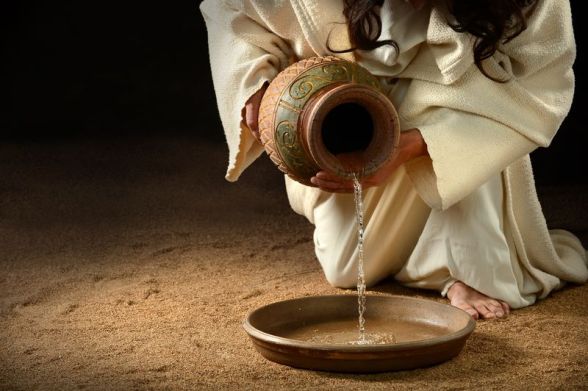
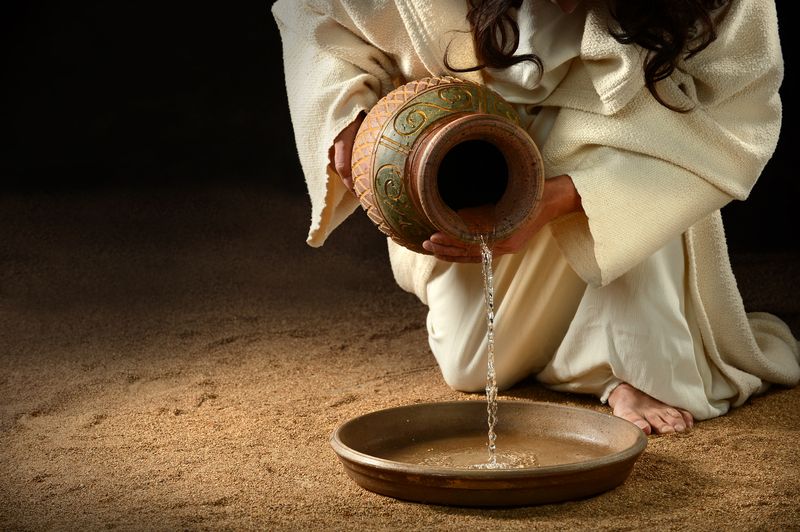
What stands out for me this year is the extent of Jesus’ willingness to humble himself and serve humanity. Remember that this is God the Son we’re talking about. Not just a Rabbi, not just a priest, not a Bishop, not the Pope – God in human human form! Yet, Jesus, knowing his identity, gets up from the dinner table and strips down to his undergarments and dons a towel and washes the feet of his disciples. Peter, is so uncomfortable with this demonstration of humility from his master. And one wonders about Judas, who has already decided to betray Jesus, and Jesus already knows this – yet Jesus washes Judas’ feet also.
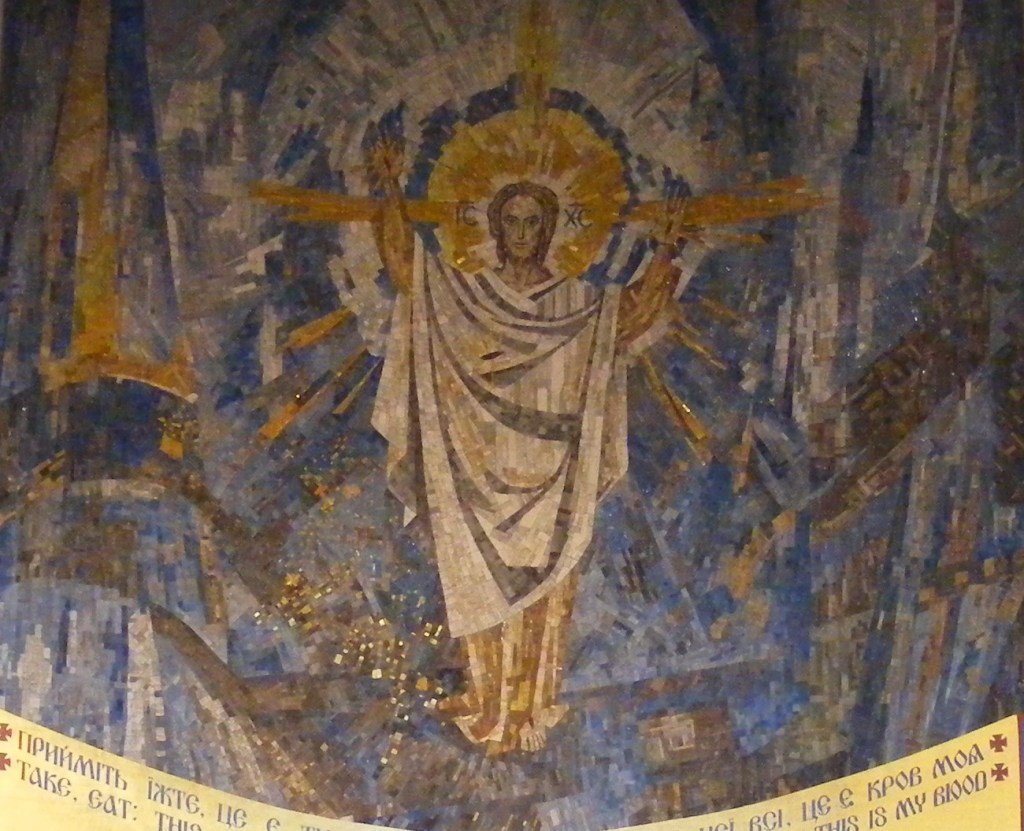
And he offers them his body – broken for us – and his blood – shed for us – for our salvation. He calls us to remember this every time we sit down for a meal. For Christians who follow the sacramental tradition – like us Anglicans – we celebrate this Eucharist at least once a week, because we regard this as the central demonstration of God’s love for us and so we re-enact Jesus great service to humanity.
Jesus whole stance, throughout his life, was one of servanthood. He is the lamb of God, foreshadowed by the Exodus story in Exodus 12:1-14. A life of sacrifice, of service, of humility, of love, of other-centredness.
After washing their feet, Jesus gets up and dresses again and takes up his place at the table and teaches them:
“Do you understand what I have done for you? You call me ‘Teacher’ and ‘Lord,’ and rightly so, for that is what I am. Now that I, your Lord and Teacher, have washed your feet, you also should wash one another’s feet. I have set you an example that you should do as I have done for you. Very truly I tell you, no servant is greater than his master, nor is a messenger greater than the one who sent him. Now that you know these things, you will be blessed if you do them.
And shortly thereafter he summarises his entire ministry (John 13:34-35):
A new command I give you: Love one another. As I have loved you, so you must love one another. By this everyone will know that you are my disciples, if you love one another.
May God give us the courage to walk his path of service.
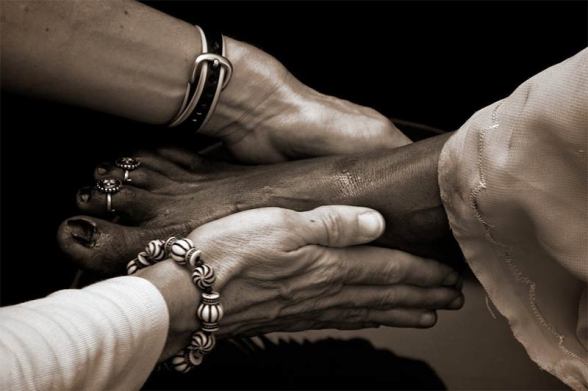
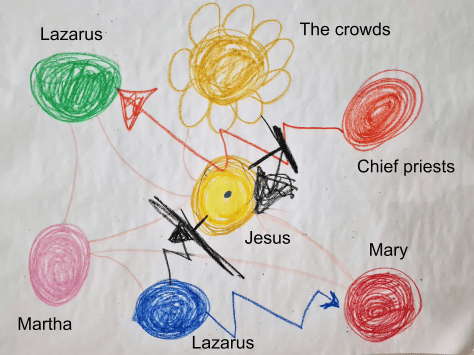
Today is the Monday of Holy Week. We read the story (John 12:1-11) of a dinner party hosted by Lazarus (whom Jesus had raised from the dead) and his sisters, Mary and Martha. During the dinner, Mary anoints Jesus’ feet with extremely expensive perfume and is reprimanded by Judas, who wants the money for himself. Meanwhile, crowds gather around the house, not only to see Jesus, but also to see Lazarus – the man back from the dead. And the chief priests plot to kill Lazarus, because his resurrection was adding to Jesus’ popularity.
In the midst of all this turmoil, Jesus is a quiet, strong, protective, light-filled centre. It is towards and into this centre that we should move when life’s challenges build up around us.
I invite you to watch the reading of the Gospel from John 12:1-11, which starts at about 14 minutes into the service. And the sermon starts at about 22 minutes and runs for about 23 minutes. This is a visual sermon, mapped out on a flipchart, so you really do need to watch it and not just listen to it. May you place yourself in the centre of Christ, in his light and peace – the best place to be!
In John 5, Jesus is accused of considering himself “equal with God”. And in his response (in verses 19-23), instead of defending himself, Jesus actually confirms the charge:
Jesus gave them this answer: “Very truly I tell you, the Son can do nothing by himself; he can do only what he sees his Father doing, because whatever the Father does the Son also does. For the Father loves the Son and shows him all he does. Yes, and he will show him even greater works than these, so that you will be amazed. For just as the Father raises the dead and gives them life, even so the Son gives life to whom he is pleased to give it. Moreover, the Father judges no one, but has entrusted all judgment to the Son, that all may honor the Son just as they honor the Father. Whoever does not honor the Son does not honor the Father, who sent him.
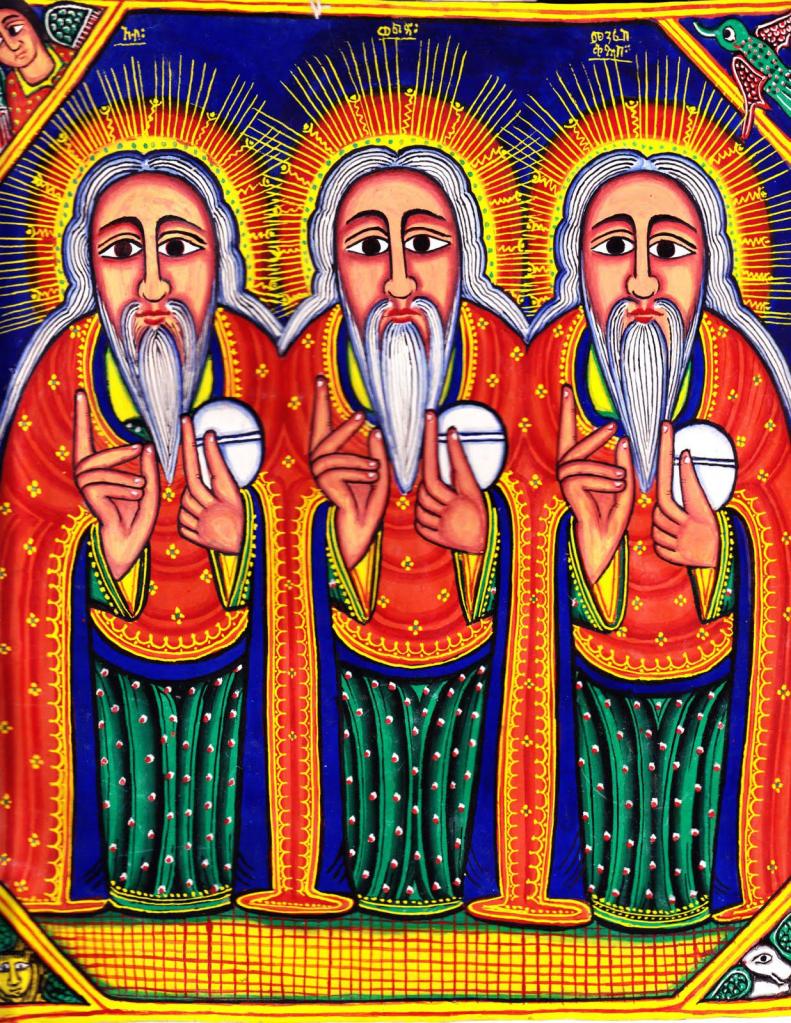
Jesus considers himself one with God – he and his father are one. They are equal, one being, even though he clearly shows that they are not the same person – for example, the Father does not judge; that role is given to the Son. But there is a closeness and alignment of purpose and desire between Father and Son (and also Holy Spirit) that leads us to the doctrine of the Trinity.
Given close unity between Father and Son, we also should strive to be one with God – to act in accordance with God’s will, to align our desires and intentions with God’s, to adopt as our own God’s values and priorities. Jesus is our example for all life. Let us become one with God.
God has always been working for our salvation and continues to do so today. This work culminates the life, death and resurrection of Christ, hence Jesus says we need to be born again. This salvation work is motivated by God’s great love, kindness, mercy and grace towards us (Ephesians 2: 1-10). Even though we were dead in our transgressions and sins – deserving of God’s wrath – God does everything to save us. Jesus himself says, “For God so loved the world that he gave his one and only Son, that whoever believes in him shall not perish but have eternal life. For God did not send his Son into the world to condemn the world, but to save the world through him” (John 3:14-21).
God’s stance towards you is always open armed – always.
God is always open towards you even if you don’t believe in him – always.
God is always moving towards you – always.
God is always turned towards you, even when you turn away from him – always.
God is always turned towards you, even when you sin – always.
God always reorientates himself towards you as you move through life – always.
God is always positively disposed towards you – always.
God always loves you – always.
God is always kind towards you – always.
God is always full of grace and mercy towards you – always.
God is always hoping you will respond to him – always.
Today is surely a watershed moment for the world: 20 January 2021, the end of Donald Trump’s administration. Whether or not one is an American, this change of administration will surely impact the world in one way or another.
This is not a sermon about America or American politics, however. Rather it is a sermon about what defines a Christian. When we look at the American right and left, who are so profoundly divided at this time, and yet who both comprise large numbers of Christians who believe that their politics is aligned with their Christian faith, we must ask, What does it mean to be a Christian? How can Christians, who follow the same book of teachings, be so polarised when it comes to their beliefs, practices and policies?
Perhaps one of the reasons is the weight that different groups of Christians give to different parts of the Bible. While we (are exhorted to) believe that “all Scripture [that is, the whole of the Bible] is God-breathed and is useful for teaching, rebuking, correcting and training in righteousness” (2 Timothy 3:16), if we base our Christian beliefs, practices and policies on the first Testament (the Old Testament) more than on the Gospels, or even on the rest of the second Testament more than on the Gospels, then something is wrong.
The Gospels present to us the very life, ministry and teaching of God the Son. These are not subsequent interpretations of Christ’s ministry, but Christ’s ministry itself. If we want to see God, we must look at his Son; and we get his Son in the Gospels. Jesus Christ’s life, as recorded in the Gospels, must be the template for Christian belief, practice and policy. And all the rest of the Bible must be interpreted through the Gospels.
Ironically, our reading today is not from the Gospels, but from Paul’s letter, where he writes about the central message we get from the Gospels: live a life of love.
Be kind and compassionate to one another, forgiving each other, just as in Christ God forgave you. Follow God’s example, therefore, as dearly loved children and live a life of love, just as Christ loved us and gave himself up for us as a fragrant offering and sacrifice to God. (Ephesians 4:32-5:2)
The life of a Christian must be rooted in love. This passage is not about love for other Christians, but love for all humanity. Paul emphasises the love that God had for us before we were saved – the love that led to God’s forgiveness of us and of Christ’s offering of himself as a sacrifice to God – these are about God’s love for us before we were saved, and thus the example is for how we love the whole world.
Love is the foundation of Christian life. Indeed, these verses are part of a larger passage which opens as follows:
So I tell you this, and insist on it in the Lord, that you must no longer live as the Gentiles do, in the futility of their thinking. They are darkened in their understanding and separated from the life of God because of the ignorance that is in them due to the hardening of their hearts. (Ephesians 4:17-18)
In other words, Paul sees this ‘life of love’ as constituting a fundamental difference between Christian life and non-Christian life. Our love for others is what is supposed to define us as Christians and differentiate us from everyone else. Indeed, Christ himself gives us this great command:
A new command I give you: Love one another. As I have loved you, so you must love one another. By this everyone will know that you are my disciples, if you love one another. (John 13:34-35)
This love for other people (and indeed for the whole of creation) is fundamental to what it means to be Christian. It is only after all this, that Paul then says, “But among you there must not be even a hint of sexual immorality” (Ephesians 5:3) and then goes on to talk about morality. Morality is important, but the life of love is even more important. When we place morality above love, we are out of step with Christ, who consistently placed love above everything else. If you are placing morality above love, you must go back to the Gospels and see how Jesus lived, what he said and how he related to people.
What is most important and definitive in the life of Christ is the life of love, which is a love that is radical and inclusive. It is this kind of love that is supposed to inform our beliefs (how we understand God, ourselves and the world), our practices (how we life our life moment by moment) and our policies (or politics).
We pray for the people of America and their new president. We pray for a drawing closer together of the American people, a reduction in polarisation and anger, and a greater rooting of life in the Gospel message of love for one another. And we pray also for ourselves and our nation, which has its own challenges.













 Reflections of God's Love
