Filled with the Spirit

Click here to listen to the audio recording of this 13-minute message. Or watch the video of the message on Facebook video (the message starts at about 25 minutes). Or read the text summary below.

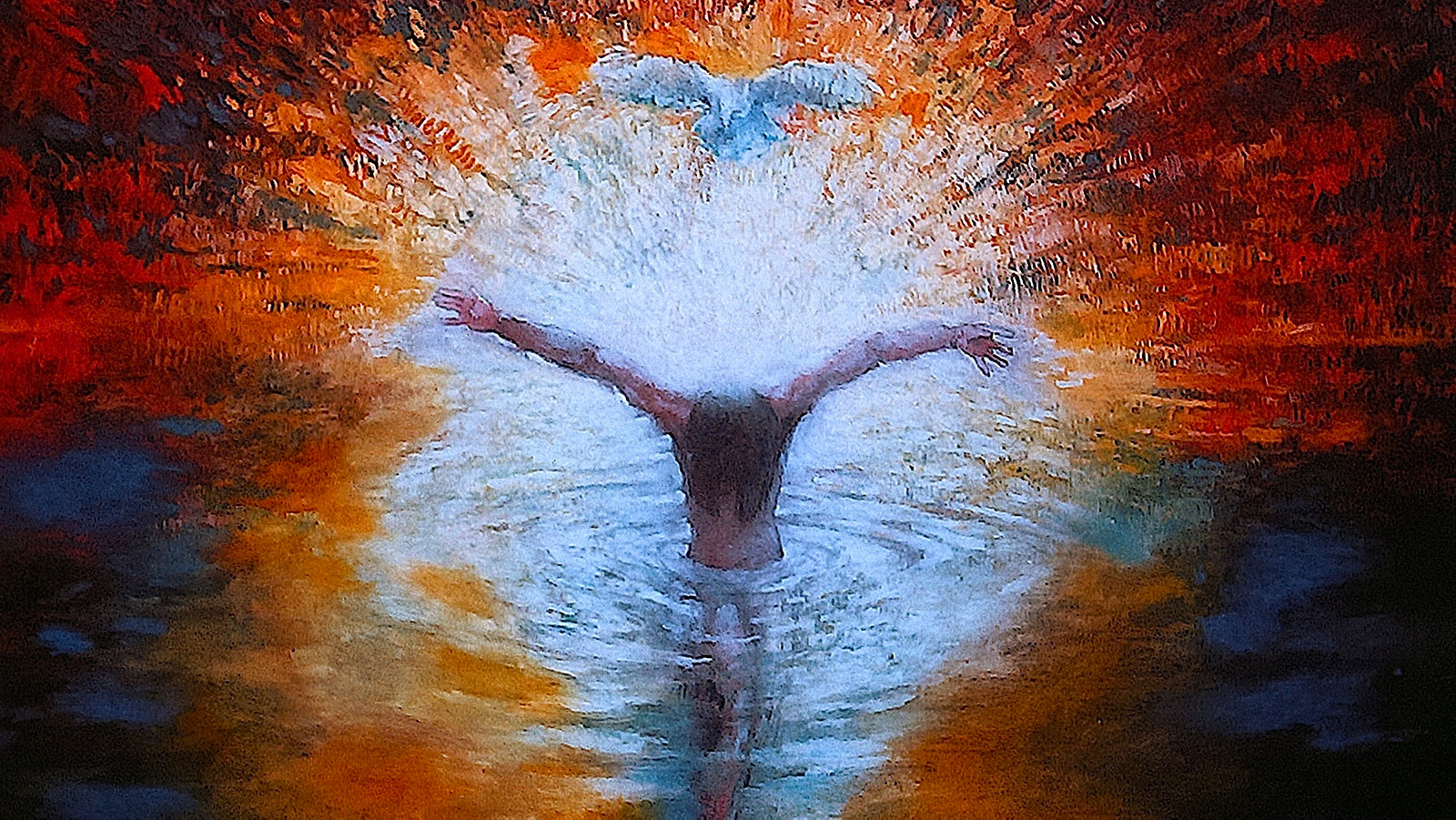
Today we commemorate and celebrate Jesus’ baptism by John in the river Jordan. Mark 1:10 tells us that “as Jesus was coming up out of the water” the Spirit descended “on him like a dove”. Jesus’ ministry starts with him being filled will the Spirit. Surely, if the Spirit is important for his life and ministry, the Spirit must be important for ours also.

Indeed, all of our readings for today speak about the work of the Spirit. Genesis 1:2 tells us that when God was creating the heavens and the earth, “the Spirit of God was hovering over the waters”. Holy Spirit was there, partnering with God in creation. And Psalm 29:3 echoes these words: “the voice of the Lord is over the waters … the Lord thunders over the mighty waters” – suggesting that the Spirit and the Lord are one and the same God. Holy Spirit is active in creation.

In Acts 19:1-7, Paul met up with some of John’s disciples and asks them if they received the Holy Spirit when they believed. They say they did not – indeed, they did not even know there was a Holy Spirit. Paul lays his hands on them and “the Holy Spirit came on them and they spoke in tongues and prophesied”. Much as we see in the story of Pentecost in Acts 2, Holy Spirit equips people for ministry.

Clearly, the Spirit is essential for creation or creativity and for ministry. Luke 4:1 tells us that after his baptism, Jesus was “full of the Holy Spirit” and that it was the Spirit who led him into the wilderness, where he was tempted. If Jesus needed to be filled with the Spirit, how much more do we need the filling of the Spirit? Paul is emphatic in Ephesians 5:18: “Be filled with the Spirit”.

Hopefully you are convinced that we need to be filled with the Spirit. If so, the question is ‘how?’ How are we to be filled with the Spirit?

Let me start by affirming that if you believe in Jesus – if you are a Christian – then Holy Spirit is already living in you. Paul makes this clear in 1 Corinthians 6:19: “Do you not know that your bodies are temples of the Holy Spirit, who is in you, whom you have received from God?” You cannot become a Christian without the working of the Spirit. So if you are a Christian, you already have the Spirit in you, whether you know it or not. Being filled with the Spirit then is something additional to this. (Remember that Jesus was already the Son of God when he was filled with the Spirit.)

How can we be filled with the Spirit? There is no formula for being filled with the Spirit. I offer some suggestions based on my own experience and the experiences I’ve heard from or seen in others:

  • Say a prayer asking Holy Spirit to fill you.
  • Ask someone to lay hands on you and pray for you to be filled with the Spirit.
  • Say a prayer in which you tell the Spirit that you surrender to the Spirit.
  • Bearing in mind that the Spirit is already in you, but that the Spirit might be shackled or chained, thus prevented from working fully, say a prayer in which you you unchain, unshackle and free-up the Spirit to work in you.
  • Identify specific areas of your life (e.g., your finances, marriage, mental health, sexuality) that you are keeping back from God and invite the Spirit to fill these areas of your life.
  • Do a walking prayer, saying “Holy Spirit fill me” as you breathe in and “I surrender to you” as you breathe out.
  • Or anything else that works for you…

I encourage you to seek the infilling of the Spirit. Not as a once-off thing, but as a regular thing. Being filled with the Spirit is not an event, but an ongoing way of life, in which we keep in step with the Spirit, like breathing. When we are filled with the Spirit, our faith will grow and flourish, our prayer life will deepen, we’ll more easily understand the Bible, and our ministry will strengthen and expand. This is what living in the Spirit is about.

Be filled with the Spirit!
Featured image from https://dg.imgix.net/why-was-jesus-baptized-en/landscape/why-was-jesus-baptized.jpg

What kind of people are we?

Click here to listen to the audio of this 18-minute message (best sound quality). Or watch the video on Facebook (the sermon starts at 25 minutes). Or read the text summary below.

Today, the central question I am asking is, What kind of people are we?

Or phrased differently, What kind of people ought we to be?

John the Baptist was the last in the line of First Testament prophets. He, like those who came before him, pointed the way to Messiah, the Christ, who appeared as Jesus of Nazareth. Mark 1:1-8 introduces John to us, telling that he came as a messenger in advance of the coming of Jesus, the Son of God, to prepare the way for the Lord.

John did this preparation by preaching a baptism of repentance for the forgiveness of sins. This was his clear message. And instead of pointing to himself or puffing himself up, he continually pointed to the one who was still to come, saying:

After me comes the one more powerful than I, the straps of whose sandals I am not worthy to stoop down and untie. I baptize you with water, but he will baptize you with the Holy Spirit. (Mark 1:7-8)

When John was a new-born, his father Zechariah said much the same about him in Luke 1:67-79. After eight verses about the coming Messiah, Zechariah finally gets to his own son, and in just four verses proclaims his mission:

And you, my child, will be called a prophet of the Most High; for you will go on before the Lord to prepare the way for him, to give his people the knowledge of salvation through the forgiveness of their sins, because of the tender mercy of our God, by which the rising sun will come to us from heaven to shine on those living in darkness and in the shadow of death, to guide our feet into the path of peace. (Luke 1:76-79)

And all of this was prophesied hundreds of years before by Isaiah in chapter 40:1-5. where he says:

Comfort, comfort my people, says your God. Speak tenderly to Jerusalem, and proclaim to her that her hard service has been completed, that her sin has been paid for, that she has received from the LORD’s hand double for all her sins. A voice of one calling: “In the wilderness prepare the way for the LORD; make straight in the desert a highway for our God. Every valley shall be raised up, every mountain and hill made low; the rough ground shall become level, the rugged places a plain. And the glory of the LORD will be revealed, and all people will see it together. For the mouth of the LORD has spoken.” (Isaiah 40:1-5)

All of these passages have this in common:

John prepared the way for the coming of Jesus by preaching repentance, forgiveness and comfort

John came, Jesus followed and John died. And then Jesus died, rose again and ascended to heaven.

We are now waiting for him to return. And while we wait:

We are to prepare the way for the second coming of Jesus by preaching repentance, forgiveness and comfort

So, as we prepare for Jesus’ return, we need to consider who we are pointing to and what message we are proclaiming through our actions and words. In 2 Peter 3:11, Peter asks this penetrating question, “What kind of people ought you to be?” He asks this in the context of second coming of Christ Jesus. Given that he is coming back soon,

What kind of people ought we to be?

We at my parish, St Stephens in Lyttelton, South Africa, are currently conducting a survey among our parishioners about what kind of church we are and what kind of church we aspire to be. One of the questions we asked was, “What qualities, values or characteristics you would like St Stephen’s to embody?” We’re still busy with the survey, but here is what we’ve learned so far:

  • God focus:
    • Focus on God, honour God’s commandments, serve God
    • Prayer, spirituality, faith, hope, wisdom
  • Relational focus:
    • Love, care, kindness, compassion, tolerance
    • Friendliness, companionship, good relationships
    • Sense of community, collaboration
    • Honesty, authenticity
    • Equality for all
    • Family values

These qualities, values or characteristics align well with Paul’s encouragement in Philippians 4:8:

Whatever is true, whatever is noble, whatever is right, whatever is pure, whatever is lovely, whatever is admirable—if anything is excellent or praiseworthy—think about such things.

A church that embodied these kinds of values and qualities would surely be a church people would want to attend, and would surely help to prepare the way for the Lord’s return, and would surely be pleasing to God.

Let us be this kind of church!

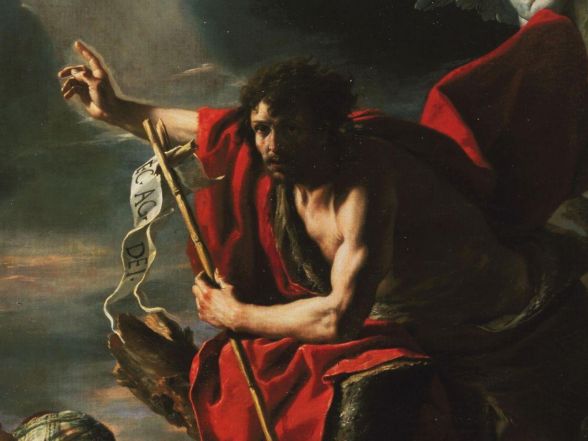
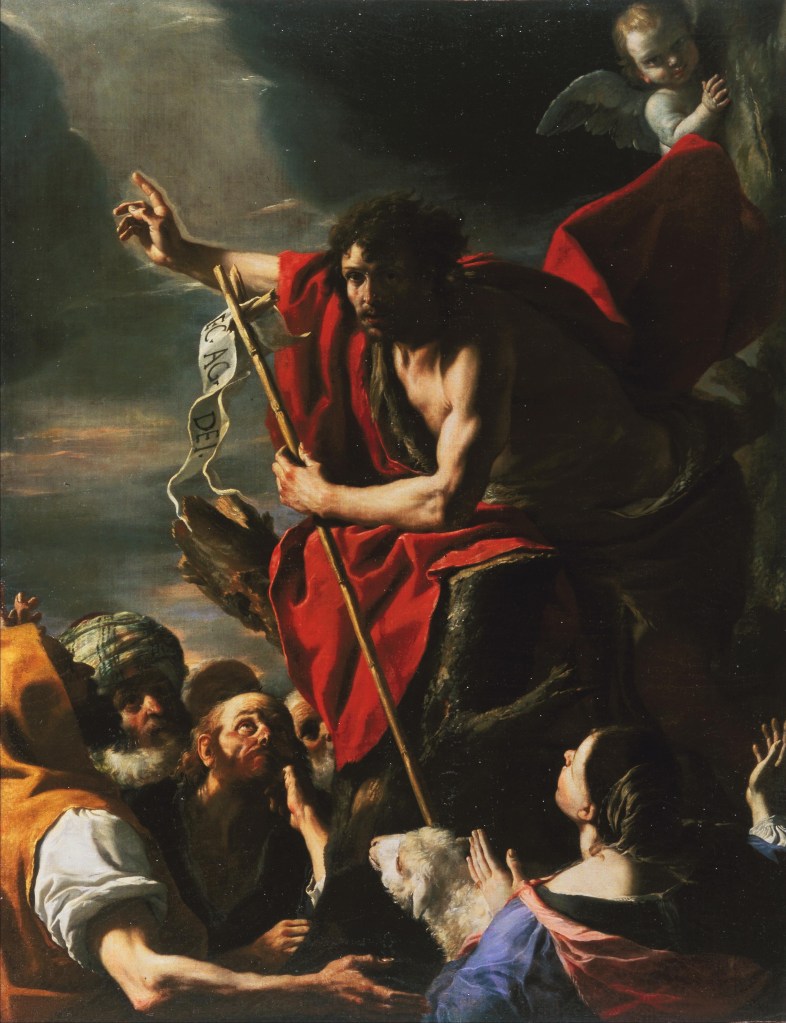
Featured image: St. John the Baptist Preaching, c. 1665, by Mattia Preti

Kindness

Click here to listen to the audio recording of this 9-minute message. Or watch the YouTube video. Or read the text summary afterwards.

We live in a world that seems to be increasingly self-centred, selfish, self-serving, self-obsessed. A world that seems often harsh, intolerant, judgmental, hostile and exclusionary. We are seeing a growth in nationalism – people putting their country’s needs first and subordinating or even rejecting the needs of the global community. Perhaps the world has always been this way. But it seems to me to be a growing trend over the past several years.

What do we as Christians do in such context?

When we want to know how to be behave in the world, the best place to go is to the Gospel narratives, to see how Jesus behaved. And to hear how Jesus spoke – not just his teachings, but what he said to people informally and how he spoke to and engaged with people.

In Matthew 15 we find the story of Jesus feeding the four thousand with a few fish and loaves of bread. The story starts with Jesus healing people of a wide array of afflictions, leaving the crowds amazed. But in the middle of this story is a profound verse that ties the entire story together:

Jesus called his disciples to him and said, “I have compassion for these people; they have already been with me three days and have nothing to eat. I do not want to send them away hungry, or they may collapse on the way.” 

What we see here in Jesus is kindness. He is kind. We could say ‘compassionate’ and that would be correct. But ‘kind’ is a much simpler, shorter word. It is the word a child is likely to use.

If we scan through the pages of the Gospels, we will see more and more examples of Jesus being kind. He is thoughtful, considerate, sensitive, responsive, engaged, attentive, slow, open, willing, touchy, generous. in a word: kind.

Psalm 23 is also a set reading for today: The Lord is my shepherd. The shepherd also is kind. Indeed, there are numerous passages in the first and second testaments about shepherds who care for and protect their sheep, who seek lost sheep, who bind up and heal injured sheep, who fight off wild animals. These images of shepherding are images of kindness.

Jesus was kind – let us be kind.

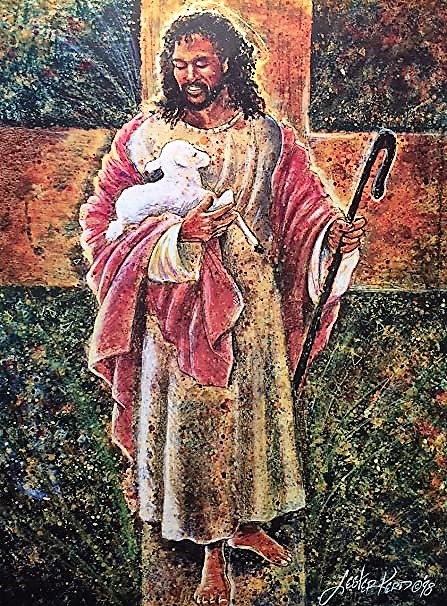
Painting by Lester Kern,
from https://www.amazon.com/He-Walks-Me-Religious-Unframed/dp/B011O9Q2MA

Who do you say I am?

Click here to listen to the audio of this 16-minute message. Or watch the YouTube video below, or read the text summary after that.

In Matthew 16:15, Jesus asks his disciples, “But what about you? Who do you say I am?” This is arguably the most central question of our faith as Christians. We are, after all, Christians. We are followers of Christ. Who Christ is – this person we follow, this person whose name defines our faith -is thus of central importance.

Jesus first asked, in Matthew 16:13, “Who do people say the Son of Man is?” and the disciples run off a list of names: “John the Baptist, Elijah, Jeremiah or one of the prophets.” These are all great prophets, and in some ways Jesus is the preeminent prophet. A prophet reveals God’s mind to us, opens up the truth of God to us. And certainly Jesus does do that. But they stop short. Jesus is so much more than ‘just’ a prophet.

So, if your answer to Jesus’ question is things like (for me) – my friend, my brother, my healer, my whole-maker, my teacher, my example, my comforter, my safe space, and so on – these are right (they are certainly not wrong!), but they don’t go far enough.

This is the only place in Matthew’s Gospel where Jesus engages in discussion about himself. He is doing identity work here – discussing who he is with his disciples. This takes place in chapter 16 of a 28-chapter book. So, it appears in the second half of the Gospel. Jesus is half-way through his journey with his disciples, and only now does he ask who they say he is. This is meaningful.

As Christians, particularly evangelical Christians, we tend to have an expectation that people must make a statement of faith in Christ as a prerequisite for conversion. But here, Jesus has allowed his disciples to walk alongside him and witness his life and his engagement with the world for a long time. And only now, much later, does he ask for a statement of faith.

The understanding of who Jesus is is not the prerequisite for faith, but the result of the journey of faith.

I converted to Christianity at age 16. At that moment, on the evening of 21 October 1984, I really didn’t know who Christ was. All I knew was that God was calling me and I had to respond to his call. It was only over years of journeying with him, through all the ups and downs of faith, that my understanding of who he is and of who he is for me has become clearer. And I anticipate in the following decades of my life, this understanding will continue to mature and deepen.

Peter’s answer, after having walked with Christ, is strong and certain: “You are the Messiah, the Son of the living God.” In the Greek, the phrasing is, “You are the Christ, the Son of the God, of the Living One”. There were, in Peter’s time, as in our time, many Gods. He feels the need to qualify who he is referring to when he says ‘God’. He is not referring to just any God, but to the God who is alive, the Living God.

It is important for us to incorporate into our experience of who Christ is for us the insight that he is the Christ, the Messiah, the Anointed One, the Son of God, God the Son, the Logos, a member of the triune Godhead, the one who has been present since before time and will continue to present after time itself has ended. This is who Jesus is!

But what about you?
Who do you say I am?

Eternity just here

Click here to listen to the audio recording of this 10-minute message. Or watch the YouTube video below, or read the text summary that follow.

Jesus goes up the mountain with Peter, James and John to pray (Luke 9:28-31). While he prays, the appearance of his face changes and his clothes become as bright as a lightning flash. And he is seen talking with Moses and Elijah, the great heroes of the Jewish community.

The boundary that separates the ordinary, daily, lived world that we inhabit from the world of the divine, of eternity, of spiritual beings, of God – that boundary is momentarily breached. It is like a dividing curtain has been pulled aside and we are given a glimpse into heaven itself.

These two worlds – the earthly finite world and the heavenly eternal world – are always touching, pressed right up against each other. Indeed, there are people crossing over from one to the other every minute, as they die.

The materialistic world view – that we believe in only what we can see and touch, measure and weigh – has become so prominent in the world today. Many people have given up any belief in a spiritual realm, in an afterlife, in God.

Luke tells us that Peter and his companions were very sleepy, but that when they became fully awake, they saw his glory (Luke 9:32). He emphasises this because we all know that when we sleep and dream, anything is possible. The rules of this material world do not apply when we are asleep. Had the disciples been ‘sleepy’ when they saw Jesus transfigure, we could put their story down to them just dreaming. But Luke emphasises this – they were fully awake – all of their critical, rational faculties, all of their empirical senses were fully active when they saw the glory of Jesus revealed.

How wonderful it would be if we were all fully awake so that we too could perceive the eternal that is just here.

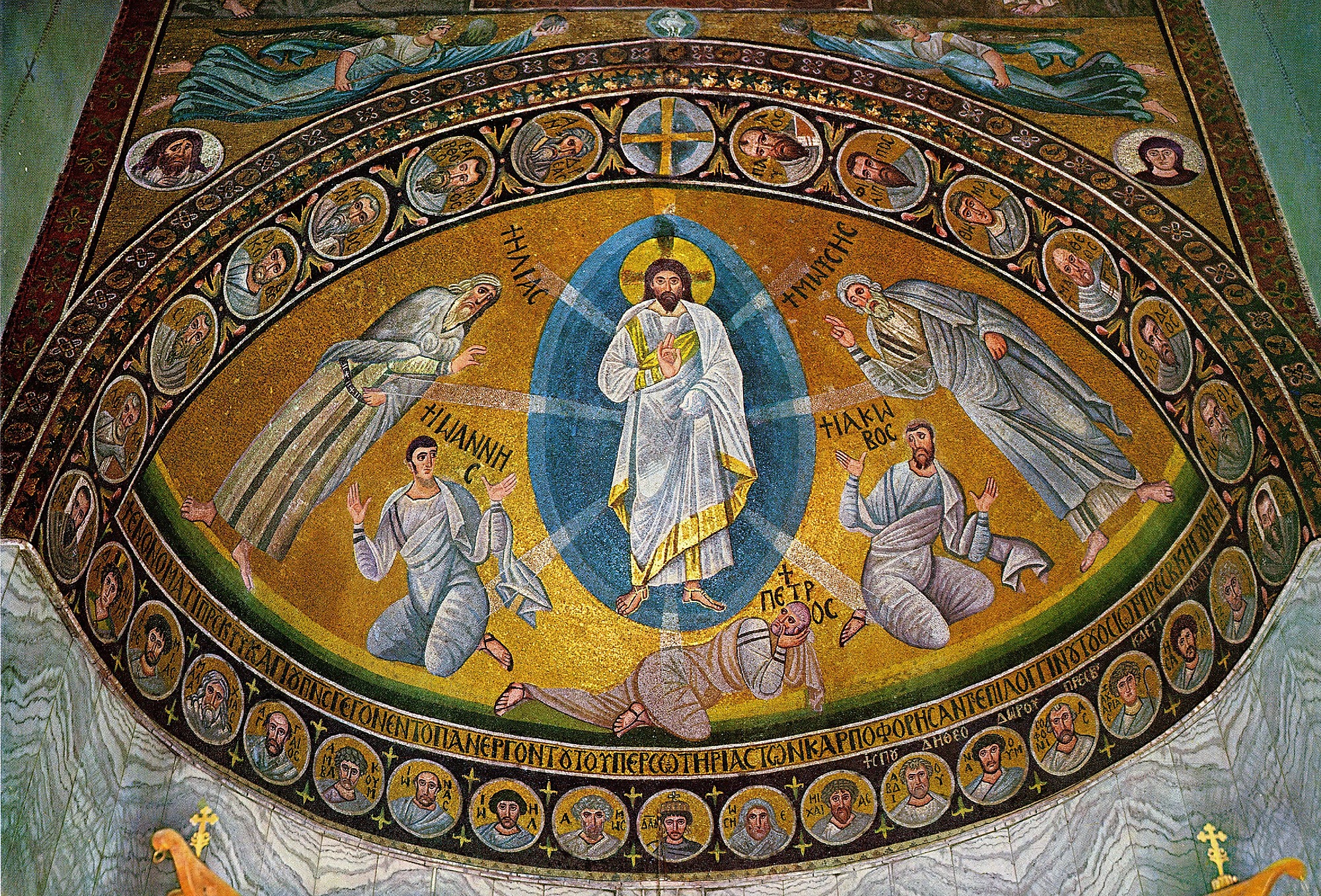
2020.08.06_Saint_Catherines_TransfigurationFeatured image of the apse mosaic of the Transfiguration scene from St. Catherine monastery in Sinai, available here. This is the oldest known image of the transfiguration, dating to AD 565-6.

Visit this website to learn more about this piece of art, as well as other artists’ depictions of the transfiguration: http://tamedcynic.org/the-transfiguration-through-art/

Why Jesus would say ‘Black Lives Matter’

Click here to listen to the audio of this 14-minute message. Or watch the YouTube video below, or read the very brief textual summary that follows.

I appreciate that this topic will be controversial for many. I really encourage you to watch this message please and not just read it, particularly if you find the title problematic. At least, just listen to what I have to say, even if you decide you don’t agree with it.

But, very briefly, the main points are:

  1. Jesus died for ALL of humanity – for the whole world – and would thus say, without equivocation, ‘All lives matter‘.
  2. But Jesus would also confront us, saying that we do not live our lives as if all lives mattered.
  3. Jesus’ ministry consistently and deliberately positions himself with those who are vulnerable, oppressed, poor, or marginalised: women, Samaritans, lepers, prostitutes, menstruating women, the dead.
  4. Throughout his ministry – throughout the Gospels – Jesus enacts the message that Black lives matter, Women’s lives matter, Immigrants’ lives matter, Children’s lives matter, etc.
  5. Jesus is not saying the lives of the poor matter more than other people’s lives; but that their lives do not matter less than other people’s lives.
  6. Jesus is sensitive to power differentials and deliberately chooses to stand with those who are disempowered and often against those who are powerful. The story of the woman caught in adultery is a good example.
  7. Jesus sometimes engages with the powerful, but does so in a way that helps them to recognise and challenge their privilege. The story of Zacchaeus is a good example example.
  8. Jesus’ ministry is consistently one of bringing down the powerful and raising up the powerless – a reversal of fortunes. Mary’s Magnificat is a good sermon on this.
  9. In the new heaven and the new earth, all lives will actually matter in people’s lives experience. But in today’s society, this is not true. Today, all lives are not equal and not equally valued. And in this times, Jesus would be saying: Women’s lives matter, Children’s lives matter, Immigrant lives matter, LGBTQI lives matter, Black lives matter.

Jesus at the centre

Click here to listen the audio of this 13-minute message. Or watch the YouTube video of the message below, or read the text summary after that.

John 14:6-11 is located immediately after the Last Supper and the washing of the disciples’ feet, as well as Jesus’ prediction of Judas’ and Peter’s betrayals. John 14 starts a four-chapter long sermon – Jesus’ final words to his disciples before his death.

In the opening of this section, Jesus presents himself as at the centre of our faith. He says to Peter, “You [already] believe in God [the Father]; [I now invite you to] believe also in me” (John 14:1). To believe in the Father is to believe in the Son. He goes on famously to say, “I am the way and the truth and the life. No one comes to the Father except through me” (John 14:6). Jesus places himself at the centre of our relationship with God the Father. It is through him that we encounter God. Jesus is the centre.

But lest we think that Jesus is setting himself up as the mediator between us and God, he goes even further, audaciously, to say that he and the Father are one. “If you really know me, you will not know my Father as well … Anyone who has seen me has seen the Father … Don’t you believe that I am in the Father and that the Father is is in me? … I am in the Father and the Father is in me” (John 14:7-11). And just a few chapters earlier, Jesus had said, “I and the Father are one” (John 10:30).

Jesus is not merely a path to God. He is God. He is God the Son. He is locked into the Father and the Father is locked into him. In the very following passage (John 14:15-27), Jesus speaks about Holy Spirit, the third person of the Trinity, who will come to continue the work of the Father and the Son, once the Son has returned to the Father. When we relate to Jesus, we are relating to God, because Jesus is God.

Ultimately, sensing that Philip and the other disciples are grappling to grasp these complex and elusive concepts, Jesus says, “At least believe on the evidence of the works themselves” (John 14:11): You have heard me teaching. You have seen me heal people, raise the dead, feed thousands. You have witnessed me reaching out to women, tax collectors, lepers, prostitutes, menstruating women, disabled people, Samaritans and Gentiles. You have heard me speak truth to power and challenge rigid interpretations of the law. You have heard me proclaim a new Law that supersedes the Law of Moses.

What you are seeing is God at work among you!

Jesus must be at the centre of our personal and collective faith. The things of the church are helpful and perhaps even important. Jesus does not do away with them. But they must not be at the centre.

Jesus – the person Jesus – is the only one worthy of being at the centre.

He is our friend, our brother, our teacher, our healer, our saviour, our Lord, our very God.

2020.05.10_6059765012_d7fafb9504_b

Featured image is the ‘glory window’ of the Thanksgiving Chapel in Dallas, Texas.

The Great Love of Jesus

Click here to listen to this 7-minute message. Or watch the YouTube video below, or read the text that follows after that.

Today is Maundy Thursday, the first of a trio of days called the ‘Triduum’, which includes Maundy Thursday, Good Friday and Holy Saturday – the three days before Christ’s resurrection on Saturday. On Maundy Thursday evening we usually have a service that commemorates and celebrates two key events in Jesus’ life this day: the Last Supper and the washing of the disciples’ feet. These are two enormous demonstrations of the great, extravagant, generous love that Jesus has for all of humankind.

The Last Supper is a symbolic enactment of Jesus’ giving of himself to us – his body and his blood. He is about to pour himself out for humanity, and indeed for the cosmos. And so he takes and blesses bread and wine and gives them to his disciples as a metaphorical giving of himself to us, so that we have within us – which is why we consume the bread and wine – the presence of Christ.

During a Eucharist service, when I distribute the host – the body of Christ – I say the words, “Receive the body of Christ, broken for you, because he loves you.” I want people to experience that this bit of ‘bread’ is a tangible manifestation of Christ’s great love for them. Sometimes, I even press the host into the palm of their hand, until the person pushes back against me, to give an unmistakable physical experience of the presence of Jesus being pressed into their body.

The washing of the disciples’ feet speaks most clearly of Jesus’ servant attitude. He did not come to be glorified or worshiped or exalted. Rather, he came to serve. And this service is vividly demonstrated in his taking off his outer clothes, putting a towel around his waist and getting down on his knees to wash the feet of his followers. It shows again his self-giving and self-sacrificial love, and his willingness to give the whole of himself for our salvation.

In these two acts – the Last Supper and the foot washing – Jesus reminds you that he loves YOU. You who are reading this right now! Say your name out loud now ______________ and hear this message: God love you ______________ . He loves you profoundly and generously, utterly and unconditionally. Try to remember this during the rest of the day.

To help you remember, I suggest you periodically press your thumb into the palm of your other hand and think the words, “This is my body, broken for you, because I love you.”

Featured image from: https://baptistmag.org.nz/feet-washing/

Look! The Lamb of God

Click here to listen to this 23-minute message.

This message is a call for us to see and look at Jesus, the Lamb of God. And to point him out others. This was the mission of John the Baptist, and it as much ours today.

We are still in the period of Epiphany, where we focus on the manifestation or revealing of Jesus Christ as the Son of God, as God’s Chosen One. Our reading for this Sunday is John 1:29-37:

29 The next day John saw Jesus coming toward him and said, “Look, the Lamb of God, who takes away the sin of the world! 30 This is the one I meant when I said, ‘A man who comes after me has surpassed me because he was before me.’ 31 I myself did not know him, but the reason I came baptizing with water was that he might be revealed to Israel.”

32 Then John gave this testimony: “I saw the Spirit come down from heaven as a dove and remain on him. 33 And I myself did not know him, but the one who sent me to baptize with water told me, ‘The man on whom you see the Spirit come down and remain is the one who will baptize with the Holy Spirit.’ 34 I have seen and I testify that this is God’s Chosen One [or Son].”

35 The next day John was there again with two of his disciples. 36 When he saw Jesus passing by, he said, “Look, the Lamb of God!” 37 When the two disciples heard him say this, they followed Jesus.

Bruner, who has written a wonderful (1200 page) commentary on John, translates some of these verses differently, emphasising the use of present and continuous tenses in the original Greek, notably:

29 The next day John sees Jesus coming toward him, and he says, “Look! The Lamb of the God, the One who is taking away the sin of the world!

36 And John looked intently at Jesus as Jesus is walking by and he says, “Look! The Lamb of God!” 

I focus on these two verses in this message, as I have felt God speaking to me particularly insistently this week about verse 29. And I make five points:

  1. John sees Jesus coming and walking towards him. Jesus is always coming towards us, even if we are moving away from him. His trajectory is always in our direction.
  2. Look! John twice says, “Look!”. I like Bruner’s addition of the exclamation mark, as it emphasises that this is a call, an imperative. John wants us to stop drifting through life blindly. Or from being so focused on other things that we don’t notice Christ coming towards us. So he calls out, in excitement, perhaps even in alarm, “Look! Look out!”
  3. Jesus is taking away the sin of the world. This is a pretty packed little sentence:
    • John speaks about ‘sin‘, not ‘sins’. It is the condition of being sinful that Jesus takes away, rather than the individual sinful acts that we do.
    • John says that Jesus ‘is taking‘, emphasising that this is a continuous activity, that has already begun, is presently happening and will continue to happen in the future. While Jesus’ death on and resurrection from the cross are surely pivotal in salvation, God has been saving humanity through the Son from the time of the fall, throughout the First Testament, through Jesus’ incarnation, life and ministry, through his death, resurrection and ascension, by the outpouring of Holy Spirit, and continuing to today and into the future. The Son of God has been and continues to be in the business of taking away sin.
    • It is the sin ‘of the world‘ (the ‘cosmos’) that Jesus takes away, not just the sin of those who repent, those who believe, those who are members of certain churches or religions, those who adhere to certain church rules or doctrine. Scripture abounds with verses that reinforce that salvation is for and of the whole world (the cosmos). It is a radical inclusion of the entire created order – the cosmos!
  4. Salvation is thus possible for all, but we have to take hold of it. That’s why John keeps saying, “Look!”, and why we are told in verse 37 that John’s disciples leave John to follow Jesus. Jesus is the Lamb of God who is taking away the sin of the world. In the Eucharist or Mass, we celebrate and re-member this great work of God the Son.
  5. And finally, we, like John and his disciples, and like Jesus’ disciples (about whose calling we learn in the rest of John 1), are invited to continue John’s ministry of pointing people to Jesus. We remind people that Christ is coming towards them. We call them to ‘Look!’ We point them not to our denomination, our pastors, our worship, ourselves; but towards Christ himself. And we show through our lives, our inclusivity, our radical love and our walking towards others that he is indeed taking away the sins of the world .

2020.01.19-Lamb of God

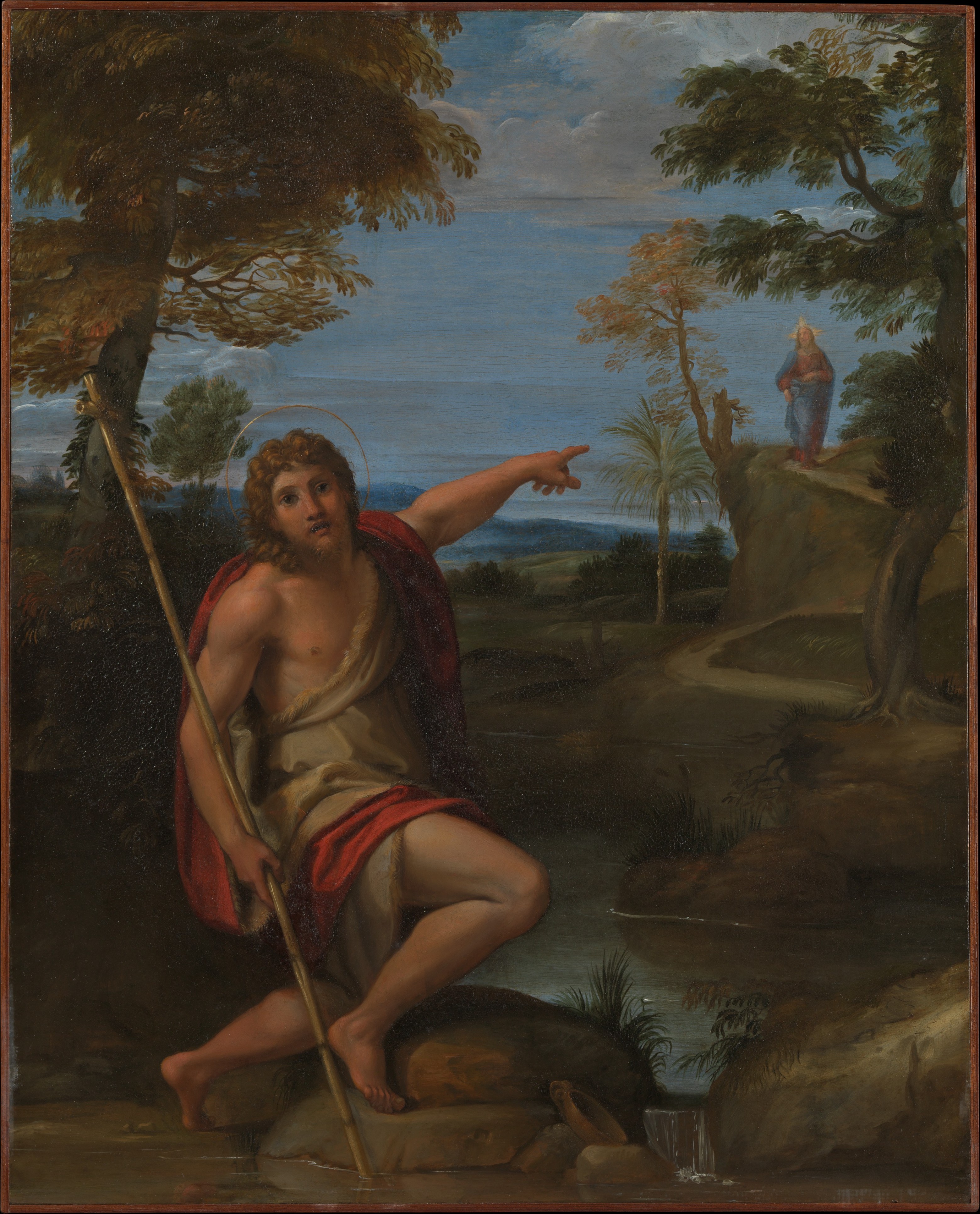
Featured image: Saint John the Baptist Bearing Witness, by Annibale Carracci, ca. 1600, downloaded from: https://www.metmuseum.org/art/collection/search/438813

To be saved

Click here to listen to this 19-minute message.

Our Gospel reading for today is the rather curious passage from Luke 20:27-38, which involves a convoluted story about a woman who was married and remarried to seven brothers in succession, with the hope that one of them would impregnate her. The question asked of Jesus by the Sadducees was which of them would be her husband at the resurrection. It is a rather awful story, filled with patriarchal beliefs about women, marriage and child bearing.

I did not feel God leading me to preach on this passage today.

However, the point of the story is of interest. Jesus affirms that there IS a resurrection, that there is an afterlife, and that it will be wonderful. And this affirmation of Jesus – that life does not simply end when our bodies die – prompts us to think about salvation and what it means to be saved.

For that, we turn to our Second Testament reading: 2 Thessalonians 2:13-17 (I’ve bolded some of the key words):

13 But we ought always to thank God for you, brothers and sisters loved by the Lord, because God chose you as firstfruits to be saved through the sanctifying work of the Spirit and through belief in the truth. 14 He called you to this through our gospel, that you might share in the glory of our Lord Jesus Christ.

15 So then, brothers and sisters, stand firm and hold fast to the teachings[b] we passed on to you, whether by word of mouth or by letter.

16 May our Lord Jesus Christ himself and God our Father, who loved us and by his grace gave us eternal encouragement and good hope, 17 encourage your hearts and strengthen you in every good deed and word.

What do we learn about salvation from this passage?

  • First, God chose us – God called us. Salvation is always God’s initiative. And God chooses and calls every person into fellowship with God. God’s mission is to reconcile the WHOLE world to God’s self, under the headship of Christ (Ephesians 1:9-14). When God calls us, God calls us by name. It is personal. God wants YOU personally. It is not just that God wants to save everyone, like some anonymous conglomerate of humanity. No! It is that God’s has chosen YOU personally, by name, and called you to be in fellowship with God, to be saved.
  • Second, we are saved through two main actions (according to this passage):
    • First, we are saved through the sanctifying work of the Spirit. When God calls us, Holy Spirit comes and resides in us. Spirit makes a home in our hearts, comes and lives inside of us (1 Corinthians 6:19). God works to transform us into the image of Christ, from the inside out, through the sanctifying work of the Spirit.
    • Second, we are saved through our belief in the truth. And what is this truth? Jesus Christ is truth (John 14:6; John 8:31-32). We can do nothing to attain salvation; salvation is in its entirety the result of Christ’s work, through creation, his incarnation, his ministry, his death, his resurrection and his ascension to the right hand of God. We can’t add to this. All we can do is respond to the truth of it. And ‘to believe in’ something or someone is much the same as ‘to trust in’ someone or even better, ‘to entrust ourselves’ to someone. We entrust ourselves into the truth of Jesus.
  • Third, the result of this salvation is that we get to share in the glory of our Lord Jesus Christ. It is not so much that we become glorious, but that we bask in the radiance of God’s glory. We can be confident that when we die, we enter into the enjoyable and wonderful presence of God. Jesus spoke about this in our earlier reading (Luke 20:36): “they can no longer die; for they are like the angels. They are God’s children, since they are children of the resurrection.”
  • Finally, because of all of this, we are encouraged to stand firm and hold fast to our faith. Sometimes, maybe often, our faith is frail and feeble. Sometimes life gets on top of us. Sometimes we succumb to sin. Sometimes pain, suffering and illness burden us. Sometimes evil in the world – violence, hatred, exclusion, oppression, poverty and injustice – overwhelm us. In these times, especially, God calls us, urges us, to stand firm in and to hold fast to Christ.

In Paul’s final words in this brief passage, he offers a blessing. I liked this blessing so much, we read it four times during the service, twice as a blessing, with my hand outstretched. I again stretch out my hands to you in blessing, saying:

May our Lord Jesus Christ himself and God our Father, who loved us and by his grace gave us eternal encouragement and good hope, encourage your hearts and strengthen you in every good deed and word.

2019.11.10_To_be_Saved