Today is Trinity Sunday and I provide a reflection on the notion of a triune God, drawing particularly on Proverbs 8, as well as Genesis 1 and Romans 5. The crux of it is that relationality is central to the being of God – the three-in-oneness of God. Therefore, the core of human life also is relationality. We need to invest in relationships, and we need to give particular attention to those relationships that are struggling or fragile.
Watch the video below of this 42-minute message. Yes, much longer than usual! I’m sorry about that, but it is – I think – worth the time, as a close reading of John 20:19-29 sheds to much light on Jesus’ character, his relationship with the disciples and his work as the Son of God. My notes are available below the video
Verses 19, 26 Both times Jesus “stood right in the middle of them”
Christ is the centre – not the priest, Bible, APB – only the person Christ
Christ-centred church
1, 19, 26 Easter Sunday morning – Jesus appears to Mary
Easter Sunday evening – Jesus appears in the upper room
Following Sunday (today) – Jesus appears again, to Thomas
19, 21, 26 Peace be with you – Shalom alechem x3
Easter Sunday – Christ made peace between us and God
Forgiveness of sins – done, paid for, wiped clean, forgotten, cast the deep
Everything is good. It’s all okay
Easter is the Great Forgiveness!
20 He showed them his hands and side
Emphasis on bodily resurrection, reconnected to his people
Not just some spiritual, esoteric thing
He is fully embodied, albeit with some unusual capacities
20 He could have come back healed, but doesn’t. Why?
His identification with us, solidarity with our pain & suffering
He remains the suffering servant of Isaiah 53 (4-5):
He took up our pain and bore our suffering. He was pierced for our transgressions, he was crushed for our iniquities, the punishment that brought us peace was on him, and by his wounds we are healed.
20 The disciples were overjoyed – full of joy
Joy (chara) & grace/gift (charis) – joy is a gift of God – because Jesus is back
21 “As the father has sent me, I am sending you”
We are to continue God’s work. We are sent, just as Christ was sent
Jn 3:16/7 “God so loved the world that he gave [sent] his one and only Son … For God did not send his Son to condemn the world, but to save it”
Every Christian is sent – not just clergy or evangelists
22 He breathed on them, “Receive the Holy Spirit”
Hebrew for spirit & breath are both? Ruach
Gen 1:2: Spirit of God hovering
22 Gen 2:7: “Then the Lord God formed a man from the dust of the ground and breathed into his nostrils the breath of life, and the man became a living being”
To receive Jesus’ breath & Holy Spirit is to be made a new living being
22 To receive Jesus’ breath & Holy Spirit is a grace/gift (charis)
As the Spirit/breath was active in the creation of earth and humanity
2 Cor 5:17: “If anyone is in Christ, they are a new creation. The old has passed away, the new has come.”
22 Holy Spirit poured out on Pentecost: Easter Season is from Easter Sunday to Pentecost
23Forgive anyone’s sin
The gift of HS is not so much miraculous signs, etc.
Instead the central commission – sending – is to forgive
And to warn that to not repent = no forgiveness
The Great Forgiveness!
24Thomas was not with the disciples when Jesus came.
Where was he? He should have been in church! We should be in church!
27 Touch, see
V20. Jesus showed them his hands and side.
Thomas wants what the others got – to see. But also to touch
Our Eucharist is a see and touch moment
– receive the body of Christ broken for you (not receive this bread)
– receive the blood of Christ (not receive this wine)
Not clear if Thomas did actually touch: “Thomas answered and said…”
Perhaps seeing and the invitation to touch was enough for him
27 Stop doubting and believe. Be a believer!!
Accept the small and periodic signs of God and believe into him
28My Lord and my God!
Hebrew: Yahweh & Elohim – names for God
Greek: Kyrie & Theos – names for God
The only place in the Gospels where Jesus is referred to as God – A profound statement of faith – perhaps the most
This 20-minute message is part of a larger reflection on Jesus’ beatitude, “Blessed are the peacemakers, for they shall be called the children of God” (Matthew 5:9). Today, the day before Maundy Thursday, we reflect on peacemaking in a broken world, by considering the story of Shadrack, Meshack and Abednego’s encounter with the grandiose, narcissist, golden King Nebuchadnezzar in Daniel 3. This passage – about imperialism and oppression, about the power of God, and about tyranny’s downfall – has great relevance in this world in 2025. The passage speaks to the presence of Christ in suffering. It speaks to the downfall of empires. It speaks to the power of disobedience, and the triumph of faith and smallness. Daniel 3 is a passage for today.
Today we celebrate Christ’s baptism, which inaugurates his ministry. John the Baptist had been preaching a Gospel of repentance for the forgiveness of sin, made tangible through baptism. And Jesus came to him to be baptised, even though Jesus was without sin.
As Jesus comes up out of the water, the heavens open and the Spirit of God descends on Jesus in the form of a dove, and the voice of God is heard saying, “You are my Son, whom I love; with you I am well pleased.” This is the only place in the Bible where Father, Son and Holy Spirit are tangibly present at the same time. This is an expression of the Epiphany, which is the season we’re currently in – Epiphany being all about God’s revelation of God’s self to the world. And this scene is certainly a great revelation of the triune God!
We could also think about this moment as an incarnation not only of Christ himself, but of all three persons of the Trinity – Jesus is there in the flesh, the Holy Spirit comes in bodily form like a dove, and God’s voice is audible to human ears (sound waves moving through the air). Father, Son and Spirit all materialise in the human world in that brief moment. This conveys the sense that the triune God works together for the salvation of humankind.
In our service, I invited three people to create a tableaux of the Father, the Spirit and the Son, similar to the paintings of Jesus’ baptism (see picture below). They are standing with their arms outstretched in love. This is an image of the triune God: three persons working in perfect harmony to pour out God’s love and salvation on humanity.
This expression of the triune God is flooded with love. Today’s first testament reading from Isaiah 43:1-7 contains these words from God: I created you, I have redeemed you, I have summoned you by name, I will be with you, I love you, I am with you, I will bring you, I will gather you, I formed you, I made you. And in Luke 3:22, we hear God saying, “You are my son, whom I love; with you I am well pleased”. We hear in these words the great enduring love that God has for his son and for us. And this is expressed through the incarnation and through the epiphany. It reminds us that love is the central characteristic of God – the foundation on which God engages within the triune Godhead and on which God engages with us.
We are encouraged, therefore, to rest into the great and generous love that God lavishes on us, which we see so clearly in the baptism of Christ.
From back to front: Father, Spirit, Son – replicating the painting below of Jesus’ baptismJuan Fernández Navarrete: The Baptism of Christ (c1567)
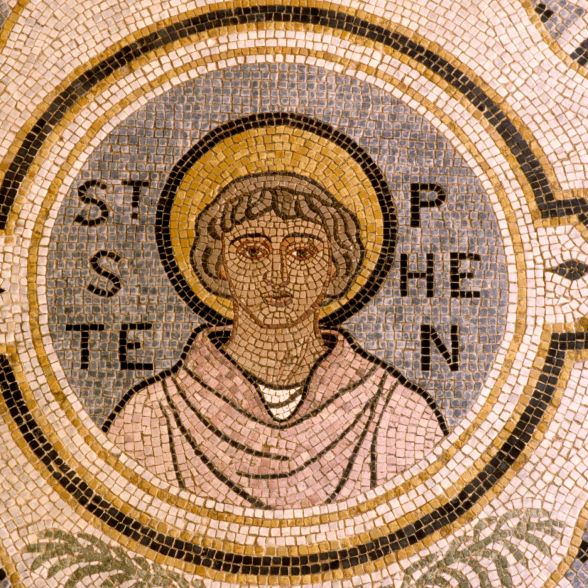
Today we celebrate St Stephen, after whom our church is named. It is our church’s patronal festival, our birthday.
Stephen was a young man, appointed a deacon in the early church. He appears only in Acts 6 and 7, but in those few pages, he makes a remarkable impression and impact. He is the first Christian martyr – stoned to death because he challenged the Jew people’s lack of faith in Jesus Christ.
While we walk primarily in the footsteps of Jesus Christ – he is God incarnate, our teacher and our Lord and saviour – we give heed also to the example of Stephen, and seek to continue his legacy in our parish community today.
Our readings centre on Acts, omitting Stephen’s long, but very impressive and persuasive sermon. This are supported by a reading from 2 Chronicles, where Zechariah (an earlier Zechariah – not the father of John the Baptist) is stoned to death for speaking God’s Word. Psalm 31, which includes the words that both Jesus and Stephen speak as they died. And John 6, which is the ordinary reading for today, from Jesus’ long sermon on the Bread of Life. I have tabulated these three people, because there are significant and meaningful similarities between them, that speak to all Christians, and especially those who are members of a church named after St Stephen:
Topic
Zechariah
Jesus
Stephen
Reading
2 Chronicles 24:17-22
John 6:24-35
Acts 6:8-10 & 7:54-60
Holy Spirit
Spirit of God came on him
Baptised by John and the Holy Spirit descended on him
Full of Holy Spirit, faith, grace and power
Care for the poor
–
Fed 5000 men (plus women and children) with bread and fish
Oversaw the daily distribution of food
Challenges with the people
They were chasing after other Gods
They just wanted food and miracles
Wanted quiet conformity with the past
Challenging the people
Why do you disobey the Lord’s commands?
Do not work for food that spoils
You stiff necked people! Your hearts are uncircumcised! You always resist the Holy Spirit! Was there ever a prophet your ancestors did not persecute?
Consequences for God’s messengers
Stoned to death
Crucified
Stoned to death
Their final words
May the Lord see this and call you to account.
Father, forgive them, for they know not what they are doing.
Lord, do not hold this sin against them.
Final prayer
–
Father, into your hands I commit my Spirit (in Luke)
Lord Jesus, receive my spirit (Psalm 31:5)
So, what do we take from this, and particularly from Stephen, into our daily lives?
We must take our faith seriously – it is costly, important and even worth dying for.
We must care for the poor, hungry and marginalised.
We must seek the infilling of Holy Spirit, who equips us for life and ministry.
We must seek after the things of God, and not after the things of this world.
We must forgive those who hurt even, even to death.
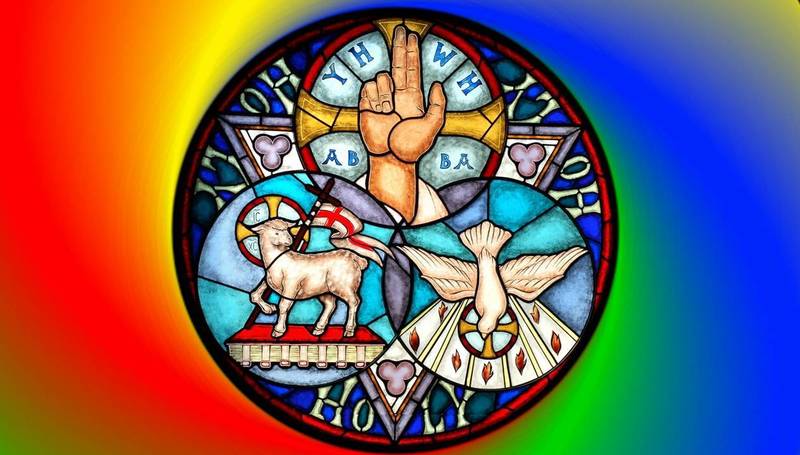
The Trinity (the three-in-one God) is a central belief for Christians, even though the term is not in the Bible and there are few explicit statements about a three-in-one God in the Bible. But there are hints and clues all over the place, e.g., in today’s readings with have:
God referring to God’s self as “us” in Isaiah 6:8,
Paul referring to God the Father, the Spirit and Christ as three distinct divine persons in Romans 8:12-17; and
Jesus speaking about the Spirit and God as two distinct divine persons in John 3:1-17.
Jews and Muslims share with us Christians the First Testament, and so it can be argued (though not all will agree) that we all worship the same God, whether by the name of Jehovah, Allah or God our Father. And all recognise Jesus as a significant person, though Jews see him as a Rabbi and Muslims as a Prophet, while we see him as God the Son. They do not recognise God as three-in-one; indeed, it sounds to them like we have three Gods. For Jews and Muslims, God is a single, male ruler – a King. They follow a pattern of a single line of authority, similar to how the military is structured. There is only One God.
For Christians, by contrast, God is plural, diverse and relational. But this plurality in the Godhead, however we might understand it, is characterised by harmony and concord. There is no conflict, competition or divergence in the triune Godhead. This is a very different conception of God.
Do we understand God’s three-in-oneness? Can we rationalise it and explain it? No, not really. It is hard enough to understand a single human being; how much harder is it to explain God, let alone a triune God! We can, should and do think about the Trinity – we theologise and theorise how God be both three and one. But ultimately, we do not find fully satisfying explanations and understandings. We often come up with analogies to explain God’s three-in-oneness: states of water, an egg, a clover, family, etc. But all of these lead us into one or other heresy about the nature of God.
We are well advised to discard all these analogies and simply gaze upon the mystery of the Godhead. We should apprehend God, not analyse or dissect God. All we can really conclude with any confidence is that God is inherently relational – there are relationships within the centre of the Godhead; relationships characterised by immense, enduring and steadfast love. Let us hold to this beautiful mystery.
So, God is not a monarch, but a cooperative, and that leads me to think about words starting with co- and com-
Community, communal, in common, companion, compassion, comradery
These co-/com- words emphasise the relational quality that is central to the being of God. And because these are central to who God is, they are central to the world that God has created. And they are central to how we live our lives. Everything that God does is relational and we are part of this relational mix. Our readings today provide important examples of this:
In Isaiah 6, God is surrounded by seraphim – heavenly beings, keeping God company. And God send Isaiah to go out as God’s spokesperson – God collaborates with Isaiah, as partners.
In Romans 8, we learn that we are adopted by God, heirs and sons of God, co-heirs (siblings) with Christ, and that we share in Christ’s suffering and also in Christ’s glory – there is a close sibling-like relationship between us and the Son of God.
In John 3, we learn that the Son came to save not just individuals, but indeed the whole world – God is interested in the human collective, not only in human individuals.
The key implication for us worshiping a triune, collective God is to develop collective thinking and behaving. Relationships are primary to God and primary to us.
Click here to listen to the audio recording of this 28-minute message. Or watch the video here on Facebook (the message starts about 25 minutes into the recording). Or read the text summary below.
Today (28 May – this post is going out a bit late – sorry) is Pentecost, where we celebrate the coming of the Holy Spirit of God. We talk a lot in church about God the Father and God the Son, but much less about God the Holy Spirit. So, today I thought to share 10 fun facts about Holy Spirit, so that we have a better understanding and appreciation of who s/he is. Let’s call it “Pneumatology 101”! Are you ready? Here we go!
Holy Spirit is the third person of the Trinity (along with the Father and Son) and therefore is God, as much as the Father and Son are God. Three persons in one being. The Spirit is as much God as the Father and Son are.
Holy Spirit is a person, as much as the Father and Son are persons. Theologically, we can debate what ‘person’ means in the Godhead. But, through our exposure to God the Father in the first Testament and God the Son in the Second Testament, we have no trouble thinking of Father and Son as persons. The same must apply to the Spirit, who is the third person of the Triune Godhead. This means we can talk with, relate to and pray to Holy Spirit, just as we pray to Father and Son. To help me think of the Spirit as a person, I drop the definite article ‘the’ and refer to the Spirit as ‘Holy Spirit’, as if that is their name, like Jesus is the Son’s name.
Holy Spirit is genderless, neither male nor female, gender neutral or gender fluid. God the Father is presented to us as a father, thus male. And God the son is presented to us as a son, as Jesus, a man, thus male. But Holy Spirit is not clearly presented with gender. It is as wrong to refer to Holy Spirit as ‘he’ as it is to refer to Spirit as ‘her’. Both are equally incorrect. All we can be sure of, is that Holy Spirit is not an ‘it’ – Holy Spirit is a person, not a power, force, wind, etc. They are a person. I choose to refer to Spirit as ‘her’, to recognise and emphasise that God is neither male nor female, or rather, that God incorporates both male and female. It helps to demasculinise my thinking about God.
Holy Spirit is active in creation – the Spirit was hovering above the waters of the deep in Genesis 1. And Holy Spirit is continually active in creating the world we live in (Psalm 104:30). Spirit is creative, artistic, extravagant, producing, making, bringing into being, empowering, enabling – all things creative.
Holy Spirit plays the key role in our sanctification. Jesus enables our salvation, but Spirit enables our becoming more and more Christlike as we journey through the ups and downs of life (1 Corinthians 6:11). Holy Spirit is the one who takes up residence on our hearts – in the temple of our body (1 Corinthians 6:19-20). She transforms us from the inside out, into the likeness of Christ.
Holy Spirit nurtures in us the Fruit of the Spirit (Galatians 5) – these are qualities of living that exemplify Christlikeness, thus the manifestation of sanctification.
Holy Spirit gives to every Christian one or more gifts – Gifts of the Holy Spirit (1 Corinthians 12). Some of these gifts appear quite ordinary (giving, mercy, helps, hospitality), while others appear quite supernatural (healing, prophecy, tongues, words of knowledge). But they are all Gifts of the Spirit, Spiritual Gifts, and thus all are supernatural gifts from God. And you have at least one.
Holy Spirit operates autonomously. She is not a cash machine that dispenses goodies on demand. She decides when and to whom to give what. 1 Corinthians 12:11 tells us that she gives gifts just as she determines. Numbers 11 has a story about 70 men selected by Moses to receive the Spirit of God; but two other men who were not selected receive the Spirit even more powerfully. Joshua is put out by this, but Moses stops him – the Spirit decides who gets what, when and how much.
Holy Spirit empowers the church for mission. She is interested in each of us as individuals, but her empowerment of us is for the work of the church. 1 Corinthians 12:7 tells us that gifts are given for the ‘common good’, not for personal edification. They are not for us ourselves and our own spiritual growth, but rather for us to serve more effectively in God’s mission to save the world.
And finally (not that there are only 10 characteristics of Holy Spirit!), Holy Spirit seems deeply committed to diversity. At Pentecost (Acts 2) many people, speaking many languages, from different parts of the world, receive the gift of tongues or hear the Gospel in their own languages – they are united in their diversity through the outpouring of Holy Spirit. Acts 2 continue continues to talk about diverse people, languages, gifts, men and women, young and old, rich and poor. Psalm 104, which speaks about Holy Spirit, emphasises the great diversity of animals in God’s creation.
It is my hope that these ideas, which you may agree with more or less, will stimulate your interest in Holy Spirit, learning more about her and getting to know her better.
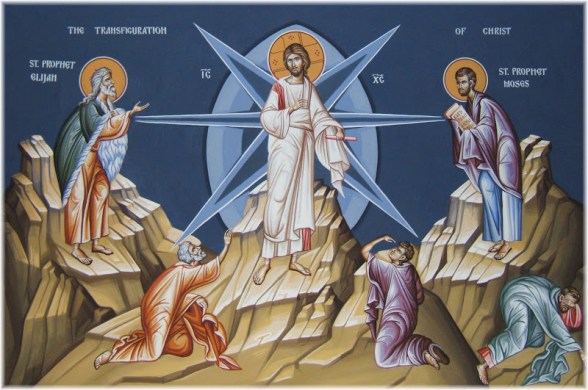
Today we celebrate and remember Jesus’ transfiguration, where he revealed his divine glory to Peter, James and John on the mountain top (Luke 9:28-36). We must remember that this moment was a transfiguration, not a transformation. A transformation implies that Jesus changes form, e.g., from ordinary human to divine being. But this not how we understand what happened on that mountain – there is no change of ‘form’ as if there are two Jesuses – one human and one divine. Instead, what changes is the ordering or configuration of Jesus – his divinity has been inside him since his conception. It was just set behind his humanity – what changed is the order what we see: his divinity comes to the fore for that short time. Hence, it is a transfiguration.
We have heard many sermons about what happens on the mountain and response of the disciples. I don’t want to repeat that today. Instead, I’d invite us to reflect on what it means for us, for our daily lives as Christians.
2 Corinthians 3:3-18 speaks of this event and contrasts it with the similar glory that Moses displayed after he had met with God on Mount Sinai (Exodus 34:29-35). Surely, the glory that Moses radiated was impressive. But Paul’s emphasizes that Moses’ glory was based in the old Covenant of the Law, which was written on tablets of stone, which was transient and which had now passed away. Instead, the glory in Paul’s time was based in the new Covenant of Christ and the Spirit of God, which are enduring and which are so much more glorious.
Paul goes on to emphasize that while Moses covered his face, because God’s glory that radiated off him made people afraid, we go around with our faces uncovered. He encourages us to be bold and let God’s glory be seen for what it is. And this glory is transformational (now this is the right word to use), in that it changes us from the inside out, into the image of Christ.
So, let’s cycle back to the question asked: What does the transfiguration mean for us, for our daily lives as Christians? Most importantly, we are urged to accept that the glory of God – through Christ and through Holy Spirit – resides within us. We might not feel it and we may not adequately reflect it in life; but it is a true reality. Put your hand on your chest and press it a bit – here is where the glory of God resides – within us, in our heart, as Paul writes, “written with the Spirit of the living God on tablets of human hearts” (2 Cor 3:3). And, so where we are, the glory of God is.
And this truth, even if we don’t embody it very well, can inspire us to be bold, to be holy and to be compassionate.
I am fortunate to belong to a church named after a great figure in the early church – St Stephen. He was one of the first second-generation leaders in the church (meaning people who came after Jesus’ ascension). Stephen fills up two chapters of Acts (chapters 6 & 7). The first person to become a leader after the first disciples was Matthias, who replaced Judas as the 12th disciple (Acts 1:23-26) – Matthias is not mentioned anywhere else in our Bible. Next, were seven deacons, who were appointed in Acts 6:5-6. Stephen is one of these seven, and the only to be discussed in any detail. Saul (who later becomes Paul) is introduced right at the end of the story about Stephen, as being present at Stephen’s stoning (Acts 7:58).
Stephen is described in some detail in the first verses of Acts 6, as being full of faith, full of the Holy Spirit, full of God’s grace, full of wisdom and full of power. He is also described as having “the face of an angel” (which might refer to a look of power and authority, more than pale cherub-like skin).
Stephen’s primary role as deacon was to take care of the widows in the early church. But he is described also as performing great signs and wonders and teaching authoritatively (as we see in his 50-verse sermon in Acts 7). Stephen was the first follower of Christ to die for his faith – the first Christian martyr. And he demonstrated his profound faith while being stoned to death and, like Jesus, forgave his murderers as he died. In many ways, Stephen exemplifies what Jesus says to his disciples in Matthew 10:17-22: “You will be hated by everyone because of me, but the one who stands firm to the end will be saved.”
While we are primarily followers of Christ, we are also all followers of St Stephen, particularly in the following ways:
We should strive to be filled with the Spirit – filled with God – in the same way that Stephen was. He was saturated with power, grace and faith through the Spirit. Perhaps, before we even climb out of bed, we should ask God to fill us anew every morning.
We should care for others, both within and without the church. Stephen’s primary role was to take care of those who were struggling. His calling was to serve the poor and vulnerable, hence we call him a ‘deacon’ (a servant). We similarly should be always alert to the opportunities to serve and care.
We should be public about our faith. This does not mean forcing our beliefs or values on others, nor necessarily about preaching on street corners. But it does mean that people should know that we are followers of Christ – Christians – and that they should know this not only by what we say but also by what we do. Our lived lives should exemplify the values that Jesus showed during his earthly ministry.
We should be steadfast in our faith, even under pressure. There is a saying, “The true flavour of a teabag only comes out in hot water.” Similarly, our faith is really revealed and proven when we go through hard times. In Stephen’s most pressured moment, he forgave, like Jesus forgave. He turned his eyes towards God and entrusted himself into God’s care.
What a great privilege it is to be a follower not only of Christ, but also of Stephen. His life reflects many of the qualities of Jesus that we appreciate and that we should emulate.
We live in a world that is fraught with challenges and unpredictabilities. We think of Russia’s war on Ukraine, the continued challenges of the people of Palestine and the various conflicts in Africa. We think in South Africa of increasing unemployment, rising inflation, the upcoming petrol price hike. We think of loadshedding and the ongoing challenges of Covid. We think of the water crisis in Nelson Mandela Bay and the devastation of the floods in KwaZulu-Natal. The world is unpredictable. Our lives are often unpredictable. Sometimes, we may feel disoriented and anxious because of the many challenges that we face at personal, national and global levels.
In these times, it is reassuring to recognise that while life may be unpredictable, God is consistent. God persists. God has always, continues to and will always engage with us. When life feels chaotic, we have a God we can rely on.
Today’s reading from John 14:23-27 is particularly strong in reassuring us of God’s continuity. Jesus starts in v23 with himself: “Anyone who loves me will obey my teaching.” And then he immediately continues, “My Father will love them.” Here is the first affirmation of consistency – between God the Son and God the Father. Jesus draws the immediate and strong link between himself, his Father and us – rooted in love – our love for Christ and the Father’s love for us. And he continues with these amazing words, “and we will come to them and make our home with them”. I love this use of ‘we’ and ‘our’ – here Jesus is referring to himself and his Father as operating together, as a partnership, and of coming dwell with us as a partnership. What a great reassurance of the continuity between the Father and the Son. And Jesus continues further, “These words you hear are not my own; they belong to the Father who sent me” – yet further reassurance of continuity and consistency between God the Father and God the Son.
Jesus then continues, introducing the Holy Spirit as “the Advocate, the Holy Spirit, whom the Father will send in my name”. In this short phrase we have Father, Son and Holy Spirit, collaborating together – the Father sends the Holy Spirit in the Son’s name. And the role of the Holy Spirit will be to “teach you all things and [to] remind you of everything I have said to you”. Here again, we have continuity and consistency – Holy Spirit does not start a new work in us, but rather continues the work of the Son, by reinforcing his teachings in us.
The result of all of this continuity from the Father of the Old Testament, the Son of the Gospels and the Spirit of the New Testament church is peace. Peace! Jesus says, “Peace I leave with you; my peace I give you. Do not let your hearts be troubled and do not be afraid.” We can breathe out, we can rest in God, we can trust that God has been consistently and persistently at work throughout history, from the creation until now and into the future. Do not be troubled. Do not be afraid. Be at peace.
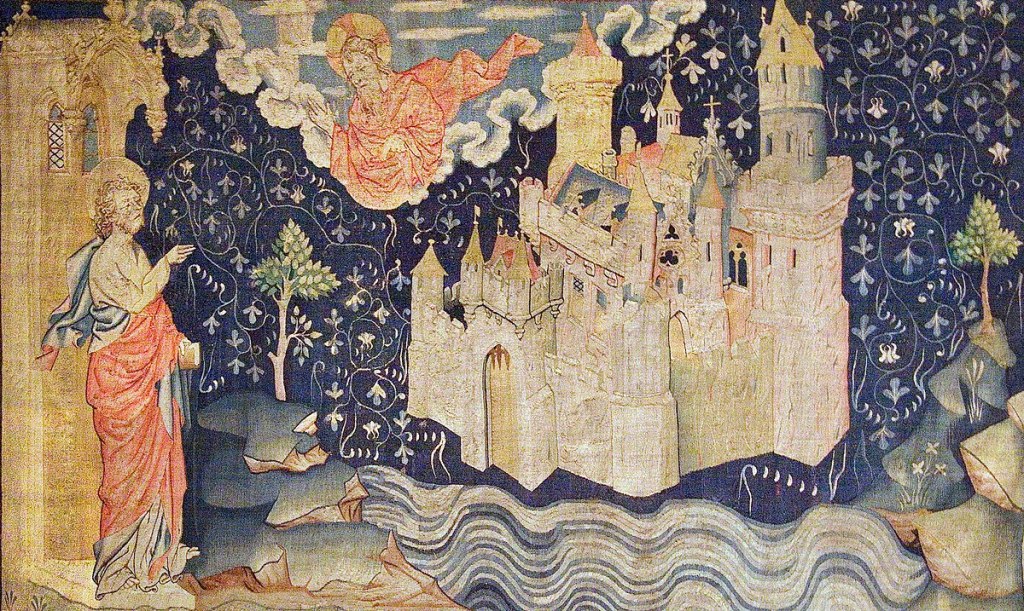
And these reassurances of God’s continuity extend into the future. Revelation 21:10 and 21:22-22:5 paint a compelling image of the heaven. John is taken by the Spirit – the same Spirit Jesus has spoken about in John’s Gospel – and sees the new Jerusalem, the Holy City coming down out of heaven from God. It is a glorious sight! There is no temple there, because God (the Father) and the Lamb (the Son) are its temple. God’s light shines out brilliantly. The gates of the city are always open. There is a river running through the city, with the water of life, and the tree of life, with leaves for the healing of the nations. We can see God’s face.
John’s vision is a deep reassurance of God’s continuity – what have seen in the Father throughout the first Testament, what we have seen confirmed in the life of the Son in the Gospels, and what we have been promised and experienced in the coming of Holy Spirit in the early Church and continuing until today, will continue into the future, until the day Christ returns.
We can rest deeply into the continuity of God, into God’s steadfast faithfulness and persistence. We can hold onto a God who is faithful, even when our own faith is frail or when life’s burdens overwhelm or depress us. We can hold fast to God’s continuity.







 Reflections of God's Love