Watch the 22-minute video of this 18-minute sermon and 4-minute song.
Sickness and trouble in life are sometimes a result of problems in our relationship with God. This is often true and often not true – sometimes sickness and trouble just arrives, even when (perhaps even especially when) our relationship with God is good. But when things are going wrong in life, when we struggle with illness, it is wise to reflect on where we are in our relationship with God.
Today’s message draws from Psalm 32, an extract of which I include below:
1 Blessed is the one whose transgressions are forgiven, whose sins are covered. 2 Blessed is the one whose sin the Lord does not count against them and in whose spirit is no deceit.
3 When I kept silent, my bones wasted away through my groaning all day long. 4 For day and night your hand was heavy on me; my strength was sapped as in the heat of summer.
5 Then I acknowledged my sin to you and did not cover up my iniquity. I said, “I will confess my transgressions to the Lord.” And you forgave the guilt of my sin.
6 Therefore let all the faithful pray to you while you may be found; surely the rising of the mighty waters will not reach them. 7 You are my hiding place; you will protect me from trouble and surround me with songs of deliverance.
8 I will instruct you and teach you in the way you should go; I will counsel you with my loving eye on you.
In the video message I talk through the message of this Psalm, drawing on the beautiful insights of Walter Brueggeman’s “The message of the Psalms: A theological commentary”.
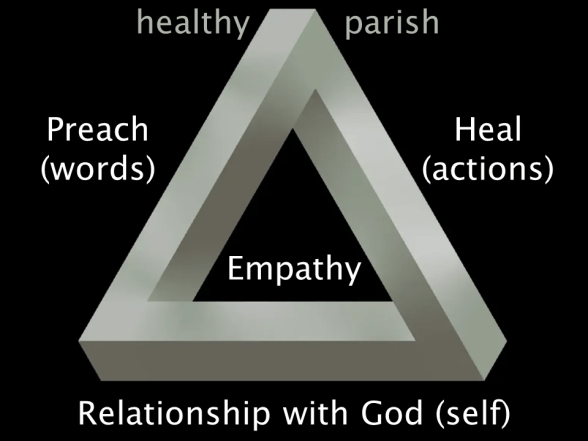
This sermon (preached a week ago on 4 February 2024) is about a healthy parish – what makes for healthy parish life. It emerges, in part, in light of various churches failing to uphold core values around clergy integrity and sexual relations. A model for a healthy church is presented, based on the readings that were set for today in the Revised Common Lectionary, viz. Isaiah 40:21-31, Psalm 147:1-11, 1 Corinthians 9:6-23 and Mark 1:29-39.
Jesus is always our model for everything to do with Christian living, including corporate or collective Christian living – the church. This model is influenced by the readings above and also by how Jesus lived his life, related to God and people, and exercised his ministry.
1. Personal relationship with God
The foundation of a healthy church – and the foundation the triangle above – is each member’s personal relationship with God. Our collective well-being rests on the aggregate of each individual person’s health relationship with God. In Mark 1:35, Jesus leaves his ministry to spend time in his personal relationship with God – he does so repeatedly, even though there are so many people waiting for his healing ministry and teaching. If a personal relationship with God is important to Jesus – who is God, the second person of the Holy Trinity – how much more important should it be to each of us.
When you fly on an airplane, you will be told that, in the event of cabin decompression, oxygen masks will drop down from above your seat. And you will be told to put your OWN mask on FIRST, before helping others (including your children). This is an apt illustration of the need for each of us to see to our personal relationship with God. I, as priest, must ensure the robustness and depth of my relationship with God.
2. Preach words
In 1 Cor 9:16-18, Paul refers to his preaching as central and as God-given. In Mark 1:38-39, Jesus says he needs to go to other villages to “preach there also”. He goes on to say, “That is why I have come”. Preaching words is important to build people’s faith.
But for a health church, I suggest we translate preaching as our words. Too often our words are harsh, judgmental, critical and gossipy. Such words break down, alienate, diminish and harm. There is no place for such words in a healthy church.
Our words should heal and create. Psalm 147:4 says, God “determines the number of stars and calls them each by name”, while Isaiah 40:26 reiterates, “Lift up your eyes and look to the heavens: who created all these? He who brings out the starry host one by one and calls forth each of them by name. … not one of them is missing”. These verses indicate how the words of God bring stars into being, as he names and calls them. Similarly, our words – whether good or bad – can call things into being.
Therefore, our words should be deliberately encouraging, edifying, building up, loving. Last year, we spent the whole of Lent reflecting on Jesus’ command to “love one another”, where we teased this out in detail.
3. Heal through actions
Mark 1:29-34 and 39 say, “…[Jesus] went to her, took her hand and helped her us. The fever left her … Jesus healed many who had various diseases. He also drove out many demons … So he travelled throughout Galilee … driving out demons.” Isaiah 40:29-31 says, “He gives strength to the weary and increases the power of the weak. Even youths grow tired and weary, and young men stumble and fall, but those who hope in the Lord will renew their strength. They will soar on wings like eagles; they will run and not grow weary, they will walk and not be faint.” Psalm 147: 2-3, 8-9, says, “The Lord builds up Jerusalem; the gathers the exiles of Israel. He heals the broken-hearted and binds up their wounds. … He covers the sky with clouds; he supplies the earth with rain and makes grass grow on the hills. He provides food for the cattle and for the young ravens when they call.”
These words are all of healing actions. How we behave impacts the health of a church. When we exclude, abandon or just do nothing, we harm the church. We break it down and weaken it. Rather, we should engage in actions that build up a health community. We can do this by simply showing up, instead of being absent. And through simple acts, like cooking a family a meal when they’re going through a hard time, giving someone a call or sending them a message, helping to clean up. In our tradition, we share the peace during the service – we can make sure we greet all the people around us, instead of rushing off to chat with our friends and ignoring a visitor.
4. Empathy
I have placed ’empathy’ at the centre of the graphic of a healthy church, even though the word ’empathy’ does not appear in the Bible. But the concept is there, for example in 1 Corinthians 9:19-23, Paul writes:
19 Though I am free and belong to no one, I have made myself a slave to everyone, to win as many as possible. 20 To the Jews I became like a Jew, to win the Jews. To those under the law I became like one under the law (though I myself am not under the law), so as to win those under the law. 21 To those not having the law I became like one not having the law (though I am not free from God’s law but am under Christ’s law), so as to win those not having the law. 22 To the weak I became weak, to win the weak. I have become all things to all people so that by all possible means I might save some. 23 I do all this for the sake of the gospel, that I may share in its blessings.
Here Paul steps into the shoes of others, in order to understand them from inside, in order to share the Gospel in a way that makes sense to them. This effort to feel with others is core to empathy.
We see this profoundly in Jesus. Until Jesus was conceived, God had no first-hand understanding of what being human was like. God was not a man, and didn’t have personal experience of being human. But when Jesus incarnated in Mary’s womb and was born like any other human, God got a first-hand experience of being human – God discovered empathy for the human condition.
Too often, however, we jump to negative conclusions, without first exercising empathy. We assume the worst of people, rather than considering other less judgmental reasons for their behaviour. For example, if we don’t see someone for a few weeks we assume they have lost their faith or reneged on their responsibilities, when in fact they might be ill. Instead, let us rather assume the best – if we’re going to make an factless assumption, let’s make a positive one rather than a negative one, until the facts suggest otherwise.
A church that is grounded in personal relationships with God, that speak and act in ways that build up and encourage, and that chooses to empathise with each other, is likely to be a healthy community. This is the kind of community or body that God desires for us. It takes some effort on each person’s part. Working together, we can build a healthy church centred on God.
This message is not so much a sermon, but rather a ‘talk’, about mental health. It emerges from Mark 1:21-28, where Jesus exorcises a demon and makes a ‘madman’ well. In Jesus’ time, most manifestations of psychological problems would have been interpreted in spiritual terms – a demon was at work. Today, there would be a tendency to define those same manifestations as psychosis, using psychiatric, medical terminology. Perhaps both have some truth.
The human has long been understood as a tripartite being, comprising body, mind (or soul) and spirit. This implies a sense separateness within a person, where these three parts operate separately:
But rather, these three parts are closely interacting, with the body and mind influencing each other, the mind and the spirit influencing each other, and the spirit and the body influencing each other – far more integrated and whole, something like this:
However, despite this integration, when someone presents with a physical (body) problem, like cancer or diabetes, we’d all cluster around and support that person. But if they present with depression, or anxiety or schizophrenia, we would tend avoid them, to speculate, to judge, to question their faith, and so on. We generally treat psychological problems differently from physical problems, even though they are interconnected. Psychological challenges tend to be stigmatised, even today.
The interconnection or integration I’m talking about is nicely illustrated in the Greek word sózó, which means both healing and salvation. In our New Testament English translations, most of the words ‘heal’ and ‘save’ are the same in the Greek. To be spiritually saved is tantamount to being physically (or psychologically) healed. For example, the woman who had been bleeding for years (Luke 8:43-48) was sózó – she was both healed and saved, and she was also restored into a harmonious place within her society (which stigmatised menstrual blood). Many English translations say she was was ‘made whole’ – that’s a good translation!
At this point in my message, I related my own experiences with depression, brought on a combination of genetic and environmental factors, that had me in psychotherapy for many years, on antidepressant medication for several years, and in a psychiatric hospital for a month. I am not going to type this up here. It is in the recording, and I’d rather you hear my story verbally than in writing. It is not essential to this message, but it does provide a first-hand account of mental illness, and recovery, and continual working on maintaining my mental health – I think of myself as a depressive in remission. This starts at about 27 minutes into the video recording and about 6 minutes into the audio.
In my recovery, two books were very meaningful to me, and might be to you:
I hope that this talk about mental health and my personal sharing about my own depression will be helpful to you in a few ways:
I hope this helps to destigmatise mental illness, because although I have had quite severe mental illness through many years of my life, I have also done quite well in life and feel that my life is good and meaningful. If you find yourself struggling with mental illness or struggle, I hope you will be less judgmental towards yourself and your symptoms, and more open and kind to yourself. And similarly towards others.
I hope this helps you become more self-aware and to self-care more. Jesus commands us to love God and to love our neighbour as you love yourself (Matthew 22:39). This last phrase is not a commandment, as such. There is a tendency among Bible scholars to assume that all people love themselves, even too much. But in my practice, many do not love themselves; people suffer from low self-esteem and even self-loathing. We should love ourselves more – like putting on the oxygen masks in the aeroplane before you help others.
I hope this helps you to pray and read the Bible more. These practices are about creating space for God to be present in us, and for us to experience God’s presence. John writes about the desire that we should experience life, and life abundantly (John 10:10)! Psalm 23 speaks of a table, a feast, prepared for us.
I hope this encourages you to seek help when you are suffering from mental health challenges. You can do this by asking your priest or minister for prayer and anointing – this part of the contribution that the church can offer you, in line with James 5:14-16. You can do this also by seeking therapy from a psychologist or clinical social worker. And you can to this by seeking medication from your GP or a psychiatrist.
I ended this talk with a 2-minute prayer for those who have listened to this message, and I encourage you to listen to or watch this prayer. It start a little after 47 minutes into the video and a little before 27 minutes into the audio recording.
Click here to watch the video of this 28-minute message on Facebook (the message starts about 29 minutes into the recording). Note that this is an active sermon – worth watching, rather than just reading. I don’t have an audio recording of this message. Or read the text summary below.
Matthew 9 tells the story of Jesus calling Matthew: “As Jesus went on from there, he saw a man named Matthew sitting at the tax collector’s booth. “Follow me,” he told him, and Matthew got up and followed him.” And Genesis 12 tells the story of God calling Abram: “Go from your country, your people and your father’s household to the land I will show you.” Go! Follow me! These calls have nuclear power to move people – Matthew got up and followed Jesus, Abram packed and moved into the unknown.
Jesus is calling you and me today – Follow me! Go! – but to where? Where do we go? Where do we follow?
Matthew 9:16-17 gives us invaluable insights into what Jesus calls us to, in the metaphor of new wine in new wineskins:
“No one sews a patch of unshrunk cloth on an old garment, for the patch will pull away from the garment, making the tear worse. Neither do people pour new wine into old wineskins. If they do, the skins will burst; the wine will run out and the wineskins will be ruined. No, they pour new wine into new wineskins, and both are preserved.”
Although the metaphor is a bit obscure, at very least we can take from this that there are challenges in mixing the old and new. Jesus leans strongly in favour of the ‘new’ – new wine and new wineskins are what we’re after. A few verses earlier (v13) he gives another clue about where we are following him to, when he quotes Hosea, “I desire mercy, not sacrifice”. Mercy represents love for people, while sacrifice represents religion. Jesus is saying – indeed God is saying – I don’t want your religion, I want your love for people. This is the ‘new’ teaching – or rather an old teaching renewed – that Jesus gives us. And the whole of Matthew 9 illustrates this with examples.
Come along with me – follow me! – as we briefly consider the seven stories that illustrate following the new wine in Matthew 9:
The chapter opens with a paralysed man, brought to Jesus by his faith-filled friends. Jesus sees their faith and says, “Take heart, son; your sins are forgiven.” The teachers of the law are outraged by Jesus’ presumption of having authority to forgive sins – they’re not interested in the man, only in their theology. Jesus responds strongly and heals the man as evidence of his authority to proclaim forgiveness of sins. Jesus’ love for this physically and spiritually broken man takes precedence over the teachers’ petty theology.
In verses 10-13, Jesus attends a party hosted by Matthew, who is now following Jesus. Matthew’s friends are tax collectors and sinners – ‘bad people’. The Pharisees – another religious group – are disgusted and ask Jesus’ disciples, “Why does your teacher eat with tax collectors and sinners?” They are not concerned with the humanity of Matthew and his fallen friends – they are concerned only with religious piety and ‘rightness’. They dehumanise these broken people. Jesus confronts them, “It is not the healthy who need a doctor, but those who are ill… For I have not come to call he righteous, but sinners.” Jesus’ love for sinners, for bad people, takes priority over everything.
In verses 14-17, while still at the same dinner party, the disciples of John the Baptist come and ask Jesus, “How is that we and the Pharisees fast often, but your disciples do not fast?” Their use of ‘often’ (we fast often) betrays the religious pride. Their interest is in religious observance and spiritual discipline. But Jesus dismisses their concerns, asking “How can the guests of the bridegroom mourn while he is with them?” He has little interest in fasting or other religious piety – he is more interested in spending time engaging with people. It is in this immediate context that he speaks about new wine – he is not interested in religious and theological precision and rightness; he is much more interested in human relationships, fellowship, compassion and love.
In verses 20-22, while still at the same party, a synagogue leader tells Jesus that his daughter has died and asks if Jesus can come and help. Jesus leaves immediately, as his compassion for this young girls outweighs his fellowship with Matthew and his friends. On the way to the house, a woman who has been bleeding (menstruating) heavily for 12 years touches his cloak and is healed by Jesus’ power. Her faith is strong: “If I only touch his cloak, I will be healed.” Jesus stops and speaks with her, he proclaims healing and wholeness and salvation. We imagine he took hold of her hand as he lifted her up onto her feet. While in the other stories there are crowds of noisy people around, here there is silence. Men and women keep menstruation quiet and private – it is not public. And in those days, women were considered unclean during their period. For Jesus to engage, speak, touch her was to make him unclean. He didn’t care about that – he cared just for her.
Reaching the house of the synagogue leader, there is a noisy crowd outside. They mock Jesus when he says the girl is just sleeping. He goes up to her room and takes her by the hand. Touching a dead person makes one unclean, but Jesus doesn’t care about that – he cares only for the girl. She is revived and gets up.
Briefly, Jesus continues on his way and heals two blind people, “According to your faith let it be done to you”. He sternly warns them not to tell anyone about him healing them. He is not interested in recognition – he cares only about their sight.
And then he encounters a demon-possessed man (perhaps today a schizophrenic). He drives out the demon. The Pharisees cannot recognise Jesus’ compassion for this man’s wholeness and well-being; they say, “It is by the prince of demons that he drives out demons”.
Jesus quoted Hosea, “I desire mercy, not sacrifice”. Jesus tells about the new wine – his people-centred gospel of love and inclusion – that is incompatible with the old wineskins of religiosity, piety, self-righteousness. He is all about people: “I have not come to call the righteous, but sinners”.
So, as we follow Jesus, as we answer his call to ‘Go!’, we must put people before religion, relationships before theology, acceptance before judgement, inclusion before exclusion, love before judgment. This is the new wine of Jesus’ Gospel that should be poured into the new wineskins of our hearts and churches.
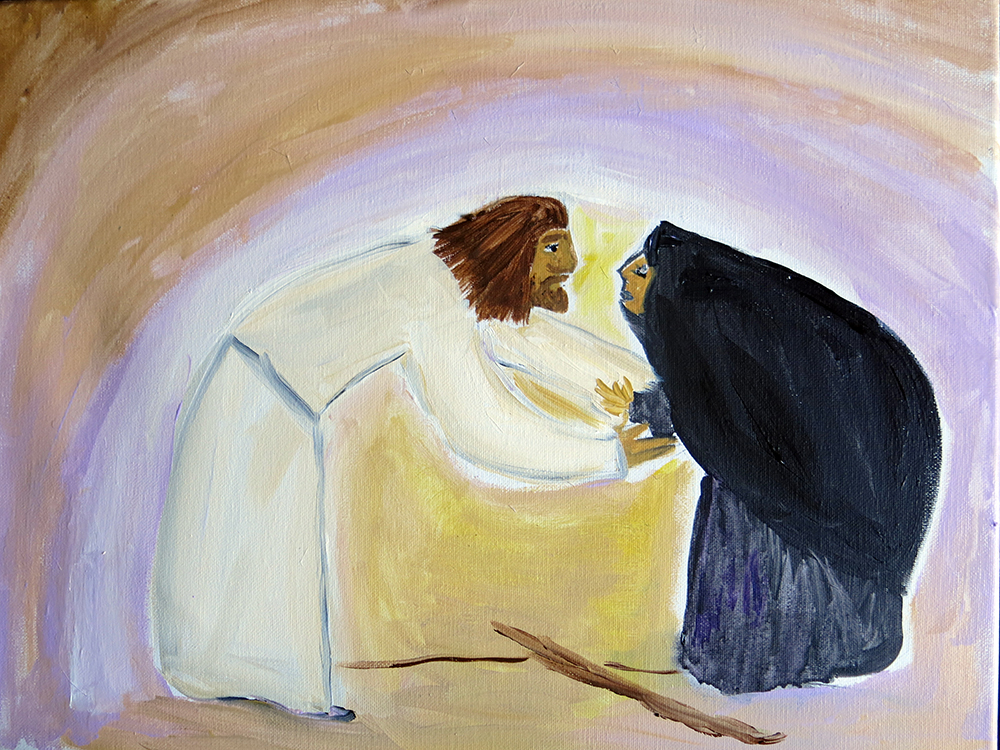
In our Gospel reading for today (Luke 13:10-17) we read a less familiar story about Jesus healing a woman who has been crippled – bent over double – for 18 years. He heals of her on the Sabbath, and for that he (and all those present) are reprimanded for seeking healing on the Sabbath. Come on any of the other six days of the week for healing, the synagogue leader says, but not on the Sabbath.
Jesus then compares the situation of his healing of this woman, with helping an oxen. He says,
“You hypocrites! Doesn’t each of you on the Sabbath untie your ox or donkey from the stall and lead it out to give it water? Then should not this woman, …whom Satan has kept bound for eighteen long years, be set free on the Sabbath day from what bound her?”
Jesus here is calling out the synagogue leader for his deep patriarchy, even misogyny. Because he regards a donkey as more important than a woman. The church has a long history of supporting patriarchy. Even in our Bible, there are numerous patriarchal passages. And the church too often upholds patriarch – that women are less than, less than men, less than human. Even women contribute to patriarchy. Research in South Africa by a colleague of mine (Prof Shahana Rasool) shows that women (mothers and aunts) are often the first person to tell a battered woman to return to her abusive husband. So, while today’s message is in many ways particularly for men to take up, it is indeed for all of us.
In this passage in Luke, we see Jesus doing five transformational anti-patriarchal things in these few verses (vv12-13, 16):
He sees her – he picks her out among the crowds, recognises her as a human in need.
He calls her – in the synagogues then, men and women were kept separate, like in orthodox synagogues today – he calls across the synagogue and calls her to him
He speaks with her – he speaks words of healing to her: “Women you are set free from your infirmity”
He lays his hands on her – he doesn’t merely touch her politely on the shoulder. He “put his hands on her” – almost unthinkable in those days.
He affirms her – and then later he refers to her as a “woman, a daughter of Abraham”.
These five acts set for us an example of recognising the full humanity, and indeed, the divine createdness of women. There is absolutely no space here for patriarchy, and even less for misogyny. Jesus see her as a unique and individual daughter of God, a person in need, who is as deserving of the ministrations of God as any one else.
Indeed, we find narratives like this throughout the scriptures. Many women and some men have given up on the Bible, because it is so saturated in patriarchy; and unfortunately, this is true. I struggle with it myself, constantly. But, when we read the Bible closely, in the context of its own time, we find that the Bible frequently challenges deeply held cultural beliefs about the relationships between men and women, and about the the status and place of women in God’s plan. Scripture is, in many ways, countercultural when it comes to patriarchy. And these challenges seem as relevant today as they were thousands of years ago.
Four quick examples – two in Genesis and two in John:
In Genesis 1:27-28, the writer describes the creation of humanity – God created man in his image, male and female he created them, in the image of God he created them. Both are fully created in God’s image. It is not that man is in God’s image, and woman is in man’s image. No! Both man and woman derive their image directly from God. And then God goes on to mandate both of them (not just the man) to rule over earth, its plants and animals – both of them! There is nothing that says Adam should rule over Eve – no! Both of them are equally commissioned with the authority of God to jointly rule over the world. This is how God created humanity! Yet, so many churches teach something different about the differential authority of women and men. It does not exist here in Genesis 1!
Two chapters later, in Genesis 3:16, we read the story of the fall of humanity. Both Adam and Even eat of the Tree of Life – both sinned. And God pronounces consequences of their sin on each of them. One of the consequences for the woman is that her husband “will rule over you”. There are Christians today who argue that this rule of husbands over wives is God’s plan for how gender relations are to be structured following the fall. Honestly, this is absolute rubbish! A consequence of the fall of humanity is patriarchy. It is not God’s desire for humanity. If it were, then all men should be out toiling in the fields to produce crops by the sweat of their their brow, because this is a consequence God gives to the man in v18. Yes, men are not doing that – they have invented machines to do it for them, or hired migrant labourers to work on their behalf for nearly nothing. Singling out this ONE facet of the fall, from all of the others, and raising it up to God’s plan for humankind post-fall, is a clear sign of patriarchy, and indeed of misogyny. It is NOT God’s desire! Indeed, Christ’s mission is to undo the effects of the Fall, including patriarchy, not to reinforce them!
Let’s move to John’s Gospel. Jesus meets the Samaritan woman at the well on a very hot day (John 4:1-42). Knowing who she is – Samaritan, not Jewish; a woman of ill repute – Jesus engages with her in a deep theological conversation. They don’t talk about baking or raising children. They talk about complex matters of faith. And she becomes the first female evangelist, as she returns to her community to tell them all about this man she had met. Jesus engages with her as a human being; not as a woman per se. Her gender, and the social norms around the relationship between men and women, are completely irrelevant to Jesus – he simply walks over them. Patriarchy is no barrier!
Lastly, let’s look at John 8:1-11, the story of the woman caught in adultery. The male religious leaders bring the woman to Jesus and ask Jesus what they should do, in accordance with the Law. Note that the man is no where to be found! It’s takes at least two to commit adultery – but where is he? They say, “This woman was caught in the act of adultery”, meaning they were were caught in the act of having sex. So he was there having sex with her; where is he now? And Leviticus instructs that both the man and the woman must be stoned – not just the woman. In this highly hostile context, Jesus kneels down and doodles in the sand. I imagine that in response, all the men shift their focus from the woman to what Jesus is doing. In so doing, he redirects the ‘male gaze‘ away from her and towards himself. He spares her the shame and humiliation of this gang of men staring at her. He champions her dignity as a human being, as a child of God. And then he challenges the men, and of course they must go. And then, at the end, he holds her accountable for her sin – she really had sinned, she has the capacity and agency to make both bad and good choices – and he forgives her and sends her off to choose to sin no more. But in the process, he has dismantled the deep patriarchy and misogyny that was at work in this narrative.
There is a great deal of patriarch in the Bible – the Bible was written in patriarchal times, mostly or perhaps entirely by men. We live today in patriarchal times. Our world is full of domestic violence (physical and verbal); of women getting passed over for promotion in favour of men; of the ways men silence, dismiss and diminish women; of the brutal rape of women and girl children; and of the exclusion of women from leadership in the church. There is certainly a lot of patriarchy in the Bible and in our church.
But there is no patriarchy in Jesus. No patriarchy in God. Our Triune God celebrates the full humanity of both men and women, and all gender fluid and nonbinary people. Jesus saw her, he called her, he spoke words of healing over her, he laid his hands on her and he celebrated her as a daughter of Abraham. How much must we follow in his footsteps.
Too often in my life, and perhaps in yours also, I ask God for something, but when that prayer is answered, I don’t thank God for it. In part, this is because I don’t notice the change, I don’t see the answer. And in part, it is because I don’t connect my prayer to God’s answer – I see the change as something natural and ordinary.
Luke provides us with a narrative about answered prayer and gratitude in Luke 17:11-19. Ten lepers call out to Jesus for pity or mercy. Jesus says to them, “Go, show yourselves to the priests”. That’s all Jesus says. He doesn’t do anything or saying else. But as the lepers obey Jesus, they are cleansed. Luke writes, “As they went, they were cleansed.”
This ‘as they went’ points to the quiet, unobtrusive actions of God. Miracles can happen as we are going about our everyday life. God’s work is often not dramatic and sensational – it is quiet, ordinary and easy to miss. Indeed, it seems only one of the ten lepers recognised that he had been cleansed: “he saw he was healed”.
This one comes back to Jesus, praising God (loudly), throws himself at Jesus’ feet and gives thanks to him. This one gives thanks! Jesus says to him, “Rise and go; your faith has made you well.” Indeed, his faith and Jesus healing ability had already made him well, while he was walking to the priests.
What, then, was the benefit of gratitude in this man? And what is the benefit of gratitude for us?
Because of his gratitude, this man gets an opportunity that none of the other nine got – to spend time with Jesus, and not at a distance as they were at the start of the story, but right at his feet. He gets to speak with Jesus. He gets some one-on-one time with Jesus.
When we are grateful for God’s work in our lives, we have two opportunities to engage with God: first at the beginning when we ask for God’s help, and then again later on when we give thanks. This double time with Jesus is the greatest gift of all – far greater than the answered prayer that we experienced.
Today we focus on the Jesus’ feeding of the 5,000 in Matthew 14:13-21. This is the ONLY miracle story to appear in ALL four Gospel accounts. It is clearly an important story for the Gospel writers. Perhaps something about it exemplifies Jesus and his ministry.
Usually, we focus on the miracle of the feeding, but today I invite you to focus on what we learn about Jesus’ heart. And Jesus’ heart reflects God’s heart. Here are five important things we learn about Jesus, that are relevant for each of us today:
Jesus feels. The story opens with Jesus hearing of the execution of John – his cousin, friend and prophet. And he feels distressed about John’s death, he feels emotions, his heart is soft and responsive. So he withdraws, privately to a solitary place. Jesus grieves and feels. He is not unmoved.
Jesus’ heart goes out. Even though Jesus tries to get away to be alone, crowds of people – thousands of people – follow him on foot. And instead of being irritated with them, he has compassion on them, his heart goes out to them. As he sees us and our difficulties, his heart softens, his heart fills with care.
Jesus heals. As his heart fills with compassion, Jesus moves into action and heals people of their illness. The Greek word for ‘ill’ in v14 is used nowhere else in the New Testament. It is best translated ‘wretchedness’, meaning unhappy, broken-hearted, poor, downtrodden, ill. Jesus makes people whole, he restores them.
Jesus embraces. The disciples want to send the crowds away, as they sent away children, lepers and others who wanted to speak to Jesus. But Jesus refuses. Instead, he instructs the disciples to feed the crowds, and invites the people to sit down on the grass. Jesus is crowd-centred, other-centred, generous, inclusive.
Jesus multiplies. Jesus takes the tiny supplies of 5 loaves and 2 fish, and multiplies them to feed thousands. He is able to see through the smallness of what we offer, to the enormous good that God can do through them. He has eyes of faith that sees the potential of the tiny to do great work.
As continue to grapple through Covid, and the many challenges it presents to us, let us look into, let us gaze upon the heart of Christ – he who feels, whose heart goes out, who heals, who embraces and includes, and who multiplies. This same Christ is present for us today. Let us look for him and sit down with him and be fed by him.
Featured image: Sacred Heart of Jesus by Joseph Fanelli (Oil on Linen) 1993 from here
Matthew 9:35-10:8 sets us on a path of discipleship in which we have the opportunity to participate in God’s work in building the Kingdom of Heaven or the Kingdom of God. Jesus’ message is “the good news of the kingdom”, which includes personal salvation as well as a transformation of the world in which we live. It shows God’s interest in the whole of human life, from the individual through to the societal.
But while the harvest is plentiful, the workers are few. Jesus calls the disciples to pray for workers who can participate with God in building the kingdom of Heaven. You are that worker! As am I! We pray regularly, “Thy Kingdom come, thy will be done, on earth as it is in heaven”. And we are the answer to that prayer.
And then in Matthew 10:1 & 5, we read that Jesus:
“Called his twelve disciples to him” – the calling is individual and collective. He calls you and he calls me, and he calls all of his followers, the church.
“Gave them authority” – Jesus authorises them to do God’s work in building the kingdom
“Sent out” the disciples – he sends them out to do his work.
We are called, authorised and sent!
Jesus instructs them to proclaim this message: “The kingdom of heaven has come near”. The kingdom is near because Christ is near; and Christ is near, because he dwells in the hearts of his followers.
What does this look like in practice? Matthew lists four things that the disciples do. These are the same things Jesus has been doing. And Jesus does them not to show off his power, but to demonstrate the heart of God – God’s loving heart for humankind. These are:
The ill are healed. This is about making people whole, and relieving pain and distress.
The dead are raised. This points us forward to the resurrection of Christ, who becomes the first of the the many who will be raised to new life in Christ.
Those with leprosy are cleansed. Leprosy was not just an illness, but also a social condition that lead to profound social exclusion and rejection. Cleansing or purification from the disease would lead to re-entry into the community, thus social restoration and integration.
Demons are driven out. Demons oppress people, holding them in bondage. When they are driven out, people are liberated from oppression. This links to Jesus’ manifesto (Luke 4:18), where he proclaims freedom for prisoners and sets the oppressed free. In this way, oppressive power in human relationships is overcome.
The proclamation of the Kingdom being near, and the evidence of this in these four acts of service, show that God is interested in wholeness, life, social integration and liberation from oppression. These are all facets of salvation and all manifestations of God’s presence.
It is to this that we are called in this present time, a time when there is much fracturing of social relationships, much oppression, much brokenness.
We do this work out of a fullness of gratitude for what God has already done for us. “Freely you have received; freely give” (Matthew 10:8b).












 Reflections of God's Love
