Irrepressible love

Love is central to the being of God, so it is little wonder that Love infuses Jesus’ post-resurrection, post-crucifixion appearances, and also his post-ascension appearances. This message unpacks the details of Jesus’ infinite and irresistible love for his people in John 21, and also his demanding and liberating love for those who are not his people in Acts 9. Watch the 24-minute video message or read my notes below that.

Let us consider John chapter 21

  • v3. The disciples go fishing. So ordinary – living life, even in the absence of their Lord.
  • v5. Jesus appears on the seashore and asks if they have caught no fish. He is concerned for them, for their well-being, for their everyday life.
  • v6. He tells them to cast their nets to the other side of the boat and the catch a massive haul! Jesus acts on behalf of the disciples, with their ordinary, everyday needs. Like he did at the wedding in Cana (Jn 2), where he rescued a couple’s wedding by making water into wine. He is concerned for our everyday lives.
  • v9. Next thing, he’s cooking food for them! This is the Son of God, raised from the dead! This is the one we read out in Rev 5, “Many angels, ten thousand times ten thousand, encircling the throne, saying in a loud voice: Worthy is the Lamb, who was slain, to receive power and wealth and wisdom and strength and honour and glory and praise!” This is the one cooking breakfast for them!
  • v9. Jesus provides the fish for the meal. They bring their catch only after he has already caught and cooked fish for them. He cares, he’s thoughtful.
  • v12. Jesus invites them, “Come and have breakfast.” So ordinary, so thoughtful. He breaks bread and fish, like he did when he fed the 5000 in Jn 6.
  • v12. This meal reminds us of the Last supper just a week or so previously in Jn 13. From supper to breakfast; from night to dawn; from death to life. This is a transformative meal – more than just brekky.
  • v15-17. Three times Jesus asks Peter, “Do you love me?” Three times Peter protests, “Of course I love you!” Here Jesus gives Peter a chance to undo the three denials on Good Friday. In so doing, Jesus resets Peter’s standing – his slate is wiped clean. This is grace.
  • v15-17. Each time, Jesus says, “Feed my lambs, take care of my sheep, feed my sheep.” This is good shepherding. This is what we want in our new bishop. We remember Jesus in Jn 10, “I am the good shepherd. I know my sheep and my sheep know me. I lay down my life for my sheep.” This is good shepherding.
  • v19. Finally, Jesus says, “Follow me!” His example is the one we are called to follow – his example, his footwashing in Jn 13. “Now that I, your Lord, have washed your feet, you should wash one another’s feet. I have set you an example.” An example of humility, of care, of love.

Let us also consider Acts 9

  • v1. “Saul is breathing out murderous threats against the Lord’s disciples”. He is a bad, bad man, full of perverse religious self-righteousness.
  • v4-5. On the road, Saul encounters the risen Jesus, who says, “Saul, Saul, why do you persecute me? I am Jesus, whom you are persecuting.”
  • Here Jesus demonstrates his “option for the poor”. He identifies with those whom Saul is persecuting – ‘you are persecuting me’, he says, because he is one with those who are persecuted.
  • Like then, still today, Jesus stands with those who suffer. He is always to be found in the midst of conflict and suffering. He stands in Gaza, he stands in Ukraine, he stands in the DRC, in Ethiopia, in Myanmar. He stands today even among minority groups in the USA who are being persecuted by their new government.
  • v6. But despite all of Saul’s repugnant hatred and self-righteousness, Jesus calls and uses Saul, who becomes Paul.
  • God’s choices are radical and loving.
  • He can transform anything and anyone. Nothing we do can block God’s purposes.
  • Jesus’ love and intentions are irrepressible.
  • Best we just surrender to him, because we cannot overcome God’s love.

To wrap up, let’s read Psalm 30

I will exalt you, O LORD, for you lifted me out of the depths and did not let my enemies gloat over me.
O LORD my God, I called to you for help and you healed me. O LORD, you brought me up from the grave; you spared me from going down into the pit. Sing to the LORD, you saints of his; praise his holy name. For his anger lasts only a moment, but his favor lasts a lifetime; weeping may remain for a night, but rejoicing comes in the morning. When I felt secure, I said, “I will never be shaken.” O LORD, when you favored me, you made my mountain stand firm; but when you hid your face, I was dismayed. To you, O LORD, I called; to the Lord I cried for mercy: “What gain is there in my destruction, in my going down into the pit? Will the dust praise you? Will it proclaim your faithfulness? Hear, O LORD, and be merciful to me; O LORD, be my help.” You turned my wailing into dancing; you removed my sackcloth and clothed me with joy, that my heart may sing to you and not be silent. O LORD my God, I will give you thanks forever.

Image by Kate Cosgrove, https://www.brethren.org/messenger/bible-study/breakfast-on-the-beach/

The Grace of Giving

Click here to listen to the audio recording of this 25-minute message. Or watch the video here on Facebook (the message starts 28 minutes into the recording). Or read the text summary below.

Today, I’d like us to reflect on giving – financial giving. Before you run for the doors, give me a chance to put giving into context.

Our Old Testament reading today (2 Samuel 1:17-27) tells of the great love between David and Jonathan. It is a very tender reading, reminding us of our loving relationships with others, with family and with God. This theme of relationship runs through all our readings today.

Psalm 130 is an intimate song of love for and trust in God. “Out of the depths I cry to you, Lord” and “I wait for the Lord, my whole being waits, and in his word I put my hope” and “with the Lord is unfailing love”. This beautiful Psalm emphasises the deep loving relationship between us and God.

And Mark 5:21-43 tells of the woman who suffered from bleeding and had all but given up hope of healing. But she hears that Jesus is in the area and so she comes towards him, hiding from the people who would judge her, trusting and having faith that he can heal her, even if she touches just the hem of his robe. And as she is healed, Jesus lifts her up and honours her.

And Jesus does the same later in the same passage with the little girl who had died, “Little girl, I say to you, get up!” And she is brought back to health and life.

All of these readings emphasise the relationship of love, faith and trust between us and God and between us and each other.

It is in this context or relationship and faith that we come to 2 Corinthians 8:7-15, where Paul speaks about giving financially:

  • v7 – Paul writes about the “grace of giving” – grace meaning a gift (charis in the Greek, from which we get charismatic – spiritual gifts)
  • v8 – He emphasises that this is not a command to give – rather it is a grace to give
  • v8 – He uses words like sincerity and earnestness in relation to giving, to emphasise how personal giving is
  • v9 – Paul compares this with Jesus’ giving of himself for us – though he was rich, for our sake he became poor, so that through his poverty we might become rich – such a great act of generosity from Christ
  • v10 – He affirms the Corinthians not just for being the first to give, but particularly for being the first to have the desire to give – this desire or willingness or wanting to give is more important to him than the actual giving
  • v11 – He emphasises that we should give “according to our means” – the quantity of giving de-emphasised in favour of the “eager willingness” with which we give
  • v12 – Again, Paul emphasises our “willingness” to give – and again he emphasises giving “according to what one has, not according to what one does not have”
  • vv13-15 – And in the following passage he speaks at length about equality. He is interested in a redistribution of wealth – that those have more give to those who have less, so that everyone has enough. “The goal is equality” he says. Perhaps the modern word ‘equity’ is more appropriate – that each person has enough according to their needs, rather than that each person has the same. This is a foundation of Christian socialism, which brings us back to the focus on relationships – we live in fellowship with each other, connected to each other, and so if we have more than we need and someone else has less than they need, our inclination should be give some of what we have to them.
  • And Paul concludes, “The one who gathered much did not have too much, and the one who gathered little did not have too little”, quoting from the Israelites gathering manna in the desert in Exodus 16:18, which also says, “Everyone had gathered just as much as they needed”.

Giving financially may not come naturally to most of us – we want to hold on to, protect, save or spend what money we have. But the scriptures call us to be both sensible and generous, based on our relationships with God, the church and each other – relationships of love, faith and trust. I encourage you to reflect on this and consider whether you should revise your giving to God’s work.

Featured image from: https://www.forbes.com/sites/johnjennings/2022/04/30/top-tips-for-effective-charitable-giving/

Grace amazing

Today’s reading is Matthew 20:1-16. It is the story about a landowner who hires people to work in his field, starting from early in the morning (perhaps 5am) until 5pm in the evening. He promises the first a denarius – a generous day’s wage; and he promises the later workers a ‘fair’ wage. He comes out himself even late in the day and asks people why they are standing around doing nothing, and they say, because no-one has hired them, and so he hires them, knowing that humans were created to work – God’s first commands to Adam and Eve are to work in the garden and take care of the earth. This is the first grace: we are invited to work with God.

Evening comes and the landowner calls the workers together and pays everyone the same – a denarius. The workers who started early are understandably unhappy. But this is not a story about labour and economics. It is a story about grace. God’s grace is abundantly given to all of us, whether we start early or late, whether we do much or little. Think of the thief on the cross beside Jesus in Luke 23 – he could do nothing on that cross, yet he entered into Christ’s paradise. The landowner asks the disgruntled workers if they are envious that he is generous – do you envy my grace? Grace if fundamentally unfair. This is the second grace: we ALL get what we do NOT deserve.

Fix your eyes on Jesus. Be amazed by grace.

Just last night, my wife Trina shared with me this video of ‘Amazing Grace’ sung differently by Dan Vasc. It fits so perfectly, I cannot help but conclude it was God’s prompting.

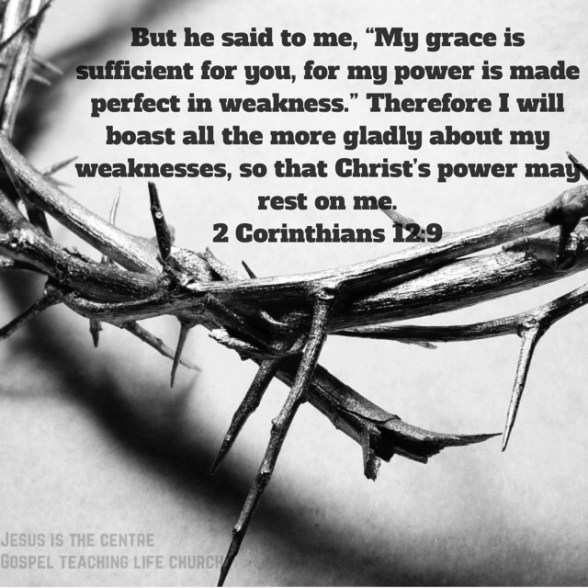
Thorn in the flesh

Click here to listen to the audio recording of this 22-minute message. Or watch the video on YouTube. The whole Eucharist service is available (59 minutes), and the message starts at 14 minutes.

What is Paul’s thorn?

  • Our English translation ‘thorn’ could be a thorn/splinter, or a stake/spike/pole, or anything pointed – differing views on which is more likely – a stake implies something shattering and devastating, while a thorn implies a low grade but constant irritation/infection
  • Could be ‘in the flesh’ or ‘for the flesh’, i.e. ‘for the inconvenience of the flesh’
  • ‘Flesh’ can mean the physical body, in which case the thorn would be some physical malady, e.g., his poor eyesight, possible epilepsy, maybe malaria, migraines. Paul seems generally strong, resilient, tough, so a physical ailment seems unlikely.
  • Paul’s appearance – some disfigurement that made him ugly.
  • Flesh also means our human nature, particularly in Paul’s writings, so this could be some aspect of his human nature, mostly probably pride.
  • ‘Sins of the flesh’ are almost always understood to be sexual sins, so this could be a sexual sin or temptation that Paul grappled with. But it would not have to be so narrowly defined – it could refer to any and all sins or temptations to sin.
  • It could the persecutions Paul suffered – the repeated attacks on his ministry, which could well have felt like a thorn in the flesh. Numbers 33:55 has a parallel: “But if you do not drive out the inhabitants of the land, those you allow to remain will become barbs in your eyes and thorns in your sides. They will give you trouble in the land where you will live.”
  • The thorn as a ‘messenger of Satan’ might best support the thorn as persecution. Other passages speak of Satan impeding God’s work: 1 Thes 2:18 – “For we wanted to come to you—certainly I, Paul, did, again and again—but Satan blocked our way.”
  • “To torment [or buffet] me” suggests this was a long-term issue, not just a temporary one. The Greek word means “to strike a blow with the fist” or “to maltreat” in a way that brings shame, humiliation and indignation. Jesus was himself humiliated by the beatings he endured before the crucifixion.
  • He later refers to his ‘weaknesses’ – it the thorn the weakness, or does the thorn cause weakness?
  • We really don’t know what the thorn was and whether it was a thorn or a stake. If it was important that we know, Paul would presumably have told us. Let’s consider than any and all of these could have been his thorn or stake, and that for us, it can be any or all or others.

How did Paul handle or make sense of his thorn?

  • Paul prayed for its removal, three times, but it was not removed. God declined his repeated request. God does not always give us what we want.
  • But the response he got from God seems to inspire him, not discourage him.
  • God’s response – ‘he said to me’ – is in the perfect tense, it is a past tense that is definitive – what God said was definitive at the time, and remains definitive in the future, that “God’s grace is sufficient”. It was almost tattooed on his hands.
  • He is unworthy, unnecessary, dispensable = our human condition
  • Yet, God chooses to work with, in and through him because God chooses to do so = grace
  • The more dependent he is on God (i.e. the weaker he is) the more God is free to shape and use him (i.e. grace) and so he ‘boasts’ and ‘delights’ in his weakness, so that Christ’s power will rest on him. ‘Rest on him’ is shekinah in Hebrew: literally, “may pitch his tent upon me” or “may tabernacle on him”
  • This is not a masochistic spirituality! It is a recognition that Christ can and does work in and through his frailties and keeps at bay any pride/boasting: Any delight Paul gains is ‘for the sake of Christ’, not for the challenges themselves.
  • ‘Then I am strong’ implies ‘strong in the Lord’, not ‘strong in myself’. He is ‘weak in himself, but strong in the Lord’.
Featured image from: https://keziaominde.files.wordpress.com/2017/09/img_5832.jpg?w=640

God’s open arms

Click here to listen to the audio recording of this 15-minute message. Or watch the video on Facebook here (the message starts at about 27 minutes). This message is strongly visual, so I recommend you watch the Facebook video rather than listen to the audio, though you’ll need to turn the sound up a bit.

God has always been working for our salvation and continues to do so today. This work culminates the life, death and resurrection of Christ, hence Jesus says we need to be born again. This salvation work is motivated by God’s great love, kindness, mercy and grace towards us (Ephesians 2: 1-10). Even though we were dead in our transgressions and sins – deserving of God’s wrath – God does everything to save us. Jesus himself says, “For God so loved the world that he gave his one and only Son, that whoever believes in him shall not perish but have eternal life. For God did not send his Son into the world to condemn the world, but to save the world through him” (John 3:14-21).

  • God’s stance towards you is always open armed – always.
  • God is always open towards you even if you don’t believe in him – always.
  • God is always moving towards you – always.
  • God is always turned towards you, even when you turn away from him – always.
  • God is always turned towards you, even when you sin – always.
  • God always reorientates himself towards you as you move through life – always.
  • God is always positively disposed towards you – always.
  • God always loves you – always.
  • God is always kind towards you – always.
  • God is always full of grace and mercy towards you – always.
  • God is always hoping you will respond to him – always.
Featured image from https://www.thebalancesmb.com/christ-the-redeemer-construction-facts-844362

Being God’s Beloved: Day 33: The Cross and Redemption

Yesterday we reflected on how Jesus, hanging dying on the cross, looks down and sees, really sees, his mother and his best friend John, and how he extends himself for their benefit, establishing a new community, a new family. In so doing, he begins to undo the effects of sin – those effects that fragment and rupture relationships, which we have repeatedly seen are central to God’s experience of being God.

Luke 23 relates another encounter of Jesus with the people around him. This version does not explicitly say that Jesus saw or looked at them, but given the depth of his responses, it seems fair to accept that Jesus did see them.

Jesus is crucified with two criminals. The one “hurled insults at him: ‘Aren’t you the Christ? Save yourself and us’” (Luke 23:39). The English “hurled insults” is, in the Greek, eblasphemei, from which, of course, we get our English word, ‘blaspheme’. It is amazing, but sadly true, to what extent arrogance and hostility towards God can continue even in the midst of judgement and suffering. This man, on the brink of death, continues to express bitterness and rage against the best that the world has to offer.

The other criminal, however, recognises that Jesus has no reason for being there – he is innocent and undeserving of death: “But the other criminal rebuked him. ‘Don’t you fear God,’ he said, ‘since you are under the same sentence? We are punished justly, for we are getting what our deeds deserve. But this man has done nothing wrong’” (Luke 23:40-41).

What is most striking about this man is this combination of taking ownership of his own wrongdoing and resultant punishment, and recognising Jesus’ innocence and thus unjust punishment. And then, to cap it all, he says, “Jesus, remember me when you come into your kingdom” (Luke 23:42). Not only does he recognise Jesus’ innocence, but he also recognises Jesus as Lord and King. He takes a remarkable leap of faith.

Perhaps Jesus ignored the taunts of the first man. But the second man catches his attention. Jesus responds, as he always has, to expressions of faith, no matter how profound (here we think of Peter’s “You are the Christ, the Son of the living God” in Mathew 16:16, or Thomas’ “My Lord and my God” in John 20:28) or how tentative (perhaps the woman who was bleeding in Mark 5:28).

Jesus replies, “I tell you the truth, today you will be with me in paradise” (Luke 23:43).

This is redemption. Today, this very day, you will be with me, in paradise with me. Truly, I tell you. Amen!

Jesus Christ redeems this man on the cross. Here, as we saw yesterday, Jesus extends himself, beyond himself, to care for another human being. It is instinctive for him to do so. It was so throughout his ministry. It was so as he hung dying on the cross. And it remains so today. Christ Jesus extends himself for those who turn towards him.

One of the amazing things that we can take out of this narrative is the fact that this criminal could do nothing to win his salvation. He was nailed to a cross. He could not get baptised or confirmed. He could not sign a membership form at the local church. He could not take Holy Communion. He could not serve in God’s mission. He could not make amends to the people he had harmed while doing crime. He could do nothing to earn his salvation. He could not even work out his salvation with fear and trembling (Philippians 2:12). All he could was to turn to Christ in faith and receive the salvation offered to him.

This is a profound example of salvation by grace through faith. Paul says, “For it is by grace you have been saved, through faith – and this not from yourselves, it is the gift of God – not by works, so that no one can boast” (Ephesians 2:8-9).

  • Salvation by grace means that salvation is something that God gifts to us – it is not earned or deserved. Indeed, this criminal deserved to be punished (perhaps not on a cross, but in some way he had earned punishment). Salvation was not something he deserved. And yet God extends salvation to him anyway.
  • Salvation through faith means that once salvation is gifted to us, we receive it on faith, by just accepting it, empty-handed, open-hearted – we just accept it. The criminal shows us salvation through faith because his hands are nailed to a cross – he can do nothing but receive what Jesus offers him.

Sometimes we tie ourselves up in knots over redemption. We know that we are saved by grace through faith, but we still feel that we have to do something to earn it. We must pray so much per day or read so much per day or attend church so many times or tithe so much or serve so much or feel remorseful so often or perform so many rituals. Any or all of these things may help us to work out our salvation – to enrich and express our salvation as we journey through life – but they add absolutely nothing to our being saved.

This is redemption. We are saved only by the mercy of God – by grace through faith – who loves us so much and so unconditionally that we are offered this gift as a gift; no strings attached, no small print, no terms or conditions.

But imagine, if you will, that there is a small family gathered near the cross. They are there to watch the execution of the criminal. He did something terrible to this family. Perhaps he raped their daughter or murdered their father. They have come to see him die, to satisfy their rage and grief. And they hear Jesus offer these words of reassurance to this criminal – the promise of salvation and life in paradise. How hard that must have been for them! He in paradise, while their loved one lies maimed or dead.

God’s capacity to forgive is far greater than ours. And as much as we want God to save us, we may want God to not save certain other people. That is human. But God is not human. God loves you. God loves all of us – even criminals, even monsters, even the most evil person you can imagine. It is terribly hard for us to get our hearts around this, and sometimes we cannot accept it; sometimes we deeply desire to reject this. But God still loves them and desires their salvation and works to reconcile them to God.

This is the great and challenging message of Christ regarding forgiveness and salvation – it is open to everyone, even those we deeply desire to not have it. All we can do is trust that God’s love is all embracing. All we can do is believe that God knows people’s hearts – ours and theirs. All we can do is pray to have God’s heart and God’s eyes.

This is redemption. Other people are saved only by the mercy of God – by grace through faith – who loves them so much and so unconditionally that they are offered this gift as a gift; no strings attached, no small print, no terms or conditions.

Just before this narrative about the criminals, Luke tells us that Jesus said, “Father, forgive them, for they do not know what they are doing” (Luke 23:34). This is the theme of this passage of Luke. Redemption or salvation is about forgiveness – undeserved, unmerited. God forgives out of the generosity of God’s love, out of God’s persistent desire to reconcile with us, to be in relationship with us. For us, forgiveness is a hard thing to do. But for God, forgiveness is an inevitable expression of persistent love.

Here, Jesus, having just been hung up to die, prays that God will forgive those who crucified him. He sets an example that very few of us can emulate. For me, forgiveness is something that I journey towards over time. It is not an on-off switch. It is a repetitive, spiral process of increasingly letting go of anger and of my sense of being entitled to retribution or compensation. And psychologically, I think that is right for us as frail human beings. But Jesus sincerely forgives in that moment and opens his heart to those who have harmed him, those who have taken his life.

This is redemption. God chooses to let go of anger and of the fully justified right to exact punishment or retribution. Divine forgiveness is God choosing to set us free of the debt that we owe for our sin, with the hope that we will reconcile with God. And that freedom is salvation.

Jesus promises the second criminal that they will be together in “paradise”. The Greek word here comes from a Persian word meaning garden. Many of us think of paradise as puffy clouds and white robes and harps – all rather ethereal and disembodied. But Jesus was thinking of something quite tangible and earthy – a garden! With trees, and shrubs, and grasses, and flowers, and soil, and birds, and insects, and lizards, and a stream running through it.

This is redemption. For Jesus, paradise is a return to the Garden of Eden. This is a turning back of world history, a turning back of the consequences of sin, a turning back of evil and judgement. To be saved is to return to Eden – to that garden in which our ancestral mother and father dwelled in harmony with God, with each other, with the world and with themselves – humanity prior to the Fall. Paradise is that place where everything that went wrong with us has been made right again.

Paradise is the place where we fully love and are fully loved by God. This is redemption.

Meditation for the Day

Reflect on the meaning of redemption. And on divine forgiveness. What does it mean to you that God has redeemed, saved and forgiven you? What does this say about your being God’s beloved?

Prayer for the Day

Oh Lord, my redeemer, my saviour, I thank you for your freely-given gift of forgiveness and reconciliation. How amazing is your love! Help me to take hold of this salvation, to fully accept it, to immerse myself in it, so that I may be transformed by your love into the image of your beloved Son.

Being_Gods_Beloved_square_3