Healthy church

Click here to listen to the audio recording of this 30-minute message (yes, again a bit longer than usual). Or watch the video here on Facebook (the message starts 24 minutes into the recording). Or read the text summary below.

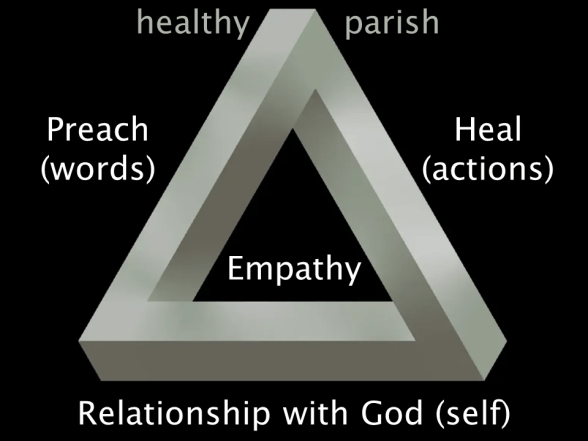
This sermon (preached a week ago on 4 February 2024) is about a healthy parish – what makes for healthy parish life. It emerges, in part, in light of various churches failing to uphold core values around clergy integrity and sexual relations. A model for a healthy church is presented, based on the readings that were set for today in the Revised Common Lectionary, viz. Isaiah 40:21-31, Psalm 147:1-11, 1 Corinthians 9:6-23 and Mark 1:29-39.

Jesus is always our model for everything to do with Christian living, including corporate or collective Christian living – the church. This model is influenced by the readings above and also by how Jesus lived his life, related to God and people, and exercised his ministry.

1. Personal relationship with God

The foundation of a healthy church – and the foundation the triangle above – is each member’s personal relationship with God. Our collective well-being rests on the aggregate of each individual person’s health relationship with God. In Mark 1:35, Jesus leaves his ministry to spend time in his personal relationship with God – he does so repeatedly, even though there are so many people waiting for his healing ministry and teaching. If a personal relationship with God is important to Jesus – who is God, the second person of the Holy Trinity – how much more important should it be to each of us.

When you fly on an airplane, you will be told that, in the event of cabin decompression, oxygen masks will drop down from above your seat. And you will be told to put your OWN mask on FIRST, before helping others (including your children). This is an apt illustration of the need for each of us to see to our personal relationship with God. I, as priest, must ensure the robustness and depth of my relationship with God.

2. Preach words

In 1 Cor 9:16-18, Paul refers to his preaching as central and as God-given. In Mark 1:38-39, Jesus says he needs to go to other villages to “preach there also”. He goes on to say, “That is why I have come”. Preaching words is important to build people’s faith.

But for a health church, I suggest we translate preaching as our words. Too often our words are harsh, judgmental, critical and gossipy. Such words break down, alienate, diminish and harm. There is no place for such words in a healthy church.

Our words should heal and create. Psalm 147:4 says, God “determines the number of stars and calls them each by name”, while Isaiah 40:26 reiterates, “Lift up your eyes and look to the heavens: who created all these? He who brings out the starry host one by one and calls forth each of them by name. … not one of them is missing”. These verses indicate how the words of God bring stars into being, as he names and calls them. Similarly, our words – whether good or bad – can call things into being.

Therefore, our words should be deliberately encouraging, edifying, building up, loving. Last year, we spent the whole of Lent reflecting on Jesus’ command to “love one another”, where we teased this out in detail.

3. Heal through actions

Mark 1:29-34 and 39 say, “…[Jesus] went to her, took her hand and helped her us. The fever left her … Jesus healed many who had various diseases. He also drove out many demons … So he travelled throughout Galilee … driving out demons.” Isaiah 40:29-31 says, “He gives strength to the weary and increases the power of the weak. Even youths grow tired and weary, and young men stumble and fall, but those who hope in the Lord will renew their strength. They will soar on wings like eagles; they will run and not grow weary, they will walk and not be faint.” Psalm 147: 2-3, 8-9, says, “The Lord builds up Jerusalem; the gathers the exiles of Israel. He heals the broken-hearted and binds up their wounds. … He covers the sky with clouds; he supplies the earth with rain and makes grass grow on the hills. He provides food for the cattle and for the young ravens when they call.”

These words are all of healing actions. How we behave impacts the health of a church. When we exclude, abandon or just do nothing, we harm the church. We break it down and weaken it. Rather, we should engage in actions that build up a health community. We can do this by simply showing up, instead of being absent. And through simple acts, like cooking a family a meal when they’re going through a hard time, giving someone a call or sending them a message, helping to clean up. In our tradition, we share the peace during the service – we can make sure we greet all the people around us, instead of rushing off to chat with our friends and ignoring a visitor.

4. Empathy

I have placed ’empathy’ at the centre of the graphic of a healthy church, even though the word ’empathy’ does not appear in the Bible. But the concept is there, for example in 1 Corinthians 9:19-23, Paul writes:

19 Though I am free and belong to no one, I have made myself a slave to everyone, to win as many as possible. 20 To the Jews I became like a Jew, to win the Jews. To those under the law I became like one under the law (though I myself am not under the law), so as to win those under the law. 21 To those not having the law I became like one not having the law (though I am not free from God’s law but am under Christ’s law), so as to win those not having the law. 22 To the weak I became weak, to win the weak. I have become all things to all people so that by all possible means I might save some. 23 I do all this for the sake of the gospel, that I may share in its blessings.

Here Paul steps into the shoes of others, in order to understand them from inside, in order to share the Gospel in a way that makes sense to them. This effort to feel with others is core to empathy.

We see this profoundly in Jesus. Until Jesus was conceived, God had no first-hand understanding of what being human was like. God was not a man, and didn’t have personal experience of being human. But when Jesus incarnated in Mary’s womb and was born like any other human, God got a first-hand experience of being human – God discovered empathy for the human condition.

Too often, however, we jump to negative conclusions, without first exercising empathy. We assume the worst of people, rather than considering other less judgmental reasons for their behaviour. For example, if we don’t see someone for a few weeks we assume they have lost their faith or reneged on their responsibilities, when in fact they might be ill. Instead, let us rather assume the best – if we’re going to make an factless assumption, let’s make a positive one rather than a negative one, until the facts suggest otherwise.

A church that is grounded in personal relationships with God, that speak and act in ways that build up and encourage, and that chooses to empathise with each other, is likely to be a healthy community. This is the kind of community or body that God desires for us. It takes some effort on each person’s part. Working together, we can build a healthy church centred on God.


Gender, by God

Click here to listen to the audio of this 35-minute message. Or watch the YouTube video below, or read the text summary after that. This is a longer-than-usual message, because this is such an important topic, that is so seldom spoken about. So, while 35 minutes is quite a long time, I urge you to set aside some time – particularly today, Women’s Day – to listen to this message.

Today – 9 August – is Women’s Day in South Africa. It’s a day when we celebrate women. But it is also a day when we confront the profound and relentless violence against and subordination of women in our society. The church must, on this day, give particular attention to its role in perpetuating, supporting and even advancing such patriarchal and misogynistic views and behaviours. My own church – the Anglican Church of Southern African – must take responsibility for our role in advancing violence against and oppression of women. And men, like me, must do the same.

So, in this message, I unpack four passages of the Bible – three in the Genesis creation story and one in the writings of Paul – that are often used to support patriarchy. I invite you to read the texts and see what they actually say and to critique how they have been used. Of course, the Bible was written in patriarchal times by people who held patriarchal views. But we are invited to read through their views to see the mind of God on the issues of gender inequality in the world.

This is an important and substantial topic, hence this is a rather lengthy message. I urge you to engage with it, as I think it will help to lay a foundation for thinking about gender relations in the world, in the church, in the workplace and in our homes.

  1. Genesis 1:27-28 tells us that both women and men are equally created in God’s image. It also tells us that they were both – as a couple, as a partnership – given authority to rule over the earth. There is no hint that the man is more created in God’s image than the woman, that he is important or more powerful than the woman. The man is not given dominion over the woman; instead both the woman and the man are given conjoint dominion over everything else. This is a picture of unity, equality and power-sharing between man and woman – a picture that is very much at odds with how life is lived in many homes today.
  2. Genesis 2:18-23 is part of the second creation story, where God recognises that it is not good for man to be alone and decides to create a ‘helper’ for him. Initially, God looks among the animals, but realising that none of these will do, God creates woman. The word ‘helper’ is often used to imply woman’s supportive, helping, subordinate role. But in v18 God recognises that man is somehow inadequate or deficient – unable to be alone – he is incomplete and needs a partner to make him whole. Therefore God creates a woman. The woman is there to help him be a whole person – this is by no means a subordinate role.
  3. Moreover, she is created from his rib, suggesting that they are equal – they stand side-by-side, joined at the rib – the midpoint between the head and the foot. God did not take Adam’s toe and create Eve’s collarbone so that Adam could stand on her head! Instead, they are created as the same, as equal, as partners. It reaffirms Genesis 1 – they are equal partners.
  4. Genesis 3:16-19 tells of God’s cursing of man and woman for their sin. v16 has a line that says “and he [your husband] will rule over you”. Many male theologians and scholars and ministers have used this verse to construct a theology that God’s divine plan for human relations post-fall is that men (husbands) exercise authority over women (wives). This is a profound perversion of the scriptures, because this is just one line out of several lines of curses, including that women will experience pain in childbirth (which humanity has constantly worked to reduce and to reduce maternal mortality).
  5. In addition to hers, there is a lengthy curse against the man (72 words to the man, compared with just 31 to the woman – the man’s curse is more than double the length of the woman’s!). God says that he will suffer and struggle to produce crops from the earth. And yet men have never accepted this as God’s divine plan for them! Men have worked, since they left Eden, to ease the burden of producing crops, through the use of slaves, animals, machines, genetic modification and most recently artificial intelligence. If the curse against men is not part of God’s divine order, why is the curse against women? It is simply patriarchy and misogyny at work!
  6. Overall, the creation story across Genesis 1-3, there is an overriding narrative of equality between woman and man. Even in the fall, both woman and man eat the apple and both woman and man are cursed. Everything is equal, parallel. Indeed, if there was any hint of gender inequality, it would be in favour of woman – she was God’s second attempt at creating a human (we are usually better the second time round) and her curse is shorter than man’s. But indeed, the dominant and pervasive narrative is one of equality and partnership between gender. This is God’s vision for gender.
  7. So, we do need to look also at the New Testament, and particularly to the writings of Paul. It is true that Paul was raised in a patriarchal society and household. He is certainly a patriarch and probably also a misogynist. He does write that men are the head over women, that women must be silent in church, etc. He clearly writes about male domination over women. This is how he was raised. There are, however, NO passages where Paul advocates or endorses, even tacitly, violence against women or the oppression of women. And just because Paul was a patriarch, does not mean God is a patriarch.
  8. Paul grapples with gender issues. He writes “there is neither male nor female, for you are all one in Christ” (Galatians 3:28). He has some sense that in God’s eyes, there is no gender; but in his own thinking, he still sees and supports gender inequality. What we seem to be seeing in Paul’s writings is a developing insight into God’s view on gender equality, emerging and receding.
  9. 1 Corinthians 7:2b-5 presents to us a profoundly egalitarian view of gender relationships from the pen of Paul. It shows a perfect equality between women and men, equal exercising of power over one’s body, equal self-giving of oneself to one’s partner. It is an image of a very modern marriage. It is completely out of step with the traditional passages we quote from Paul on ‘wives must submit to their husbands’. If men are going to quote Paul on gender, let us quote ALL of Paul on gender, and recognise that here is a man whose views on gender are uneven. And this unevenness is best explained as Paul’s growing understanding of God’s view of gender equality.

In light of these challenges about God’s views – and Scriptures views – on gender equality, I suggest two principles that should inform and shape how we interpret scripture:

  1. First, we need to look at the whole of scripture when we formulate a position on something, like gender relations. We need to look at the whole body, and we need to understand the underlying mind of God, which we see most clearly expressed in the mind of Christ, which we best gain insight into in the Gospel narratives.
  2. Second, we need to separate custom from teaching, description from prescription. Just before the Bible writers believed the earth was flat and that the sky was a bowl over the earth, does not mean that the earth is actually flat and that there is actually a bowl in the sky. Even though they express this view in the Bible, e.g., in the Psalms, does not mean it is true or that God believes this. We are inclined to bring our cultural beliefs and impose them onto scripture – gender is a good example of this. Instead, we are required to bring God’s mind, expressed in the scriptures, and use these to sanctify and transform society. When it comes to gender, we impose our preconceived patriarchal beliefs on scripture, even though scripture advocates a far more egalitarian view on gender.

2020.08.09_St. Praxedes and Paul

Featured image of St Praxedes and St Paul, presented as equal co-workers for Christ, in the Basilica Santa Prassede, Rome, from here