Encountering the risen Christ

Watch the video below of this 42-minute message. Yes, much longer than usual! I’m sorry about that, but it is – I think – worth the time, as a close reading of John 20:19-29 sheds to much light on Jesus’ character, his relationship with the disciples and his work as the Son of God. My notes are available below the video

Verses 19, 26    Both times Jesus “stood right in the middle of them”

Christ is the centre – not the priest, Bible, APB – only the person Christ

Christ-centred church

1, 19, 26               Easter Sunday morning – Jesus appears to Mary

Easter Sunday evening – Jesus appears in the upper room

Following Sunday (today) – Jesus appears again, to Thomas

19, 21, 26             Peace be with you – Shalom alechem x3

Easter Sunday – Christ made peace between us and God

Forgiveness of sins – done, paid for, wiped clean, forgotten, cast the deep

Everything is good. It’s all okay

Easter is the Great Forgiveness!

20           He showed them his hands and side

Emphasis on bodily resurrection, reconnected to his people

Not just some spiritual, esoteric thing

He is fully embodied, albeit with some unusual capacities

20           He could have come back healed, but doesn’t. Why?

His identification with us, solidarity with our pain & suffering

He remains the suffering servant of Isaiah 53 (4-5):

He took up our pain and bore our suffering. He was pierced for our transgressions, he was crushed for our iniquities, the punishment that brought us peace was on him, and by his wounds we are healed.

20           The disciples were overjoyed – full of joy

Joy (chara) & grace/gift (charis) – joy is a gift of God – because Jesus is back

21           “As the father has sent me, I am sending you”

We are to continue God’s work. We are sent, just as Christ was sent

Jn 3:16/7 “God so loved the world that he gave [sent] his one and only Son … For God did not send his Son to condemn the world, but to save it”

Every Christian is sent – not just clergy or evangelists

22           He breathed on them, “Receive the Holy Spirit

Hebrew for spirit & breath are both? Ruach

Gen 1:2: Spirit of God hovering

22           Gen 2:7: “Then the Lord God formed a man from the dust of the ground and breathed into his nostrils the breath of life, and the man became a living being”

To receive Jesus’ breath & Holy Spirit is to be made a new living being

22           To receive Jesus’ breath & Holy Spirit is a grace/gift (charis)

As the Spirit/breath was active in the creation of earth and humanity

2 Cor 5:17: “If anyone is in Christ, they are a new creation. The old has passed away, the new has come.”

22           Holy Spirit poured out on Pentecost: Easter Season is from Easter Sunday to Pentecost

23           Forgive anyone’s sin

The gift of HS is not so much miraculous signs, etc.

Instead the central commission – sending – is to forgive

And to warn that to not repent = no forgiveness

The Great Forgiveness!

24           Thomas was not with the disciples when Jesus came.

Where was he? He should have been in church! We should be in church!

27           Touch, see

V20. Jesus showed them his hands and side.

Thomas wants what the others got – to see. But also to touch

Our Eucharist is a see and touch moment

– receive the body of Christ broken for you (not receive this bread)

– receive the blood of Christ (not receive this wine)

Not clear if Thomas did actually touch: “Thomas answered and said…”

Perhaps seeing and the invitation to touch was enough for him

27           Stop doubting and believe. Be a believer!!

Accept the small and periodic signs of God and believe into him

28           My Lord and my God!

Hebrew: Yahweh & Elohim – names for God

Greek: Kyrie & Theos – names for God

The only place in the Gospels where Jesus is referred to as God – A profound statement of faith – perhaps the most

Seeing is not believing

Click here to listen to the audio recording of this 21-minute message. Or watch the video here on Facebook (the message starts 25 minutes into the recording). Or read the text summary below.

In Luke 24:13-35, we have the story of the two disciples who are walking to Emmaus and who encounter a stranger, who we later learn is the resurrected Jesus. They did not recognise him, despite having a long conversation. It was only as they sat down for a meal that “their eyes were opened and they recognised him” (v31), and immediately Jesus disappeared. They saw Jesus, but they did not recognise him.

In our reading set for today (Luke 24:36-48), Jesus meets the disciples in a room, and although they see him and recognise him, they do not believe him. They have moved a little further than the previous two disciples, but they have not moved to a place of belief or faith: seeing is not always believing. In response, Jesus – patient as ever with the disciples’ slowness – presents a series of evidence to prove to them that he is indeed risen from the dead and not a ghost:

v38 – Jesus asks why they are troubled and why they doubt. He confronts their lack of belief and faith. But still they do not believe.

v39-40 – Jesus invited them to look, to touch, to see. He shows them his hands and his feet, so they can get physical evidence of his wounded body. But still they do not believe.

v41-43 – So Jesus asks if they have any fish. Not because he is hungry, but to prove that he is not a ghost, but a physical being, who can eat food. But still they do not believe.

44-47 – So Jesus tells them about the scriptures – the Law of Moses, the Prophets and the Psalms – which all prophecy everything that has happened to Jesus. But still they do not believe.

48 – So Jesus reminds them that they are first-hand witnesses of everything that Jesus did – healings, forgiveness, raising people from the dead – they saw a lot and they themselves did some of these miracles in his name. But still they do not believe.

50-51 – And then, finally, he blesses them and ascends in front of them up into heaven.

And then they believed! They worshipped him and returned to Jerusalem with great joy.

Sjoe, they were really SLOW! Slow to recognise him. Slow to believe in him. Slow to put their faith in him.

Perhaps we also are slow. Perhaps we also fail to recognise Jesus’ actions in our lives and in the lives of those around us. Or perhaps we see them, but don’t believe them. Or we believe them, but we don’t put our faith in him. In the recording of the sermon I share an experience of my own slowness to believe, to illustrate my own slowness.

Fortunately – thanks be to God – Jesus is supremely patient. And he is willing to provide us with evidence and to persuade us (this also is part of my testimony in the recording). I encourage you, therefore, to make a choice to see God’s hand at work in your life. To accept that it may be possible – even likely – that God is present with you, even when you don’t perceive God. That God is working in you, even when you don’t recognise that. That God loves you, even when you may feel unloved.

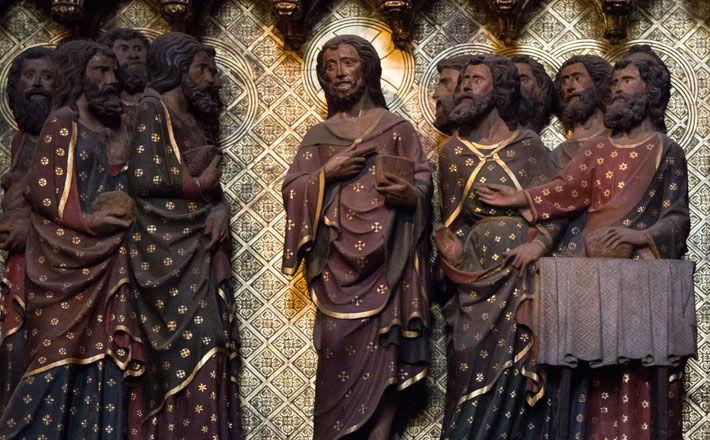
Featured image: “The Disciples give Fish to the Risen Lord to eat” from the medieval polychromed choir screen of Notre Dame de Paris. Image by Lawrence OP via Flickr; licensed under CC BY-NC-ND 2.0. (https://www.workingpreacher.org/wp-content/uploads/2020/06/LawrenceOP_Jesus_Fish_710.jpg)

Faith journey

Click here to listen to this 19-minute message..

How is your faith life? How are you doing in your relationship with God?

We are all on a journey of faith. Luke presents it to us like this in Luke 9:51-62 and Paul does so in Galatians 5:13-25. Journeys are typically not straight forward lines. They go up and down and round about. Journeys are messy. And our journey of faith is no different. My own journey looks more like a bowl of spaghetti than a box of spaghetti!

In this message, I unpack three facets of this journey from our two readings for today:

  1. Jesus is quite chilled about our journey. He adopts a ‘take it or leave it’ stance. He desires us to journey with him, but he will not force or coerce us.
  2. Jesus is quite demanding about our journey. He wants a total commitment from us. He has high expectations of us.
  3. Holy Spirit journeys with us, enabling us, strengthening and filling us. We are not on this journey alone. We live with, are led by and keep in step with the Spirit.

On this day, and during this coming week, I’d love you to reflect more deeply and deliberately on our faith journey with God.

2019.06.30.road

Featured image from here.

Truth

Click here to listen to this 17-minute message.

What do you believe? What do you hold to be true? How certain are you that these truths are in fact true? Are you open to the possibility that what you think is true might actually be incorrect? Are you open to possibility that other truths, that are different from your own, might be true? Or are you certain that you are right and they are wrong? In the pantheon of all that you believe is true, is there a central truth – a core truth – that you hold with the greatest certainty? That you’d be prepared to die for?

Truth is a big deal in contemporary society. We live in a post-modern era, where we regard truth as socially constructed, and where one person’s truth is acceptably another person’s fiction or even falsehood. It is a time of relative belief, of ‘live and let live’, of ‘each to their own’.

Yet, for many Christians, truth is absolute and unquestionable. What the Bible says – at least, what those passages that we choose to read – is absolutely true and must be imposed on others as being undoubtedly truly for all people everywhere.

The Apostle Paul presents what appears to be a core truth for himself in 1 Corinthians 15. It centres on the resurrection of Christ. He argues that Christ’s resurrection is so central, that if you don’t believe it, then everything else that you think you believe is flawed and futile.

What is your core truth?

I believe a lot of things about my faith strongly. For example, I believe that God created everything, that God is three distinct persons in one being, that Jesus Christ was the incarnation of God into the world, and that Jesus has uniquely facilitated the restoration of our relationship with God. But I’m not entirely certain how God created everything, whether God is just three persons or if there may yet be additional persons in the Godhead whom we’ve not yet met, or when and how the incarnation took place, and whether there is any limit on the reach of Christ’s reconciliation of people to God. I have thoughts on all of these, and I believe them quite strongly, but I’m open to the possibility – even the likelihood – that I may be wrong.

Yet, for me, I have an unshakable core belief that the heart of God is filled to overflowing with generous, extravagant, fierce love. This one core belief is the centre of my faith. I’m willing to lay down my life for that belief. And everything else that I believe emanates from that central truth. It is why I wrote the book Being God’s Beloved.

What is your core truth?

2019.02.10_Truth

Link to featured image