Love is central to the being of God, so it is little wonder that Love infuses Jesus’ post-resurrection, post-crucifixion appearances, and also his post-ascension appearances. This message unpacks the details of Jesus’ infinite and irresistible love for his people in John 21, and also his demanding and liberating love for those who are not his people in Acts 9. Watch the 24-minute video message or read my notes below that.
Let us consider John chapter 21
v3. The disciples go fishing. So ordinary – living life, even in the absence of their Lord.
v5. Jesus appears on the seashore and asks if they have caught no fish. He is concerned for them, for their well-being, for their everyday life.
v6. He tells them to cast their nets to the other side of the boat and the catch a massive haul! Jesus acts on behalf of the disciples, with their ordinary, everyday needs. Like he did at the wedding in Cana (Jn 2), where he rescued a couple’s wedding by making water into wine. He is concerned for our everyday lives.
v9. Next thing, he’s cooking food for them! This is the Son of God, raised from the dead! This is the one we read out in Rev 5, “Many angels, ten thousand times ten thousand, encircling the throne, saying in a loud voice: Worthy is the Lamb, who was slain, to receive power and wealth and wisdom and strength and honour and glory and praise!” This is the one cooking breakfast for them!
v9. Jesus provides the fish for the meal. They bring their catch only after he has already caught and cooked fish for them. He cares, he’s thoughtful.
v12. Jesus invites them, “Come and have breakfast.” So ordinary, so thoughtful. He breaks bread and fish, like he did when he fed the 5000 in Jn 6.
v12. This meal reminds us of the Last supper just a week or so previously in Jn 13. From supper to breakfast; from night to dawn; from death to life. This is a transformative meal – more than just brekky.
v15-17. Three times Jesus asks Peter, “Do you love me?” Three times Peter protests, “Of course I love you!” Here Jesus gives Peter a chance to undo the three denials on Good Friday. In so doing, Jesus resets Peter’s standing – his slate is wiped clean. This is grace.
v15-17. Each time, Jesus says, “Feed my lambs, take care of my sheep, feed my sheep.” This is good shepherding. This is what we want in our new bishop. We remember Jesus in Jn 10, “I am the good shepherd. I know my sheep and my sheep know me. I lay down my life for my sheep.” This is good shepherding.
v19. Finally, Jesus says, “Follow me!” His example is the one we are called to follow – his example, his footwashing in Jn 13. “Now that I, your Lord, have washed your feet, you should wash one another’s feet. I have set you an example.” An example of humility, of care, of love.
Let us also consider Acts 9
v1. “Saul is breathing out murderous threats against the Lord’s disciples”. He is a bad, bad man, full of perverse religious self-righteousness.
v4-5. On the road, Saul encounters the risen Jesus, who says, “Saul, Saul, why do you persecute me? I am Jesus, whom you are persecuting.”
Here Jesus demonstrates his “option for the poor”. He identifies with those whom Saul is persecuting – ‘you are persecuting me’, he says, because he is one with those who are persecuted.
Like then, still today, Jesus stands with those who suffer. He is always to be found in the midst of conflict and suffering. He stands in Gaza, he stands in Ukraine, he stands in the DRC, in Ethiopia, in Myanmar. He stands today even among minority groups in the USA who are being persecuted by their new government.
v6. But despite all of Saul’s repugnant hatred and self-righteousness, Jesus calls and uses Saul, who becomes Paul.
God’s choices are radical and loving.
He can transform anything and anyone. Nothing we do can block God’s purposes.
Jesus’ love and intentions are irrepressible.
Best we just surrender to him, because we cannot overcome God’s love.
To wrap up, let’s read Psalm 30
I will exalt you, O LORD, for you lifted me out of the depths and did not let my enemies gloat over me. O LORD my God, I called to you for help and you healed me. O LORD, you brought me up from the grave; you spared me from going down into the pit. Sing to the LORD, you saints of his; praise his holy name. For his anger lasts only a moment, but his favor lasts a lifetime; weeping may remain for a night, but rejoicing comes in the morning. When I felt secure, I said, “I will never be shaken.” O LORD, when you favored me, you made my mountain stand firm; but when you hid your face, I was dismayed. To you, O LORD, I called; to the Lord I cried for mercy: “What gain is there in my destruction, in my going down into the pit? Will the dust praise you? Will it proclaim your faithfulness? Hear, O LORD, and be merciful to me; O LORD, be my help.” You turned my wailing into dancing; you removed my sackcloth and clothed me with joy, that my heart may sing to you and not be silent. O LORD my God, I will give you thanks forever.
Click below to watch the video of this message on Jesus’ style of leadership, preached on Maundy Thursday, 17 April 2025, drawing on the reading from John 13:1-17. Jesus’ leadership is all about partnerships, delegation, setting an example, serving, and humility. All this, terribly out of sync with most modern leadership styles.
Almighty and everlasting God, whose will it is to restore all things in your well-beloved Son, the King of kings and Lord of lords: Mercifully grant that the peoples of the earth, divided and enslaved by sin, may be freed and brought together under his most gracious rule; who lives and reigns with you and the Holy Spirit, one God, now and forever. Amen.
Christ the King – festival established only in 1925, first celebrated in 1926 – less than 100yr ago
A response to growing secularism and atheism after WWI, & growth of fascism, all of which we see even more today
During a time when secular national leadership was not functioning, it was helpful to remember that Christ is the ultimate King, over all nations. King of kings. Rev: “the ruler of the kings of the earth”
In 1969, Pope Paul changed name to “Our Lord Jesus Christ, King of the Universe”
We still call it ‘Christ the King’
Jesus Christ is our personal Lord and saviour – our king, whose throne is in our hearts
He is also creator of & King over the universe.
He is King over both sacred and secular parts of the world – the church, and the world.
We should not be too afraid to speak his kingliness – He is king!
But while Jesus walked this earth, he kept his kingship hidden until the end of his life. He says to Pilate J18: “You say that I am a king”
He came as a servant, not as a Royal, Monarch, President, Dictator.
“I was born and came into the world to testify to the truth” > God
2 Sam 23:3-4 – God said to David: lead in righteousness = in right relationship with God and with people – a beautiful thing
All too often, standing up for Jesus centres on morality – homosexuality, abortion, marriage, etc
And Pope Pius’ original thinking for this festival was that individuals and states must submit to the rule of the Saviour – “the Empire of Our Lord”. He almost wanted a Theocracy.
But what Jesus stood up for was the poor, the excluded, the marginalised, the vulnerable.
His Good News was one of a social order in which power was flat, and people were cared for, reversal of fortunes.
This is not what we typically think of as ‘kingship’.
He sets for us a model for leadership and power
We lead through service – to work for the best for those whom we lead, even if by sacrifice
We exercise power to protect, not to dominate
Often link CtK to Christ as the Good Shepherd
Servant leadership is the closest model to Jesus’ leadership
To ensure the wellbeing and flourishing of every person under our leadership
To remove obstacles and challenges, so people can move forward unencumbered
To set an example of what we want from them, rather than demanding but not living it
Most Gracious God, who in Jesus of Nazareth showed us an alternative to the kings, queens and emperors of history, help us to revere and emulate Jesus’ leadership: To love, and to seek justice for all people. Help us to recognize the true grandeur and life-changing power based in loving you and all of our neighbors. In Christ Jesus, with you and the Holy Spirit, may we co-create a world ruled not through domination, but in that radical and all-powerful compassion and love. Amen.
Today we celebrate St Stephen, after whom our church is named. It is our church’s patronal festival, our birthday.
Stephen was a young man, appointed a deacon in the early church. He appears only in Acts 6 and 7, but in those few pages, he makes a remarkable impression and impact. He is the first Christian martyr – stoned to death because he challenged the Jew people’s lack of faith in Jesus Christ.
While we walk primarily in the footsteps of Jesus Christ – he is God incarnate, our teacher and our Lord and saviour – we give heed also to the example of Stephen, and seek to continue his legacy in our parish community today.
Our readings centre on Acts, omitting Stephen’s long, but very impressive and persuasive sermon. This are supported by a reading from 2 Chronicles, where Zechariah (an earlier Zechariah – not the father of John the Baptist) is stoned to death for speaking God’s Word. Psalm 31, which includes the words that both Jesus and Stephen speak as they died. And John 6, which is the ordinary reading for today, from Jesus’ long sermon on the Bread of Life. I have tabulated these three people, because there are significant and meaningful similarities between them, that speak to all Christians, and especially those who are members of a church named after St Stephen:
Topic
Zechariah
Jesus
Stephen
Reading
2 Chronicles 24:17-22
John 6:24-35
Acts 6:8-10 & 7:54-60
Holy Spirit
Spirit of God came on him
Baptised by John and the Holy Spirit descended on him
Full of Holy Spirit, faith, grace and power
Care for the poor
–
Fed 5000 men (plus women and children) with bread and fish
Oversaw the daily distribution of food
Challenges with the people
They were chasing after other Gods
They just wanted food and miracles
Wanted quiet conformity with the past
Challenging the people
Why do you disobey the Lord’s commands?
Do not work for food that spoils
You stiff necked people! Your hearts are uncircumcised! You always resist the Holy Spirit! Was there ever a prophet your ancestors did not persecute?
Consequences for God’s messengers
Stoned to death
Crucified
Stoned to death
Their final words
May the Lord see this and call you to account.
Father, forgive them, for they know not what they are doing.
Lord, do not hold this sin against them.
Final prayer
–
Father, into your hands I commit my Spirit (in Luke)
Lord Jesus, receive my spirit (Psalm 31:5)
So, what do we take from this, and particularly from Stephen, into our daily lives?
We must take our faith seriously – it is costly, important and even worth dying for.
We must care for the poor, hungry and marginalised.
We must seek the infilling of Holy Spirit, who equips us for life and ministry.
We must seek after the things of God, and not after the things of this world.
We must forgive those who hurt even, even to death.
John 15: 9-17 presents us with a powerful summary of Jesus’ economy of love. Here’s a summary of the promises that Jesus makes about his love for us:
9. Jesus loves us as the Father loves him
11. Jesus’ joy is in us > our joy is complete
12. Jesus loves us
13. Jesus lays down his life for us
14. We are Jesus’ friends
15. We are Jesus’ friends (not his servants)
16. Jesus chooses us (not us him)
16. Jesus appoints us
16. Jesus enables us to be fruitful
16. God gives us whatever we ask in Jesus’ name
Part of what is beautiful about this passage is the generous and unconditional outpouring of love, care and enabling of us by Christ.
However, there are some aspects of this passage that are conditional – there are some IFs
11. We remain in Jesus’ love IF we keep his commands
14. We are Jesus’ friends IF we do what he commands
It is true that Jesus’ love has conditions – it is not utterly unconditional. He has expectations and makes demands of us. It is not a free-for-all. But before we get worked up about being held hostage to God’s expectations, let’s look at what those conditions are:
12. My command is this: love each other as I have loved you
17. This is my command: love each other
That’s it. Just two commands. Actually, just ONE command, because they are the same command: Love each other. That’s the only condition that Jesus places on us: Leave each other.
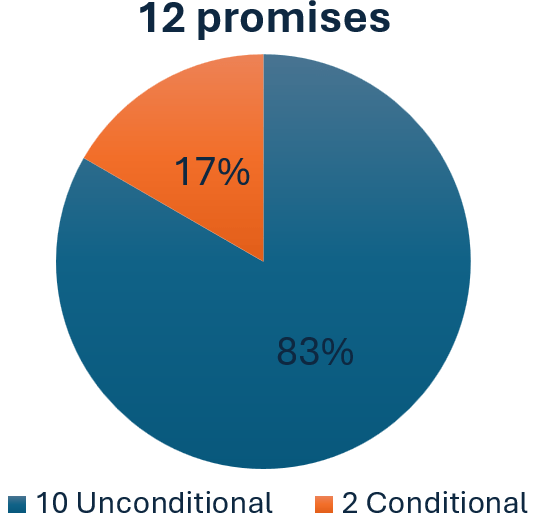
And let’s look at the ratio of unconditional and conditional promises in this passage:
That’s a pretty good economy! 83% of Jesus’ promises in today’s reading are unconditional. And the 17% that are conditional are conditional on something that is surely good for everyone – us and everyone else! To love one another.
Loving one another surely in our own interests – if we love others and all the others are loving us, that’s a good deal!
Hence John writes in his first letter (1 John 5:3), “God’s commands are not burdensome”. I’m not sure I fully agree with John here, because loving others is sometimes not easy. We have to love difficult people, people who don’t love or respect us, people who do bad things, and so on. It is not always easy to love others. But we are talking about just ONE command, not 613 commands, not 10 commands, not even 2 commands: JUST ONE!
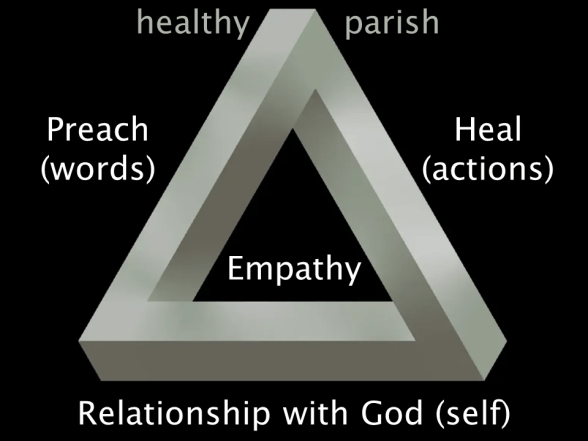
This sermon (preached a week ago on 4 February 2024) is about a healthy parish – what makes for healthy parish life. It emerges, in part, in light of various churches failing to uphold core values around clergy integrity and sexual relations. A model for a healthy church is presented, based on the readings that were set for today in the Revised Common Lectionary, viz. Isaiah 40:21-31, Psalm 147:1-11, 1 Corinthians 9:6-23 and Mark 1:29-39.
Jesus is always our model for everything to do with Christian living, including corporate or collective Christian living – the church. This model is influenced by the readings above and also by how Jesus lived his life, related to God and people, and exercised his ministry.
1. Personal relationship with God
The foundation of a healthy church – and the foundation the triangle above – is each member’s personal relationship with God. Our collective well-being rests on the aggregate of each individual person’s health relationship with God. In Mark 1:35, Jesus leaves his ministry to spend time in his personal relationship with God – he does so repeatedly, even though there are so many people waiting for his healing ministry and teaching. If a personal relationship with God is important to Jesus – who is God, the second person of the Holy Trinity – how much more important should it be to each of us.
When you fly on an airplane, you will be told that, in the event of cabin decompression, oxygen masks will drop down from above your seat. And you will be told to put your OWN mask on FIRST, before helping others (including your children). This is an apt illustration of the need for each of us to see to our personal relationship with God. I, as priest, must ensure the robustness and depth of my relationship with God.
2. Preach words
In 1 Cor 9:16-18, Paul refers to his preaching as central and as God-given. In Mark 1:38-39, Jesus says he needs to go to other villages to “preach there also”. He goes on to say, “That is why I have come”. Preaching words is important to build people’s faith.
But for a health church, I suggest we translate preaching as our words. Too often our words are harsh, judgmental, critical and gossipy. Such words break down, alienate, diminish and harm. There is no place for such words in a healthy church.
Our words should heal and create. Psalm 147:4 says, God “determines the number of stars and calls them each by name”, while Isaiah 40:26 reiterates, “Lift up your eyes and look to the heavens: who created all these? He who brings out the starry host one by one and calls forth each of them by name. … not one of them is missing”. These verses indicate how the words of God bring stars into being, as he names and calls them. Similarly, our words – whether good or bad – can call things into being.
Therefore, our words should be deliberately encouraging, edifying, building up, loving. Last year, we spent the whole of Lent reflecting on Jesus’ command to “love one another”, where we teased this out in detail.
3. Heal through actions
Mark 1:29-34 and 39 say, “…[Jesus] went to her, took her hand and helped her us. The fever left her … Jesus healed many who had various diseases. He also drove out many demons … So he travelled throughout Galilee … driving out demons.” Isaiah 40:29-31 says, “He gives strength to the weary and increases the power of the weak. Even youths grow tired and weary, and young men stumble and fall, but those who hope in the Lord will renew their strength. They will soar on wings like eagles; they will run and not grow weary, they will walk and not be faint.” Psalm 147: 2-3, 8-9, says, “The Lord builds up Jerusalem; the gathers the exiles of Israel. He heals the broken-hearted and binds up their wounds. … He covers the sky with clouds; he supplies the earth with rain and makes grass grow on the hills. He provides food for the cattle and for the young ravens when they call.”
These words are all of healing actions. How we behave impacts the health of a church. When we exclude, abandon or just do nothing, we harm the church. We break it down and weaken it. Rather, we should engage in actions that build up a health community. We can do this by simply showing up, instead of being absent. And through simple acts, like cooking a family a meal when they’re going through a hard time, giving someone a call or sending them a message, helping to clean up. In our tradition, we share the peace during the service – we can make sure we greet all the people around us, instead of rushing off to chat with our friends and ignoring a visitor.
4. Empathy
I have placed ’empathy’ at the centre of the graphic of a healthy church, even though the word ’empathy’ does not appear in the Bible. But the concept is there, for example in 1 Corinthians 9:19-23, Paul writes:
19 Though I am free and belong to no one, I have made myself a slave to everyone, to win as many as possible. 20 To the Jews I became like a Jew, to win the Jews. To those under the law I became like one under the law (though I myself am not under the law), so as to win those under the law. 21 To those not having the law I became like one not having the law (though I am not free from God’s law but am under Christ’s law), so as to win those not having the law. 22 To the weak I became weak, to win the weak. I have become all things to all people so that by all possible means I might save some. 23 I do all this for the sake of the gospel, that I may share in its blessings.
Here Paul steps into the shoes of others, in order to understand them from inside, in order to share the Gospel in a way that makes sense to them. This effort to feel with others is core to empathy.
We see this profoundly in Jesus. Until Jesus was conceived, God had no first-hand understanding of what being human was like. God was not a man, and didn’t have personal experience of being human. But when Jesus incarnated in Mary’s womb and was born like any other human, God got a first-hand experience of being human – God discovered empathy for the human condition.
Too often, however, we jump to negative conclusions, without first exercising empathy. We assume the worst of people, rather than considering other less judgmental reasons for their behaviour. For example, if we don’t see someone for a few weeks we assume they have lost their faith or reneged on their responsibilities, when in fact they might be ill. Instead, let us rather assume the best – if we’re going to make an factless assumption, let’s make a positive one rather than a negative one, until the facts suggest otherwise.
A church that is grounded in personal relationships with God, that speak and act in ways that build up and encourage, and that chooses to empathise with each other, is likely to be a healthy community. This is the kind of community or body that God desires for us. It takes some effort on each person’s part. Working together, we can build a healthy church centred on God.
Over the past two Sundays, our readings have directed us towards the conclusion that God wants the whole of us – for us to give ourselves utterly into God’s hands to do with us as God wills. We first got this from Jesus’ teachings in Matthew 10 (Hard Words) and second from Abraham’s willingness to sacrifice his son Isaac (Abraham’s Example). Typically, our inclination is to hold back and not surrender – relinquishing ourselves to God does not come naturally.
Today’s readings continue this theme but from a somewhat different perspective. They all point towards the roles of actors in a divine drama or play. We are the actors, and God is the Director. The play works out best when each actor does their part according to the directions of the Director. Since our Director is both competent and good, the drama of our lives can also be successful and good. But only if we as actors follow our Director’s directions.
Abraham is nearing death and wants his son Isaac to get married, but not to someone from the neighbouring communities, but rather from his home country.
His senior servant is called in to act on Abraham’s behalf – the servant is not named, but is the central actor in this chapter. The servant has charge over all of Abraham’s things. Abraham commissions him to go to his homeland and get a wife for his son, giving detailed instructions on what to do and not to do.
In vv12-14, the servant prays to the God of his master Abraham to make him successful and to show kindness to Abraham – remember that the Director is both competent and kind. In his prayer, the servant sets out a narrative of how he hopes things will go – that he speaks to a young woman, asking her for a drink, she offers him a drink and also offers water for his camels.
Rebekah then comes out, and the narrative plays out just as the servant had prayed (vv15-22).
The servant then asks if he can spend the night at her father’s house and it all works out. The servant gives thanks to God for “his kindness and faithfulness” to his master (v27).
Rebekah runs home and tells her family about the servant, and her brother Laban comes out to welcome him into their home. They take care of both the servant and his camels (vv28-33).
The servant then recounts to Laban and his family the whole story that we have already been told (vv34-49).
This is followed by various details of the negotiations that rapidly culminate in Rebekah agreeing to go immediately with the servant to get married to Isaac (vv50-61). They arrive back at Abraham’s home, Rebekah and Isaac meet and get married (vv62-67), in so doing continuing the lineage from Abraham to Jesus (as provided in Matthew 1).
In this narrative, the servant is an actor – an agent who behaves, speaks, makes decisions, impacts the world. He trusts in Abraham and in Abraham’s God, thereby carrying out the will of God. He relinquishes himself to God.
Rebekah is similarly an actor – she engages with the servant, shows hospitality to him and his animals, argues against her brothers about leaving immediately rather than later, and agrees to marry Isaac. She exercises power and agency in her life, in accordance with the will of God. She relinquishes herself to God.
In short, we have actors doing the will of God the Director.
The Psalms provided in the Lectionary typically provide a commentary on the First Testament reading and today is no exception. Psalm 45 presents us with three actors and a director.
v1 starts with “My heart … as I recite … my tongue.” Here is the Psalmist, writing in first person and also congratulating themselves on their skill as a Psalmist. The Psalmist is an actor – present and active in the creation of this Psalm.
vvv2-9 are addressed to ‘you’ – to the King. In the context of Genesis 24, we should think of the King as representing Isaac, though Isaac was not a King. The King/Isaac is also an Actor, because of how the Psalmist describes him, e.g., as defending truth, humility and justice.
vv10-12 are addressed to ‘daughter‘, the bride. She represents Rebekah and the Psalmist speaks directly to her (not just about her) making her an actor.
vv13-15 are a commentary, by the Psalmist, about the wedding and how wonderful it is.
v16 is directed again at the King – your sons, your fathers, you will make – confirming the King as an actor.
v17, finally, returns to the “I” (which we last heard in verse 1). In verse 1, the I referred to the Psalmist. It is possible that the I in v17 is also the Psalmist, but I think the claims that are made in v17 exceed the capacity and power of the Psalmist, and that here ‘I’ refers to the Director – to God. The Psalmist’s life is too short, but God can work “for ever and ever”. It is God who will perpetuate the memory of the king through all generations and across all nations.
Thus, God is revealed in the last verse of the Psalm to be the Director. Although the Psalmist has considerable power in writing the Psalm, ultimately, even the Psalmist is an actor in a larger play directed by God.
This passage from Romans is full of “I”. It seems obvious that Paul is here referring to himself, writing in first person, but it is possible that he is referring to ‘a person’ using ‘I’ as a shorthand, and there is debate among commentators on whether the ‘I’ is a Christian or an unconverted person. I don’t want to get into all that today. The key point for today is that there is a clear actor here, referred to as “I“, whoever that person may be.
What we see happening in this actor’s life is a grappling between a desire to be good and a tendency to do evil. We are given an insight into the heart of this person, grappling with their own brokenness. This reaches a climax in v24, “What a wretched man I am! Who will rescue me from this body that is subject to death?”
And then the Director steps in: “Thanks be to God, who delivers me through Jesus Christ our Lord!” Or arguably, two actors, but so in sync with each other, that they are truly one being or essence.
What we can take from Romans 7 is that in our grappling with ourselves, as we hope to become transformed into the image of Christ, God is directing. And God is competent and good – God will bring it to fruition in God’s good time. We must, in the meantime, play our part as actors who make repeated choices to act in accordance with God’s desire for and image of a redeemed humanity.
Lastly, we come to our Gospel reading. In the opening verses of this passage, Jesus seems to be saying that the people of this world think that they are directors (vv16-17):
“To what can I compare this generation? They are like children sitting in the marketplaces and calling out to others: ‘We played the pipe for you, and you did not dance; we sang a dirge, and you did not mourn’.”
They think they are puppeteers, who can direct others to do their bidding. But unlike God the Director, they are neither competent nor good. Instead, they are capricious and mean-spirited, as Jesus explains in vv18-19:
“For John came neither eating nor drinking, and they say, ‘He has a demon.’ The Son of Man came eating and drinking, and they say, ‘Here is a glutton and a drunkard, a friend of tax collectors and sinners.’ But wisdom is proved right by her deeds.”
In this last sentence of v19, Jesus reveals who the director is: Wisdom! Wisdom is the First Testament forerunner of Holy Spirit. The Spirit of God is the Director: wise, good and competent. It is by her deeds – her actions – that she is proved right.
In the rest of this passage (vv25-30) Jesus emphasises God as a good and kind director, who has our best interests at heart.
In summary, God does want all us, completely and utterly. It is when we follow his directions (i.e. when we are yoked to him) that we become true and full actors, free to play our part in his play.
Click here to watch the video of this 28-minute message on Facebook (the message starts about 29 minutes into the recording). Note that this is an active sermon – worth watching, rather than just reading. I don’t have an audio recording of this message. Or read the text summary below.
Matthew 9 tells the story of Jesus calling Matthew: “As Jesus went on from there, he saw a man named Matthew sitting at the tax collector’s booth. “Follow me,” he told him, and Matthew got up and followed him.” And Genesis 12 tells the story of God calling Abram: “Go from your country, your people and your father’s household to the land I will show you.” Go! Follow me! These calls have nuclear power to move people – Matthew got up and followed Jesus, Abram packed and moved into the unknown.
Jesus is calling you and me today – Follow me! Go! – but to where? Where do we go? Where do we follow?
Matthew 9:16-17 gives us invaluable insights into what Jesus calls us to, in the metaphor of new wine in new wineskins:
“No one sews a patch of unshrunk cloth on an old garment, for the patch will pull away from the garment, making the tear worse. Neither do people pour new wine into old wineskins. If they do, the skins will burst; the wine will run out and the wineskins will be ruined. No, they pour new wine into new wineskins, and both are preserved.”
Although the metaphor is a bit obscure, at very least we can take from this that there are challenges in mixing the old and new. Jesus leans strongly in favour of the ‘new’ – new wine and new wineskins are what we’re after. A few verses earlier (v13) he gives another clue about where we are following him to, when he quotes Hosea, “I desire mercy, not sacrifice”. Mercy represents love for people, while sacrifice represents religion. Jesus is saying – indeed God is saying – I don’t want your religion, I want your love for people. This is the ‘new’ teaching – or rather an old teaching renewed – that Jesus gives us. And the whole of Matthew 9 illustrates this with examples.
Come along with me – follow me! – as we briefly consider the seven stories that illustrate following the new wine in Matthew 9:
The chapter opens with a paralysed man, brought to Jesus by his faith-filled friends. Jesus sees their faith and says, “Take heart, son; your sins are forgiven.” The teachers of the law are outraged by Jesus’ presumption of having authority to forgive sins – they’re not interested in the man, only in their theology. Jesus responds strongly and heals the man as evidence of his authority to proclaim forgiveness of sins. Jesus’ love for this physically and spiritually broken man takes precedence over the teachers’ petty theology.
In verses 10-13, Jesus attends a party hosted by Matthew, who is now following Jesus. Matthew’s friends are tax collectors and sinners – ‘bad people’. The Pharisees – another religious group – are disgusted and ask Jesus’ disciples, “Why does your teacher eat with tax collectors and sinners?” They are not concerned with the humanity of Matthew and his fallen friends – they are concerned only with religious piety and ‘rightness’. They dehumanise these broken people. Jesus confronts them, “It is not the healthy who need a doctor, but those who are ill… For I have not come to call he righteous, but sinners.” Jesus’ love for sinners, for bad people, takes priority over everything.
In verses 14-17, while still at the same dinner party, the disciples of John the Baptist come and ask Jesus, “How is that we and the Pharisees fast often, but your disciples do not fast?” Their use of ‘often’ (we fast often) betrays the religious pride. Their interest is in religious observance and spiritual discipline. But Jesus dismisses their concerns, asking “How can the guests of the bridegroom mourn while he is with them?” He has little interest in fasting or other religious piety – he is more interested in spending time engaging with people. It is in this immediate context that he speaks about new wine – he is not interested in religious and theological precision and rightness; he is much more interested in human relationships, fellowship, compassion and love.
In verses 20-22, while still at the same party, a synagogue leader tells Jesus that his daughter has died and asks if Jesus can come and help. Jesus leaves immediately, as his compassion for this young girls outweighs his fellowship with Matthew and his friends. On the way to the house, a woman who has been bleeding (menstruating) heavily for 12 years touches his cloak and is healed by Jesus’ power. Her faith is strong: “If I only touch his cloak, I will be healed.” Jesus stops and speaks with her, he proclaims healing and wholeness and salvation. We imagine he took hold of her hand as he lifted her up onto her feet. While in the other stories there are crowds of noisy people around, here there is silence. Men and women keep menstruation quiet and private – it is not public. And in those days, women were considered unclean during their period. For Jesus to engage, speak, touch her was to make him unclean. He didn’t care about that – he cared just for her.
Reaching the house of the synagogue leader, there is a noisy crowd outside. They mock Jesus when he says the girl is just sleeping. He goes up to her room and takes her by the hand. Touching a dead person makes one unclean, but Jesus doesn’t care about that – he cares only for the girl. She is revived and gets up.
Briefly, Jesus continues on his way and heals two blind people, “According to your faith let it be done to you”. He sternly warns them not to tell anyone about him healing them. He is not interested in recognition – he cares only about their sight.
And then he encounters a demon-possessed man (perhaps today a schizophrenic). He drives out the demon. The Pharisees cannot recognise Jesus’ compassion for this man’s wholeness and well-being; they say, “It is by the prince of demons that he drives out demons”.
Jesus quoted Hosea, “I desire mercy, not sacrifice”. Jesus tells about the new wine – his people-centred gospel of love and inclusion – that is incompatible with the old wineskins of religiosity, piety, self-righteousness. He is all about people: “I have not come to call the righteous, but sinners”.
So, as we follow Jesus, as we answer his call to ‘Go!’, we must put people before religion, relationships before theology, acceptance before judgement, inclusion before exclusion, love before judgment. This is the new wine of Jesus’ Gospel that should be poured into the new wineskins of our hearts and churches.
Many who are reading this post may have experienced ‘toxic leadership’ – where people in leadership positions exploit, undermine or harm the people they lead. They poison the people they lead. We may have experienced this in the workplace, from our boss or manager – someone who was more interested in targets that people, who used you to climb up the corporate ladder, who did not recognise you as a real person. We may have experienced toxic leadership from our parents, who did not nurture and nourish us, but neglected us, put their own interests first, or even abused us. We may have experienced toxic husbanding or toxic wifing, where the marriage relationship breaks down instead of building up, discredits, maligns, abuses.
We may also have experienced toxic leadership in the church – from clergy, lay leaders, and influential people – who use their positions of leadership and authority in the church to advance their own agendas and to hurt and harm others, often in the name of God. Those with spiritual or church power may seek to oppress other members of a church community, through judging, excluding, humiliating and excommunicating. We see this most grotesquely in the sexual and other abuse of children and women and young men. This happens in many denominations, such as the Catholic church, the Southern Baptist Convention, Hillsong and the Anglican Church (to name some recent examples). Few churches are exempt from this, even our own parish.
The truth is that you yourself may be that toxic leader! Here we must critically self-reflect. Am I a toxic leader? Do I use others to get ahead? Do I put myself first? Do I harm or neglect those I am entrusted to care for? Let us not only point the finger at others; let us also critically examine ourselves.
In the Bible, some of the harshest words are reserved for spiritual and other leaders who are toxic.
Jeremiah 23 is a good example. God, through Jeremiah, confronts the leaders of Israel and says they are rubbish, corrupt leaders. That he will remove them. That he will take over their leadership. ‘Woe to the shepherds who are destroying and scattering the sheep of my pasture!’ declares the Lord. They exploited and harmed the very people God placed in their care; instead of protecting and shepherding them, they exploited and harmed them.
In the previous book in the Bible, Ezekiel 34: 1-6, 9-10, we get a similar message:
This is what the Sovereign Lord says: woe to you shepherds of Israel who only take care of yourselves! Should not shepherds take care of the flock? You eat the curds, clothe yourselves with the wool and slaughter the choice animals, but you do not take care of the flock. You have not strengthened the weak or healed those who are ill or bound up the injured. You have not brought back the strays or searched for the lost. You have ruled them harshly and brutally. So they were scattered because there was no shepherd, and when they were scattered they became food for all the wild animals. My sheep wandered over all the mountains and on every high hill. They were scattered over the whole earth, and no-one searched or looked for them. … therefore, you shepherds, hear the word of the Lord: this is what the Sovereign Lord says: I am against the shepherds and will hold them accountable for my flock. I will remove them from tending the flock so that the shepherds can no longer feed themselves. I will rescue my flock from their mouths, and it will no longer be food for them.
Strong words from God through Ezekiel! The shepherds or leaders of Israel had not only failed as leaders, they had exploited and even eaten the flock that God had entrusted to them. And God therefore utters these damning words, “I am against you!” In gangsta language, “I will take you out”. And God says that he himself will take over as the shepherd of the people (Ezekiel 34:11-16):
I myself will search for my sheep and look after them … I will look after my sheep. I will rescue them from all the places where they were scattered … I will bring them out from the nations and gather them from the countries, and I will bring them into their own land. I will pasture them on the mountains of Israel … I will tend them in a good pasture … I myself will tend my sheep and make them lie down… I will search for the lost and bring back the strays. I will bind up the injured and strengthen the weak… I will shepherd the flock with justice.
Jesus describes himself as the good shepherd. In John 10, Jesus says that the hired hand (the part-time shepherd) doesn’t care about the sheep – he cares only for making a living. So when danger comes, he flees and abandons the herd. But, by stark contrast, Jesus describes himself as the good shepherd, who will lay down his life for his sheep, and who will leave the 99 to seek out and find the one who has got lost. This is what good shepherding is about – taking care, putting them first, putting yourself in danger, going out of your way to look after the one.
The key word that emerges through all these readings from Jeremiah 23, Ezekiel 34 and John 10, is gather: “I will gather my flock.” The abusive, toxic shepherds scatter their flock. This is what toxic leadership does – it deeply undermines and breaks cohesion, collaboration, togetherness, trust, safety and belonging – qualities that are essential for healthy teams. And so God’s first word is to gather together the flock, to reconstitute the community, to reconcile and unite. The image of the flock speaks to us about a healthy community under the protective and caring leadership of a shepherd. The First Testament refers to the Shepherd King – a king who is pastoral, caring and protective, and who invests in the holding together a flock. This image says that being a good King means to be a good shepherd – quite a contrast in status! Shepherding is a key role of Kings and leaders.
This shepherding is central to Jesus’ ministry – both when he walked this earth, and still today. He is quintessentially our ‘shepherd’. He gathers, reconciles and unites, he binds up and restores those who are wounded and broken, he stands up for us in the face of danger, he heals and saves, he welcomes and pardons, he brings peace and safety. This is what leadership is about, in both the church and the rest of the world.
Almost every person who reads or listens to this is a leader – as a parent, manager, church leader, older sibling – you are a leader. And leadership comes with great demands. And many of us here have experienced bad leadership from clergy, who have been bad shepherds who harm their flock.
Rev’d Marti and I have no desire to be bad shepherds. We are both deeply committed to walking in Christ’s path and being good shepherds. But we are human. We make mistakes, we run out of time, we forget. And sometimes we get irritable, frustrated or angry. Power may go to our head. We might become heavy handed, thinking an issue is more important than the people.
And when we do this, we invite you to challenge us. To remind us of our role. To bring us back to the path of Christ. If you can’t talk directly to us, complain about us to the Wardens, who are the Bishop’s eyes and ears in the parish. Speak up. Send us a WhatsApp. It might not be pleasant for any of us. But this is what we need.
And hold yourself accountable, as Christ himself did. Even in this moment as you read or listen to this, consider what kind of leader are you? Are you a good shepherd? And if not, challenge yourself and allow God to work a change within you, to take up a leadership role that reflects the values and principles of Christ our Shepherd King.
Today’s Gospel presents us with some of the most baffling words from Jesus:
“Do you think I came to bring peace on earth? No, I tell you, but division. From now on there will be five in one family divided against each other, three against two and two against three. They will be divided, father against son and son against father, mother against daughter and daughter against mother, mother-in-law against daughter-in-law and daughter-in-law against mother-in-law” (Luke 12:49-58).
It is hard to reconcile such divisive, anti-peace language with the Jesus who repeatedly says, “Peace be with you” and “Love one another as I have loved you”. It may be helpful to differentiate between prescriptive statements and descriptive statements. A prescriptive statement is an instruction or command, such as, “Love your neighbour as yourself”. In such statements, Jesus is telling us the desire and intention of God for us. A descriptive statement, on the other hand, merely describes what is, without necessarily defining it as good or desirable.
This passage from Luke is phrased as a descriptive statement. Jesus is not prescribing the absence of peace or the presence of division – he is rather describing how things will be. His later critique in Luke 12:56, “How is it that you don’t know how to interpret this present time?”, suggests that the entire passage is a description of how things will be and a challenge to our faith to make sense of such divisions.
Last week, Rev Marti addressed the topic of faith in some detail. Her sermon was beautiful and encouraging. Remember Jesus’ words in Luke 12:32, “Do not be afraid, little flock, for your Father has been pleased to give you the kingdom”. She commented on how lovely it is to be a little lamb in God’s little flock. Today, we continue to reflect on faith, but faith that is tested; faith that is under pressure; faith that must stand in the gap.
So, let’s go back to our First Testament readings to see how these may help us make better sense of our Luke passage.
Isaiah 5:1-7
Isaiah 5 pens with a story of a beautiful and very much-loved vineyard in vv1-2. It could easily have been found in Song of Songs – it is quite sensual. But all too soon, in v7, there is deep disappointment in God, as he looks for justice, but sees only bloodshed; looks for righteousness, but hears only cries of distress. How is it possible to go from something so beautiful to something so dreadful in just a couple of verses? God laments in v4, “What more could have been done for my vineyard than I have done for it? When I looked for good grapes, why did it yield only bad?” God is baffled by the capacity of the people of Israel and Judah to transform something so good into something so bad. Consequently, God destroys and tramples the beloved vineyard, he makes it a wasteland, uncultivated, dry and desolate.
This passage presents us with a sobering example of the failure of faith. What God has desired – what he expects of his faithful people – is social justice and righteousness. This is the prescription or command of God. But when we fail to live up to this expectation – when we become faithless – God is grieved, and the consequence can be destruction. The destruction is described, not prescribed – it is the natural result of our turning from God.
Psalm 80
Psalm 80 could have been written by Isaiah – the narratives have so many similarities. vv8-11 describe a beautiful vineyard, tended and cared for, sheltered and protected. This is followed immediately by a lament (vv12-13). Here the lament is not from God, but rather from God’s people: “Why have you broken down its walls so that all who pass by pick its grapes?” As in Isaiah, God destroys the vineyard, but now it is the people who lament. And in contrast to the Isaiah passage, there is now a turning back to God, asking for reconciliation. In vv14 & 19 they say: “Return to us, God Almighty! Look down from heaven and see! Watch over this vine. … Restore us, Lord God Almighty; make your face shine on us, that we may be saved.”
And in their prayer for restoration, they prophecy about the coming Messiah. In v15 they say, “Watch over this vine, the root your right hand has planted, the son you have raised up for yourself.” And in v17, “Let your hand rest on the man at your right hand, the son of man you have raised up for yourself.” Who is this son, this man at God’s right hand, this raised-up son of man, if not Christ? Here we see a restoration of the faith of the people, as they give voice to the prescription of God – that we entrust ourselves to God and to his anointed son.
In this narrative, God’s destruction of the vineyard, though terrible, gives rise to new faith. It reminds me of the fires over the mountains in Cape Town. They are destructive and devastating. But out of the fire, new fynbos and protea grow. Many of you may have seen, driving over Ou Kaapse Weg for example, the new green-green shoots of life emerging out of the blackened ground. The destructive fire, as hard as it is, is tied up with the new life that emerges from the ashes.
Hebrews 11:29-12:2
And then we pick up in Hebrews 11 where we left off last week – a reminder of the many ways faith has persevered through difficult times in the First Testament. Despite the many adversities they face, there are people of faith who come through these fires – Rahab, Gideon, Barak, Samson, Jephthah, David, Samuel and many others. The writer of Hebrews even points out in v39 that many of them never saw the fruit of their faith – for example, Abraham was promised, but never saw, the great nation that would flow from him; and Moses never crossed into the promised land, despite all his faithful efforts in leading his people out of Egypt and through the wilderness.
And now for us, who come after Christ’s incarnation, life, death, resurrection and ascension, how much more are we able to be people of faith. As Hebrews 12:1-2 says, given this legacy of people of such faith and everything that Christ has done for us, we must “run with perseverance the race marked out for us, fixing our eyes on Jesus, the pioneer and perfecter of faith.” Jesus himself scorns the shame of the cross, because he has deep faith that it is through such testing and trials that God’s Will will be accomplished.
Luke 12:49-58
So, let us then return to today’s Gospel reading. What does Jesus mean when he says, “Do you think I came to bring peace on earth? No, I tell you, but division.” Jesus is not prescribing division, but describing it. Division is, strangely, a consequence of faith! Jesus did not come to make human life comfortable and easy. We are not playing nicey-nicey. No! On the contrary (as a member of our parish said so well yesterday in Morning Prayer), Jesus is a revolutionary! He came to disrupt the corruption, hypocrisy, injustice, violence and exploitation of this world. Throughout the Gospels we see Jesus standing against such evils. His vision for humanity and for the whole of creation is magnificent and prescriptive – we must live up to the ideals of God.
But when we live up to God’s ideals of love, social justice, radical inclusivity, forgiveness, reconciliation, tolerance and righteousness, we will inevitably create conflict. Indeed, let me say that we should inevitably create conflict. This is not a prescription, but a description of the inevitable. Revolution is not nice! It causes division.
We can think of many contemporary examples of such division and the absence of peace, as a result of diverse issues in the world. For example, let’s consider the continuing question of the place of LGBTQI+ people in the church – their membership, their ministry, their marriage, their ordination. This is such a divisive topic for Christians. Many years of discussion in the Anglican church have brought little common ground.
At the Lambeth conference over the past couple of weeks – the Anglican communion’s global meeting – the Archbishop of Canterbury proposed a kind of live-and-let-live compromise for everyone: each country decides what they believe is right and good. Is this a solution? I’m sorry, but I don’t think so. Does it bring peace and unity? No, I doubt it; it might even achieve the opposite.
My own view on this is that when we place sexual morality or our views of gender ahead of radically inclusive love, then we have strayed far off the path that Jesus walked. I am firmly convinced that the pattern of life that Jesus established leads inevitably to the inclusion of members of the LGBTQI+ community in the life, sacraments and ministry of the church, even if one believes that homosexual acts are wrong. But many of you here today may disagree with me and this may lead to a lack of peace between us, perhaps even disunity. So be it.
And of course, there may be many other issues we could fall out over: the conflict between Palestine and Israel; our stand on abortion; global warming; our affiliation to political parties in South Africa. The opportunities for conflict and discord are numerous.
I suggest, though, that what we are learning from Jesus in Luke 12 is that such tensions are inevitable and tolerable. They may be uncomfortable. And we pray that they do not tear us apart. But they are not fundamentally wrong or bad. After all, Jesus himself says, “I came to bring division”.
But towards the end of this passage, Jesus makes some important points about divisive issues in the Christian community. In Luke 12:54-56, he criticises people for being able to interpret the signs in the sky and the earth, such as predicting the weather, but being unable to interpret the signs of the “present time”. It is as if Jesus is saying, “Look! Wake up! Open your eyes! Wragtig julle!” We cannot control the weather, but we can discern and shape human behaviour and its impact on the world.
For example, the eight women who were recently gang raped by dozens of men in Krugersdorp. How can we allow this continue? What is wrong with us in this country that we have the highest rate of rape in the world? What are we doing about it?
And Jesus goes on immediately in vv57-58 to urge us to think for ourselves about what is right and what is wrong. And to make reconciliation our aim, rather than to be adversarial. His prescription for Christian living, even in complex times, is clearly stated here – think about what is right and do reconciliation.
The tensions between peace and division, and the handling of complex ethical and moral questions are complex. How do we then go about discerning what is right and wrong in the world, and interpreting the signs of this age? How can we be revolutionary, as Christ was, while also working for peace and unity, as Christ did? Let me suggest two central principles that may help us navigate these challenging paths**:
The primacy of love. If there is one thing that stands out so strongly in all of Jesus’ teachings and actions, that we cannot deny it and still call ourselves Christian, it is the priority that Jesus gives to love. I refer to his love as ‘radically inclusive love’, because Jesus never turns people away on the basis of gender, ethnicity or race, religion or morality. He may criticise people’s behaviour, but he always reaches out in love and includes them in his loving presence. Love is the most important!
God’s preferential option for the poor. Quoting Wikipedia, God’s option for the poor “refers to a trend throughout the Bible, of preference being given to the well-being of the poor and powerless of society in the teachings and commands of God as well as the prophets and other righteous people.” We see this particularly in Jesus’ ministry and especially in Luke’s Gospel. In practice, this means that “through our words, prayers and deeds we must show solidarity with, and compassion for, the poor.” It implies that we do take sides, and that we take sides with the ‘poor’. (‘Poor’ is defined inclusively to refer not only to those who are economically poor, but also those who are marginalised, oppressed, discriminated against, lacking voice, and so on).
In conclusion, we persevere in our faith in God in a complex world by engaging thoughtfully and critically with the world around us. We protect and build the vineyard that God has entrusted into our care. We work for social justice and righteousness. We disagree and might even divide. We trust in God, that even out of these fallouts, new life and new faith will emerge. And we work to engage collectively in reading the signs of the times according to the key principles and values Jesus sets out for us.








 Reflections of God's Love