Watch the video recording of today’s 16-minute message here at YouTube.
We focus a lot on Jesus’ love, generosity, healing, and forgiveness – and so we should. But emphasising these gentle qualities of Jesus can sometimes lead us to diminish him – gentle Jesus, meek and mild. The transfiguration, in Luke 9, reminds the disciples and us that Jesus is the Son of God, a divine being, creator of all that is, and our God. It is a sober reminder that we are accountable to God, who is both demanding of holiness and generous with forgiveness. We must live in that space between these two qualities of Jesus Christ.
Today we celebrate St Stephen, after whom our church is named. It is our church’s patronal festival, our birthday.
Stephen was a young man, appointed a deacon in the early church. He appears only in Acts 6 and 7, but in those few pages, he makes a remarkable impression and impact. He is the first Christian martyr – stoned to death because he challenged the Jew people’s lack of faith in Jesus Christ.
While we walk primarily in the footsteps of Jesus Christ – he is God incarnate, our teacher and our Lord and saviour – we give heed also to the example of Stephen, and seek to continue his legacy in our parish community today.
Our readings centre on Acts, omitting Stephen’s long, but very impressive and persuasive sermon. This are supported by a reading from 2 Chronicles, where Zechariah (an earlier Zechariah – not the father of John the Baptist) is stoned to death for speaking God’s Word. Psalm 31, which includes the words that both Jesus and Stephen speak as they died. And John 6, which is the ordinary reading for today, from Jesus’ long sermon on the Bread of Life. I have tabulated these three people, because there are significant and meaningful similarities between them, that speak to all Christians, and especially those who are members of a church named after St Stephen:
Topic
Zechariah
Jesus
Stephen
Reading
2 Chronicles 24:17-22
John 6:24-35
Acts 6:8-10 & 7:54-60
Holy Spirit
Spirit of God came on him
Baptised by John and the Holy Spirit descended on him
Full of Holy Spirit, faith, grace and power
Care for the poor
–
Fed 5000 men (plus women and children) with bread and fish
Oversaw the daily distribution of food
Challenges with the people
They were chasing after other Gods
They just wanted food and miracles
Wanted quiet conformity with the past
Challenging the people
Why do you disobey the Lord’s commands?
Do not work for food that spoils
You stiff necked people! Your hearts are uncircumcised! You always resist the Holy Spirit! Was there ever a prophet your ancestors did not persecute?
Consequences for God’s messengers
Stoned to death
Crucified
Stoned to death
Their final words
May the Lord see this and call you to account.
Father, forgive them, for they know not what they are doing.
Lord, do not hold this sin against them.
Final prayer
–
Father, into your hands I commit my Spirit (in Luke)
Lord Jesus, receive my spirit (Psalm 31:5)
So, what do we take from this, and particularly from Stephen, into our daily lives?
We must take our faith seriously – it is costly, important and even worth dying for.
We must care for the poor, hungry and marginalised.
We must seek the infilling of Holy Spirit, who equips us for life and ministry.
We must seek after the things of God, and not after the things of this world.
We must forgive those who hurt even, even to death.
Our First Testament readings today (2 Samuel 7 and Psalm 89) speak of the chosenness of King David and by extension of the Jewish people, the people of Israel. God affirms that he gives a place of safety to the people of Israel and that David’s throne and kingdom are forever.
Two days ago (19 July 2024), the UN’s International Court of Justice, declared Israel’s occupation of the West Bank, East Jerusalem and the Gaza Strip as illegal and called on Israel it withdraw its occupation and all settlers living there and to pay reparations for the harm done to Palestinian people. Prime Minister Benjamin Netanyahu responded: “The Jewish people are not occupiers in their own land — not in our eternal capital Jerusalem, not in the land of our ancestors in Judea and Samaria. No false decision in The Hague will distort this historical truth, just as the legality of Israeli settlement in all the territories of our homeland cannot be contested.”
Netanyahu’s response harks back to these First Testament promises, though neglects several other important First Testament principles. First, a crucial First Testament theology and principle is hospitality. God is hospitable – inviting humanity to share in God’s work in the world and coming to meet with God’s people and journey with them. God expects Israel to be hospitable to other peoples. Deuteronomy is explicit that foreigners should be treated as if they were Israel’s own. There should be no discrimination.
Second, God uses other nations to discipline Israel through the First Testament. The people Israel turn away from God towards other gods; God sends enemy forces to disrupt Israel; Israel repents and turns back to God; peace between God and Israel is restored. This is a pattern repeated over and over in the historical books of the First Testament.
If Israel’s First Testament status as ‘chosen’ is still valid, surely all the other aspects of its relationship with God should be valid also.
Of course, there are many different views on Israel and Palestine. The situation is complex and feelings are hot!
And then, as we move into the Second Testament, there is a shift again. There is Jesus’ radical inclusivity, which I’ve spoken about frequently. Paul, in Ephesians 2, writes about the exclusion from Gentiles from Israel, but how Christ has destroyed the dividing wall of hostility between Jews and Gentiles, and made us one person, through Christ’s body on the cross. There is now peace for us all. And in Galatians 3, Paul says that in Christ there is neither Jew nor Gentile, slave nor free, male nor female. For we are all one in Christ Jesus. God’s desire is for a united humanity, centred on Christ.
But the world is a messed-up place. Such conflicts all over – not just in the Middle East, but between Democrats and Republicans in the USA, ethnic groups in many countries in Africa, Muslims and Hindus in India, Europeans and refugees in Europe, and the list goes on. We are a fractured race, seriously out of step with God’s desire for humanity.
We can probably do little to nothing to solve the challenges in the Middle East and elsewhere, but there are some things we can do to contribute to a shift in the world. First, we can ensure that we are inclusive and diverse, that we treat every person as God’s creation, much loved and blessed, and ensure that racism, sexism and other -isms are wiped out of our interactions. Second, we can pray, and pray some more, because prayers for unity and harmony and mutual respect and love are fully aligned with God’s vision for humanity and so this surely must be a prayer that God will answer.
King David Playing the Harp (1622) by Gerard van Honthorst
Our readings today (23 June 2024) point to and illustrate the adversities and adversaries that we encounter in like. Adversities are difficult situations and adversaries are difficult people – often these collide. Here is a summary of these challenges in the readings:
Mark 4:35-51 has the disciples and Jesus in a boat in a wild storm on the lake. This is an adversity – a situation. Many of the disciples were fishermen and familiar with storms at sea, so this must have been an exceptional storm to stir up such terror.
2 Corinthians 6:1-13 has Paul recounting many of the challenges he has faced in life: troubles, hardships, distresses, beatings, imprisonments, riots, hard work, sleepless nights, hunger, dishonour, bad reports, impostors, unknown, dying, beaten, having nothing. It’s quite a list!
1 Samuel 17:32-49 presents young David going up against the tremendous Goliath in single-handed combat. He didn’t stand a chance against such a formidable adversary!
Psalm 9 describes the Psalmist’s enemies and wicked people – many adversaries!
We may resonate with these challenges and adversaries. We often face challenging situations and difficult people. And sometimes that overwhelms us, as we wonder where God is in this.
But despite the challenges, scripture presents God as more powerful the any adversary we may face, and on our side when we face adverse situations. We are encouraged and urged to put our faith and trust in him:
Mark 4:35-51 describes Jesus standing up in the boat and commanding the storm: “Quiet! Be still!” and it was so – the storm dissipated. The disciples found themselves being more terrified by Jesus’ power over the elements than they had been by the storm itself! A real turnabout.
2 Cor 6:1-13 has Paul affirming that despite the litany of adversities, he remains always rejoicing and possessing everything. All of these adversities are, for him, ‘nothing’ compared to the blessing of being God’s child.
1 Samuel 17:32-49 recounts David’s plucky engagement with Goliath – he has bested bears and other wild animals – surely he can best this giant. And with a flick of his wrist and little catty, a stone embeds itself in Goliath’s head and he falls down dead and David decapitates him. God is on his side.
Psalm 9 intersperses its complaints about wicked enemies with affirmations of God’s allegiance: The Lord is a refuge for the oppressed, a stronghold in times of trouble … Those who know your name trust in you, for you, Lord, have never forsaken those who seek you … he does not ignore the cries of the afflicted … The Lord is known by his acts of justice … But God will never forget the needy; the hope of the afflicted will never perish.
Let us take heart in these affirmations. Let us strengthen our resolve in times of adversity. Let us not be cowed by adversaries. Let us trust in the Lord’s strength and love to take care of his own.
But there is a warning here also: let us not be the adversary to someone else and let us not cause adversity for others. God is on the side of his children, but he will not stand by us when we harm his other children. God expects us to emulate him, by standing up for people and by not being an adversary. The warnings are severe in Psalm 9 for those who make themselves enemies of God: “The wicked ensnared by the world of their hands. The wicked go down to the realm of the dead, all the people that forget God. … Let the nations know they are only mortal.” We do not want to become enemies of God! We want to keep on God’s right hand – his hand of power and protection – we do not want to fall under God’s wrath.
Instead, walk in God’s ways – the way of love, of justice and mercy.
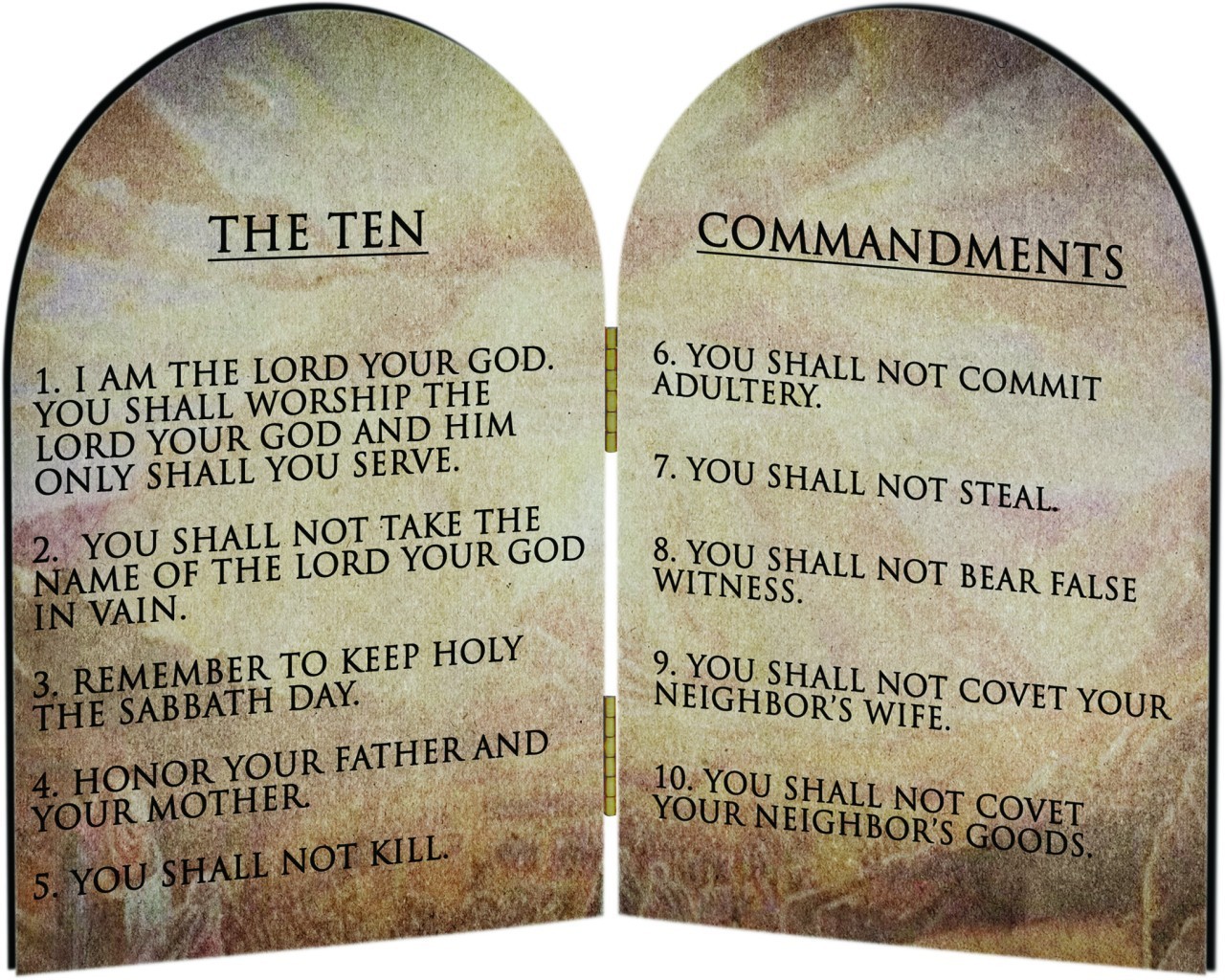
Today, we focus on the Decalogue, or Ten Commandments, from Exodus 20:1-17. In the church where I became a Christian, a reformed evangelical church, we had the Decalogue up on the walls at the front of the church – they were presented as the most important verses of Scripture and central to our faith.
Four of the commands are about our relationship with God – essentially, it is supposed to be an exclusive relationship (“no other Gods but me”) – a 100% commitment to God, to Yahweh. And six of the commands are about our relationships with people – essentially, they are supposed to be ethical relationships – we are to treat people well.
In the First Testament, the Decalogue was written on stone tablets, but the very finger of God. But the later prophets, Ezekiel (11:19 & 36:26) and Jeremiah (31:33), wrote about having hearts of flesh instead of hearts of stone, and of God writing God’s law on our hearts.
We see this fleshy version of the Decalogue most powerfully in Christ’s incarnation – God come to dwell among us in human form. And Jesus, when asked about the Decalogue, distills them into just two: Love God and love your neighbour. These align well with what I wrote about – to be exclusive with God and ethical with people. But what is particularly emphasised in Jesus’ summary, and not obvious from the Decalogue, is love. (In Exodus 20, love appears only in verse 6, as an explanation of God’s jealous love for God’s people.)
If I were still at the church where I became a Christian, I’d be advocating for removing the Decalogue – the First Covenant Law – and replacing it with Jesus’ Great Commandment – the distillation of the Second Covenant, which is rooted in freedom and love.
That brings us to our gospel reading for today (John 2:13-22), where Jesus clears out the template. In Matthew, Mark and Luke, this story is narrated during Holy Week, on or after Palm Sunday, and as being the trigger for Jesus’ arrest and crucifixion. It is the culmination of Jesus’ offensiveness to the Jewish priests and leaders. But in John’s gospel, it comes as Jesus’ second act, right at the start of his ministry – following immediately on the wedding at Cana. The wedding story, with its extravagant and exceptional wine, is a story of freedom, generosity and abundance – the abundant life that John writes about so much. While the clearing of the template story is about God’s demand for our exclusivity and ethics.
Here, at the start of his ministry, Jesus acts out the requirements of the Great Commandment. Firstly, God’s house is being used in unholy ways. The things of God (the animal sacrifices) are being sold and bought. There is no place for such unGodly things in the very house of God. The exclusive relationship with God that is required by the Decalogue and by the Great Commandment, is being violated. And in addition, the people – the worshippers – are being exploited, having to pay to exchange currencies, to purchase animals for sacrifice. This is not ethical, not loving.
Jesus clears the template as a demonstration of the Great Commandment – Love God, Love your neighbour!
These standards that Jesus sets for us are impossibly high. I, certainly, fail again and again at these two seemingly simple commands. I stray from my exclusive relationship with God, and I fail to love others as myself.
Thanks be to God, Jesus bridges the gap between the high ideals and our broken efforts. He connects us to God, and his faithfulness transcends our fickleness. He strength transcends our frailty. He maintains the bond of fellowship between us and God and each other, even when we inevitably fail.
And so, as we continue our pilgrimage through Lent, let us continue to turn back to Jesus, and recommit ourselves to the Great Commandment: love God, love others or be exclusive with God and ethical with others.
John the Baptist is arguably the second most important person in the New Testament – second only to Jesus. He was the last of the First Covenant prophets – prophesying about the coming Messiah. Once Jesus arrived, John’s ministry, and that of all the prophets in the First Testament, had reached fulfillment.
Curiously, in John 1:6-35, John the Baptist (or the writer of the Gospel according to the John) repeatedly speaks to who John is NOT, rather than to who John IS. In total, there are five negative declarations in this passage, suggesting a humility on the part of John and a clear understanding of his role, as the forerunner and preparer for the Messiah. John is not the light (8), not the Messiah (20), not Elijah (21), not the Prophet (21) (even though that is really what he is), and not worthy to untie the sandals of the Messiah (27). Strong negative statements about who he is NOT.
Alongside these are three affirmations of who John IS, only one of which he voices himself: he is a witness to testify concerning the light (7), he is a witness to the light (8) and he is the voice of one calling in the wilderness, ‘Make straight the way for the Lord’ (23), even though this last is John quoting Isaiah. John makes not independent statements of himself in his own words.
John’s negations and lack of affirmations about his pivotal role and place in the Christian story suggest great humility and that the focus of all his efforts is on Jesus, the Messiah, the promised Son of God. His life purpose is to point to Christ.
This is confirmed in John’s testimony about Jesus, which includes him sharing that he himself did not recognise Jesus (31), but that he saw the Spirit of God descend upon him and remain on him (33).
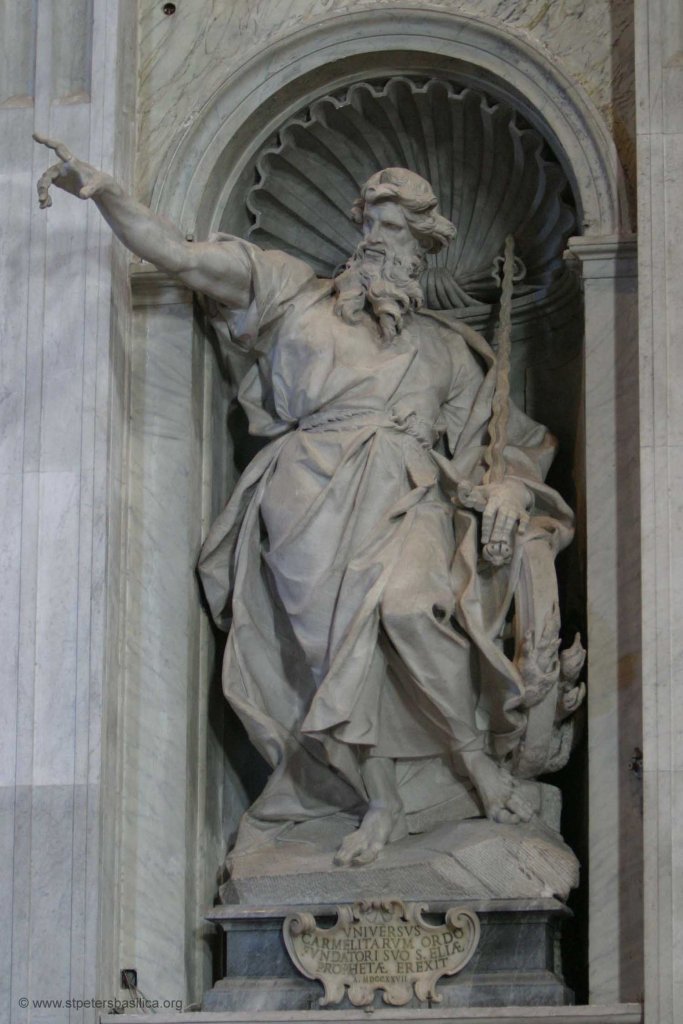
And so John points us to Jesus: “Look, the Lamb of God, who takes away the sin of the world! This is the one I meant…” (29) and the next day, “Look, the Lamb of God!” (35). This is the role of the Prophet – to witness to his experience of Jesus and to point us to Jesus. He is the pointer.
Our role, as Christians today, at the end of 2023, is to take up John’s prophetic role, by pointing to Jesus, as John did. Through our lives, our actions, our words and our values, we are (for better or worse) God’s prophets, pointing the way to Christ.
How do we do this? Our readings provide suggestions:
Isaiah 61 suggests we do so by sharing good news to the poor, binding up the broken hearted, proclaiming freedom to captives, comforting those who mourn, providing for those who grieve, restoring places long devastated, standing up for justice, and standing against robbery and wrong doing. All of these prophetic actions are located in the world – they all speak to the social justice that characterises the Kingdom of God.
Mary’s song in Luke 1:46-55 echoes some of Isaiah’s sentiments: extending mercy, lifting up the humble, and filling the hungry with good things. But Mary’s vision of her son, the Messiah, also includes some strong prophetic words: scattering the proud and sending the rich away empty.
And 1 Thessalonians 5:16-22 focuses on more obviously ‘spiritual’ actions: to rejoice always, pray continually, give thanks in all circumstances, hold to the good and reject evil.
It is all of these actions – standing up for social justice, speaking out against injustice and evil, and ensuring a robust spiritual life – that serve as a prophetic voice in the world today. This is perhaps the most important thing for us as Christians to be doing in the world – pointing the way to the Messiah.
Statue of Elijah pointing, by Agostino Cornacchini (1727) at St Peter’s Basilica, Vatican City
Click here to watch the video of this 28-minute message on Facebook (the message starts about 29 minutes into the recording). Note that this is an active sermon – worth watching, rather than just reading. I don’t have an audio recording of this message. Or read the text summary below.
Matthew 9 tells the story of Jesus calling Matthew: “As Jesus went on from there, he saw a man named Matthew sitting at the tax collector’s booth. “Follow me,” he told him, and Matthew got up and followed him.” And Genesis 12 tells the story of God calling Abram: “Go from your country, your people and your father’s household to the land I will show you.” Go! Follow me! These calls have nuclear power to move people – Matthew got up and followed Jesus, Abram packed and moved into the unknown.
Jesus is calling you and me today – Follow me! Go! – but to where? Where do we go? Where do we follow?
Matthew 9:16-17 gives us invaluable insights into what Jesus calls us to, in the metaphor of new wine in new wineskins:
“No one sews a patch of unshrunk cloth on an old garment, for the patch will pull away from the garment, making the tear worse. Neither do people pour new wine into old wineskins. If they do, the skins will burst; the wine will run out and the wineskins will be ruined. No, they pour new wine into new wineskins, and both are preserved.”
Although the metaphor is a bit obscure, at very least we can take from this that there are challenges in mixing the old and new. Jesus leans strongly in favour of the ‘new’ – new wine and new wineskins are what we’re after. A few verses earlier (v13) he gives another clue about where we are following him to, when he quotes Hosea, “I desire mercy, not sacrifice”. Mercy represents love for people, while sacrifice represents religion. Jesus is saying – indeed God is saying – I don’t want your religion, I want your love for people. This is the ‘new’ teaching – or rather an old teaching renewed – that Jesus gives us. And the whole of Matthew 9 illustrates this with examples.
Come along with me – follow me! – as we briefly consider the seven stories that illustrate following the new wine in Matthew 9:
The chapter opens with a paralysed man, brought to Jesus by his faith-filled friends. Jesus sees their faith and says, “Take heart, son; your sins are forgiven.” The teachers of the law are outraged by Jesus’ presumption of having authority to forgive sins – they’re not interested in the man, only in their theology. Jesus responds strongly and heals the man as evidence of his authority to proclaim forgiveness of sins. Jesus’ love for this physically and spiritually broken man takes precedence over the teachers’ petty theology.
In verses 10-13, Jesus attends a party hosted by Matthew, who is now following Jesus. Matthew’s friends are tax collectors and sinners – ‘bad people’. The Pharisees – another religious group – are disgusted and ask Jesus’ disciples, “Why does your teacher eat with tax collectors and sinners?” They are not concerned with the humanity of Matthew and his fallen friends – they are concerned only with religious piety and ‘rightness’. They dehumanise these broken people. Jesus confronts them, “It is not the healthy who need a doctor, but those who are ill… For I have not come to call he righteous, but sinners.” Jesus’ love for sinners, for bad people, takes priority over everything.
In verses 14-17, while still at the same dinner party, the disciples of John the Baptist come and ask Jesus, “How is that we and the Pharisees fast often, but your disciples do not fast?” Their use of ‘often’ (we fast often) betrays the religious pride. Their interest is in religious observance and spiritual discipline. But Jesus dismisses their concerns, asking “How can the guests of the bridegroom mourn while he is with them?” He has little interest in fasting or other religious piety – he is more interested in spending time engaging with people. It is in this immediate context that he speaks about new wine – he is not interested in religious and theological precision and rightness; he is much more interested in human relationships, fellowship, compassion and love.
In verses 20-22, while still at the same party, a synagogue leader tells Jesus that his daughter has died and asks if Jesus can come and help. Jesus leaves immediately, as his compassion for this young girls outweighs his fellowship with Matthew and his friends. On the way to the house, a woman who has been bleeding (menstruating) heavily for 12 years touches his cloak and is healed by Jesus’ power. Her faith is strong: “If I only touch his cloak, I will be healed.” Jesus stops and speaks with her, he proclaims healing and wholeness and salvation. We imagine he took hold of her hand as he lifted her up onto her feet. While in the other stories there are crowds of noisy people around, here there is silence. Men and women keep menstruation quiet and private – it is not public. And in those days, women were considered unclean during their period. For Jesus to engage, speak, touch her was to make him unclean. He didn’t care about that – he cared just for her.
Reaching the house of the synagogue leader, there is a noisy crowd outside. They mock Jesus when he says the girl is just sleeping. He goes up to her room and takes her by the hand. Touching a dead person makes one unclean, but Jesus doesn’t care about that – he cares only for the girl. She is revived and gets up.
Briefly, Jesus continues on his way and heals two blind people, “According to your faith let it be done to you”. He sternly warns them not to tell anyone about him healing them. He is not interested in recognition – he cares only about their sight.
And then he encounters a demon-possessed man (perhaps today a schizophrenic). He drives out the demon. The Pharisees cannot recognise Jesus’ compassion for this man’s wholeness and well-being; they say, “It is by the prince of demons that he drives out demons”.
Jesus quoted Hosea, “I desire mercy, not sacrifice”. Jesus tells about the new wine – his people-centred gospel of love and inclusion – that is incompatible with the old wineskins of religiosity, piety, self-righteousness. He is all about people: “I have not come to call the righteous, but sinners”.
So, as we follow Jesus, as we answer his call to ‘Go!’, we must put people before religion, relationships before theology, acceptance before judgement, inclusion before exclusion, love before judgment. This is the new wine of Jesus’ Gospel that should be poured into the new wineskins of our hearts and churches.
Today’s set of compelling readings from Micah 6:8, Psalm 15:1-3, Matthew 5:3-10 and 1 Corinthians 1:27-28, point us to the heart of a God who is concerned for those who are marginalised, vilified and outcast. They also emphasise that our responsibility as Christians is to be merciful, kind, humble, inclusive and generous.
In light of these readings, today’s message addresses the complex and controversial topic of sexuality in the church, particularly homosexuality. This is a topic that has been long ignored and more recent has lead to deep divisions within the the church between those who are against and those who are for (or at least tolerant of) gay relationships. Many gay Christians feel deeply rejected by the church – not just for what they do sexually, but for who they are – for their very being, their humanity, which is experienced to be under attack by Christians and the church.
In today’s message, I endeavour to the following, which I encourage you to watch, listen to or read, using the links provided at the top of today’s blog.
Some clarification of terminologies, particularly the difference between gender identity (who I see myself as being in terms of gender – traditionally male or female) and sexuality (who I have sexually or romantically attracted to – traditionally heterosexual or homosexual). Both of these terms have become increasingly diverse and nuanced in recent years.
Developing an understanding of how the Scriptures were authored within particular historical and cultural contexts that differ vastly from contemporary society.
I address five broad points of discussion in this message:
The belief of many Christians that heterosexuality is God’s only legitimate sexual orientation. I’ll show that this is not true.
The belief of many Christians that the Bible does not anywhere say that gay relationships are okay. I’ll show that this is not entirely true.
The belief of many Christians that the Bible condemns homosexual relationships as an abomination. I’ll show that this is not true.
The point that among the numerous laws in the Bible, some Christians draw on preconceived cultural beliefs to justify their condemnation of homosexual relationships.
And the primary of love that is presented in Jesus Christ’s teachings and his example of radical inclusivity.
Based on the above discussion points, I draw 4 key conclusions:
In human relationships, God is most interested in the quality of our love.
God is not interested in the sex or gender of the person we love.
Marriage is sacred, a divine joining together, and must be protected.
Marriage (defined as a sacred joining together or union) is not restricted to a man and a woman.
And in light of this I hope that my parish and your church community would aspire to:
emulate Jesus’ example of radical inclusivity, diversity and love
create a church space where people of various sexual orientations feel welcome, accepted and loved
focus on and champion the quality of love in human relationships.
I do appreciate that the views of Christians on the subject of homosexuality vary widely, and that there are many that will view my understandings and interpretations of the Scriptures as false and heretical. Our views on this subject can be deeply divisive. Nevertheless, I take Jesus’ lived life (how he behaved with people he encountered) and Jesus’ spoken teachings about what is most important to God as the central guides to make sense of the rest of Scripture. He is God incarnate – he is the perfect reflection of who God is. He himself says, “Whoever has seen me has seen the Father” (John 14:9). I follow him.
John the Baptist is the one who prepares the world for the first coming of Christ, some 2,000 years ago. We, today, follow in his footsteps in continuing to prepare the world to receive Christ when he comes again. The world we live in now continues to grapple with many challenges.
Currently, we think of those many who have died of Covid-10: in South Africa, since the start of the pandemic, some 102 000 people have died, amounting to an average of about 102 per day since March 2020.
We continue to grapple with HIV and AIDS: 14% of South Africans are living with HIV or Aids, an average of about one in seven people.
We continue to see high Aids-related death rates: 86 000 this year alone, an average of 235 deaths per day – and the death rates have been rising over the past five years.
And gender-based violence remains a scourge of our society, with an average 115 women raped every day this year – a total of 45 000 so far this year.
It is into this broken and wounded world that we prepare for the coming of Christ. How do we do this? What are the guidelines we’re given in the scriptures set for today?
Matthew 3:1-12 presents John’s call to repentance, confession and baptism. He strongly confronts the religious leaders of his day: “You brood of vipers!” His words are confrontational and damning. He calls them to produce the fruit of repentance – it is one thing to repent, and another to demonstrate that repentance in your behaviour – the fruit. And he warns, all very challengingly, that if they fail to do so, they will be chopped down like an unproductive tree, or burned up in the fire, like the chaff from winnowing.
The story of John’s ministry in Mark’s gospel is a little softer: there he speaks of a baptism of repentance for the forgiveness of sins. Matthew doesn’t make any mention of forgiveness. And Luke’s version incorporates both what Matthew and what Mark say. (And John provides a quite different version altogether.)
John, then, sets a pattern for us that is both encouraging and challenging. But what else can we learn from today’s readings about preparing the world for Christ?
Isaiah 11 presents a prophecy of the branch that will come from Jesse – King David’s father and, many generations later, forefather of Jesus. This passage opens with a repeated emphasis on the Spirit: “The Spirit of the LORD will rest on him— the Spirit of wisdom and of understanding, the Spirit of counsel and of might, the Spirit of the knowledge and fear of the LORD” (Isaiah 11:2). Clearly, we cannot do anything without the enabling of the Spirit of God.
And in the following verses, Isaiah emphasises God’s concern for those who are vulnerable: “He will not judge by what he sees with his eyes, or decide by what he hears with his ears; but with righteousness he will judge the needy, with justice he will give decisions for the poor of the earth” (Isaiah 11:3-4). Righteousness and justice are the keywords here.
And this is followed by the imagery of wolves, leopards and lions living in harmony with lambs, goats and yearlings, under the leadership of children (Isaiah 11:6). This is the kind of egalitarian and harmonious society that we are called to bring into being as we prepare for Christ’s return.
Psalm 72 continues some of these themes from Isaiah, notably God’s defence of the poor, vulnerable, needy, marginalised, silenced and outcast: “May he defend the afflicted among the people and save the children of the needy; may he crush the oppressor” (Psalm 72:4). Here we see God taking sides – he aligns with the poor and against the oppressor. God is not neutral – he sides with those who are vulnerable. The Psalmist goes on, “For he will deliver the needy who cry out, the afflicted who have no one to help. He will take pity on the weak and the needy and save the needy from death. He will rescue them from oppression and violence, for precious is their blood in his sight” (Psalm 72:12-14). In those days, life was in the blood, so when the Psalmist says, “precious is their blood in his sight”, s/he is in effect saying that God sees their lives as precious and worthy of protection. Theologians call this “God’s option for the poor” or “God’s preference for the poor”.
When we wonder where we should stand on things, the Biblical answer is unequivocal – stand with those who are vulnerable. That is always where we will find God. And that is where we should be found.
Romans 15 invites us to take on the attitude of Christ: “May the God who gives endurance and encouragement give you the same attitude of mind toward each other that Christ Jesus had, so that with one mind and one voice you may glorify the God and Father of our Lord Jesus Christ. Accept one another, then, just as Christ accepted you, in order to bring praise to God” (Romans 15:5-7). The result of thinking like Christ, is that we will accept one another – here again is a call to inclusivity and now also being non-judgmental. Indeed, in the previous chapter, Paul explicitly tells us to stop judging others: “Therefore let us stop passing judgment on one another. Instead, make up your mind not to put any stumbling block or obstacle in the way of a brother or sister” (Romans 14:13). This was in the context of conflicts of various dietary laws of the diverse group of Jewish and Gentile Christians. But regardless of the topic of conflict, the principles remain: accept and do not judge. Be tolerant and inclusive. Celebrate diversity.
As we strive to be Christians who, like John the Baptist, are preparing the way for Christ’s return, we need to take up the examples we are given in the Scriptures: honest words, an invitation to repent and receive forgiveness, the presence of the Spirit, values of righteousness and justice, an option for the ‘poor’, and acceptance and tolerance. These constitute the mind of Christ. And as we embody and live out Christ’s mind, we will be preparing the world for his return.










 Reflections of God's Love