Today is the last Sunday in Advent, a few days before Christmas. During this Advent season, we’ve been reflecting on Christ’s coming into the world, both 2000 years ago and one day in the future. We’ve also reflected on John the Baptist, and the prophets before him, who prophesied Christ’s coming in the past and his coming again one day. And we’ve reflected on Christ’s birth in our hearts this Christmas, 2024.
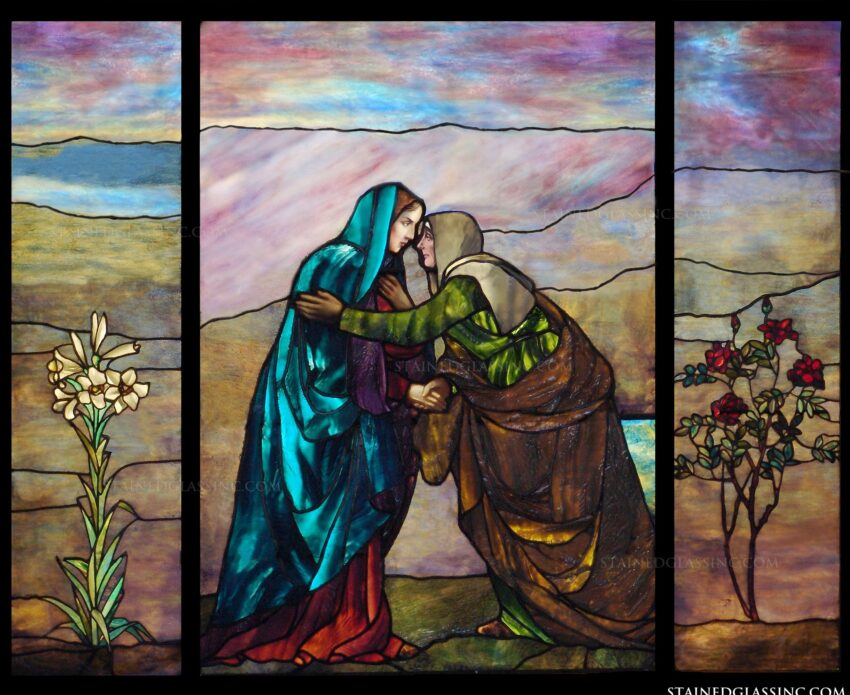
Today, as we bring Advent to a close, we read about Mary’s and Elizabeth’s pregnancies, and about what they and the prophets thought about the kind of person the Messiah would be. Although he came as an infant, he was set to turn the world upside down. God’s emerging into humanity was a profound change for the universe – disruptive, outrageous and exciting. Watch the 18-minute video of today’s message, and let’s be challenged by the readings from Micah 5, Hebrews 10 and Luke 1.
Almighty and everlasting God, whose will it is to restore all things in your well-beloved Son, the King of kings and Lord of lords: Mercifully grant that the peoples of the earth, divided and enslaved by sin, may be freed and brought together under his most gracious rule; who lives and reigns with you and the Holy Spirit, one God, now and forever. Amen.
Christ the King – festival established only in 1925, first celebrated in 1926 – less than 100yr ago
A response to growing secularism and atheism after WWI, & growth of fascism, all of which we see even more today
During a time when secular national leadership was not functioning, it was helpful to remember that Christ is the ultimate King, over all nations. King of kings. Rev: “the ruler of the kings of the earth”
In 1969, Pope Paul changed name to “Our Lord Jesus Christ, King of the Universe”
We still call it ‘Christ the King’
Jesus Christ is our personal Lord and saviour – our king, whose throne is in our hearts
He is also creator of & King over the universe.
He is King over both sacred and secular parts of the world – the church, and the world.
We should not be too afraid to speak his kingliness – He is king!
But while Jesus walked this earth, he kept his kingship hidden until the end of his life. He says to Pilate J18: “You say that I am a king”
He came as a servant, not as a Royal, Monarch, President, Dictator.
“I was born and came into the world to testify to the truth” > God
2 Sam 23:3-4 – God said to David: lead in righteousness = in right relationship with God and with people – a beautiful thing
All too often, standing up for Jesus centres on morality – homosexuality, abortion, marriage, etc
And Pope Pius’ original thinking for this festival was that individuals and states must submit to the rule of the Saviour – “the Empire of Our Lord”. He almost wanted a Theocracy.
But what Jesus stood up for was the poor, the excluded, the marginalised, the vulnerable.
His Good News was one of a social order in which power was flat, and people were cared for, reversal of fortunes.
This is not what we typically think of as ‘kingship’.
He sets for us a model for leadership and power
We lead through service – to work for the best for those whom we lead, even if by sacrifice
We exercise power to protect, not to dominate
Often link CtK to Christ as the Good Shepherd
Servant leadership is the closest model to Jesus’ leadership
To ensure the wellbeing and flourishing of every person under our leadership
To remove obstacles and challenges, so people can move forward unencumbered
To set an example of what we want from them, rather than demanding but not living it
Most Gracious God, who in Jesus of Nazareth showed us an alternative to the kings, queens and emperors of history, help us to revere and emulate Jesus’ leadership: To love, and to seek justice for all people. Help us to recognize the true grandeur and life-changing power based in loving you and all of our neighbors. In Christ Jesus, with you and the Holy Spirit, may we co-create a world ruled not through domination, but in that radical and all-powerful compassion and love. Amen.
We are journeying through Stewardship Month, when we reflect on what God has entrusted to us and how we give back to God from what he has blessed us. Two weeks ago, we focused on the Old Testament principle of tithing (10%) and not withholding from God what is God’s (Leviticus 27:30-34). The tithe is no longer obligatory, under God’s grace, but it remains a good benchmark or point of departure for our giving. Then last Sunday, Rev Ronald focused on the parable of the rich man who hoarded his wealth for his future (Luke 12:13-21). He was called a ‘fool’ by God, for thinking that he had control over his future. Our true security lies in our relationship with God. We are stewards of God’s riches, and we reap what we sow.
On this third week, we focus on New Testament principles of sacrificial giving – a development on the Old Testament principle of tithing. First, Psalm 89 draws our focus to the fact that everything is made by God, comes from God and belongs to God. The psalmist says (v11), “The heavens are yours, and yours also the earth; you founded the world and all that is in it.” We may feel that our possessions are ours, that our salaries are ours, that the assets that we’ve accumulated are ours. But the Psalmist reminds us, as we see throughout the scriptures, that everything belongs to God. This is our first principle (albeit from the First Testament) – everything is God’s, it is just on loan to us.
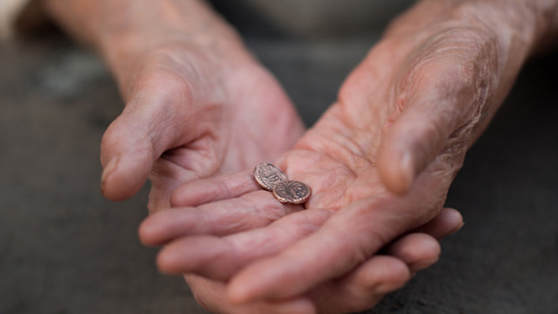
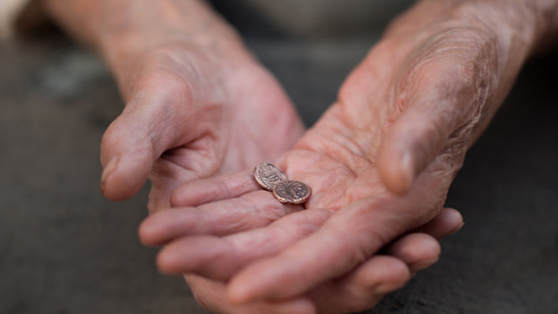
Second, in Luke 21:1-4, Jesus reflects on witnessing an older woman who put a tiny amount of money into the temple offering. Even though her gift was very small, he praised her for giving generously out of the little she had. This echoes the principle of tithing – it is less about the absolute amount that we give and more about the percentage of what we give. This is the second New Testament – give a percentage of your income to God.
The third principle is this: to give to the collective. Acts 4:32-37 tells us about the early church, just after Pentecost. Because they saw what God had done for them, they gave of their wealth to the church. Some even sold land or houses, and gave the proceeds to the church, so that there was enough cash in the church to cover costs and give to those in need. We think of this as an early form of Christian socialism – that you put your giving into the church collective, as a form of redistribution of wealth, the third principle.
The fourth principle comes from 2 Corinthians 8:1-15. Paul cites the church in Macedonia as an example of sacrificial giving. It would be great is St Stephen’s could stand as such an example – and in fact, in previous years we have done just that, such as financially supporting the building of St Timothy’s in the Reeds, and helping all the parishes in our Archdeaconry with finances in 2021, after COVID-19 impacted parishes severely.
Paul notes that the church was going through a “very severe trial” (v2), but even they were generous in their giving. This giving was based on both “their overwhelming joy and their extreme poverty”. Now the joy bit makes sense, right? But the extreme poverty seems out of sync – if we fact extreme poverty, we should give less, right? But in fact the Macedonian church gave more! Paul links back to our second principle – “they gave as much as they were able” (v3) but also highlights that they gave “even beyond their ability”. This is how the Old Testament principle of tithing 10% is transformed into giving even ‘more than we are able’. Paul also notes that they did this “entirely on their own” (v3). Indeed, they even “urgently pleaded” for the “privilege of sharing” (v4).
Paul uses the Macedonian church as an example for the Corinthian church and invites the Corinthians to act like the Macedonians (v7). Now it is important to remember that this was not a command, but rather an invitation (v8). Our giving must come from the sincerity of our love – he complements the Corinthians for being not only the first to give, but also to be the first “to have the desire to do so” (v10). We are not commanded, but invited. He writes, “If the willingness [to give] is there, [then] the gift is acceptable, according to what one has, not according to what one does not have” (v12). So, the fourth principle is giving willingly according to our means.
So here we have four principles that should guide the decisions that we make for 2025 regarding our financial giving:
Everything we have belongs to God.
We should focus on the percentage of our possessions we give, not the actual amount.
We should prioritise giving to the local church.
We should give willingly and eagerly and joyfully, according to our means.
Today we celebrate St Stephen, after whom our church is named. It is our church’s patronal festival, our birthday.
Stephen was a young man, appointed a deacon in the early church. He appears only in Acts 6 and 7, but in those few pages, he makes a remarkable impression and impact. He is the first Christian martyr – stoned to death because he challenged the Jew people’s lack of faith in Jesus Christ.
While we walk primarily in the footsteps of Jesus Christ – he is God incarnate, our teacher and our Lord and saviour – we give heed also to the example of Stephen, and seek to continue his legacy in our parish community today.
Our readings centre on Acts, omitting Stephen’s long, but very impressive and persuasive sermon. This are supported by a reading from 2 Chronicles, where Zechariah (an earlier Zechariah – not the father of John the Baptist) is stoned to death for speaking God’s Word. Psalm 31, which includes the words that both Jesus and Stephen speak as they died. And John 6, which is the ordinary reading for today, from Jesus’ long sermon on the Bread of Life. I have tabulated these three people, because there are significant and meaningful similarities between them, that speak to all Christians, and especially those who are members of a church named after St Stephen:
Topic
Zechariah
Jesus
Stephen
Reading
2 Chronicles 24:17-22
John 6:24-35
Acts 6:8-10 & 7:54-60
Holy Spirit
Spirit of God came on him
Baptised by John and the Holy Spirit descended on him
Full of Holy Spirit, faith, grace and power
Care for the poor
–
Fed 5000 men (plus women and children) with bread and fish
Oversaw the daily distribution of food
Challenges with the people
They were chasing after other Gods
They just wanted food and miracles
Wanted quiet conformity with the past
Challenging the people
Why do you disobey the Lord’s commands?
Do not work for food that spoils
You stiff necked people! Your hearts are uncircumcised! You always resist the Holy Spirit! Was there ever a prophet your ancestors did not persecute?
Consequences for God’s messengers
Stoned to death
Crucified
Stoned to death
Their final words
May the Lord see this and call you to account.
Father, forgive them, for they know not what they are doing.
Lord, do not hold this sin against them.
Final prayer
–
Father, into your hands I commit my Spirit (in Luke)
Lord Jesus, receive my spirit (Psalm 31:5)
So, what do we take from this, and particularly from Stephen, into our daily lives?
We must take our faith seriously – it is costly, important and even worth dying for.
We must care for the poor, hungry and marginalised.
We must seek the infilling of Holy Spirit, who equips us for life and ministry.
We must seek after the things of God, and not after the things of this world.
We must forgive those who hurt even, even to death.
Jesus crosses the Sea of Galilee and then ascends the mountainside (v. 3) and sits down – it is on mountains that God often appears to people. Think of Moses and the burning bush, Moses receiving the Ten Commandments, Jesus transfigured before Peter, James and John. His ascent cues us that something important is going to happen – some revelation of the being or character of God.
John then tells us (v. 4) – seemingly for no reason – that the Jewish Passover Festival was near. Another translation (Bruner) has, “Now, the Passover, the festival of the Jewish people, was coming up.” The Passover, which takes place when the Jews are slaves in Egypt, includes the passing over of the Jewish households and their fleeing Egypt across the Red Sea. It is THE central narrative of the Jewish religion, in the same way that Christ’s death and resurrection are THE central narrative of the Christian religion. It speaks of deliverance, freedom, salvation, relief and hope. It speaks of God coming near to God’s people and answering the deep cries. So John mentions this to raise up in us a hopeful expectation of what God might do for us.
There are two layers to this story of the feeding of the five thousand: food and faith
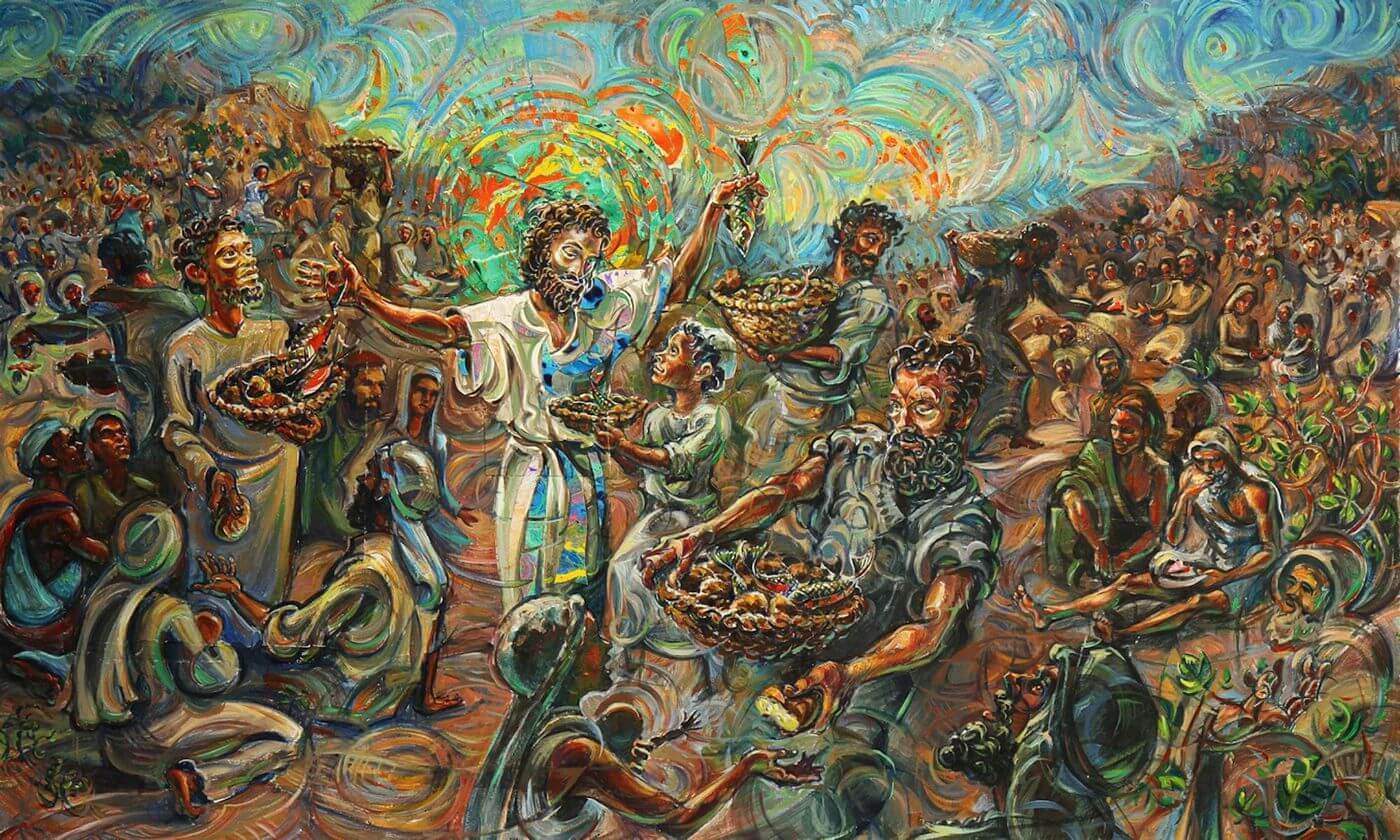
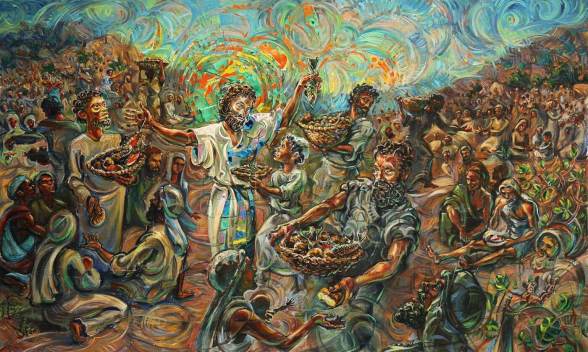
First, there is a practical layer – food. There are 5000 men there, presumably together with women and children. They are hungry and there is no place to get food. So Jesus creates enough food out of five small barley loaves and two small fish to feed them all, and to have 12 baskets of leftovers. This miracle, which may remind us of Jesus turning water into excellent wine at a wedding, a few chapters earlier, speaks to God’s concern for the basic needs of humanity. God desires us to have what we need to live. Basic needs for shelter, food, warmth, healthcare, education and safety are important to God. And Jesus provides for them. This is the first part of God’s revelation of himself in this story – God is concerned for your everyday needs and is willing and able to help you meet those needs, just as he helped free the Jews in slavery in Egypt.
Second, there is a spiritual layer – faith. Looking at the large crowds, the disciples are overwhelmed, and their mustard seeds of faith flee. Jesus knows that their faith is feeble, and so he asks Philip, “Where shall we buy bread for these people to eat?” His question leaves no wriggle room for Philip to say they must sort themselves out – it is clear that bread must be provided. The only question is where they will buy it. Philip’s faith collapses, as he says, “It would take more than half a year’s wages to buy enough bread for each one to have a bite!” Philip is unable to imagine that Jesus can do more than what is humanly possible. His feet are deeply embedded in the ground.
But then Andrew brings along a little boy who has five small barley loaves and two small fish and presents him to Jesus. It feels as if Andrew has some spark of faith that maybe something could be done with this little bit of padkos. But almost immediately, his faith also collapses, as he says, “but how far will they go among so many?”
Jesus takes control of the situation and issues instructions. The disciples trust and obey, and everyone ate as much as they wanted. Although Jesus will come to criticize the people for chasing after food, in this moment, they recognise him: “Surely this the Prophet who is to come into the world!” They want him to be king, but he just wants to reveal God to them.
And today’s reading ends with Jesus walking across the surface of the lake in a storm, several kilometers from the shore, and reminding them of who he is: “It is I. I am. Don’t be afraid.”
Our First Testament readings today (2 Samuel 7 and Psalm 89) speak of the chosenness of King David and by extension of the Jewish people, the people of Israel. God affirms that he gives a place of safety to the people of Israel and that David’s throne and kingdom are forever.
Two days ago (19 July 2024), the UN’s International Court of Justice, declared Israel’s occupation of the West Bank, East Jerusalem and the Gaza Strip as illegal and called on Israel it withdraw its occupation and all settlers living there and to pay reparations for the harm done to Palestinian people. Prime Minister Benjamin Netanyahu responded: “The Jewish people are not occupiers in their own land — not in our eternal capital Jerusalem, not in the land of our ancestors in Judea and Samaria. No false decision in The Hague will distort this historical truth, just as the legality of Israeli settlement in all the territories of our homeland cannot be contested.”
Netanyahu’s response harks back to these First Testament promises, though neglects several other important First Testament principles. First, a crucial First Testament theology and principle is hospitality. God is hospitable – inviting humanity to share in God’s work in the world and coming to meet with God’s people and journey with them. God expects Israel to be hospitable to other peoples. Deuteronomy is explicit that foreigners should be treated as if they were Israel’s own. There should be no discrimination.
Second, God uses other nations to discipline Israel through the First Testament. The people Israel turn away from God towards other gods; God sends enemy forces to disrupt Israel; Israel repents and turns back to God; peace between God and Israel is restored. This is a pattern repeated over and over in the historical books of the First Testament.
If Israel’s First Testament status as ‘chosen’ is still valid, surely all the other aspects of its relationship with God should be valid also.
Of course, there are many different views on Israel and Palestine. The situation is complex and feelings are hot!
And then, as we move into the Second Testament, there is a shift again. There is Jesus’ radical inclusivity, which I’ve spoken about frequently. Paul, in Ephesians 2, writes about the exclusion from Gentiles from Israel, but how Christ has destroyed the dividing wall of hostility between Jews and Gentiles, and made us one person, through Christ’s body on the cross. There is now peace for us all. And in Galatians 3, Paul says that in Christ there is neither Jew nor Gentile, slave nor free, male nor female. For we are all one in Christ Jesus. God’s desire is for a united humanity, centred on Christ.
But the world is a messed-up place. Such conflicts all over – not just in the Middle East, but between Democrats and Republicans in the USA, ethnic groups in many countries in Africa, Muslims and Hindus in India, Europeans and refugees in Europe, and the list goes on. We are a fractured race, seriously out of step with God’s desire for humanity.
We can probably do little to nothing to solve the challenges in the Middle East and elsewhere, but there are some things we can do to contribute to a shift in the world. First, we can ensure that we are inclusive and diverse, that we treat every person as God’s creation, much loved and blessed, and ensure that racism, sexism and other -isms are wiped out of our interactions. Second, we can pray, and pray some more, because prayers for unity and harmony and mutual respect and love are fully aligned with God’s vision for humanity and so this surely must be a prayer that God will answer.
King David Playing the Harp (1622) by Gerard van Honthorst
1 Great is the Lord, and most worthy of praise, in the city of our God, his holy mountain.
2 Beautiful in its loftiness, the joy of the whole earth, like the heights of Zaphon is Mount Zion, the city of the Great King. 3 God is in her citadels; he has shown himself to be her fortress.
4 When the kings joined forces, when they advanced together, 5 they saw her and were astounded; they fled in terror. 6 Trembling seized them there, pain like that of a woman in labor. 7 You destroyed them like ships of Tarshish shattered by an east wind.
8 As we have heard, so we have seen in the city of the Lord Almighty, in the city of our God: God makes her secure forever.
9 Within your temple, O God, we meditate on your unfailing love. 10 Like your name, O God, your praise reaches to the ends of the earth; your right hand is filled with righteousness. 11 Mount Zion rejoices, the villages of Judah are glad because of your judgments.
12 Walk about Zion, go around her, count her towers, 13 consider well her ramparts, view her citadels, that you may tell of them to the next generation.
14 For this God is our God for ever and ever; he will be our guide even to the end.
Psalm 48 centres on Zion – God’s sanctuary, the temple, the City of our God, the Holy Mountain, the fortress. I will refer to Zion as God’s sanctuary from here on.
God’s sanctuary is inhabited by God, the Lord, the Lord Almighty, the Great King.
God’s sanctuary is a feminine space – the feminine pronoun ‘her’ is used eight times to emphasise the feminine character of the sanctuary. It is something like a womb – a safe, protective, nourishing and nurturing space. The enemies of God experienced pain like that of a woman in labour, but for those who dwell in the sanctuary, it is a womb.
God’s sanctuary is a place of refuge and safety – a sanctuary.
In God’s sanctuary, there is beauty, joy, security, meditation, unfailing love, God’s right hand, righteousness, rejoicing, gladness, our guide, God, for ever and ever.
God’s sanctuary is the place we are invited to enter: Walk about Zion, go around her, count her towers, consider well her ramparts, view her citadels.
God’s sanctuary is where we can retreat when things get on top of us, when we feel pressured or burdened, when we are worried or distressed, when we’re afraid, when we need replenishing, when our faith founders, when life’s adversities are too much, when we are alone. The sanctuary is God’s place, God’s grace.
Our readings today (23 June 2024) point to and illustrate the adversities and adversaries that we encounter in like. Adversities are difficult situations and adversaries are difficult people – often these collide. Here is a summary of these challenges in the readings:
Mark 4:35-51 has the disciples and Jesus in a boat in a wild storm on the lake. This is an adversity – a situation. Many of the disciples were fishermen and familiar with storms at sea, so this must have been an exceptional storm to stir up such terror.
2 Corinthians 6:1-13 has Paul recounting many of the challenges he has faced in life: troubles, hardships, distresses, beatings, imprisonments, riots, hard work, sleepless nights, hunger, dishonour, bad reports, impostors, unknown, dying, beaten, having nothing. It’s quite a list!
1 Samuel 17:32-49 presents young David going up against the tremendous Goliath in single-handed combat. He didn’t stand a chance against such a formidable adversary!
Psalm 9 describes the Psalmist’s enemies and wicked people – many adversaries!
We may resonate with these challenges and adversaries. We often face challenging situations and difficult people. And sometimes that overwhelms us, as we wonder where God is in this.
But despite the challenges, scripture presents God as more powerful the any adversary we may face, and on our side when we face adverse situations. We are encouraged and urged to put our faith and trust in him:
Mark 4:35-51 describes Jesus standing up in the boat and commanding the storm: “Quiet! Be still!” and it was so – the storm dissipated. The disciples found themselves being more terrified by Jesus’ power over the elements than they had been by the storm itself! A real turnabout.
2 Cor 6:1-13 has Paul affirming that despite the litany of adversities, he remains always rejoicing and possessing everything. All of these adversities are, for him, ‘nothing’ compared to the blessing of being God’s child.
1 Samuel 17:32-49 recounts David’s plucky engagement with Goliath – he has bested bears and other wild animals – surely he can best this giant. And with a flick of his wrist and little catty, a stone embeds itself in Goliath’s head and he falls down dead and David decapitates him. God is on his side.
Psalm 9 intersperses its complaints about wicked enemies with affirmations of God’s allegiance: The Lord is a refuge for the oppressed, a stronghold in times of trouble … Those who know your name trust in you, for you, Lord, have never forsaken those who seek you … he does not ignore the cries of the afflicted … The Lord is known by his acts of justice … But God will never forget the needy; the hope of the afflicted will never perish.
Let us take heart in these affirmations. Let us strengthen our resolve in times of adversity. Let us not be cowed by adversaries. Let us trust in the Lord’s strength and love to take care of his own.
But there is a warning here also: let us not be the adversary to someone else and let us not cause adversity for others. God is on the side of his children, but he will not stand by us when we harm his other children. God expects us to emulate him, by standing up for people and by not being an adversary. The warnings are severe in Psalm 9 for those who make themselves enemies of God: “The wicked ensnared by the world of their hands. The wicked go down to the realm of the dead, all the people that forget God. … Let the nations know they are only mortal.” We do not want to become enemies of God! We want to keep on God’s right hand – his hand of power and protection – we do not want to fall under God’s wrath.
Instead, walk in God’s ways – the way of love, of justice and mercy.
Today we get two of Jesus’ parables: the parable of the growing seed and the parable of the mustard seed. These follow the parable of the sower (the one who sowed seeds in different kinds of ground) and the lesson about putting our lamp on a stand.
First, in the parable of the seed, the sower scatters the seed and then does nothing more. That’s his only role – to scatter seed. Then, spontaneously or (in the Greek) automatically the seeds grow. It is in their nature to grow, once they have been scattered. So the man goes to sleep and gets up and the seeds are doing their thing. “All by itself, the soil produces corn.” And the seed knows the steps of growth – they are programmed into the seed: “first the stalk, then the ear, then the full grain in the ear.” And when it is ripe and ready, the man comes to harvest the result.
This parable suggests that our role and responsibility as followers of Christ is to scatter seed. Presumably, this is good seed – seed that produces a crop: wheat, maize, barley. Our job is to scatter the seed. God’s job is to make that seed grow. The ‘automatic’ growth of the seed in this parable is the code that God has embedded into the DNA of the seed. (Apologies if my scientific understanding of seeds is incorrect!) For example, we may speak to someone about our faith (scattering seed), but we cannot force them to believe or come to faith (that is God’s work). We may encourage parishioners to attend church (scattering seed), but we cannot compel them to come (that is God’s work). We are encouraged by this parable to do our part and trust God to do his.
This resonates with 1 Corinthians 3:6-7, where Paul writes,
“I planted the seed, Apollos watered it, but God made it grow. So neither he who plants nor he who waters is anything, but only God, who makes things grow.”
This gives us perspective on what is our role, and what is not.
Second, in the parable of the mustard seed, Jesus contrasts the size of the mustard seed (which he says is the smallest of all seeds on the earth) and the resultant mustard plant (which he says is the largest of all garden plants or shrubs, with such big branches that the birds can perch in its shade).
This parable suggests that the scattering of even a tiny seed – even a very small act in the world – could produce a very large tree – a substantial change. Much like a lever, where a small amount of strength and effort can move a large heavy object, the tiny mustard seed, when scattered, can produce a large bush.
This resonates with Matthew 13:33, where Jesus says,
“The kingdom of heaven is like yeast that a woman took and mixed into about 23kg of flour until it worked all through the dough.”
A tiny amount of yeast can spread through a large amount of flour and rise to produce a massive number of loaves of bread. Small efforts can have large results.
These parables suggest that we ought to be scattering seed into the world, and that these seeds need not necessarily be big, dramatic, sophisticated or demanding. They might be small, understated comments or actions that go a long way. The key is to scatter these seeds – to be mindful and intentional about scattering them. And then to leave them to God to grow.
Third, although Jesus does not say this in Mark 4, this reading also evokes a warning: to be careful about what kind of seeds we sow. The seeds Jesus refers to are corn and mustard. It is hard to believe Jesus would support the scattering of weed seeds – indeed, he spoke out against weeds or thorns in the parable of the sower (Mark 4:18-19).
When we scatter bad seed, these too may grow fast and spread, just like the good seed, but with potentially terrible consequences. This resonates with James’ teaching about the tongue:
“Those who consider themselves religious and yet do not keep a tight rein on their tongues deceive themselves, and their religion is worthless” (1:26). “The tongue is a small part of the body, but it makes great boasts. Consider what a great forest is set on fire by a small spark. The tongue also is a fire, a world of evil among the parts of the body. It corrupts the whole body, sets the whole course of one’s life on fire, and is itself set on fire by hell. … With the tongue we praise our Lord and Father, and with it we curse human beings, who have been made in God’s likeness. Out of the same mouth come praise and cursing. My brothers and sisters, this should not be. ” (3:5-6, 9-10)
Just as we cannot make seeds grow into bushes, we cannot stop harmful words from causing damage. We are called to sow seeds, but only good seed; bad seed should not be scattered – it should be eliminated from our minds and tongues.
John 15: 9-17 presents us with a powerful summary of Jesus’ economy of love. Here’s a summary of the promises that Jesus makes about his love for us:
9. Jesus loves us as the Father loves him
11. Jesus’ joy is in us > our joy is complete
12. Jesus loves us
13. Jesus lays down his life for us
14. We are Jesus’ friends
15. We are Jesus’ friends (not his servants)
16. Jesus chooses us (not us him)
16. Jesus appoints us
16. Jesus enables us to be fruitful
16. God gives us whatever we ask in Jesus’ name
Part of what is beautiful about this passage is the generous and unconditional outpouring of love, care and enabling of us by Christ.
However, there are some aspects of this passage that are conditional – there are some IFs
11. We remain in Jesus’ love IF we keep his commands
14. We are Jesus’ friends IF we do what he commands
It is true that Jesus’ love has conditions – it is not utterly unconditional. He has expectations and makes demands of us. It is not a free-for-all. But before we get worked up about being held hostage to God’s expectations, let’s look at what those conditions are:
12. My command is this: love each other as I have loved you
17. This is my command: love each other
That’s it. Just two commands. Actually, just ONE command, because they are the same command: Love each other. That’s the only condition that Jesus places on us: Leave each other.
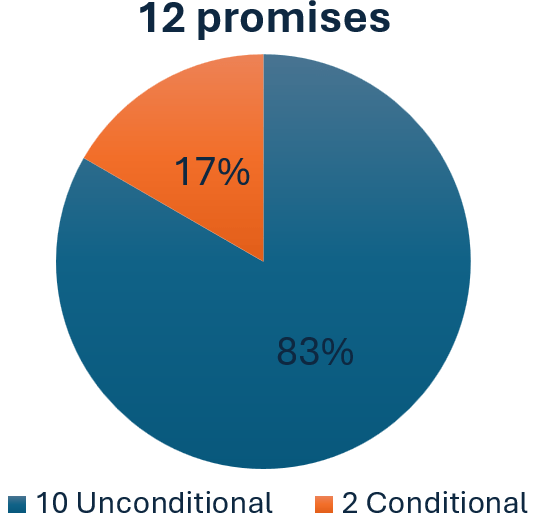
And let’s look at the ratio of unconditional and conditional promises in this passage:
That’s a pretty good economy! 83% of Jesus’ promises in today’s reading are unconditional. And the 17% that are conditional are conditional on something that is surely good for everyone – us and everyone else! To love one another.
Loving one another surely in our own interests – if we love others and all the others are loving us, that’s a good deal!
Hence John writes in his first letter (1 John 5:3), “God’s commands are not burdensome”. I’m not sure I fully agree with John here, because loving others is sometimes not easy. We have to love difficult people, people who don’t love or respect us, people who do bad things, and so on. It is not always easy to love others. But we are talking about just ONE command, not 613 commands, not 10 commands, not even 2 commands: JUST ONE!











 Reflections of God's Love