The older brother

Click here to listen to this 21-minute message.

We all have, consciously or unconsciously, a hierarchy of people’s goodness to badness, of people’s worthiness of God’s loving attention or of salvation. Even if we believe in salvation through the work of Christ alone, we probably still can imagine people we think undeserving of eternal life.

This was the problem of the Pharisees in Jesus’ time. They were so focused on keeping God’s Law (see my related message on Jesus’ Law) that they could have nothing to do with people who were not righteous, people who were lower down on the hierarchy.

So when the Pharisees see Jesus hanging out with so called ‘sinners’ and tax collectors, they are horrified and mutter, “This man welcomes sinners and eats with them” (Luke 15:1-2). They regarded such behaviour as being absolutely at odds with being a Godly person.

This prompts Jesus to tell three parables, intended to reveal God’s soft heart for “sinners and tax collectors”, for the lost, and to challenge the Pharisees’ misalignment with the God they sincerely followed:

  1. The lost sheep. “Suppose one of you has a hundred sheep and loses one of them. Doesn’t he leave the ninety-nine in the open country and go after the lost sheep until he finds it?” (Luke 15:4-7) Here, Jesus speaks of the lost one in a hundred.
  2. The lost coin. “Suppose a woman has ten silver coins and loses one. Doesn’t she light a lamp, sweep the house and search carefully until she finds it?” (Luke 15:8-10) Here, Jesus speaks of the one in ten.
  3. The lost son. “[Suppose] there was a man who had two sons” (Luke 15:11-32). One of them gets lost. Here, Jesus speaks of the one in two. (Though in truth, both sons get lost.)

In this parable (commonly known as the parable of the prodigal son, ‘prodigal’ meaning financially wasteful) we meet a father and his two sons. The younger son asks for his inheritance up front, and then squanders it on wild living. Eventually he comes to his senses and, realising that his fathers servants live better than he is now living, returns to his father, acknowledges his sinfulness and asks to be hired as a servant. The father is overjoyed at the son’s return, hugs him, clothes him and throws a lavish party for him.

In most preaching about this parable, this is what we focus on. Rightly so, because it reveals the extravagantly loving heart of God, God’s willingness to reconcile with anyone who turns to God, God’s unconditional love. It exemplifies Jesus’ ministry, which is to find those who are disconnected from God, and welcome them back into fellowship with God. For example,

  1. In Jesus’ manifesto – his mission statement – he says (Luke 4:18-19):
       “The Spirit of the Lord is on me,
           because he has anointed me
           to proclaim good news to the poor.
       He has sent me to proclaim freedom for the prisoners
           and recovery of sight for the blind,
       to set the oppressed free,
           to proclaim the year of the Lord’s favor.”
  2. And in his reflection on his encounter with the tax collector Zacchaeus (the one who climbs a tree to see Jesus), Jesus concludes (Luke 19:10)
       “For the Son of Man came to seek and to save the lost.”

But actually, the narrative focus of the story is on the older son, whose attitude towards his wayward brother is the same as that of the Pharisees. Jesus wants the Pharisees (perhaps us also) to recognise themselves in the older son, whose attitude is so at odds with his father (who represents God, who in turn is represented by Jesus):

  1. The older son is angry, while his father is filled with compassion.
  2. He refuses to join in the feast the father is hosting, thereby distancing himself from his family.
  3. His father has to humiliate himself by leaving his guests to come out an plead with the older son.
  4. In his response to his father, the older son speaks with disrespect, saying “Look!” instead of “Father”.
  5. The son constructs his role in the family as one of slave, rather than son.
  6. He distances himself from his younger brother, referring to him as “this son of yours”.

This is exactly what the Pharisees did to Jesus (as the father in the story) in his engagement with sinners and tax collectors (as the younger son in the story). They said to Jesus, “This man welcomes sinners and eats with them”, just as the father in the story welcomed his younger son and threw a feast for him.

The father, however, recognises that this older son is also, in his own way, lost. He has lost his sense of fellowship with his father. He does not share his father’s values and outlook on the world. He has dissociated himself from his father’s family. But the father says:

  1. “My son”, even though the older son did not say, “My father”. He speaks with respect to his disrespectful son.
  2. He affirms that the older son is always with him (in relationship with him) and that everything that is the father’s is the son’s also, affirming his sonship.
  3. He refers to the younger son as “this brother of yours”, affirming the boys’ brotherhood.
  4. He reinforces the need to celebrate the return of the lost younger son, perhaps hinting that there would be a further celebration to celebrate the return of the lost older son.
  5. He concludes the narrative with the words: “He was lost and is found.”

As children of God, we (like the Pharisees) are urged to adopt the heart of God, as evidenced in the behaviour of the father in this parable, and to welcome and eat with so called ‘sinners’.

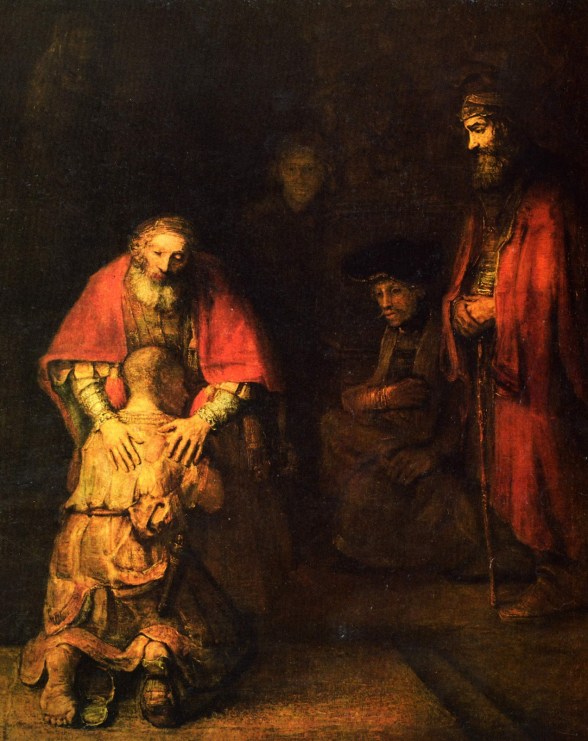
2019.03.31_Rembrandt

This painting by Rembrandt van Rijn is called ‘The Return of the Prodigal Son’ c.1662. The original hangs in the Hermitage in St. Petersburg. The older son is depicted on the right, in a red cloak, looking rather disapproving, and distanced from the father and younger son on the left.

Notice also the father’s hands – the one on the left is smaller and thinner than the one on the right. Most people think Rembrandt was endeavouring to depict both the fatherhood and motherhood of God.

Henri Nouwen has written a book about this narrative and painting called, ‘The return of the prodigal son’. You can read some of it here on Amazon. Read particularly pages 71 and following, about the older son. Or click here for a brief reflection on this painting.

Humility

Click here to listen to this 11-minute message.

God calls us to humility – in our relationship with God, and in our relationship with other people.

Luke 18:9-14 gives us the parable of the pharisee and tax collector, both at prayer.

  1. The pharisee – a person who was devout, religious, righteous, obedient to God’s laws – stands and prays loudly about how wonderful he is and thanks God for not making him like those ‘other’ people (explicitly mentioning the tax collector). Jesus says that this person will not be justified before God, and that people like that, who exalt themselves, will be humbled.
  2. The tax collector – a person who was regarded as dishonest, extortionist and reprehensible, and who Jesus often refers to when talking about sinful people – hides away in a corner, cannot look up towards heaven and can pray only, “God, have mercy on me, a sinner”. Jesus says that this person will go home justified before God, and that a humble person like this will be exalted.

Clearly, God calls us to humility – both in our relationship with God and in our relationship with people.

Of course, this ‘humility’ is not about self-denigration or having a poor self-esteem or negative self-image. Paul says clearly in Romans 12:3 that humility is about assessing our strengths and weaknesses honestly and accurately: “Do not think of yourself more highly than you ought, but rather think of yourself with sober judgment.”

In our other reading for today – Hosea 5:13-6:6 – there is a dialogue between God and Israel:

  1. God observes that when Israel was in need, instead of turning to God, they turned for help to people who did not know God. Therefore, God sent suffering to them, to help them admit their guilt (i.e. to humble them) and until they sincerely sought God’s face.
  2. Israel then reflects that the suffering they have experienced is justified, and that despite God’s anger towards them, God will nevertheless heal them and bind up their wounds. They long to be revived and restored and to live in God’s presence. Twice they say, “Let us acknowledge God” – that word ‘acknowledge’ in Hebrew means ‘to know’ (as in knowing  a fact), but also as in knowing or discerning something not obvious (such as the truth of someone’s intentions), and is used as a euphemism for sex (as in, Adam knew Eve and she fell pregnant). Israel desires to be humble before God and to truly and intimately know God.
  3. God, the exasperated parent, responds positively. God reminds them that God’s desire is for mercy (hesed, meaning steadfast love and compassion) and acknowledgement (that ‘knowing’ word again), far more than empty religion (sacrifices and burned offerings).

Clearly, God calls us to humility – both in our relationship with God and in our relationship with people.

2019.03.30_Kneeling-in-Prayer_Rippelmeyer

Feature image ‘Kneeling in Prayer‘ by Nadine Rippelmeyer (2006)

Turning towards God

Click here to listen to this 11-minute message.

Today is Ash Wednesday, the first day of Lent. Lent is the period of 40 days of fasting and prayer that leads up to Easter. It is a time of preparation for Calvary.

We have three key readings today:

  1. Matthew 6:1-16,16-21. Jesus emphasises that when we do things like giving to the needy, praying and fasting in a way that draws people’s attention to ourselves, our reward for doing it is people’s attention. God is no much impressed. But when we do these things quietly, secretly, then God (who sees what is done in secret) will reward us with treasures that last for eternity.
  2. Psalm 51. In this Psalm, David acknowledges his brokenness and comes before God with empty hands. He does not pretend that he is something when he’s not. And he is honest about his sinfulness. He concludes that God will not despite or reject a broken spirit or a broken and contrite heart.
  3. Isaiah 58:1-12This passage (titled ‘true fasting’ in the NIV translation) emphasises that our fasting my (1) be wholehearted, not merely a performance or duty, and (2) must be matched with how we live out our faith in deeds of justice, compassion and rightness. When we just go through the motions, God will not answer. But when we are sincere and ‘walk the talk’, and call on God, he will say, “Here am I”.

In light of this, I make four key recommendations for prayer and fasting during Lent:

  1. Turn to God – quietly and privately.
  2. Repent of your sins – sincerely.
  3. Align yourself with God – wholeheartedly.
  4. Act on this alignment – purposefully.

Finally, I recommend a prayerful reading of Psalm 51 (NRSV).

1 Have mercy on me, O God,
according to your steadfast love;
according to your abundant mercy
blot out my transgressions.
2 Wash me thoroughly from my iniquity,
and cleanse me from my sin.

3 For I know my transgressions,
and my sin is ever before me.
4 Against you, you alone, have I sinned,
and done what is evil in your sight,
so that you are justified in your sentence
and blameless when you pass judgement.
5 Indeed, I was born guilty,
a sinner when my mother conceived me.

6 You desire truth in the inward being;
therefore teach me wisdom in my secret heart.
7 Purge me with hyssop, and I shall be clean;
wash me, and I shall be whiter than snow.
8 Let me hear joy and gladness;
let the bones that you have crushed rejoice.
9 Hide your face from my sins,
and blot out all my iniquities.

10 Create in me a clean heart, O God,
and put a new and right spirit within me.
11 Do not cast [fling] me away from your presence,
and do not take your holy spirit from me.
12 Restore to me the joy of your salvation,
and sustain in me a willing spirit.

13 Then I will teach transgressors your ways,
and sinners will return to you.
14 Deliver me from bloodshed, O God,
O God of my salvation,
and my tongue will sing aloud of your deliverance.

15 O Lord, open my lips,
and my mouth will declare your praise.
16 For you have no delight in sacrifice;
if I were to give a burnt-offering, you would not be pleased.
17 The sacrifice acceptable to God is a broken spirit;
a broken and contrite heart, O God, you will not despise.

Or listen to Bach’s Cantata based on Psalm 51 (music adapted from Pergolesi’s Stabat Mater)


Featured image from https://www.catholiccompany.com/getfed/ash-wednesday-beginning-lent-5548

2019.03.06_AshWednesday

Truth

Click here to listen to this 17-minute message.

What do you believe? What do you hold to be true? How certain are you that these truths are in fact true? Are you open to the possibility that what you think is true might actually be incorrect? Are you open to possibility that other truths, that are different from your own, might be true? Or are you certain that you are right and they are wrong? In the pantheon of all that you believe is true, is there a central truth – a core truth – that you hold with the greatest certainty? That you’d be prepared to die for?

Truth is a big deal in contemporary society. We live in a post-modern era, where we regard truth as socially constructed, and where one person’s truth is acceptably another person’s fiction or even falsehood. It is a time of relative belief, of ‘live and let live’, of ‘each to their own’.

Yet, for many Christians, truth is absolute and unquestionable. What the Bible says – at least, what those passages that we choose to read – is absolutely true and must be imposed on others as being undoubtedly truly for all people everywhere.

The Apostle Paul presents what appears to be a core truth for himself in 1 Corinthians 15. It centres on the resurrection of Christ. He argues that Christ’s resurrection is so central, that if you don’t believe it, then everything else that you think you believe is flawed and futile.

What is your core truth?

I believe a lot of things about my faith strongly. For example, I believe that God created everything, that God is three distinct persons in one being, that Jesus Christ was the incarnation of God into the world, and that Jesus has uniquely facilitated the restoration of our relationship with God. But I’m not entirely certain how God created everything, whether God is just three persons or if there may yet be additional persons in the Godhead whom we’ve not yet met, or when and how the incarnation took place, and whether there is any limit on the reach of Christ’s reconciliation of people to God. I have thoughts on all of these, and I believe them quite strongly, but I’m open to the possibility – even the likelihood – that I may be wrong.

Yet, for me, I have an unshakable core belief that the heart of God is filled to overflowing with generous, extravagant, fierce love. This one core belief is the centre of my faith. I’m willing to lay down my life for that belief. And everything else that I believe emanates from that central truth. It is why I wrote the book Being God’s Beloved.

What is your core truth?

2019.02.10_Truth

Link to featured image

God cares for you

Click here to listen to this 20-minute message.

The story of Jesus changing water into wine at the wedding in Cana (John 2:1-11) is well-known to most people. It is, in John’s version of the Gospel story, the first act by which Jesus reveals his glory to people. It is an epiphany – an appearance or manifestation of the glory of God in Christ, showing Christ to be God incarnate, the Son of God, the second person of the Holy Trinity.

But before all of that, the changing of water into wine is an act of kindness that reveals to us the interest and care that God has for us. God is interested in and cares about all the daily events in our lives – our concerns and worries, the stumbling blocks and hurdles that we encounter, and our hopes and aspirations. God is not so preoccupied with the great events of the universe that God has no time to attend to the small details of our personal life. Jesus’ assistance with the wedding in Cana, where the wine for the celebrations had run out, is evidence of this.

That the first miracle Jesus performs in John’s Gospel is at a wedding is itself no coincidence. It points to God’s interest in human relationships, in love, in the connections between couples and between families. This reveals the heart of God, which is filled with love for us.

The miracle itself is also performed quietly and unobtrusively, unlike many of the miracles churches sell to people today, which are spectacles. Without any fanfare, Jesus asks some servants to ‘fill’, ‘draw’ and ‘take’, and only they and his mother knew that a miracle had been performed. It was almost done in secret.

As a result of this, his disciples entrusted themselves to Jesus; they put their faith in him, they believed into him. Because they saw that he had both power and compassion.

This miracle, however, also has layers of meaning that deepen our appreciation for this story. First, there are many pointers towards this being a story of Christ’s work to bring salvation to humanity, which we commemorate in the Eucharist (also known as the Holy Community or Lord’s Supper). Second, the wedding banquet is an image used throughout the Bible to point towards God’s great plan to reconcile the world to God’s self, culminating in a great eschatological wedding between us and God and a generous banquet.

At this grand level of the whole of cosmic history,

and at the level of Christ’s work for the salvation of humankind,

and at the level of a wedding in a small village where the families ran out of wine

– at all these levels – this story speaks of God’s care for us. Yes, God loves us. But, in addition, God cares. God cares about and responds to the little and the big things in our lives and God willing and able to respond to them.


Featured image from https://i.pinimg.com/originals/b4/fe/af/b4feaf55ff1f500f40c530ff0edf21cb.jpg

Created in love to love

Click here to listen to this 17-minute message.

It all starts with love. In the beginning… what? In the beginning… God. But not a solitary God. No! A plural God, a triune God, a God in relationship with Godself. The three-in-one God.

We know little of God-as-God, because most everything we know of God is God-in-relationship-to-creation. Theologians refer to this God as the ‘economic trinity‘ – the active God engaging with the world that God had created. Just as who we are inside (our identify, our sense of self) is not equivalent to the person people encounter us to be at work or church, God’s actual self (which theologians call the ‘immanent trinity‘) is not equivalent to God as humanity encounters God.

So, what do we know about God as God, the immanent trinity? Not much! All we really know is that God was always three. Yet also one. God the Spirit and God the Word were already present with God the Parent “in the beginning”.

And while we know there have always been three persons (perhaps there are more than three, but God has revealed to us, so far, just three), these three persons are one being, one essence. I argue that LOVE is the most fundamental essential to the being of God. Relationship between the Parent, Word and Spirit that is so powerful, so intimate, so in tune with each other, so embracing, that the three are in fact one (what theologians call ‘perichoresis’).

Love. Love is the heart of God.

Image result for god love trinity

Those of you who are familiar with my work will hopefully recognise that this is the centre of my theology. It is, in theological terms, my ‘hermeneutic key’, that is, it is the key statement of faith by which I make meaning of everything else in my faith – my experience of God, of others and of myself, my reading of the Scriptures, my reflections on my thinking or reason, and my adoption (or rejection) of tradition. It is the cornerstone. Read chapter 3 of my book for a bit more on this, and if you’re inspired, read the whole book – Being God’s Beloved – online or buy the book.

Based on this, I suggest two small practical ways that we can give expression to this great example of love, ways that we can become the image of God by behaving like God:

  1. Being kind to those we meet in the course of our day, by smiling, greeting, showing interest to and asking after the strangers we pass during our daily lives. By seeing these people through the eyes of Christ – seeing them as Christ sees them.
  2. Loving the work that we do (whether that is paid employment, volunteer work or house work), by investing energy and effort in our work, treating this work as something that God has entrusted to us, as he entrusted the Garden of Eden to Adam, to tend and care for.

If love is the heart of the triune God, and if we are created in God’s image, then we are most like God when we express love in all that we do.

We are created in love, to love.

Feature image from: https://www.christianity.com/god/trinity/god-in-three-persons-a-doctrine-we-barely-understand-11634405.html

Faith Impossible

Click here to listen to this 20-minute message.

Mark 10:17-31 presents us with the story of the (rich, young) man who came to Jesus asking, “Good teacher, what must I do to inherit eternal life?”. Jesus’ response conveys to us the impossibility of faith. Jesus’ expectations of this man are so high, that the man goes away crestfallen. And Jesus’ engagement with his disciples after that serves only to make faith yet more impossible. No wonder the disciples asked each other, “Who then can be saved?”

The lectionary does nothing to soften Jesus’ hard words. Indeed, the other readings reinforce them yet further:

  • Hebrews 4:12-13 says that the Word of God reveals everything about us to God – everything is uncovered, everything is laid bare. There is no place to hide, no place for modesty.
  • Psalm 22 opens with the words “My God, my God, why have you forsaken me?”, which Jesus spoke on the cross. They remind us of the profound and utter devotion of Jesus towards God and his willingness to give up everything for us.
  • Job 23 presents a man who has lost everything and who wants to encounter God, to challenge God, to confront God. But God is not to be found. Having lost everything, but still seeking faith, Job experiences God as unreachable.

Together these readings paint a picture of faith as utterly unattainable. It can leave us feeling perplexed and hopeless.

But, there are three lines in Mark 10 that provide us with some hope. In this sermon, I unpack each of these and show what they mean and how they provide a counterbalance to the impossibly high standards for faith that Jesus sets for us:

  1. Mark 10:21 “Jesus looked at him and loved him.”
  2. Mark 10:15 “Truly I tell you, anyone who will not receive the kingdom of God like a little child will never enter it.”
  3. Mark 10:27 “With man this is impossible, but not with God; all things are possible with God.”

This juxtaposition of the impossible demands of faith that God makes of us, with the loving permissiveness and generosity of Jesus, suggests that while we should strive for faith and to be true disciples of Christ, we can and should also relax into his grace, not fretting and not losing hope.

See also: A little faith

Feature image from: http://kairosterzomillennio.blogspot.com/2015/05/lunedi-della-viii-settimana-del-tempo.html

Images of Stewardship

Click here to listen to this 21-minute message.

September each year is ‘stewardship month’ in the Anglican Church of Southern Africa, during which we focus intensively on the question of our contribution to God’s work in building the Kingdom of God in our midst. Traditionally, we focus on time, talents and treasures as the main focus areas of our contribution. This year, we’ve also focused on our stewardship of creation, particularly in response to the growing plastics threat.

This is the last of our stewardship messages this year, where I was led, by some difficult circumstances, to reflect on the meaning of stewardship. Using a set of six images, I show the multifacetedness of stewardship, and what it means to work as partners with God in transforming our world into the image of God. These images are:

  1. Parenthood
  2. Safeguarding (1 Corinthians 6)
  3. Care-taking (1 Kings 17)
  4. Gardening (Psalm 24)
  5. Loving (serving) (Ephesians 5)
  6. Friendship (John 15)

The image of stewardship as parenthood emerged in a crisis with my son during this past week, where he was involved in a very serious car accident. Although he was not badly hurt, thankfully, his life was jeopardised, and this raised considerable distress for me as a parent. It led me to think of my role as parent as that of a steward of this young man, who is first and foremost God’s son, and only secondarily my son.

The image of stewardship as friendship emerged from John 15, where Jesus says that we are not servants, but friends; friends of Christ and friends of God. Friendship, I suggest, involves freedom, reciprocity (mutuality) and equality. And friendship is the ultimate foundation of stewardship.

It is against these images that I believe we are invited to be coworkers with Christ in his mission to redeem the cosmos.

Blessings
Adrian

Standing against patriarchy

Click here to listen to this 20-minute message.

The church has fallen far short of its expected role in championing the dignity and worth of women. Instead, the church has been complicit in advancing patriarchy: women and children have been abused and exploited by clergy and church leaders; the role and authority of women has been dampened in the church; women have been encouraged to return and submit to their abusive husbands; and a theology of male supremacy has been advocated. The church has and continues to advance patriarchy.

This is at odds with the teaching of Scripture. While the Bible was written men in a patriarchal world and reflects patriarchal patterns of life, this does not mean that God is a patriarch, nor that the church should be patriarchal. We need to revise our theology in light of a reading of scripture that is not dictated by cultural norms about gender relations.

For example, the creation narrative in Genesis is often used to support male superiority – woman was derived from man, man was created to rule, etc. But a close reading of Genesis 1:27-8 and 2:18-23 presents a picture of God creating woman-and-man as a partnership.

  • Both were commissioned to rule over the world – man was not mandated to rule over woman. They were co-workers, partners, sharing in an egalitarian way the responsibilities for taking care of the world.
  • Woman was created out of man, from Adam’s side, showing that they are the same (or similar). They are equals, partners, lovers.
  • Woman was created as a ‘helper‘, but that word does not imply servitude or subordination. It is used 21 times in the First Testament, 16 of which refer to God helping the people of Israel, e.g. Psalm 121:1-2. God is hardly the servant of or subordinate to Israel! If anything, being a ‘helper’ connotes a position of strength and capability.
  • The creation narrative speaks not of male supremacy and female subordination, but of gender equality and mutuality, of partnership and sameness.

Another example, Paul’s writings in the New Testament are riddled with patriarchy: wives submit to your husbands, husbands are the head of the wife, husbands are the head and wives are the neck, women must remain silent in church, etc. Unquestionably, Paul was a patriarch in a patriarchal world. But, we too seldom hear another thread in Paul’s writings: a thread that is at odds with the patriarchal narrative.

  • In Galatians 3:28, Paul writes about the unity of humanity in Christ. He starts with divisions that he fully understands and lives out: “neither Jew nor Greek, slave nor Free”. These shifts towards equity in race and class were radical at that time; indeed they are radical today. But Paul was struggling with “neither male nor female”. One has a sense that Paul understands and partly believes that there is gender equality in Christ, but that his upbringing and investment in a patriarchal world-view hold him captive.
  • In 1 Corinthians 7:3-5, Paul presents a view of marriage – of sex in marriage – that is contrasts starkly with the views he presents in Ephesians 5:22-33. In 1 Corinthians 7, Paul presents sexual relations in marriage as entirely egalitarian and mutual. There is no sense here of a hierarchy of status or even of a differentiation of roles. Instead, there is simply a loving, mutual self-giving of one to the other. Egalitarian marriage.

I’m not arguing here that the Bible narrative advances gender equity. Far from it – the Bible was written by patriarchs in a patriarchal world, and is full of patriarchy. But I am arguing that the Bible equally presents God’s view of humanity as endorsing gender equity. At very least, we must admit that the Bible is not unequivocally in support of patriarchy.

And when we combine this fracture in the patriarchal edifice, even if only a tiny fault line, with the person of Jesus, and his ministry among the women and men of his day, the church must stand up to and against patriarchy. Patriarchy is a social evil that harms the life of the majority of humanity: all women, all children and (arguably) all men. We are all held captive to patriarchy, with some of us (mostly us men) benefiting at the expense of women. This cannot be. This is not the image of the Kingdom of God presented by Jesus Christ.

I call on all of us, but especially men, to do four things:

  1. Be transformed by the renewing of your mind. Then you will be able to test and approve what God’s will is—his good, pleasing and perfect will” (Romans 12:2). We have to start with our own minds, which have been taught patriarchal ways of viewing the world and ourselves since infancy. Let us be transformed, so that we can perceive God’s will more clearly. Let us challenge the deeply engrained patriarchal patterns of thinking.
  2. We need to speak out against patriarchal talk and behaviour. Let us not be silent. Let us not turn our eyes away. Let us speak up for truth and love, for gender equality and for the full dignity and worth of both women and men.
  3. We need to challenge the misuse of Scripture, which draws on handfuls of texts that bolster the culture norms of our society, but are not aligned with the Kingdom values that Christ presents in his teachings and ministry. Scripture has problematic passages, to be sure, but the overriding thread that runs throughout Scripture, and that is our key to making sense of the Bible, is God’s extravagant love for humanity, revealed through creation and the life of Christ.
  4. We need to stand, unequivocally and unflinchingly, with the victims of gender-based violence. For too long, the church has stood with the perpetrators. We see this particularly in the Roman Catholic church, for example, in Pope Francis’ protection of Bishop Juan Barros in Chile, and his later apology to the victims of Bishop Karadima. But let those of us who are not Catholic, not be complacent and point fingers. Child sexual abuse and sexual harassment of women manifests in all churches, including, for example, the Church of England and Willow Creek. The church – you and me – must stand with those who are violated and abused. That is what Christ did, repeatedly. We can do no less.

In the midst of the #MeToo movement, the Church should and must stand up to and against patriarchy, and for the voice of those who have been disempowered and silenced. This was the role that Christ Jesus took up during his brief time on earth. It is the role that his mother gave voice to in her great Magnificat. And it is the role that the church, and all its individual members, must continue today.

A Little Faith

Click here to listen to this 14-minute message.

While there are people who have oodles of faith, many of us have a frail, faltering, fractured faith. I’m one of these people. As a young Christian, I berated myself for being faithless, and envied those who seemed to have waterfalls of faith. As I got older, I clung to Matthew 17: 20, where Jesus says, “Truly I tell you, if you have faith as small as a mustard seed, you can say to this mountain, ‘Move from here to there,’ and it will move. Nothing will be impossible for you.” While large faith is wonderful – God bless those of you who have lots of faith – a little faith is fine.

It is not the quantity of our faith that is so important, as much as the one in whom we place our faith.

Our faith does not accomplish much, but the one in whom we place our faith can accomplish a great deal.

Today’s message draws on John 6:5-13, the narrative of Jesus feeding the 5000. I focus on four points to make the argument that a little bit of faith can go a long way:

  1. Philip‘s problem was that he was so focused on the thousands of hungry people that he lost sight of Jesus, who was standing right beside him. We also, often, get so absorbed in the problem, that we forget to look to Jesus, who is standing right next to us.
  2. Andrew had a little faith: he found a boy who had 5 little loaves of bread and 2 little fish. ‘Here is something, something small’, he thought. But then he too lost sight of Jesus and became overwhelmed by the enormity of the task. We also may find that we have a little faith, a little gift, a little ability, but quickly feel daunted by the enormity of the task ahead and falter.
  3. Jesus, however, is more than able to feed thousands and already had a plan long before he asked Philip’s input. Jesus’ capacity to do the Work of God is not dependent on us, on our faith. However, he wants our partnership. So, he instructs Philip and Andrew to prepare the crowd for the miracle, by getting them to sit down. Regardless of our faith – large, little or nothing – Jesus invites us to move ahead, as if we had faith. We are invited to act. You don’t actually have to have faith to act; through action comes faith.
  4. The crowd receive the bread and the fish, and they eat their full. Today, we’d probably question the bread and the fish, and be hesitant to partake. But the crowd then also exercised a little faith – they participated, they ate. When Jesus offers us a gift – a gift of faith – do we accept it? Or do we critique and doubt it?

Ultimately, Jesus shows that he is more than able to take care of an impossible need, with or without the faith of the disciples. This shows us, that it is not about our faith, but about Jesus, the one in whom we entrust our faith. And that whether our faith is large or little or absent, Jesus can and does work out God’s purposes among us.

Let us, then, cultivate just a little faith by looking to Jesus, by taking small steps, by doing something and by opening ourselves to his capacity for love and work.

Brandon Heath – A Little Faith (Official Audio):
“A little faith, just a little faith; a little faith goes a long long way”