Encountering the risen Christ

Watch the video below of this 42-minute message. Yes, much longer than usual! I’m sorry about that, but it is – I think – worth the time, as a close reading of John 20:19-29 sheds to much light on Jesus’ character, his relationship with the disciples and his work as the Son of God. My notes are available below the video

Verses 19, 26    Both times Jesus “stood right in the middle of them”

Christ is the centre – not the priest, Bible, APB – only the person Christ

Christ-centred church

1, 19, 26               Easter Sunday morning – Jesus appears to Mary

Easter Sunday evening – Jesus appears in the upper room

Following Sunday (today) – Jesus appears again, to Thomas

19, 21, 26             Peace be with you – Shalom alechem x3

Easter Sunday – Christ made peace between us and God

Forgiveness of sins – done, paid for, wiped clean, forgotten, cast the deep

Everything is good. It’s all okay

Easter is the Great Forgiveness!

20           He showed them his hands and side

Emphasis on bodily resurrection, reconnected to his people

Not just some spiritual, esoteric thing

He is fully embodied, albeit with some unusual capacities

20           He could have come back healed, but doesn’t. Why?

His identification with us, solidarity with our pain & suffering

He remains the suffering servant of Isaiah 53 (4-5):

He took up our pain and bore our suffering. He was pierced for our transgressions, he was crushed for our iniquities, the punishment that brought us peace was on him, and by his wounds we are healed.

20           The disciples were overjoyed – full of joy

Joy (chara) & grace/gift (charis) – joy is a gift of God – because Jesus is back

21           “As the father has sent me, I am sending you”

We are to continue God’s work. We are sent, just as Christ was sent

Jn 3:16/7 “God so loved the world that he gave [sent] his one and only Son … For God did not send his Son to condemn the world, but to save it”

Every Christian is sent – not just clergy or evangelists

22           He breathed on them, “Receive the Holy Spirit

Hebrew for spirit & breath are both? Ruach

Gen 1:2: Spirit of God hovering

22           Gen 2:7: “Then the Lord God formed a man from the dust of the ground and breathed into his nostrils the breath of life, and the man became a living being”

To receive Jesus’ breath & Holy Spirit is to be made a new living being

22           To receive Jesus’ breath & Holy Spirit is a grace/gift (charis)

As the Spirit/breath was active in the creation of earth and humanity

2 Cor 5:17: “If anyone is in Christ, they are a new creation. The old has passed away, the new has come.”

22           Holy Spirit poured out on Pentecost: Easter Season is from Easter Sunday to Pentecost

23           Forgive anyone’s sin

The gift of HS is not so much miraculous signs, etc.

Instead the central commission – sending – is to forgive

And to warn that to not repent = no forgiveness

The Great Forgiveness!

24           Thomas was not with the disciples when Jesus came.

Where was he? He should have been in church! We should be in church!

27           Touch, see

V20. Jesus showed them his hands and side.

Thomas wants what the others got – to see. But also to touch

Our Eucharist is a see and touch moment

– receive the body of Christ broken for you (not receive this bread)

– receive the blood of Christ (not receive this wine)

Not clear if Thomas did actually touch: “Thomas answered and said…”

Perhaps seeing and the invitation to touch was enough for him

27           Stop doubting and believe. Be a believer!!

Accept the small and periodic signs of God and believe into him

28           My Lord and my God!

Hebrew: Yahweh & Elohim – names for God

Greek: Kyrie & Theos – names for God

The only place in the Gospels where Jesus is referred to as God – A profound statement of faith – perhaps the most
Food and faith

Click here to listen to the audio recording of this 22-minute message. Or watch the video here on Facebook (the message starts 31 minutes into the recording). Or read the text summary below.

Jesus crosses the Sea of Galilee and then ascends the mountainside (v. 3) and sits down – it is on mountains that God often appears to people. Think of Moses and the burning bush, Moses receiving the Ten Commandments, Jesus transfigured before Peter, James and John. His ascent cues us that something important is going to happen – some revelation of the being or character of God.

John then tells us (v. 4) – seemingly for no reason – that the Jewish Passover Festival was near. Another translation (Bruner) has, “Now, the Passover, the festival of the Jewish people, was coming up.” The Passover, which takes place when the Jews are slaves in Egypt, includes the passing over of the Jewish households and their fleeing Egypt across the Red Sea. It is THE central narrative of the Jewish religion, in the same way that Christ’s death and resurrection are THE central narrative of the Christian religion. It speaks of deliverance, freedom, salvation, relief and hope. It speaks of God coming near to God’s people and answering the deep cries. So John mentions this to raise up in us a hopeful expectation of what God might do for us.

There are two layers to this story of the feeding of the five thousand: food and faith

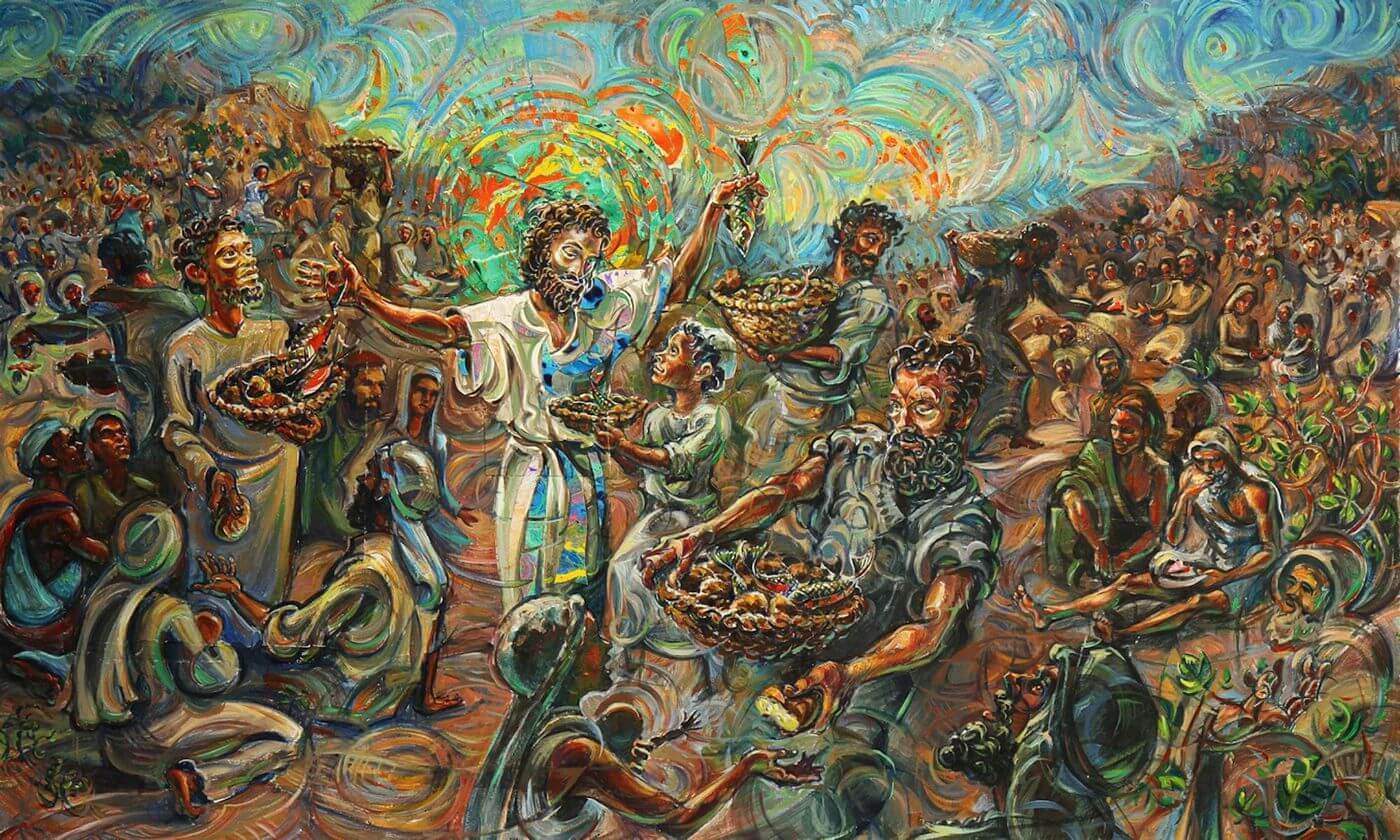
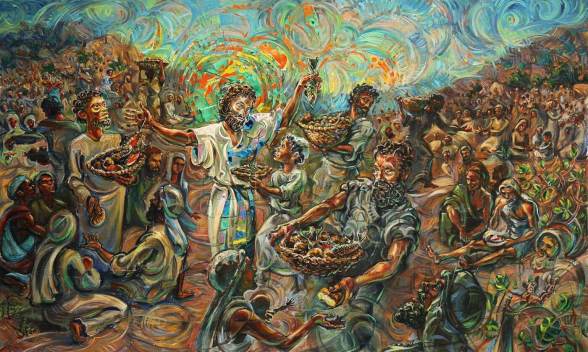
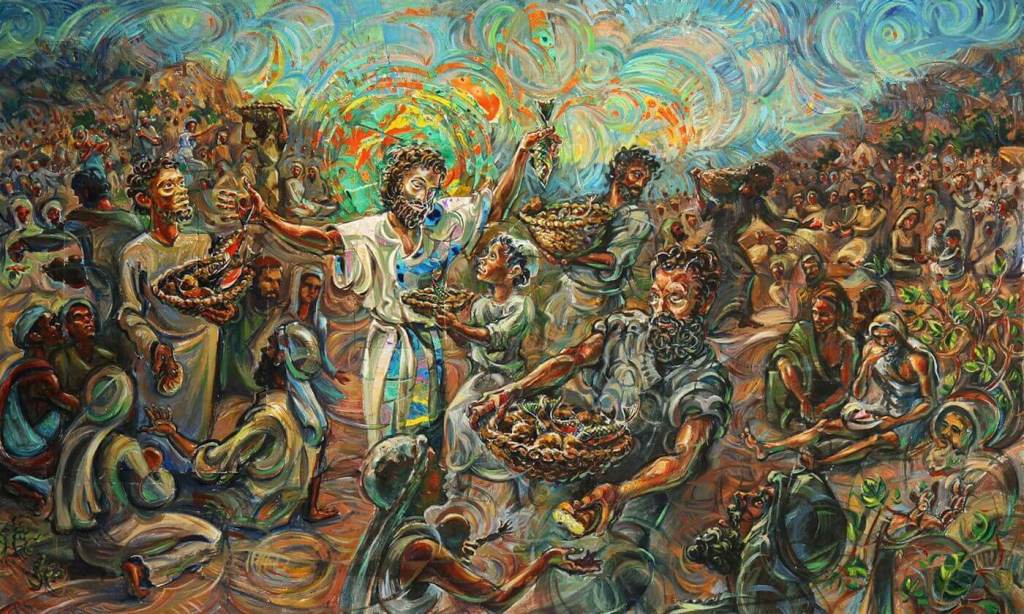
First, there is a practical layer – food. There are 5000 men there, presumably together with women and children. They are hungry and there is no place to get food. So Jesus creates enough food out of five small barley loaves and two small fish to feed them all, and to have 12 baskets of leftovers. This miracle, which may remind us of Jesus turning water into excellent wine at a wedding, a few chapters earlier, speaks to God’s concern for the basic needs of humanity. God desires us to have what we need to live. Basic needs for shelter, food, warmth, healthcare, education and safety are important to God. And Jesus provides for them. This is the first part of God’s revelation of himself in this story – God is concerned for your everyday needs and is willing and able to help you meet those needs, just as he helped free the Jews in slavery in Egypt.

Second, there is a spiritual layer – faith. Looking at the large crowds, the disciples are overwhelmed, and their mustard seeds of faith flee. Jesus knows that their faith is feeble, and so he asks Philip, “Where shall we buy bread for these people to eat?” His question leaves no wriggle room for Philip to say they must sort themselves out – it is clear that bread must be provided. The only question is where they will buy it. Philip’s faith collapses, as he says, “It would take more than half a year’s wages to buy enough bread for each one to have a bite!” Philip is unable to imagine that Jesus can do more than what is humanly possible. His feet are deeply embedded in the ground.

But then Andrew brings along a little boy who has five small barley loaves and two small fish and presents him to Jesus. It feels as if Andrew has some spark of faith that maybe something could be done with this little bit of padkos. But almost immediately, his faith also collapses, as he says, “but how far will they go among so many?”

Jesus takes control of the situation and issues instructions. The disciples trust and obey, and everyone ate as much as they wanted. Although Jesus will come to criticize the people for chasing after food, in this moment, they recognise him: “Surely this the Prophet who is to come into the world!” They want him to be king, but he just wants to reveal God to them.

And today’s reading ends with Jesus walking across the surface of the lake in a storm, several kilometers from the shore, and reminding them of who he is: “It is I. I am. Don’t be afraid.”

Featured image from https://www.tallengestore.com/cdn/shop/products/Jesus_Feeds_5000_-_Christian_Art_Painting_587f4577-c1f0-48ea-a738-38da1dc7cd19.jpg?v=1575281602

Sabbath church

Click here to listen to the audio recording of this 25-minute message. Or watch the video here on Facebook (the message starts 22 minutes into the recording). Or read the text summary below.

Genesis 2:2-3 institutes the Sabbath (or Shabbat or Shabbos). Most Christians celebrate this on Sunday, while Jews and some Christians (e.g., Seventh Day Adventists) observe it on Saturday (or from sunset on Friday to sunset on Saturday). Muslims have a holy day on Friday, called Jumu’ah, and will pray at noon at the mosque (or wherever they are, if there is no accessible mosque), though it is not a day of rest. For Christians, then, the Sabbath is intended to be a day of rest. And it is traditionally when we spend time in God’s house with God’s people.

In the evangelical Bible church where I came to faith in my teens, the Sabbath was a very holy day. We were expected to come to both the morning and evening services (which I routinely did), and also the early morning Bible study (which I did). And we were not allowed to work (no home work or office work, no shopping, no parties, etc.), which I also conformed to. In my family, Sunday was also the day we all relaxed. Dad would do a braai (barbecue), always burning the outside of the meat to charcoal! We’d have ice cream for pudding, play in the pool, watch Dad watching motor racing on the TV, reading the Sunday paper, sleeping. Although I am not fixed on Sabbath prohibitions anymore, I still feel guilty stopping at the shops on the way home from church – sometimes I’ll take off my dog collar and put on a t-shirt, to go incognito – a guilty remnant of my rule-based Christian formation.

In today’s Gospel reading (Mark 2:23-3:6), Jesus flaunts the strict Jewish Sabbath laws of his time: he and his disciples (1) travel, (2) harvest, and (3) eat, and in the following passage, Jesus (4) heals a man with a shrivelled hand. This behaviour of Jesus – to flaunt Jewish laws in favour of human relationships and well-being – is typical of Jesus’ ministry, and contributed to his murder.

Jesus, however, challenges the Sabbath laws. He draws on a story from Samuel (not actually about the Sabbath) to argue that Jesus, like David, broke rules about giving food to his companions. It is as if Jesus is saying, “Chill! It’s not that important. Relax. My disciples were hungry, so I’m fine with them reaping and eating some grain.” He says to the Pharisees, “The Sabbath was made for humans, not humans for the Sabbath” (Mark 2:27). Jesus always prioritises people over rules, even when this is deeply offensive to other people who prioritise rules over people.

Jesus does the same in the following healing story. Here he juxtaposes goodness with evil, and saving life with murder – which is lawful on the Sabbath? Perhaps the correct answer was that none of these were lawful, but the Pharisees remain silent. They were not willing to recognise that there is a continuum between evil to good, between dying and healing. They applied their rules rigidly. This angers Jesus: “He looked around at them in anger, deeply distressed at their stubborn hearts” (Mark 3:5).

This wordless response of Jesus is vital to our faith – Jesus always prioritises people over rules. Rules are important for civilisation and harmony, but when rules dehumanise people, they must be challenged. And so Jesus provocatively and flagrantly heals the man in front of the Pharisees, who immediately start plotting his death.

The Sabbath, then, is God’s gift to humankind. In the Ten Commandments in Exodus 20:8-11, God says via Moses:

“Remember the Sabbath day by keeping it holy. Six days you shall labor and do all your work, 10 but the seventh day is a sabbath to the LORD your God. On it you shall not do any work, neither you, nor your son or daughter, nor your male or female servant, nor your animals, nor any foreigner residing in your towns. 11 For in six days the LORD made the heavens and the earth, the sea, and all that is in them, but he rested on the seventh day. Therefore the LORD blessed the Sabbath day and made it holy.

God knows us. God created us. God knows what we need. God knows we need down-time. Psalm 139 reveals this intimate knowledge that God has for each of us:

1 You have searched me, Lord, and you know me. 2 You know when I sit and when I rise; you perceive my thoughts from afar. 3 You discern my going out and my lying down; you are familiar with all my ways. 4 Before a word is on my tongue you, Lord, know it completely. 5 You hem me in behind and before, and you lay your hand upon me. … 13 For you created my inmost being; you knit me together in my mother’s womb. 14 I praise you because I am fearfully and wonderfully made; your works are wonderful, I know that full well. 15 My frame was not hidden from you when I was made in the secret place, when I was woven together in the depths of the earth. 16 Your eyes saw my unformed body; all the days ordained for me were written in your book before one of them came to be.

2 Corinthians 4:7 also has important insight for us: “But we have this treasure in jars of clay, to show that the surpassing power belongs to God and not to us.” We are the jars of clay – fragile vessels, easily shattered. God is the treasure, the surpassing power, the light, the life, the potential, the very Spirit of God. God chooses to dwell in these fragile vessels that we are.

All of this brings us back to the Sabbath. Without getting legalistic about Sabbath rules, can we agree that spending time with God is good for us? Can we agree that prayer, both personal and collective, is good for us? That singing together is good for us? That hearing the Word of God read in public is good for us? Can we agree that hearing the Word of God explained and applied to our lives is good for us? That spending a little time chatting with other Christians over a cup of tea of coffee is good for us? That leaving the dishes in the sink for another 15 minutes to spend time in fellowship is good for us? Can we agree that being at church as a family is good for us? That participating in the Eucharist – receiving the signs of Christ’s exceptional love for us – is good for us? That being reminded every week that Christ dwells within us and wants us to walk in step with him is good for us?

Surely the answer to all these questions must be YES?!

Come to church! Even if you are tired. Even if you don’t like your minister. Even if you don’t like some people at church. Even if there are things you disagree with. Even if you have other work that needs to be done. Even if you come without your family because they are not interested.

Put yourself into a place where God can bless you. Come with an expectant heart. Open your heart to God’s Spirit. Look for the good in your church. Forgive your church for its lacks and failures. Come to church!

Featured image from https://img.freepik.com/premium-photo/church-congregation-christian-gospel-singers-raising-praise-lord-jesus-christ_829699-356.jpg

Unpacking the Eucharist

Click here to watch the 2-hour video of this service on Facebook.

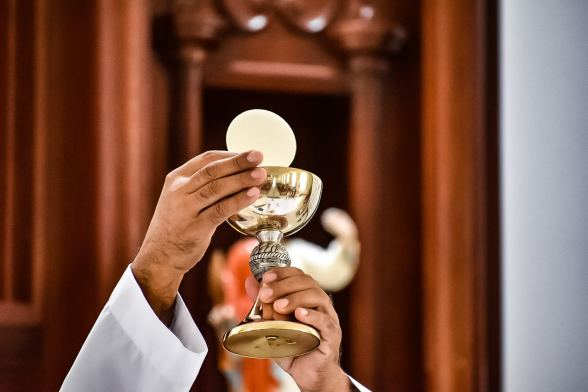
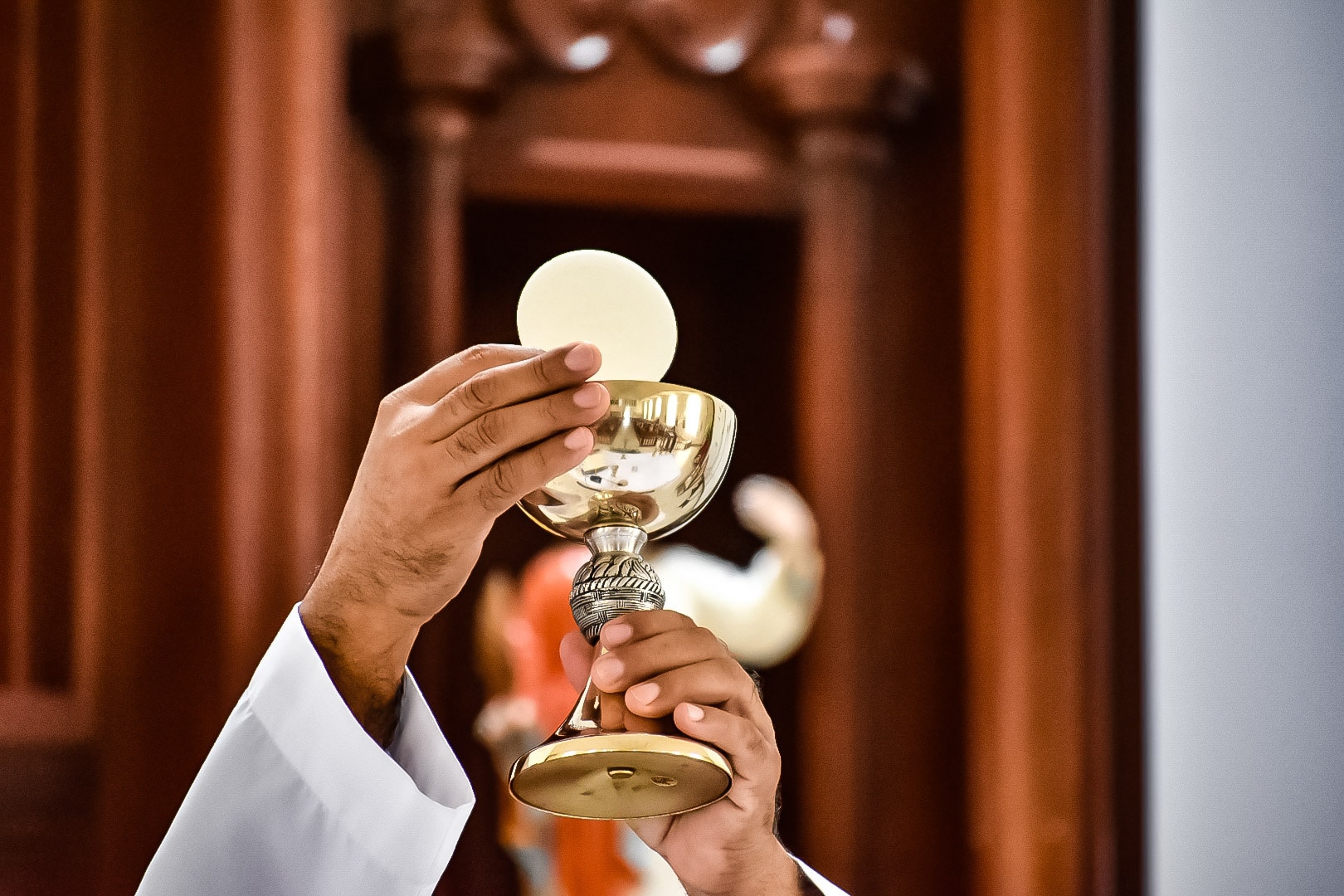
Today we did an Instructed Eucharist. This is a normal Anglican Eucharist service, the same as we do every Sunday, but with a commentary on what we’re doing and why we’re doing it. We learn about the meaning of the colours, the liturgy, our prayers, the readings, our gestures, the things on the altar, and why we do what we do.

You can download the text that was read here, in case you want to read the details more closely.

Featured image from https://lacatholics.org/wp-content/uploads/2021/06/eucharist-being-consecrated-during-Mass.jpg

Bread of Heaven (Part 4)

Click here to listen to the audio recording of this 27-minute message. Or watch the video on Facebook here (the message starts at 23 minutes). Today’s sermon is delivered by Gaba Tabane, a lay preacher at my church. Or read my text summary below.

We continue with our series on the Bread of Heaven, this week focusing on John 6:51-58. In today’s passage, Jesus dives into the deep end of his teaching so far, focusing squarely on himself as the bread of life, and calling us to eat of his flesh and drink of his blood. This is a difficult reading:

“Very truly I tell you, unless you eat the flesh of the Son of Man and drink his blood, you have no life in you. Whoever eats my flesh and drinks my blood has eternal life, and I will raise them up at the last day. For my flesh is real food and my blood is real drink. Whoever eats my flesh and drinks my blood remains in me, and I in them. Just as the living Father sent me and I live because of the Father, so the one who feeds on me will live because of me. This is the bread that came down from heaven. Your ancestors ate manna and died, but whoever feeds on this bread will live forever.”

Jesus appears to confront us this almost cannibalistic image to make intangible spiritual truths as tangible and tactile as possible, even to the point of being gross. He is speaking of the Eucharist (communion, Lord’s Supper, Holy Mass). He wants us to understand that we obtain eternal life by filling ourselves with his presence. By making him an essential part of ourselves. Thus, eating his flesh and drinking his blood is a metaphor or image to help us grasp how seriously he wants us to allow him to fill us up spiritually and diffuse through every cell of our body and every thought of our mind.

When we let Jesus into ourselves, we have life eternal in ourselves. But if we refuse to let him in, we have no life in us. This is what he says in verses 53 and 54. When we let him in, we will have deep, lasting life and we will be raised up again to new life on the last day. He says in verse 56 that when we allow him in, he will come make his home in us. The NIV says “you remain in me and I remain in you”, but this ‘remain’ means to ‘take up dwelling in’, to ‘make your home in’. Jesus dwells in us – in our body, in our mind, in our emotions, in our spirit.

Jesus says that his flesh is real food and his blood is real drink. Some churches think of the eucharist bread and wine as symbols of his body and blood. Others think of them as actual flesh and blood. Our church thinks of them as bread and wine that have been transformed in such a way that the real presence of Christ is present in them. They are real bread and wine, and also real flesh and blood – Jesus makes himself present and available to us in these elements, so that we can feast on him. Jesus says, at the last supper, “This is my body” and “This is my blood”, yet he is sitting right there, alive and without any loss of flesh or blood. So, this middle way between symbolism and transubstantiation is the most workable way of understanding his meaning. Jesus is genuinely and actually present in the bread and wine, but the bread and wine are still bread and wine, and yet far more than just that. We call this consubstantiation, which means both substances at the same time. This is a sacrament: “An outward and visible sign (baked bread) of inward and spiritual grace (bread from heaven), given by Christ as sure and certain means by which we receive that grace”.

Bruner (2012, p. 436-437) summarises his passage like this:

“Here it is; here I am; take a good look; this is it; the Great Heavenly Visit is now right here in front of you in this little space. You are very privileged to have access to this cosmic, once-in-a-lifetime event. You are looking straight at the meaning of life. This is what it is all about.”

Featured image of rye bread from https://dexam.co.uk/rye-bread

Bread of Heaven (Part 3)

Click here to listen to the audio recording of this 16-minute message. Or watch the video on Facebook here (the message starts at 26 minutes). Or read the text summary below.

We continue with our series on the Bread of Heaven, this week focusing on John 6:35-51. Last week (Part 2) we saw how Jesus persisted in redirecting people from worldly work and food to heavenly work and food, from our actions to Christ’s actions, from our small vision to God’s grand agenda, and from bread to Christ. Everything was focused on getting us to redirect ourselves towards Christ, to orientate ourselves towards him.

Our passage today continues that theme, as Jesus unpacks what it means to orientate ourselves to him and how he takes the leading in enabling us to do that. I’ll be extracting five word themes from the passage. We’ll see that Jesus is once again persistent in using the same phrases over and over to drive home his message.

Christ’s invitation – come to me

First, Jesus repeatedly uses language that speaks to us coming to him, believing in him, eating of him, looking to him. Eleven times in 14 verses he uses these terms. He issues us an invitation, an open and generous invitation, to come to him. It is the central message of today’s text – come to me!

35 Whoever comes to me will never go hungry
37 All those the Father gives me will come to me
37 whoever comes to me I will never drive away
44 No one can come to me unless the father draws them
45 Everyone who has heard the Father comes to me
35 whoever believes in me will never be thirsty
40 everyone who believes in him shall have eternal life
47 the one who believes has eternal life
50 anyone may eat and not die
50 Whoever eats this bread will live forever
40 everyone who looks to the Son shall have eternal life

God’s grace – the Father’s will

Our ability to come to Christ is, however, by God’s grace. It is through the will of Father, and not through our own efforts or initiative that we can come to God. Only by grace, through faith in Christ. Six times, Jesus emphasises that it is through the work of the Father that we can come.

37 All those the Father gives me will come to me
39 this is the will of him who sent me
40 For my Father’s will is that
44 the Father who sent me draws them
45 They will all be taught by God
45 heard the Father and learned from him

Christ’s initiative – Christ comes down

As much as our capacity to come to Christ is through the grace and will of God, Christ himself also assists in coming down to us. We don’t have to go far to find him – he has already come to us. In the three places where Jesus refers to his coming down from heaven, he uses three different tenses: I have come, I am coming right now, I came. This suggests that his coming is timeless: yesterday, today and tomorrow, Christ is coming down from heaven.

38 I have come down from heaven
50 here is the bread that is coming down right now from heaven
51 I am the living bread that came down from heaven

Christ’s inclusivity – each one and everyone

Jesus conveys his inclusivity in the way he refers to people in both the singular (9 times) and plural (8 times). It seems that he wants us to think of ourselves as being of special importance – just me, every single person, you the individual. And he also wants us to appreciate that he includes everyone, a radical inclusion that, in the last verse, encompasses the whole world!

35 whoever comes to me
35 whoever believes in me
38 whoever comes to me
39 I shall lose not one
44 No one can come to me
46 Not one has seen the Father
47 the one who believes has eternal life
50 any one may eat and not die
51 Whoever eats this bread will live forever

37 All those the Father gives
39 raise them up
40 my Father’s will is that everyone
40 raise them up
44 raise them up
45 They will all be taught by God
45 Everyone who has heard the Father
51 for the life of the world

Christ – the Bread of Life

And finally, Jesus repeatedly refers to himself as The Bread. Six times he calls himself the bread. In Parts 1 and 2 of our series, we encountered this only once – in the same verse that opens today’s reading. But here, he drives home that the bread we hunger after, the bread that sustains life, the bread that fills us up, is indeed Christ himself. If we are hungry and thirsty for something, Jesus is the one who satisfies us.

35 I am the bread of life
48 I am the bread of life
50 here is the bread that comes down from heaven
51 I am the living bread
51 Whoever eats this bread will live forever
51 This bread is my flesh

Today’s reading emphasises, repeatedly, that Jesus is the one we are after, that he is the one who, with the support of the Father, initiates the invitation for us to come to him and makes it easier by coming to us, so that each and everyone of us and all of us together can feast on the bread of life that has, is and continues to come down from heaven.

Come to Jesus!

Featured image of roti from https://www.cookhalaal.com/recipe/my-mothers-roti-recipe/

Bread of Heaven (Part 1)

Click here to listen to the audio recording of this 22-minute message. Or watch the video on Facebook here (the message starts at about 31 minutes). Or read the text summary below.

Our reading this morning is from John 6:1-21. We will be spending five weeks on this chapter. I think that this is the most consecutive Sundays we spend on any chapter in the Bible. (I stand to be corrected.) This is because we receive here some of Jesus’ most profound and important teaching – about the Bread of Life, the Bread of Heaven. It starts with a story about ‘real bread’ and becomes a story about ‘Real Bread’ (Bruner’s commentary on John).

In the first 15 verses of John 6, we are introduced to bread. It sets the scene for the rest of the chapter. We can read this story at two levels: on the ground floor, it is a story about Jesus feeding 5000 men from five small barley loaves and two small fish – a story of compassion and care; on the first floor, it is a story about an invitation to faith – faith in Jesus, who is the Bread of Life.

The ground floor – a story about caring

Jesus is on the mountain side and he sees a large crowd heading his way. John writes “Jesus looked up and saw”. Jesus is always looking up and seeing. We get this again and again in the Gospel narratives. He has his eyes open and sees the needs of those around him. If you listen to my messages over the past month, you’ll hear it over and over. He sees. And he has compassion.

So he asks his disciples how they can arrange bread to feed the people. It is a huge ask, of course, with 5,000 men, plus children (we know there are children there, because soon we meet a ‘boy’ in v9) and women (if there are children, there are surely women). So, there were perhaps 15,000 or 20,000 people! Andrew brings a boy who has a little bit of food – not much more than a snack. Jesus gives thanks for the food and distributes it to the people. (One wonders what the boy thought about having his lunch annexed by the Andrew and Jesus!) Everyone eats their fill, so much so, that there are 12 large baskets (big baskets that could hold a man) of leftovers of the barley bread.

Many of us believe that Jesus performed a miracle, in which he multiplied that little bread into much bread. Others believe that when people saw Jesus’ (and perhaps also the boy’s) generosity and compassion, they were moved to share what they had with those who had less. And so, what we see is a social miracle about people moved to caring and sharing. Either way, this is a story about Jesus caring for others – caring for our everyday needs. As we often pray, ‘Give us this day our daily bread’. Bread is life in come communities. In others, it is maize meal porridge. In others, it is rice. Every society has a staple food that provides the foundation of life. Jesus cares about this and wants people to have food in their stomachs. And to have it abundantly.

The first floor – a story about faith

The feeding of the 5000 is an important miracle story in the Bible. It is the ONLY miracle, taking place between Jesus’ baptism and his entry into Jerusalem on Palm Sunday, that appears in ALL FOUR Gospels. There is no other miracle that appears across all four Gospels, except this one. And in John’s gospel, it introduces a lengthy chapter about the spiritual meaning of Real Bread. Still, even on the first floor, the real bread is just bread. But the interactions between Jesus and the others are an invitation to faith.

John tells us that the event takes place just before the Passover festival (v4). The Passover symbolised, as it still does, liberation and redemption from slavery in Egypt, God standing up for the people of God, God caring for God’s chosen ones. It is central to Jewish faith, like the cross is central to Christian faith. This cues us that this is a story about faith.

Seeing the large crowds, Jesus invited Philip to faith: “Where shall we buy bread for these people to eat?” For sure, this is a big ask – it is a big crowd. But Philip was there in John 2, when Jesus changed water into wine – a lot of wine, a lot of really good wine! Jesus invites Philip to have faith. A faith response might have been, “Lord, I can’t imagine where we could get or afford so much bread. But I know you can make a plan! If anyone can feed this many people, it is you!” That would be a faith response, particularly after witnessing the water into wine miracle. Instead, all Philip can see is the large crowd. He loses sight of Jesus. His faith fails him.

Andrew shows a little faith, however. He finds a boy with some food. He emphasises the smallness of what the boy has: “five small barley loaves and two small fish” (v8). And then his tiny bubble of faith pops: “But how far will they go among so many people?”

Yet, that is all Jesus needed: a tiny morsel of faith. He takes those small loaves and small fish and gives thanks for (literally ‘eucharists’) them and feeds 5000+ people. Jesus is not constrained by the size of our faith. Andrew’s faith is feeble, small and easily fizzles. But what is important is not so much our faith, as the one in whom we place our faith: Jesus is more than capable of calming our storms, feeding us, healing us, helping us. He is the Lord of lords and King of kings. He is God incarnate. He can do anything.

It is only in the collecting of the leftovers that the disciples and the people recognise a miracle has taken place. I think Jesus instructs the disciples to collect the leftovers so they can see and touch the miracle, much as Jesus does with Thomas in John 20 – “Put your finger here; see my hand”. As Thomas was invited by Jesus to see, touch and respond in faith, so were Philip and the other disciples invited to see, touch and respond in faith. And so are we. Particularly during times of turmoil, illness, loss, distress and hunger.

Postscript

Immediately after the story of the feeding of the 5000, we have John’s version of the story of Jesus walking on the water (see my sermon on this same story from Mark’s Gospel, a month ago). The disciples are alone in a boat on a lake in a storm and struggling to make headway. Jesus sees their plight and walks across the water to them. They are terrified to see him, but he says, ‘It is I; don’t be afraid“, and he climbs into the storm-rocked boat with them – he chooses to be in the boat in the storm with them – and immediately, they find they have reached the other side of the lake, where they were headed.

Jesus remains more than capable of riding out and calming the storms in our lives.

Featured image from https://www.kitchensanctuary.com/artisan-bread-recipe/

Stewarding our world

Click here to listen to the audio version of this 12-minute message. Or watch the YouTube video below. Or read the text summary that follows.

Father almighty
we offer ourselves to you as a living sacrifice in Jesus Christ our Lord.
Send us out into the world in the power of the Holy Spirit
To live and work to your praise and glory.

We end each Eucharist service with this prayer. It is the endpoint of the entire service of communion. We do come to be filled, restored and healed; we do come to worship and praise God; we do come for fellowship; we do come to learn; and we do come to celebrate the Eucharist. But the purpose of all of this is to equip and fill us to go out into the world and serve the Lord.

The church is a refuelling station, in which we are filled up and restored, so that we can go out and do God’s work in the world.

Today is the fourth and last Sunday in our stewardship programme.

  1. In the first week, we considered stewarding ourselves;
  2. then stewarding our communion (our church fellowship);
  3. and last week, stewarding our things, particularly our money.
  4. Today, we reflect on what it means to steward the world.

Genesis 2 presents the narrative of God’s creation of humanity. God then placed the man he had created in the Garden of Eden and commissioned him to ‘tend and care for it’; that is, to steward the world. We continue to carry this commission.

Stewarding the world includes a focus on the planet – the earth itself – with all its natural resources: the sky, the oceans, the water, the land, the minerals, the renewable and non-renewable energy resources. We are commissioned to take care of the earth (and indeed the cosmos) – not to exploit, plunder, rape and destroy. ‘Tend and care’ are gentle, kind, caring, nurturing words, to describe the relationship we ought to have to the world around us.

In addition, stewarding the world includes a focus on its people – on all of humankind – regardless of anything (religion, race, gender, politics, nationality, sexual orientation, gender identity, age, disability, and so on). We are to be Christ’s presence among humanity – his hands, his feet, his eyes, his mouth, his heart (as Saint Teresa of Ávila may have written – see video below). It is unfortunate that many Christians see their Christ-like presence in the world as reduced just to fighting against two issues: human sexuality and abortion. While these are important topics to engage, Jesus’ own presence in the world focused pervasively on fighting for love, kindness, justice, inclusion. To steward the people of this world is to imitate Christ’s engagement with humankind.

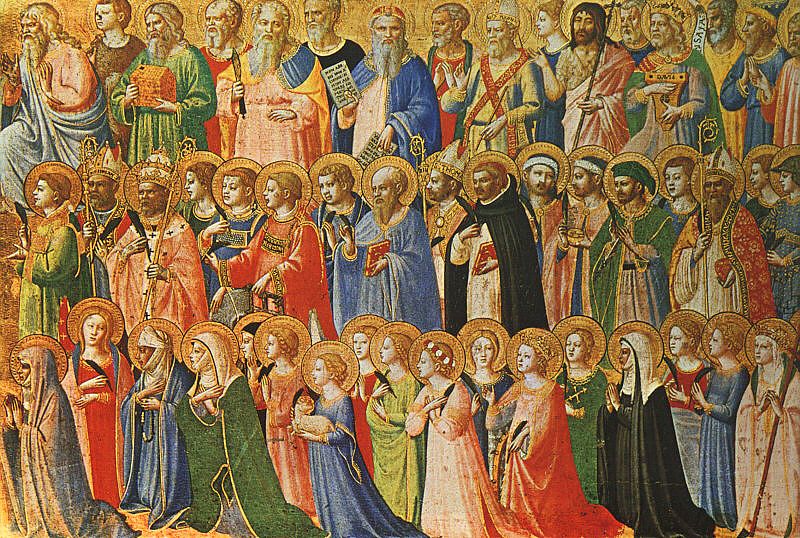
Appropriately, today is All Saints Day, the day on which we commemorate and celebrate the lives of the saints. My church is named after St Stephen, who is described in Acts 6-7. Carrying his name, we in our parish are invited to adopt Stephen as a model or example for our lives. Stephen was a young deacon, whose ministry lasted less than a year. A deacon is a servant, who works out in the community, helping the poor and marginalised. Stephen is described as being “full of faith and of the Holy Spirit”. He was a bold preacher, delivering the longest sermon in the book of Acts. It resulted in his murder, at the age of 29. As he died, his last words were to forgive those who stoned him.

Stephen is a shining example of stewarding the world. He was a servant to the people of God and to people seeking God.

Let us each take up our own role, in our own place, in our own way, using our own Spirit-given gifts, to love and serve the world.

Go in peace to love and serve the Lord
In the name of Christ.
Amen

Painting of the saints by Fra Angelico (in the 1400s) from https://en.wikipedia.org/wiki/All_Saints%27_Day
https://www.youtube.com/watch?v=w7ymxW3rndk

Instructed Eucharist – Lent 2013

Communion

Click here to listen to the audio recording of the whole service – it is an hour and a quarter, because I’ve included the WHOLE service!

Figuring out the Anglican communion service (known as the Holy Eucharist) can be quite a challenge, particularly for those of us who did not grow up Anglican. So many words in the prayer book, sit-stand-kneel-stand-kneel-sit and all the robes, chalices, bowing and crossing – it can leave you feeling quite overwhelmed and confused! Many of those who have been members of the Anglican church for many years have forgotten what everything means – we just do what we’ve always done, often without understanding why we’re doing what we’re doing. Many people who are not familiar with the sacramental tradition find it all far to elaborate and ritualistic – a real turn-off.

Because of this, our church decided to run an ‘instructed Eucharist’ – this is our second one. It is a regular Eucharist service (though a little trimmed down to keep it not too long) with commentary provided as we go along, to explain what we’re doing and why we’re doing it. The Anglican service offers some unique experiences of worship, different from most Protestant and charismatic churches. While it is not for everyone, it may still be interesting – even if you’re not Anglican. We are not a very ‘high’ Anglican church – just regular folk who love Jesus and who are members of a small Anglican community church.

Click here to download just the transcript (PDF) of the instruction. You are most welcome to use and adapt our transcript for your own church. My thanks to the various sources that I drew on to prepare this one.

Click here to watch a video extract of the setting up of the communion table and the prayers leading up to the Eucharist 

(Apologies for the poor visuals. The original video was quite shaky. YouTube has kindly removed the shake by keeping the picture steady but moving the frame around. It’s a little odd, but at least Father Aaron is not shaking anymore!)

Thanks to Lynda Smith for the photograph of an outdoor Eucharist at our parish, held in November 2012.

Instructed Eucharist – Advent

Instructed Eucharist – Advent

This is a printed transcript of an Instructed Eucharist. At several points during the service we paused the action and reflected on what we are doing and why. 2 December 2012.