Thorn in the flesh

Click here to listen to the audio recording of this 22-minute message. Or watch the video on YouTube. The whole Eucharist service is available (59 minutes), and the message starts at 14 minutes.

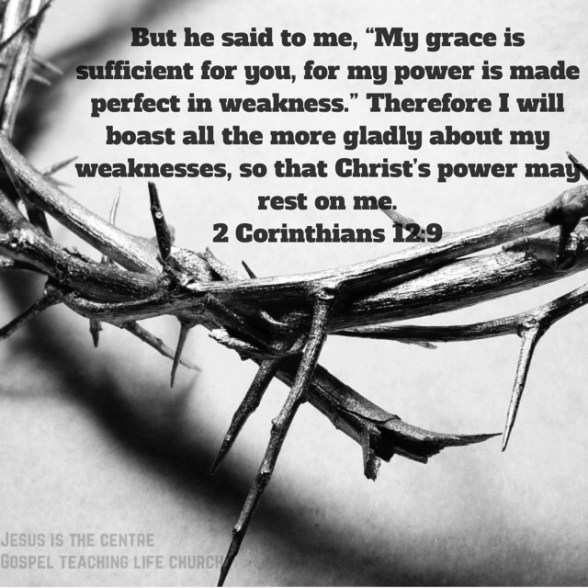
What is Paul’s thorn?

  • Our English translation ‘thorn’ could be a thorn/splinter, or a stake/spike/pole, or anything pointed – differing views on which is more likely – a stake implies something shattering and devastating, while a thorn implies a low grade but constant irritation/infection
  • Could be ‘in the flesh’ or ‘for the flesh’, i.e. ‘for the inconvenience of the flesh’
  • ‘Flesh’ can mean the physical body, in which case the thorn would be some physical malady, e.g., his poor eyesight, possible epilepsy, maybe malaria, migraines. Paul seems generally strong, resilient, tough, so a physical ailment seems unlikely.
  • Paul’s appearance – some disfigurement that made him ugly.
  • Flesh also means our human nature, particularly in Paul’s writings, so this could be some aspect of his human nature, mostly probably pride.
  • ‘Sins of the flesh’ are almost always understood to be sexual sins, so this could be a sexual sin or temptation that Paul grappled with. But it would not have to be so narrowly defined – it could refer to any and all sins or temptations to sin.
  • It could the persecutions Paul suffered – the repeated attacks on his ministry, which could well have felt like a thorn in the flesh. Numbers 33:55 has a parallel: “But if you do not drive out the inhabitants of the land, those you allow to remain will become barbs in your eyes and thorns in your sides. They will give you trouble in the land where you will live.”
  • The thorn as a ‘messenger of Satan’ might best support the thorn as persecution. Other passages speak of Satan impeding God’s work: 1 Thes 2:18 – “For we wanted to come to you—certainly I, Paul, did, again and again—but Satan blocked our way.”
  • “To torment [or buffet] me” suggests this was a long-term issue, not just a temporary one. The Greek word means “to strike a blow with the fist” or “to maltreat” in a way that brings shame, humiliation and indignation. Jesus was himself humiliated by the beatings he endured before the crucifixion.
  • He later refers to his ‘weaknesses’ – it the thorn the weakness, or does the thorn cause weakness?
  • We really don’t know what the thorn was and whether it was a thorn or a stake. If it was important that we know, Paul would presumably have told us. Let’s consider than any and all of these could have been his thorn or stake, and that for us, it can be any or all or others.

How did Paul handle or make sense of his thorn?

  • Paul prayed for its removal, three times, but it was not removed. God declined his repeated request. God does not always give us what we want.
  • But the response he got from God seems to inspire him, not discourage him.
  • God’s response – ‘he said to me’ – is in the perfect tense, it is a past tense that is definitive – what God said was definitive at the time, and remains definitive in the future, that “God’s grace is sufficient”. It was almost tattooed on his hands.
  • He is unworthy, unnecessary, dispensable = our human condition
  • Yet, God chooses to work with, in and through him because God chooses to do so = grace
  • The more dependent he is on God (i.e. the weaker he is) the more God is free to shape and use him (i.e. grace) and so he ‘boasts’ and ‘delights’ in his weakness, so that Christ’s power will rest on him. ‘Rest on him’ is shekinah in Hebrew: literally, “may pitch his tent upon me” or “may tabernacle on him”
  • This is not a masochistic spirituality! It is a recognition that Christ can and does work in and through his frailties and keeps at bay any pride/boasting: Any delight Paul gains is ‘for the sake of Christ’, not for the challenges themselves.
  • ‘Then I am strong’ implies ‘strong in the Lord’, not ‘strong in myself’. He is ‘weak in himself, but strong in the Lord’.
Featured image from: https://keziaominde.files.wordpress.com/2017/09/img_5832.jpg?w=640

Riding the storm (part 2)

Click here to listen to the audio recording of this 18-minute messages. Or watch the video on Facebook here (the message starts at about 30 minutes into the video). Or read the short summary below.

Last week, we read and reflected on the story from Mark 4:35-41 about Jesus calming the storm (see last week’s message – Riding the storm – here). It’s worth watching or listening to if you missed it. I emphasised three key points:

  1. Jesus is in the boat with us in the midst of the storm. He is not sitting far off watching, dispassionate. No! He is right in the storm with us, in the boat with us.
  2. Jesus controls the storm that buffets and scares us. He is more than capable to put the storm in its place.
  3. Jesus reminds us of the many times before that he has been faithful and capable, so that we can have faith in him, confidence in him, even during the storm.

Today, I want to add two additional stories to this one, so that we can build up our faith muscles when we are weathering a storm. This is particularly important, given that we are in the midst of the third wave of the COVID-19 pandemic, and given that our churches have, once again, closed their doors and moved online for services.

The first story is an echo of the one above and comes from Mark 6:45-51. The disciples are again in a boat on the Sea of Galilee, but this time Jesus is up on the hillside praying. He can see that the disciples have encountered a storm and are struggling. So he walks down the hill and across the top of the water towards the disciples’ boat. They are terrified, thinking he’s a ghost, but he calms them, saying, “Take courage! It is I. Don’t be afraid.” Then he climbs into the boat with them, and the storm calms down. Mark does not say Jesus calmed the storm, but it seems an unlikely coincidence that the storm just happened to subside when Jesus arrived. We learn three important lessons about Jesus when we are in a storm:

  1. Jesus sees the disciples plight and comes to them and speaks words of comfort to them: ‘I am here, it is I, don’t be afraid.’
  2. Jesus climbs into the boat. In the previous story Jesus was already in the boat when the storm arrived. In this story, Jesus climbs into the boat with the disciples in the midst of the strong winds. He chooses to enter the difficult place where they are.
  3. Jesus calms the waves, demonstrating (again) that he is more than capable.

The second story is a healing story, that is located within a larger healing story. The larger story is about Jairus’ daughter who is mortally ill and (it seems) dies before Jesus gets there, because Jesus is delayed by the inner story, which is recounted in Mark 5:24-34. The story is set in a large crowd – many people, all jostling around and up against Jesus, as he walks the streets.

The crowd feels like a storm – buffeting, noisy, knocking up against, pushing, threatening. (Hence the picture for today’s message.)

This is the story of the woman who had been bleeding for 12 years and all her efforts to find a cure were futile. He hears about Jesus and believes that even if she can just touch just the hem of his outer clothing, she will be healed. Even though she is unclean due to her persistent bleeding, she enters the crowd and manages to just touch Jesus’ clothes. And she is fully healed! Jesus can feel that power has gone out of him and wants to see who was healed. We learn three important lessons about Jesus when we are struggling in life’s storms:

  1. Jesus cures her. She merely needed faith, and without him even knowing or intending it, without even actually touching her, she is healed. It is as if Jesus’ natural instinct is to heal and make whole, so it just pours out of him when someone has faith in him.
  2. Jesus knows her. He initially doesn’t know who touched him, but he knows someone did, and when she owns up, he fully engages with her as if the crowd is not even there – like the still centre of a tornado.
  3. Jesus restores her. Her healing is primarily physical. But the result of that physical healing is that she becomes clean again, and thus able to touch other people, able to engage in the life of her family and community, able to participate in her faith.

There are many storms raging around us. Covid is the most public and universal. But there are others: financial concerns, loss of work, mental health issues, substance abuse, marital problems, divorce, illness, death, loneliness, addictions, and so on and so on. The list is almost endless.

But there are three important take-home messages for you today:

  1. Jesus sees you. He sees and knows you right where you are. He knows everything about you and your circumstances, no matter how private you are and no matter how alone you might feel. He sees you.
  2. Jesus joins you. He does not remain remote. He does not watch from a distance. He climbs into your boat, into your life, into your shoes. He is right there with you – so close, there is no gap between you and him.
  3. Jesus acts for you. Jesus calms storms, he banishes fear, he heals disease. He is more than capable and he is more than willing. We just have to reach out to him, to touch the hem of his robe.
Featured image from: https://www.popsci.com/what-to-do-crowd-crush-panic/

Riding the storm

Click here to listen to the audio recording of this week’s 12-minute message (followed by some singing). Or watch the video here on Facebook (the message starts at about 35 minutes).

The disciples find themselves in a boat in the midst of a ferocious storm (Mark 4:35-41). They cry out to Jesus: “Don’t you care?” We sometimes find ourselves in a similar situation. The world seems to swirl around us, exploding, destabilising. We wish for a granite foundation, but instead we are in a boat in the storm; at sea. But the disciples learn three things in this experience:

  1. Jesus is in the boat with them. He is not standing at a distance, watching. He is right with them in the boat, in the midst of the storm.
  2. Jesus demonstrates that he has the power to subdue nature. He is more than able to overcome any adversity we may experience, to calm any storm we may experience.
  3. Jesus reminds his disciples that they have experienced his capability in the past; and so should remember it in the present. “Do you still have so little faith?” he asks them.

When we are in the midst of the storm – as we are now with the third wave of Covid threatening to overwhelm us – we need to keep turning back to Jesus. He is the source of strength, healing and wholeness.

Featured image by Bernard Allen at https://twitter.com/bernardallenart/status/900703185479897090
I appreciate how we see Jesus both sleeping (in the lower left) and calming the storm (in the upper right), with the sea reflecting the storm and calm in the two sections.

Fall and rise of faith

Click here to listen to the audio recording of this 32-minute message. Or watch the video on Facebook (the message starts at about 24 minutes). Or read the summary below.

The final chapter of Luke’s Gospel (chapter 24) tells us of the fall and rise of faith. Ordinarily in English, we’d talk about the ‘rise and fall’ of something, but in this narrative, the order is truly first the fall of faith and then the stumbling, feeble rise of faith. It is a story of the fragility of faith, and tell us about some of the key ingredients that help to build faith: walking, friends, scripture, fellowship, the Eucharist, and worship. It is through our encounters with these elements – in all of which Jesus is fully incarnated and present – that we discover faith. With all its ups and downs and faltering.

v1-10: The women visit Jesus’ tomb early on the third day, on Easter Sunday, and find it empty. But they encounter shining men, like angels. They rush back to tell the men.

v11: But the men “did not believe the women”. Just so. Perhaps a clear example of patriarchy, because Peter immediately goes to verify what they have said. Or perhaps a clear sign of the fall of faith.

v12: Peter finds the tomb empty, but is baffled. We goes away, wondering to himself what had happened. We applaud his thoughtful reflection. But there is a sense of Peter feeling disoriented and lost – wandering alone. His faith falters and falls.

v13: Still on that same day, two of the disciples leave Jerusalem to head to a village called Emmaus. It’s still Easter Sunday and already we see the start of a scattering of the disciples, a fragmenting of the fellowship that had sustained them for three years, and of a movement away from the centre of the Easter narrative – away from Jerusalem. Faith falters when we fall out of fellowship with each other and when we walk away from the church.

v14-18: As they walk a man joins them – it is in fact “Jesus himself” – but their eyes are kept from recognising him. So they engage him as a stranger, and we get insight into their true feelings and thoughts about current events.

v19: When they describe Jesus to this traveller, they use language associated with Moses – a great man, but just a man. A powerful prophet, but just a human prophet. All sense of Christ’s divinity and majesty, all the prophesies he mentioned, linking himself to the suffering servant in Isaiah, are forgotten. Faith has fallen.

v21: “We had hoped” they say – meaning the hope they had had, has now been lost. And they mention that “it is the third day since all this took place”. Somewhere they remembered Jesus saying that on the third day he would rise again. It was now the third day and there was no sign of him (or so they thought). Whatever shreds of hope – of faith – they had had were rapidly slipping away. Faith falls further.

v22-24. They mention the women – that the women “amazed” them – and confirm that the tomb was found just as they said. “But they did not see Jesus.”

v25-29: The traveller (Jesus, but still not recognised) then explains to them how everything in the first testament scriptures point towards Jesus. But still they do not recognise him. Though they appreciate him enough to persuade him to stay and join them for dinner.

v30: “At the table with them, he took bread, gave thanks, broke it and began to give it to them.”

v31: THEN!! Ah, this wonderful THEN! “Then their eyes were opened and they recognised him!” It was in this moment of sharing a meal together that they recognise him. No fanfare. No miracle. No sermon. No revelation. Just a simple meal, where Jesus took, blessed, broke and gave the bread, just like at any other Jewish meal. And then their eyes were opened. Faith surges!

v32: And though he disappears from their sight, they then remember that as he taught them from the scriptures, their hearts were burning within them. Faith rises!

v33: Two two rush back to Jerusalem, still that same Sunday night. They rush back towards the fellowship with the other disciples and the women. Back towards the ‘church’ – the gathering of the believers in Christ.

v34: Simon had, in the meantime, also seen Jesus, and the disciples were exclaiming, “It is true! The Lord has risen!” Jesus, no longer just a prophet, but The Lord. Faith rises some more! And the two disciples share their story with the group. Through sharing faith continues to rise.

v36: In that moment Jesus appears among them, with his familiar post-resurrection assurance, “Peace be with you.”

v37-38: Immediately, however, they are startled and frightened, thinking him a ghost, troubled and doubting. Faith so quickly falls.

v39: Jesus’ response is to provide evidence: “look, touch, see”.

v41: But “they still did not believe it”! When faith falls, it struggles to rise.

v42: Jesus provides more evidence by eating food, to demonstrate that he is no ghost, but flesh and blood. But still no faith response.

v44-49: Then Jesus teaches, as he taught the two on the road to Emmaus. And he “opened their minds so they could understand the Scriptures”. We are not, however, told how the disciples received this and how it influenced their faith. Indeed, curiously, neither of Jesus’ teachings (in vv25-27 and vv45-49) appears to prompt a rise in faith.

v50-51: Jesus then goes out, blesses them and is taken up before their very eyes into heaven.

v52-53: THEN!! Ah, this wonderful THEN again! “Then they worshipped him and returned to Jerusalem with great joy, and stayed continually at the temple, praising God.” Finally! Faith rises. In v32, faith rose through the simplicity of a shared meal, friendship and the symbolic breaking and sharing of bread. In v51, faith rose through the lifting up of the Son of God and of the disciples’ eyes towards heaven – a visual lifting up towards God.

Your faith, like my faith, like the disciples’ faith, rises and falls, falls and rises. It is seldom a nice smooth, continuous, upwards line. It ebbs and flows, waxes and wanes, rises and falls. But we see in this narrative, with all the real humanity of humans, the important ingredients of walking, friends, scripture, fellowship, the Eucharist, and worship.

Featured image: “Supper at Emmaus”, by Caravaggio (1601-02) depicts the moment the disciples recognize Jesus, from https://upload.wikimedia.org/wikipedia/commons/3/3a/Caravaggio.emmaus.750pix.jpg

Into the dark

Today is the Wednesday of Holy Week. In tonight’s reading, from John 13:21-30, we read the catastrophic narrative of Judas’ decision to betray Jesus. Judas makes a conscious decision to betray his Lord, and thereafter Satan enters him, and then he goes into the night, into the dark. He makes a choice to turn away from the light. He abandons his belief in the light, ceases to walk in the light (choosing rather to walk in the dark) and relinquishes his sonship of God – all the things we reflected on last night in the message ‘Into the light‘. It is a tragic story, as when Judas finally realises what he has done, he can find no forgiveness and takes his own life. There is a cautionary tale in this – to believe in the light, to walk in the light and to become children of light.

Watch the video of this message at https://fb.watch/4AvYOqTk25/. The reading starts at about 20 minutes into the recording, while the sermon starts at about 31 minutes and runs for 14 minutes.

Featured image from: https://assets.archpaper.com/wp-content/uploads/2020/09/DarkMatterUniversity_Primary.jpg

Thirst for God

Click here to listen to the audio recording of this 11-minute message. Or watch the YouTube video below. Or read the short text summary after that.

Psalm 63 is a wonderful psalm calling us to a deeper dependence and reliance on God, much like thirsting for God.

You, God, are my God, earnestly I seek you; I thirst for you, my whole being longs for you, in a dry and parched land where there is no water.

In this first section, David describes his deep longing for God as a thirsting after God. He was actually out in the desert and was probably actually thirsty. Our need for God needs to be more like a thirst. We think of the opening verses of Psalm 42, “As the deer pants for streams of water, so my soul pants for you, my God. My soul thirsts for God, for the living God. “

I have seen you in the sanctuary and beheld your power and your glory. Because your love is better than life, my lips will glorify you. I will praise you as long as I live, and in your name I will lift up my hands. I will be fully satisfied as with the richest of foods; with singing lips my mouth will praise you.

In the midst of his thirst, David remembers a time when he has seen God, encountered God. We have those moments in our lives, sometimes only a handful – moments where we know for sure that God is real, present, engaged. These are touchstones that we take up and hold when we are going through difficult times.

On my bed I remember you; I think of you through the watches of the night. Because you are my help, I sing in the shadow of your wings. I cling to you; your right hand upholds me.

And then, David lies on his bed and ruminates on God. Often, when we’re stressed, we lie on our bed and ruminate about our worries and problems. But instead, David thinks about God. Notice how every phrase has the word ‘you’ or ‘your’ in it – David immerses his thoughts in God, calling to him from his bed.

Those who want to kill me will be destroyed; they will go down to the depths of the earth. They will be given over to the sword and become food for jackals. But the king will rejoice in God; all who swear by God will glory in him, while the mouths of liars will be silenced.

And finally, relying on his thirst and his previous experiences of God, David reaches a resolution of knowing, for certain, that God is on his side; as God is on your side. God will draw alongside you. God will take care of you. God will protect you. God will lead you through.

This morning, in the midst of whatever difficulties we are facing, we are encouraged to nurture our thirst for God and to recall and hold fast to those moments where we know we have been in God’s presence.

Follow me

Click here to listen to the audio recording of this 15-minute message (low data, better quality sound, no picture) or watch the video of the sermon on Facebook (starts at about 30 minutes into the recording).

Jesus begins his ministry by calling people to follow him. In John 1:43-51 Jesus calls Philip – “follow me”. Philip goes to call his friend Nathanael to meet Jesus, becoming one of the first evangelists. As Nathanael arrives, Jesus says some things about him, showing that he knows Nathanael, before they had even met. And then Jesus reveals that he saw Nathanael sitting under a tree even before Philip had called him.

In this message, I share my own experience of being called by Jesus to follow him. It is not definitive, but provides just one experience of being called and (eventually) responding to God’s call.

Jesus remains the same today – he knows us and sees us. He knows where we are in life and in our relationship with him, and he sees where we are and what we are doing. And it with this knowledge of us, that Jesus calls us to follow him.

I thus urge you also to respond to the call of Jesus – to follow him. Put in the effort to build a relationship with Jesus – talk with him, read the Bible, come to church, talk with Christian friends, think about Jesus. He is ready and waiting for you. He is calling you to follow him. You just need to reach back.

Featured image from https://www.followmeretreat.org/

Journey of faith

Click here to listen to the audio of this 20-minute message (this has the lowest data usage and the best sound quality). Or watch the service on Facebook (the sermon starts at about 30 minutes – unfortunately the sound quality is very poor today). Or read the text summary after that.

The journey of faith is seldom easy or straight-forward, even when people present it in this way. And holding onto faith when we are in the midst of the storm or facing a rolling crisis like COVID19 is not always easy. In his first letter to the Thessalonians (5:18), Paul writes, “Give thanks in all situations for this is God’s will for you in Christ Jesus.” Paul makes it sound simple – just accept that your challenging situation is God’s will for you in Christ – give thanks for it. Of course, it is not simple!

We have a great master class in how to journey in faith in the person of Mary, the mother of Jesus of Nazareth. Mary, who we revere because she is the Christ-bearer (the Christotokos, or even more remarkable, the God-bearer or Theotokos), shows us that faith is not simple or straight-forward. She shows her own journey of faith. This journey is not a template or recipe for us – it is simply one example of someone making this journey But it may help the rest of us – particularly those of us who struggle with faith – to make peace with our journey of faith.

The well-known story is told in Luke 1:26-38.

Mary, an engaged but not yet married teenager from a small village called Nazareth, encounters an angel. He greets her warmly and kindly, “Greetings, you who are highly favoured! The Lord is with you.”

But Mary’s first response is to be “greatly troubled at his words” and wonder “what king of greeting this might be” and to be “afraid“. The response of fear when encountering an angel seems to be almost universal in the Bible – most people who encounter an angel respond first with fear: Zechariah, John’s father, in Luke 1:12-13 and the shepherds in Luke 2:9-10, for example. But, let us recognise that Mary does not immediately respond with faith or joy when the angel appears to her – her response is one of fear, trepidation, uncertainty, anxiety.

The angel – much as angels do in other passages – reassures her (“Do not be afraid”) and says that she has found favour with God. He explains that she will conceive a child and call him Jesus and that he will become a great king forever.

In Mary’s second response, we see that she is no longer afraid. She is now thinking, critically, about what the angel has said: “How will this be? Since I am a virgin?” Mary does not immediately accept the angel’s message. She asks what is surely an obvious question – how can I be pregnant if I’ve not had sex? Mary is realistic, pragmatic, critical. She does not just accept what the angel is saying to her. Let us imagine also (though this is not explicit in the passage) that she realises that a pregnancy at her age and without a husband will be scandalous and difficult. Let us imagine that she has some intuition about the implications of being the mother of the “Son of the Most High”. And let us imagine that she even anticipates the tragic loss that she will suffer as her son is taken from her. (These imaginings are captured so well in the song, Mary did you know)

The angel accepts Mary’s questions. He does not reprimand or challenge her. Instead, he provides further explanation and clarifies also that even her aunt, Elizabeth (in her old age), has conceived a child – John.

And now – only now – Mary accepts the angel’s message, saying “I am the Lord’s servant. May your word to me be fulfilled“. She accepts God’s will for her life, as Paul wrote in 1 Thessalonians 5:18. But at this point, her acceptance is just that – an acceptance, even a blind faith. It does not seem to be based on a full understanding. She submits, relinquishes, surrenders to the will of God – do with me as you wish.

Mary then visits her aunt Elizabeth and they stay together for some time. Luke 1:39-45 gives a clear indication that they talked about their experiences of pregnancy and of their place in God’s plans. One can easily imagine that they spent a great deal of time talking, sharing, reflecting, praying, seeking understanding.

And out of this sharing, Mary achieves faith with understanding, which is expressed powerfully in the Magnificat in Luke 1:46-55. Mary understands, for example, that God is a God of love and mercy – “His mercy extends to those who fear him, from generation to generation.” And she also understands that there will be a righting of wrongs (a reversal of fortunes) – “He has brought down rulers from their thrones but has lifted up the humble.” She understands that through the great things God has done for her, God will bring justice for all those who are marginalised and oppressed.

Although we esteem Mary greatly, her journey of faith is not instant. She grapples and wrestles with what God wants from her, with the storm that she finds herself in. Her own journey is one of fear, questioning, acceptance and then understanding. Her faith journey is a process over time, not a turning point in time. Indeed, even in narratives where it appears that faith emerges at a point in time (such as Paul’s Damascus road experience in Acts 9), a closer read around the experience will show that there is a journey and that the turning point is a culmination of a longer process that came before and that works its way out after.

Mary’s faith experience is not a template for us. It an example of a journey of faith, of one whom we can revere as most highly favoured and blessed of all humans. If her faith journey is not not simple or straight-forward, why should yours be? If you are doubting your faith because it seems complicated, fragile, questioning, confused, and so on, be reassured that Mary’s faith was all these things also. And yet, she bore the Son of God. Faith is a journey. Just keep on with the journey and know that God is faithful.

 ‘The Annunciation’ (1437-46) by Fra Angelico from https://medium.com/thinksheet/symbols-in-art-the-annunciation-7347bddb89d

Journey with Jesus

Click here to listen to the audio of this 12-minute message. Click watch the video below, or read the text thereafter.

Between Easter and Pentecost we focus on people’s encounters with the risen Christ. Last week we reflected on Thomas’ encounter with Jesus some days after the resurrection. Today, in Luke 24: 13-35, we reflect on the two disciples who met Jesus while they were travelling from Jerusalem to Emmaus. They don’t realise that it was Jesus until the very end. Their journey has three phases:

  1. They initially fellowship with Jesus, sharing their story of Jesus with this stranger and commiserating about his untimely death.
  2. Then Jesus teaches them about the Christ, drawing on the whole of the First Testament, explaining who the Messiah was prophesied to be and how these prophecies were fulfilled in the Christ. But still, they did not recognise Jesus.
  3. Finally, they shared a meal with Jesus – they broke bread together. And as Jesus, took, blessed (or gave thanks), broke and gave the break to them, their eyes were opened and they finally recognised him.

In hindsight, they realised that they had encountered Jesus: “Were not our hearts burning within us while he talked with us on the road and opened the Scriptures to us?” (Luke 24:32)

Ultimately, it is in the taking, thanking, breaking and giving that they recognise Jesus. This is what Jesus did in Luke 9:16, when he fed the five thousand. And also just a few days before at the Last Supper in Luke 22:19. This celebration of the Eucharist (Lord’s Supper, Communion, Mass, Divine Liturgy) was the clincher, following fellowship and teaching, that reveals Christ to them.

This narrative follows the same pattern of the early church in Acts 2:42: “They devoted themselves to the apostles’ teaching and to fellowship, to the breaking of bread and to prayer.” Now, our passage in Luke 24 doesn’t mention prayer, but prayer is (essentially) talking with and listening to Jesus. Prayer is just conversation with God. And this is what the two disciples were doing, even though they did not realise it, during the long walk from Jerusalem to Emmaus, as they journeyed with Jesus: they were talking with God.

2020.04.26_EmausDecepcionAAlegria

Featured image Emmaus Road, by Chinese artist He Qi. https://alfayomega.es/106963/emaus-de-la-decepcion-a-la-alegria

Seeking Jesus

Click here to listen to the audio of this 11-minute message. Or watch the YouTube video below. Or read the summary text thereafter.

The story of Thomas’ encounter with the risen Jesus in John 20:24-29 is one of my favourites and Thomas is the disciple with whom I identity the most. Thomas is unfairly labelled a doubter. He did not doubt Jesus. He doubted his friends – the other disciples. He wanted to see and experience Jesus first hand. He was unwilling to take on a second-hand faith. He wanted to know Jesus for himself. And so Jesus appears to him and invites him to see and touch his hands and the hole in his side.

It seems Thomas does not in fact touch Jesus, but immediately experiences a surge of faith and cries out, “My Lord and my God!” In effect, he falls on his face and covers his eyes because he knows that he is in the presence of God the Son.

This reminds me of the story of Job, who was a man blessed by God, a man who had everything. For whatever reason, he then loses everything. He goes into a kind of ‘lockdown’, where he loses his possessions, his family, his health, his well-being, his freedom. Two of his friends join him in his despair and provide comfort for a few days and then engage in a lengthy debate with him to persuade him that his faith must be insufficient. God would not punish a righteous man – he must have done something wrong. But Job persists that he is righteous and wants to meet with God to present his case.

And then in Job 38, God appears and over the course of four chapters presents his credentials to Job, much as Jesus presented his credentials (the holes in his hands and side) to Thomas. God meets Job in his unhappiness and questioning.

In Job 42:1-6, Job’s response to encountering God is to throw himself down and cover his eyes – “I despise myself and repent in dust and ashes”. But before that he proclaims his faith: “My ears had heard of you, but now my eyes have seen you!” Job had had a second-hand faith – what he had heard from others or from the scriptures. But now, God had appeared to him in person, and his eyes had not see him. And recognises that he is in the presence of God the Father.

God eagerly desires to engage you in your faith, as he does me in mine. And God also eagerly desires to engage you in your doubt, as he does me in mine. God is not turned away by uncertainty, by questions, by doubt or by the need for ‘evidence’. Instead, God turns towards us and engages us. Let us continue to seek Jesus, for this is exactly what he wants from us: Seek him and you shall find him.

2020.04.19_thomas-sees-jesus-wounds-gloria-ssali

Featured image: ‘Thomas Sees Jesus Wounds’ by Gloria Ssali, https://fineartamerica.com/featured/thomas-sees-jesus-wounds-gloria-ssali.html