Watch the 22-minute video of this 18-minute sermon and 4-minute song.
Sickness and trouble in life are sometimes a result of problems in our relationship with God. This is often true and often not true – sometimes sickness and trouble just arrives, even when (perhaps even especially when) our relationship with God is good. But when things are going wrong in life, when we struggle with illness, it is wise to reflect on where we are in our relationship with God.
Today’s message draws from Psalm 32, an extract of which I include below:
1 Blessed is the one whose transgressions are forgiven, whose sins are covered. 2 Blessed is the one whose sin the Lord does not count against them and in whose spirit is no deceit.
3 When I kept silent, my bones wasted away through my groaning all day long. 4 For day and night your hand was heavy on me; my strength was sapped as in the heat of summer.
5 Then I acknowledged my sin to you and did not cover up my iniquity. I said, “I will confess my transgressions to the Lord.” And you forgave the guilt of my sin.
6 Therefore let all the faithful pray to you while you may be found; surely the rising of the mighty waters will not reach them. 7 You are my hiding place; you will protect me from trouble and surround me with songs of deliverance.
8 I will instruct you and teach you in the way you should go; I will counsel you with my loving eye on you.
In the video message I talk through the message of this Psalm, drawing on the beautiful insights of Walter Brueggeman’s “The message of the Psalms: A theological commentary”.
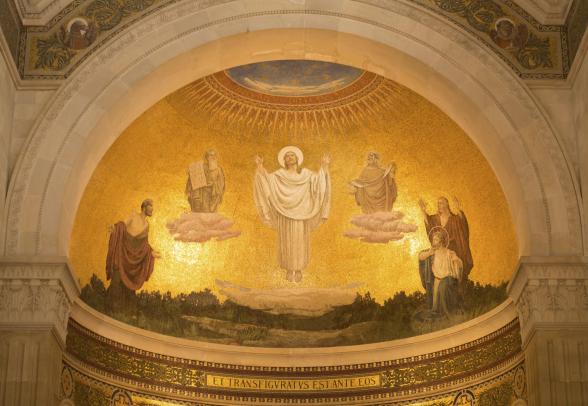
Today’s 18-minute message – on the transfiguration of Jesus Christ – locates this spectacular moment in a brief liminal space between Epiphany (and even before with the Annunciation and Jesus’ birth) and Lent, leading to Holy Week and Easter. This high point, which seems to last for only a few minutes, before Jesus leads his disciples back down the mountain and instructs them not to share the event with others, suggests that the mountain top is not the place for us to live, but rather one of those moments that strengthen us to deal with the ups and downs of life.
Mosaic in the Roman Catholic Church of the Transfiguration on Mount Tabor, Israel
Watch the video below of this 42-minute message. Yes, much longer than usual! I’m sorry about that, but it is – I think – worth the time, as a close reading of John 20:19-29 sheds to much light on Jesus’ character, his relationship with the disciples and his work as the Son of God. My notes are available below the video
Verses 19, 26 Both times Jesus “stood right in the middle of them”
Christ is the centre – not the priest, Bible, APB – only the person Christ
Christ-centred church
1, 19, 26 Easter Sunday morning – Jesus appears to Mary
Easter Sunday evening – Jesus appears in the upper room
Following Sunday (today) – Jesus appears again, to Thomas
19, 21, 26 Peace be with you – Shalom alechem x3
Easter Sunday – Christ made peace between us and God
Forgiveness of sins – done, paid for, wiped clean, forgotten, cast the deep
Everything is good. It’s all okay
Easter is the Great Forgiveness!
20 He showed them his hands and side
Emphasis on bodily resurrection, reconnected to his people
Not just some spiritual, esoteric thing
He is fully embodied, albeit with some unusual capacities
20 He could have come back healed, but doesn’t. Why?
His identification with us, solidarity with our pain & suffering
He remains the suffering servant of Isaiah 53 (4-5):
He took up our pain and bore our suffering. He was pierced for our transgressions, he was crushed for our iniquities, the punishment that brought us peace was on him, and by his wounds we are healed.
20 The disciples were overjoyed – full of joy
Joy (chara) & grace/gift (charis) – joy is a gift of God – because Jesus is back
21 “As the father has sent me, I am sending you”
We are to continue God’s work. We are sent, just as Christ was sent
Jn 3:16/7 “God so loved the world that he gave [sent] his one and only Son … For God did not send his Son to condemn the world, but to save it”
Every Christian is sent – not just clergy or evangelists
22 He breathed on them, “Receive the Holy Spirit”
Hebrew for spirit & breath are both? Ruach
Gen 1:2: Spirit of God hovering
22 Gen 2:7: “Then the Lord God formed a man from the dust of the ground and breathed into his nostrils the breath of life, and the man became a living being”
To receive Jesus’ breath & Holy Spirit is to be made a new living being
22 To receive Jesus’ breath & Holy Spirit is a grace/gift (charis)
As the Spirit/breath was active in the creation of earth and humanity
2 Cor 5:17: “If anyone is in Christ, they are a new creation. The old has passed away, the new has come.”
22 Holy Spirit poured out on Pentecost: Easter Season is from Easter Sunday to Pentecost
23Forgive anyone’s sin
The gift of HS is not so much miraculous signs, etc.
Instead the central commission – sending – is to forgive
And to warn that to not repent = no forgiveness
The Great Forgiveness!
24Thomas was not with the disciples when Jesus came.
Where was he? He should have been in church! We should be in church!
27 Touch, see
V20. Jesus showed them his hands and side.
Thomas wants what the others got – to see. But also to touch
Our Eucharist is a see and touch moment
– receive the body of Christ broken for you (not receive this bread)
– receive the blood of Christ (not receive this wine)
Not clear if Thomas did actually touch: “Thomas answered and said…”
Perhaps seeing and the invitation to touch was enough for him
27 Stop doubting and believe. Be a believer!!
Accept the small and periodic signs of God and believe into him
28My Lord and my God!
Hebrew: Yahweh & Elohim – names for God
Greek: Kyrie & Theos – names for God
The only place in the Gospels where Jesus is referred to as God – A profound statement of faith – perhaps the most
This Easter Sunday message centres on the idea that a most important fruit of the Easter story is that God’s forgiveness is extended and stretched to its limit, thereby including every sin imaginable. It is all already paid and cleared, cast into the deep. The return of Christ to humanity, after we so brutally murdered him, is the evidence of God’s extreme and great forgiveness. There could be no greater crime or violence against God. That God returns his son to us on Easter morning is a sign of God’s radical forgiveness. This great act of forgiveness for the murder of Christ is like a great whirlwind that catches up not only this sin, but all of our other sins also. They are all caught up in the one extra-ordinary and unprecedented act of forgiveness, and done with. And so, when we sin – as we will – we can know for sure that we can come to God, to sincerely ask his forgiveness, and to be sure that he will forgive and indeed has already, long ago done so.
(We love the screams and laughs of the children throughout this sermon. Jesus welcome children around him, while he was teaching. Certainly, they would have been as noisy as these ones were. Many were here to be baptised. Others were just full of beans!)
Today is the fifth and last Sunday that we spend in John chapter 6. It has been a long and challenging 5 weeks. Next week, we go back to our journey through Mark’s gospel.
The setting of much of John 6, from after the feeding of the 5000 and Jesus walking on the water, is in a synagogue in Capernaum. In v59 we read, “Jesus said this while teaching the synagogue of Capernaum.” So, where did this teaching start? It started in v26, where, in the two verses before we read, that the crowds “got into the boats and went to Capernaum in search of Jesus. When they found him on the other side of the lake [in Capernaum], they asked him ‘Rabbi, when did you get here?'” and so the long teaching on the bread of life starts. John 6:25-71 all takes place in the synagogue at Capernaum.
This is not coincidental. While we can find Christ anywhere, he chooses to meet us in synagogues, in churches, in the midst of the people of God. We read this in John 18:20, where, before the high priest, Jesus says, “I always taught in the synagogues or at the temple, where all the Jews come together. I said nothing in secret.” Here is Jesus affirming that he consistently taught in the centre of the synagogues, in the midst of God’s people. And in Matthew 18:20, Jesus says, “For when two or three gather in my name, there I am with them” or ‘in the midst of them’. (I have to smile at the similarity between John 18:20 and Matthew 18:20!) And in most Anglican churches, we read the Gospel in the centre of the church, not from the front, because Christ, the Word, is central to the people of God. The Word is in the midst of us.
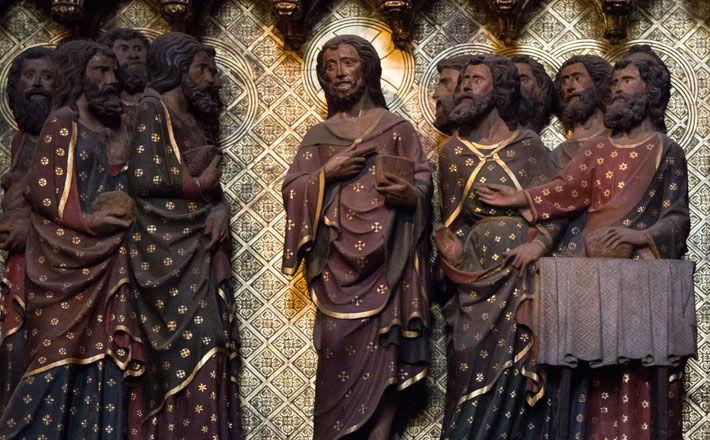
Christ is our centre, and we congregate around him.
But, Jesus’ word is hard. Last week, we chewed through a difficult passage about eating Jesus’ flesh and drinking his blood. His teaching is challenging and hard to understand. As a result, MANY of his disciples or followers fell away and left. They could not swallow his message. It was easier – so they thought – to move on and find an easier teaching elsewhere.
Jesus seems disappointed and sad at their leaving, because he turns to his 12 disciples, and says to them, rather than asking them, “You don’t want to leave too, do you.” He hopes and trusts that his people will remain with him.
Jesus’ himself says in v63, “The words I have spoken to you – they are full of the Spirit and and of life!” One thinks of God’s Word ringing out in Genesis 1, calling the universe into being through his word. And we think of John 1, “In the beginning was the Word, and the Word was with God, and the Word was God. He was with God in the beginning.” Christ does not merely speak words; he IS The Word!
And the 12 disciples know and understand this, because they have spent so much time sitting with Christ in their midst. And so Peter says, “Lord, to whom shall we go? YOU have the words of eternal life. We have come to believe and to know that you are the Holy One of God.” Jesus, as the Word of God that creates the world and as the Bread that comes down from heaven and gives life to the world, we feast on his word and bread. We hear the Gospel preached and we participate in the Eucharist. It is here, in this church community, that we find divine food, life and hope.
We must remain clustered around the centre, where Christ is. Let us not drift away to the edges, and then slip out into the darkness. We need to remain in the centre, where Christ, our light and life is. We need to remain in the centre and our church friends need to remain in the centre. Let us not drift away. And let us call back those who have. For Jesus has Spirit and Life – away from the centre, we are cold and lost.
Jesus crosses the Sea of Galilee and then ascends the mountainside (v. 3) and sits down – it is on mountains that God often appears to people. Think of Moses and the burning bush, Moses receiving the Ten Commandments, Jesus transfigured before Peter, James and John. His ascent cues us that something important is going to happen – some revelation of the being or character of God.
John then tells us (v. 4) – seemingly for no reason – that the Jewish Passover Festival was near. Another translation (Bruner) has, “Now, the Passover, the festival of the Jewish people, was coming up.” The Passover, which takes place when the Jews are slaves in Egypt, includes the passing over of the Jewish households and their fleeing Egypt across the Red Sea. It is THE central narrative of the Jewish religion, in the same way that Christ’s death and resurrection are THE central narrative of the Christian religion. It speaks of deliverance, freedom, salvation, relief and hope. It speaks of God coming near to God’s people and answering the deep cries. So John mentions this to raise up in us a hopeful expectation of what God might do for us.
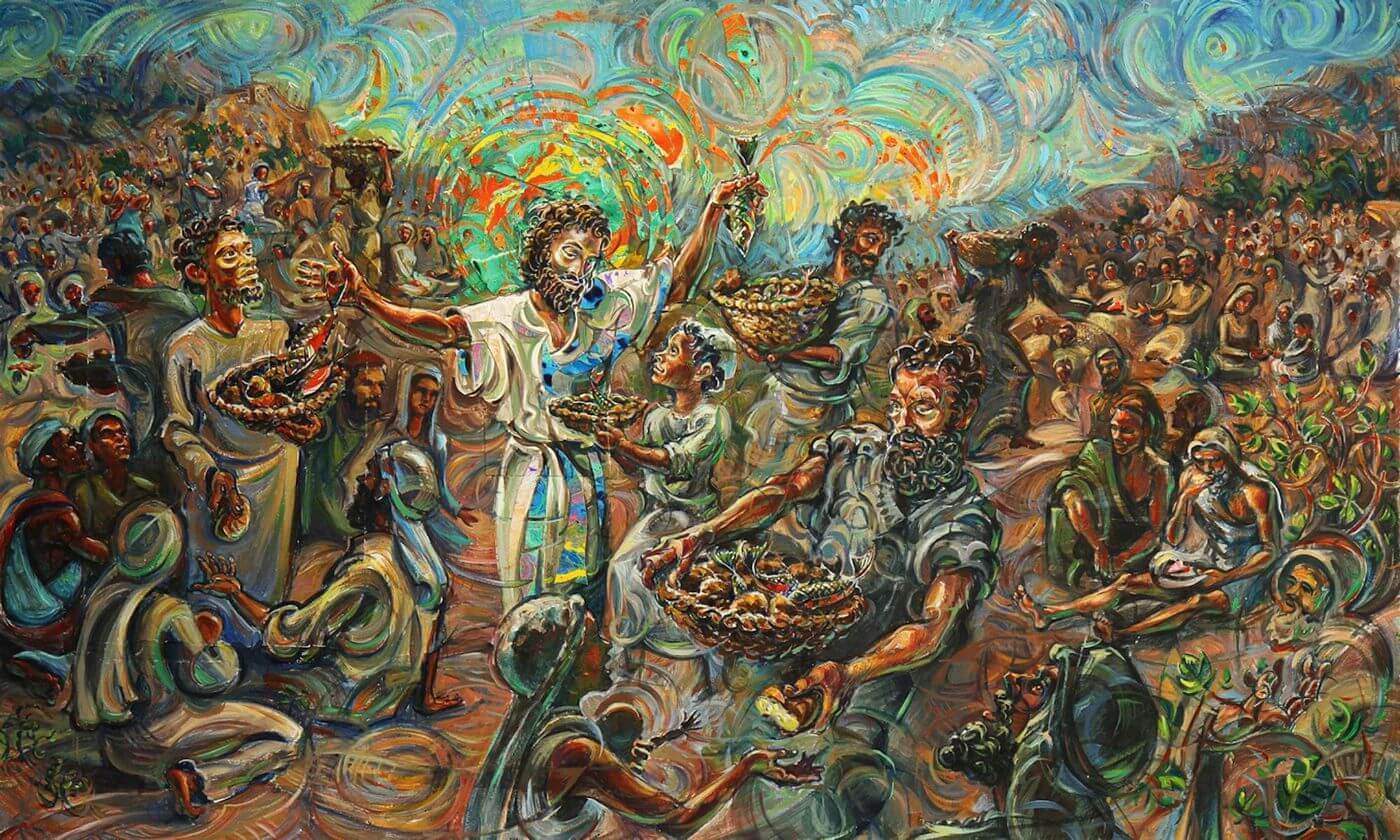
There are two layers to this story of the feeding of the five thousand: food and faith
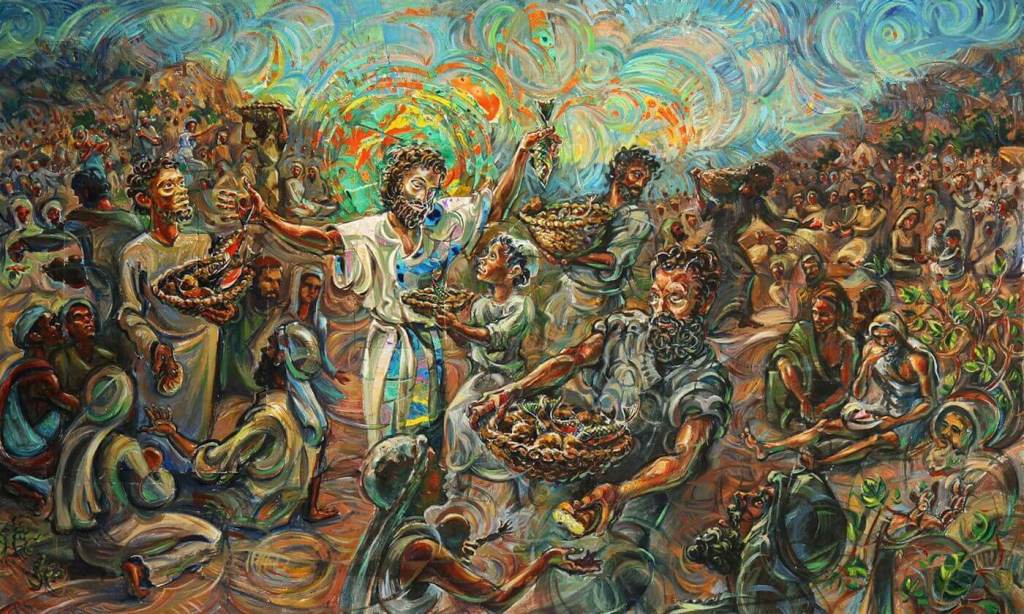
First, there is a practical layer – food. There are 5000 men there, presumably together with women and children. They are hungry and there is no place to get food. So Jesus creates enough food out of five small barley loaves and two small fish to feed them all, and to have 12 baskets of leftovers. This miracle, which may remind us of Jesus turning water into excellent wine at a wedding, a few chapters earlier, speaks to God’s concern for the basic needs of humanity. God desires us to have what we need to live. Basic needs for shelter, food, warmth, healthcare, education and safety are important to God. And Jesus provides for them. This is the first part of God’s revelation of himself in this story – God is concerned for your everyday needs and is willing and able to help you meet those needs, just as he helped free the Jews in slavery in Egypt.
Second, there is a spiritual layer – faith. Looking at the large crowds, the disciples are overwhelmed, and their mustard seeds of faith flee. Jesus knows that their faith is feeble, and so he asks Philip, “Where shall we buy bread for these people to eat?” His question leaves no wriggle room for Philip to say they must sort themselves out – it is clear that bread must be provided. The only question is where they will buy it. Philip’s faith collapses, as he says, “It would take more than half a year’s wages to buy enough bread for each one to have a bite!” Philip is unable to imagine that Jesus can do more than what is humanly possible. His feet are deeply embedded in the ground.
But then Andrew brings along a little boy who has five small barley loaves and two small fish and presents him to Jesus. It feels as if Andrew has some spark of faith that maybe something could be done with this little bit of padkos. But almost immediately, his faith also collapses, as he says, “but how far will they go among so many?”
Jesus takes control of the situation and issues instructions. The disciples trust and obey, and everyone ate as much as they wanted. Although Jesus will come to criticize the people for chasing after food, in this moment, they recognise him: “Surely this the Prophet who is to come into the world!” They want him to be king, but he just wants to reveal God to them.
And today’s reading ends with Jesus walking across the surface of the lake in a storm, several kilometers from the shore, and reminding them of who he is: “It is I. I am. Don’t be afraid.”
Our readings today (23 June 2024) point to and illustrate the adversities and adversaries that we encounter in like. Adversities are difficult situations and adversaries are difficult people – often these collide. Here is a summary of these challenges in the readings:
Mark 4:35-51 has the disciples and Jesus in a boat in a wild storm on the lake. This is an adversity – a situation. Many of the disciples were fishermen and familiar with storms at sea, so this must have been an exceptional storm to stir up such terror.
2 Corinthians 6:1-13 has Paul recounting many of the challenges he has faced in life: troubles, hardships, distresses, beatings, imprisonments, riots, hard work, sleepless nights, hunger, dishonour, bad reports, impostors, unknown, dying, beaten, having nothing. It’s quite a list!
1 Samuel 17:32-49 presents young David going up against the tremendous Goliath in single-handed combat. He didn’t stand a chance against such a formidable adversary!
Psalm 9 describes the Psalmist’s enemies and wicked people – many adversaries!
We may resonate with these challenges and adversaries. We often face challenging situations and difficult people. And sometimes that overwhelms us, as we wonder where God is in this.
But despite the challenges, scripture presents God as more powerful the any adversary we may face, and on our side when we face adverse situations. We are encouraged and urged to put our faith and trust in him:
Mark 4:35-51 describes Jesus standing up in the boat and commanding the storm: “Quiet! Be still!” and it was so – the storm dissipated. The disciples found themselves being more terrified by Jesus’ power over the elements than they had been by the storm itself! A real turnabout.
2 Cor 6:1-13 has Paul affirming that despite the litany of adversities, he remains always rejoicing and possessing everything. All of these adversities are, for him, ‘nothing’ compared to the blessing of being God’s child.
1 Samuel 17:32-49 recounts David’s plucky engagement with Goliath – he has bested bears and other wild animals – surely he can best this giant. And with a flick of his wrist and little catty, a stone embeds itself in Goliath’s head and he falls down dead and David decapitates him. God is on his side.
Psalm 9 intersperses its complaints about wicked enemies with affirmations of God’s allegiance: The Lord is a refuge for the oppressed, a stronghold in times of trouble … Those who know your name trust in you, for you, Lord, have never forsaken those who seek you … he does not ignore the cries of the afflicted … The Lord is known by his acts of justice … But God will never forget the needy; the hope of the afflicted will never perish.
Let us take heart in these affirmations. Let us strengthen our resolve in times of adversity. Let us not be cowed by adversaries. Let us trust in the Lord’s strength and love to take care of his own.
But there is a warning here also: let us not be the adversary to someone else and let us not cause adversity for others. God is on the side of his children, but he will not stand by us when we harm his other children. God expects us to emulate him, by standing up for people and by not being an adversary. The warnings are severe in Psalm 9 for those who make themselves enemies of God: “The wicked ensnared by the world of their hands. The wicked go down to the realm of the dead, all the people that forget God. … Let the nations know they are only mortal.” We do not want to become enemies of God! We want to keep on God’s right hand – his hand of power and protection – we do not want to fall under God’s wrath.
Instead, walk in God’s ways – the way of love, of justice and mercy.
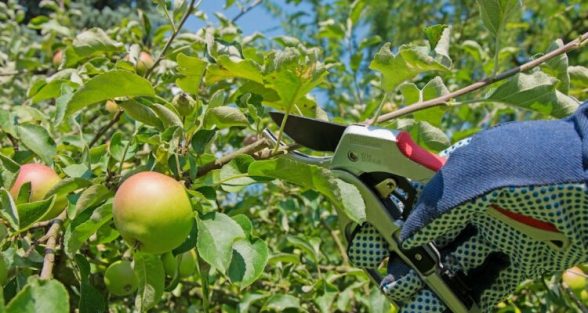
Cutting in the Christian faith is inevitable. In John 15:1-8 Jesus makes it clear that we will be cut as part of our faith journey. If we bear no fruit, we will be cut off; and if we do bear fruit, we will be pruned. When we are cut off, we will not produce any further fruit, but when we are pruned, we will produce even more fruit. So, what Jesus says in John 15 is that we will experience cutting in our faith journey. This cutting will be either a whole branch that is cut off, or bits of a branch that will be pruned off. The purpose of this cutting and pruning is to make us even more fruitful. Jesus’ teaching here in John 15 is indeed sobering. No-one wants to be cut.
In this same passage Jesus also speaks about the importance of remaining in him. And when we remain in him, he remains in us, just as he remains in his father and his father remains in him. In this passage today of eight versus, Jesus uses the word remain eight times. It is a central theme for the message today. So how do we not remain in Christ? We do not remain in Christ when we do not invest in our relationship with Christ. And we do not remain in Christ when we are fruitless, because we will either wither will be cut off.
So then how do we remain in Christ? John’s first letter, chapter 4, provides us with some answers to this question. In verses 8 and 9, John says, “God is love. This is how we how God showed his love among us: he sent his one and only son into the world that we might live through him.” So, we remain in God’s love first because God comes to us and loves us. All remaining in Christ is always a response to Christ’s coming to us. In verse 16, John continues saying, “God is love. Whoever lives in love lives in God and God in them.” This sounds very much like remaining in Christ and Christ remaining in us. It is a reciprocal action of remaining. And further on, in verses 20 and 21, John emphasises that our love for God must manifest in our love for one another. He writes, “Whoever claims to love God yet hates a brother or sister is a liar. For whoever does not love their brother and sister whom they have seen, cannot love God whom they have not seen. And he has given us this command: anyone who loves God must also love their brother and sister.” Central to us remaining in Christ is God’s love for us, is our love for God and is our love for one another.
Therefore, let us remain grafted into Christ. We must accept that they will be cutting and pruning in our Christian journey. And yes, this is painful and uncomfortable. And sometimes it may make us question God’s love for us. But I am reminded of Peter’s response to Jesus in John 6: 67-69. Jesus had provided a difficult teaching and many of his followers turn away. And then Jesus asks his disciples, “You do not want to leave too do you?” And Simon Peter answers Jesus, “Lord to whom shall we go? You have the words of eternal life. We have come to believe and to know that you are the holy one of God.” There is no better alternative then remaining in Christ.
And so, I encourage us today to take seriously our faith in Christ: to remain in him, to be grafted into him, to accept God’s pruning, and to be fruitful in our love for God and one another.
In Luke 24:13-35, we have the story of the two disciples who are walking to Emmaus and who encounter a stranger, who we later learn is the resurrected Jesus. They did not recognise him, despite having a long conversation. It was only as they sat down for a meal that “their eyes were opened and they recognised him” (v31), and immediately Jesus disappeared. They saw Jesus, but they did not recognise him.
In our reading set for today (Luke 24:36-48), Jesus meets the disciples in a room, and although they see him and recognise him, they do not believe him. They have moved a little further than the previous two disciples, but they have not moved to a place of belief or faith: seeing is not always believing. In response, Jesus – patient as ever with the disciples’ slowness – presents a series of evidence to prove to them that he is indeed risen from the dead and not a ghost:
v38 – Jesus asks why they are troubled and why they doubt. He confronts their lack of belief and faith. But still they do not believe.
v39-40 – Jesus invited them to look, to touch, to see. He shows them his hands and his feet, so they can get physical evidence of his wounded body. But still they do not believe.
v41-43 – So Jesus asks if they have any fish. Not because he is hungry, but to prove that he is not a ghost, but a physical being, who can eat food. But still they do not believe.
44-47 – So Jesus tells them about the scriptures – the Law of Moses, the Prophets and the Psalms – which all prophecy everything that has happened to Jesus. But still they do not believe.
48 – So Jesus reminds them that they are first-hand witnesses of everything that Jesus did – healings, forgiveness, raising people from the dead – they saw a lot and they themselves did some of these miracles in his name. But still they do not believe.
50-51 – And then, finally, he blesses them and ascends in front of them up into heaven.
And then they believed! They worshipped him and returned to Jerusalem with great joy.
Sjoe, they were really SLOW! Slow to recognise him. Slow to believe in him. Slow to put their faith in him.
Perhaps we also are slow. Perhaps we also fail to recognise Jesus’ actions in our lives and in the lives of those around us. Or perhaps we see them, but don’t believe them. Or we believe them, but we don’t put our faith in him. In the recording of the sermon I share an experience of my own slowness to believe, to illustrate my own slowness.
Fortunately – thanks be to God – Jesus is supremely patient. And he is willing to provide us with evidence and to persuade us (this also is part of my testimony in the recording). I encourage you, therefore, to make a choice to see God’s hand at work in your life. To accept that it may be possible – even likely – that God is present with you, even when you don’t perceive God. That God is working in you, even when you don’t recognise that. That God loves you, even when you may feel unloved.
Today’s message is about second-hand faith, meaning faith that rests on other people’s experiences of God, rather than on our own. 1 John 1: 1-4 presents such a faith. John emphasises his and the other disciples’ first-hand experience of Jesus, using words like see, looked, appeared, heard and touched a total of nine times in just a few verses. And he concludes by saying that we must believe him, and through believing him, who knows God, we get close to God. We are given a second-hand faith. Most of us don’t want a second-hand faith! We want our own, first-hand faith!
John 20:19-25 has a similar narrative. The disciples – minus Judas, who was not there – have a first-hand encounter with the risen Christ, who shows them his hands and his side. When Thomas joins them later, they say, “We have seen the Lord!” and expect that Thomas will be satisfied with this second-hand account. But Thomas says, “Unless I see the nail marks in his hands and put my finger where the nails were, and put my hand into his side, I will not believe.” Thomas wants simply what everyone wants – he wants to know first-hand that Jesus is risen. He wants to see and to touch. And Jesus meets this need.
We also want a first-hand faith. We want to know for sure and for ourselves that Jesus exists. We want to see him. We want to touch him. Where can we get such first-hand experiences? Three places: (1) We get them from the Scripture, where we read first-hand accounts of others and have confidence that their testimony is true. We can tag these accounts for future reference. (2) We rely on what others in our community tell us about God’s grace and working, and have confidence that their testimony is true. We can tag these accounts also for future reference.
(3) And we rely on our own experiences of God working in our own lives. We may not have many such experiences of our own, and they may not be particularly spectacular. But they are first-hand – they are OUR experiences and we KNOW them. These are the experiences we need to recover and treasure. We can tag them, because they are our first-hand encounters with God. They are the touchstones or reference points that we turn to when our faith gets shaky.








 Reflections of God's Love