Faith journey

Click here to listen to this 19-minute message..

How is your faith life? How are you doing in your relationship with God?

We are all on a journey of faith. Luke presents it to us like this in Luke 9:51-62 and Paul does so in Galatians 5:13-25. Journeys are typically not straight forward lines. They go up and down and round about. Journeys are messy. And our journey of faith is no different. My own journey looks more like a bowl of spaghetti than a box of spaghetti!

In this message, I unpack three facets of this journey from our two readings for today:

  1. Jesus is quite chilled about our journey. He adopts a ‘take it or leave it’ stance. He desires us to journey with him, but he will not force or coerce us.
  2. Jesus is quite demanding about our journey. He wants a total commitment from us. He has high expectations of us.
  3. Holy Spirit journeys with us, enabling us, strengthening and filling us. We are not on this journey alone. We live with, are led by and keep in step with the Spirit.

On this day, and during this coming week, I’d love you to reflect more deeply and deliberately on our faith journey with God.

2019.06.30.road

Featured image from here.

Discomfort zone

Click here to listen to this 18-minute message.

Most of us like to remain within our comfort zones. They are, by definition, comfortable. So, we tend to stay within our comfort zone.

In Galatians 3:23-29, Paul explains that while we were formerly imprisoned by Law, we are now set free from such bondage. We’re set free by Christ, who brought a new kind of faith. We are now clothed with Christ. The result of this, is the breakdown of divisions among us: race (Jew and Gentile), class (slave and free) and gender (male and female). Elsewhere, Paul describes this as the destruction of a barrier, a “dividing wall of hostility” (Ephesians 2:14-16). We are made into one people. A diverse people.

As Christians, we are thus freed up to cross the boundaries that divide us. Choosing to cross boundaries is not easy for most of us. We tend to stay without our comfort zone. And that zone is typically populated by people who are similar to us. Engaging authentically with people who are of a different race, class or gender pushes us into a discomfort zone. Christ has freed us to step into these discomfort zones.

Indeed, we are mandated to step into our discomfort zones, because this is exactly what Jesus did. Again and again! Luke’s Gospel is particularly attentive to the ways Jesus deliberately and consciously – sometimes even flagrantly! – stepped over the boundaries that divide, placing himself and others in their discomfort zones.

A great example of this is Luke 8:26-39. Here Jesus crosses into gentile territory and engages a profoundly demon-possessed man, who is naked, uncontrollable and living wild among the tombs. In numerous ways, this man takes Jesus into his discomfort zone; Jesus breaks several Jewish taboos to be with this man. It is in this this context of discomfort that Jesus heals him, saves him, transforms him. When the community sees the man again, he is clothed, sitting at Jesus’ feet and in his right mind. Jesus does this reconciling work in his discomfort zone.

And this pushes the people of that region into their discomfort zone. They are afraid; overcome with fear. They beg Jesus to leave. They want their discomfort removed, and that means getting rid of Jesus. So Jesus leaves. He leaves them in their comfort zone. Separated from the loving presence of Christ.

But the man himself begs to follow Jesus. However, Jesus sends him back into his discomfort zone, back into the community from which he has long been feared and excluded. Jesus commissions him to be a missionary – perhaps the first gentile missionary to the gentiles! And it is into this zone of discomfort that the man goes, telling everyone what Jesus had done for him.

God wants us to step out of our comfort zones and into discomfort zones. God knows this is not easy. But God also knows that it is in these places that healing, transformation and reconciliation take place. So, what are your discomfort zones? And what can you do to cross into them deliberately?

2019.06.23_Statues-The-Divide-Northern-Ireland

Featured image called “Hands Across the Divide” in Derry, Northern Ireland. From http://www.bbcamerica.com/anglophenia/2013/11/snapshot-18-photos-of-u-k-statues

Trinitarian relationship

Click here to listen to this 18-minute message.

The concept and doctrine of the Trinity is enough to give anyone a headache. And the various metaphors people use to make it easier to grasp all fall short of adequately capturing this doctrine. But in this message I suggest that the evidence for a triune (three-in-one) God provided in the scriptures lead us to a fairly simple but important conceptualisation of the Trinity, viz. God is about relationship.

Father, Son and Holy Spirit have co-existed from before the creation of time and space. They have been in eternal relationship with one another from before the beginning. This relationship between the three is so intense, so powerful, so intimate, so harmonious, that they are in fact one being, one God. This relationship is one of perfect love. Only love can weld three persons together into one being.

If relationship is so central to the being of God, then relationship should be central to us also. We are created in God’s image, and that image is relationship. So, our relationships should be important to us, vitally important to us. We are most like God when we are in relationships that reflect the love we find between Father, Son and Spirit.

This plays out at the macro level, in relations between people of a different race, ethnic group, gender, sexual orientation, socio-economic status, religion, denomination, and so on. In South Africa, we have been well-schooled in othering and diminishing those who are different from us. There is no place in God’s Kingdom for such othering.

This plays out also at the micro level, in our relationships with our parents, siblings, spouse, children, friends, co-workers, neighbours and fellow Christians. How are we doing with these?

Today – Trinity Sunday – we need to reflect critically on our relationships with others and repent from the ways in which our relationships are broken. We need to hold before us the model of the triune God and strive to become related to others like Father, Son and Spirit are related to each other.

2019.06.16_Trinitarian_Relationship

Featured image from: https://pixels.com/featured/celtic-triquetra-or-trinity-knot-symbol-3-joan-stratton.html

Christ has no body but yours

Click here to listen to this 16-minute message.

Today’s reading (John 14:23-29) speaks to us about the centrality of relationships in the Christian journey of faith.

First, we learn that relationship is central to God’s self. This passage is steeped in Trinitarian language: the sense that God, while one being, comprises three persons.

  1. John 14:23 “My Father will love them, and we will come to them and make our home with them.” This verse is unique in that it is the only passage where Jesus uses first person plural language to refer to himself and the Father operating as a unit. Jesus talks about himself and the Father as two distinct persons, working together.
  2. John 14:24 These words you hear are not my own; they belong to the Father who sent me.” Here, Jesus emphasises the unity of his words and the Father’s words. The Father and the Son speak from one mouth. It echoes John 14:10, where Jesus says, “Don’t you believe that I am in the Father, and that the Father is in me?The words I say to you I do not speak on my own authority. Rather, it is the Father, living in me, who is doing his work.”
  3. John 14:26 “…the Holy Spirit, whom the Father will send in my name, will teach you all things and will remind you of everything I have said to you.” Here, Jesus mentions all three persons of the Trinity (Father, Son and Holy Spirit), operating in unity with one another.

God the Father, God the Son and God the Holy Spirit are in eternal and loving relationship with one another, so powerful that they are one being. Although the doctrine of the Trinity is not explicitly taught in Scripture, it is (for the vast majority of Christians) the most inevitable way of reconciling the oneness and the threeness of God that the Scriptures present to us. And this passage from John is one of those that does so strongly.

If nothing else, and perhaps most importantly, we learn from this that relationship is central to God and to God’s experience of God’s self. And if relationships are important to God, they must surely be important to us also.

Second, we learn that relationship is central to God’s mission on earth. Jesus message in John 14:23 is a response to a question from Judas, one of his disciples, “But, Lord, why do you intend to show yourself to us [only] and not to the world?” Judas was concerned that the good news that Jesus was telling the disciples about was not going to be heard by everyone. His was a question about mission.

And Jesus answer is that God the Father and God the Son will come to the disciples (and by extension to all Christians) and make their home in us. This means that God’s showing of God’s self to the world will be through us. As God resides in us, we reveal God to the world.

This is an extension of the incarnation. When God the Son came into the world as a human, in the form of Jesus of Nazareth, he was available to the world as just one man, with all the limitations of a single human. But when Jesus returned to the Father at his ascension, he sent Holy Spirit who fills up every Christian. Moreover, the Father and Son also come to dwell in us. In this way, Christ is incarnated in the world through the Body of Christ, the church, that is, through the community of believers. We are Christ’s body on earth.

Thus, God continues to work through God’s relationship with each of us and our relationships with everyone in our social environment – those at church, those in our families, those in our workplaces and play spaces, those in our communities, those we meet in passing as we shop, travel and live.

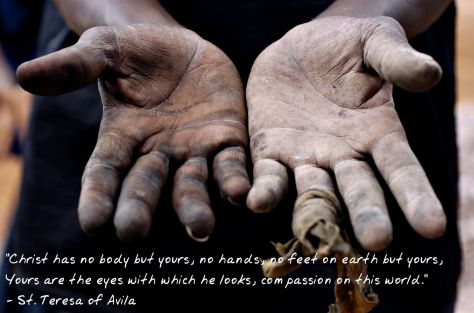
This reminds me of the prayer of St Teresa of Avila, who lived in the 1500s:

Christ has no body but yours,
No hands, no feet on earth but yours,
Yours are the eyes with which he looks
Compassion on this world,
Yours are the feet with which he walks to do good,
Yours are the hands, with which he blesses all the world.
Yours are the hands, yours are the feet,
Yours are the eyes, you are his body.
Christ has no body now on earth but yours.

I end this message by singing John Michael Talbot’s arrangement of this prayer.

(Note: This sermon was preached at a home for women with intellectual disabilities.)

Here are two beautiful performances of this prayer. Music by David Ogden.


2019.05.26_Christ_has_no_body

Link to featured image.

Love one another

Click here to listen to this 16-minute message.

I have been redeployed from the church I’ve attended for over 20 years (St Martin-in-the-Fields) to a new church, not too far away (St Stephens, Lyttelton) as part of my curacy. Today was the first time I have preached to this new parish, so it was a good opportunity to lay down what is most important to my faith and that what is most prominent in my preaching. And it is this:

God is most essentially and completely LOVE. The three persons of the Godhead (Father, Son and Spirit) have been in eternal relationship with one another since before the creation of time and space. It is the profound love between these three persons that makes the one being. God created time and space out of a fullness of love. God created humanity out of a generosity of love, to be shared. And God’s actions throughout human history embody and describe love. Love that is fierce, generous, extravagant, radically inclusive, steadfast and unshakable.

Today’s reading from John 13:34-35 sets out Jesus’ command to us:

A new command I give you: Love one another. As I have loved you, so you must love one another. By this everyone will know that you are my disciples, if you love one another.

In this message, I provide the context in which Jesus delivered this message – a context that represents on the crisis points in his ministry, characterised by betrayal, denial and isolation.

And I set out what is ‘new’ about old command to love, viz. the source of our capacity to love and the missional impact of our love for one another.

Let the love of God be the centre of your life.

2019.05.19_love-one-another-400x400

Link to featured image

God’s Will

Click here to listen to this 13-minute sermon.

One of the key themes of Easter is that God’s Will will not be thwarted. No matter what we raise against God’s Will – God’s Intentions – God will accomplish God’s Will. This comes into relief in today’s reading from John 11:45-57. It is a passage about the Jewish leaders’ sense of threat from the success of Jesus’ ministry, and their decision to eliminate him. Their concerns and actions are motivated by self-preservation, and they believe that eliminating Jesus will secure their future salvation.

Ironically, they could not be more correct, but not in the way they thought. Jesus’ death (the death of one person) did indeed make possible the salvation of the entire world – not just the Jewish nation, but indeed all people, everywhere, at all times, including both past and future.

God took their evil intent and incorporated it into God’s Will, to accomplish the great plan that God had already conceptualised at the dawn of time: to save the cosmos. God’s Will is glacial, moving inexorably towards its destination.

The Will of God will not be thwarted. We see this tenacity of God’s Will strikingly in Ezekiel 37:21-28, where God’s “will” is articulated 24 times in just 8 verses:

‘This is what the Sovereign Lord says: I will take the Israelites out of the nations where they have gone. I will gather them from all around and bring them back into their own land. 22 I will make them one nation in the land, on the mountains of Israel. There will be one king over all of them and they will never again be two nations or be divided into two kingdoms. 23 They will no longer defile themselves with their idols and vile images or with any of their offenses, for I will save them from all their sinful backsliding, and I will cleanse them. They will be my people, and I will be their God.

24 “‘My servant David will be king over them, and they will all have one shepherd. They will follow my laws and be careful to keep my decrees.25 They will live in the land I gave to my servant Jacob, the land where your ancestors lived. They and their children and their children’s children will live there forever, and David my servant will be their prince forever.26 I will make a covenant of peace with them; it will be an everlasting covenant. I will establish them and increase their numbers, and I will put my sanctuary among them forever. 27 My dwelling place will be with them; I will be their God, and they will be my people. 28 Then the nations will know that I the Lord make Israel holy, when my sanctuary is among them forever.’”

If God is able to accomplish so much when people are working against God, imagine what God can accomplish when people work with God! Today we are reminded of the remarkable opportunity to partner with God in implementing God’s Will, and in so doing, to be part of history-making.

2019.04.13_College_Fjord

Featured image of one of the glaciers in College Fjord in Alaska.

The older brother

Click here to listen to this 21-minute message.

We all have, consciously or unconsciously, a hierarchy of people’s goodness to badness, of people’s worthiness of God’s loving attention or of salvation. Even if we believe in salvation through the work of Christ alone, we probably still can imagine people we think undeserving of eternal life.

This was the problem of the Pharisees in Jesus’ time. They were so focused on keeping God’s Law (see my related message on Jesus’ Law) that they could have nothing to do with people who were not righteous, people who were lower down on the hierarchy.

So when the Pharisees see Jesus hanging out with so called ‘sinners’ and tax collectors, they are horrified and mutter, “This man welcomes sinners and eats with them” (Luke 15:1-2). They regarded such behaviour as being absolutely at odds with being a Godly person.

This prompts Jesus to tell three parables, intended to reveal God’s soft heart for “sinners and tax collectors”, for the lost, and to challenge the Pharisees’ misalignment with the God they sincerely followed:

  1. The lost sheep. “Suppose one of you has a hundred sheep and loses one of them. Doesn’t he leave the ninety-nine in the open country and go after the lost sheep until he finds it?” (Luke 15:4-7) Here, Jesus speaks of the lost one in a hundred.
  2. The lost coin. “Suppose a woman has ten silver coins and loses one. Doesn’t she light a lamp, sweep the house and search carefully until she finds it?” (Luke 15:8-10) Here, Jesus speaks of the one in ten.
  3. The lost son. “[Suppose] there was a man who had two sons” (Luke 15:11-32). One of them gets lost. Here, Jesus speaks of the one in two. (Though in truth, both sons get lost.)

In this parable (commonly known as the parable of the prodigal son, ‘prodigal’ meaning financially wasteful) we meet a father and his two sons. The younger son asks for his inheritance up front, and then squanders it on wild living. Eventually he comes to his senses and, realising that his fathers servants live better than he is now living, returns to his father, acknowledges his sinfulness and asks to be hired as a servant. The father is overjoyed at the son’s return, hugs him, clothes him and throws a lavish party for him.

In most preaching about this parable, this is what we focus on. Rightly so, because it reveals the extravagantly loving heart of God, God’s willingness to reconcile with anyone who turns to God, God’s unconditional love. It exemplifies Jesus’ ministry, which is to find those who are disconnected from God, and welcome them back into fellowship with God. For example,

  1. In Jesus’ manifesto – his mission statement – he says (Luke 4:18-19):
       “The Spirit of the Lord is on me,
           because he has anointed me
           to proclaim good news to the poor.
       He has sent me to proclaim freedom for the prisoners
           and recovery of sight for the blind,
       to set the oppressed free,
           to proclaim the year of the Lord’s favor.”
  2. And in his reflection on his encounter with the tax collector Zacchaeus (the one who climbs a tree to see Jesus), Jesus concludes (Luke 19:10)
       “For the Son of Man came to seek and to save the lost.”

But actually, the narrative focus of the story is on the older son, whose attitude towards his wayward brother is the same as that of the Pharisees. Jesus wants the Pharisees (perhaps us also) to recognise themselves in the older son, whose attitude is so at odds with his father (who represents God, who in turn is represented by Jesus):

  1. The older son is angry, while his father is filled with compassion.
  2. He refuses to join in the feast the father is hosting, thereby distancing himself from his family.
  3. His father has to humiliate himself by leaving his guests to come out an plead with the older son.
  4. In his response to his father, the older son speaks with disrespect, saying “Look!” instead of “Father”.
  5. The son constructs his role in the family as one of slave, rather than son.
  6. He distances himself from his younger brother, referring to him as “this son of yours”.

This is exactly what the Pharisees did to Jesus (as the father in the story) in his engagement with sinners and tax collectors (as the younger son in the story). They said to Jesus, “This man welcomes sinners and eats with them”, just as the father in the story welcomed his younger son and threw a feast for him.

The father, however, recognises that this older son is also, in his own way, lost. He has lost his sense of fellowship with his father. He does not share his father’s values and outlook on the world. He has dissociated himself from his father’s family. But the father says:

  1. “My son”, even though the older son did not say, “My father”. He speaks with respect to his disrespectful son.
  2. He affirms that the older son is always with him (in relationship with him) and that everything that is the father’s is the son’s also, affirming his sonship.
  3. He refers to the younger son as “this brother of yours”, affirming the boys’ brotherhood.
  4. He reinforces the need to celebrate the return of the lost younger son, perhaps hinting that there would be a further celebration to celebrate the return of the lost older son.
  5. He concludes the narrative with the words: “He was lost and is found.”

As children of God, we (like the Pharisees) are urged to adopt the heart of God, as evidenced in the behaviour of the father in this parable, and to welcome and eat with so called ‘sinners’.

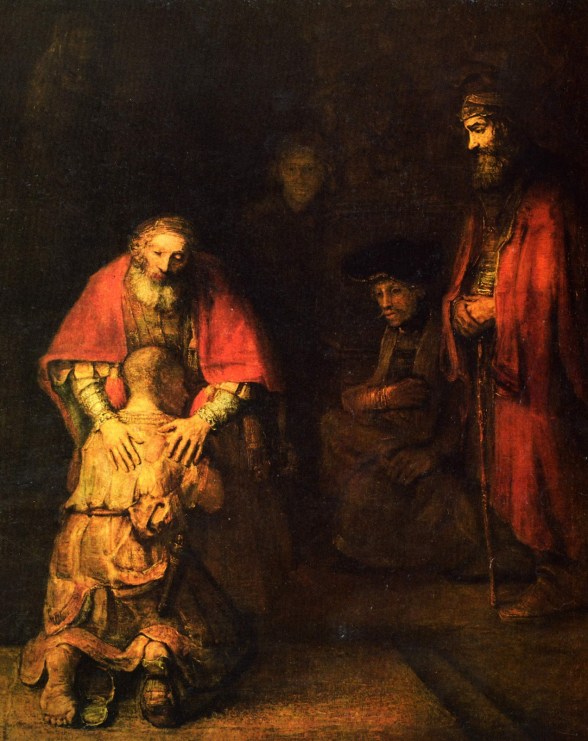
2019.03.31_Rembrandt

This painting by Rembrandt van Rijn is called ‘The Return of the Prodigal Son’ c.1662. The original hangs in the Hermitage in St. Petersburg. The older son is depicted on the right, in a red cloak, looking rather disapproving, and distanced from the father and younger son on the left.

Notice also the father’s hands – the one on the left is smaller and thinner than the one on the right. Most people think Rembrandt was endeavouring to depict both the fatherhood and motherhood of God.

Henri Nouwen has written a book about this narrative and painting called, ‘The return of the prodigal son’. You can read some of it here on Amazon. Read particularly pages 71 and following, about the older son. Or click here for a brief reflection on this painting.

Humility

Click here to listen to this 11-minute message.

God calls us to humility – in our relationship with God, and in our relationship with other people.

Luke 18:9-14 gives us the parable of the pharisee and tax collector, both at prayer.

  1. The pharisee – a person who was devout, religious, righteous, obedient to God’s laws – stands and prays loudly about how wonderful he is and thanks God for not making him like those ‘other’ people (explicitly mentioning the tax collector). Jesus says that this person will not be justified before God, and that people like that, who exalt themselves, will be humbled.
  2. The tax collector – a person who was regarded as dishonest, extortionist and reprehensible, and who Jesus often refers to when talking about sinful people – hides away in a corner, cannot look up towards heaven and can pray only, “God, have mercy on me, a sinner”. Jesus says that this person will go home justified before God, and that a humble person like this will be exalted.

Clearly, God calls us to humility – both in our relationship with God and in our relationship with people.

Of course, this ‘humility’ is not about self-denigration or having a poor self-esteem or negative self-image. Paul says clearly in Romans 12:3 that humility is about assessing our strengths and weaknesses honestly and accurately: “Do not think of yourself more highly than you ought, but rather think of yourself with sober judgment.”

In our other reading for today – Hosea 5:13-6:6 – there is a dialogue between God and Israel:

  1. God observes that when Israel was in need, instead of turning to God, they turned for help to people who did not know God. Therefore, God sent suffering to them, to help them admit their guilt (i.e. to humble them) and until they sincerely sought God’s face.
  2. Israel then reflects that the suffering they have experienced is justified, and that despite God’s anger towards them, God will nevertheless heal them and bind up their wounds. They long to be revived and restored and to live in God’s presence. Twice they say, “Let us acknowledge God” – that word ‘acknowledge’ in Hebrew means ‘to know’ (as in knowing  a fact), but also as in knowing or discerning something not obvious (such as the truth of someone’s intentions), and is used as a euphemism for sex (as in, Adam knew Eve and she fell pregnant). Israel desires to be humble before God and to truly and intimately know God.
  3. God, the exasperated parent, responds positively. God reminds them that God’s desire is for mercy (hesed, meaning steadfast love and compassion) and acknowledgement (that ‘knowing’ word again), far more than empty religion (sacrifices and burned offerings).

Clearly, God calls us to humility – both in our relationship with God and in our relationship with people.

2019.03.30_Kneeling-in-Prayer_Rippelmeyer

Feature image ‘Kneeling in Prayer‘ by Nadine Rippelmeyer (2006)

Jesus’ Law

Click here to listen to this 13-minute message.

In Matthew 5:17-20, Jesus presents (albeit very briefly) his most comprehensive teaching on his view of Law of Moses. He says that he has not come to abolish the law, that the dot on every i and the cross on every t is vital, that the Law has not passed away, and that we need to practice and teach it. Many commentators (naturally) read this to mean that the First Testament Law is as binding on Christians today as it was on the people of Israel in years between Moses and Christ.

However, when we look at Jesus’ teaching and behaviour, even just within Matthew’s Gospel, we see him repeatedly massaging the Law, challenging the Law, even brazenly disobeying the Law – certainly as the Law was understood by the Pharisees of his day. For example:

  1. Matthew 5:21-48. Through the rest of chapter 5, Jesus uses the formula: “You have heard that it was said… But I tell you…” In this formula he, by his own authority, reinterprets the Law and in cases appears to overturn it. At its heart, he shifts the focus from the external letter of the Law, towards the heart attitude underlying the Law. And is so doing, makes keeping the Law much harder.
  2. Matthew 9:14-17. Here Jesus breaks the fasting laws. He is challenged on this, and explains that since the he is there, they should celebrate.
  3. Matthew 12:1-14. Here Jesus breaks the Sabbath laws – very important laws! He walks, he harvests and he eats, all on the Sabbath, and with his disciples. When challenged by the Pharisees, he even uses the Law to justify his breaking of the Law! And then he goes on to heal a man. In the parallel story in Mark’s Gospel (2:27), Jesus justifies his breaking of the Sabbath Laws by saying, “The Sabbath was made for man, not man for the Sabbath”
  4. Matthew 15:1-20. Here Jesus breaks the dietary (Kosher) laws (specifically not washing their hands before they eat). His answer is quite wide-ranging. He says, “What goes into someone’s mouth does not defile them, but what comes out of their mouth, that is what defiles them” (v11). And then he later explains in more detail: “Don’t you see that whatever enters the mouth goes into the stomach and then out of the body? But the things that come out of a person’s mouth come from the heart, and these defile them. For out of the heart come evil thoughts—murder, adultery, sexual immorality, theft, false testimony, slander. These are what defile a person; but eating with unwashed hands does not defile them

How do we reconcile Matthew 5’s apparently strict teaching with the rest of Jesus’ teaching and his daily behaviour? They do appear to be at odds with each other!

I suggest the following:

  • Under the First Testament Law, people believed that keeping the Law lead to Righteousness (i.e. to a right relationship with God). Because of this, they invested in keeping the Law down to the smallest letter (the jot and the tittle in the King James version). And the Pharisees, in particular, were highly devout in unpacking what each Law meant, and how it had to be lived out in the daily life.
  • Under the Second Testament, Jesus teaches that Righteousness (i.e. having a right relationship with God) leads to the keeping of the Law. We are made right with God through Jesus’ incarnation, ministry, death and resurrection. He is the one who, through his grace, makes us right with God, and we receive this righteousness through faith. Because of this, and in the power of the Spirit, we are enabled to keep God’s Law. But even this Law is not a legalistic ‘jot and tittle’ law, but a living, heart-based, relationship-centred Law. It is the Law of Love.

I end with a paraphrase of Matthew 5:17-20 by RT France (2007, pp. 190-191) in his commentary on Matthew’s Gospel:

“Do not suppose that I came to undermine the authority of the OT scriptures, and in particular the law of Moses. I did not come to set them aside but to bring into reality that to which they pointed forward. I tell you truly: the law, down to its smallest details, is as permanent as heaven and earth and will never lose its significance; on the contrary, all that is points forward to will in fact become a reality (and is now doing so in my ministry). So anyone who treats even the most insignificant of the commandments of the law as of no value and teaches other people to belittle them is an unworthy representative of the new regime, while anyone who takes them seriously in word and deed will be a true member of God’s kingdom.

“But do not imagine that simply keeping all those rules will bring salvation. For I tell you truly: it is only those whose righteousness of life goes far beyond the old policy of literal rulekeeping which the scribes and Pharisees represent who will prove to be God’s true people in this era of fulfillment.”


Turn to God

Click here to listen to this 18-minute sermon.

Today is the first Sunday in Lent, when we reflect on Jesus’ 40-day fast in the desert, and the way the devil tempted him during this time (Luke 4:1-13). Here’s the point I believe God wants us to hear from this passage today:

  1. Fasting from something makes that something a point of focus for spiritual tension.
  2. As a result, we’ll experience an increase in temptation related to that something.
  3. That creates increased opportunities to choose to turn towards God or to sin.
  4. Thus, fasting creates opportunities for us to turn to God.

Jesus experienced this during his 40-day fast. We experience it when we fast. Fasting creates these intensified opportunities to turn to God. It is the gift of the fast.

How can we turn to God? Here are two ways:

  1. Select a Bible verse that is meaningful to you and and relevant to what you’re fasting from. Memorise it. Whenever you feel tempted, recite the verse.
  2. Select a brief prayer that you can easily memorise and recite, e.g. the Jesus Prayer: “Lord Jesus Christ, Son of God, have mercy on me, a sinner.” Whenever you feel tempted, say the prayer.

Use the verse or prayer to remind you that you have made a commitment to God. Use it to help turn your focus towards God. Remind yourself that while breaking your fast may, actually, be trivial, remaining true to God is not.

Blessings as you journey through Lent.

2019.03.10_Forkintheroad

Featured image from https://thewellarmedwoman.com/blog/fork-in-the-road/