God cares for you

Click here to listen to this 20-minute message.

The story of Jesus changing water into wine at the wedding in Cana (John 2:1-11) is well-known to most people. It is, in John’s version of the Gospel story, the first act by which Jesus reveals his glory to people. It is an epiphany – an appearance or manifestation of the glory of God in Christ, showing Christ to be God incarnate, the Son of God, the second person of the Holy Trinity.

But before all of that, the changing of water into wine is an act of kindness that reveals to us the interest and care that God has for us. God is interested in and cares about all the daily events in our lives – our concerns and worries, the stumbling blocks and hurdles that we encounter, and our hopes and aspirations. God is not so preoccupied with the great events of the universe that God has no time to attend to the small details of our personal life. Jesus’ assistance with the wedding in Cana, where the wine for the celebrations had run out, is evidence of this.

That the first miracle Jesus performs in John’s Gospel is at a wedding is itself no coincidence. It points to God’s interest in human relationships, in love, in the connections between couples and between families. This reveals the heart of God, which is filled with love for us.

The miracle itself is also performed quietly and unobtrusively, unlike many of the miracles churches sell to people today, which are spectacles. Without any fanfare, Jesus asks some servants to ‘fill’, ‘draw’ and ‘take’, and only they and his mother knew that a miracle had been performed. It was almost done in secret.

As a result of this, his disciples entrusted themselves to Jesus; they put their faith in him, they believed into him. Because they saw that he had both power and compassion.

This miracle, however, also has layers of meaning that deepen our appreciation for this story. First, there are many pointers towards this being a story of Christ’s work to bring salvation to humanity, which we commemorate in the Eucharist (also known as the Holy Community or Lord’s Supper). Second, the wedding banquet is an image used throughout the Bible to point towards God’s great plan to reconcile the world to God’s self, culminating in a great eschatological wedding between us and God and a generous banquet.

At this grand level of the whole of cosmic history,

and at the level of Christ’s work for the salvation of humankind,

and at the level of a wedding in a small village where the families ran out of wine

– at all these levels – this story speaks of God’s care for us. Yes, God loves us. But, in addition, God cares. God cares about and responds to the little and the big things in our lives and God willing and able to respond to them.


Featured image from https://i.pinimg.com/originals/b4/fe/af/b4feaf55ff1f500f40c530ff0edf21cb.jpg

Jesus’ Anointing

Click here to listen to this 16-minute message.

We continue through the season of Epiphany in my church, which is the season in which we reflect on the manifestation or appearance of God in the world. This is particularly so in his Son Jesus Christ, who is the great shining forth of God’s presence in the incarnation of Christ, the Son of God, the second person of the Trinity.

Today we focus on the baptism of Jesus by John. In Matthew and Mark’s accounts of the baptism, God the Father speaks and God the Holy Spirit descends as John baptises Jesus and as Jesus comes up out of the water. But in Luke’s version of the baptism (Luke 3:15-22), things look quite different and it is less about his baptism and more about his anointing.

John is removed from the scene a few verses earlier, Jesus’ baptism is mentioned only in passing as background, and the appearance of God happens as Jesus prays. Moreover, the language used (passive voice and infinitive clauses – people were being baptised, Jesus was baptised, heaven was opened, a voice came from heaven)) creates a sense of time being suspended. It is as if the globe stops spinning and all falls silent, as the heavens are torn open, the Spirit descends in bodily form and the voice of God is heard. It is a moment of mystery. It is an epiphany!

Luke accentuates this by echoing imagery and language from the prophetic literature and the Psalms of the First Testament, e.g.

  • Ezekiel 1.1 and 2:1-3:1, where the heavens open, Ezekiel is filled with the Holy Spirit and God appears, reaching out of the heavens towards Ezekiel, and commissions him for ministry.
  • Psalm 2:7, where God says “you are my son”.
  • Isaiah 42:1, where God speaks of his chosen servant, who he fills with Spirit, to bring justice to the world.

These passages reinforce what follows Jesus’ baptism in Luke: Jesus goes out in the desert for 40 days (Luke 4:1-13) and then into the synagogue, where he proclaims his manifesto – “The Spirit of the Lord is on me, because he has anointed me to preach good news to the poor” (Luke 4:14-30).

How wonderful it would be if we ourselves experienced such an epiphany! Sadly, for most of us, God speaks quietly and subtly, not in such dramatic ways. Yes, let us not doubt that God does call us, manifest himself to us, anoint us with Holy Spirit and commission us for service. We are as much called into God’s work as Jesus was.


Featured image from: https://www.desiringgod.org/interviews/why-was-jesus-baptized

The Word became flesh

Click here to listen to this 20-minute message.

In the beginning was the Word, and the Word was with God and the Word was God (John 1:1).

These majestic words open the Gospel according to St John, and continue over 18 verses in one of the most majestic hymns to the Christ. On Christmas Day, we celebrated the birth of an infant, a little child who promised hope and new life. But he was, after all, just an infant. By contrast, John presents us with the pre-existent second person of the Trinity, the Son of God, the Holy One. Magnificent, eternal, powerful, unfettered, transcendent.

We really cannot dissect and analyse such an image of Christ. Rather, we must merely apprehend it, gaze upon it, marvel at it. My own church tradition is low church, not high, but it is on days like today that I wish we had incense in my church, as its fragrance and appearance would serve to lift us up out of the intellectual to the mystical, and to merely and deeply appreciate the mystery of the Word.

This Word, who became flesh, and who made his dwelling among us (John 1:14). How amazing that God should became human, that God should shrink down to be merged with a single human cell at conception, and develop into a neonate, a son.

We, like John the Baptist, like John the beloved disciple, can only witness this gift of love, to see it and hear it and know it. And then to be witnesses to it, to proclaim it. The Word made flesh!

Here are today’s key readings:

Featured image from: https://www.nbcnews.com/mach/science/what-big-bang-theory-ncna881136

Opening bars of Strauss’ Also sprach Zarathustra, performed by the Berlin Philharmonic Orchestra, under the baton of Gustavo Dudamel: https://www.amazon.com/Strauss-R-Also-sprach-Zarathustra/dp/B00EYVGAO6

Wondering where that music comes from? Here you are:

Radical inclusion

Click here to listen to this 16-minute message.

Luke 1 presents a compelling narrative about two women and two unborn babies. It is a remarkable way to start a story. Four individuals who, in various ways, are at the margins of society – an old barren woman, a teenage girl barely out of childhood, a six-month old foetus and a newly-fertilised egg. This is hardly a group of individuals that one would think would change the course of global history!

Yet, it is this very group that God chooses to initiate God’s major intervention in human history. It points to a pattern that we see in much of God’s work among humans – radical inclusion. God seeks to draw unexpected people into the centre of God’s working, people who society might often think of as ‘less than’ or ‘other’. Often, it is not the powerful, influential, reputable, wealthy, intelligent or educated that God places in key roles. Rather, God often chooses the outcast, the downtrodden, the humble, those who recognise their limitations and those who feel they have little to offer.

In this sermon, I tease out some of the remarkable insights we gain into Elizabeth and Mary, and the unborn John and Jesus, that Luke presents to us in the opening chapter of his Gospel narrative. I show the many ways in which we see God’s grace working itself out in profound and striking ways among this unlikely group of individuals.

From this, we get the message that there is no-one with whom God does not want to work. Every person – every single individual – has a part to play in God’s great work to redeem the cosmos. There are no exceptions. No matter how insignificant or inadequate or unavailable you may perceive yourself to be, God has a place for you, a role for you. We have to trust that this is indeed true. We have to relinquish ourselves to participate. As Mary so gracefully says, “I am the Lord’s servant. May it be to me as you have said” (Luke 1:38).

Conversely, we have to accept that God chooses to work with people we may feel God should not be working with. We (humans) tend to be far less tolerant and gracious than God! It is important for us not to become an obstacle to others who seek to play their part in God’s work. Even when we feel they are not right for or up to the task. Who are we to interfere with God’s judgment on who is worthy of participating in God’s work?

God’s radical inclusion is presented to us in Luke’s gospel as a cornerstone of God’s means of working. Through Luke, we see marginalised people, particularly women, being brought into the centre of Jesus’ ministry and God’s mission. We as individual Christians, and as a collective Church, should be emulating this approach.

Feature image cropped from: https://www.pexels.com/photo/grayscale-photo-of-two-pregnant-women-1253592/

Alignment

Click here to listen to this 13-minute message.

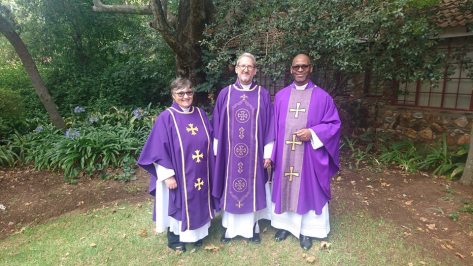
This message was preached on a special day: the first service I led as an ordained Anglican priest in the Diocese of Pretoria, South Africa. There’s a picture of me below, flanked by The Rev’d Marti Slater (Assistant Priest) and The Rev’d Siphiwo Bam (Rector of our parish) after the service.

In this message, I share a little of my journey of being called into ministry, which goes back about 30 years since I first heard the call (and began avoiding it) and 14 years since I accepted the call and began journeying towards ordination. There is a long story, the details of which I don’t go into in this message. Suffice it to say that it has not been easy and that I and many others are delighted that this day has finally arrived.

In the process of this journey, particularly in the past year or so, and especially during this past week of preparation for yesterday’s ordination (Saturday 15 December), I have come to understand that God has been working to increasingly align my life – the whole of my life, both interior and public, both in church and in the ‘secular’ workspace – with God’s will and desire. Alignment has become the word I use to express my experience of this journey towards ordination.

Looking at the Advent reading for today, from Luke 3:7-18, we see John the Baptist calling people to prepare for the coming Messiah, to make their hearts and their society ready to receive him. He says, “Produce fruit in keeping with repentance” (vs 8a), which I interpret as a call to alignment. Repentance is an internal and spiritual act, between oneself and God. Producing fruit, on the other hand, is a public and social act, between oneself and the world.

After exhorting his congregation to repentance, people ask him, “What should we do then?” and John gives three responses that point to a message of social justice – about treating people fairly, honestly, kindly and with integrity. His message of repentance is, in many ways, a social message. But then he goes on to warn people that one greater than he will come, who baptizes not with water but with Spirit and fire. This message is a religious and spiritual one.

John is not presenting a muddled message. Rather, he is calling for an alignment between our private and public lives, between our ‘sacred’ and ‘secular’ lives. He is anticipating Paul’s disclosure of the mystery of God’s will, viz. “He [God] made known to us the mystery of his will according to his good pleasure, which he purposed in Christ, to be put into effect when the times reach their fulfillment—to bring unity to all things in heaven and on earth under Christ” (Ephesians 1:9-10).

Ultimately, there is no distinction between our private and public lives, between our ‘sacred’ and ‘secular’ lives. All are within the sphere of God’s interest and mission. All need to align with God. As we journey towards alignment, we help to make straight paths for the Lord, rather than crooked ones. We help to fill in the valleys and make low the mountains, so that rough ways become smooth. Then all people will see God’s salvation (Luke 3:4-6).

Here is a definition of Christian alignment that I have been working on. Alignment is:

  • The will of God the Father,
  • Enacted by God the Son,
  • Empowered by God the Holy Spirit,
  • Illuminating our hearts and minds,
  • Expressed through our values in action, and
  • Transforming the world.

2018.12.16_Alignment_priests

The video below is a song written and performed by Gregory Porter called Take me to the Alley. I have been listening to this song over the past week, and during retreat it was ever in my mind. I find the words profound and the style of the song very moving. I think it is an Advent hymn.


Feature image from: http://mxtrianz.me/stone-stack/stone-stack-9-stack-of-stones-and-sea-splash-stock-footage-video-4820351/


Created in love to love

Click here to listen to this 17-minute message.

It all starts with love. In the beginning… what? In the beginning… God. But not a solitary God. No! A plural God, a triune God, a God in relationship with Godself. The three-in-one God.

We know little of God-as-God, because most everything we know of God is God-in-relationship-to-creation. Theologians refer to this God as the ‘economic trinity‘ – the active God engaging with the world that God had created. Just as who we are inside (our identify, our sense of self) is not equivalent to the person people encounter us to be at work or church, God’s actual self (which theologians call the ‘immanent trinity‘) is not equivalent to God as humanity encounters God.

So, what do we know about God as God, the immanent trinity? Not much! All we really know is that God was always three. Yet also one. God the Spirit and God the Word were already present with God the Parent “in the beginning”.

And while we know there have always been three persons (perhaps there are more than three, but God has revealed to us, so far, just three), these three persons are one being, one essence. I argue that LOVE is the most fundamental essential to the being of God. Relationship between the Parent, Word and Spirit that is so powerful, so intimate, so in tune with each other, so embracing, that the three are in fact one (what theologians call ‘perichoresis’).

Love. Love is the heart of God.

Image result for god love trinity

Those of you who are familiar with my work will hopefully recognise that this is the centre of my theology. It is, in theological terms, my ‘hermeneutic key’, that is, it is the key statement of faith by which I make meaning of everything else in my faith – my experience of God, of others and of myself, my reading of the Scriptures, my reflections on my thinking or reason, and my adoption (or rejection) of tradition. It is the cornerstone. Read chapter 3 of my book for a bit more on this, and if you’re inspired, read the whole book – Being God’s Beloved – online or buy the book.

Based on this, I suggest two small practical ways that we can give expression to this great example of love, ways that we can become the image of God by behaving like God:

  1. Being kind to those we meet in the course of our day, by smiling, greeting, showing interest to and asking after the strangers we pass during our daily lives. By seeing these people through the eyes of Christ – seeing them as Christ sees them.
  2. Loving the work that we do (whether that is paid employment, volunteer work or house work), by investing energy and effort in our work, treating this work as something that God has entrusted to us, as he entrusted the Garden of Eden to Adam, to tend and care for.

If love is the heart of the triune God, and if we are created in God’s image, then we are most like God when we express love in all that we do.

We are created in love, to love.

Feature image from: https://www.christianity.com/god/trinity/god-in-three-persons-a-doctrine-we-barely-understand-11634405.html

Faith Impossible

Click here to listen to this 20-minute message.

Mark 10:17-31 presents us with the story of the (rich, young) man who came to Jesus asking, “Good teacher, what must I do to inherit eternal life?”. Jesus’ response conveys to us the impossibility of faith. Jesus’ expectations of this man are so high, that the man goes away crestfallen. And Jesus’ engagement with his disciples after that serves only to make faith yet more impossible. No wonder the disciples asked each other, “Who then can be saved?”

The lectionary does nothing to soften Jesus’ hard words. Indeed, the other readings reinforce them yet further:

  • Hebrews 4:12-13 says that the Word of God reveals everything about us to God – everything is uncovered, everything is laid bare. There is no place to hide, no place for modesty.
  • Psalm 22 opens with the words “My God, my God, why have you forsaken me?”, which Jesus spoke on the cross. They remind us of the profound and utter devotion of Jesus towards God and his willingness to give up everything for us.
  • Job 23 presents a man who has lost everything and who wants to encounter God, to challenge God, to confront God. But God is not to be found. Having lost everything, but still seeking faith, Job experiences God as unreachable.

Together these readings paint a picture of faith as utterly unattainable. It can leave us feeling perplexed and hopeless.

But, there are three lines in Mark 10 that provide us with some hope. In this sermon, I unpack each of these and show what they mean and how they provide a counterbalance to the impossibly high standards for faith that Jesus sets for us:

  1. Mark 10:21 “Jesus looked at him and loved him.”
  2. Mark 10:15 “Truly I tell you, anyone who will not receive the kingdom of God like a little child will never enter it.”
  3. Mark 10:27 “With man this is impossible, but not with God; all things are possible with God.”

This juxtaposition of the impossible demands of faith that God makes of us, with the loving permissiveness and generosity of Jesus, suggests that while we should strive for faith and to be true disciples of Christ, we can and should also relax into his grace, not fretting and not losing hope.

See also: A little faith

Feature image from: http://kairosterzomillennio.blogspot.com/2015/05/lunedi-della-viii-settimana-del-tempo.html

There will be signs!

Click here to listen to this 20-minute message.

Today is the first Sunday in Advent – the four Sundays leading up to Christmas – during which time we reflect on our preparation for Christ’s comings into the world – his first coming some two thousand years ago, and his second coming some time in the future.

Today’s Gospel reading, Luke 21:25-36, presents part of Jesus’ prophecy about the future, specifically, the Day of the Lord, or the day on which he will return, aka the ‘second coming’. He opens this passage with the words, “There will be signs…”

We all look for signs – signs about our past, to explain where we come from; signs about the future, so we know where we’re going; and signs about the present, to help us make sense of our current situations. In this passage, Jesus gives us insights into all of these.

Advent is a time of going back more than 2000 years, so we can look forward to the birth of Christ, whose birthday we will celebrate in a few weeks. In those days, people were looking for signs of the long-awaited Messiah. Now, today, we are looking forward to his second coming, and looking at the signs that foretell this.

Jesus’ teaching in Luke raises both the light and dark of Jesus’ second coming, some time in the future. He cautions us about the dangers and risks of that time. And he also encourages us to be faithful during these times.

Drawing on Christ’s teaching, I suggest that he calls us – in our faith, and also in our private and public lives – to cast one eye on the future and the other on the present. I explain why he says this and why it is a useful approach for contemporary living. I argue that we should live in the present, with roots in our past and looking forward to the future.

Feature image from: https://blog.obitel-minsk.com/2017/05/orthodox-understanding-of-the-second.html

Images of Stewardship

Click here to listen to this 21-minute message.

September each year is ‘stewardship month’ in the Anglican Church of Southern Africa, during which we focus intensively on the question of our contribution to God’s work in building the Kingdom of God in our midst. Traditionally, we focus on time, talents and treasures as the main focus areas of our contribution. This year, we’ve also focused on our stewardship of creation, particularly in response to the growing plastics threat.

This is the last of our stewardship messages this year, where I was led, by some difficult circumstances, to reflect on the meaning of stewardship. Using a set of six images, I show the multifacetedness of stewardship, and what it means to work as partners with God in transforming our world into the image of God. These images are:

  1. Parenthood
  2. Safeguarding (1 Corinthians 6)
  3. Care-taking (1 Kings 17)
  4. Gardening (Psalm 24)
  5. Loving (serving) (Ephesians 5)
  6. Friendship (John 15)

The image of stewardship as parenthood emerged in a crisis with my son during this past week, where he was involved in a very serious car accident. Although he was not badly hurt, thankfully, his life was jeopardised, and this raised considerable distress for me as a parent. It led me to think of my role as parent as that of a steward of this young man, who is first and foremost God’s son, and only secondarily my son.

The image of stewardship as friendship emerged from John 15, where Jesus says that we are not servants, but friends; friends of Christ and friends of God. Friendship, I suggest, involves freedom, reciprocity (mutuality) and equality. And friendship is the ultimate foundation of stewardship.

It is against these images that I believe we are invited to be coworkers with Christ in his mission to redeem the cosmos.

Blessings
Adrian

Standing against patriarchy

Click here to listen to this 20-minute message.

The church has fallen far short of its expected role in championing the dignity and worth of women. Instead, the church has been complicit in advancing patriarchy: women and children have been abused and exploited by clergy and church leaders; the role and authority of women has been dampened in the church; women have been encouraged to return and submit to their abusive husbands; and a theology of male supremacy has been advocated. The church has and continues to advance patriarchy.

This is at odds with the teaching of Scripture. While the Bible was written men in a patriarchal world and reflects patriarchal patterns of life, this does not mean that God is a patriarch, nor that the church should be patriarchal. We need to revise our theology in light of a reading of scripture that is not dictated by cultural norms about gender relations.

For example, the creation narrative in Genesis is often used to support male superiority – woman was derived from man, man was created to rule, etc. But a close reading of Genesis 1:27-8 and 2:18-23 presents a picture of God creating woman-and-man as a partnership.

  • Both were commissioned to rule over the world – man was not mandated to rule over woman. They were co-workers, partners, sharing in an egalitarian way the responsibilities for taking care of the world.
  • Woman was created out of man, from Adam’s side, showing that they are the same (or similar). They are equals, partners, lovers.
  • Woman was created as a ‘helper‘, but that word does not imply servitude or subordination. It is used 21 times in the First Testament, 16 of which refer to God helping the people of Israel, e.g. Psalm 121:1-2. God is hardly the servant of or subordinate to Israel! If anything, being a ‘helper’ connotes a position of strength and capability.
  • The creation narrative speaks not of male supremacy and female subordination, but of gender equality and mutuality, of partnership and sameness.

Another example, Paul’s writings in the New Testament are riddled with patriarchy: wives submit to your husbands, husbands are the head of the wife, husbands are the head and wives are the neck, women must remain silent in church, etc. Unquestionably, Paul was a patriarch in a patriarchal world. But, we too seldom hear another thread in Paul’s writings: a thread that is at odds with the patriarchal narrative.

  • In Galatians 3:28, Paul writes about the unity of humanity in Christ. He starts with divisions that he fully understands and lives out: “neither Jew nor Greek, slave nor Free”. These shifts towards equity in race and class were radical at that time; indeed they are radical today. But Paul was struggling with “neither male nor female”. One has a sense that Paul understands and partly believes that there is gender equality in Christ, but that his upbringing and investment in a patriarchal world-view hold him captive.
  • In 1 Corinthians 7:3-5, Paul presents a view of marriage – of sex in marriage – that is contrasts starkly with the views he presents in Ephesians 5:22-33. In 1 Corinthians 7, Paul presents sexual relations in marriage as entirely egalitarian and mutual. There is no sense here of a hierarchy of status or even of a differentiation of roles. Instead, there is simply a loving, mutual self-giving of one to the other. Egalitarian marriage.

I’m not arguing here that the Bible narrative advances gender equity. Far from it – the Bible was written by patriarchs in a patriarchal world, and is full of patriarchy. But I am arguing that the Bible equally presents God’s view of humanity as endorsing gender equity. At very least, we must admit that the Bible is not unequivocally in support of patriarchy.

And when we combine this fracture in the patriarchal edifice, even if only a tiny fault line, with the person of Jesus, and his ministry among the women and men of his day, the church must stand up to and against patriarchy. Patriarchy is a social evil that harms the life of the majority of humanity: all women, all children and (arguably) all men. We are all held captive to patriarchy, with some of us (mostly us men) benefiting at the expense of women. This cannot be. This is not the image of the Kingdom of God presented by Jesus Christ.

I call on all of us, but especially men, to do four things:

  1. Be transformed by the renewing of your mind. Then you will be able to test and approve what God’s will is—his good, pleasing and perfect will” (Romans 12:2). We have to start with our own minds, which have been taught patriarchal ways of viewing the world and ourselves since infancy. Let us be transformed, so that we can perceive God’s will more clearly. Let us challenge the deeply engrained patriarchal patterns of thinking.
  2. We need to speak out against patriarchal talk and behaviour. Let us not be silent. Let us not turn our eyes away. Let us speak up for truth and love, for gender equality and for the full dignity and worth of both women and men.
  3. We need to challenge the misuse of Scripture, which draws on handfuls of texts that bolster the culture norms of our society, but are not aligned with the Kingdom values that Christ presents in his teachings and ministry. Scripture has problematic passages, to be sure, but the overriding thread that runs throughout Scripture, and that is our key to making sense of the Bible, is God’s extravagant love for humanity, revealed through creation and the life of Christ.
  4. We need to stand, unequivocally and unflinchingly, with the victims of gender-based violence. For too long, the church has stood with the perpetrators. We see this particularly in the Roman Catholic church, for example, in Pope Francis’ protection of Bishop Juan Barros in Chile, and his later apology to the victims of Bishop Karadima. But let those of us who are not Catholic, not be complacent and point fingers. Child sexual abuse and sexual harassment of women manifests in all churches, including, for example, the Church of England and Willow Creek. The church – you and me – must stand with those who are violated and abused. That is what Christ did, repeatedly. We can do no less.

In the midst of the #MeToo movement, the Church should and must stand up to and against patriarchy, and for the voice of those who have been disempowered and silenced. This was the role that Christ Jesus took up during his brief time on earth. It is the role that his mother gave voice to in her great Magnificat. And it is the role that the church, and all its individual members, must continue today.