Up to life

You can watch the video of today’s Easter message here. The Gospel reading and sermon start at about 23 minutes into the recording and continue for about 19 minutes.

Today we celebrate Easter Sunday – the culmination of weeks of Lenten fasting and penitence, and a week of daily soul-searching services. On Good Friday, we watched our Lord’s life slip away on the cross and experienced darkness fall over the earth as the Light and Life of God was snuffed out. And then we waited, through Friday and Saturday – wondering, what might happen, how might this all turn out.

It is relatively easy for us, because we are so familiar with the outcome of the story. But for those first believers – such as Mary and the other women in Mark 16:1-8 – it must have been surreal and terrifying. The unthinkable had happened. No wonder Mark relates the confusion of the first women to arrive at Jesus’ grave, and their fear and silence after encountering what they thought was a young man (but probably an angel).

For us, though, we now understand and appreciate the resurrection of Christ as the fruit of Christ’s triumph over death, of God’s generous and complete forgiveness of sins of all humanity, of a profound and utter reconciliation with God, and the restoration of Christ as the light of the world. God gifts back to humanity the very one that humanity sought to extinguish, as a sign of their joint unconditional and extravagant love for humankind, and indeed the whole cosmos.

Alleluia! Christ is risen indeed!!

In Romans 6:3-11 we gain further insights from Paul into the ways in which our salvation follows the same path as Christ’s death and resurrection. In our baptism, we die to self in a watery grave; only to be raised again to new life in Christ, a life filled with Holy Spirit. In our service today we baptise little Onyedikachuckwu Christian Okafor – a visible sign of God’s salvation – and renew our own baptismal vows, said originally on our behalf as infants, and today renewed freely by ourselves.

Lord, you have nourished us with your Easter sacrament. Fill us with your Spirit and make us one in peace and love. We ask this through Jesus Chris our Lord. Amen.

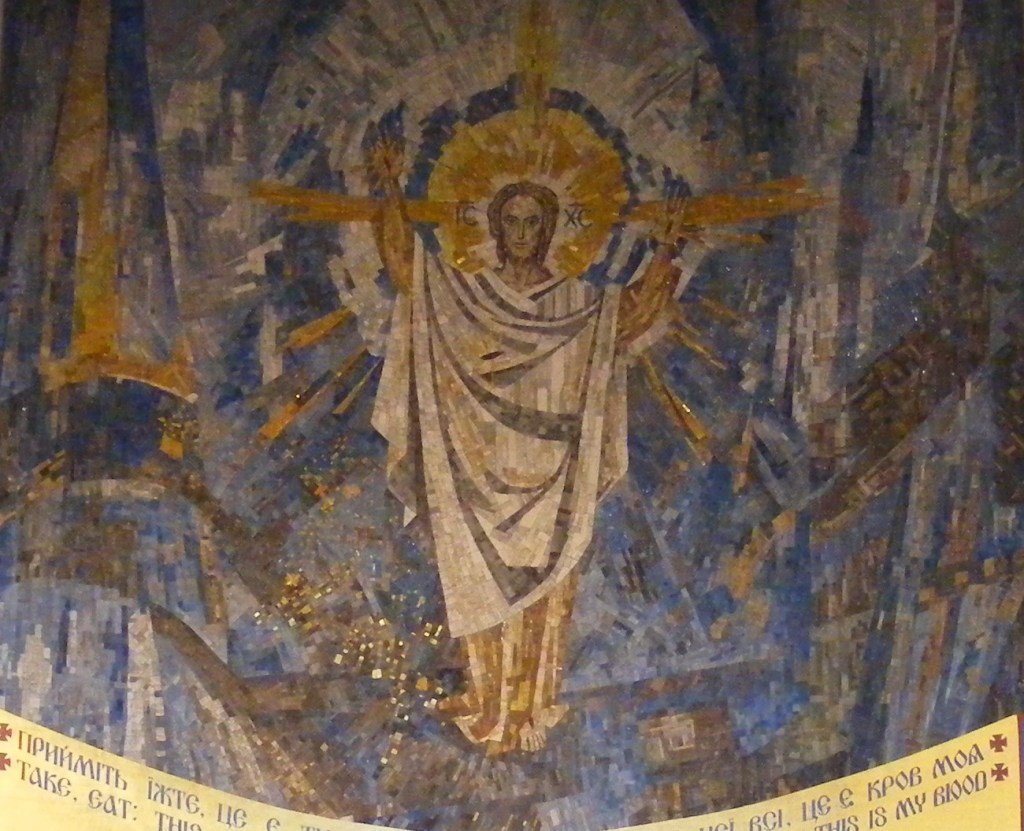
Mosaic from St. Basil’s Ukrainian Catholic Church in Edmonton at https://royaldoors.net/?p=3751

Suffering God

Watch the video of today’s Good Friday service here. The Gospel reading and sermon start at about 25 minutes and continue for a total of about 25 minutes. If you want to hear me sing, you can also skip to about 1 hour and 18 minutes, as I lead the singing of “Sing, my tongue, the glorious battle”.

Today is Good Friday on which we commemorate the suffering and death of Christ, the Son of God. Part of what is so remarkable, even shocking, is that it is not just Jesus the man who suffers and dies, but God the Son who suffers and dies.

From the moment of his incarnation, separating out the second person of the Trinity into human form, God began to experience life as a human. This reaches a climax on the cross, when the evil and darkness of this world crashes into the Son of God. It is the whole person of Jesus – with both his human and his divine natures – who suffers and dies on the cross – not just the human Jesus.

  1. Christ experiences the sins of all the world – past, present and future – falling upon him, leaving him feeling dirty, tainted, defiled. No wonder he says, “I thirst”.
  2. Christ experiences sin’s separation from God – an ocean of sin distancing him from the Father with whom he had already existed for eternity. No wonder he says, “My God, my God, why have you forsaken me”.
  3. Christ experiences the surprise of human love, and the ways in which compassion between people brings God into our midst. Thus he says to his mother, “Woman, here is your son” and to his beloved disciple, “Here is your mother”.
  4. Christ experiences the grace of God, able to transform the darkest and most painful into a moment of salvation and glory. Thus he is able to say, “It is finished!”
  5. Christ experiences death – the loss of life, the loss of this world, the loss of self. John writes poetically, “He bowed his head and gave up his spirit”.

As much as we might want to end today’s story with a ‘Happy Easter’, scripture does not permit this. We have to end with the darkness that covers that earth as the Son of God’s light and life is snuffed out. And we wait in silence and hope for his resurrection.

Featured image from: https://media.swncdn.com/cms/CW/30914-cross-5-facebook.jpg

The way of service

Click here to watch the video of tonight’s message – the reading and sermon start at about 21 minutes and continues for 20 minutes.

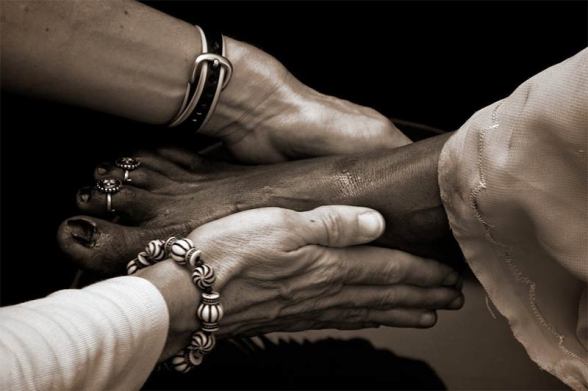
Tonight is Maundy Thursday, when we co-celebrate Jesus’ washing his disciples’ feet and Jesus’ institution of the Lord’s Supper (also known as the Eucharist or Mass). This year we read about these events in John 13:1-17 and 1 Corinthians 11:23-26. (I’ve preached about some of this before in a chapter in my book entitled the Kenotic U.)

What stands out for me this year is the extent of Jesus’ willingness to humble himself and serve humanity. Remember that this is God the Son we’re talking about. Not just a Rabbi, not just a priest, not a Bishop, not the Pope – God in human human form! Yet, Jesus, knowing his identity, gets up from the dinner table and strips down to his undergarments and dons a towel and washes the feet of his disciples. Peter, is so uncomfortable with this demonstration of humility from his master. And one wonders about Judas, who has already decided to betray Jesus, and Jesus already knows this – yet Jesus washes Judas’ feet also.

And he offers them his body – broken for us – and his blood – shed for us – for our salvation. He calls us to remember this every time we sit down for a meal. For Christians who follow the sacramental tradition – like us Anglicans – we celebrate this Eucharist at least once a week, because we regard this as the central demonstration of God’s love for us and so we re-enact Jesus great service to humanity.

Jesus whole stance, throughout his life, was one of servanthood. He is the lamb of God, foreshadowed by the Exodus story in Exodus 12:1-14. A life of sacrifice, of service, of humility, of love, of other-centredness.

After washing their feet, Jesus gets up and dresses again and takes up his place at the table and teaches them:

“Do you understand what I have done for you? You call me ‘Teacher’ and ‘Lord,’ and rightly so, for that is what I am. Now that I, your Lord and Teacher, have washed your feet, you also should wash one another’s feet. I have set you an example that you should do as I have done for you. Very truly I tell you, no servant is greater than his master, nor is a messenger greater than the one who sent him. Now that you know these things, you will be blessed if you do them.

And shortly thereafter he summarises his entire ministry (John 13:34-35):

A new command I give you: Love one another. As I have loved you, so you must love one another. By this everyone will know that you are my disciples, if you love one another.

May God give us the courage to walk his path of service.

Featured image from: https://clergystuff.com/daily-devotions/a9up3ynpgva5w35rwzbhqaj9zjy7pz

Into the dark

Today is the Wednesday of Holy Week. In tonight’s reading, from John 13:21-30, we read the catastrophic narrative of Judas’ decision to betray Jesus. Judas makes a conscious decision to betray his Lord, and thereafter Satan enters him, and then he goes into the night, into the dark. He makes a choice to turn away from the light. He abandons his belief in the light, ceases to walk in the light (choosing rather to walk in the dark) and relinquishes his sonship of God – all the things we reflected on last night in the message ‘Into the light‘. It is a tragic story, as when Judas finally realises what he has done, he can find no forgiveness and takes his own life. There is a cautionary tale in this – to believe in the light, to walk in the light and to become children of light.

Watch the video of this message at https://fb.watch/4AvYOqTk25/. The reading starts at about 20 minutes into the recording, while the sermon starts at about 31 minutes and runs for 14 minutes.

Featured image from: https://assets.archpaper.com/wp-content/uploads/2020/09/DarkMatterUniversity_Primary.jpg

Into the light

Click here to watch the video of this sermon. It is a visually driven message so good to watch if you can. The Gospel reading starts at about 17 minutes, and the sermon starts at about 35 minutes and lasts 22 minutes.

https://fb.watch/4zbbA1Fosv/

Today is the Tuesday of Holy Week. We continue with John 12, focusing today on vv 20-36. I preached on this just a few days ago – a message titled Following Jesus, which you can access here. Tonight I want to focus on just the last two verses of this passage:

Then Jesus told them, “You are going to have the light just a little while longer. Walk while you have the light, before darkness overtakes you. Whoever walks in the dark does not know where they are going. Believe in the light while you have the light, so that you may become children of light.” When he had finished speaking, Jesus left and hid himself from them.

In these two verses, Jesus uses the word ‘light’ five times in reference to himself. This reinforces yesterday’s sermon, Light in the centre, where I emphasized in a drawing that Jesus is the light at the centre of all of life’s complications, and that the centre light is where we most want and need to be.

Jesus stresses in tonight’s passage that the light is surrounded by darkness and at risk of being overtaken by darkness and that the light will not be with us for long – just a little while. We get the sense that the Light of Christ is precious and to be embraced. Light is something beautiful, wonderful, fragile, exceptional and desirable. We want the light!

And then Jesus gives us three instructions:

  • Believe in the light. Jesus is himself the light (John 1:4-9 and John 14:6), so to believe in the light is to believe in Christ.
  • Walk in the light. Jesus says he is the way and the light (John 14:6). We want to walk in the light, not in the dark. In the dark we get hurt and lost, but in the light, we cannot put a foot wrong.
  • Become children of light. Paul writes, “Now if we are children, then we are heirs—heirs of God and co-heirs with Christ” (Romans 8:17). This adoption as children of God, children of light, is an incarnation of the Spirit of God into us, as God makes our bodies a temple for Holy Spirit.

As we journey out of church into the darkness, and we journey through the various darknesses in the world around us (rape, abuse, racism, social exclusion, poverty, Covid, xenophobia, and so the list goes), let us believe in the light, walk in the light and become children of light. When we do that, we become God’s light-filled presence in a world that is much in need of light.

Light in the centre

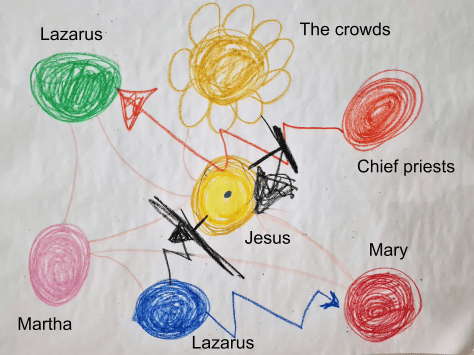
Today is the Monday of Holy Week. We read the story (John 12:1-11) of a dinner party hosted by Lazarus (whom Jesus had raised from the dead) and his sisters, Mary and Martha. During the dinner, Mary anoints Jesus’ feet with extremely expensive perfume and is reprimanded by Judas, who wants the money for himself. Meanwhile, crowds gather around the house, not only to see Jesus, but also to see Lazarus – the man back from the dead. And the chief priests plot to kill Lazarus, because his resurrection was adding to Jesus’ popularity.

In the midst of all this turmoil, Jesus is a quiet, strong, protective, light-filled centre. It is towards and into this centre that we should move when life’s challenges build up around us.

I invite you to watch the reading of the Gospel from John 12:1-11, which starts at about 14 minutes into the service. And the sermon starts at about 22 minutes and runs for about 23 minutes. This is a visual sermon, mapped out on a flipchart, so you really do need to watch it and not just listen to it. May you place yourself in the centre of Christ, in his light and peace – the best place to be!

Watch the video by clicking here: https://fb.watch/4xReFll03A/

Passion of Christ (according to Mark)

Today, instead of a sermon, we listened to a reading of the Passion of Christ, from Mark chapters 14 and 15, using the JB Phillips translation. You can listen to the audio recording of the reading here. Or you can watch the video of the reading on Facebook here (the reading starts at 30 minutes). The reading takes 27 minutes.

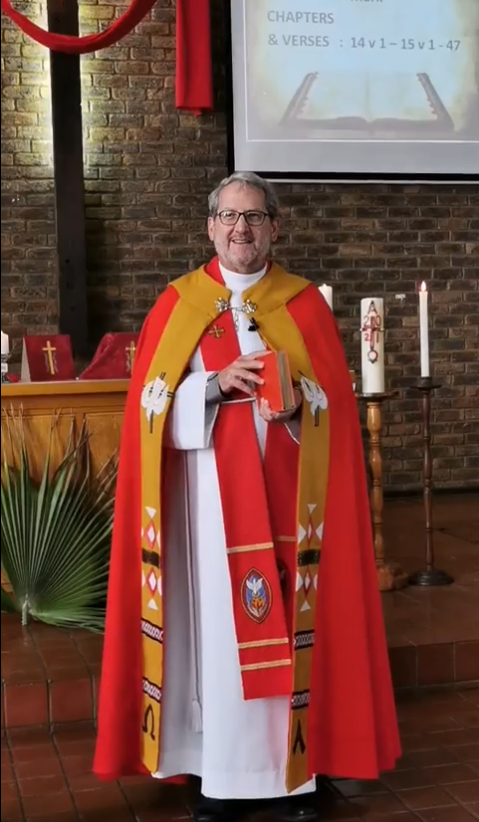
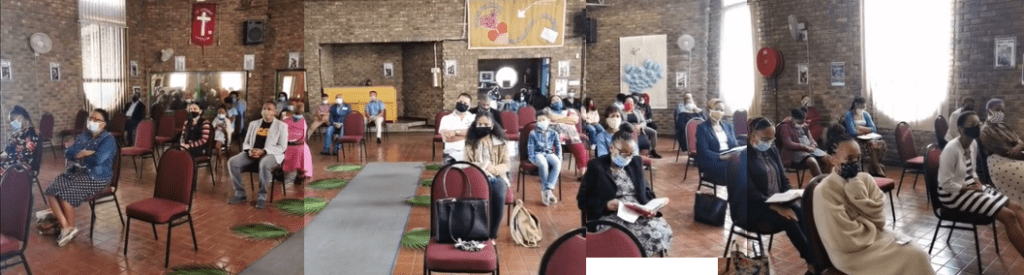
Below are a few photos of me reading and a composite photo of our in-house congregation.

Following Jesus

Click here to listen to the audio recording of this 16-minute message. Or watch the video on Facebook (message starts at about 20 minutes). Or read the text summary below.

John 12:23-28 narrates Jesus’ thoughts about his journey towards the cross.

Regarding his own death he shares:

  • Jesus describes his crucifixion as his “glorification”. He recognises that his journey to and through the cross will culminate in his glorification. So he ironically uses these terms interchangeably.
  • Jesus makes sense of his journey through the metaphor of ‘one for many’: if a single seed refuses to die, it remains one seed; but if it dies, it produces many seeds. In other words, through the the death of one man (himself) there is life for many (salvation of humankind).
  • Jesus is genuinely troubled, disturbed, in dread of this path that he has been called to follow. The journey to the cross is not easy for him. He wishes there could be an easier route. Let us not be glib in our perception of Jesus’ mission.
  • Yet he resolves himself to his mission, his reason for coming and to the glory of God.

In the midst of this narrative, Jesus calls us to follow this same path:

  • If we want to serve him, he says, we must follow him and be where he is. And where he is at that moment is on the journey towards the cross. That is where we must follow him.
  • For sure, when we follow him, there will be glory – just as for him. Our Father will honour us if we serve Christ. But that is in the future. For now, we are called to a present path of suffering.
  • He cautions us to not hang tightly to this life, to be in love with this life. If we do, we will lose it. Rather, we must almost hate this life, by comparison, and rather invest in the life that is yet to come.
  • Many churches are teaching that Jesus’ desire for us is for our wealth, happiness, success, possessions and power. But there is no hint of such teaching from Jesus in John 12. Rather, we are to spurn such trappings of this life, and journey with him on his path.

During these last days of Lent, Jesus is calling us to journey alongside him towards the cross. Let us immerse ourselves in his journey. Let us walk close beside him. Let us accept the path of humility, service, laying ourselves down, suffering and dying to self and to this life.

Featured image by David Byrne, from http://monolandscapes.net/portfolio/cross-road

One with God

Click here to listen to the audio recording of this 6-minute message. Or watch the YouTube video below.

In John 5, Jesus is accused of considering himself “equal with God”. And in his response (in verses 19-23), instead of defending himself, Jesus actually confirms the charge:

Jesus gave them this answer: “Very truly I tell you, the Son can do nothing by himself; he can do only what he sees his Father doing, because whatever the Father does the Son also does. For the Father loves the Son and shows him all he does. Yes, and he will show him even greater works than these, so that you will be amazed. For just as the Father raises the dead and gives them life, even so the Son gives life to whom he is pleased to give it. Moreover, the Father judges no one, but has entrusted all judgment to the Son, that all may honor the Son just as they honor the Father. Whoever does not honor the Son does not honor the Father, who sent him.

Jesus considers himself one with God – he and his father are one. They are equal, one being, even though he clearly shows that they are not the same person – for example, the Father does not judge; that role is given to the Son. But there is a closeness and alignment of purpose and desire between Father and Son (and also Holy Spirit) that leads us to the doctrine of the Trinity.

Given close unity between Father and Son, we also should strive to be one with God – to act in accordance with God’s will, to align our desires and intentions with God’s, to adopt as our own God’s values and priorities. Jesus is our example for all life. Let us become one with God.

Featured image of an Ethiopian icon of the Trinity
from https://www.reddit.com/r/OrthodoxChristianity/comments/jgjbqe/ethiopian_orthodox_icon_of_the_holy_trinity/

God’s open arms

Click here to listen to the audio recording of this 15-minute message. Or watch the video on Facebook here (the message starts at about 27 minutes). This message is strongly visual, so I recommend you watch the Facebook video rather than listen to the audio, though you’ll need to turn the sound up a bit.

God has always been working for our salvation and continues to do so today. This work culminates the life, death and resurrection of Christ, hence Jesus says we need to be born again. This salvation work is motivated by God’s great love, kindness, mercy and grace towards us (Ephesians 2: 1-10). Even though we were dead in our transgressions and sins – deserving of God’s wrath – God does everything to save us. Jesus himself says, “For God so loved the world that he gave his one and only Son, that whoever believes in him shall not perish but have eternal life. For God did not send his Son into the world to condemn the world, but to save the world through him” (John 3:14-21).

  • God’s stance towards you is always open armed – always.
  • God is always open towards you even if you don’t believe in him – always.
  • God is always moving towards you – always.
  • God is always turned towards you, even when you turn away from him – always.
  • God is always turned towards you, even when you sin – always.
  • God always reorientates himself towards you as you move through life – always.
  • God is always positively disposed towards you – always.
  • God always loves you – always.
  • God is always kind towards you – always.
  • God is always full of grace and mercy towards you – always.
  • God is always hoping you will respond to him – always.
Featured image from https://www.thebalancesmb.com/christ-the-redeemer-construction-facts-844362