Resurrection Life

???????????????????????????

Click here to listen to the MP3 of this 18 minute sermon.

Today is the first Sunday after Easter and we centre our thoughts on the resurrection and what it means for us. In John’s Gospel, resurrection is virtually synonymous with Life, and so this sermon is about the Resurrection Life. Jesus says, “I am the Resurrection and the Life”. He also says, “I have come that they may have life, and have it to the full”.

I am including the readings from John (New International Version) so that you have them readily at hand.

Love, peace and joy
Adrian

________________________________________________________________________________

Resurrection and Life are intimately tied together in Jesus

  • Jn 11:25 – Jesus said to her, “I am the resurrection and the life. He who believes in me will live, even though he dies;

Jesus repeatedly speaks as if he embodies Life itself

  • Jn 1:4 – In him was life, and that life was the light of men.
  • Jn 5:26 –  For as the Father has life in himself, so he has granted the Son to have life in himself.
  • Jn 6:63 – The Spirit gives life; the flesh counts for nothing. The words I have spoken to you are spirit and they are life.

Jesus repeatedly says that he IS Life

  • Jn 14:6 – Jesus answered, “I am the way and the truth and the life. No one comes to the Father except through me.
  • Jn 6:48 – I am the bread of life.
  • Jn 8:12 – When Jesus spoke again to the people, he said, “I am the light of the world. Whoever follows me will never walk in darkness, but will have the light of life.”

Jesus repeatedly says that we obtain Life through him

  • Jn 10:10 – The thief comes only to steal and kill and destroy; I have come that they may have life, and have it to the full.
  • Jn 4:14 – but whoever drinks the water I give him will never thirst. Indeed, the water I give him will become in him a spring of water welling up to eternal life.”
  • Jn 6:27 – Do not work for food that spoils, but for food that endures to eternal life, which the Son of Man will give you. On him God the Father has placed his seal of approval.”
  • Jn 6:35 – Then Jesus declared, “I am the bread of life. He who comes to me will never go hungry, and he who believes in me will never be thirsty.
  • Jn 6:51 – I am the living bread that came down from heaven. If anyone eats of this bread, he will live forever. This bread is my flesh, which I will give for the life of the world.”
  • Jn 6:54 – Whoever eats my flesh and drinks my blood has eternal life, and I will raise him up at the last day.

Jesus repeatedly says that we must believe in him to gain eternal life

  • Jn 3:16 – “For God so loved the world that he gave his one and only Son, that whoever believes in him shall not perish but have eternal life.
  • Jn 17:3 – Now this is eternal life: that they may know you, the only true God, and Jesus Christ, whom you have sent.
  • Jn 5:24 – “I tell you the truth, whoever hears my word and believes him who sent me has eternal life and will not be condemned; he has crossed over from death to life.
  • Jn 6:40 – For my Father’s will is that everyone who looks to the Son and believes in him shall have eternal life, and I will raise him up at the last day.”

Being God’s Beloved: Talk 5: God’s Love Revealed Through The Cross

This is the fifth and final talk in the series on “Being God’s Beloved”, presented at St Martin’s Anglican Church, Irene, South Africa, on 9 April 2014. We conclude the talks by focusing on the Cross and Resurrection, and the way in which the sequence of events over the Easter weekend reveals God’s love to us.

Click here to open the video from YouTube

Being God’s Beloved: Day 33: The Cross and Redemption

Yesterday we reflected on how Jesus, hanging dying on the cross, looks down and sees, really sees, his mother and his best friend John, and how he extends himself for their benefit, establishing a new community, a new family. In so doing, he begins to undo the effects of sin – those effects that fragment and rupture relationships, which we have repeatedly seen are central to God’s experience of being God.

Luke 23 relates another encounter of Jesus with the people around him. This version does not explicitly say that Jesus saw or looked at them, but given the depth of his responses, it seems fair to accept that Jesus did see them.

Jesus is crucified with two criminals. The one “hurled insults at him: ‘Aren’t you the Christ? Save yourself and us’” (Luke 23:39). The English “hurled insults” is, in the Greek, eblasphemei, from which, of course, we get our English word, ‘blaspheme’. It is amazing, but sadly true, to what extent arrogance and hostility towards God can continue even in the midst of judgement and suffering. This man, on the brink of death, continues to express bitterness and rage against the best that the world has to offer.

The other criminal, however, recognises that Jesus has no reason for being there – he is innocent and undeserving of death: “But the other criminal rebuked him. ‘Don’t you fear God,’ he said, ‘since you are under the same sentence? We are punished justly, for we are getting what our deeds deserve. But this man has done nothing wrong’” (Luke 23:40-41).

What is most striking about this man is this combination of taking ownership of his own wrongdoing and resultant punishment, and recognising Jesus’ innocence and thus unjust punishment. And then, to cap it all, he says, “Jesus, remember me when you come into your kingdom” (Luke 23:42). Not only does he recognise Jesus’ innocence, but he also recognises Jesus as Lord and King. He takes a remarkable leap of faith.

Perhaps Jesus ignored the taunts of the first man. But the second man catches his attention. Jesus responds, as he always has, to expressions of faith, no matter how profound (here we think of Peter’s “You are the Christ, the Son of the living God” in Mathew 16:16, or Thomas’ “My Lord and my God” in John 20:28) or how tentative (perhaps the woman who was bleeding in Mark 5:28).

Jesus replies, “I tell you the truth, today you will be with me in paradise” (Luke 23:43).

This is redemption. Today, this very day, you will be with me, in paradise with me. Truly, I tell you. Amen!

Jesus Christ redeems this man on the cross. Here, as we saw yesterday, Jesus extends himself, beyond himself, to care for another human being. It is instinctive for him to do so. It was so throughout his ministry. It was so as he hung dying on the cross. And it remains so today. Christ Jesus extends himself for those who turn towards him.

One of the amazing things that we can take out of this narrative is the fact that this criminal could do nothing to win his salvation. He was nailed to a cross. He could not get baptised or confirmed. He could not sign a membership form at the local church. He could not take Holy Communion. He could not serve in God’s mission. He could not make amends to the people he had harmed while doing crime. He could do nothing to earn his salvation. He could not even work out his salvation with fear and trembling (Philippians 2:12). All he could was to turn to Christ in faith and receive the salvation offered to him.

This is a profound example of salvation by grace through faith. Paul says, “For it is by grace you have been saved, through faith – and this not from yourselves, it is the gift of God – not by works, so that no one can boast” (Ephesians 2:8-9).

  • Salvation by grace means that salvation is something that God gifts to us – it is not earned or deserved. Indeed, this criminal deserved to be punished (perhaps not on a cross, but in some way he had earned punishment). Salvation was not something he deserved. And yet God extends salvation to him anyway.
  • Salvation through faith means that once salvation is gifted to us, we receive it on faith, by just accepting it, empty-handed, open-hearted – we just accept it. The criminal shows us salvation through faith because his hands are nailed to a cross – he can do nothing but receive what Jesus offers him.

Sometimes we tie ourselves up in knots over redemption. We know that we are saved by grace through faith, but we still feel that we have to do something to earn it. We must pray so much per day or read so much per day or attend church so many times or tithe so much or serve so much or feel remorseful so often or perform so many rituals. Any or all of these things may help us to work out our salvation – to enrich and express our salvation as we journey through life – but they add absolutely nothing to our being saved.

This is redemption. We are saved only by the mercy of God – by grace through faith – who loves us so much and so unconditionally that we are offered this gift as a gift; no strings attached, no small print, no terms or conditions.

But imagine, if you will, that there is a small family gathered near the cross. They are there to watch the execution of the criminal. He did something terrible to this family. Perhaps he raped their daughter or murdered their father. They have come to see him die, to satisfy their rage and grief. And they hear Jesus offer these words of reassurance to this criminal – the promise of salvation and life in paradise. How hard that must have been for them! He in paradise, while their loved one lies maimed or dead.

God’s capacity to forgive is far greater than ours. And as much as we want God to save us, we may want God to not save certain other people. That is human. But God is not human. God loves you. God loves all of us – even criminals, even monsters, even the most evil person you can imagine. It is terribly hard for us to get our hearts around this, and sometimes we cannot accept it; sometimes we deeply desire to reject this. But God still loves them and desires their salvation and works to reconcile them to God.

This is the great and challenging message of Christ regarding forgiveness and salvation – it is open to everyone, even those we deeply desire to not have it. All we can do is trust that God’s love is all embracing. All we can do is believe that God knows people’s hearts – ours and theirs. All we can do is pray to have God’s heart and God’s eyes.

This is redemption. Other people are saved only by the mercy of God – by grace through faith – who loves them so much and so unconditionally that they are offered this gift as a gift; no strings attached, no small print, no terms or conditions.

Just before this narrative about the criminals, Luke tells us that Jesus said, “Father, forgive them, for they do not know what they are doing” (Luke 23:34). This is the theme of this passage of Luke. Redemption or salvation is about forgiveness – undeserved, unmerited. God forgives out of the generosity of God’s love, out of God’s persistent desire to reconcile with us, to be in relationship with us. For us, forgiveness is a hard thing to do. But for God, forgiveness is an inevitable expression of persistent love.

Here, Jesus, having just been hung up to die, prays that God will forgive those who crucified him. He sets an example that very few of us can emulate. For me, forgiveness is something that I journey towards over time. It is not an on-off switch. It is a repetitive, spiral process of increasingly letting go of anger and of my sense of being entitled to retribution or compensation. And psychologically, I think that is right for us as frail human beings. But Jesus sincerely forgives in that moment and opens his heart to those who have harmed him, those who have taken his life.

This is redemption. God chooses to let go of anger and of the fully justified right to exact punishment or retribution. Divine forgiveness is God choosing to set us free of the debt that we owe for our sin, with the hope that we will reconcile with God. And that freedom is salvation.

Jesus promises the second criminal that they will be together in “paradise”. The Greek word here comes from a Persian word meaning garden. Many of us think of paradise as puffy clouds and white robes and harps – all rather ethereal and disembodied. But Jesus was thinking of something quite tangible and earthy – a garden! With trees, and shrubs, and grasses, and flowers, and soil, and birds, and insects, and lizards, and a stream running through it.

This is redemption. For Jesus, paradise is a return to the Garden of Eden. This is a turning back of world history, a turning back of the consequences of sin, a turning back of evil and judgement. To be saved is to return to Eden – to that garden in which our ancestral mother and father dwelled in harmony with God, with each other, with the world and with themselves – humanity prior to the Fall. Paradise is that place where everything that went wrong with us has been made right again.

Paradise is the place where we fully love and are fully loved by God. This is redemption.

Meditation for the Day

Reflect on the meaning of redemption. And on divine forgiveness. What does it mean to you that God has redeemed, saved and forgiven you? What does this say about your being God’s beloved?

Prayer for the Day

Oh Lord, my redeemer, my saviour, I thank you for your freely-given gift of forgiveness and reconciliation. How amazing is your love! Help me to take hold of this salvation, to fully accept it, to immerse myself in it, so that I may be transformed by your love into the image of your beloved Son.

Being_Gods_Beloved_square_3

Being God’s Beloved: Day 31: The Cup of Suffering

Today we start a week of reflection on the cross. The cross is, for most Christians, the centre of their faith – the key representation and demonstration of God’s love. If we want to know what God’s love looks like, they say, look at the cross, for it is here that we see the extent to which God is willing to sacrifice on our behalf. However, the cross is also a picture of pain and suffering. It raises profound and difficult questions for all of us as to why it was necessary for Jesus to endure such agony on our behalf. Why does the Father allow the Son to suffer so? These questions are particularly poignant for those who have suffered in abusive relationships.

And so, as we start this week’s journey, I invite you to be sensitive and generous towards the range of views that there are on the meaning of the cross and the different spiritual responses that it evokes in people of genuine faith. You may not agree with everything you read this week – that’s okay. Just consider what you read, mull it over, and use it to strengthen your own understanding.

After the Last Supper, Jesus goes into the garden of Gethsemane to pray. Matthew 26:36-46 narrates this event in great detail and with much pathos. He uses a great deal of emotive language to describe Jesus’ experience, more than any other section of the Gospels: Jesus was sorrowful and troubled, overwhelmed with sorrow to the point of death.

Matthew does this to highlight for us as readers that this experience was among the most challenging for Jesus. It serves to guide us into a deep appreciation for the tremendous psychological and spiritual conflict that the cross evoked in Jesus. This was no walk in the park! We should think about Gethsemane as the central crisis in Jesus’ ministry. Although the cross itself was profoundly traumatic, it is in Gethsemane that Jesus must confront the horror that lies before him and choose whether or not to follow that path. Choice is often the hardest part of a difficult course – once chosen, the taking of the course is acceptable.

Sometimes when we think about the cross, we split the human and divine natures that coexist in the person of Jesus Christ. We may say, for example, that it was Jesus’ human nature that suffered or doubted, while his divine nature was protected from suffering and not vulnerable to doubt. But this creates an artificial split in the whole person of Jesus Christ that is at odds with our belief that the two natures are fully present and indivisibly connected in the one person. Think of the crisis as involving Jesus’ whole person and then one gets some sense of the awful bridge that he faced and had to cross.

In this passage, Jesus speaks about a “cup”, which we should understand as a metaphor for the suffering that he must endure. It is the Cup of Suffering. Three times he prays about it. First, in verse 39, he asks God to take it away from him. The second time, in verse 42, he asks that if it is not possible for it to be taken away, that God’s will might be done through it. What we are seeing in these two brief verses is a summary of an extended and heart-wrenching grappling with God. Jesus here is fighting with God much like Jacob did with the angel at  Peniel (Genesis 32:22-32). Initially Jesus wants to be utterly rid of the cup. Yet he recognizes that God’s will for the redemption of humanity is somehow tied up in the dreadful cup. And so he continues to grapple. Later, he reaches a point of recognizing that the cup is inevitable and necessary and prays that his drinking of it will be worthwhile and effective. Yet, still he prays the same thing for a third time. This is no easy prayer, and acceptance of the path of suffering is hard in coming.

What does Jesus see as he looks into the cup?

He sees the dregs of humanity. Everything about us that is wrong is in that cup – the cup of suffering. It is full of our hatred, our unbelief, our selfishness, our pride, our arrogance, our apathy, our anger, our petty mindedness, our stigma of and discrimination against those who are different from us, our quickness to judge and belittle, our fear, our lust and greed, our tendency to turn away from God rather than towards God. The Cup of Suffering is a Cup of Sin.

Jesus looks into this Cup of Suffering. He does not want to drink it. It fills him with horror! It fills him with terror, shock, despair. This Cup of Suffering is the most awful thing he has ever encountered. He wants to get as far from this Cup as he possibly can.

Let us remember that Jesus was without sin. He had never sinned. Of course, he had lived his whole life in the midst of sin – his parents, his brothers and sisters, his friends, his disciples and those he ministered to were all sinful human beings, just like me and you. Jesus was not unaware of or protected from sin. But he had never experienced sin in his own body, in his self. Drinking this Cup of Suffering entailed a personal encounter with sin. For the first time he would know sin – really know sin. He would take that sin, our sins, into himself, onto himself, and experience it first hand. It terrifies and horrifies him.

“My Father, if it is possible, may this cup be taken from me. … My Father, if it is not possible for this cup to be taken away unless I drink it, may your will be done.”

Eventually, Jesus, realising and sharing the Father’s will, looks into the Cup of Suffering. He stares into the depths of human depravity, brokenness and sin. It is ugly.

But as he gazes, he begins to recognise that the Cup of Suffering is not just a cup of sin in the abstract. Rather, it is a cup of the sins of people: people with lives, with histories, with relationships, with hopes and fears, with conflicting and contradictory feelings, thoughts and behaviors. People with names. People he loves. Jesus starts to recognize names: Adrian, Trina, Erin, Anne, Michael, Theo, Nancy, John, Marianne, Cathy, Keith… He recognizes me. He recognizes you!

This Cup of Suffering is not merely a cup of horror. It is also a cup of people! It is not just a cup of sin. It is also a cup of love! These are God’s beloved. These are Jesus’ beloved. These are the ones he came to earth for in the first place.

These are the beloved. That changes everything!

It does not make the cup any easier to drink. It does not take away the horror. But it provides meaning and purpose. And meaning and purpose provide motivation. And motivation generates resolve. “May your will be done.”

Jesus decides to drink the Cup of Suffering.

The cross is a drinking of the Cup of Suffering. On the cross, Christ drinks the dregs of humanity. He drinks the dregs of me. He drinks the dregs of you. He drinks because he loves. He loves me. He loves you. And so he drinks. Were there another way, he’d have seized it with both hands. This was a deep and bitter cup. But realizing there was no other way and embracing his love for you and me, he drinks, to the bottom.

“Father, into your hands I commit my spirit.”

And then a remarkable thing happens! A miracle!

The Cup of Suffering is transformed into the Cup of Salvation.

It seems impossible, but it happens. By God’s grace and mercy, by the triune God’s extravagant and unmerited love, a love that is willing to risk everything, the Cup of Suffering becomes the Cup of Salvation.

This shocking event that we call ‘the cross’, which was intended to destroy – to annihilate – the Son of God, becomes the preeminent means of grace. The horror of the cross is transformed into the path of redemption. This place of hatred becomes, by God’s generosity, a place of supreme love.

It is the triune God who works this miracle for us. The cross itself is inherently an object of suffering and death. There is nothing glorious about it. It is not to be admired. It is a symbol of shame, of the worst that humanity can dish up. But God redeems this symbol, showing God’s capacity to redeem even the very worst of humanity, to transform what is most ugly into what is most beautiful. The Cup of Salvation!

The cross can and should evoke in us conflicted responses. On the one hand, we should shudder with disgust and shame, we should flinch away from the terrible thing that we did to God’s one and only, God’s delight, God’s Son. But on the other hand, we should be amazed at the profound expression of love, demonstrated by Jesus, in drinking the Cup of Suffering. And we should be in awe of God’s ability to transform evil into good, shame into glory, death into life.

This Gethsemane partnership between Jesus and his parent, God, establishes a model or a path that we experience as we journey in faith with God. God, our parent, takes everything that is broken about us, and transforms it into something beautiful and whole. Those many aspects of our own lives that are wrong, turned away from God, even evil, are able to be changed into something good, something that honours God, something divine. If God was able to transform the Cup of Suffering into a Cup of Salvation, surely God can transform one individual, transform you!

Meditation for the Day

Reflect on the Cup of Suffering that confronted Christ Jesus. What sins of yours were in that cup? Take ownership of your own contribution to Jesus’ ordeal. How could Jesus’ transformation of the cup be evidenced in His transformation of you?

Prayer for the Day

Precious Saviour, I am sorry for my sin that you chose to drink on the cross. Please forgive me. Thank you for your amazing demonstration of love in both drinking and transforming the Cup of Suffering. Please transform me.

Being_Gods_Beloved_square_3

Jesus, the Second Adam

Click here to listen to this 21 minute audio recording of today’s sermon.

In Romans 5, Paul draws parallels between Adam and Jesus (who he refers to in 1 Corinthians 15 as the first man and second man) showing both similarities and differences between them. This is a profound insight by Paul, who recognises that Adam’s (and Eve’s) actions introduced sin and death into the world for all humans, while Jesus’s actions undid sin and death and brought grace, justification, righteousness and life into the world for all humans. In this sermon, which includes quite a bit of congregation participation, I tease out this parallel. I also apply it to a view of the whole scripture as a love story in which God works to undo the negative effects of Adam and Eve’s Fall.

It will help to have Genesis 3 and Matthew 4 open in front of you before you start to listen.

I wish you God’s blessings as you journey through Lent.
Adrian

Christ – The Delivered Deliverer

Click here to listen to this 28 minute sermon.

Today we study the passage from Matthew 2: 13-23 which reports on the flight of Joseph and his family from Bethlehem to Egypt and his later return to Nazareth in Galilee. It will be helpful if you have a copy of the passage in front of you before you listen to the recording. If you can’t lay your hands on one quickly, here is a link to an online Bible.

Sometimes, when we read this and similar passages, we get caught up in the events of the narrative and lose sight of the theological meaning that Matthew wove into the text. We read the scripture from our own, Gentile perspective, rather than from the perspective of Matthew’s audience – Jewish Christians, steeped in the Old Testament narrative and theology. In this sermon we peel back the layers to uncover some of the deeper messages that the original readers would have understood.

What we get from this is a deeper insight into Jesus as saviour and redeemer. At one level, the story is about the infant Jesus delivered from a paranoid and violent ruler (Herod). At a deeper level, the story is about Jesus as the deliverer of humanity, the new Moses inaugurating a new Exodus, embodying the new and true Israel.

May Christ rise in your heart as you reflect further on the great miracle of God coming into the world in the person of Jesus of Nazareth, the long awaited Messiah.

Reflecting on the Incarnation

Click here to listen to a podcast of this 23 minute sermon.

Today is the start of Advent, that season in which we reflect back on Christ’s entry into the world some two thousand years ago and anticipate his coming again, one day, in glory. Western Christians (in contrast to Eastern Orthodox Christians) have tended to reduce Advent to a celebration of Christmas – the birth of Jesus. But the incarnation properly starts at conception. Somehow – who knows how! – God spliced himself into Mary’s egg. The incarnation is a full blending of human and divine in the individual called Jesus. It is a profound mystery that I really cannot explain. But we assert that Jesus is both fully God and fully human. What we learn from the Orthodox tradition is that this is the central event in Christian history – that in the incarnation God changed the course of history forever – changing the genetic makeup of humanity and opening up a spiritual path that had til then been closed.

In this sermon I try to unpack this in terms of two central theologies:

  • The notion of kenosis, that God emptied himself in order to merge with Mary’s egg – emptied of omnipotence, omniscience, omnipresence – to be teeny tiny small; left the eternal and perfect union between Father, Son and Spirit in order to join with humanity; immersed himself into human experience with all its sorrows and joys. Kenosis is a profound and radical expression of God’s love for humanity. What else could prompt such an extravagant and risky venture?
  • The notion of theosis, that the chasm between God the uncreated and humans the created creatures was closed when God became human, thereby opening a path for humans to participate in the divine. That God would have incarnated even if humanity had not fallen. That the purpose for Jesus coming into the world was not merely to die on the cross, but to pioneer a path for humanity to reconcile with God. Theosis points us towards hope – hope for the future, hope for what God is able to achieve in us, hope for the coming transformation and restoration.

This is a rather cerebral sermon – be warned! It invites us to engage with ways of thinking about the incarnation that may be unfamiliar to us. Don’t feel obliged to agree with what I say – I myself am not sure about all of it! But engaging with different Christian perspectives can be deeply enriching. I do, however, assert that Love and Hope are key Advent themes, and hope that these reflections on kenosis and theosis may provide some food for thought to underpin these themes.

Oh, and it is World Aids Day today, so I attempt to make some links from all of this to the ongoing fight against HIV and Aids.

Blessings and joy during this season!

Persevere in Faith

Click here to listen to the podcast of this 20 minute sermon.

Sometimes our faith flags – God seems absent, silent, unresponsive; our hearts feel dry and dusty; we are thirsty, but barely know we’re thirsty. Sometimes the world around us presses in and squashes our faith – the demands are so great, so burdensome, that it is hard to remain connected to God. Sometimes people say things or we witness or experience things that shake our confidence in God – how could a good God allow these things to happen, how can a rational person believe in God?

All of us experience ups and downs in our faith journeys. We are, though, encouraged to persevere in our faith through the dry times, in the hope that better days will come. Today, here in Pretoria, South Africa, we are experiencing our first real rain after the long dry winter. What a blessing when the rains finally come! The ground sucks it up and brings new life. What a blessing it is when God’s Spirit falls afresh on us after a period of drought!

This sermon speaks about persevering in faith – about hanging on to God, about clinging to the Word of God, about staying in touch with other Christians. It is about continuing to walk in faith, even if not in feelings or experience, praying that God will rekindle our faith, restore our hope, bring the fresh rains.

It draws on four readings:

  • Luke 18:1-8 – “Always pray and never give up”
  • 2 Timothy 3:14 – 4:5 – “Continue in what you have learned”
  • Jeremiah 31:27-34 – “God’s Law is written on our hearts”
  • Psalm 119:97-105 – “Thy Word is a lamp unto my feet”

Love, peace and fresh rains
Adrian

Tithing

Click here to listen to the podcast of this 25 minute sermon.

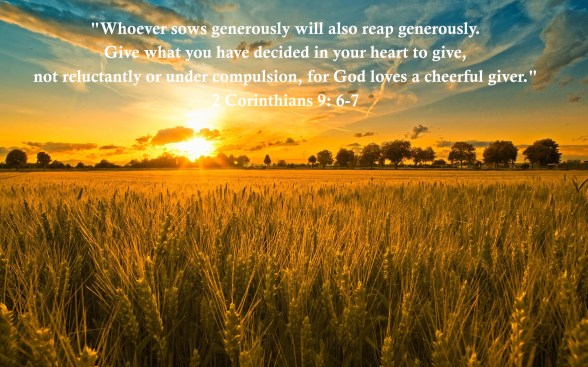
Money is a touchy subject for many Christians and particularly in some Christian denominations. In our church, our giving is extremely private – our financial contributions are known only to ourselves and one other person (the dedicated giving recorder, who keeps a record of monies received). So discussing money is sensitive.

In this sermon I map out four principles of money matters in the church, on the premise that our thinking about money is in need of transformation. Paul says that we need to be transformed by the renewing of our minds, so that we can test and approve God’s will. Finance is an area in need of transformative, sanctified thinking.

  • The first two principles speak to how we think about our own money:
    • Everything we have belongs to God
    • God has entrusted everything to our care and for our use.
  • The second two principles speak to how we think about giving:
    • Our giving should be in proportion to what we have
    • Our giving should emanate from our confidence in God’s trustworthiness

I advocate a particular position on the ten percent tithe that not everyone will agree with. As it is, tithing is hotly debated in the church. I think that my position is aligned with Jesus’ approach to Old Testament Law. Listen and see what you think.

When all is said and done, we have a unique opportunity to participate with God in God’s great work in the world. One of the ways of participating is through our financial giving. What a privilege to partner with God in the work of bringing into being God’s Kingdom on earth!

Love and peace
Adrian

The Passion of our Lord Jesus Christ (according to Mark)

Pietà, by Giovanni Bellini (1505)

Click here to listen to the podcast of the Passion of Jesus Christ, according to St Mark.

Holy Week (from Palm Sunday to Easter Sunday) climaxes today (Good Friday) as we commemorate the death of Jesus Christ. It is the high point, or perhaps more accurately, the low point of the Christian year, because it is through Christ’s death that God’s works God’s ultimate act of salvation and redemption. It is also the day when our hearts break, because it is we ourselves who put Jesus there.

It is tradition in the Anglican church to read the whole passion narrative on Palm Sunday, and this post links to a recording of that reading that I did in 2012. It is taken from J.B. Phillips translation of the New Testament, a translation (actually, a paraphrase) that I find fresh and beautiful. It is the whole of Mark 14 and 15, starting with the anointing of Jesus at Bethany and ending with Jesus’ burial – 22 minutes of recording (click here).

I am also uploading a reflection on Holy Week that I prepared a couple of years ago, but have not previously shared here. Particularly for those who do not observe Holy Week, I hope that this may give you new and helpful insights into this important period in the life of the Christian. It is a written document, which you can download by clicking here.

My prayer is that over these last days of Lent, we will rediscover the meaning of Christ’s death for ourselves and for the world, that we will mourn and repent, and that we will experience new life with Christ in his resurrection on Sunday.

Love and blessings
Adrian