Riding the storm (part 2)

Click here to listen to the audio recording of this 18-minute messages. Or watch the video on Facebook here (the message starts at about 30 minutes into the video). Or read the short summary below.

Last week, we read and reflected on the story from Mark 4:35-41 about Jesus calming the storm (see last week’s message – Riding the storm – here). It’s worth watching or listening to if you missed it. I emphasised three key points:

  1. Jesus is in the boat with us in the midst of the storm. He is not sitting far off watching, dispassionate. No! He is right in the storm with us, in the boat with us.
  2. Jesus controls the storm that buffets and scares us. He is more than capable to put the storm in its place.
  3. Jesus reminds us of the many times before that he has been faithful and capable, so that we can have faith in him, confidence in him, even during the storm.

Today, I want to add two additional stories to this one, so that we can build up our faith muscles when we are weathering a storm. This is particularly important, given that we are in the midst of the third wave of the COVID-19 pandemic, and given that our churches have, once again, closed their doors and moved online for services.

The first story is an echo of the one above and comes from Mark 6:45-51. The disciples are again in a boat on the Sea of Galilee, but this time Jesus is up on the hillside praying. He can see that the disciples have encountered a storm and are struggling. So he walks down the hill and across the top of the water towards the disciples’ boat. They are terrified, thinking he’s a ghost, but he calms them, saying, “Take courage! It is I. Don’t be afraid.” Then he climbs into the boat with them, and the storm calms down. Mark does not say Jesus calmed the storm, but it seems an unlikely coincidence that the storm just happened to subside when Jesus arrived. We learn three important lessons about Jesus when we are in a storm:

  1. Jesus sees the disciples plight and comes to them and speaks words of comfort to them: ‘I am here, it is I, don’t be afraid.’
  2. Jesus climbs into the boat. In the previous story Jesus was already in the boat when the storm arrived. In this story, Jesus climbs into the boat with the disciples in the midst of the strong winds. He chooses to enter the difficult place where they are.
  3. Jesus calms the waves, demonstrating (again) that he is more than capable.

The second story is a healing story, that is located within a larger healing story. The larger story is about Jairus’ daughter who is mortally ill and (it seems) dies before Jesus gets there, because Jesus is delayed by the inner story, which is recounted in Mark 5:24-34. The story is set in a large crowd – many people, all jostling around and up against Jesus, as he walks the streets.

The crowd feels like a storm – buffeting, noisy, knocking up against, pushing, threatening. (Hence the picture for today’s message.)

This is the story of the woman who had been bleeding for 12 years and all her efforts to find a cure were futile. He hears about Jesus and believes that even if she can just touch just the hem of his outer clothing, she will be healed. Even though she is unclean due to her persistent bleeding, she enters the crowd and manages to just touch Jesus’ clothes. And she is fully healed! Jesus can feel that power has gone out of him and wants to see who was healed. We learn three important lessons about Jesus when we are struggling in life’s storms:

  1. Jesus cures her. She merely needed faith, and without him even knowing or intending it, without even actually touching her, she is healed. It is as if Jesus’ natural instinct is to heal and make whole, so it just pours out of him when someone has faith in him.
  2. Jesus knows her. He initially doesn’t know who touched him, but he knows someone did, and when she owns up, he fully engages with her as if the crowd is not even there – like the still centre of a tornado.
  3. Jesus restores her. Her healing is primarily physical. But the result of that physical healing is that she becomes clean again, and thus able to touch other people, able to engage in the life of her family and community, able to participate in her faith.

There are many storms raging around us. Covid is the most public and universal. But there are others: financial concerns, loss of work, mental health issues, substance abuse, marital problems, divorce, illness, death, loneliness, addictions, and so on and so on. The list is almost endless.

But there are three important take-home messages for you today:

  1. Jesus sees you. He sees and knows you right where you are. He knows everything about you and your circumstances, no matter how private you are and no matter how alone you might feel. He sees you.
  2. Jesus joins you. He does not remain remote. He does not watch from a distance. He climbs into your boat, into your life, into your shoes. He is right there with you – so close, there is no gap between you and him.
  3. Jesus acts for you. Jesus calms storms, he banishes fear, he heals disease. He is more than capable and he is more than willing. We just have to reach out to him, to touch the hem of his robe.
Featured image from: https://www.popsci.com/what-to-do-crowd-crush-panic/

Riding the storm

Click here to listen to the audio recording of this week’s 12-minute message (followed by some singing). Or watch the video here on Facebook (the message starts at about 35 minutes).

The disciples find themselves in a boat in the midst of a ferocious storm (Mark 4:35-41). They cry out to Jesus: “Don’t you care?” We sometimes find ourselves in a similar situation. The world seems to swirl around us, exploding, destabilising. We wish for a granite foundation, but instead we are in a boat in the storm; at sea. But the disciples learn three things in this experience:

  1. Jesus is in the boat with them. He is not standing at a distance, watching. He is right with them in the boat, in the midst of the storm.
  2. Jesus demonstrates that he has the power to subdue nature. He is more than able to overcome any adversity we may experience, to calm any storm we may experience.
  3. Jesus reminds his disciples that they have experienced his capability in the past; and so should remember it in the present. “Do you still have so little faith?” he asks them.

When we are in the midst of the storm – as we are now with the third wave of Covid threatening to overwhelm us – we need to keep turning back to Jesus. He is the source of strength, healing and wholeness.

Featured image by Bernard Allen at https://twitter.com/bernardallenart/status/900703185479897090
I appreciate how we see Jesus both sleeping (in the lower left) and calming the storm (in the upper right), with the sea reflecting the storm and calm in the two sections.

Stand for life

Click here to listen to the audio recording of this 12-minute message. Or watch the YouTube video below. Or read the text summary thereafter.

In John 3:17, Jesus says,

For God did not send his Son into the world to condemn the world, but to save the world through him.

This follows probably the most well-known verse in the Bible, John 3:16, where Jesus says,

For God so loved the world that he gave his one and only Son, that whoever believes in him shall not perish but have eternal life.

In both passages, there is a pattern of speaking from Jesus: not this, but this:

  • Not to condemn, but to save
  • Not perish, but eternal life

This ‘not-but’ pattern helps to make Jesus’ mission in the world – or rather, God’s mission for Jesus in the world – clear. Jesus’ mission is NOT about condemnation, judgement and death, BUT rather about salvation, health (in the Greek, the word for ‘save’ also means ‘heal’) and life (eternal and abundant).

A first implication of this is about our own thinking. Often we get caught up in spirals of negative thinking, where we focus excessively on the negative things about this world. While there are, of course, many negative things around us, dwelling or ruminating on these does not lead us towards salvation, health and life, but rather towards condemnation and death. In our obsession with negativity, we overlook or miss the many good things that there are in this world, the many gifts and blessings from God.

In the same way that Jesus’ mission is oriented towards salvation, health and eternal life – in a world that is full of darkness, corruption and despair – so should our thinking about the world be oriented towards salvation, health and eternal life.

A second implication of this ‘not-but’ pattern concerns what we stand for as Christians in this modern secular world. Too often, when Christians decide to stand up for something in our faith and to speak into the world, we stand up to condemn something – gays, trans, premarital sex, abortion, and so on. And our standing up for the things of God is often expressed in angry, judgemental, condemnatory and even hateful ways. All the things that Jesus says he did NOT come for.

Instead, let us stand for salvation, for health and for life abundant. For example, let us stand for access to health care, for quality and free education, for decent housing, for a higher minimum wage, for expanded social services. Let us stand for the sustainability of our planet, for building human fellowship and compassion, let us stand for the poor, let us stand for life. These are the things Jesus stood for. As Christians we should be standing for the same things.

For God did not send his Son into the world to condemn the world, but to save the world through him.

Featured image from https://evolutionnews.org/wp-content/uploads/2017/10/seedling.jpg

Dealing with sin

Click here to listen to the audio recording of this 23-minute message. Or watch the video recording on Facebook (the message starts at about 31 minutes).

1 John 1:1 – 2:2 provides a remarkable account of sin in the life of the Christian. John’s point of departure is that God is light, which comes up also in the opening chapter of John’s Gospel. In 1 John 1:5, John affirms that because God is light, no darkness can exist in or around him at all. The consequence of this is that if we are walking a path of darkness – in other words, a path of sin – then we cannot be in God’s light, because darkness cannot exist in the light. (In the message I provide an explanation of how darkness disappears in light, and apply this to John’s account in 1:6.

However, the reality for Christians is that we do sin, as John says in v 8 (If we claim to be without sin, we deceive ourselves) and v 10 (If we claim we have not sinned, we make God out to be a liar). Clearly, in John’s mind and experience, sin is inevitably part of the life of the Christian. And merely claiming that we are without sin is to sin! We deceive not only ourselves, but also God. So the question is not whether you or I sin, but rather what sin(s) we are committing. What is important is to at least acknowledge that we sin, to own it, to be honest about it.

But even though John sees sin as inevitable for Christians, he does also say that we should not sin: “My dear children, I write this to you so that you will not sin” (2:1). There is an expectation that we ought to be sinning, since (as we saw before) sin cannot exist within God’s light. How then to we resolve this conundrum?

Jesus Christ is solution to this challenge. His incarnation, life, ministry, teaching, death, resurrection and ascension together create a solution for our inevitable sin. His blood purifies us from sin (1:7). If we confess our sin, God will (because God is faithful and justice) forgive us and purify us (1:9). And Jesus will serve as our advocate, speaking on our behalf with God the Father, atoning for our sins, and indeed the sin of all humanity (2:1-2). Everything we have focused on over the past weeks, since Ash Wednesday, has been laying the foundation for this understanding: the great salvation work of Christ on behalf of all of humankind.

In summary, John gives three steps for a Christian response to sin:

  1. Try hard not to sin! Avoid stepping out of the light into the darkness.
  2. When to you do (inevitably) sin, be honest about it. Don’t pretend like you’re not sinning. But also don’t beat yourself up about it. We are all sinners!
  3. When you sin, stepping into the shadow and the path of darkness, turn as quickly as you can back towards Christ, the Light and Life of the world. Say you’re sorry. Ask for his forgiveness and accept it. Go back to step 1 and repeat (many times).
Featured image from https://personal-injury-claims-scotland.co.uk/general/how-to-avoid-mistakes-when-making-a-personal-injury-claim/attachment/yellow-road-sign-saying-danger-wrong-way-turn-back/

Up to life

You can watch the video of today’s Easter message here. The Gospel reading and sermon start at about 23 minutes into the recording and continue for about 19 minutes.

Today we celebrate Easter Sunday – the culmination of weeks of Lenten fasting and penitence, and a week of daily soul-searching services. On Good Friday, we watched our Lord’s life slip away on the cross and experienced darkness fall over the earth as the Light and Life of God was snuffed out. And then we waited, through Friday and Saturday – wondering, what might happen, how might this all turn out.

It is relatively easy for us, because we are so familiar with the outcome of the story. But for those first believers – such as Mary and the other women in Mark 16:1-8 – it must have been surreal and terrifying. The unthinkable had happened. No wonder Mark relates the confusion of the first women to arrive at Jesus’ grave, and their fear and silence after encountering what they thought was a young man (but probably an angel).

For us, though, we now understand and appreciate the resurrection of Christ as the fruit of Christ’s triumph over death, of God’s generous and complete forgiveness of sins of all humanity, of a profound and utter reconciliation with God, and the restoration of Christ as the light of the world. God gifts back to humanity the very one that humanity sought to extinguish, as a sign of their joint unconditional and extravagant love for humankind, and indeed the whole cosmos.

Alleluia! Christ is risen indeed!!

In Romans 6:3-11 we gain further insights from Paul into the ways in which our salvation follows the same path as Christ’s death and resurrection. In our baptism, we die to self in a watery grave; only to be raised again to new life in Christ, a life filled with Holy Spirit. In our service today we baptise little Onyedikachuckwu Christian Okafor – a visible sign of God’s salvation – and renew our own baptismal vows, said originally on our behalf as infants, and today renewed freely by ourselves.

Lord, you have nourished us with your Easter sacrament. Fill us with your Spirit and make us one in peace and love. We ask this through Jesus Chris our Lord. Amen.

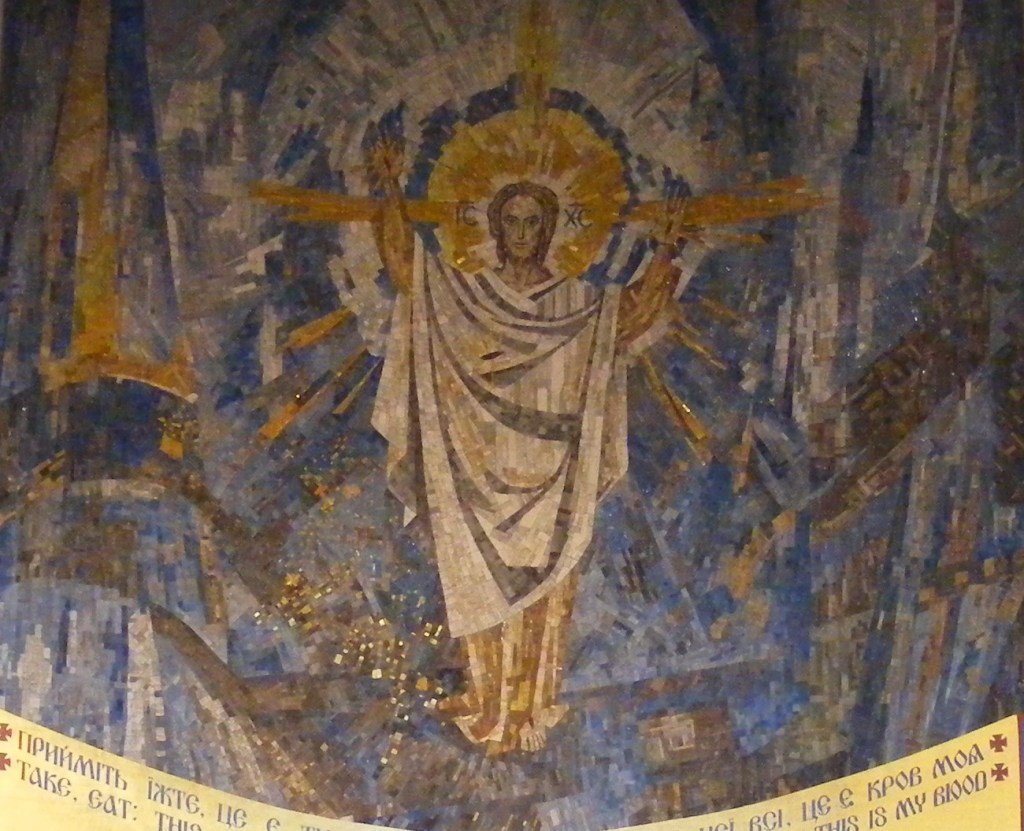
Mosaic from St. Basil’s Ukrainian Catholic Church in Edmonton at https://royaldoors.net/?p=3751

Passion of Christ (according to Mark)

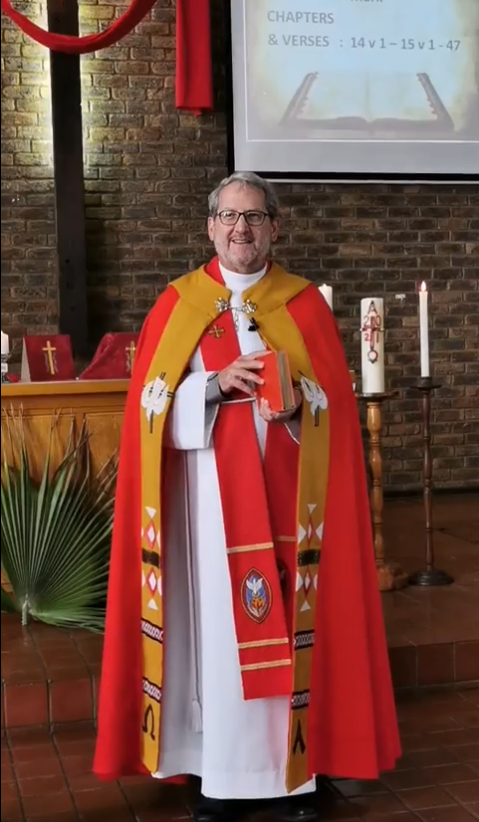
Today, instead of a sermon, we listened to a reading of the Passion of Christ, from Mark chapters 14 and 15, using the JB Phillips translation. You can listen to the audio recording of the reading here. Or you can watch the video of the reading on Facebook here (the reading starts at 30 minutes). The reading takes 27 minutes.

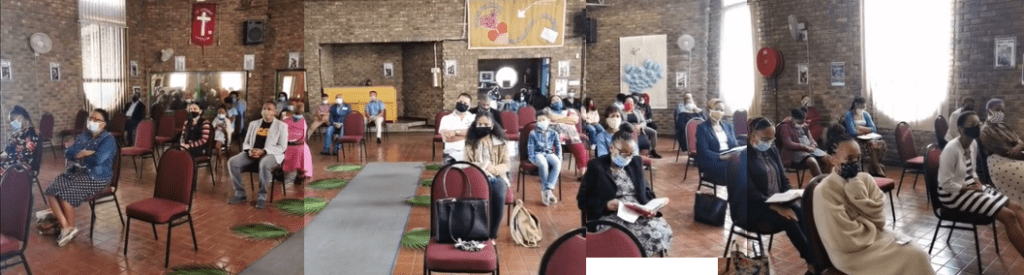
Below are a few photos of me reading and a composite photo of our in-house congregation.

Mother of God

Click here to listen to the audio recording of this 11-minute message. Or watch the YouTube video below, or read the text summary that follows.

Today (25 March) we celebrate the Festival of the Annunciation to the Blessed Virgin Mary. Today is exactly nine months before Christmas Day, and on this day we celebrate the conception of Jesus in Mary’s womb. As it is written in Luke 1:30-33:

“Do not be afraid, Mary; you have found favor with God. You will conceive and give birth to a son, and you are to call him Jesus. He will be great and will be called the Son of the Most High. The Lord God will give him the throne of his father David, and he will reign over Jacob’s descendants forever; his kingdom will never end.”

While the Western (Catholic and Protestant) churches celebrate Christmas as the high point of the church calendar, the real miracle of Christmas takes place at the conception, nine months before. It is at this moment that God incarnates into human form. Mary is thus referred to as the ‘Mother of God’ or the Theotokos (or God bearer) because she carries and gives birth to God. It is not that she creates God! But rather that she bears God in her womb.

What is conceived in Mary is, from conception, a hybrid of human and divine natures in the one person of Jesus. This is a mystery, hard to fathom – the nature of Jesus Christ. But whatever it is, and however we understand Christ’s divine and human natures, it starts at his conception, not at his birth.

Let me suggest three reasons why this rather mysterious and mystical notion is important:

  1. The conception demonstrates the enormity of God’s emptying out of God’s self on behalf of humankind (which we read about in Philippians 2) – we refer to this emptying out as ‘kenosis’. Typically, we think of God’s kenosis in the birth of Christ, but really it is in his conception. God – the omnipotent, eternal, omnipresent and all powerful God – folds down into a single human cell, then an embryo and then a foetus. The willingness of God to become so small is quite overwhelming – God pouring out God’s self for humanity.
  2. The conception is a profound example of God’s choice to work in partnership with humans. We see this choice from the beginning of creation, when God entrusts creation to Adam and Eve. But here it is particularly profound. While others could assist in taking care of a newborn, only the mother can take care of an unborn. God the son was, during gestation, utterly and solely dependent on the young woman Mary. God was truly at the hands of this one person. God trusted her and entrusted God’s self to her.
  3. And, drawing on Eastern Orthodox theology, in the conception, God inserts God’s DNA (so to speak, metaphorically) into human DNA. In so doing, God begins to change and save human nature itself. For Orthodox Christians, the conception is the foundation of salvation, because the very fabric of human nature is infused with the presence of the divine, and God begins (or continues and deepens) the work saving not just individual humans, but the nature of humanity.

Let us not let this momentous day slip by unnoticed. Let us give thanks to God for his incarnation at the moment of conception. And let us give thanks to Mary for being willing to bear God in her womb.

Featured image of Theotokos from https://myocn.net/celebrating-theotokos-throughout-year/

God’s open arms

Click here to listen to the audio recording of this 15-minute message. Or watch the video on Facebook here (the message starts at about 27 minutes). This message is strongly visual, so I recommend you watch the Facebook video rather than listen to the audio, though you’ll need to turn the sound up a bit.

God has always been working for our salvation and continues to do so today. This work culminates the life, death and resurrection of Christ, hence Jesus says we need to be born again. This salvation work is motivated by God’s great love, kindness, mercy and grace towards us (Ephesians 2: 1-10). Even though we were dead in our transgressions and sins – deserving of God’s wrath – God does everything to save us. Jesus himself says, “For God so loved the world that he gave his one and only Son, that whoever believes in him shall not perish but have eternal life. For God did not send his Son into the world to condemn the world, but to save the world through him” (John 3:14-21).

  • God’s stance towards you is always open armed – always.
  • God is always open towards you even if you don’t believe in him – always.
  • God is always moving towards you – always.
  • God is always turned towards you, even when you turn away from him – always.
  • God is always turned towards you, even when you sin – always.
  • God always reorientates himself towards you as you move through life – always.
  • God is always positively disposed towards you – always.
  • God always loves you – always.
  • God is always kind towards you – always.
  • God is always full of grace and mercy towards you – always.
  • God is always hoping you will respond to him – always.
Featured image from https://www.thebalancesmb.com/christ-the-redeemer-construction-facts-844362

A long story of God’s salvation

Click here to listen to the audio recording of today’s 17-minute message. Or watch the video on Facebook here (the message starts at about 25 minutes). Or read the short summary below.

Our Old Testament readings over Lent provide us with highlighted of the long story of God’s salvation of humanity. I thought that today we should look at all of these readings – the five Old Testament Sunday Lent readings, and today’s New Testament reading.

I summarise the development of God’s work for salvation as follows:

  1. God’s unconditional covenant with humanity
    • Genesis 9 (God’s rainbow covenant)
    • ‘Covenant’ is mentioned seven times
    • God promises never to destroy humanity with a flood
    • The rainbow reminds God of this covenant God has made with us
    • This covenant is entirely God’s doing and initiative, and unconditional for all humanity
  2. God’s everlasting covenant, plus circumcision
    • Genesis 17 (God’s covenant of circumcision)
    • ‘Covenant’ is mentioned 10 times
    • In three of these God says the covenant is everlasting
    • However, now the covenant has conditions:
    • Abraham must walk before God faithfully and blamelessly (v1), and
    • Males must be circumcised.
    • Males who are not circumcised fall outside God’s covenant (v14)
  3. God’s external law, which humanity must obey
    • Exodus 20 (God’s 10 commandments)
    • God now sets external laws by which we must abide
    • Now the responsibility for maintaining a right relationship with God is entirely humanity’s
    • Paul’s problem with this approach is that we inevitably break the law and thus fall out of favour with God
    • The solution of the Law alienates us from God
  4. Punishment for sin, but grace for salvation
    • Numbers 21 (God’s bronze snake)
    • But now we see a shift in God’s engagement with humanity
    • Still, law is important, and those who sin were bitten by poisonous snakes
    • But God instructs Moses to make a bronze snake which is lifted up
    • Those who look to this snake are saved/healed
    • This is a sign of grace – we look to God and God saves
    • The is a foreshadowing of the cross – we look up to Jesus on the cross, who saves
  5. God’s internal law; God’s choice to forgive
    • Jeremiah 31 (God’s law written on our hearts)
    • God says he is now setting out a new law that replaces the old – we see God shifting
    • This new law is written in our hearts – not on tablets or paper
    • And God chooses to forgive, out of God’s own initiative (v34b)
  6. Christ wins once-for-all salvation through faith
    • Romans 2-4 (God’s salvation by grace through faith)
    • Now, after Christ, salvation is by grace – it is won by Christ for us
    • We can add nothing to the salvation he has made possible
    • God chooses to forgive us, and indeed has already forgiven us and our descendants already – this is grace (a free gift)
    • We receive this grace through faith – we simply open our hearts and receive what is already available to us
    • We don’t earn our salvation – Christ has already done that – we merely receive it

There are three summary messages from today’s teaching:

  1. God has always been working for our salvation, since the creation – and continues to do so today
  2. God’s ways of working with humanity shift over time – God is not a stone – God is a person who adjusts their style of interacting with us
  3. Christ has fully accomplished our salvation – we can and need add nothing to it – we are invited merely to receive it
Featured image from https://davidjeremiah.blog/wp-content/uploads/2018/04/an-assurance-of-salvation-verse-to-know-by-heart.jpg

Resurrection life

Click here to listen to the audio recording of this 12-minute message. Or watch the YouTube video. Or read the text summary below.

I am taking a funeral later today for a parishioner who died of Covid. I asked his wife if she would like to pick a Scripture reading that she or her husband liked, and she selected Acts 24:15. I was quite surprised! I’ve participated in many funerals over the years and can never recall this verse being used. But it is a very apt passage, as I hope you will see.

I admit that I worship the God of our ancestors as a follower of the Way, which they call a sect. I believe everything that is in accordance with the Law and that is written in the Prophets, and I have the same hope in God as these men themselves have, that there will be a resurrection of both the righteous and the wicked. So I strive always to keep my conscience clear before God and man. (Acts 24:14-16)

Paul was currently under house arrest due to charges laid against him by the Jewish leaders. This continues for a number of years under various Roman rulers, and eventually he is transferred to Rome, where he spends the rest of his life. So, in today’s passage, Paul is both defending himself and declaring his faith. He is giving a testimony of what he believes. And this has four elements:

  1. He is a follower of the Way, which is how people referred in those days to Christians. Christianity was known as ‘the Way’ and Christians as followers (of the Way).
  2. He believes in the First Testament scriptures (the Law and the Prophets). In this way, he regards the First Testament as part of a Christian bible.
  3. He hopes for the resurrection, as did some, but not all, Jewish people in that time.
  4. He strives to keep a clear conscience with God and people, that is, to be on good terms with everyone.

The centre of the passage, however, is the third point about the resurrection.

First, he says that he has hope there will be a resurrection. This hope implies that there is more to life than just this life. Some people then and today believe that this life is all there is, and when we die, that’s the end. Paul says instead that there is a life after this life, the resurrection life. And so, while this life will end, there will be continuation of life in the resurrection life. And this implies that what we do in this life has implications for the next life. Our pattern of living is shaped not only by a present morality, but also by a recognition that how we live now will shape how we live the next life.

Second, Paul says something unique here – that both the righteous and the wicked will be raised. This means we are raised for judgement. As Jesus says, to separate the sheep from the goats. And judgement determines our eternal future.

Therefore, Paul says, he strives always to keep a clear conscience before God and humanity. Because this life impacts the next life, what we do now impacts our life then, and therefore it is important that we maintain good relations with God and humanity.

How do we do that? Paul says two things. First, we are urged to follow the Way of Christ. To model ourselves on him, to learn from him, to shape our behaviour on him, to assimilate his values. Second, we are urged to believe the Scriptures. We may not always understand them, we may prefer some passages over others; but we do have to engage respectfully and thoughtfully with the Scriptures. It is all Spirit-breathed and useful for living out our faith. So, Paul emphasizes that both our beliefs and our behaviour are important for Christian living.

The Covid pandemic is confronting us with the fragility of life – how quickly it can be snuffed out, and how easily we can lose life, even if we are young. It reminds us how precious this present life is and how we need to use it fully to develop and live out our faith. Acts 24:14-16 encapsulates the heart of Paul’s faith. Let us listen to Paul and follow Christ’s Way.

Featured image from https://www.ministrymatters.com/preach/entry/8904/resurrection-and-suffering-saints