Irrepressible love

Love is central to the being of God, so it is little wonder that Love infuses Jesus’ post-resurrection, post-crucifixion appearances, and also his post-ascension appearances. This message unpacks the details of Jesus’ infinite and irresistible love for his people in John 21, and also his demanding and liberating love for those who are not his people in Acts 9. Watch the 24-minute video message or read my notes below that.

Let us consider John chapter 21

  • v3. The disciples go fishing. So ordinary – living life, even in the absence of their Lord.
  • v5. Jesus appears on the seashore and asks if they have caught no fish. He is concerned for them, for their well-being, for their everyday life.
  • v6. He tells them to cast their nets to the other side of the boat and the catch a massive haul! Jesus acts on behalf of the disciples, with their ordinary, everyday needs. Like he did at the wedding in Cana (Jn 2), where he rescued a couple’s wedding by making water into wine. He is concerned for our everyday lives.
  • v9. Next thing, he’s cooking food for them! This is the Son of God, raised from the dead! This is the one we read out in Rev 5, “Many angels, ten thousand times ten thousand, encircling the throne, saying in a loud voice: Worthy is the Lamb, who was slain, to receive power and wealth and wisdom and strength and honour and glory and praise!” This is the one cooking breakfast for them!
  • v9. Jesus provides the fish for the meal. They bring their catch only after he has already caught and cooked fish for them. He cares, he’s thoughtful.
  • v12. Jesus invites them, “Come and have breakfast.” So ordinary, so thoughtful. He breaks bread and fish, like he did when he fed the 5000 in Jn 6.
  • v12. This meal reminds us of the Last supper just a week or so previously in Jn 13. From supper to breakfast; from night to dawn; from death to life. This is a transformative meal – more than just brekky.
  • v15-17. Three times Jesus asks Peter, “Do you love me?” Three times Peter protests, “Of course I love you!” Here Jesus gives Peter a chance to undo the three denials on Good Friday. In so doing, Jesus resets Peter’s standing – his slate is wiped clean. This is grace.
  • v15-17. Each time, Jesus says, “Feed my lambs, take care of my sheep, feed my sheep.” This is good shepherding. This is what we want in our new bishop. We remember Jesus in Jn 10, “I am the good shepherd. I know my sheep and my sheep know me. I lay down my life for my sheep.” This is good shepherding.
  • v19. Finally, Jesus says, “Follow me!” His example is the one we are called to follow – his example, his footwashing in Jn 13. “Now that I, your Lord, have washed your feet, you should wash one another’s feet. I have set you an example.” An example of humility, of care, of love.

Let us also consider Acts 9

  • v1. “Saul is breathing out murderous threats against the Lord’s disciples”. He is a bad, bad man, full of perverse religious self-righteousness.
  • v4-5. On the road, Saul encounters the risen Jesus, who says, “Saul, Saul, why do you persecute me? I am Jesus, whom you are persecuting.”
  • Here Jesus demonstrates his “option for the poor”. He identifies with those whom Saul is persecuting – ‘you are persecuting me’, he says, because he is one with those who are persecuted.
  • Like then, still today, Jesus stands with those who suffer. He is always to be found in the midst of conflict and suffering. He stands in Gaza, he stands in Ukraine, he stands in the DRC, in Ethiopia, in Myanmar. He stands today even among minority groups in the USA who are being persecuted by their new government.
  • v6. But despite all of Saul’s repugnant hatred and self-righteousness, Jesus calls and uses Saul, who becomes Paul.
  • God’s choices are radical and loving.
  • He can transform anything and anyone. Nothing we do can block God’s purposes.
  • Jesus’ love and intentions are irrepressible.
  • Best we just surrender to him, because we cannot overcome God’s love.

To wrap up, let’s read Psalm 30

I will exalt you, O LORD, for you lifted me out of the depths and did not let my enemies gloat over me.
O LORD my God, I called to you for help and you healed me. O LORD, you brought me up from the grave; you spared me from going down into the pit. Sing to the LORD, you saints of his; praise his holy name. For his anger lasts only a moment, but his favor lasts a lifetime; weeping may remain for a night, but rejoicing comes in the morning. When I felt secure, I said, “I will never be shaken.” O LORD, when you favored me, you made my mountain stand firm; but when you hid your face, I was dismayed. To you, O LORD, I called; to the Lord I cried for mercy: “What gain is there in my destruction, in my going down into the pit? Will the dust praise you? Will it proclaim your faithfulness? Hear, O LORD, and be merciful to me; O LORD, be my help.” You turned my wailing into dancing; you removed my sackcloth and clothed me with joy, that my heart may sing to you and not be silent. O LORD my God, I will give you thanks forever.

Image by Kate Cosgrove, https://www.brethren.org/messenger/bible-study/breakfast-on-the-beach/

Encountering the risen Christ

Watch the video below of this 42-minute message. Yes, much longer than usual! I’m sorry about that, but it is – I think – worth the time, as a close reading of John 20:19-29 sheds to much light on Jesus’ character, his relationship with the disciples and his work as the Son of God. My notes are available below the video

Verses 19, 26    Both times Jesus “stood right in the middle of them”

Christ is the centre – not the priest, Bible, APB – only the person Christ

Christ-centred church

1, 19, 26               Easter Sunday morning – Jesus appears to Mary

Easter Sunday evening – Jesus appears in the upper room

Following Sunday (today) – Jesus appears again, to Thomas

19, 21, 26             Peace be with you – Shalom alechem x3

Easter Sunday – Christ made peace between us and God

Forgiveness of sins – done, paid for, wiped clean, forgotten, cast the deep

Everything is good. It’s all okay

Easter is the Great Forgiveness!

20           He showed them his hands and side

Emphasis on bodily resurrection, reconnected to his people

Not just some spiritual, esoteric thing

He is fully embodied, albeit with some unusual capacities

20           He could have come back healed, but doesn’t. Why?

His identification with us, solidarity with our pain & suffering

He remains the suffering servant of Isaiah 53 (4-5):

He took up our pain and bore our suffering. He was pierced for our transgressions, he was crushed for our iniquities, the punishment that brought us peace was on him, and by his wounds we are healed.

20           The disciples were overjoyed – full of joy

Joy (chara) & grace/gift (charis) – joy is a gift of God – because Jesus is back

21           “As the father has sent me, I am sending you”

We are to continue God’s work. We are sent, just as Christ was sent

Jn 3:16/7 “God so loved the world that he gave [sent] his one and only Son … For God did not send his Son to condemn the world, but to save it”

Every Christian is sent – not just clergy or evangelists

22           He breathed on them, “Receive the Holy Spirit

Hebrew for spirit & breath are both? Ruach

Gen 1:2: Spirit of God hovering

22           Gen 2:7: “Then the Lord God formed a man from the dust of the ground and breathed into his nostrils the breath of life, and the man became a living being”

To receive Jesus’ breath & Holy Spirit is to be made a new living being

22           To receive Jesus’ breath & Holy Spirit is a grace/gift (charis)

As the Spirit/breath was active in the creation of earth and humanity

2 Cor 5:17: “If anyone is in Christ, they are a new creation. The old has passed away, the new has come.”

22           Holy Spirit poured out on Pentecost: Easter Season is from Easter Sunday to Pentecost

23           Forgive anyone’s sin

The gift of HS is not so much miraculous signs, etc.

Instead the central commission – sending – is to forgive

And to warn that to not repent = no forgiveness

The Great Forgiveness!

24           Thomas was not with the disciples when Jesus came.

Where was he? He should have been in church! We should be in church!

27           Touch, see

V20. Jesus showed them his hands and side.

Thomas wants what the others got – to see. But also to touch

Our Eucharist is a see and touch moment

– receive the body of Christ broken for you (not receive this bread)

– receive the blood of Christ (not receive this wine)

Not clear if Thomas did actually touch: “Thomas answered and said…”

Perhaps seeing and the invitation to touch was enough for him

27           Stop doubting and believe. Be a believer!!

Accept the small and periodic signs of God and believe into him

28           My Lord and my God!

Hebrew: Yahweh & Elohim – names for God

Greek: Kyrie & Theos – names for God

The only place in the Gospels where Jesus is referred to as God – A profound statement of faith – perhaps the most

Seeing is not believing

Click here to listen to the audio recording of this 21-minute message. Or watch the video here on Facebook (the message starts 25 minutes into the recording). Or read the text summary below.

In Luke 24:13-35, we have the story of the two disciples who are walking to Emmaus and who encounter a stranger, who we later learn is the resurrected Jesus. They did not recognise him, despite having a long conversation. It was only as they sat down for a meal that “their eyes were opened and they recognised him” (v31), and immediately Jesus disappeared. They saw Jesus, but they did not recognise him.

In our reading set for today (Luke 24:36-48), Jesus meets the disciples in a room, and although they see him and recognise him, they do not believe him. They have moved a little further than the previous two disciples, but they have not moved to a place of belief or faith: seeing is not always believing. In response, Jesus – patient as ever with the disciples’ slowness – presents a series of evidence to prove to them that he is indeed risen from the dead and not a ghost:

v38 – Jesus asks why they are troubled and why they doubt. He confronts their lack of belief and faith. But still they do not believe.

v39-40 – Jesus invited them to look, to touch, to see. He shows them his hands and his feet, so they can get physical evidence of his wounded body. But still they do not believe.

v41-43 – So Jesus asks if they have any fish. Not because he is hungry, but to prove that he is not a ghost, but a physical being, who can eat food. But still they do not believe.

44-47 – So Jesus tells them about the scriptures – the Law of Moses, the Prophets and the Psalms – which all prophecy everything that has happened to Jesus. But still they do not believe.

48 – So Jesus reminds them that they are first-hand witnesses of everything that Jesus did – healings, forgiveness, raising people from the dead – they saw a lot and they themselves did some of these miracles in his name. But still they do not believe.

50-51 – And then, finally, he blesses them and ascends in front of them up into heaven.

And then they believed! They worshipped him and returned to Jerusalem with great joy.

Sjoe, they were really SLOW! Slow to recognise him. Slow to believe in him. Slow to put their faith in him.

Perhaps we also are slow. Perhaps we also fail to recognise Jesus’ actions in our lives and in the lives of those around us. Or perhaps we see them, but don’t believe them. Or we believe them, but we don’t put our faith in him. In the recording of the sermon I share an experience of my own slowness to believe, to illustrate my own slowness.

Fortunately – thanks be to God – Jesus is supremely patient. And he is willing to provide us with evidence and to persuade us (this also is part of my testimony in the recording). I encourage you, therefore, to make a choice to see God’s hand at work in your life. To accept that it may be possible – even likely – that God is present with you, even when you don’t perceive God. That God is working in you, even when you don’t recognise that. That God loves you, even when you may feel unloved.

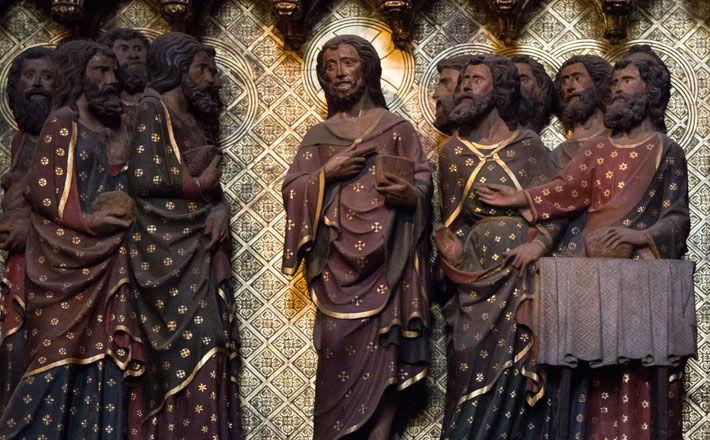
Featured image: “The Disciples give Fish to the Risen Lord to eat” from the medieval polychromed choir screen of Notre Dame de Paris. Image by Lawrence OP via Flickr; licensed under CC BY-NC-ND 2.0. (https://www.workingpreacher.org/wp-content/uploads/2020/06/LawrenceOP_Jesus_Fish_710.jpg)

Second-hand Faith

Click here to listen to the audio recording of this 16-minute message. Or watch the video here on Facebook (the message starts 24 minutes into the recording). Or read the text summary below.

Today’s message is about second-hand faith, meaning faith that rests on other people’s experiences of God, rather than on our own. 1 John 1: 1-4 presents such a faith. John emphasises his and the other disciples’ first-hand experience of Jesus, using words like see, looked, appeared, heard and touched a total of nine times in just a few verses. And he concludes by saying that we must believe him, and through believing him, who knows God, we get close to God. We are given a second-hand faith. Most of us don’t want a second-hand faith! We want our own, first-hand faith!

John 20:19-25 has a similar narrative. The disciples – minus Judas, who was not there – have a first-hand encounter with the risen Christ, who shows them his hands and his side. When Thomas joins them later, they say, “We have seen the Lord!” and expect that Thomas will be satisfied with this second-hand account. But Thomas says, “Unless I see the nail marks in his hands and put my finger where the nails were, and put my hand into his side, I will not believe.” Thomas wants simply what everyone wants – he wants to know first-hand that Jesus is risen. He wants to see and to touch. And Jesus meets this need.

We also want a first-hand faith. We want to know for sure and for ourselves that Jesus exists. We want to see him. We want to touch him. Where can we get such first-hand experiences? Three places: (1) We get them from the Scripture, where we read first-hand accounts of others and have confidence that their testimony is true. We can tag these accounts for future reference. (2) We rely on what others in our community tell us about God’s grace and working, and have confidence that their testimony is true. We can tag these accounts also for future reference.

(3) And we rely on our own experiences of God working in our own lives. We may not have many such experiences of our own, and they may not be particularly spectacular. But they are first-hand – they are OUR experiences and we KNOW them. These are the experiences we need to recover and treasure. We can tag them, because they are our first-hand encounters with God. They are the touchstones or reference points that we turn to when our faith gets shaky.

Featured image from https://ericclapp.com/wp-content/uploads/2021/04/doubting-thomas-by-julia-ward.jpg

What happens to souls

Click here to listen to the audio recording of this 23-minute message. Or watch the video here on Facebook (the message starts at about 26 minutes into the video).

Today we celebrated All Souls, also known as the Commemoration of the Faithful Departed. In fact, it should be celebrated on 2 November, but we moved it today, since it’s Sunday. It is the day on which remember all those whom we have loved and lost – parent, family, friends, and others who have died. Later in the service we came up to light candles to remember and appreciate them.

Strictly, the ‘faithful departed’ mean those who died in the faith. But what about those who died outside the faith? What happens to them? And, indeed, what happens to the faithful departed? In this message, I try to explain the main teachings in the scriptures about what happens to us after we die. The truth is that the Bible presents rather mixed and even contradictory accounts of this, which can leave us a bit confused. Perhaps because no-one who has died, has come back to explain what happens. But what we can rely on in all this, is the grace and love of God, whose heart is open to humanity.

Psalm 130: 3-4 says, “If you, Lord, kept a record of sins, Lord, who could stand? But with you there is forgiveness , so that we can, with reverence, serve you.” And late, the same Psalm encourages us to “put your hope in the Lord, for with the lord is unfailing love and with him is full redemption”.

So, what happens to those die in the faith?

  • There are some verses that say our spirit goes immediately into the presence of God. Luke 23 tells of Jesus hanging on cross and saying to the one criminal hanging next to him, “Truly I tell you, today you will be with me in paradise.” Today means today – not sometime in the future, but this very day. 2 Corinthians 5:8 is also thought to say that we transition immediately into the presence of God.
  • But other passages suggest we go to sleep for a period, until the last day. 1 Thessalonians 4:13-15 speaks three times about believers who were asleep – all those who died before Christ’s second coming would remain asleep, until he returned and woke them up with a the trumpet call of God.
  • Either way, it seems that our bodies will be resurrected only on the last day, when Christ returns – the second coming. Whether you’ve been cremated, or long buried and decomposed, or recently buried, God seems able to raise up our bodies. 1 Thessalonians 4:16 speaks about this, as well as several other passages about the resurrection, e.g., 1 Corinthians 15:12-58.
  • And will the faithful departed then be judged? John 5:24 and 29 say ‘no’: “Very truly I tell you, whoever hears my word and believes him who sent me has eternal life and will not be judged, but has crossed from death to life … Those who have what is good will rise to live”. But 2 Corinthians 5:9-10 say ‘yes’: “So we make it our goal to please [God], whether we are home in the body or away from it. For we must all appear before the judgement seat of Christ, so that each of us may receive what is due to us for the things done while in the body, whether good or bad.”

It’s all a bit confusing! Although we may not know the specifics of the mechanisms of what happens after we die, we can surely rest assured that we will experience the love, grace and forgiveness of God.

And what, then, about those who die without faith in Christ? What happens to them?

  • In John 3:36, Jesus is pretty blunt: “Whoever rejects the Son will not see life, for God’s wrath remains on them.”
  • And John 5:29 reinforces this: “Those who have done what is evil will rise to be condemned.”
  • Again, in Luke 13:27, Jesus speaks about the narrow gate through which few will get, and the door closing and the owner saying, “I don’t know you! Away from me!”

It seems then that there is no hope for the ‘unfaithful’ departed. But, we must remember the repeated messages through the entire Bible about God’s great, extravagant and all-embracing love. This gives us hope, that maybe somehow God will find a way to win over the hearts of all or at least many people who died outside of faith.

  • For example, Lamentation 3:31-33 says, “For no-one is cast off by the Lord for ever. Though he brings grief, he will show compassion, so great is his unfailing love. For he does not willingly bring affliction or grief to anyone.” This points us to the heart of God, which seeks good for every person.
  • Col 1:17-20 also speaks of God’s desire to save every person: “He is before all things, and in him all things hold together. And he is the head of the body, the church; he is the beginning and the firstborn from among the dead, so that in everything he might have the supremacy. For God was pleased to have all his fullness dwell in him, and through him to reconcile to himself all things, whether things on earth or things in heaven, by making peace through his blood, shed on the cross.”
  • And similarly in Ephesians 1:9-10 tells us that the mystery of God’s will is “to bring unity to all things iun heave and on earth under Christ”.

Since Christ died for the sins of the whole world, and not just for the sins of the faithful, universal salvation is at least a possibility. God’s love is radically inclusive, not exclusionary, and so there is the possibility that all could be saved. But God does not force himself on people – we have the right reject God. But it is perhaps hard to imagine unbelievers encountering the God of love face to face and denying his existence or rejecting his offer of a relationship. His love is almost irresitable.

And so, we try to win over those who do not believe, through our witness, our words and our prayers. And we continue to pray for those who have died outside the faith, that God will make a way for them to find salvation. We don’t have to understand how – that’s God’s business. But we can pray and hope and trust in the expansive and extravagant love of God.

Featured image from https://live.staticflickr.com/5046/5642983250_95071a5ca8_b.jpg

Risen Christ

Click here to listen to the audio recording of this 10-minute message. Or watch the video on Facebook here (the message starts 27 minutes into the video).

Jesus meets his disciples in their rooms twice after his resurrection, according to John 20:19-32: first on the night of Easter Sunday and again a week later – this evening, the second Sunday of Easter. The first time Thomas was not there, and the second time, Jesus speaks directly to Thomas. In both accounts, there are three points of overlap:

  1. Jesus appears in the midst or among the disciples (vv 19 & 26).
  2. He greets them with the words “Peace be with you!” (or Shalom aleichem, in Hebrew) (vv 19 & 26, and indeed a third time in v 21).
  3. He shows them the wounds or marks in his hands and side (vv 20 & 27). With Thomas, he not only shows his hands and side, but also invites Thomas to put his finger or hand into Jesus’ hand or side.

What is the meaning of these three actions, which are repeated almost exactly on these consecutive Sunday nights?

Jesus appears in the midst of or among the disciples. Literally, Jesus appears in the middle of them. This is the most appropriate place for Jesus be – in the middle: in the middle of ourselves, in the middle of our family, in the middle of our church and in the middle of our community. In our church, we usually read the Gospel from the middle of the church and all those attending will turn to face the centre. This is to help us feel the presence of Christ in the centre of everything we do. In our church today we also baptised five children, and after the baptism we give each child or family a candle, with the words , “Christ, our light”. This to symbolises Christ as the light in the centre of our personal and collective lives, in the church and in the world. Our lives revolve around the risen Christ.

Shalom aleichem. Three times Jesus greets the disciples with these words. Often when Jesus meets with people, and when angels meet with people, they use the words “Don’t be afraid”, for example when Gabriel appears to Mary at the annunciation (Luke 1:30). Jesus’ words here (“Peace be with you”) are not another way of saying “Don’t be afraid”. The word Shalom or peace means far more than the absence of conflict. Rather, it means the presence of wholeness, completeness, balance, order, goodness, rightness. It is a rich words that speak of the fullness of life, as ordered by God. Through Jesus incarnation, life, ministry, death and resurrection, God has brought about peace with humanity, peace between God and us, order and wholeness. We might not always feel or experience this wholeness – life is often fractured and difficult – but the potential for shalom is there and made possible by the risen Christ.

Jesus showed his hands and his side. We don’t under what kind of body Jesus was raised with. In some ways, it seems like an ordinary body, and in other ways it seems more like a spiritual body. But whatever it was, the marks of his crucifixion are still visible, so much so that Thomas is invited to put his finger into the holes in Jesus’ hands and his hand into the hole in Jesus’ side. These are clear evidence that this is indeed Jesus who hung on the cross. His is whole and restored, but also marked by his sacrifice for humanity. Jesus is quite willing, in both appearances, to provide evidence to his disciples for who he is. He provides evidence that he is the risen Christ.

We live on this side of Christ’s earthly life. He is the risen and resurrected Christ, who invites us to join him in the resurrection life – a life that is more than just an ordinary human life, a life centred on and lit by Christ, a life of peace and wholeness, and a life that celebrates everything Jesus did for the salvation of humankind. We are a resurrection people. In our church today, we celebrated this with baptisms, a sign of dying to self and rising again in the new life of Christ. We share with Christ in his risen life.

Featured image from https://www.jesuits.org/wp-content/uploads/2021/03/easter-original.jpg

Up to life

You can watch the video of today’s Easter message here. The Gospel reading and sermon start at about 23 minutes into the recording and continue for about 19 minutes.

Today we celebrate Easter Sunday – the culmination of weeks of Lenten fasting and penitence, and a week of daily soul-searching services. On Good Friday, we watched our Lord’s life slip away on the cross and experienced darkness fall over the earth as the Light and Life of God was snuffed out. And then we waited, through Friday and Saturday – wondering, what might happen, how might this all turn out.

It is relatively easy for us, because we are so familiar with the outcome of the story. But for those first believers – such as Mary and the other women in Mark 16:1-8 – it must have been surreal and terrifying. The unthinkable had happened. No wonder Mark relates the confusion of the first women to arrive at Jesus’ grave, and their fear and silence after encountering what they thought was a young man (but probably an angel).

For us, though, we now understand and appreciate the resurrection of Christ as the fruit of Christ’s triumph over death, of God’s generous and complete forgiveness of sins of all humanity, of a profound and utter reconciliation with God, and the restoration of Christ as the light of the world. God gifts back to humanity the very one that humanity sought to extinguish, as a sign of their joint unconditional and extravagant love for humankind, and indeed the whole cosmos.

Alleluia! Christ is risen indeed!!

In Romans 6:3-11 we gain further insights from Paul into the ways in which our salvation follows the same path as Christ’s death and resurrection. In our baptism, we die to self in a watery grave; only to be raised again to new life in Christ, a life filled with Holy Spirit. In our service today we baptise little Onyedikachuckwu Christian Okafor – a visible sign of God’s salvation – and renew our own baptismal vows, said originally on our behalf as infants, and today renewed freely by ourselves.

Lord, you have nourished us with your Easter sacrament. Fill us with your Spirit and make us one in peace and love. We ask this through Jesus Chris our Lord. Amen.

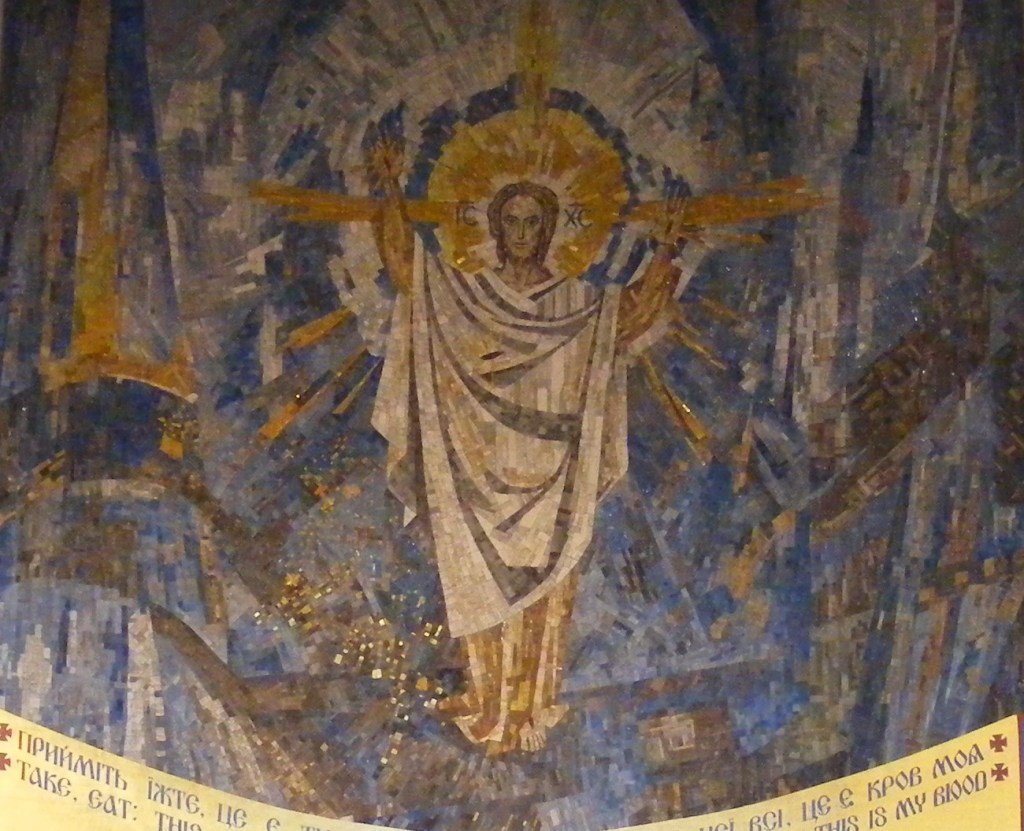
Mosaic from St. Basil’s Ukrainian Catholic Church in Edmonton at https://royaldoors.net/?p=3751

He ascended into heaven

Click here to listen to the audio of this 13-minute message. Or watch the YouTube video below, or read the text summary thereafter.

Ascension day is one of those days that Christians can easily miss – it takes place mid-week (on a Thursday) and is not a public holiday in most countries. And many would be hard pressed to give a good account of why the ascension is important. Fortunately, there are several online blogs that speak to the meaning of Christ’s ascension, e.g.,

But I find that the reasons many give are really descriptions of what Jesus does after his ascension – such as sitting at God’s right hand and sending Holy Spirit to us – rather than explanations of the ascension itself. Luke includes a narrative of the ascension both at the end of his Gospel narrative (Luke 24:50-51) and at the start of his sequel about the Apostles (Acts 1:9-10). Clearly, Luke thought the ascension was important.

Let me offer a way of thinking about the theological and practical significance of the ascension.

Let’s go back to the incarnation. In the incarnation God inserted God’s self into human nature at the conception. We can almost thinking that God integrated divine DNA into human DNA to create a new entity – a God-man – Jesus Christ. Orthodox theologians see the incarnation as central to salvation. God redeems and transforms human nature. (Click here to listen to a sermon where I set out the centrality of the incarnation in more detail.)

Let me suggest that in the ascension there is a similar but inverse process. As Jesus ascends to the Father, and as the triune God (Father, Son and Holy Spirit) is reunited in the ascension, God the Son brings with him some aspect of human nature, including his body, which is woven into the being of God.

What is the evidence for this? Perhaps most importantly, Luke emphasises in both narratives that Jesus ascended bodily, much as he rose bodily. When Jesus rises from dead, he rises with his body – he does not leave it behind and rise as a spiritual being. Of course, his body has been transformed – it has both physical and spiritual qualities. But the BODY is important. We affirm this in the Apostle’s Creed: “I believe … in the resurrection of the body”.

So too, in the ascension, Jesus rises with his body – he does not slough off his body, to release his spirit, which rises up to heaven. He ascends with his body. The disciples are described as “looking intently up into the sky as he was going” (Acts 1:10). It seems certain that Jesus physically rose up into the sky until he disappeared in the clouds.

Let me suggest, cautiously, that before the incarnation God did not have first-hand experience of what it is like to be a human being. God is spirit; God transcends time and space. But in the incarnation, God becomes a human being, with all of its limitations. God the Son experiences the joys and the pain of being human. He experiences friendship. He experiences betrayal, torture and death. When God the Son ascends bodily, these experiences are woven into the being of the triune God. God no longer just imagines what human life is like; God now truly and experientially knows what it is like to be human, with all its ups and down.

What this theology offers us in our daily life, is a deep assurance that God really knows what human life is like and what suffering feels like. God is not watching ‘from a distance’ (as Bette Midler so nicely sings). Rather, God is deeply immersed in our human experiences. So, when you are going through dark times, we can be sure that God is fully present with us in the darkness, experiencing them with us, sharing our pain and distress.

God is immediately available and fully experiences all we go through.

2020.05.21_WilliamHole_Ascension

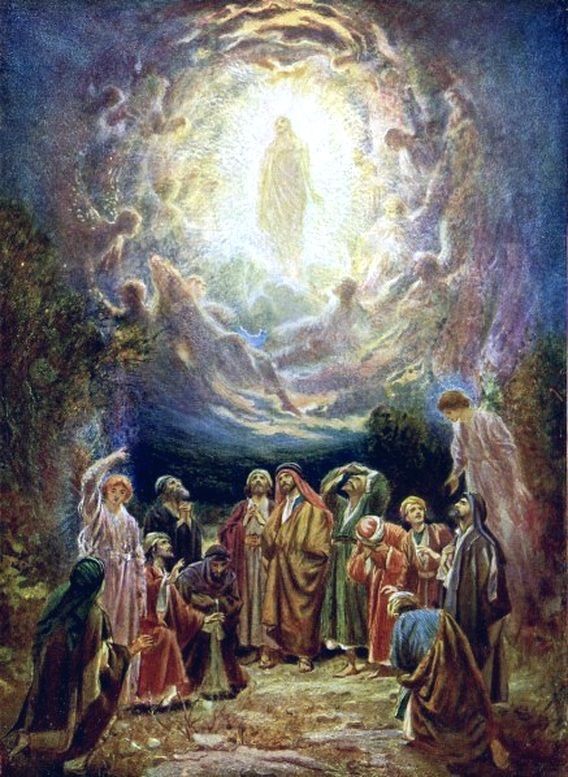
Featured image: Jesus ascending into heaven by William Brassey Hole (1846-1917)

God’s great forgiveness

Click here to listen to the audio of this 6-minute message. Or watch the YouTube video below, or read the text that follows after that.

The Lord is Risen! He is Risen Indeed!! Alleluia!!!

During this past week, we have confronted the dark side of humanity and of ourselves. We have recognised that it is our sin – each of ours – that contributed to Christ’s death. Humanity, in its arrogance, attempted to murder God the Son! What greater sin can there be? One might imagine that a God of justice would wipe the earth clean.

Instead, God forgives humanity. God returns to us the very Son that we murdered! What greater forgiveness can there be? All the rest of our sins are caught up in God’s great forgiveness of this greatest of all sins. All God asks of us to acknowledge our sin – Father, I am sorry; please forgive me. God says “Yes!” to humanity. God says “Yes!” to maintaining and enabling fellowship with each of us.

Moreover, Christ’s triumph over death, he rising from the grave to new life, is God’s “Yes!” to life and “No!” to death. Particularly during the COVID-19 plague, which has already taken the lives of over 100,000 people, we are in need of this reassurance that God has already triumphed over death. COVID-19 will do its worst, but it will die, and humankind will live. God will triumph over death.

Almighty God,
this night explodes with the radiance of the risen Christ;
set us ablaze with the power of your love
and propel us into the world
to live and proclaim the gospel of the living Lord;
who lives and reigns with you and the Holy Spirit,
one God, now and for ever.
Amen

2020.04.12_El_Greco_-_The_Resurrection_-_WGA10530

Painting of The Resurrection, by El Greco, 1597-1600. From here.

Featured image: Resurrection of Christ, by Raphael, 1499–1502. From here.

Painting in the YouTube video: Resurrection of Christ, by Rottenhammer (1564–1625)


Dying to live

Click here to listen to this 10-minute message.

I am still reeling at the destruction of Notre Dame through the fire yesterday. That cathedral was a symbol of God’s presence in France, and its burning reverberates powerfully with me. The burned church evokes images of Christ’s death on the cross. Like the cathedral, Christ is damaged and destroyed. Its devastation leaves an empty shell. We are shocked, dismayed. How is this possible?

But in John 12:20-36, Jesus talks about his own death, not as something to be avoided, and not even as something inevitable, but as something necessary, intended, perhaps even desirable. He uses the analogy of a seed, that must die in order to produce more seeds.

And he also says that we who follow him, must similarly die; that if we love this life on earth too much, we’re in trouble; that we need to hold on to it just lightly. Instead, if we follow him, through death, we will be with him in glory.

He raises the question of what we have to die to today. Of what in our lives needs to burn to the ground, so that something new can spring forth.

2019.04.16_Notre_Dame

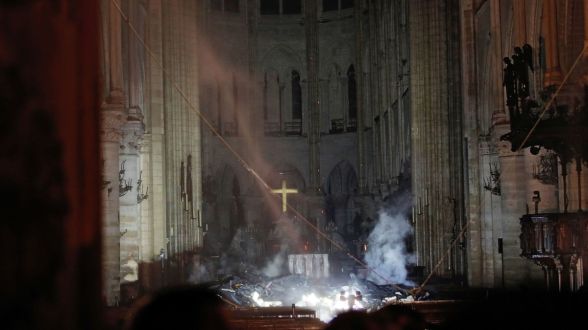
Feature image: Interior of Notre Dame following the fire on 15 April 2019, CNN.