Irrepressible love

Love is central to the being of God, so it is little wonder that Love infuses Jesus’ post-resurrection, post-crucifixion appearances, and also his post-ascension appearances. This message unpacks the details of Jesus’ infinite and irresistible love for his people in John 21, and also his demanding and liberating love for those who are not his people in Acts 9. Watch the 24-minute video message or read my notes below that.

Let us consider John chapter 21

  • v3. The disciples go fishing. So ordinary – living life, even in the absence of their Lord.
  • v5. Jesus appears on the seashore and asks if they have caught no fish. He is concerned for them, for their well-being, for their everyday life.
  • v6. He tells them to cast their nets to the other side of the boat and the catch a massive haul! Jesus acts on behalf of the disciples, with their ordinary, everyday needs. Like he did at the wedding in Cana (Jn 2), where he rescued a couple’s wedding by making water into wine. He is concerned for our everyday lives.
  • v9. Next thing, he’s cooking food for them! This is the Son of God, raised from the dead! This is the one we read out in Rev 5, “Many angels, ten thousand times ten thousand, encircling the throne, saying in a loud voice: Worthy is the Lamb, who was slain, to receive power and wealth and wisdom and strength and honour and glory and praise!” This is the one cooking breakfast for them!
  • v9. Jesus provides the fish for the meal. They bring their catch only after he has already caught and cooked fish for them. He cares, he’s thoughtful.
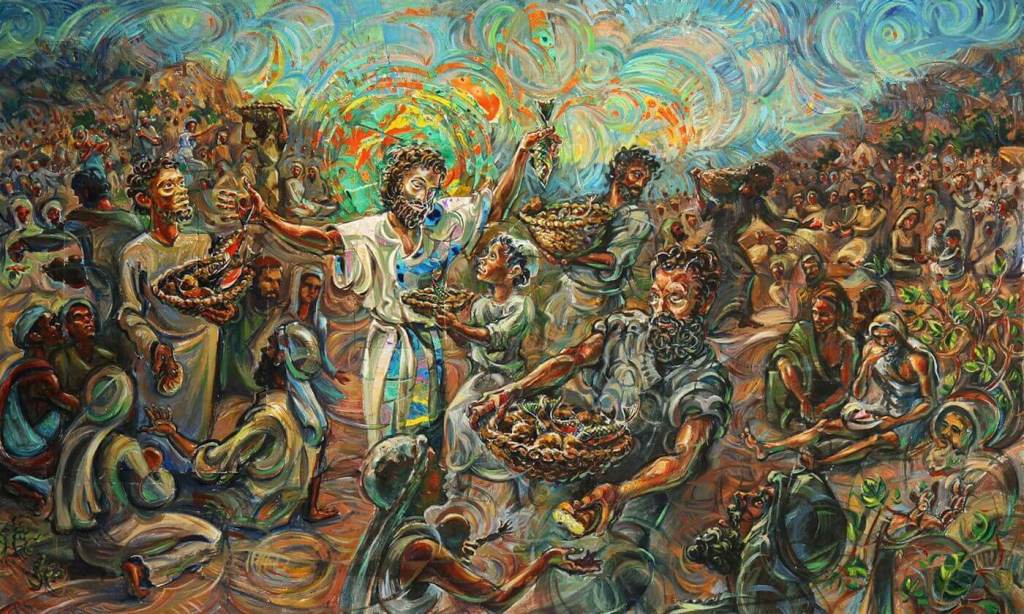
  • v12. Jesus invites them, “Come and have breakfast.” So ordinary, so thoughtful. He breaks bread and fish, like he did when he fed the 5000 in Jn 6.
  • v12. This meal reminds us of the Last supper just a week or so previously in Jn 13. From supper to breakfast; from night to dawn; from death to life. This is a transformative meal – more than just brekky.
  • v15-17. Three times Jesus asks Peter, “Do you love me?” Three times Peter protests, “Of course I love you!” Here Jesus gives Peter a chance to undo the three denials on Good Friday. In so doing, Jesus resets Peter’s standing – his slate is wiped clean. This is grace.
  • v15-17. Each time, Jesus says, “Feed my lambs, take care of my sheep, feed my sheep.” This is good shepherding. This is what we want in our new bishop. We remember Jesus in Jn 10, “I am the good shepherd. I know my sheep and my sheep know me. I lay down my life for my sheep.” This is good shepherding.
  • v19. Finally, Jesus says, “Follow me!” His example is the one we are called to follow – his example, his footwashing in Jn 13. “Now that I, your Lord, have washed your feet, you should wash one another’s feet. I have set you an example.” An example of humility, of care, of love.

Let us also consider Acts 9

  • v1. “Saul is breathing out murderous threats against the Lord’s disciples”. He is a bad, bad man, full of perverse religious self-righteousness.
  • v4-5. On the road, Saul encounters the risen Jesus, who says, “Saul, Saul, why do you persecute me? I am Jesus, whom you are persecuting.”
  • Here Jesus demonstrates his “option for the poor”. He identifies with those whom Saul is persecuting – ‘you are persecuting me’, he says, because he is one with those who are persecuted.
  • Like then, still today, Jesus stands with those who suffer. He is always to be found in the midst of conflict and suffering. He stands in Gaza, he stands in Ukraine, he stands in the DRC, in Ethiopia, in Myanmar. He stands today even among minority groups in the USA who are being persecuted by their new government.
  • v6. But despite all of Saul’s repugnant hatred and self-righteousness, Jesus calls and uses Saul, who becomes Paul.
  • God’s choices are radical and loving.
  • He can transform anything and anyone. Nothing we do can block God’s purposes.
  • Jesus’ love and intentions are irrepressible.
  • Best we just surrender to him, because we cannot overcome God’s love.

To wrap up, let’s read Psalm 30

I will exalt you, O LORD, for you lifted me out of the depths and did not let my enemies gloat over me.
O LORD my God, I called to you for help and you healed me. O LORD, you brought me up from the grave; you spared me from going down into the pit. Sing to the LORD, you saints of his; praise his holy name. For his anger lasts only a moment, but his favor lasts a lifetime; weeping may remain for a night, but rejoicing comes in the morning. When I felt secure, I said, “I will never be shaken.” O LORD, when you favored me, you made my mountain stand firm; but when you hid your face, I was dismayed. To you, O LORD, I called; to the Lord I cried for mercy: “What gain is there in my destruction, in my going down into the pit? Will the dust praise you? Will it proclaim your faithfulness? Hear, O LORD, and be merciful to me; O LORD, be my help.” You turned my wailing into dancing; you removed my sackcloth and clothed me with joy, that my heart may sing to you and not be silent. O LORD my God, I will give you thanks forever.

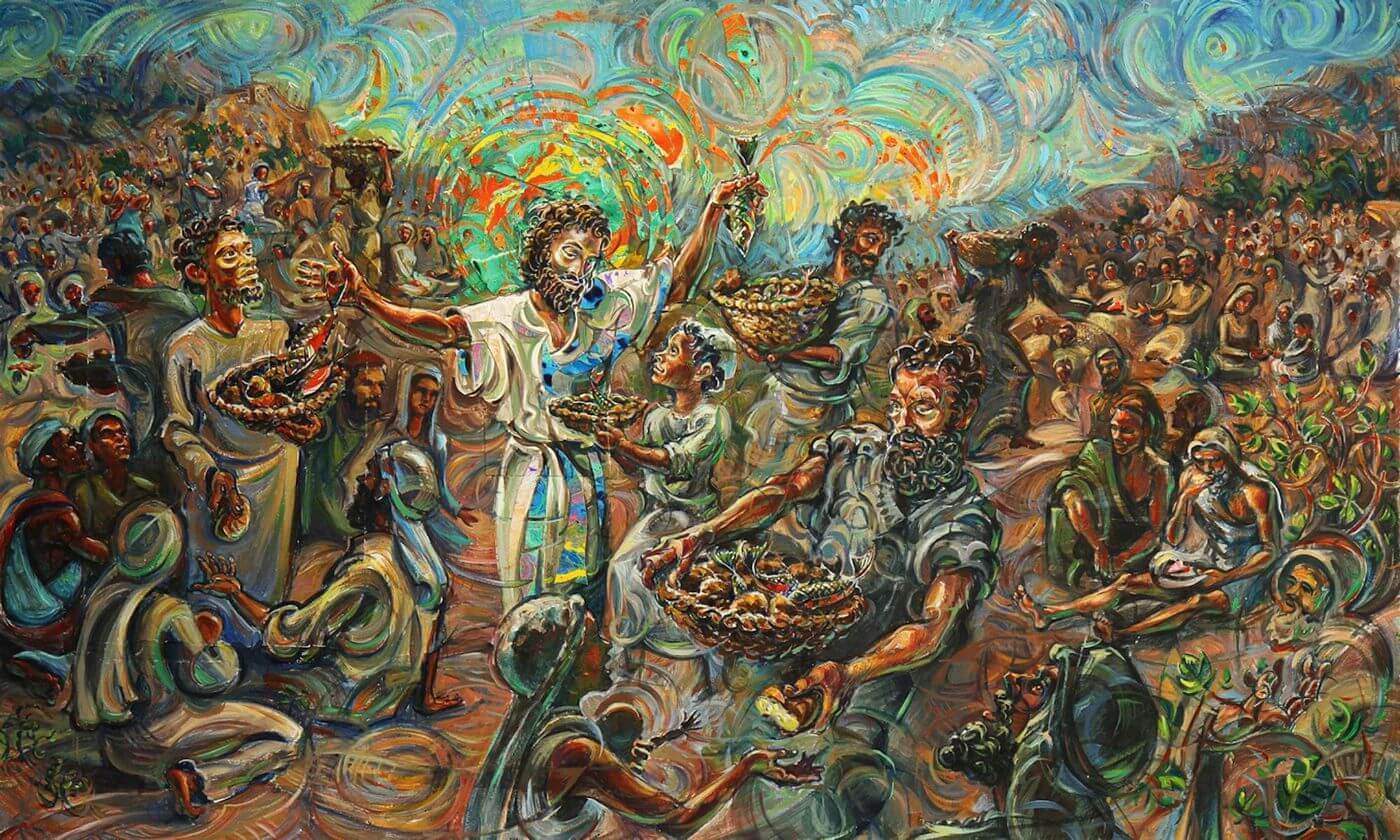
Image by Kate Cosgrove, https://www.brethren.org/messenger/bible-study/breakfast-on-the-beach/

Love abnormally

Watch the video recording of last Sunday’s 18-minute message (23 February 2025) here at YouTube.

Jesus calls us to love our enemies, and goes on to give crazy examples of this, that almost no-one would follow. We are reminded that God loved us even while we were his enemies, and that he even died for us. That takes loving to a whole new level of abnormality. Not easy! Let’s be abnormal! Let’s love abnormally.

Christ the King

Click here to listen to the audio recording of this 25-minute message. Or watch the video here on Facebook (the message starts 21 minutes into the recording). Or read the text summary below.

  • Almighty and everlasting God, whose will it is to restore all things in your well-beloved Son, the King of kings and Lord of lords: Mercifully grant that the peoples of the earth, divided and enslaved by sin, may be freed and brought together under his most gracious rule; who lives and reigns with you and the Holy Spirit, one God, now and forever. Amen.
  • Christ the King – festival established only in 1925, first celebrated in 1926 – less than 100yr ago
  • A response to growing secularism and atheism after WWI,
    & growth of fascism, all of which we see even more today
  • During a time when secular national leadership was not functioning, it was helpful to remember that Christ is the ultimate King, over all nations. King of kings. Rev: “the ruler of the kings of the earth”
  • In 1969, Pope Paul changed name to
    “Our Lord Jesus Christ, King of the Universe”
  • We still call it ‘Christ the King’
  • Jesus Christ is our personal Lord and saviour
    – our king, whose throne is in our hearts
  • He is also creator of & King over the universe.
  • He is King over both sacred and secular parts of the world
    – the church, and the world.
  • We should not be too afraid to speak his kingliness – He is king!
  • But while Jesus walked this earth, he kept his kingship hidden until the end of his life. He says to Pilate J18: “You say that I am a king”
  • He came as a servant, not as a Royal, Monarch, President, Dictator.
  • “I was born and came into the world to testify to the truth” > God
  • 2 Sam 23:3-4 – God said to David: lead in righteousness
    = in right relationship with God and with people – a beautiful thing
  • All too often, standing up for Jesus centres on morality – homosexuality, abortion, marriage, etc
  • And Pope Pius’ original thinking for this festival was that individuals and states must submit to the rule of the Saviour –
    “the Empire of Our Lord”. He almost wanted a Theocracy.
  • But what Jesus stood up for was the poor, the excluded,
    the marginalised, the vulnerable.
  • His Good News was one of a social order in which power was flat, and people were cared for, reversal of fortunes.
  • This is not what we typically think of as ‘kingship’.
  • He sets for us a model for leadership and power
    • We lead through service – to work for the best for those whom we lead, even if by sacrifice
    • We exercise power to protect, not to dominate
    • Often link CtK to Christ as the Good Shepherd
  • Servant leadership is the closest model to Jesus’ leadership
    • To ensure the wellbeing and flourishing
      of every person under our leadership
    • To remove obstacles and challenges,
      so people can move forward unencumbered
    • To set an example of what we want from them,
      rather than demanding but not living it
  • Most Gracious God, who in Jesus of Nazareth showed us an alternative to the kings, queens and emperors of history, help us to revere and emulate Jesus’ leadership: To love, and to seek justice for all people. Help us to recognize the true grandeur and life-changing power based in loving you and all of our neighbors. In Christ Jesus, with you and the Holy Spirit, may we co-create a world ruled not through domination, but in that radical and all-powerful compassion and love. Amen.

Featured image from https://www.youtube.com/watch?v=DWVJqcFcISE

Be grateful, be kind

Click here to listen to the audio recording of this 16-minute message. Or watch the video here on Facebook (the message starts 27 minutes into the recording). Or read the text summary below.

Our readings today urge us to be mindful – to think about what we think about, and about what we feel, say and do. We are invited to not simply react instinctively, but to consider how we react. Our thoughts and reactions impact ourselves and others, whether we are mindful or thoughtless, whether we are grateful or thankless, whether we are kind or harmful. We are urged to be grateful and kind.

In John 6:41-51, the people who had just had the blessing of being part of the Jesus’ feeding of the 5,000 (men, plus women and children) with fish and bread. You’d think they’d be grateful, but no, they were not. And then Jesus counsels them to not settle for bread that goes stale and moldy, but rather to seek after the Bread from heaven, that never spoils, but endures to eternal life (6:27). He even shares with them that God has sent him as the true bread from heaven and that he gives life to the world.

Still, they grumble and mutter. They remember him growing up in his family and cannot imagine that he could be the bread from heaven. “How can he now say, ‘I came down from heaven?'” Thankless they are! And Jesus chastises them: “Stop grumbling among yourselves!” One senses Jesus’ growing frustration, not only with how earth-bound they are (bread is more valuable to them than God the Son), but also with their unwillingness to see him for who he is.

And so he repeats “Very truly I tell you, the one who believes has eternal life.” And, “I am the bread of life.” And, “Your ancestors ate the manna in the wilderness, yet they died.” And, “But here is the bread that comes down from heaven, which anyone may eat and not die.” How much clearer can he be! You can hear his exasperation with these ungrateful and close-minded people. And so he repeats, “I am the living bread that came down from heaven. Whoever eats this bread will live forever.” And in case they still don’t get it (which they don’t!), he concludes, “This bread is my flesh! I will give it for the life of the world!”

And how do they respond? They “began to argue sharply among themselves.” Eish, the frustration of Jesus that we should be so mindless and so thankless. Here he is, offering us eternal life, right in our midst, and all we do is grumble, moan and argue.

Jesus calls us to a spirit of gratitude – to be grateful that the bread from heaven has come down into our midst, and to cast aside regular bread and instead feast on this heavenly bread that leads us to eternal life.

Paul, in the closing verses of Ephesians 4, similarly calls the Ephesians (whom he profoundly blessed in Ephesians 1 – you can catch my sermon on that here) to be kind to one another. Having been blessed with God’s greatest and most enduring and satisfying gifts (much as Jesus does in John 6), Paul calls us to be kind and considerate to each other. He calls us to set aside falsehood, anger, theft, laziness, unwholesome talk, grieving the Holy Spirit, bitterness, rage, anger, brawling, slander and malice. It’s quite a list!

And instead, Paul calls us to speak truthfully, not to let the sun go down without resolving our anger, to work, to do something useful, to share with those in need, to speak helpful words, to build other up according to their needs, to be kind, to be compassionate, to forgive others, to live a life of love, to follow God’s example.

Paul calls us to be kind – to be considerate, thoughtful, sensitive and helpful to other people, in just the same way that Jesus is with us – since Jesus loved us and gave himself up for us as a fragrant offering and sacrifice to God.

This message – be grateful, be kind – may seem twee and insincere and lefty. But it is core to Jesus’ message, and therefore core to the message of apostles, like Paul, and therefore core to my message as a pastor today, and should therefore be core to how you live your own life.

Of course, we fail. Some of you will have experience me being ungrateful and unkind. I and we can do better. Thankfully, though, we have a God who knows that we fail, and who has already been kind, loving and forgiving of us. We simply come back to him, say we’re sorry, ask for forgiveness, and pray for strength and grace to do better: to be grateful and to be kind. Amen.

St Stephen

Click here to listen to the audio recording of this 20-minute message. Or watch the video here on Facebook (the message starts 25 minutes into the recording). Or read the text summary below.

Today we celebrate St Stephen, after whom our church is named. It is our church’s patronal festival, our birthday.

Stephen was a young man, appointed a deacon in the early church. He appears only in Acts 6 and 7, but in those few pages, he makes a remarkable impression and impact. He is the first Christian martyr – stoned to death because he challenged the Jew people’s lack of faith in Jesus Christ.

While we walk primarily in the footsteps of Jesus Christ – he is God incarnate, our teacher and our Lord and saviour – we give heed also to the example of Stephen, and seek to continue his legacy in our parish community today.

Our readings centre on Acts, omitting Stephen’s long, but very impressive and persuasive sermon. This are supported by a reading from 2 Chronicles, where Zechariah (an earlier Zechariah – not the father of John the Baptist) is stoned to death for speaking God’s Word. Psalm 31, which includes the words that both Jesus and Stephen speak as they died. And John 6, which is the ordinary reading for today, from Jesus’ long sermon on the Bread of Life. I have tabulated these three people, because there are significant and meaningful similarities between them, that speak to all Christians, and especially those who are members of a church named after St Stephen:

TopicZechariahJesusStephen
Reading2 Chronicles 24:17-22John 6:24-35Acts 6:8-10 & 7:54-60
Holy SpiritSpirit of God came on himBaptised by John and the Holy Spirit descended on himFull of Holy Spirit, faith, grace and power
Care for the poorFed 5000 men (plus women and children) with bread and fishOversaw the daily distribution of food
Challenges with the peopleThey were chasing after other GodsThey just wanted food and miraclesWanted quiet conformity with the past
Challenging the peopleWhy do you disobey the Lord’s commands?Do not work for food that spoilsYou stiff necked people! Your hearts are uncircumcised! You always resist the Holy Spirit! Was there ever a prophet your ancestors did not persecute?
Consequences for God’s messengersStoned to deathCrucifiedStoned to death
Their final wordsMay the Lord see this and call you to account.Father, forgive them, for they know not what they are doing.Lord, do not hold this sin against them.
Final prayerFather, into your hands I commit my Spirit (in Luke)Lord Jesus, receive my spirit (Psalm 31:5)

So, what do we take from this, and particularly from Stephen, into our daily lives?

  1. We must take our faith seriously – it is costly, important and even worth dying for.
  2. We must care for the poor, hungry and marginalised.
  3. We must seek the infilling of Holy Spirit, who equips us for life and ministry.
  4. We must seek after the things of God, and not after the things of this world.
  5. We must forgive those who hurt even, even to death.
  6. We must entrust ourselves to God – He has got us!

St Stephen the protomartyr. Icon by Theophili

Food and faith

Click here to listen to the audio recording of this 22-minute message. Or watch the video here on Facebook (the message starts 31 minutes into the recording). Or read the text summary below.

Jesus crosses the Sea of Galilee and then ascends the mountainside (v. 3) and sits down – it is on mountains that God often appears to people. Think of Moses and the burning bush, Moses receiving the Ten Commandments, Jesus transfigured before Peter, James and John. His ascent cues us that something important is going to happen – some revelation of the being or character of God.

John then tells us (v. 4) – seemingly for no reason – that the Jewish Passover Festival was near. Another translation (Bruner) has, “Now, the Passover, the festival of the Jewish people, was coming up.” The Passover, which takes place when the Jews are slaves in Egypt, includes the passing over of the Jewish households and their fleeing Egypt across the Red Sea. It is THE central narrative of the Jewish religion, in the same way that Christ’s death and resurrection are THE central narrative of the Christian religion. It speaks of deliverance, freedom, salvation, relief and hope. It speaks of God coming near to God’s people and answering the deep cries. So John mentions this to raise up in us a hopeful expectation of what God might do for us.

There are two layers to this story of the feeding of the five thousand: food and faith

First, there is a practical layer – food. There are 5000 men there, presumably together with women and children. They are hungry and there is no place to get food. So Jesus creates enough food out of five small barley loaves and two small fish to feed them all, and to have 12 baskets of leftovers. This miracle, which may remind us of Jesus turning water into excellent wine at a wedding, a few chapters earlier, speaks to God’s concern for the basic needs of humanity. God desires us to have what we need to live. Basic needs for shelter, food, warmth, healthcare, education and safety are important to God. And Jesus provides for them. This is the first part of God’s revelation of himself in this story – God is concerned for your everyday needs and is willing and able to help you meet those needs, just as he helped free the Jews in slavery in Egypt.

Second, there is a spiritual layer – faith. Looking at the large crowds, the disciples are overwhelmed, and their mustard seeds of faith flee. Jesus knows that their faith is feeble, and so he asks Philip, “Where shall we buy bread for these people to eat?” His question leaves no wriggle room for Philip to say they must sort themselves out – it is clear that bread must be provided. The only question is where they will buy it. Philip’s faith collapses, as he says, “It would take more than half a year’s wages to buy enough bread for each one to have a bite!” Philip is unable to imagine that Jesus can do more than what is humanly possible. His feet are deeply embedded in the ground.

But then Andrew brings along a little boy who has five small barley loaves and two small fish and presents him to Jesus. It feels as if Andrew has some spark of faith that maybe something could be done with this little bit of padkos. But almost immediately, his faith also collapses, as he says, “but how far will they go among so many?”

Jesus takes control of the situation and issues instructions. The disciples trust and obey, and everyone ate as much as they wanted. Although Jesus will come to criticize the people for chasing after food, in this moment, they recognise him: “Surely this the Prophet who is to come into the world!” They want him to be king, but he just wants to reveal God to them.

And today’s reading ends with Jesus walking across the surface of the lake in a storm, several kilometers from the shore, and reminding them of who he is: “It is I. I am. Don’t be afraid.”

Featured image from https://www.tallengestore.com/cdn/shop/products/Jesus_Feeds_5000_-_Christian_Art_Painting_587f4577-c1f0-48ea-a738-38da1dc7cd19.jpg?v=1575281602

Jesus’ economy of love

Click here to listen to the audio recording of this 10-minute message. Or watch the video here on Facebook (the message starts 20 minutes into the recording). Or read the text summary below. And you can download the PowerPoint presentation I used here.

John 15: 9-17 presents us with a powerful summary of Jesus’ economy of love. Here’s a summary of the promises that Jesus makes about his love for us:

  • 9. Jesus loves us as the Father loves him
  • 11. Jesus’ joy is in us > our joy is complete
  • 12. Jesus loves us
  • 13. Jesus lays down his life for us
  • 14. We are Jesus’ friends
  • 15. We are Jesus’ friends (not his servants)
  • 16. Jesus chooses us (not us him)
  • 16. Jesus appoints us
  • 16. Jesus enables us to be fruitful
  • 16. God gives us whatever we ask in Jesus’ name

Part of what is beautiful about this passage is the generous and unconditional outpouring of love, care and enabling of us by Christ.

However, there are some aspects of this passage that are conditional – there are some IFs

  • 11. We remain in Jesus’ love IF we keep his commands
  • 14. We are Jesus’ friends IF we do what he commands

It is true that Jesus’ love has conditions – it is not utterly unconditional. He has expectations and makes demands of us. It is not a free-for-all. But before we get worked up about being held hostage to God’s expectations, let’s look at what those conditions are:

  • 12. My command is this: love each other as I have loved you
  • 17. This is my command: love each other

That’s it. Just two commands. Actually, just ONE command, because they are the same command: Love each other. That’s the only condition that Jesus places on us: Leave each other.

And let’s look at the ratio of unconditional and conditional promises in this passage:

That’s a pretty good economy! 83% of Jesus’ promises in today’s reading are unconditional. And the 17% that are conditional are conditional on something that is surely good for everyone – us and everyone else! To love one another.

Loving one another surely in our own interests – if we love others and all the others are loving us, that’s a good deal!

Hence John writes in his first letter (1 John 5:3), “God’s commands are not burdensome”. I’m not sure I fully agree with John here, because loving others is sometimes not easy. We have to love difficult people, people who don’t love or respect us, people who do bad things, and so on. It is not always easy to love others. But we are talking about just ONE command, not 613 commands, not 10 commands, not even 2 commands: JUST ONE!

Love each other.

Surely this is something we can do?

Featured image from: https://www.sobig.org/uploads/9/1/5/4/91543778/love-like-jesus_orig.jpg

Pruning

Click here to listen to the audio recording of this 13-minute message. Or watch the video here on Facebook (the message starts 27 minutes into the recording). Or read the text summary below.

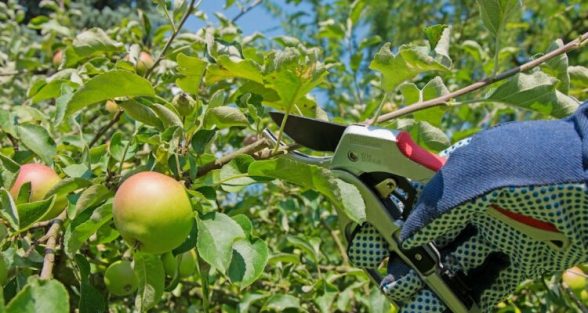
Cutting in the Christian faith is inevitable. In John 15:1-8 Jesus makes it clear that we will be cut as part of our faith journey. If we bear no fruit, we will be cut off; and if we do bear fruit, we will be pruned. When we are cut off, we will not produce any further fruit, but when we are pruned, we will produce even more fruit. So, what Jesus says in John 15 is that we will experience cutting in our faith journey. This cutting will be either a whole branch that is cut off, or bits of a branch that will be pruned off. The purpose of this cutting and pruning is to make us even more fruitful. Jesus’ teaching here in John 15 is indeed sobering. No-one wants to be cut.

In this same passage Jesus also speaks about the importance of remaining in him. And when we remain in him, he remains in us, just as he remains in his father and his father remains in him. In this passage today of eight versus, Jesus uses the word remain eight times. It is a central theme for the message today. So how do we not remain in Christ? We do not remain in Christ when we do not invest in our relationship with Christ. And we do not remain in Christ when we are fruitless, because we will either wither will be cut off.

So then how do we remain in Christ? John’s first letter, chapter 4, provides us with some answers to this question. In verses 8 and 9, John says, “God is love. This is how we how God showed his love among us: he sent his one and only son into the world that we might live through him.” So, we remain in God’s love first because God comes to us and loves us. All remaining in Christ is always a response to Christ’s coming to us. In verse 16, John continues saying, “God is love. Whoever lives in love lives in God and God in them.” This sounds very much like remaining in Christ and Christ remaining in us. It is a reciprocal action of remaining. And further on, in verses 20 and 21, John emphasises that our love for God must manifest in our love for one another. He writes, “Whoever claims to love God yet hates a brother or sister is a liar. For whoever does not love their brother and sister whom they have seen, cannot love God whom they have not seen. And he has given us this command: anyone who loves God must also love their brother and sister.” Central to us remaining in Christ is God’s love for us, is our love for God and is our love for one another.

Therefore, let us remain grafted into Christ. We must accept that they will be cutting and pruning in our Christian journey. And yes, this is painful and uncomfortable. And sometimes it may make us question God’s love for us. But I am reminded of Peter’s response to Jesus in John 6: 67-69. Jesus had provided a difficult teaching and many of his followers turn away. And then Jesus asks his disciples, “You do not want to leave too do you?” And Simon Peter answers Jesus, “Lord to whom shall we go? You have the words of eternal life. We have come to believe and to know that you are the holy one of God.” There is no better alternative then remaining in Christ.

And so, I encourage us today to take seriously our faith in Christ: to remain in him, to be grafted into him, to accept God’s pruning, and to be fruitful in our love for God and one another.

Featured image from https://moowy.co.uk/pruning-apple-trees/

Inclusive shepherd

Click here to listen to the audio recording of this 12-minute message. Or watch the video here on Facebook (the message starts 26 minutes into the recording). Or read the text summary below.

In John 10:11-18, Jesus strives to convey to us the depth of his love for and connection with us, and his desire and expectation that we should love one another. This passage is part of a larger set of “I am” statements related to Jesus being a shepherd – the good shepherd. Central to this message is this:

Jesus knows you. Jesus loves you.

I encourage you to hear these words and to take them to heart. In our service, I gave each person a paperclip, and asked them hold and fiddle with it during the sermon. A paperclip is used to hold things together, and today’s message is about Jesus holding us to himself and to each other.

  • Twice, Jesus says that he is the good shepherd – not just a shepherd, but the good shepherd (vv 11 & 14)
  • Jesus emphasises, “I know my sheep”. We are not merely a mass of sheep in a large flock. He knows each one of us. Indeed, Jesus says that he knows us and we know him “just as the Father knows me and I know the Father” (vv 14-15).
  • Four times, Jesus says that he lays down his life for his sheep – for you (vv 11, 15, 17 & 18). This points to the extravagance and not-withholding nature of Jesus love. Indeed John says (in 1 John 3:16): “This is how we know what love is: Jesus Christ laid down his life for us.”

It is hard to ignore these words of affirmation and extravagant love from Jesus. His love for you is immeasurable.

In the middle of this passage, Jesus says something a little different (v16):

I have other sheep that are not of this sheepfold. I must bring them also. They too will listen to my voice, and there shall be one flock and one shepherd.

Outside of this verse, there is a sense that Jesus loves only me. But v16 suggests not only that Jesus loves you, but also that he loves completely different groups from you. And the words, “I must bring them also”, are extremely strong in the Greek, conveying the sense that, “I absolutely have to bring them also”.

We should also note the sequence that Jesus presents: [In the present] I have other sheep [and now] I must bring them [and then in the future] they too will listen to my voice [and then after that] there shall be one flock with one shepherd. While these sheep do not yet know Jesus’ voice, Jesus still regards them as “his sheep” (“I have other sheep…”), and he loves them.

Who might these ‘other sheep’ be? The possibility that Jesus engages other groups outside of our group, outside of our congregation, outside of our denomination and even outside of the Christian faith, is tantalizing. But even if we do not go that far, think of those in your group, in your flock, that you dislike, those you think are not living an adequate Christian life, those you think are not adequately committed, those you think don’t believe correctly, those you think should rather leave your group.

Perhaps these people are sheep in Jesus’ other sheepfold. If so, Jesus loves them just as he loves you. And who are we not to love them, since Jesus loves them? Every sheep is loved by Jesus. And he is the Good Shepherd, who brings them into his fold. And so should we.

Featured image from https://media.istockphoto.com/id/1331924301/photo/stack-of-colorful-paper-clips.jpg

Decalogue

Click here to listen to the audio recording of this 16-minute message. Or watch the video here on Facebook (the message starts 24 minutes into the recording). Or read the text summary below.

Today, we focus on the Decalogue, or Ten Commandments, from Exodus 20:1-17. In the church where I became a Christian, a reformed evangelical church, we had the Decalogue up on the walls at the front of the church – they were presented as the most important verses of Scripture and central to our faith.

Four of the commands are about our relationship with God – essentially, it is supposed to be an exclusive relationship (“no other Gods but me”) – a 100% commitment to God, to Yahweh. And six of the commands are about our relationships with people – essentially, they are supposed to be ethical relationships – we are to treat people well.

In the First Testament, the Decalogue was written on stone tablets, but the very finger of God. But the later prophets, Ezekiel (11:19 & 36:26) and Jeremiah (31:33), wrote about having hearts of flesh instead of hearts of stone, and of God writing God’s law on our hearts.

We see this fleshy version of the Decalogue most powerfully in Christ’s incarnation – God come to dwell among us in human form. And Jesus, when asked about the Decalogue, distills them into just two: Love God and love your neighbour. These align well with what I wrote about – to be exclusive with God and ethical with people. But what is particularly emphasised in Jesus’ summary, and not obvious from the Decalogue, is love. (In Exodus 20, love appears only in verse 6, as an explanation of God’s jealous love for God’s people.)

If I were still at the church where I became a Christian, I’d be advocating for removing the Decalogue – the First Covenant Law – and replacing it with Jesus’ Great Commandment – the distillation of the Second Covenant, which is rooted in freedom and love.

That brings us to our gospel reading for today (John 2:13-22), where Jesus clears out the template. In Matthew, Mark and Luke, this story is narrated during Holy Week, on or after Palm Sunday, and as being the trigger for Jesus’ arrest and crucifixion. It is the culmination of Jesus’ offensiveness to the Jewish priests and leaders. But in John’s gospel, it comes as Jesus’ second act, right at the start of his ministry – following immediately on the wedding at Cana. The wedding story, with its extravagant and exceptional wine, is a story of freedom, generosity and abundance – the abundant life that John writes about so much. While the clearing of the template story is about God’s demand for our exclusivity and ethics.

Here, at the start of his ministry, Jesus acts out the requirements of the Great Commandment. Firstly, God’s house is being used in unholy ways. The things of God (the animal sacrifices) are being sold and bought. There is no place for such unGodly things in the very house of God. The exclusive relationship with God that is required by the Decalogue and by the Great Commandment, is being violated. And in addition, the people – the worshippers – are being exploited, having to pay to exchange currencies, to purchase animals for sacrifice. This is not ethical, not loving.

Jesus clears the template as a demonstration of the Great Commandment – Love God, Love your neighbour!

These standards that Jesus sets for us are impossibly high. I, certainly, fail again and again at these two seemingly simple commands. I stray from my exclusive relationship with God, and I fail to love others as myself.

Thanks be to God, Jesus bridges the gap between the high ideals and our broken efforts. He connects us to God, and his faithfulness transcends our fickleness. He strength transcends our frailty. He maintains the bond of fellowship between us and God and each other, even when we inevitably fail.

And so, as we continue our pilgrimage through Lent, let us continue to turn back to Jesus, and recommit ourselves to the Great Commandment: love God, love others or be exclusive with God and ethical with others.

Picture downloaded from https://www.thecatholictelegraph.com/wp-content/uploads/2018/06/ten-commandments.jpg