
Click here to listen to the audio recording of this 18-minute message. Or watch the video here on Facebook (the message starts about 25 minutes into the recording). Or read the text summary below.
John the Baptist is arguably the second most important person in the New Testament – second only to Jesus. He was the last of the First Covenant prophets – prophesying about the coming Messiah. Once Jesus arrived, John’s ministry, and that of all the prophets in the First Testament, had reached fulfillment.
Curiously, in John 1:6-35, John the Baptist (or the writer of the Gospel according to the John) repeatedly speaks to who John is NOT, rather than to who John IS. In total, there are five negative declarations in this passage, suggesting a humility on the part of John and a clear understanding of his role, as the forerunner and preparer for the Messiah. John is not the light (8), not the Messiah (20), not Elijah (21), not the Prophet (21) (even though that is really what he is), and not worthy to untie the sandals of the Messiah (27). Strong negative statements about who he is NOT.
Alongside these are three affirmations of who John IS, only one of which he voices himself: he is a witness to testify concerning the light (7), he is a witness to the light (8) and he is the voice of one calling in the wilderness, ‘Make straight the way for the Lord’ (23), even though this last is John quoting Isaiah. John makes not independent statements of himself in his own words.
John’s negations and lack of affirmations about his pivotal role and place in the Christian story suggest great humility and that the focus of all his efforts is on Jesus, the Messiah, the promised Son of God. His life purpose is to point to Christ.
This is confirmed in John’s testimony about Jesus, which includes him sharing that he himself did not recognise Jesus (31), but that he saw the Spirit of God descend upon him and remain on him (33).
And so John points us to Jesus: “Look, the Lamb of God, who takes away the sin of the world! This is the one I meant…” (29) and the next day, “Look, the Lamb of God!” (35). This is the role of the Prophet – to witness to his experience of Jesus and to point us to Jesus. He is the pointer.
Our role, as Christians today, at the end of 2023, is to take up John’s prophetic role, by pointing to Jesus, as John did. Through our lives, our actions, our words and our values, we are (for better or worse) God’s prophets, pointing the way to Christ.
How do we do this? Our readings provide suggestions:
Isaiah 61 suggests we do so by sharing good news to the poor, binding up the broken hearted, proclaiming freedom to captives, comforting those who mourn, providing for those who grieve, restoring places long devastated, standing up for justice, and standing against robbery and wrong doing. All of these prophetic actions are located in the world – they all speak to the social justice that characterises the Kingdom of God.
Mary’s song in Luke 1:46-55 echoes some of Isaiah’s sentiments: extending mercy, lifting up the humble, and filling the hungry with good things. But Mary’s vision of her son, the Messiah, also includes some strong prophetic words: scattering the proud and sending the rich away empty.
And 1 Thessalonians 5:16-22 focuses on more obviously ‘spiritual’ actions: to rejoice always, pray continually, give thanks in all circumstances, hold to the good and reject evil.
It is all of these actions – standing up for social justice, speaking out against injustice and evil, and ensuring a robust spiritual life – that serve as a prophetic voice in the world today. This is perhaps the most important thing for us as Christians to be doing in the world – pointing the way to the Messiah.
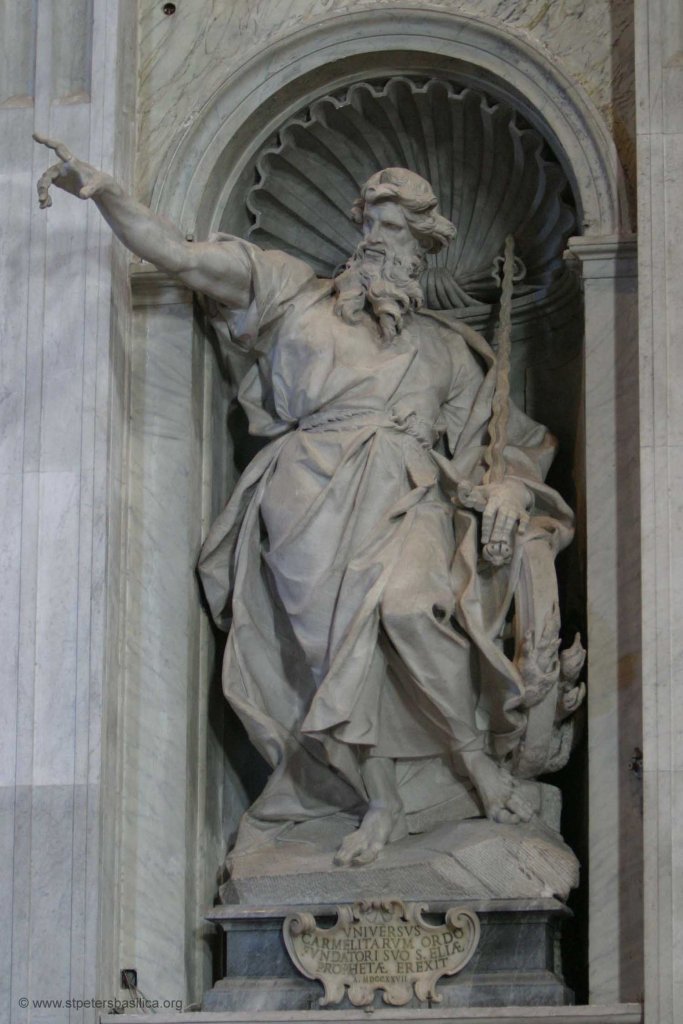
Statue of Elijah pointing, by Agostino Cornacchini (1727) at St Peter’s Basilica, Vatican City

 Reflections of God's Love