
Click here to listen to the audio recording of this 27-minute message. Or watch the video here on Facebook (the message starts 24 minutes into the recording). Or read the text summary below.
Our readings for today – the First Sunday in Lent – includes God’s Covenant with Noah after the great flood, in Genesis 9:8-17. Below I present this text from the interlinear bible, which endeavours to translate the Hebrew word-for-word into English:
8And God spoke to Noah, and to his sons with him, saying, 9“Behold, I, even I, am establishing my covenant with you, and with your seed after you, 10and with every living creature which is with you, among fowl, among cattle, among every animal of the earth with you, from all that go out from the ark, to every animal on earth. 11And I have made stand my covenant with you, and all flesh shall not be cut off again by the waters of a flood; nor shall there ever again be a flood to destroy the earth.”
12And God said, “This is a sign of the covenant, which I am about to make between me and you, and every living soul which is with you, for everlasting generations. 13I have set my bow in the cloud, and it shall be a sign of a covenant between me and the earth. 14And when I gather the clouds on the earth, then the bow shall be seen in the clouds. 15And I will remember my covenant which is between me and you, and every living soul in all flesh. And the waters shall not again become a flood to destroy all flesh. 16And the bow shall be in the clouds, and I shall see it, to remember the everlasting covenant between God and every living soul, in all flesh which is on the earth.”
17And God said to Noah: “This is the sign of the covenant which I have made stand between me and all flesh that is on the earth.”
It is worth taking careful note of the language used this passage, to gain an understanding of how radically inclusive God’s post-flood covenant with Noah was. See below the same text with coloured key words.
- In green, note the 8 uses of “you“: 5x “with you”, 1x “with your seed” and 2x “me and you”. God’s message to Noah is very directed towards him and particularly towards a partnership with him – the ‘with’ and the ‘and’.
- In yellow, note the 6 uses of “every“: 1x “every living creature”, 2x “every animal” and 3x “every living soul”. The Hebrew words behind the English all point towards living entities, whether human or animal – context may lean us towards one or other, but overall, the passage speaks equally about both people and animals.
- In blue, note the 5 uses of “all flesh“. In the Hebrew, ‘all flesh’ refers to the skin or flesh of any living being – again, people or animals, and also plants. The verb form of this Hebrew word means to be full of life, hence the skin (perhaps with its reddish colour) prompts us to think of living beings. But the Hebrew verb also means ‘good news’ and that’s a lovely link between this passage and the goodness of the Kingdom of God that Jesus preaches.
- In pink, note the 7 (yes 7!) mentions of the “earth“. In 5 of these, the reference is merely to people or animals “on the earth” – the earth is just a ground (soil) on which living things live. But in verses 11 and 13, we get two radical statements. In v11, God says that a flood will never again destroy the ‘earth’ – this is an expansion on God’s covenant not to destroy living things (animals and people) – now God also commits to protecting the earth itself. Moreover, in v13, God says that the rainbow “shall be a sign of a covenant between me and the earth”! Not only is the Noahic Covenant with Noah, people, animals AND plants, it is ALSO with the very earth itself. As if the earth is a living and sentient being! A great passage for those committed to ecospirituality.
- Finally, in lime, note the 5 uses of “between“. Two of these are “between me and you” emphasising a close partnering between God and Noah. The other three ‘between’s are between God and the earth, every living soul and all flesh. Here God shows his partnering with people, animals, plants and the planet (and perhaps by implication, the cosmos).
In short, this passage strongly emphasises a radical inclusivity by God towards the whole of God’s creation, encompassing not only all of humanity, not even also only of all animals, but also of the entire planet itself. This implies a universal covenant – a broad baobab tree with enough space for all created things to shelter under is branches. Humans, plus, plus, plus!

In this same passage, we also have 7 uses of the term “covenant”, which is why this passage is referred to the Noahic Covenant, following the devastating flood. A covenant is a binding agreement, and we get the heart of it in v11, “I have made stand [erected] my covenant with you, and all flesh shall not be cut off again by the waters of a flood; nor shall there ever again be a flood to destroy the earth.” The famous rainbow (mentioned three times as “bow”) is “a sign of the Covenant” – it is not the Covenant itself; just a symbol or sign that points to it (vv 12-13).

But what is most striking about this sign, is that it appears to be more for God’s benefit than for ours. God says in v16, “And the bow shall be in the clouds, and I shall see it, to remember the everlasting covenant between God and every living soul, in all flesh which is on the earth.” The bow is there for God to see, so that God will remember the covenant. It is hard to imagine God might forget about the covenant, so this is particularly intriguing, suggesting a strong commitment on God’s part.
It is reminiscent of the Passover blood that the Israelites painted on the doors of their homes. Exodus 12:13 has God saying, “When I see the blood, I will pass over you.” Here again is a sign that God sees that activates Covenant protection and blessing.
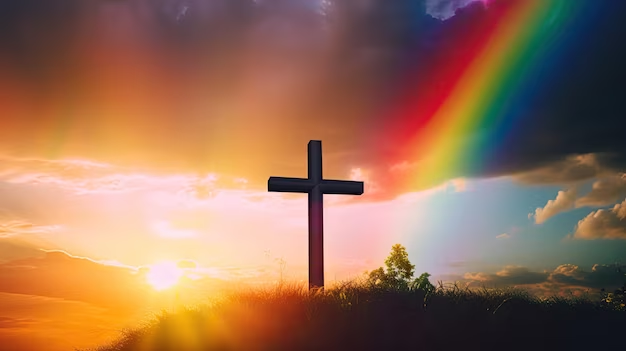
God’s covenant with Noah is universal – humans, plus, plus, plus. It foreshadows a far later Covenant, made in Christ.
This new covenant that we have through Jesus Christ is similarly radically inclusive and universal. Jesus died for the sins of the whole world, not just of some. Thus everyone can potentially be saved. And perhaps, if one adopts a universalist theology, God may just find a way to actually save every person. I don’t know, but I hope so!
Christ expands the Noahic covenant and completes it. His death and resurrection is God’s final Word on salvation. Christ incarnated, ministering, on the cross, resurrected and ascended is the new sign, replacing the rainbow. It fulfils the Noahic covenant.
We look forward in Lent towards remembering and walking through this new covenant that Jesus makes possible for the whole of creation.

 Reflections of God's Love
