Irrepressible love

Love is central to the being of God, so it is little wonder that Love infuses Jesus’ post-resurrection, post-crucifixion appearances, and also his post-ascension appearances. This message unpacks the details of Jesus’ infinite and irresistible love for his people in John 21, and also his demanding and liberating love for those who are not his people in Acts 9. Watch the 24-minute video message or read my notes below that.

Let us consider John chapter 21

  • v3. The disciples go fishing. So ordinary – living life, even in the absence of their Lord.
  • v5. Jesus appears on the seashore and asks if they have caught no fish. He is concerned for them, for their well-being, for their everyday life.
  • v6. He tells them to cast their nets to the other side of the boat and the catch a massive haul! Jesus acts on behalf of the disciples, with their ordinary, everyday needs. Like he did at the wedding in Cana (Jn 2), where he rescued a couple’s wedding by making water into wine. He is concerned for our everyday lives.
  • v9. Next thing, he’s cooking food for them! This is the Son of God, raised from the dead! This is the one we read out in Rev 5, “Many angels, ten thousand times ten thousand, encircling the throne, saying in a loud voice: Worthy is the Lamb, who was slain, to receive power and wealth and wisdom and strength and honour and glory and praise!” This is the one cooking breakfast for them!
  • v9. Jesus provides the fish for the meal. They bring their catch only after he has already caught and cooked fish for them. He cares, he’s thoughtful.
  • v12. Jesus invites them, “Come and have breakfast.” So ordinary, so thoughtful. He breaks bread and fish, like he did when he fed the 5000 in Jn 6.
  • v12. This meal reminds us of the Last supper just a week or so previously in Jn 13. From supper to breakfast; from night to dawn; from death to life. This is a transformative meal – more than just brekky.
  • v15-17. Three times Jesus asks Peter, “Do you love me?” Three times Peter protests, “Of course I love you!” Here Jesus gives Peter a chance to undo the three denials on Good Friday. In so doing, Jesus resets Peter’s standing – his slate is wiped clean. This is grace.
  • v15-17. Each time, Jesus says, “Feed my lambs, take care of my sheep, feed my sheep.” This is good shepherding. This is what we want in our new bishop. We remember Jesus in Jn 10, “I am the good shepherd. I know my sheep and my sheep know me. I lay down my life for my sheep.” This is good shepherding.
  • v19. Finally, Jesus says, “Follow me!” His example is the one we are called to follow – his example, his footwashing in Jn 13. “Now that I, your Lord, have washed your feet, you should wash one another’s feet. I have set you an example.” An example of humility, of care, of love.

Let us also consider Acts 9

  • v1. “Saul is breathing out murderous threats against the Lord’s disciples”. He is a bad, bad man, full of perverse religious self-righteousness.
  • v4-5. On the road, Saul encounters the risen Jesus, who says, “Saul, Saul, why do you persecute me? I am Jesus, whom you are persecuting.”
  • Here Jesus demonstrates his “option for the poor”. He identifies with those whom Saul is persecuting – ‘you are persecuting me’, he says, because he is one with those who are persecuted.
  • Like then, still today, Jesus stands with those who suffer. He is always to be found in the midst of conflict and suffering. He stands in Gaza, he stands in Ukraine, he stands in the DRC, in Ethiopia, in Myanmar. He stands today even among minority groups in the USA who are being persecuted by their new government.
  • v6. But despite all of Saul’s repugnant hatred and self-righteousness, Jesus calls and uses Saul, who becomes Paul.
  • God’s choices are radical and loving.
  • He can transform anything and anyone. Nothing we do can block God’s purposes.
  • Jesus’ love and intentions are irrepressible.
  • Best we just surrender to him, because we cannot overcome God’s love.

To wrap up, let’s read Psalm 30

I will exalt you, O LORD, for you lifted me out of the depths and did not let my enemies gloat over me.
O LORD my God, I called to you for help and you healed me. O LORD, you brought me up from the grave; you spared me from going down into the pit. Sing to the LORD, you saints of his; praise his holy name. For his anger lasts only a moment, but his favor lasts a lifetime; weeping may remain for a night, but rejoicing comes in the morning. When I felt secure, I said, “I will never be shaken.” O LORD, when you favored me, you made my mountain stand firm; but when you hid your face, I was dismayed. To you, O LORD, I called; to the Lord I cried for mercy: “What gain is there in my destruction, in my going down into the pit? Will the dust praise you? Will it proclaim your faithfulness? Hear, O LORD, and be merciful to me; O LORD, be my help.” You turned my wailing into dancing; you removed my sackcloth and clothed me with joy, that my heart may sing to you and not be silent. O LORD my God, I will give you thanks forever.

Image by Kate Cosgrove, https://www.brethren.org/messenger/bible-study/breakfast-on-the-beach/

Inclusive shepherd

Click here to listen to the audio recording of this 12-minute message. Or watch the video here on Facebook (the message starts 26 minutes into the recording). Or read the text summary below.

In John 10:11-18, Jesus strives to convey to us the depth of his love for and connection with us, and his desire and expectation that we should love one another. This passage is part of a larger set of “I am” statements related to Jesus being a shepherd – the good shepherd. Central to this message is this:

Jesus knows you. Jesus loves you.

I encourage you to hear these words and to take them to heart. In our service, I gave each person a paperclip, and asked them hold and fiddle with it during the sermon. A paperclip is used to hold things together, and today’s message is about Jesus holding us to himself and to each other.

  • Twice, Jesus says that he is the good shepherd – not just a shepherd, but the good shepherd (vv 11 & 14)
  • Jesus emphasises, “I know my sheep”. We are not merely a mass of sheep in a large flock. He knows each one of us. Indeed, Jesus says that he knows us and we know him “just as the Father knows me and I know the Father” (vv 14-15).
  • Four times, Jesus says that he lays down his life for his sheep – for you (vv 11, 15, 17 & 18). This points to the extravagance and not-withholding nature of Jesus love. Indeed John says (in 1 John 3:16): “This is how we know what love is: Jesus Christ laid down his life for us.”

It is hard to ignore these words of affirmation and extravagant love from Jesus. His love for you is immeasurable.

In the middle of this passage, Jesus says something a little different (v16):

I have other sheep that are not of this sheepfold. I must bring them also. They too will listen to my voice, and there shall be one flock and one shepherd.

Outside of this verse, there is a sense that Jesus loves only me. But v16 suggests not only that Jesus loves you, but also that he loves completely different groups from you. And the words, “I must bring them also”, are extremely strong in the Greek, conveying the sense that, “I absolutely have to bring them also”.

We should also note the sequence that Jesus presents: [In the present] I have other sheep [and now] I must bring them [and then in the future] they too will listen to my voice [and then after that] there shall be one flock with one shepherd. While these sheep do not yet know Jesus’ voice, Jesus still regards them as “his sheep” (“I have other sheep…”), and he loves them.

Who might these ‘other sheep’ be? The possibility that Jesus engages other groups outside of our group, outside of our congregation, outside of our denomination and even outside of the Christian faith, is tantalizing. But even if we do not go that far, think of those in your group, in your flock, that you dislike, those you think are not living an adequate Christian life, those you think are not adequately committed, those you think don’t believe correctly, those you think should rather leave your group.

Perhaps these people are sheep in Jesus’ other sheepfold. If so, Jesus loves them just as he loves you. And who are we not to love them, since Jesus loves them? Every sheep is loved by Jesus. And he is the Good Shepherd, who brings them into his fold. And so should we.

Featured image from https://media.istockphoto.com/id/1331924301/photo/stack-of-colorful-paper-clips.jpg

Kindness

Click here to listen to the audio recording of this 9-minute message. Or watch the YouTube video. Or read the text summary afterwards.

We live in a world that seems to be increasingly self-centred, selfish, self-serving, self-obsessed. A world that seems often harsh, intolerant, judgmental, hostile and exclusionary. We are seeing a growth in nationalism – people putting their country’s needs first and subordinating or even rejecting the needs of the global community. Perhaps the world has always been this way. But it seems to me to be a growing trend over the past several years.

What do we as Christians do in such context?

When we want to know how to be behave in the world, the best place to go is to the Gospel narratives, to see how Jesus behaved. And to hear how Jesus spoke – not just his teachings, but what he said to people informally and how he spoke to and engaged with people.

In Matthew 15 we find the story of Jesus feeding the four thousand with a few fish and loaves of bread. The story starts with Jesus healing people of a wide array of afflictions, leaving the crowds amazed. But in the middle of this story is a profound verse that ties the entire story together:

Jesus called his disciples to him and said, “I have compassion for these people; they have already been with me three days and have nothing to eat. I do not want to send them away hungry, or they may collapse on the way.” 

What we see here in Jesus is kindness. He is kind. We could say ‘compassionate’ and that would be correct. But ‘kind’ is a much simpler, shorter word. It is the word a child is likely to use.

If we scan through the pages of the Gospels, we will see more and more examples of Jesus being kind. He is thoughtful, considerate, sensitive, responsive, engaged, attentive, slow, open, willing, touchy, generous. in a word: kind.

Psalm 23 is also a set reading for today: The Lord is my shepherd. The shepherd also is kind. Indeed, there are numerous passages in the first and second testaments about shepherds who care for and protect their sheep, who seek lost sheep, who bind up and heal injured sheep, who fight off wild animals. These images of shepherding are images of kindness.

Jesus was kind – let us be kind.

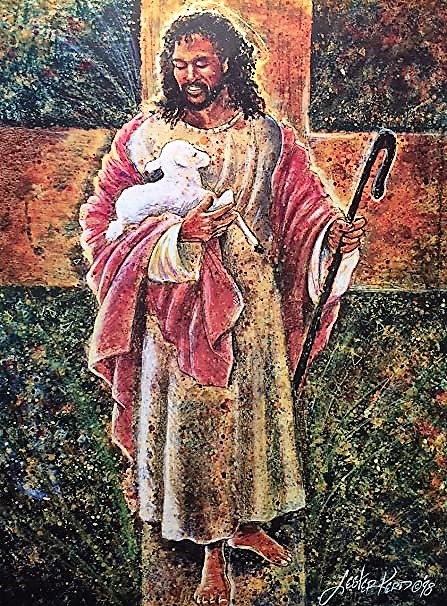
Painting by Lester Kern,
from https://www.amazon.com/He-Walks-Me-Religious-Unframed/dp/B011O9Q2MA