Adversities & Adversaries

Click here to listen to the audio recording of this 15-minute message, which was delivered on 23 June 2024. Or watch the video here on Facebook (the message starts 27 minutes into the recording). Or read the text summary below.

Our readings today (23 June 2024) point to and illustrate the adversities and adversaries that we encounter in like. Adversities are difficult situations and adversaries are difficult people – often these collide. Here is a summary of these challenges in the readings:

  • Mark 4:35-51 has the disciples and Jesus in a boat in a wild storm on the lake. This is an adversity – a situation. Many of the disciples were fishermen and familiar with storms at sea, so this must have been an exceptional storm to stir up such terror.
  • 2 Corinthians 6:1-13 has Paul recounting many of the challenges he has faced in life: troubles, hardships, distresses, beatings, imprisonments, riots, hard work, sleepless nights, hunger, dishonour, bad reports, impostors, unknown, dying, beaten, having nothing. It’s quite a list!
  • 1 Samuel 17:32-49 presents young David going up against the tremendous Goliath in single-handed combat. He didn’t stand a chance against such a formidable adversary!
  • Psalm 9 describes the Psalmist’s enemies and wicked people – many adversaries!

We may resonate with these challenges and adversaries. We often face challenging situations and difficult people. And sometimes that overwhelms us, as we wonder where God is in this.

But despite the challenges, scripture presents God as more powerful the any adversary we may face, and on our side when we face adverse situations. We are encouraged and urged to put our faith and trust in him:

  • Mark 4:35-51 describes Jesus standing up in the boat and commanding the storm: “Quiet! Be still!” and it was so – the storm dissipated. The disciples found themselves being more terrified by Jesus’ power over the elements than they had been by the storm itself! A real turnabout.
  • 2 Cor 6:1-13 has Paul affirming that despite the litany of adversities, he remains always rejoicing and possessing everything. All of these adversities are, for him, ‘nothing’ compared to the blessing of being God’s child.
  • 1 Samuel 17:32-49 recounts David’s plucky engagement with Goliath – he has bested bears and other wild animals – surely he can best this giant. And with a flick of his wrist and little catty, a stone embeds itself in Goliath’s head and he falls down dead and David decapitates him. God is on his side.
  • Psalm 9 intersperses its complaints about wicked enemies with affirmations of God’s allegiance: The Lord is a refuge for the oppressed, a stronghold in times of trouble … Those who know your name trust in you, for you, Lord, have never forsaken those who seek you … he does not ignore the cries of the afflicted … The Lord is known by his acts of justice … But God will never forget the needy; the hope of the afflicted will never perish.

Let us take heart in these affirmations. Let us strengthen our resolve in times of adversity. Let us not be cowed by adversaries. Let us trust in the Lord’s strength and love to take care of his own.

But there is a warning here also: let us not be the adversary to someone else and let us not cause adversity for others. God is on the side of his children, but he will not stand by us when we harm his other children. God expects us to emulate him, by standing up for people and by not being an adversary. The warnings are severe in Psalm 9 for those who make themselves enemies of God: “The wicked ensnared by the world of their hands. The wicked go down to the realm of the dead, all the people that forget God. … Let the nations know they are only mortal.” We do not want to become enemies of God! We want to keep on God’s right hand – his hand of power and protection – we do not want to fall under God’s wrath.

Instead, walk in God’s ways – the way of love, of justice and mercy.

Featured image from https://i.swncdn.com/media/980w/via/11268-woman-tucked-inside-bible-at-night-with-flash.jpg

Seeds of faith

Click here to listen to the audio recording of this 15-minute message. Or watch the video here on Facebook (the message starts 32 minutes into the recording). Or read the text summary below.

Today we get two of Jesus’ parables: the parable of the growing seed and the parable of the mustard seed. These follow the parable of the sower (the one who sowed seeds in different kinds of ground) and the lesson about putting our lamp on a stand.

First, in the parable of the seed, the sower scatters the seed and then does nothing more. That’s his only role – to scatter seed. Then, spontaneously or (in the Greek) automatically the seeds grow. It is in their nature to grow, once they have been scattered. So the man goes to sleep and gets up and the seeds are doing their thing. “All by itself, the soil produces corn.” And the seed knows the steps of growth – they are programmed into the seed: “first the stalk, then the ear, then the full grain in the ear.” And when it is ripe and ready, the man comes to harvest the result.

This parable suggests that our role and responsibility as followers of Christ is to scatter seed. Presumably, this is good seed – seed that produces a crop: wheat, maize, barley. Our job is to scatter the seed. God’s job is to make that seed grow. The ‘automatic’ growth of the seed in this parable is the code that God has embedded into the DNA of the seed. (Apologies if my scientific understanding of seeds is incorrect!) For example, we may speak to someone about our faith (scattering seed), but we cannot force them to believe or come to faith (that is God’s work). We may encourage parishioners to attend church (scattering seed), but we cannot compel them to come (that is God’s work). We are encouraged by this parable to do our part and trust God to do his.

This resonates with 1 Corinthians 3:6-7, where Paul writes,

“I planted the seed, Apollos watered it, but God made it grow. So neither he who plants nor he who waters is anything, but only God, who makes things grow.”

This gives us perspective on what is our role, and what is not.

Second, in the parable of the mustard seed, Jesus contrasts the size of the mustard seed (which he says is the smallest of all seeds on the earth) and the resultant mustard plant (which he says is the largest of all garden plants or shrubs, with such big branches that the birds can perch in its shade).

This parable suggests that the scattering of even a tiny seed – even a very small act in the world – could produce a very large tree – a substantial change. Much like a lever, where a small amount of strength and effort can move a large heavy object, the tiny mustard seed, when scattered, can produce a large bush.

This resonates with Matthew 13:33, where Jesus says,

“The kingdom of heaven is like yeast that a woman took and mixed into about 23kg of flour until it worked all through the dough.”

A tiny amount of yeast can spread through a large amount of flour and rise to produce a massive number of loaves of bread. Small efforts can have large results.

These parables suggest that we ought to be scattering seed into the world, and that these seeds need not necessarily be big, dramatic, sophisticated or demanding. They might be small, understated comments or actions that go a long way. The key is to scatter these seeds – to be mindful and intentional about scattering them. And then to leave them to God to grow.

Third, although Jesus does not say this in Mark 4, this reading also evokes a warning: to be careful about what kind of seeds we sow. The seeds Jesus refers to are corn and mustard. It is hard to believe Jesus would support the scattering of weed seeds – indeed, he spoke out against weeds or thorns in the parable of the sower (Mark 4:18-19).

When we scatter bad seed, these too may grow fast and spread, just like the good seed, but with potentially terrible consequences. This resonates with James’ teaching about the tongue:

“Those who consider themselves religious and yet do not keep a tight rein on their tongues deceive themselves, and their religion is worthless” (1:26). “The tongue is a small part of the body, but it makes great boasts. Consider what a great forest is set on fire by a small spark. The tongue also is a fire, a world of evil among the parts of the body. It corrupts the whole body, sets the whole course of one’s life on fire, and is itself set on fire by hell. … With the tongue we praise our Lord and Father, and with it we curse human beings, who have been made in God’s likeness. Out of the same mouth come praise and cursing. My brothers and sisters, this should not be. ” (3:5-6, 9-10)

Just as we cannot make seeds grow into bushes, we cannot stop harmful words from causing damage. We are called to sow seeds, but only good seed; bad seed should not be scattered – it should be eliminated from our minds and tongues.

Featured image from https://www.algiersumc.com/woman-scattering-seeds/

Sabbath church

Click here to listen to the audio recording of this 25-minute message. Or watch the video here on Facebook (the message starts 22 minutes into the recording). Or read the text summary below.

Genesis 2:2-3 institutes the Sabbath (or Shabbat or Shabbos). Most Christians celebrate this on Sunday, while Jews and some Christians (e.g., Seventh Day Adventists) observe it on Saturday (or from sunset on Friday to sunset on Saturday). Muslims have a holy day on Friday, called Jumu’ah, and will pray at noon at the mosque (or wherever they are, if there is no accessible mosque), though it is not a day of rest. For Christians, then, the Sabbath is intended to be a day of rest. And it is traditionally when we spend time in God’s house with God’s people.

In the evangelical Bible church where I came to faith in my teens, the Sabbath was a very holy day. We were expected to come to both the morning and evening services (which I routinely did), and also the early morning Bible study (which I did). And we were not allowed to work (no home work or office work, no shopping, no parties, etc.), which I also conformed to. In my family, Sunday was also the day we all relaxed. Dad would do a braai (barbecue), always burning the outside of the meat to charcoal! We’d have ice cream for pudding, play in the pool, watch Dad watching motor racing on the TV, reading the Sunday paper, sleeping. Although I am not fixed on Sabbath prohibitions anymore, I still feel guilty stopping at the shops on the way home from church – sometimes I’ll take off my dog collar and put on a t-shirt, to go incognito – a guilty remnant of my rule-based Christian formation.

In today’s Gospel reading (Mark 2:23-3:6), Jesus flaunts the strict Jewish Sabbath laws of his time: he and his disciples (1) travel, (2) harvest, and (3) eat, and in the following passage, Jesus (4) heals a man with a shrivelled hand. This behaviour of Jesus – to flaunt Jewish laws in favour of human relationships and well-being – is typical of Jesus’ ministry, and contributed to his murder.

Jesus, however, challenges the Sabbath laws. He draws on a story from Samuel (not actually about the Sabbath) to argue that Jesus, like David, broke rules about giving food to his companions. It is as if Jesus is saying, “Chill! It’s not that important. Relax. My disciples were hungry, so I’m fine with them reaping and eating some grain.” He says to the Pharisees, “The Sabbath was made for humans, not humans for the Sabbath” (Mark 2:27). Jesus always prioritises people over rules, even when this is deeply offensive to other people who prioritise rules over people.

Jesus does the same in the following healing story. Here he juxtaposes goodness with evil, and saving life with murder – which is lawful on the Sabbath? Perhaps the correct answer was that none of these were lawful, but the Pharisees remain silent. They were not willing to recognise that there is a continuum between evil to good, between dying and healing. They applied their rules rigidly. This angers Jesus: “He looked around at them in anger, deeply distressed at their stubborn hearts” (Mark 3:5).

This wordless response of Jesus is vital to our faith – Jesus always prioritises people over rules. Rules are important for civilisation and harmony, but when rules dehumanise people, they must be challenged. And so Jesus provocatively and flagrantly heals the man in front of the Pharisees, who immediately start plotting his death.

The Sabbath, then, is God’s gift to humankind. In the Ten Commandments in Exodus 20:8-11, God says via Moses:

“Remember the Sabbath day by keeping it holy. Six days you shall labor and do all your work, 10 but the seventh day is a sabbath to the LORD your God. On it you shall not do any work, neither you, nor your son or daughter, nor your male or female servant, nor your animals, nor any foreigner residing in your towns. 11 For in six days the LORD made the heavens and the earth, the sea, and all that is in them, but he rested on the seventh day. Therefore the LORD blessed the Sabbath day and made it holy.

God knows us. God created us. God knows what we need. God knows we need down-time. Psalm 139 reveals this intimate knowledge that God has for each of us:

1 You have searched me, Lord, and you know me. 2 You know when I sit and when I rise; you perceive my thoughts from afar. 3 You discern my going out and my lying down; you are familiar with all my ways. 4 Before a word is on my tongue you, Lord, know it completely. 5 You hem me in behind and before, and you lay your hand upon me. … 13 For you created my inmost being; you knit me together in my mother’s womb. 14 I praise you because I am fearfully and wonderfully made; your works are wonderful, I know that full well. 15 My frame was not hidden from you when I was made in the secret place, when I was woven together in the depths of the earth. 16 Your eyes saw my unformed body; all the days ordained for me were written in your book before one of them came to be.

2 Corinthians 4:7 also has important insight for us: “But we have this treasure in jars of clay, to show that the surpassing power belongs to God and not to us.” We are the jars of clay – fragile vessels, easily shattered. God is the treasure, the surpassing power, the light, the life, the potential, the very Spirit of God. God chooses to dwell in these fragile vessels that we are.

All of this brings us back to the Sabbath. Without getting legalistic about Sabbath rules, can we agree that spending time with God is good for us? Can we agree that prayer, both personal and collective, is good for us? That singing together is good for us? That hearing the Word of God read in public is good for us? Can we agree that hearing the Word of God explained and applied to our lives is good for us? That spending a little time chatting with other Christians over a cup of tea of coffee is good for us? That leaving the dishes in the sink for another 15 minutes to spend time in fellowship is good for us? Can we agree that being at church as a family is good for us? That participating in the Eucharist – receiving the signs of Christ’s exceptional love for us – is good for us? That being reminded every week that Christ dwells within us and wants us to walk in step with him is good for us?

Surely the answer to all these questions must be YES?!

Come to church! Even if you are tired. Even if you don’t like your minister. Even if you don’t like some people at church. Even if there are things you disagree with. Even if you have other work that needs to be done. Even if you come without your family because they are not interested.

Put yourself into a place where God can bless you. Come with an expectant heart. Open your heart to God’s Spirit. Look for the good in your church. Forgive your church for its lacks and failures. Come to church!

Featured image from https://img.freepik.com/premium-photo/church-congregation-christian-gospel-singers-raising-praise-lord-jesus-christ_829699-356.jpg

Thinking Trinity

Click here to listen to the audio recording of this 22-minute message. Or watch the video here on Facebook (the message starts 24 minutes into the recording). Or read the text summary below.

The Trinity (the three-in-one God) is a central belief for Christians, even though the term is not in the Bible and there are few explicit statements about a three-in-one God in the Bible. But there are hints and clues all over the place, e.g., in today’s readings with have:

  • God referring to God’s self as “us” in Isaiah 6:8,
  • Paul referring to God the Father, the Spirit and Christ as three distinct divine persons in Romans 8:12-17; and
  • Jesus speaking about the Spirit and God as two distinct divine persons in John 3:1-17.

Jews and Muslims share with us Christians the First Testament, and so it can be argued (though not all will agree) that we all worship the same God, whether by the name of Jehovah, Allah or God our Father. And all recognise Jesus as a significant person, though Jews see him as a Rabbi and Muslims as a Prophet, while we see him as God the Son. They do not recognise God as three-in-one; indeed, it sounds to them like we have three Gods. For Jews and Muslims, God is a single, male ruler – a King. They follow a pattern of a single line of authority, similar to how the military is structured. There is only One God.

For Christians, by contrast, God is plural, diverse and relational. But this plurality in the Godhead, however we might understand it, is characterised by harmony and concord. There is no conflict, competition or divergence in the triune Godhead. This is a very different conception of God.

Do we understand God’s three-in-oneness? Can we rationalise it and explain it? No, not really. It is hard enough to understand a single human being; how much harder is it to explain God, let alone a triune God! We can, should and do think about the Trinity – we theologise and theorise how God be both three and one. But ultimately, we do not find fully satisfying explanations and understandings. We often come up with analogies to explain God’s three-in-oneness: states of water, an egg, a clover, family, etc. But all of these lead us into one or other heresy about the nature of God.

We are well advised to discard all these analogies and simply gaze upon the mystery of the Godhead. We should apprehend God, not analyse or dissect God. All we can really conclude with any confidence is that God is inherently relational – there are relationships within the centre of the Godhead; relationships characterised by immense, enduring and steadfast love. Let us hold to this beautiful mystery.

So, God is not a monarch, but a cooperative, and that leads me to think about words starting with co- and com-

  • Collaborate, co-operate, co-lead, co-ordinate, collective, correlate, coincide, colleague, collegial, co-worker
  • Community, communal, in common, companion, compassion, comradery

These co-/com- words emphasise the relational quality that is central to the being of God. And because these are central to who God is, they are central to the world that God has created. And they are central to how we live our lives. Everything that God does is relational and we are part of this relational mix. Our readings today provide important examples of this:

  • In Isaiah 6, God is surrounded by seraphim – heavenly beings, keeping God company. And God send Isaiah to go out as God’s spokesperson – God collaborates with Isaiah, as partners.
  • In Romans 8, we learn that we are adopted by God, heirs and sons of God, co-heirs (siblings) with Christ, and that we share in Christ’s suffering and also in Christ’s glory – there is a close sibling-like relationship between us and the Son of God.
  • In John 3, we learn that the Son came to save not just individuals, but indeed the whole world – God is interested in the human collective, not only in human individuals.

The key implication for us worshiping a triune, collective God is to develop collective thinking and behaving. Relationships are primary to God and primary to us.

Featured image from https://www.stpaulscalgary.ca/podcasts/media/2020-06-07-trinity-sunday

Jesus’ economy of love

Click here to listen to the audio recording of this 10-minute message. Or watch the video here on Facebook (the message starts 20 minutes into the recording). Or read the text summary below. And you can download the PowerPoint presentation I used here.

John 15: 9-17 presents us with a powerful summary of Jesus’ economy of love. Here’s a summary of the promises that Jesus makes about his love for us:

  • 9. Jesus loves us as the Father loves him
  • 11. Jesus’ joy is in us > our joy is complete
  • 12. Jesus loves us
  • 13. Jesus lays down his life for us
  • 14. We are Jesus’ friends
  • 15. We are Jesus’ friends (not his servants)
  • 16. Jesus chooses us (not us him)
  • 16. Jesus appoints us
  • 16. Jesus enables us to be fruitful
  • 16. God gives us whatever we ask in Jesus’ name

Part of what is beautiful about this passage is the generous and unconditional outpouring of love, care and enabling of us by Christ.

However, there are some aspects of this passage that are conditional – there are some IFs

  • 11. We remain in Jesus’ love IF we keep his commands
  • 14. We are Jesus’ friends IF we do what he commands

It is true that Jesus’ love has conditions – it is not utterly unconditional. He has expectations and makes demands of us. It is not a free-for-all. But before we get worked up about being held hostage to God’s expectations, let’s look at what those conditions are:

  • 12. My command is this: love each other as I have loved you
  • 17. This is my command: love each other

That’s it. Just two commands. Actually, just ONE command, because they are the same command: Love each other. That’s the only condition that Jesus places on us: Leave each other.

And let’s look at the ratio of unconditional and conditional promises in this passage:

That’s a pretty good economy! 83% of Jesus’ promises in today’s reading are unconditional. And the 17% that are conditional are conditional on something that is surely good for everyone – us and everyone else! To love one another.

Loving one another surely in our own interests – if we love others and all the others are loving us, that’s a good deal!

Hence John writes in his first letter (1 John 5:3), “God’s commands are not burdensome”. I’m not sure I fully agree with John here, because loving others is sometimes not easy. We have to love difficult people, people who don’t love or respect us, people who do bad things, and so on. It is not always easy to love others. But we are talking about just ONE command, not 613 commands, not 10 commands, not even 2 commands: JUST ONE!

Love each other.

Surely this is something we can do?

Featured image from: https://www.sobig.org/uploads/9/1/5/4/91543778/love-like-jesus_orig.jpg

Pruning

Click here to listen to the audio recording of this 13-minute message. Or watch the video here on Facebook (the message starts 27 minutes into the recording). Or read the text summary below.

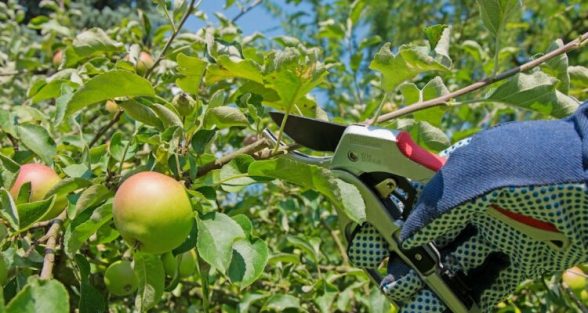
Cutting in the Christian faith is inevitable. In John 15:1-8 Jesus makes it clear that we will be cut as part of our faith journey. If we bear no fruit, we will be cut off; and if we do bear fruit, we will be pruned. When we are cut off, we will not produce any further fruit, but when we are pruned, we will produce even more fruit. So, what Jesus says in John 15 is that we will experience cutting in our faith journey. This cutting will be either a whole branch that is cut off, or bits of a branch that will be pruned off. The purpose of this cutting and pruning is to make us even more fruitful. Jesus’ teaching here in John 15 is indeed sobering. No-one wants to be cut.

In this same passage Jesus also speaks about the importance of remaining in him. And when we remain in him, he remains in us, just as he remains in his father and his father remains in him. In this passage today of eight versus, Jesus uses the word remain eight times. It is a central theme for the message today. So how do we not remain in Christ? We do not remain in Christ when we do not invest in our relationship with Christ. And we do not remain in Christ when we are fruitless, because we will either wither will be cut off.

So then how do we remain in Christ? John’s first letter, chapter 4, provides us with some answers to this question. In verses 8 and 9, John says, “God is love. This is how we how God showed his love among us: he sent his one and only son into the world that we might live through him.” So, we remain in God’s love first because God comes to us and loves us. All remaining in Christ is always a response to Christ’s coming to us. In verse 16, John continues saying, “God is love. Whoever lives in love lives in God and God in them.” This sounds very much like remaining in Christ and Christ remaining in us. It is a reciprocal action of remaining. And further on, in verses 20 and 21, John emphasises that our love for God must manifest in our love for one another. He writes, “Whoever claims to love God yet hates a brother or sister is a liar. For whoever does not love their brother and sister whom they have seen, cannot love God whom they have not seen. And he has given us this command: anyone who loves God must also love their brother and sister.” Central to us remaining in Christ is God’s love for us, is our love for God and is our love for one another.

Therefore, let us remain grafted into Christ. We must accept that they will be cutting and pruning in our Christian journey. And yes, this is painful and uncomfortable. And sometimes it may make us question God’s love for us. But I am reminded of Peter’s response to Jesus in John 6: 67-69. Jesus had provided a difficult teaching and many of his followers turn away. And then Jesus asks his disciples, “You do not want to leave too do you?” And Simon Peter answers Jesus, “Lord to whom shall we go? You have the words of eternal life. We have come to believe and to know that you are the holy one of God.” There is no better alternative then remaining in Christ.

And so, I encourage us today to take seriously our faith in Christ: to remain in him, to be grafted into him, to accept God’s pruning, and to be fruitful in our love for God and one another.

Featured image from https://moowy.co.uk/pruning-apple-trees/

Inclusive shepherd

Click here to listen to the audio recording of this 12-minute message. Or watch the video here on Facebook (the message starts 26 minutes into the recording). Or read the text summary below.

In John 10:11-18, Jesus strives to convey to us the depth of his love for and connection with us, and his desire and expectation that we should love one another. This passage is part of a larger set of “I am” statements related to Jesus being a shepherd – the good shepherd. Central to this message is this:

Jesus knows you. Jesus loves you.

I encourage you to hear these words and to take them to heart. In our service, I gave each person a paperclip, and asked them hold and fiddle with it during the sermon. A paperclip is used to hold things together, and today’s message is about Jesus holding us to himself and to each other.

  • Twice, Jesus says that he is the good shepherd – not just a shepherd, but the good shepherd (vv 11 & 14)
  • Jesus emphasises, “I know my sheep”. We are not merely a mass of sheep in a large flock. He knows each one of us. Indeed, Jesus says that he knows us and we know him “just as the Father knows me and I know the Father” (vv 14-15).
  • Four times, Jesus says that he lays down his life for his sheep – for you (vv 11, 15, 17 & 18). This points to the extravagance and not-withholding nature of Jesus love. Indeed John says (in 1 John 3:16): “This is how we know what love is: Jesus Christ laid down his life for us.”

It is hard to ignore these words of affirmation and extravagant love from Jesus. His love for you is immeasurable.

In the middle of this passage, Jesus says something a little different (v16):

I have other sheep that are not of this sheepfold. I must bring them also. They too will listen to my voice, and there shall be one flock and one shepherd.

Outside of this verse, there is a sense that Jesus loves only me. But v16 suggests not only that Jesus loves you, but also that he loves completely different groups from you. And the words, “I must bring them also”, are extremely strong in the Greek, conveying the sense that, “I absolutely have to bring them also”.

We should also note the sequence that Jesus presents: [In the present] I have other sheep [and now] I must bring them [and then in the future] they too will listen to my voice [and then after that] there shall be one flock with one shepherd. While these sheep do not yet know Jesus’ voice, Jesus still regards them as “his sheep” (“I have other sheep…”), and he loves them.

Who might these ‘other sheep’ be? The possibility that Jesus engages other groups outside of our group, outside of our congregation, outside of our denomination and even outside of the Christian faith, is tantalizing. But even if we do not go that far, think of those in your group, in your flock, that you dislike, those you think are not living an adequate Christian life, those you think are not adequately committed, those you think don’t believe correctly, those you think should rather leave your group.

Perhaps these people are sheep in Jesus’ other sheepfold. If so, Jesus loves them just as he loves you. And who are we not to love them, since Jesus loves them? Every sheep is loved by Jesus. And he is the Good Shepherd, who brings them into his fold. And so should we.

Featured image from https://media.istockphoto.com/id/1331924301/photo/stack-of-colorful-paper-clips.jpg

Seeing is not believing

Click here to listen to the audio recording of this 21-minute message. Or watch the video here on Facebook (the message starts 25 minutes into the recording). Or read the text summary below.

In Luke 24:13-35, we have the story of the two disciples who are walking to Emmaus and who encounter a stranger, who we later learn is the resurrected Jesus. They did not recognise him, despite having a long conversation. It was only as they sat down for a meal that “their eyes were opened and they recognised him” (v31), and immediately Jesus disappeared. They saw Jesus, but they did not recognise him.

In our reading set for today (Luke 24:36-48), Jesus meets the disciples in a room, and although they see him and recognise him, they do not believe him. They have moved a little further than the previous two disciples, but they have not moved to a place of belief or faith: seeing is not always believing. In response, Jesus – patient as ever with the disciples’ slowness – presents a series of evidence to prove to them that he is indeed risen from the dead and not a ghost:

v38 – Jesus asks why they are troubled and why they doubt. He confronts their lack of belief and faith. But still they do not believe.

v39-40 – Jesus invited them to look, to touch, to see. He shows them his hands and his feet, so they can get physical evidence of his wounded body. But still they do not believe.

v41-43 – So Jesus asks if they have any fish. Not because he is hungry, but to prove that he is not a ghost, but a physical being, who can eat food. But still they do not believe.

44-47 – So Jesus tells them about the scriptures – the Law of Moses, the Prophets and the Psalms – which all prophecy everything that has happened to Jesus. But still they do not believe.

48 – So Jesus reminds them that they are first-hand witnesses of everything that Jesus did – healings, forgiveness, raising people from the dead – they saw a lot and they themselves did some of these miracles in his name. But still they do not believe.

50-51 – And then, finally, he blesses them and ascends in front of them up into heaven.

And then they believed! They worshipped him and returned to Jerusalem with great joy.

Sjoe, they were really SLOW! Slow to recognise him. Slow to believe in him. Slow to put their faith in him.

Perhaps we also are slow. Perhaps we also fail to recognise Jesus’ actions in our lives and in the lives of those around us. Or perhaps we see them, but don’t believe them. Or we believe them, but we don’t put our faith in him. In the recording of the sermon I share an experience of my own slowness to believe, to illustrate my own slowness.

Fortunately – thanks be to God – Jesus is supremely patient. And he is willing to provide us with evidence and to persuade us (this also is part of my testimony in the recording). I encourage you, therefore, to make a choice to see God’s hand at work in your life. To accept that it may be possible – even likely – that God is present with you, even when you don’t perceive God. That God is working in you, even when you don’t recognise that. That God loves you, even when you may feel unloved.

Featured image: “The Disciples give Fish to the Risen Lord to eat” from the medieval polychromed choir screen of Notre Dame de Paris. Image by Lawrence OP via Flickr; licensed under CC BY-NC-ND 2.0. (https://www.workingpreacher.org/wp-content/uploads/2020/06/LawrenceOP_Jesus_Fish_710.jpg)

Second-hand Faith

Click here to listen to the audio recording of this 16-minute message. Or watch the video here on Facebook (the message starts 24 minutes into the recording). Or read the text summary below.

Today’s message is about second-hand faith, meaning faith that rests on other people’s experiences of God, rather than on our own. 1 John 1: 1-4 presents such a faith. John emphasises his and the other disciples’ first-hand experience of Jesus, using words like see, looked, appeared, heard and touched a total of nine times in just a few verses. And he concludes by saying that we must believe him, and through believing him, who knows God, we get close to God. We are given a second-hand faith. Most of us don’t want a second-hand faith! We want our own, first-hand faith!

John 20:19-25 has a similar narrative. The disciples – minus Judas, who was not there – have a first-hand encounter with the risen Christ, who shows them his hands and his side. When Thomas joins them later, they say, “We have seen the Lord!” and expect that Thomas will be satisfied with this second-hand account. But Thomas says, “Unless I see the nail marks in his hands and put my finger where the nails were, and put my hand into his side, I will not believe.” Thomas wants simply what everyone wants – he wants to know first-hand that Jesus is risen. He wants to see and to touch. And Jesus meets this need.

We also want a first-hand faith. We want to know for sure and for ourselves that Jesus exists. We want to see him. We want to touch him. Where can we get such first-hand experiences? Three places: (1) We get them from the Scripture, where we read first-hand accounts of others and have confidence that their testimony is true. We can tag these accounts for future reference. (2) We rely on what others in our community tell us about God’s grace and working, and have confidence that their testimony is true. We can tag these accounts also for future reference.

(3) And we rely on our own experiences of God working in our own lives. We may not have many such experiences of our own, and they may not be particularly spectacular. But they are first-hand – they are OUR experiences and we KNOW them. These are the experiences we need to recover and treasure. We can tag them, because they are our first-hand encounters with God. They are the touchstones or reference points that we turn to when our faith gets shaky.

Featured image from https://ericclapp.com/wp-content/uploads/2021/04/doubting-thomas-by-julia-ward.jpg

Decalogue

Click here to listen to the audio recording of this 16-minute message. Or watch the video here on Facebook (the message starts 24 minutes into the recording). Or read the text summary below.

Today, we focus on the Decalogue, or Ten Commandments, from Exodus 20:1-17. In the church where I became a Christian, a reformed evangelical church, we had the Decalogue up on the walls at the front of the church – they were presented as the most important verses of Scripture and central to our faith.

Four of the commands are about our relationship with God – essentially, it is supposed to be an exclusive relationship (“no other Gods but me”) – a 100% commitment to God, to Yahweh. And six of the commands are about our relationships with people – essentially, they are supposed to be ethical relationships – we are to treat people well.

In the First Testament, the Decalogue was written on stone tablets, but the very finger of God. But the later prophets, Ezekiel (11:19 & 36:26) and Jeremiah (31:33), wrote about having hearts of flesh instead of hearts of stone, and of God writing God’s law on our hearts.

We see this fleshy version of the Decalogue most powerfully in Christ’s incarnation – God come to dwell among us in human form. And Jesus, when asked about the Decalogue, distills them into just two: Love God and love your neighbour. These align well with what I wrote about – to be exclusive with God and ethical with people. But what is particularly emphasised in Jesus’ summary, and not obvious from the Decalogue, is love. (In Exodus 20, love appears only in verse 6, as an explanation of God’s jealous love for God’s people.)

If I were still at the church where I became a Christian, I’d be advocating for removing the Decalogue – the First Covenant Law – and replacing it with Jesus’ Great Commandment – the distillation of the Second Covenant, which is rooted in freedom and love.

That brings us to our gospel reading for today (John 2:13-22), where Jesus clears out the template. In Matthew, Mark and Luke, this story is narrated during Holy Week, on or after Palm Sunday, and as being the trigger for Jesus’ arrest and crucifixion. It is the culmination of Jesus’ offensiveness to the Jewish priests and leaders. But in John’s gospel, it comes as Jesus’ second act, right at the start of his ministry – following immediately on the wedding at Cana. The wedding story, with its extravagant and exceptional wine, is a story of freedom, generosity and abundance – the abundant life that John writes about so much. While the clearing of the template story is about God’s demand for our exclusivity and ethics.

Here, at the start of his ministry, Jesus acts out the requirements of the Great Commandment. Firstly, God’s house is being used in unholy ways. The things of God (the animal sacrifices) are being sold and bought. There is no place for such unGodly things in the very house of God. The exclusive relationship with God that is required by the Decalogue and by the Great Commandment, is being violated. And in addition, the people – the worshippers – are being exploited, having to pay to exchange currencies, to purchase animals for sacrifice. This is not ethical, not loving.

Jesus clears the template as a demonstration of the Great Commandment – Love God, Love your neighbour!

These standards that Jesus sets for us are impossibly high. I, certainly, fail again and again at these two seemingly simple commands. I stray from my exclusive relationship with God, and I fail to love others as myself.

Thanks be to God, Jesus bridges the gap between the high ideals and our broken efforts. He connects us to God, and his faithfulness transcends our fickleness. He strength transcends our frailty. He maintains the bond of fellowship between us and God and each other, even when we inevitably fail.

And so, as we continue our pilgrimage through Lent, let us continue to turn back to Jesus, and recommit ourselves to the Great Commandment: love God, love others or be exclusive with God and ethical with others.

Picture downloaded from https://www.thecatholictelegraph.com/wp-content/uploads/2018/06/ten-commandments.jpg