Irrepressible love

Love is central to the being of God, so it is little wonder that Love infuses Jesus’ post-resurrection, post-crucifixion appearances, and also his post-ascension appearances. This message unpacks the details of Jesus’ infinite and irresistible love for his people in John 21, and also his demanding and liberating love for those who are not his people in Acts 9. Watch the 24-minute video message or read my notes below that.

Let us consider John chapter 21

  • v3. The disciples go fishing. So ordinary – living life, even in the absence of their Lord.
  • v5. Jesus appears on the seashore and asks if they have caught no fish. He is concerned for them, for their well-being, for their everyday life.
  • v6. He tells them to cast their nets to the other side of the boat and the catch a massive haul! Jesus acts on behalf of the disciples, with their ordinary, everyday needs. Like he did at the wedding in Cana (Jn 2), where he rescued a couple’s wedding by making water into wine. He is concerned for our everyday lives.
  • v9. Next thing, he’s cooking food for them! This is the Son of God, raised from the dead! This is the one we read out in Rev 5, “Many angels, ten thousand times ten thousand, encircling the throne, saying in a loud voice: Worthy is the Lamb, who was slain, to receive power and wealth and wisdom and strength and honour and glory and praise!” This is the one cooking breakfast for them!
  • v9. Jesus provides the fish for the meal. They bring their catch only after he has already caught and cooked fish for them. He cares, he’s thoughtful.
  • v12. Jesus invites them, “Come and have breakfast.” So ordinary, so thoughtful. He breaks bread and fish, like he did when he fed the 5000 in Jn 6.
  • v12. This meal reminds us of the Last supper just a week or so previously in Jn 13. From supper to breakfast; from night to dawn; from death to life. This is a transformative meal – more than just brekky.
  • v15-17. Three times Jesus asks Peter, “Do you love me?” Three times Peter protests, “Of course I love you!” Here Jesus gives Peter a chance to undo the three denials on Good Friday. In so doing, Jesus resets Peter’s standing – his slate is wiped clean. This is grace.
  • v15-17. Each time, Jesus says, “Feed my lambs, take care of my sheep, feed my sheep.” This is good shepherding. This is what we want in our new bishop. We remember Jesus in Jn 10, “I am the good shepherd. I know my sheep and my sheep know me. I lay down my life for my sheep.” This is good shepherding.
  • v19. Finally, Jesus says, “Follow me!” His example is the one we are called to follow – his example, his footwashing in Jn 13. “Now that I, your Lord, have washed your feet, you should wash one another’s feet. I have set you an example.” An example of humility, of care, of love.

Let us also consider Acts 9

  • v1. “Saul is breathing out murderous threats against the Lord’s disciples”. He is a bad, bad man, full of perverse religious self-righteousness.
  • v4-5. On the road, Saul encounters the risen Jesus, who says, “Saul, Saul, why do you persecute me? I am Jesus, whom you are persecuting.”
  • Here Jesus demonstrates his “option for the poor”. He identifies with those whom Saul is persecuting – ‘you are persecuting me’, he says, because he is one with those who are persecuted.
  • Like then, still today, Jesus stands with those who suffer. He is always to be found in the midst of conflict and suffering. He stands in Gaza, he stands in Ukraine, he stands in the DRC, in Ethiopia, in Myanmar. He stands today even among minority groups in the USA who are being persecuted by their new government.
  • v6. But despite all of Saul’s repugnant hatred and self-righteousness, Jesus calls and uses Saul, who becomes Paul.
  • God’s choices are radical and loving.
  • He can transform anything and anyone. Nothing we do can block God’s purposes.
  • Jesus’ love and intentions are irrepressible.
  • Best we just surrender to him, because we cannot overcome God’s love.

To wrap up, let’s read Psalm 30

I will exalt you, O LORD, for you lifted me out of the depths and did not let my enemies gloat over me.
O LORD my God, I called to you for help and you healed me. O LORD, you brought me up from the grave; you spared me from going down into the pit. Sing to the LORD, you saints of his; praise his holy name. For his anger lasts only a moment, but his favor lasts a lifetime; weeping may remain for a night, but rejoicing comes in the morning. When I felt secure, I said, “I will never be shaken.” O LORD, when you favored me, you made my mountain stand firm; but when you hid your face, I was dismayed. To you, O LORD, I called; to the Lord I cried for mercy: “What gain is there in my destruction, in my going down into the pit? Will the dust praise you? Will it proclaim your faithfulness? Hear, O LORD, and be merciful to me; O LORD, be my help.” You turned my wailing into dancing; you removed my sackcloth and clothed me with joy, that my heart may sing to you and not be silent. O LORD my God, I will give you thanks forever.

Image by Kate Cosgrove, https://www.brethren.org/messenger/bible-study/breakfast-on-the-beach/

The Great Forgiveness

This Easter Sunday message centres on the idea that a most important fruit of the Easter story is that God’s forgiveness is extended and stretched to its limit, thereby including every sin imaginable. It is all already paid and cleared, cast into the deep. The return of Christ to humanity, after we so brutally murdered him, is the evidence of God’s extreme and great forgiveness. There could be no greater crime or violence against God. That God returns his son to us on Easter morning is a sign of God’s radical forgiveness. This great act of forgiveness for the murder of Christ is like a great whirlwind that catches up not only this sin, but all of our other sins also. They are all caught up in the one extra-ordinary and unprecedented act of forgiveness, and done with. And so, when we sin – as we will – we can know for sure that we can come to God, to sincerely ask his forgiveness, and to be sure that he will forgive and indeed has already, long ago done so.

(We love the screams and laughs of the children throughout this sermon. Jesus welcome children around him, while he was teaching. Certainly, they would have been as noisy as these ones were. Many were here to be baptised. Others were just full of beans!)

Seeing is not believing

Click here to listen to the audio recording of this 21-minute message. Or watch the video here on Facebook (the message starts 25 minutes into the recording). Or read the text summary below.

In Luke 24:13-35, we have the story of the two disciples who are walking to Emmaus and who encounter a stranger, who we later learn is the resurrected Jesus. They did not recognise him, despite having a long conversation. It was only as they sat down for a meal that “their eyes were opened and they recognised him” (v31), and immediately Jesus disappeared. They saw Jesus, but they did not recognise him.

In our reading set for today (Luke 24:36-48), Jesus meets the disciples in a room, and although they see him and recognise him, they do not believe him. They have moved a little further than the previous two disciples, but they have not moved to a place of belief or faith: seeing is not always believing. In response, Jesus – patient as ever with the disciples’ slowness – presents a series of evidence to prove to them that he is indeed risen from the dead and not a ghost:

v38 – Jesus asks why they are troubled and why they doubt. He confronts their lack of belief and faith. But still they do not believe.

v39-40 – Jesus invited them to look, to touch, to see. He shows them his hands and his feet, so they can get physical evidence of his wounded body. But still they do not believe.

v41-43 – So Jesus asks if they have any fish. Not because he is hungry, but to prove that he is not a ghost, but a physical being, who can eat food. But still they do not believe.

44-47 – So Jesus tells them about the scriptures – the Law of Moses, the Prophets and the Psalms – which all prophecy everything that has happened to Jesus. But still they do not believe.

48 – So Jesus reminds them that they are first-hand witnesses of everything that Jesus did – healings, forgiveness, raising people from the dead – they saw a lot and they themselves did some of these miracles in his name. But still they do not believe.

50-51 – And then, finally, he blesses them and ascends in front of them up into heaven.

And then they believed! They worshipped him and returned to Jerusalem with great joy.

Sjoe, they were really SLOW! Slow to recognise him. Slow to believe in him. Slow to put their faith in him.

Perhaps we also are slow. Perhaps we also fail to recognise Jesus’ actions in our lives and in the lives of those around us. Or perhaps we see them, but don’t believe them. Or we believe them, but we don’t put our faith in him. In the recording of the sermon I share an experience of my own slowness to believe, to illustrate my own slowness.

Fortunately – thanks be to God – Jesus is supremely patient. And he is willing to provide us with evidence and to persuade us (this also is part of my testimony in the recording). I encourage you, therefore, to make a choice to see God’s hand at work in your life. To accept that it may be possible – even likely – that God is present with you, even when you don’t perceive God. That God is working in you, even when you don’t recognise that. That God loves you, even when you may feel unloved.

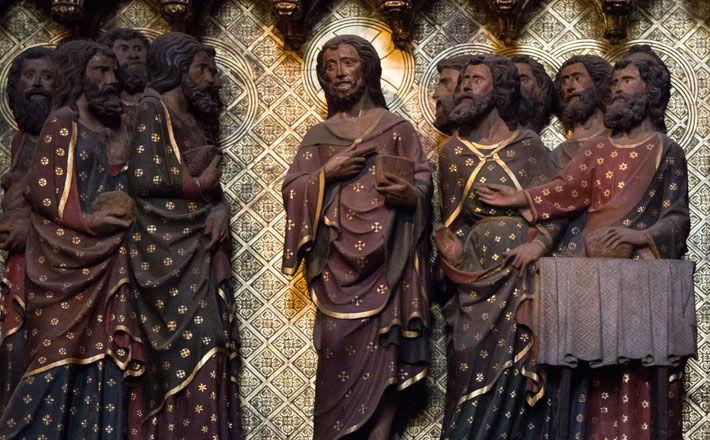
Featured image: “The Disciples give Fish to the Risen Lord to eat” from the medieval polychromed choir screen of Notre Dame de Paris. Image by Lawrence OP via Flickr; licensed under CC BY-NC-ND 2.0. (https://www.workingpreacher.org/wp-content/uploads/2020/06/LawrenceOP_Jesus_Fish_710.jpg)

Passion of Christ (according to Matthew)

Click here to listen to a reading of the Passion of Christ according to St Matthew (26:14-27:66, from the New International Version) or click here to watch a video of this reading (the reading starts at about 26 minutes).

For centuries, Christians have combined the celebration of Palm Sunday with the reading of the Passion Story. I did not grow up in a church that did this. We had “Hallelujah’s” on Palm Sunday as Jesus rides triumphally into Jerusalem, and then “Christ is Risen Indeed” on Easter Sunday. In between, there was nothing. But our tradition is to set together these two sets of narratives to drive home the stark reality of how easily we humans can go from ‘Hallelujah!’ to ‘Crucify him!’ within days. The reading takes about 25 minutes. It is the only time each year that we read the entire Passion Story, and so well worth listening to or watching.

Featured image by Jyoti Sahi (Indian, 1944–), Way of the Cross, 2009. Oil on canvas. From: https://www.imb.org/2017/04/12/journey-cross-artists-visualize-christs-passion-part-2/

God’s self-revelation

Click here to listen to the audio recording of this 12-minute message. Or watch the video on Facebook here (the message starts at about 25 minutes).

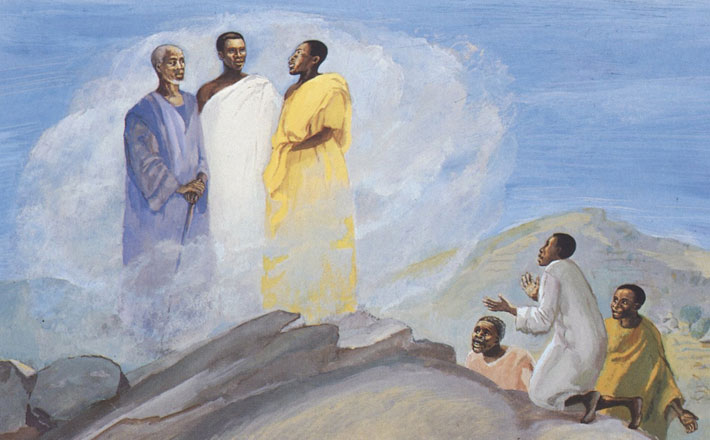
Today we celebrate the transfiguration (Luke 9:28-36), where Jesus reveals his divine nature to three of his disciples. This event, which in our church we celebrate with the colour white, falls after a period of ‘ordinary time’ in the church calendar, which we celebrate with green, and Lent, which we observe with purple. This celebration is thus well placed as a link between a period of ordinary growth in the church and period of intensive penitence and critical self-reflection.

Furthermore, the transfiguration is located in our church calendar almost exactly at the midpoint between Christmas (two months and two days ago) and Easter Sunday (10 days less than two months from now). Each of these events – the birth of Christ, the transfiguration of Christ and the resurrection of Christ – are moments of God’s self-reflection, or epiphanies. God shows God’s self for who God is, in these key moments in the life of Christ.

Christmas focuses on the incarnation of God the Son in the form of the human Jesus. It is God’s emptying of God’s self – the kenosis – in which God immerses God’s self into human life and comes to live among us as one of us. It is also a story of the birth of a child – of hope, of new life, of a baby. The Christmas self-revelation emphasises the light and life of God in our midst.

The transfiguration shows us that Jesus is more than ‘just’ a teacher, more than ‘just’ a healer or miracle worker. He is revealed in all his divine splendour, as the Son of God, even more, as God the Son. All the fullness of the Godhead dwells in Jesus. Most of the time it is hidden from sight. But in the transfiguration, Jesus kind-of drops his human skin and reveals his divine nature to Peter, James and John. The transfiguration self-revelation emphasises the power and divine majesty of God in our midst.

Easter focuses on the discipline and love of Jesus for his Father, and for humanity, leading him to walk a path that he knows will lead to his humiliation, suffering and ultimately, his death. He knows this is a path of suffering, but he also knows that it is a path towards the salvation of all of humanity. Jesus’ Easter resurrection is God’s self-revelation of profound and reckless love for humanity.

These revelations of God’s self – of who the triune God truly is – as our focus as we enter Lent. God is the child that brings life and light. God is the divine being, filled with power and majesty. And God is our saviour, filled with love and compassion. It is into this God, this Christ, that we immerse ourselves during the coming period of Lent.

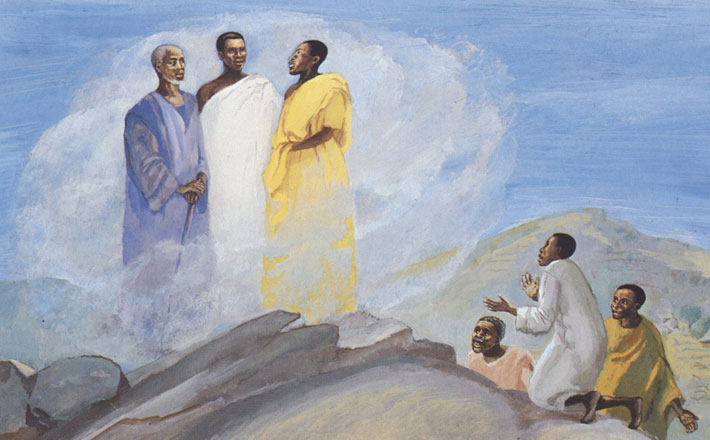
Featured image: JESUS MAFA. Transfiguration, from Art in the Christian Tradition, a project of the Vanderbilt Divinity Library, Nashville, Tenn. https://www.workingpreacher.org/wp-content/uploads/2020/06/Mafa_Transfiguration_710.jpg

Up to life

You can watch the video of today’s Easter message here. The Gospel reading and sermon start at about 23 minutes into the recording and continue for about 19 minutes.

Today we celebrate Easter Sunday – the culmination of weeks of Lenten fasting and penitence, and a week of daily soul-searching services. On Good Friday, we watched our Lord’s life slip away on the cross and experienced darkness fall over the earth as the Light and Life of God was snuffed out. And then we waited, through Friday and Saturday – wondering, what might happen, how might this all turn out.

It is relatively easy for us, because we are so familiar with the outcome of the story. But for those first believers – such as Mary and the other women in Mark 16:1-8 – it must have been surreal and terrifying. The unthinkable had happened. No wonder Mark relates the confusion of the first women to arrive at Jesus’ grave, and their fear and silence after encountering what they thought was a young man (but probably an angel).

For us, though, we now understand and appreciate the resurrection of Christ as the fruit of Christ’s triumph over death, of God’s generous and complete forgiveness of sins of all humanity, of a profound and utter reconciliation with God, and the restoration of Christ as the light of the world. God gifts back to humanity the very one that humanity sought to extinguish, as a sign of their joint unconditional and extravagant love for humankind, and indeed the whole cosmos.

Alleluia! Christ is risen indeed!!

In Romans 6:3-11 we gain further insights from Paul into the ways in which our salvation follows the same path as Christ’s death and resurrection. In our baptism, we die to self in a watery grave; only to be raised again to new life in Christ, a life filled with Holy Spirit. In our service today we baptise little Onyedikachuckwu Christian Okafor – a visible sign of God’s salvation – and renew our own baptismal vows, said originally on our behalf as infants, and today renewed freely by ourselves.

Lord, you have nourished us with your Easter sacrament. Fill us with your Spirit and make us one in peace and love. We ask this through Jesus Chris our Lord. Amen.

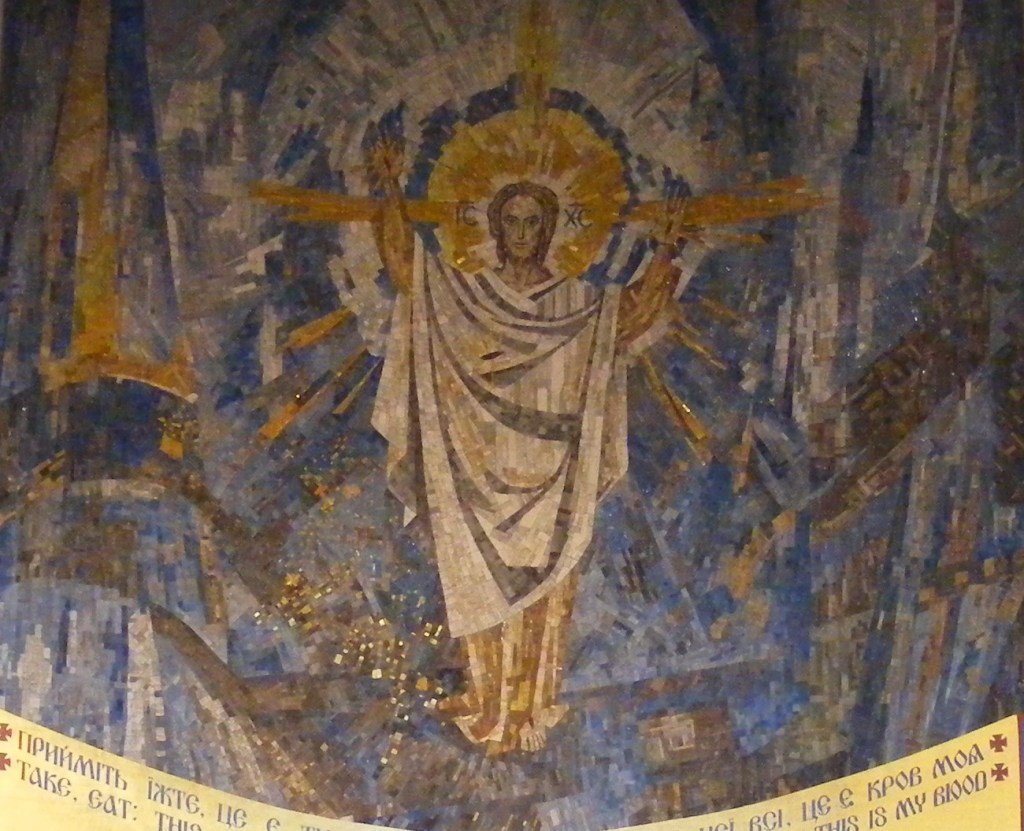
Mosaic from St. Basil’s Ukrainian Catholic Church in Edmonton at https://royaldoors.net/?p=3751

Passion of Christ (according to Mark)

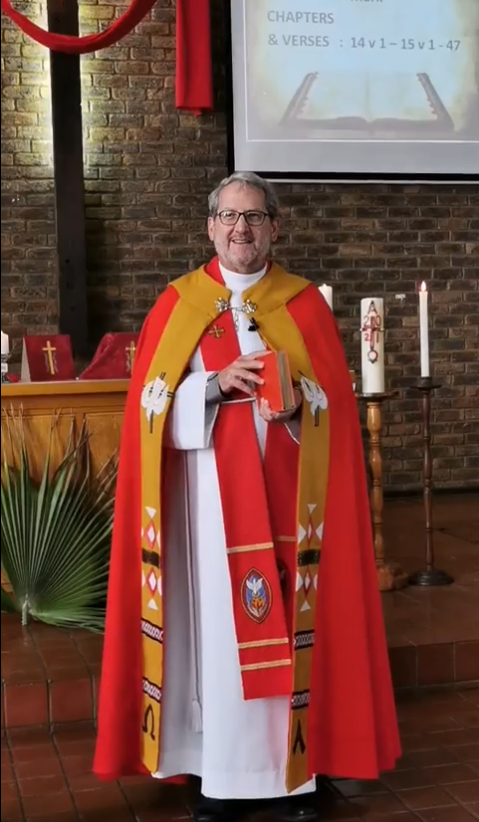
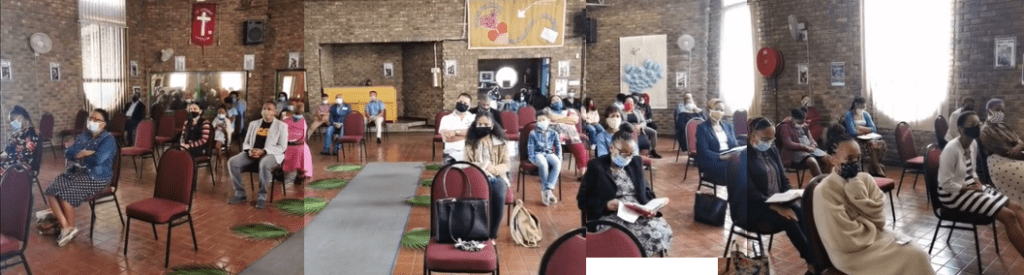
Today, instead of a sermon, we listened to a reading of the Passion of Christ, from Mark chapters 14 and 15, using the JB Phillips translation. You can listen to the audio recording of the reading here. Or you can watch the video of the reading on Facebook here (the reading starts at 30 minutes). The reading takes 27 minutes.

Below are a few photos of me reading and a composite photo of our in-house congregation.

God’s great forgiveness

Click here to listen to the audio of this 6-minute message. Or watch the YouTube video below, or read the text that follows after that.

The Lord is Risen! He is Risen Indeed!! Alleluia!!!

During this past week, we have confronted the dark side of humanity and of ourselves. We have recognised that it is our sin – each of ours – that contributed to Christ’s death. Humanity, in its arrogance, attempted to murder God the Son! What greater sin can there be? One might imagine that a God of justice would wipe the earth clean.

Instead, God forgives humanity. God returns to us the very Son that we murdered! What greater forgiveness can there be? All the rest of our sins are caught up in God’s great forgiveness of this greatest of all sins. All God asks of us to acknowledge our sin – Father, I am sorry; please forgive me. God says “Yes!” to humanity. God says “Yes!” to maintaining and enabling fellowship with each of us.

Moreover, Christ’s triumph over death, he rising from the grave to new life, is God’s “Yes!” to life and “No!” to death. Particularly during the COVID-19 plague, which has already taken the lives of over 100,000 people, we are in need of this reassurance that God has already triumphed over death. COVID-19 will do its worst, but it will die, and humankind will live. God will triumph over death.

Almighty God,
this night explodes with the radiance of the risen Christ;
set us ablaze with the power of your love
and propel us into the world
to live and proclaim the gospel of the living Lord;
who lives and reigns with you and the Holy Spirit,
one God, now and for ever.
Amen

2020.04.12_El_Greco_-_The_Resurrection_-_WGA10530

Painting of The Resurrection, by El Greco, 1597-1600. From here.

Featured image: Resurrection of Christ, by Raphael, 1499–1502. From here.

Painting in the YouTube video: Resurrection of Christ, by Rottenhammer (1564–1625)


Suffering and Glory

Click here to listen to this 16-minute message.

Jesus provides us an example of faithful journeying along the path that God had set him, a path which lead into and through suffering. He follows this path, trusting that God is present and enabling, and believing that it is a path that leads to glory.

Jesus encourages us also to follow such paths, to understand the meaning and value of hardship, and to trust that through these experiences we will reap a reward of honour and glory.

Such insights are particularly meaningful as we journey through Lent and approach Easter, when Jesus pays the ultimate price for our sin.

This message is based on John 12:20-33.