Transfiguration – a moment of light

Click here to listen to the audio recording of this 22-minute message. Or watch the video here on Facebook (the message starts 23 minutes into the recording). Or read the text summary below.

The transfiguration of Christ, which is reported in Mark 9 (our reading for today), Matthew 17 and Luke 9 (all with very similar content), is a remarkable story. I wish I had been there with Peter, James and John, to see this for myself! What a beautiful and transcendent experience. And also how terrifying and mind bending. No wonder the disciples were rendered virtually unconscious. We read this passage every year and get a sermon on it every year. What more can be said?

This year, I spent time reading the texts on either side of the transfiguration narrative, and found that these passages also were congruent across the synoptic Gospels (Matthew, Mark and Luke). What struck me the most was how difficult and dark these passages were. The transfiguration is just a brief moment of light – brilliant, blinding, cosmic light – within a much darker narrative.

Before the transfiguration, we read about Peter declaring Jesus to be the Messiah (v29), Jesus telling the disciples that he will soon be killed (v31), Peter rebuking Jesus for saying this (v32), Jesus rebuking Peter and uttering these dreadful words – “Get behind me Satan!” (v33, reported also in Matthew, but not Luke) and Jesus explaining the cost of discipleship and the way of the cross (v34). Wow, dark material indeed!

After the transfiguration, the dark material continues. Jesus and the three disciples find a major argument going on among the people because the disciples were unable to cast out a demon (v18), Jesus gets angry asking, “You unbelieving generation, how long shall I stay with you?” (v19) (or “how long must I put up with you?” in Matthew). And then Jesus repeats his message that he will soon be killed (v31).

These passages before and after the transfiguration are in such stark contrast with the transfiguration itself. In the midst of dark, difficult, conflictual narrative is this brief blinding moment of Christ’s glory as God the Son. But it is so short lived – the three disciples come crashing back into a challenging world.

This contrast reminds me of our Palm Sunday services in our (Anglican) tradition. We start our service outside in red, with crosses and candles and incense and palm branches, shouting “Hosanna! Blessed is he who comes in the name of the Lord!”, processing around the church and into the road singing “All glory, laud and honour!” Such an exciting and happy time. And then our reading for the day is the whole of the passion narrative (from the last supper to Jesus’ burial). This contrast in tone (from joy to despair) is stark and shocking.

We ought not to think that we are promised a happy joyful, prosperous, wealthy, healthy life, even though some churches do teach this. We do not find it in the scriptures – it is not in the life of Jesus, it is not in Jesus’ teachings and it is not in the transfiguration narrative. Instead, we are invited to grapple with faith, discipleship, health, death, effectiveness and power. And within this real but difficult life, there are moments of light, joy and peace.

This is not to say that we should wallow in depression or succumb to despair and hopelessness. No! Certainly not! Rather, we need to face and confront depression, despair, hopelessness and all the other challenges we face in life. We walk in faith, trusting in God’s abiding presence, even in the darkness. We call on him for life, for salvation, and to offer thanks. We journey through the challenges of life, knowing that God is on our side.

To help us with this, I encourage you to read Psalm 116. And if life is sitting heavily on you, I encourage you read it multiple times each day, as a prayer for protection and God’s sustaining presence. Here it is:


I love the Lord, for he heard my voice;
    he heard my cry for mercy.
Because he turned his ear to me,
    I will call on him as long as I live.

The cords of death entangled me,
    the anguish of the grave came over me;
    I was overcome by distress and sorrow.
Then I called on the name of the Lord:
    “Lord, save me!”

The Lord is gracious and righteous;
    our God is full of compassion.
The Lord protects the unwary;
    when I was brought low, he saved me.

Return to your rest, my soul,
    for the Lord has been good to you.

For you, Lord, have delivered me from death,
    my eyes from tears,
    my feet from stumbling,
that I may walk before the Lord
    in the land of the living.

10 I trusted in the Lord when I said,
    “I am greatly afflicted”;
11 in my alarm I said,
    “Everyone is a liar.”

12 What shall I return to the Lord
    for all his goodness to me?

13 I will lift up the cup of salvation
    and call on the name of the Lord.
14 I will fulfill my vows to the Lord
    in the presence of all his people.

15 Precious in the sight of the Lord
    is the death of his faithful servants.
16 Truly I am your servant, Lord;
    I serve you just as my mother did;
    you have freed me from my chains.

17 I will sacrifice a thank offering to you
    and call on the name of the Lord.
18 I will fulfill my vows to the Lord
    in the presence of all his people,
19 in the courts of the house of the Lord—
    in your midst, Jerusalem.

Praise the Lord.

Image from http://livingwordrec.ca/archive/the-transfiguration-who-do-you-say-that-i-am/

Abraham’s example

Click here to listen to the audio recording of this 28-minute message. Or watch the video here on Facebook (the message starts about 28 minutes into the recording). Or read the text summary below.

In last week’s sermon, ‘Hard words’, from Matthew 10:24-39, we heard almost impossible words from Jesus regarding his expectations of how we should live our lives. In particular:

37 Anyone who loves their father or mother more than me
is not worthy of me;
anyone who loves their son or daughter more than me
is not worthy of me;
38 whoever does not take up their cross and follow me
is not worthy of me.

Despite these words, the take-home message from last week was (1) that God loves us deeply and with great attention to the detail of our lives, and (2) that God wants the whole of us and not just small pieces of us.

Genesis 22:1-18, our reading for today, illustrates what we spoke about last time. Abraham gets an unthinkable instruction from God:

“Take your son, your only son, whom you love—Isaac—and go to the region of Moriah. Sacrifice him there as a burnt offering on a mountain I will show you.”

I wonder what we would do if we got such an instruction from God. Honestly, I would say ‘no’. Just, ‘no’.

We must remember, though, that we know much more about God’s character today than Abraham did. God only began revealing himself to the world in Genesis 12, when he selected Abraham to be his ambassador and to bring God’s blessings to all nations. Abraham was just getting to know God and had little to go on 10 chapters later. But we have the rest of the entire First Testament, plus the Gospels and all the writings of the early church. We have a much greater grasp of who God is and what God would or would not demand of us.

Still, Abraham is committed and so obeys God’s command. He and his only son Isaac start the journey towards Isaac’s sacrifice. Isaac may be a child, but he’s not stupid. He notices that everything for the sacrifice is there except the lamb. Where is the lamb? he asks his father. And Abraham answers, God will provide.

They continue on to the site God had selected. Abraham establishes the altar, lays his son on the wood, and gets ready to kill him with a knife before burning his body as a sacrifice to God. In that final moment, God stops him and affirms his faith. And provides a ram (not just a lamb) to be sacrificed in Isaac’s place. And God renews his original promise to Abraham in Genesis 12 in Genesis 22:15-18.

It is in many ways an unthinkable, dreadful story!

The only real comparison is Jesus’ death on the cross – also a sacrifice on our behalf. But there are major differences between Jesus’ sacrifice and Isaac’s. Jesus was a full and equal partner with God the Father and God the Spirit in working out the plan for his sacrifice of himself on the cross. Jesus went in knowing what he was doing and fully agreeing to it. And he knew the outcome it would produce. Isaac, on the other hand, was kept in the dark about all of this.

I said to my congregation in the sermon that if they believe God is instructing them sacrifice a member of their family, they should come and talk with me first. Seriously! This narrative in Genesis 22 is not the norm.

But it does illustrate the kind of whole-hearted and willing-to-go-to-the-very-end commitment that Jesus spoke about in Matthew 10 last week. Sometimes, God does call us to do something unimaginable, extraordinary, risky, and extravagant. And often, that is precisely what we should do. God does want our whole selves – every piece of us.

Featured image from the 4th Sorrowful Mystery Chapel in the Basilica of the National Shrine of the Immaculate Conception in Washington, D.C. (https://www.nationalshrine.org/blog/why-did-god-ask-abraham-to-sacrifice-isaac/)

Hard words

Click here to listen to the audio recording of this 28-minute message. Or watch the video here on Facebook (the message starts about 25 minutes into the recording). Or read the text summary below. (This message was preached on 25 June 2023.)

The context of today’s Gospel reading (Matthew 10:24-39) is persecution – Jesus’ warning to his disciples that they will be persecuted (vv 16 & 22):

I am sending you out like sheep among the wolves… You will be hated by everyone because of me…

And so we read this passage section by section and listen to what God is saying to us through the Word:

24 The student is not above the teacher, nor a servant above his master. 25 It is enough for students to be like their teachers, and servants like their masters. If the head of the house has been called Beelzebul, how much more the members of his household!

We are described as Jesus’ servants or slaves and as Jesus’ students. What happens to him will happen to us. How he is treated, so shall we be treated. If he is called Beelzebul (the devil), so shall we. But there is also hope in these lines: hope that we can become like our teacher and master; and hope that we upgrade from students and servants to members of his household.

26 So do not be afraid of them,
for there is nothing concealed that will not be disclosed,
or hidden that will not be made known.
27 What I tell you in the dark, speak in the daylight;
what is whispered in your ear, proclaim from the roofs.

Who is it that we need not be afraid of? Surely not the people in the previous verses? No, I think most likely is it the ‘they’ referred to in verse 19, “But when they arrest you, do not worry about what to say or how to say it.”

These verses present 4 contrasts between what happens in private (concealed, hidden, in the dark, in the ear) and what is done publicly (disclosed, made known, in the daylight, from the rooftops). We are encouraged to be bold!

28 Do not be afraid of those who kill the body but cannot kill the soul.
Rather, be afraid of the One who can destroy both soul and body in hell.

Here we get the second reassurance to not be afraid. ‘Those who kill the body’ refers to those people who persecute – many Christians in the early church were persecuted and killed. But instead, be afraid of the one who can destroy the soul. I’ve often thought that meant the devil, but commentators argue that the devil does not have the power to destroy souls – only God has that power. So, if we are going to be afraid of anyone, we should be afraid of (or rather, we should fear) God.

29 Are not two sparrows sold for a penny? Yet not one of them will fall to the ground outside your Father’s care (or will or knowledge).
30 And even the very hairs of your head are all numbered.
31 So don’t be afraid; you are worth more than many sparrows.

Verse 29 contrasts the cheapness of sparrows with God’s concern for their death. The last word of verse 29 has multiple meanings, but ‘care’ seems most appropriate in context – God cares about even the cheap little sparrows. He directs his attention towards even them. He does not, however, save them from dying – they do die. But he is present with and caring for them, as they die.

Verse 30 emphasises God’s interest in the smallest details of our lives, even the number of hairs on our head. It is trivial, but God knows such details. Again, he does not stop our hair from falling out! But he does keep count.

Verse 31 gives us the third “don’t be afraid”. Because sparrows – small as they are – are loved by God. How much more are we then loved by God.

32 Whoever acknowledges me before others,
I will also acknowledge before my Father in heaven.

33 But whoever disowns me before others,
I will disown before my Father in heaven.

These two verses provide a parallel response from us to Christ: if we acknowledge him, he’ll acknowledge us. If we disown him, he’ll disown us. These are blunt words, but honest and direct.

34 Do not suppose that I have come to bring peace to the earth. I did not come to bring peace, but a sword. 35 For I have come to turn
“a man against his father,
a daughter against her mother,
a daughter-in-law against her mother-in-law—
36 a man’s enemies will be the members of his own household”. (Micah 7:6)

Jesus preaches love consistently, but then we get these verses about the violence within families. In truth, faith can fracture families. Nations go to war over religion. And so do families.

37 Anyone who loves their father or mother more than me
is not worthy of me;
anyone who loves their son or daughter more than me
is not worthy of me;
38 whoever does not take up their cross and follow me
is not worthy of me.

This triptych of “is not worthy of me” is among the most chilling words uttered by Jesus. They seem so out of character. A punch in the belly. His emphasis is on his requirement for our total allegiance.

39 Whoever finds their life will lose it, and whoever loses their life for my sake will find it.

We must lose ourselves in Christ. That is the path to finding ourselves.

So, as we we wrap this difficult passage, there are two take-home messages:

First, God knows and loves us – we are members of his household, valued, known and cared for.

Second, God expects everything of us – he wants our utter commitment.

Featured image from https://www.thegospelcoalition.org/blogs/erik-raymond/truth-and-tone-go-hand-in-hand/

Following the new wine

Click here to watch the video of this 28-minute message on Facebook (the message starts about 29 minutes into the recording). Note that this is an active sermon – worth watching, rather than just reading. I don’t have an audio recording of this message. Or read the text summary below.

Matthew 9 tells the story of Jesus calling Matthew: “As Jesus went on from there, he saw a man named Matthew sitting at the tax collector’s booth. “Follow me,” he told him, and Matthew got up and followed him.” And Genesis 12 tells the story of God calling Abram: “Go from your country, your people and your father’s household to the land I will show you.” Go! Follow me! These calls have nuclear power to move people – Matthew got up and followed Jesus, Abram packed and moved into the unknown.

Jesus is calling you and me today – Follow me! Go! – but to where? Where do we go? Where do we follow?

Matthew 9:16-17 gives us invaluable insights into what Jesus calls us to, in the metaphor of new wine in new wineskins:

“No one sews a patch of unshrunk cloth on an old garment, for the patch will pull away from the garment, making the tear worse. Neither do people pour new wine into old wineskins. If they do, the skins will burst; the wine will run out and the wineskins will be ruined. No, they pour new wine into new wineskins, and both are preserved.”

Although the metaphor is a bit obscure, at very least we can take from this that there are challenges in mixing the old and new. Jesus leans strongly in favour of the ‘new’ – new wine and new wineskins are what we’re after. A few verses earlier (v13) he gives another clue about where we are following him to, when he quotes Hosea, “I desire mercy, not sacrifice”. Mercy represents love for people, while sacrifice represents religion. Jesus is saying – indeed God is saying – I don’t want your religion, I want your love for people. This is the ‘new’ teaching – or rather an old teaching renewed – that Jesus gives us. And the whole of Matthew 9 illustrates this with examples.

Come along with me – follow me! – as we briefly consider the seven stories that illustrate following the new wine in Matthew 9:

  1. The chapter opens with a paralysed man, brought to Jesus by his faith-filled friends. Jesus sees their faith and says, “Take heart, son; your sins are forgiven.” The teachers of the law are outraged by Jesus’ presumption of having authority to forgive sins – they’re not interested in the man, only in their theology. Jesus responds strongly and heals the man as evidence of his authority to proclaim forgiveness of sins. Jesus’ love for this physically and spiritually broken man takes precedence over the teachers’ petty theology.
  2. In verses 10-13, Jesus attends a party hosted by Matthew, who is now following Jesus. Matthew’s friends are tax collectors and sinners – ‘bad people’. The Pharisees – another religious group – are disgusted and ask Jesus’ disciples, “Why does your teacher eat with tax collectors and sinners?” They are not concerned with the humanity of Matthew and his fallen friends – they are concerned only with religious piety and ‘rightness’. They dehumanise these broken people. Jesus confronts them, “It is not the healthy who need a doctor, but those who are ill… For I have not come to call he righteous, but sinners.” Jesus’ love for sinners, for bad people, takes priority over everything.
  3. In verses 14-17, while still at the same dinner party, the disciples of John the Baptist come and ask Jesus, “How is that we and the Pharisees fast often, but your disciples do not fast?” Their use of ‘often’ (we fast often) betrays the religious pride. Their interest is in religious observance and spiritual discipline. But Jesus dismisses their concerns, asking “How can the guests of the bridegroom mourn while he is with them?” He has little interest in fasting or other religious piety – he is more interested in spending time engaging with people. It is in this immediate context that he speaks about new wine – he is not interested in religious and theological precision and rightness; he is much more interested in human relationships, fellowship, compassion and love.
  4. In verses 20-22, while still at the same party, a synagogue leader tells Jesus that his daughter has died and asks if Jesus can come and help. Jesus leaves immediately, as his compassion for this young girls outweighs his fellowship with Matthew and his friends. On the way to the house, a woman who has been bleeding (menstruating) heavily for 12 years touches his cloak and is healed by Jesus’ power. Her faith is strong: “If I only touch his cloak, I will be healed.” Jesus stops and speaks with her, he proclaims healing and wholeness and salvation. We imagine he took hold of her hand as he lifted her up onto her feet. While in the other stories there are crowds of noisy people around, here there is silence. Men and women keep menstruation quiet and private – it is not public. And in those days, women were considered unclean during their period. For Jesus to engage, speak, touch her was to make him unclean. He didn’t care about that – he cared just for her.
  5. Reaching the house of the synagogue leader, there is a noisy crowd outside. They mock Jesus when he says the girl is just sleeping. He goes up to her room and takes her by the hand. Touching a dead person makes one unclean, but Jesus doesn’t care about that – he cares only for the girl. She is revived and gets up.
  6. Briefly, Jesus continues on his way and heals two blind people, “According to your faith let it be done to you”. He sternly warns them not to tell anyone about him healing them. He is not interested in recognition – he cares only about their sight.
  7. And then he encounters a demon-possessed man (perhaps today a schizophrenic). He drives out the demon. The Pharisees cannot recognise Jesus’ compassion for this man’s wholeness and well-being; they say, “It is by the prince of demons that he drives out demons”.

Jesus quoted Hosea, “I desire mercy, not sacrifice”. Jesus tells about the new wine – his people-centred gospel of love and inclusion – that is incompatible with the old wineskins of religiosity, piety, self-righteousness. He is all about people: “I have not come to call the righteous, but sinners”.

So, as we follow Jesus, as we answer his call to ‘Go!’, we must put people before religion, relationships before theology, acceptance before judgement, inclusion before exclusion, love before judgment. This is the new wine of Jesus’ Gospel that should be poured into the new wineskins of our hearts and churches.

Featured image from https://www.wholelifechallenge.com/weekly-challenge-8-reach/

Invited to follow

Click here to listen to the audio recording of this 22-minute message. Unfortunately the video livestreaming did not work today, so we have only the audio version of this message.

One of the foci of the Bible is on the past. Lots of references to ‘remember’ – remember when I brought you out of Egypt, remember when I led you into the promised land, remember Abraham and Jacob, remember where you came from, etc. Our region focused on ‘remembrance’ last year (2022). In our parish, and perhaps in your church also, there are good things to remember and also bad things to remember. Churches are seldom always happy all the time – we go through ups and downs, storms and rainbows. This is certainly true in my church.

Our readings today speak of such troubled times. 1 Cor 1:10-18 speaks about divisions and quarrels in the Corinthian church, with members aligning with different leaders and sowing descension between between them. And Isaiah 9:1-7 similarly speaks of darkness, oppression, a bar across one’s shoulders, distress, gloom and defeat. And later Isaiah 58 speaks of the yoke of oppression. There are many hard times in most churches. Some of this might be hidden from many members of a church, but when you look closely, there it is.

We want something better! For 2023, we want a better experience of church. And so, our region this year is focusing on ‘identity’ in 2023. The question to answer is, “Who are we?” What are we about? What’s important to us? What characterises us? Sometimes we say nice things about our identity, but don’t actually live the out. We need to walk our talk. At the start of last year, our parish did some strategic planning about identity and came up with values like being Christ-centred, generous, united, a family/community, a sense of belonging, caring and so on.

Back to Isaiah 9:1-7 where we read about some of these ideas: light, overcoming oppression, the shattering of the yoke, peace, justice and righteousness. And Psalm 27 – what a magnificent and uplifting Psalm!! – speaks about light, salvation, dwelling in God’s home, sheltered by God, seeking God’s grace and (my favourite line), “to gaze on the beauty of the Lord”.

Actually, at this point in the sermon, I went to sit with the congregation and joined them in looking forward into the sanctuary. I invited them to imagine God standing up there in the front and us just gazing on him. We spend some minutes doing just what. What a wonderful experience it was to sit quietly in God’s gracious presence and to just be and to feel his love.

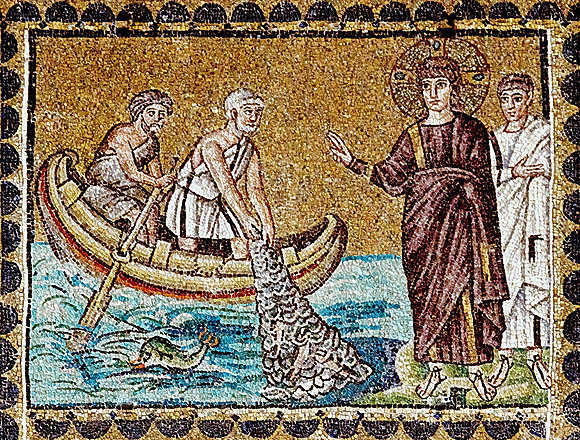
And then we come to Matthew 4:18-23, about Jesus’ calling of the brothers Simon Peter and Andrew, and the other brothers James and John, sons of Zebedee. They were all fishermen, out on the Sea of Galilee catching fish. Jesus stands on the water’s edge and calls them, “Hey you! Follow me! With me you’ll catch people instead of fish! Come!” No hesitation from any of them! None!! Peter and Andrew: “At once they left their nets and followed him.” James and John: “Immediately they left the boat and their father and followed him.”

It’s incredible really. Jesus was not well known at that point. He had no followers, no reputation, no means, nothing. But something in his call must have been so compelling that without a second thought they all left their livelihood, their families, their community and followed Jesus, and remained faithful disciples until they died.

At this point in the sermon, I went around the church touching people on their shoulder and calling them, “Jesus is calling you to follow him… He wants you to partner with him… He wants you to work alongside him.”

This invitation is incredible. God’s modus operandi, from Genesis 1, has always been to work in partnership with people. He could do everything and anything himself without us. But he chooses and desires to work in partnership with us. What a mind-blowing opportunity – to work alongside God, to be a co-worker with and partner of God.

This is what we want to do more of in our parish this year. This is who our identity is. We want to be a church that partners with God in accomplishing God’s goals and living out God’s values. As a start, we want to become an increasingly caring and compassionate church. We want to see each other, know each other, reach out to and support each other, take care of and care for each other. Jesus says that when people see how we love each other within the church, then they will know that we are his disciples and will be drawn to him. So, that’s our main churches main programme for the first half of 2023 – to strengthen our capacity to care. We will do this through two main initiatives. First, during Lent, which start in a couple of weeks, we will focus our teaching on caring for and loving one another, and after Easter, we will run a series of short training sessions on how to be a better, more attentive, more caring friend – not a counsellor or therapist, but a good friend.

In this way, we will be responding to Jesus’ invitation to follow him and build our identity as people after Jesus’ heart.

Calling of the Apostles Peter and Andrew, Lorenzo Veneziano, 1370; Staatliche Museum, Berlin. From https://www.praytellblog.com//wp-content/uploads/2017/11/15_Lorenzo_Veneziano_Calling_of_the_Apostles_Peter_and_Andrew._1370_Staatliche_Museen_Berlin..jpg

Following Jesus

Click here to listen to the audio recording of this 16-minute message. Or watch the video on Facebook (message starts at about 20 minutes). Or read the text summary below.

John 12:23-28 narrates Jesus’ thoughts about his journey towards the cross.

Regarding his own death he shares:

  • Jesus describes his crucifixion as his “glorification”. He recognises that his journey to and through the cross will culminate in his glorification. So he ironically uses these terms interchangeably.
  • Jesus makes sense of his journey through the metaphor of ‘one for many’: if a single seed refuses to die, it remains one seed; but if it dies, it produces many seeds. In other words, through the the death of one man (himself) there is life for many (salvation of humankind).
  • Jesus is genuinely troubled, disturbed, in dread of this path that he has been called to follow. The journey to the cross is not easy for him. He wishes there could be an easier route. Let us not be glib in our perception of Jesus’ mission.
  • Yet he resolves himself to his mission, his reason for coming and to the glory of God.

In the midst of this narrative, Jesus calls us to follow this same path:

  • If we want to serve him, he says, we must follow him and be where he is. And where he is at that moment is on the journey towards the cross. That is where we must follow him.
  • For sure, when we follow him, there will be glory – just as for him. Our Father will honour us if we serve Christ. But that is in the future. For now, we are called to a present path of suffering.
  • He cautions us to not hang tightly to this life, to be in love with this life. If we do, we will lose it. Rather, we must almost hate this life, by comparison, and rather invest in the life that is yet to come.
  • Many churches are teaching that Jesus’ desire for us is for our wealth, happiness, success, possessions and power. But there is no hint of such teaching from Jesus in John 12. Rather, we are to spurn such trappings of this life, and journey with him on his path.

During these last days of Lent, Jesus is calling us to journey alongside him towards the cross. Let us immerse ourselves in his journey. Let us walk close beside him. Let us accept the path of humility, service, laying ourselves down, suffering and dying to self and to this life.

Featured image by David Byrne, from http://monolandscapes.net/portfolio/cross-road

Welcome & Reward

Click here to listen to the audio version of this 16-minute message. Or watch the YouTube video below, or read the summary text that follows.

Matthew 10 presents the narrative of Jesus sending out the 12 disciples to do his work in the world. The chapter is filled with all kinds of dire messages about how difficult this work will be: the disciples will be rejected, beaten, persecuted, threatened by Satan, etc. They are like sheep among wolves. Jesus says that he has not come to bring peace, but a sword, and prophecies deep discord between family members. And finally he says that anyone who loves their family more than him is not worthy of him.

These are tough words! Being a disciple is not fun and games! It is hard, threatening, demanding work. 

By the time we get to verse 40, the disciples were probably feeling rather shattered by what was expected of them and daunted by Jesus’ expectations. But finally, in the last three verses there is a little respite:

“Anyone who welcomes you welcomes me, and anyone who welcomes me welcomes the one who sent me. Whoever welcomes a prophet as a prophet will receive a prophet’s reward, and whoever welcomes a righteous person as a righteous person will receive a righteous person’s reward. And if anyone gives even a cup of cold water to one of these little ones who is my disciple, truly I tell you, that person will certainly not lose their reward.” (Matthew 10:40-42)

There are two messages here: one for the disciples (and all Christian workers) and one for all Christians:

  1. For the disciples (and all Christian workers), there is the encouragement that we will be welcomed by members of the church. The word ‘welcome’ appears six times in two verses. Welcoming suggests at least the following:
    • That Christian workers are embraced warmly by church members, valued, appreciated, encouraged, thanked, etc. This welcome is relational, personal, support.
    • That Christian workers’ subsistence needs are met. This appears particularly in the last verse which refers to “a cup of cold water”. I’m not advocating that Christian workers received sports cars and mansions! Definitely not!! But I am saying that Jesus promises that workers’ needs will be met by the church.
  2. For the Christian who does the welcoming, there is a promise of a reward – when we welcome a Christian worker, we welcome Christ; and when we welcome Christ, we welcome God the Father (and no doubt Holy Spirit also). The reward is not a pat on the back, community recognition or a medal. The reward is the very presence of God!

Finally, we note that Jesus seems to present some kind of hierarchy of Christian workers: the 12 disciples, prophets, righteous persons and little ones who are his disciples. The implication is that all Christians are Christian workers, whether you are an illustrious disciple or prophet, or ‘just’ a humble follower of Christ doing what you can – a ‘little fish’, so to speak. If this is the case – that all followers of Christ, all Christians, are Christian workers – then the welcoming that we do for each other is mutual – we welcome each other.

That means Jesus is describing the whole church as a working and welcoming community.


Featured image from https://www.churchleadership.com/leading-ideas/jesus-asked-the-right-questions/

Disciples in the Way of Christ

Click here to listen to this 19 minute message

In Matthew 4, Jesus starts off on his ministry. The first thing he does is to call four disciples – fishermen, who become partners and co-workers with Christ. Almost half of Matthew’s gospel is spent in Galilee – Jesus’ home province. And Jesus, with his disciples, embody the presence of God – “the Kingdom of Heaven is near”. From these three basic elements, this message constructs a guide for us being disciples, walking in the way of Christ, bringing the Light of God into dark places, to draw people towards the love of God.

Peace and blessings
Adrian