Click here to listen to the audio recording of this 30-minute message (yes, a bit longer than usual). Or watch the video here on Facebook (the message starts just before 21 minutes into the recording). Or read the text summary below.
This message is not so much a sermon, but rather a ‘talk’, about mental health. It emerges from Mark 1:21-28, where Jesus exorcises a demon and makes a ‘madman’ well. In Jesus’ time, most manifestations of psychological problems would have been interpreted in spiritual terms – a demon was at work. Today, there would be a tendency to define those same manifestations as psychosis, using psychiatric, medical terminology. Perhaps both have some truth.
The human has long been understood as a tripartite being, comprising body, mind (or soul) and spirit. This implies a sense separateness within a person, where these three parts operate separately:

But rather, these three parts are closely interacting, with the body and mind influencing each other, the mind and the spirit influencing each other, and the spirit and the body influencing each other – far more integrated and whole, something like this:

However, despite this integration, when someone presents with a physical (body) problem, like cancer or diabetes, we’d all cluster around and support that person. But if they present with depression, or anxiety or schizophrenia, we would tend avoid them, to speculate, to judge, to question their faith, and so on. We generally treat psychological problems differently from physical problems, even though they are interconnected. Psychological challenges tend to be stigmatised, even today.
The interconnection or integration I’m talking about is nicely illustrated in the Greek word sózó, which means both healing and salvation. In our New Testament English translations, most of the words ‘heal’ and ‘save’ are the same in the Greek. To be spiritually saved is tantamount to being physically (or psychologically) healed. For example, the woman who had been bleeding for years (Luke 8:43-48) was sózó – she was both healed and saved, and she was also restored into a harmonious place within her society (which stigmatised menstrual blood). Many English translations say she was was ‘made whole’ – that’s a good translation!
At this point in my message, I related my own experiences with depression, brought on a combination of genetic and environmental factors, that had me in psychotherapy for many years, on antidepressant medication for several years, and in a psychiatric hospital for a month. I am not going to type this up here. It is in the recording, and I’d rather you hear my story verbally than in writing. It is not essential to this message, but it does provide a first-hand account of mental illness, and recovery, and continual working on maintaining my mental health – I think of myself as a depressive in remission. This starts at about 27 minutes into the video recording and about 6 minutes into the audio.
In my recovery, two books were very meaningful to me, and might be to you:
- Victor Frankl’s Man’s Search for Meaning.
- Thomas Moore’s Care of the Soul, particularly the chapter titled, Gifts of Depression. Here is a reading of this chapter on YouTube.
I hope that this talk about mental health and my personal sharing about my own depression will be helpful to you in a few ways:
- I hope this helps to destigmatise mental illness, because although I have had quite severe mental illness through many years of my life, I have also done quite well in life and feel that my life is good and meaningful. If you find yourself struggling with mental illness or struggle, I hope you will be less judgmental towards yourself and your symptoms, and more open and kind to yourself. And similarly towards others.
- I hope this helps you become more self-aware and to self-care more. Jesus commands us to love God and to love our neighbour as you love yourself (Matthew 22:39). This last phrase is not a commandment, as such. There is a tendency among Bible scholars to assume that all people love themselves, even too much. But in my practice, many do not love themselves; people suffer from low self-esteem and even self-loathing. We should love ourselves more – like putting on the oxygen masks in the aeroplane before you help others.
- I hope this helps you to pray and read the Bible more. These practices are about creating space for God to be present in us, and for us to experience God’s presence. John writes about the desire that we should experience life, and life abundantly (John 10:10)! Psalm 23 speaks of a table, a feast, prepared for us.
- I hope this encourages you to seek help when you are suffering from mental health challenges. You can do this by asking your priest or minister for prayer and anointing – this part of the contribution that the church can offer you, in line with James 5:14-16. You can do this also by seeking therapy from a psychologist or clinical social worker. And you can to this by seeking medication from your GP or a psychiatrist.
I ended this talk with a 2-minute prayer for those who have listened to this message, and I encourage you to listen to or watch this prayer. It start a little after 47 minutes into the video and a little before 27 minutes into the audio recording.

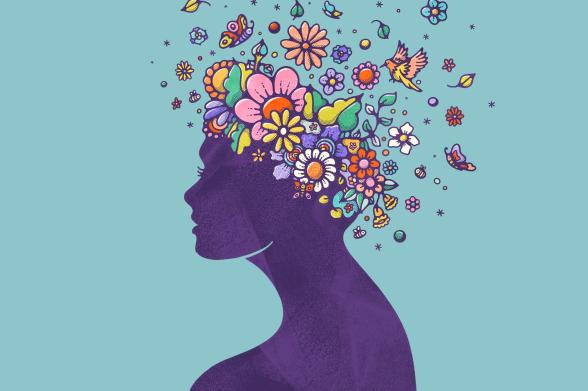
Image from https://www.hypresslive.com/2024/01/18/breaking-the-mental-health-stigma-in-the-workplace-in-2024/

 Reflections of God's Love