Today we get two of Jesus’ parables: the parable of the growing seed and the parable of the mustard seed. These follow the parable of the sower (the one who sowed seeds in different kinds of ground) and the lesson about putting our lamp on a stand.
First, in the parable of the seed, the sower scatters the seed and then does nothing more. That’s his only role – to scatter seed. Then, spontaneously or (in the Greek) automatically the seeds grow. It is in their nature to grow, once they have been scattered. So the man goes to sleep and gets up and the seeds are doing their thing. “All by itself, the soil produces corn.” And the seed knows the steps of growth – they are programmed into the seed: “first the stalk, then the ear, then the full grain in the ear.” And when it is ripe and ready, the man comes to harvest the result.
This parable suggests that our role and responsibility as followers of Christ is to scatter seed. Presumably, this is good seed – seed that produces a crop: wheat, maize, barley. Our job is to scatter the seed. God’s job is to make that seed grow. The ‘automatic’ growth of the seed in this parable is the code that God has embedded into the DNA of the seed. (Apologies if my scientific understanding of seeds is incorrect!) For example, we may speak to someone about our faith (scattering seed), but we cannot force them to believe or come to faith (that is God’s work). We may encourage parishioners to attend church (scattering seed), but we cannot compel them to come (that is God’s work). We are encouraged by this parable to do our part and trust God to do his.
This resonates with 1 Corinthians 3:6-7, where Paul writes,
“I planted the seed, Apollos watered it, but God made it grow. So neither he who plants nor he who waters is anything, but only God, who makes things grow.”
This gives us perspective on what is our role, and what is not.
Second, in the parable of the mustard seed, Jesus contrasts the size of the mustard seed (which he says is the smallest of all seeds on the earth) and the resultant mustard plant (which he says is the largest of all garden plants or shrubs, with such big branches that the birds can perch in its shade).
This parable suggests that the scattering of even a tiny seed – even a very small act in the world – could produce a very large tree – a substantial change. Much like a lever, where a small amount of strength and effort can move a large heavy object, the tiny mustard seed, when scattered, can produce a large bush.
This resonates with Matthew 13:33, where Jesus says,
“The kingdom of heaven is like yeast that a woman took and mixed into about 23kg of flour until it worked all through the dough.”
A tiny amount of yeast can spread through a large amount of flour and rise to produce a massive number of loaves of bread. Small efforts can have large results.
These parables suggest that we ought to be scattering seed into the world, and that these seeds need not necessarily be big, dramatic, sophisticated or demanding. They might be small, understated comments or actions that go a long way. The key is to scatter these seeds – to be mindful and intentional about scattering them. And then to leave them to God to grow.
Third, although Jesus does not say this in Mark 4, this reading also evokes a warning: to be careful about what kind of seeds we sow. The seeds Jesus refers to are corn and mustard. It is hard to believe Jesus would support the scattering of weed seeds – indeed, he spoke out against weeds or thorns in the parable of the sower (Mark 4:18-19).
When we scatter bad seed, these too may grow fast and spread, just like the good seed, but with potentially terrible consequences. This resonates with James’ teaching about the tongue:
“Those who consider themselves religious and yet do not keep a tight rein on their tongues deceive themselves, and their religion is worthless” (1:26). “The tongue is a small part of the body, but it makes great boasts. Consider what a great forest is set on fire by a small spark. The tongue also is a fire, a world of evil among the parts of the body. It corrupts the whole body, sets the whole course of one’s life on fire, and is itself set on fire by hell. … With the tongue we praise our Lord and Father, and with it we curse human beings, who have been made in God’s likeness. Out of the same mouth come praise and cursing. My brothers and sisters, this should not be. ” (3:5-6, 9-10)
Just as we cannot make seeds grow into bushes, we cannot stop harmful words from causing damage. We are called to sow seeds, but only good seed; bad seed should not be scattered – it should be eliminated from our minds and tongues.
John 15: 9-17 presents us with a powerful summary of Jesus’ economy of love. Here’s a summary of the promises that Jesus makes about his love for us:
9. Jesus loves us as the Father loves him
11. Jesus’ joy is in us > our joy is complete
12. Jesus loves us
13. Jesus lays down his life for us
14. We are Jesus’ friends
15. We are Jesus’ friends (not his servants)
16. Jesus chooses us (not us him)
16. Jesus appoints us
16. Jesus enables us to be fruitful
16. God gives us whatever we ask in Jesus’ name
Part of what is beautiful about this passage is the generous and unconditional outpouring of love, care and enabling of us by Christ.
However, there are some aspects of this passage that are conditional – there are some IFs
11. We remain in Jesus’ love IF we keep his commands
14. We are Jesus’ friends IF we do what he commands
It is true that Jesus’ love has conditions – it is not utterly unconditional. He has expectations and makes demands of us. It is not a free-for-all. But before we get worked up about being held hostage to God’s expectations, let’s look at what those conditions are:
12. My command is this: love each other as I have loved you
17. This is my command: love each other
That’s it. Just two commands. Actually, just ONE command, because they are the same command: Love each other. That’s the only condition that Jesus places on us: Leave each other.
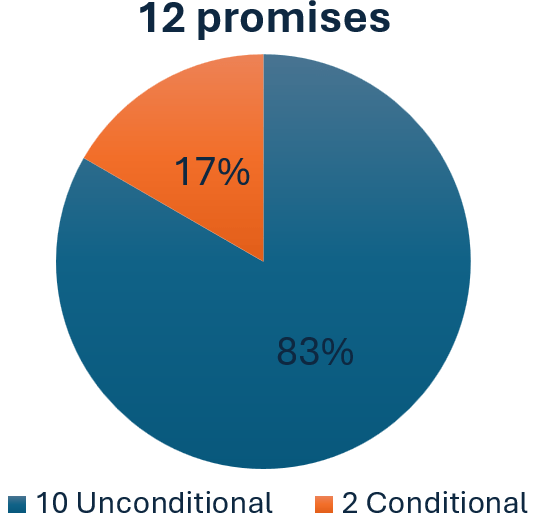
And let’s look at the ratio of unconditional and conditional promises in this passage:
That’s a pretty good economy! 83% of Jesus’ promises in today’s reading are unconditional. And the 17% that are conditional are conditional on something that is surely good for everyone – us and everyone else! To love one another.
Loving one another surely in our own interests – if we love others and all the others are loving us, that’s a good deal!
Hence John writes in his first letter (1 John 5:3), “God’s commands are not burdensome”. I’m not sure I fully agree with John here, because loving others is sometimes not easy. We have to love difficult people, people who don’t love or respect us, people who do bad things, and so on. It is not always easy to love others. But we are talking about just ONE command, not 613 commands, not 10 commands, not even 2 commands: JUST ONE!
Mary, the mother of Jesus, had a difficult start to her pregnancy – she was young (probably about 13) and unmarried (only betrothed). Many of us may have become parents in less than ideal circumstances, and so we can feel with her the challenges she faced, when the angel Gabriel comes and informs her that she will become the mother of Son of God (Luke 1:26-38).
In reflecting on this well-known passage, three things stand out for me afresh:
First, Mary had a community of people around her, who loved and supported her. First, Joseph, the man (probably a boy, really, aged perhaps 14 or 15) who she was engaged to. He could so easily have spurned her, but instead, he remains steadfast at her side and protects her from judgmental neighbours. He was accepting, loving and faithful in ways that are quite extraordinary. Although we know little about Joseph, he sounds like a great father.
In addition, Mary’s aunt, Elizabeth, and her husband Zechariah. They were very old and Elizabeth had not borne a child. They too were vital sources of support for Mary, and in the following passage we read about Mary’s visit to Elizabeth.
This human community of support is important for all of us. We all need people in our orbit who care, love, accept, cherish, nourish, empower, advocate, challenge and enable. We need this at home, and we need it in the church.
Second, Mary did not go from ‘zero to hero’ in one leap. She was ‘greatly troubled’ by Gabriel’s message, so much so that the angel had to reassure her: Do not be afraid, Mary. And after Gabriel’s pitch to her, Mary asks questions of Gabriel, “How will this be since I am a virgin?” Gabriel is fully willing to engage her uncertainty, her fear, her incredulity and her questions.
This is in contrast to Gabriel’s response to Zechariah, who in v18 says something similar to Gabriel: “How can I be sure of this? I am an old man and my white is well on in years.” Zechariah’s words are not unlike Mary’s, but Gabriel responds strongly, asserting his authority, and silencing Zechariah until after John’s birth.
After some discussion with Gabriel, Mary come to a place of acceptance, or rather of acquiescence, “I am the Lord’s servant. May your word to me be fulfilled.” I have selected the word ‘acquiescence’ because I think it best captures Mary’s initial response. Acquiescence can be defined as “the reluctant acceptance of something without protest.” It is almost a resignation, similar to the Arabic “Inshallah”, which means “if God wills”, and implies that if God wills, it will happen whether we want it to or not. We surrender to God’s will.
We need also to learn to hear God’s voice speaking into our lives, to engage with God about God’s will, and to make decisions to acquiesce to God’s will. In other words, to trust in God.
Third, this passage shows forth a long-held principle (dating back to Genesis 1) of God choosing to partner with humans. Almost always there is a co-working between God and people to accomplish God’s aims. In this passage (v31), we get a series of things Mary will do: You will conceive. You will give birth to a son. You are to call him Jesus. And (v32-33), we get a series of things God will do: Jesus will be great, Jesus will be called the Son of the Most High, God will give him the throne of his father David, Jesus will reign over Jacob’s descendants for ever, Jesus’ kingdom will never end.
This plan that Gabriel brings to Mary involves a partnership between Mary and God. Without the partnership, the plan is impossible. And so it is with much of God’s work in the world – God chooses to limit God’s self by working with imperfect and limited human beings. This is God’s modus operandi.
In conclusion, let us follow Mary’s example, and that of Joseph, Elizabeth and Zechariah, and partnering with each other and with God, to accomplish those things that God desires in this world.
The Annunciation, fresco by Fra Angelico, 1438–45, San Marco, Florence
Over the past two Sundays, our readings have directed us towards the conclusion that God wants the whole of us – for us to give ourselves utterly into God’s hands to do with us as God wills. We first got this from Jesus’ teachings in Matthew 10 (Hard Words) and second from Abraham’s willingness to sacrifice his son Isaac (Abraham’s Example). Typically, our inclination is to hold back and not surrender – relinquishing ourselves to God does not come naturally.
Today’s readings continue this theme but from a somewhat different perspective. They all point towards the roles of actors in a divine drama or play. We are the actors, and God is the Director. The play works out best when each actor does their part according to the directions of the Director. Since our Director is both competent and good, the drama of our lives can also be successful and good. But only if we as actors follow our Director’s directions.
Abraham is nearing death and wants his son Isaac to get married, but not to someone from the neighbouring communities, but rather from his home country.
His senior servant is called in to act on Abraham’s behalf – the servant is not named, but is the central actor in this chapter. The servant has charge over all of Abraham’s things. Abraham commissions him to go to his homeland and get a wife for his son, giving detailed instructions on what to do and not to do.
In vv12-14, the servant prays to the God of his master Abraham to make him successful and to show kindness to Abraham – remember that the Director is both competent and kind. In his prayer, the servant sets out a narrative of how he hopes things will go – that he speaks to a young woman, asking her for a drink, she offers him a drink and also offers water for his camels.
Rebekah then comes out, and the narrative plays out just as the servant had prayed (vv15-22).
The servant then asks if he can spend the night at her father’s house and it all works out. The servant gives thanks to God for “his kindness and faithfulness” to his master (v27).
Rebekah runs home and tells her family about the servant, and her brother Laban comes out to welcome him into their home. They take care of both the servant and his camels (vv28-33).
The servant then recounts to Laban and his family the whole story that we have already been told (vv34-49).
This is followed by various details of the negotiations that rapidly culminate in Rebekah agreeing to go immediately with the servant to get married to Isaac (vv50-61). They arrive back at Abraham’s home, Rebekah and Isaac meet and get married (vv62-67), in so doing continuing the lineage from Abraham to Jesus (as provided in Matthew 1).
In this narrative, the servant is an actor – an agent who behaves, speaks, makes decisions, impacts the world. He trusts in Abraham and in Abraham’s God, thereby carrying out the will of God. He relinquishes himself to God.
Rebekah is similarly an actor – she engages with the servant, shows hospitality to him and his animals, argues against her brothers about leaving immediately rather than later, and agrees to marry Isaac. She exercises power and agency in her life, in accordance with the will of God. She relinquishes herself to God.
In short, we have actors doing the will of God the Director.
The Psalms provided in the Lectionary typically provide a commentary on the First Testament reading and today is no exception. Psalm 45 presents us with three actors and a director.
v1 starts with “My heart … as I recite … my tongue.” Here is the Psalmist, writing in first person and also congratulating themselves on their skill as a Psalmist. The Psalmist is an actor – present and active in the creation of this Psalm.
vvv2-9 are addressed to ‘you’ – to the King. In the context of Genesis 24, we should think of the King as representing Isaac, though Isaac was not a King. The King/Isaac is also an Actor, because of how the Psalmist describes him, e.g., as defending truth, humility and justice.
vv10-12 are addressed to ‘daughter‘, the bride. She represents Rebekah and the Psalmist speaks directly to her (not just about her) making her an actor.
vv13-15 are a commentary, by the Psalmist, about the wedding and how wonderful it is.
v16 is directed again at the King – your sons, your fathers, you will make – confirming the King as an actor.
v17, finally, returns to the “I” (which we last heard in verse 1). In verse 1, the I referred to the Psalmist. It is possible that the I in v17 is also the Psalmist, but I think the claims that are made in v17 exceed the capacity and power of the Psalmist, and that here ‘I’ refers to the Director – to God. The Psalmist’s life is too short, but God can work “for ever and ever”. It is God who will perpetuate the memory of the king through all generations and across all nations.
Thus, God is revealed in the last verse of the Psalm to be the Director. Although the Psalmist has considerable power in writing the Psalm, ultimately, even the Psalmist is an actor in a larger play directed by God.
This passage from Romans is full of “I”. It seems obvious that Paul is here referring to himself, writing in first person, but it is possible that he is referring to ‘a person’ using ‘I’ as a shorthand, and there is debate among commentators on whether the ‘I’ is a Christian or an unconverted person. I don’t want to get into all that today. The key point for today is that there is a clear actor here, referred to as “I“, whoever that person may be.
What we see happening in this actor’s life is a grappling between a desire to be good and a tendency to do evil. We are given an insight into the heart of this person, grappling with their own brokenness. This reaches a climax in v24, “What a wretched man I am! Who will rescue me from this body that is subject to death?”
And then the Director steps in: “Thanks be to God, who delivers me through Jesus Christ our Lord!” Or arguably, two actors, but so in sync with each other, that they are truly one being or essence.
What we can take from Romans 7 is that in our grappling with ourselves, as we hope to become transformed into the image of Christ, God is directing. And God is competent and good – God will bring it to fruition in God’s good time. We must, in the meantime, play our part as actors who make repeated choices to act in accordance with God’s desire for and image of a redeemed humanity.
Lastly, we come to our Gospel reading. In the opening verses of this passage, Jesus seems to be saying that the people of this world think that they are directors (vv16-17):
“To what can I compare this generation? They are like children sitting in the marketplaces and calling out to others: ‘We played the pipe for you, and you did not dance; we sang a dirge, and you did not mourn’.”
They think they are puppeteers, who can direct others to do their bidding. But unlike God the Director, they are neither competent nor good. Instead, they are capricious and mean-spirited, as Jesus explains in vv18-19:
“For John came neither eating nor drinking, and they say, ‘He has a demon.’ The Son of Man came eating and drinking, and they say, ‘Here is a glutton and a drunkard, a friend of tax collectors and sinners.’ But wisdom is proved right by her deeds.”
In this last sentence of v19, Jesus reveals who the director is: Wisdom! Wisdom is the First Testament forerunner of Holy Spirit. The Spirit of God is the Director: wise, good and competent. It is by her deeds – her actions – that she is proved right.
In the rest of this passage (vv25-30) Jesus emphasises God as a good and kind director, who has our best interests at heart.
In summary, God does want all us, completely and utterly. It is when we follow his directions (i.e. when we are yoked to him) that we become true and full actors, free to play our part in his play.
Click here to watch the video of this 28-minute message on Facebook (the message starts about 29 minutes into the recording). Note that this is an active sermon – worth watching, rather than just reading. I don’t have an audio recording of this message. Or read the text summary below.
Matthew 9 tells the story of Jesus calling Matthew: “As Jesus went on from there, he saw a man named Matthew sitting at the tax collector’s booth. “Follow me,” he told him, and Matthew got up and followed him.” And Genesis 12 tells the story of God calling Abram: “Go from your country, your people and your father’s household to the land I will show you.” Go! Follow me! These calls have nuclear power to move people – Matthew got up and followed Jesus, Abram packed and moved into the unknown.
Jesus is calling you and me today – Follow me! Go! – but to where? Where do we go? Where do we follow?
Matthew 9:16-17 gives us invaluable insights into what Jesus calls us to, in the metaphor of new wine in new wineskins:
“No one sews a patch of unshrunk cloth on an old garment, for the patch will pull away from the garment, making the tear worse. Neither do people pour new wine into old wineskins. If they do, the skins will burst; the wine will run out and the wineskins will be ruined. No, they pour new wine into new wineskins, and both are preserved.”
Although the metaphor is a bit obscure, at very least we can take from this that there are challenges in mixing the old and new. Jesus leans strongly in favour of the ‘new’ – new wine and new wineskins are what we’re after. A few verses earlier (v13) he gives another clue about where we are following him to, when he quotes Hosea, “I desire mercy, not sacrifice”. Mercy represents love for people, while sacrifice represents religion. Jesus is saying – indeed God is saying – I don’t want your religion, I want your love for people. This is the ‘new’ teaching – or rather an old teaching renewed – that Jesus gives us. And the whole of Matthew 9 illustrates this with examples.
Come along with me – follow me! – as we briefly consider the seven stories that illustrate following the new wine in Matthew 9:
The chapter opens with a paralysed man, brought to Jesus by his faith-filled friends. Jesus sees their faith and says, “Take heart, son; your sins are forgiven.” The teachers of the law are outraged by Jesus’ presumption of having authority to forgive sins – they’re not interested in the man, only in their theology. Jesus responds strongly and heals the man as evidence of his authority to proclaim forgiveness of sins. Jesus’ love for this physically and spiritually broken man takes precedence over the teachers’ petty theology.
In verses 10-13, Jesus attends a party hosted by Matthew, who is now following Jesus. Matthew’s friends are tax collectors and sinners – ‘bad people’. The Pharisees – another religious group – are disgusted and ask Jesus’ disciples, “Why does your teacher eat with tax collectors and sinners?” They are not concerned with the humanity of Matthew and his fallen friends – they are concerned only with religious piety and ‘rightness’. They dehumanise these broken people. Jesus confronts them, “It is not the healthy who need a doctor, but those who are ill… For I have not come to call he righteous, but sinners.” Jesus’ love for sinners, for bad people, takes priority over everything.
In verses 14-17, while still at the same dinner party, the disciples of John the Baptist come and ask Jesus, “How is that we and the Pharisees fast often, but your disciples do not fast?” Their use of ‘often’ (we fast often) betrays the religious pride. Their interest is in religious observance and spiritual discipline. But Jesus dismisses their concerns, asking “How can the guests of the bridegroom mourn while he is with them?” He has little interest in fasting or other religious piety – he is more interested in spending time engaging with people. It is in this immediate context that he speaks about new wine – he is not interested in religious and theological precision and rightness; he is much more interested in human relationships, fellowship, compassion and love.
In verses 20-22, while still at the same party, a synagogue leader tells Jesus that his daughter has died and asks if Jesus can come and help. Jesus leaves immediately, as his compassion for this young girls outweighs his fellowship with Matthew and his friends. On the way to the house, a woman who has been bleeding (menstruating) heavily for 12 years touches his cloak and is healed by Jesus’ power. Her faith is strong: “If I only touch his cloak, I will be healed.” Jesus stops and speaks with her, he proclaims healing and wholeness and salvation. We imagine he took hold of her hand as he lifted her up onto her feet. While in the other stories there are crowds of noisy people around, here there is silence. Men and women keep menstruation quiet and private – it is not public. And in those days, women were considered unclean during their period. For Jesus to engage, speak, touch her was to make him unclean. He didn’t care about that – he cared just for her.
Reaching the house of the synagogue leader, there is a noisy crowd outside. They mock Jesus when he says the girl is just sleeping. He goes up to her room and takes her by the hand. Touching a dead person makes one unclean, but Jesus doesn’t care about that – he cares only for the girl. She is revived and gets up.
Briefly, Jesus continues on his way and heals two blind people, “According to your faith let it be done to you”. He sternly warns them not to tell anyone about him healing them. He is not interested in recognition – he cares only about their sight.
And then he encounters a demon-possessed man (perhaps today a schizophrenic). He drives out the demon. The Pharisees cannot recognise Jesus’ compassion for this man’s wholeness and well-being; they say, “It is by the prince of demons that he drives out demons”.
Jesus quoted Hosea, “I desire mercy, not sacrifice”. Jesus tells about the new wine – his people-centred gospel of love and inclusion – that is incompatible with the old wineskins of religiosity, piety, self-righteousness. He is all about people: “I have not come to call the righteous, but sinners”.
So, as we follow Jesus, as we answer his call to ‘Go!’, we must put people before religion, relationships before theology, acceptance before judgement, inclusion before exclusion, love before judgment. This is the new wine of Jesus’ Gospel that should be poured into the new wineskins of our hearts and churches.
Today’s set of compelling readings from Micah 6:8, Psalm 15:1-3, Matthew 5:3-10 and 1 Corinthians 1:27-28, point us to the heart of a God who is concerned for those who are marginalised, vilified and outcast. They also emphasise that our responsibility as Christians is to be merciful, kind, humble, inclusive and generous.
In light of these readings, today’s message addresses the complex and controversial topic of sexuality in the church, particularly homosexuality. This is a topic that has been long ignored and more recent has lead to deep divisions within the the church between those who are against and those who are for (or at least tolerant of) gay relationships. Many gay Christians feel deeply rejected by the church – not just for what they do sexually, but for who they are – for their very being, their humanity, which is experienced to be under attack by Christians and the church.
In today’s message, I endeavour to the following, which I encourage you to watch, listen to or read, using the links provided at the top of today’s blog.
Some clarification of terminologies, particularly the difference between gender identity (who I see myself as being in terms of gender – traditionally male or female) and sexuality (who I have sexually or romantically attracted to – traditionally heterosexual or homosexual). Both of these terms have become increasingly diverse and nuanced in recent years.
Developing an understanding of how the Scriptures were authored within particular historical and cultural contexts that differ vastly from contemporary society.
I address five broad points of discussion in this message:
The belief of many Christians that heterosexuality is God’s only legitimate sexual orientation. I’ll show that this is not true.
The belief of many Christians that the Bible does not anywhere say that gay relationships are okay. I’ll show that this is not entirely true.
The belief of many Christians that the Bible condemns homosexual relationships as an abomination. I’ll show that this is not true.
The point that among the numerous laws in the Bible, some Christians draw on preconceived cultural beliefs to justify their condemnation of homosexual relationships.
And the primary of love that is presented in Jesus Christ’s teachings and his example of radical inclusivity.
Based on the above discussion points, I draw 4 key conclusions:
In human relationships, God is most interested in the quality of our love.
God is not interested in the sex or gender of the person we love.
Marriage is sacred, a divine joining together, and must be protected.
Marriage (defined as a sacred joining together or union) is not restricted to a man and a woman.
And in light of this I hope that my parish and your church community would aspire to:
emulate Jesus’ example of radical inclusivity, diversity and love
create a church space where people of various sexual orientations feel welcome, accepted and loved
focus on and champion the quality of love in human relationships.
I do appreciate that the views of Christians on the subject of homosexuality vary widely, and that there are many that will view my understandings and interpretations of the Scriptures as false and heretical. Our views on this subject can be deeply divisive. Nevertheless, I take Jesus’ lived life (how he behaved with people he encountered) and Jesus’ spoken teachings about what is most important to God as the central guides to make sense of the rest of Scripture. He is God incarnate – he is the perfect reflection of who God is. He himself says, “Whoever has seen me has seen the Father” (John 14:9). I follow him.
Many who are reading this post may have experienced ‘toxic leadership’ – where people in leadership positions exploit, undermine or harm the people they lead. They poison the people they lead. We may have experienced this in the workplace, from our boss or manager – someone who was more interested in targets that people, who used you to climb up the corporate ladder, who did not recognise you as a real person. We may have experienced toxic leadership from our parents, who did not nurture and nourish us, but neglected us, put their own interests first, or even abused us. We may have experienced toxic husbanding or toxic wifing, where the marriage relationship breaks down instead of building up, discredits, maligns, abuses.
We may also have experienced toxic leadership in the church – from clergy, lay leaders, and influential people – who use their positions of leadership and authority in the church to advance their own agendas and to hurt and harm others, often in the name of God. Those with spiritual or church power may seek to oppress other members of a church community, through judging, excluding, humiliating and excommunicating. We see this most grotesquely in the sexual and other abuse of children and women and young men. This happens in many denominations, such as the Catholic church, the Southern Baptist Convention, Hillsong and the Anglican Church (to name some recent examples). Few churches are exempt from this, even our own parish.
The truth is that you yourself may be that toxic leader! Here we must critically self-reflect. Am I a toxic leader? Do I use others to get ahead? Do I put myself first? Do I harm or neglect those I am entrusted to care for? Let us not only point the finger at others; let us also critically examine ourselves.
In the Bible, some of the harshest words are reserved for spiritual and other leaders who are toxic.
Jeremiah 23 is a good example. God, through Jeremiah, confronts the leaders of Israel and says they are rubbish, corrupt leaders. That he will remove them. That he will take over their leadership. ‘Woe to the shepherds who are destroying and scattering the sheep of my pasture!’ declares the Lord. They exploited and harmed the very people God placed in their care; instead of protecting and shepherding them, they exploited and harmed them.
In the previous book in the Bible, Ezekiel 34: 1-6, 9-10, we get a similar message:
This is what the Sovereign Lord says: woe to you shepherds of Israel who only take care of yourselves! Should not shepherds take care of the flock? You eat the curds, clothe yourselves with the wool and slaughter the choice animals, but you do not take care of the flock. You have not strengthened the weak or healed those who are ill or bound up the injured. You have not brought back the strays or searched for the lost. You have ruled them harshly and brutally. So they were scattered because there was no shepherd, and when they were scattered they became food for all the wild animals. My sheep wandered over all the mountains and on every high hill. They were scattered over the whole earth, and no-one searched or looked for them. … therefore, you shepherds, hear the word of the Lord: this is what the Sovereign Lord says: I am against the shepherds and will hold them accountable for my flock. I will remove them from tending the flock so that the shepherds can no longer feed themselves. I will rescue my flock from their mouths, and it will no longer be food for them.
Strong words from God through Ezekiel! The shepherds or leaders of Israel had not only failed as leaders, they had exploited and even eaten the flock that God had entrusted to them. And God therefore utters these damning words, “I am against you!” In gangsta language, “I will take you out”. And God says that he himself will take over as the shepherd of the people (Ezekiel 34:11-16):
I myself will search for my sheep and look after them … I will look after my sheep. I will rescue them from all the places where they were scattered … I will bring them out from the nations and gather them from the countries, and I will bring them into their own land. I will pasture them on the mountains of Israel … I will tend them in a good pasture … I myself will tend my sheep and make them lie down… I will search for the lost and bring back the strays. I will bind up the injured and strengthen the weak… I will shepherd the flock with justice.
Jesus describes himself as the good shepherd. In John 10, Jesus says that the hired hand (the part-time shepherd) doesn’t care about the sheep – he cares only for making a living. So when danger comes, he flees and abandons the herd. But, by stark contrast, Jesus describes himself as the good shepherd, who will lay down his life for his sheep, and who will leave the 99 to seek out and find the one who has got lost. This is what good shepherding is about – taking care, putting them first, putting yourself in danger, going out of your way to look after the one.
The key word that emerges through all these readings from Jeremiah 23, Ezekiel 34 and John 10, is gather: “I will gather my flock.” The abusive, toxic shepherds scatter their flock. This is what toxic leadership does – it deeply undermines and breaks cohesion, collaboration, togetherness, trust, safety and belonging – qualities that are essential for healthy teams. And so God’s first word is to gather together the flock, to reconstitute the community, to reconcile and unite. The image of the flock speaks to us about a healthy community under the protective and caring leadership of a shepherd. The First Testament refers to the Shepherd King – a king who is pastoral, caring and protective, and who invests in the holding together a flock. This image says that being a good King means to be a good shepherd – quite a contrast in status! Shepherding is a key role of Kings and leaders.
This shepherding is central to Jesus’ ministry – both when he walked this earth, and still today. He is quintessentially our ‘shepherd’. He gathers, reconciles and unites, he binds up and restores those who are wounded and broken, he stands up for us in the face of danger, he heals and saves, he welcomes and pardons, he brings peace and safety. This is what leadership is about, in both the church and the rest of the world.
Almost every person who reads or listens to this is a leader – as a parent, manager, church leader, older sibling – you are a leader. And leadership comes with great demands. And many of us here have experienced bad leadership from clergy, who have been bad shepherds who harm their flock.
Rev’d Marti and I have no desire to be bad shepherds. We are both deeply committed to walking in Christ’s path and being good shepherds. But we are human. We make mistakes, we run out of time, we forget. And sometimes we get irritable, frustrated or angry. Power may go to our head. We might become heavy handed, thinking an issue is more important than the people.
And when we do this, we invite you to challenge us. To remind us of our role. To bring us back to the path of Christ. If you can’t talk directly to us, complain about us to the Wardens, who are the Bishop’s eyes and ears in the parish. Speak up. Send us a WhatsApp. It might not be pleasant for any of us. But this is what we need.
And hold yourself accountable, as Christ himself did. Even in this moment as you read or listen to this, consider what kind of leader are you? Are you a good shepherd? And if not, challenge yourself and allow God to work a change within you, to take up a leadership role that reflects the values and principles of Christ our Shepherd King.
John the Baptist is the one who prepares the world for the first coming of Christ, some 2,000 years ago. We, today, follow in his footsteps in continuing to prepare the world to receive Christ when he comes again. The world we live in now continues to grapple with many challenges.
Currently, we think of those many who have died of Covid-10: in South Africa, since the start of the pandemic, some 102 000 people have died, amounting to an average of about 102 per day since March 2020.
We continue to grapple with HIV and AIDS: 14% of South Africans are living with HIV or Aids, an average of about one in seven people.
We continue to see high Aids-related death rates: 86 000 this year alone, an average of 235 deaths per day – and the death rates have been rising over the past five years.
And gender-based violence remains a scourge of our society, with an average 115 women raped every day this year – a total of 45 000 so far this year.
It is into this broken and wounded world that we prepare for the coming of Christ. How do we do this? What are the guidelines we’re given in the scriptures set for today?
Matthew 3:1-12 presents John’s call to repentance, confession and baptism. He strongly confronts the religious leaders of his day: “You brood of vipers!” His words are confrontational and damning. He calls them to produce the fruit of repentance – it is one thing to repent, and another to demonstrate that repentance in your behaviour – the fruit. And he warns, all very challengingly, that if they fail to do so, they will be chopped down like an unproductive tree, or burned up in the fire, like the chaff from winnowing.
The story of John’s ministry in Mark’s gospel is a little softer: there he speaks of a baptism of repentance for the forgiveness of sins. Matthew doesn’t make any mention of forgiveness. And Luke’s version incorporates both what Matthew and what Mark say. (And John provides a quite different version altogether.)
John, then, sets a pattern for us that is both encouraging and challenging. But what else can we learn from today’s readings about preparing the world for Christ?
Isaiah 11 presents a prophecy of the branch that will come from Jesse – King David’s father and, many generations later, forefather of Jesus. This passage opens with a repeated emphasis on the Spirit: “The Spirit of the LORD will rest on him— the Spirit of wisdom and of understanding, the Spirit of counsel and of might, the Spirit of the knowledge and fear of the LORD” (Isaiah 11:2). Clearly, we cannot do anything without the enabling of the Spirit of God.
And in the following verses, Isaiah emphasises God’s concern for those who are vulnerable: “He will not judge by what he sees with his eyes, or decide by what he hears with his ears; but with righteousness he will judge the needy, with justice he will give decisions for the poor of the earth” (Isaiah 11:3-4). Righteousness and justice are the keywords here.
And this is followed by the imagery of wolves, leopards and lions living in harmony with lambs, goats and yearlings, under the leadership of children (Isaiah 11:6). This is the kind of egalitarian and harmonious society that we are called to bring into being as we prepare for Christ’s return.
Psalm 72 continues some of these themes from Isaiah, notably God’s defence of the poor, vulnerable, needy, marginalised, silenced and outcast: “May he defend the afflicted among the people and save the children of the needy; may he crush the oppressor” (Psalm 72:4). Here we see God taking sides – he aligns with the poor and against the oppressor. God is not neutral – he sides with those who are vulnerable. The Psalmist goes on, “For he will deliver the needy who cry out, the afflicted who have no one to help. He will take pity on the weak and the needy and save the needy from death. He will rescue them from oppression and violence, for precious is their blood in his sight” (Psalm 72:12-14). In those days, life was in the blood, so when the Psalmist says, “precious is their blood in his sight”, s/he is in effect saying that God sees their lives as precious and worthy of protection. Theologians call this “God’s option for the poor” or “God’s preference for the poor”.
When we wonder where we should stand on things, the Biblical answer is unequivocal – stand with those who are vulnerable. That is always where we will find God. And that is where we should be found.
Romans 15 invites us to take on the attitude of Christ: “May the God who gives endurance and encouragement give you the same attitude of mind toward each other that Christ Jesus had, so that with one mind and one voice you may glorify the God and Father of our Lord Jesus Christ. Accept one another, then, just as Christ accepted you, in order to bring praise to God” (Romans 15:5-7). The result of thinking like Christ, is that we will accept one another – here again is a call to inclusivity and now also being non-judgmental. Indeed, in the previous chapter, Paul explicitly tells us to stop judging others: “Therefore let us stop passing judgment on one another. Instead, make up your mind not to put any stumbling block or obstacle in the way of a brother or sister” (Romans 14:13). This was in the context of conflicts of various dietary laws of the diverse group of Jewish and Gentile Christians. But regardless of the topic of conflict, the principles remain: accept and do not judge. Be tolerant and inclusive. Celebrate diversity.
As we strive to be Christians who, like John the Baptist, are preparing the way for Christ’s return, we need to take up the examples we are given in the Scriptures: honest words, an invitation to repent and receive forgiveness, the presence of the Spirit, values of righteousness and justice, an option for the ‘poor’, and acceptance and tolerance. These constitute the mind of Christ. And as we embody and live out Christ’s mind, we will be preparing the world for his return.
Today’s Gospel presents us with some of the most baffling words from Jesus:
“Do you think I came to bring peace on earth? No, I tell you, but division. From now on there will be five in one family divided against each other, three against two and two against three. They will be divided, father against son and son against father, mother against daughter and daughter against mother, mother-in-law against daughter-in-law and daughter-in-law against mother-in-law” (Luke 12:49-58).
It is hard to reconcile such divisive, anti-peace language with the Jesus who repeatedly says, “Peace be with you” and “Love one another as I have loved you”. It may be helpful to differentiate between prescriptive statements and descriptive statements. A prescriptive statement is an instruction or command, such as, “Love your neighbour as yourself”. In such statements, Jesus is telling us the desire and intention of God for us. A descriptive statement, on the other hand, merely describes what is, without necessarily defining it as good or desirable.
This passage from Luke is phrased as a descriptive statement. Jesus is not prescribing the absence of peace or the presence of division – he is rather describing how things will be. His later critique in Luke 12:56, “How is it that you don’t know how to interpret this present time?”, suggests that the entire passage is a description of how things will be and a challenge to our faith to make sense of such divisions.
Last week, Rev Marti addressed the topic of faith in some detail. Her sermon was beautiful and encouraging. Remember Jesus’ words in Luke 12:32, “Do not be afraid, little flock, for your Father has been pleased to give you the kingdom”. She commented on how lovely it is to be a little lamb in God’s little flock. Today, we continue to reflect on faith, but faith that is tested; faith that is under pressure; faith that must stand in the gap.
So, let’s go back to our First Testament readings to see how these may help us make better sense of our Luke passage.
Isaiah 5:1-7
Isaiah 5 pens with a story of a beautiful and very much-loved vineyard in vv1-2. It could easily have been found in Song of Songs – it is quite sensual. But all too soon, in v7, there is deep disappointment in God, as he looks for justice, but sees only bloodshed; looks for righteousness, but hears only cries of distress. How is it possible to go from something so beautiful to something so dreadful in just a couple of verses? God laments in v4, “What more could have been done for my vineyard than I have done for it? When I looked for good grapes, why did it yield only bad?” God is baffled by the capacity of the people of Israel and Judah to transform something so good into something so bad. Consequently, God destroys and tramples the beloved vineyard, he makes it a wasteland, uncultivated, dry and desolate.
This passage presents us with a sobering example of the failure of faith. What God has desired – what he expects of his faithful people – is social justice and righteousness. This is the prescription or command of God. But when we fail to live up to this expectation – when we become faithless – God is grieved, and the consequence can be destruction. The destruction is described, not prescribed – it is the natural result of our turning from God.
Psalm 80
Psalm 80 could have been written by Isaiah – the narratives have so many similarities. vv8-11 describe a beautiful vineyard, tended and cared for, sheltered and protected. This is followed immediately by a lament (vv12-13). Here the lament is not from God, but rather from God’s people: “Why have you broken down its walls so that all who pass by pick its grapes?” As in Isaiah, God destroys the vineyard, but now it is the people who lament. And in contrast to the Isaiah passage, there is now a turning back to God, asking for reconciliation. In vv14 & 19 they say: “Return to us, God Almighty! Look down from heaven and see! Watch over this vine. … Restore us, Lord God Almighty; make your face shine on us, that we may be saved.”
And in their prayer for restoration, they prophecy about the coming Messiah. In v15 they say, “Watch over this vine, the root your right hand has planted, the son you have raised up for yourself.” And in v17, “Let your hand rest on the man at your right hand, the son of man you have raised up for yourself.” Who is this son, this man at God’s right hand, this raised-up son of man, if not Christ? Here we see a restoration of the faith of the people, as they give voice to the prescription of God – that we entrust ourselves to God and to his anointed son.
In this narrative, God’s destruction of the vineyard, though terrible, gives rise to new faith. It reminds me of the fires over the mountains in Cape Town. They are destructive and devastating. But out of the fire, new fynbos and protea grow. Many of you may have seen, driving over Ou Kaapse Weg for example, the new green-green shoots of life emerging out of the blackened ground. The destructive fire, as hard as it is, is tied up with the new life that emerges from the ashes.
Hebrews 11:29-12:2
And then we pick up in Hebrews 11 where we left off last week – a reminder of the many ways faith has persevered through difficult times in the First Testament. Despite the many adversities they face, there are people of faith who come through these fires – Rahab, Gideon, Barak, Samson, Jephthah, David, Samuel and many others. The writer of Hebrews even points out in v39 that many of them never saw the fruit of their faith – for example, Abraham was promised, but never saw, the great nation that would flow from him; and Moses never crossed into the promised land, despite all his faithful efforts in leading his people out of Egypt and through the wilderness.
And now for us, who come after Christ’s incarnation, life, death, resurrection and ascension, how much more are we able to be people of faith. As Hebrews 12:1-2 says, given this legacy of people of such faith and everything that Christ has done for us, we must “run with perseverance the race marked out for us, fixing our eyes on Jesus, the pioneer and perfecter of faith.” Jesus himself scorns the shame of the cross, because he has deep faith that it is through such testing and trials that God’s Will will be accomplished.
Luke 12:49-58
So, let us then return to today’s Gospel reading. What does Jesus mean when he says, “Do you think I came to bring peace on earth? No, I tell you, but division.” Jesus is not prescribing division, but describing it. Division is, strangely, a consequence of faith! Jesus did not come to make human life comfortable and easy. We are not playing nicey-nicey. No! On the contrary (as a member of our parish said so well yesterday in Morning Prayer), Jesus is a revolutionary! He came to disrupt the corruption, hypocrisy, injustice, violence and exploitation of this world. Throughout the Gospels we see Jesus standing against such evils. His vision for humanity and for the whole of creation is magnificent and prescriptive – we must live up to the ideals of God.
But when we live up to God’s ideals of love, social justice, radical inclusivity, forgiveness, reconciliation, tolerance and righteousness, we will inevitably create conflict. Indeed, let me say that we should inevitably create conflict. This is not a prescription, but a description of the inevitable. Revolution is not nice! It causes division.
We can think of many contemporary examples of such division and the absence of peace, as a result of diverse issues in the world. For example, let’s consider the continuing question of the place of LGBTQI+ people in the church – their membership, their ministry, their marriage, their ordination. This is such a divisive topic for Christians. Many years of discussion in the Anglican church have brought little common ground.
At the Lambeth conference over the past couple of weeks – the Anglican communion’s global meeting – the Archbishop of Canterbury proposed a kind of live-and-let-live compromise for everyone: each country decides what they believe is right and good. Is this a solution? I’m sorry, but I don’t think so. Does it bring peace and unity? No, I doubt it; it might even achieve the opposite.
My own view on this is that when we place sexual morality or our views of gender ahead of radically inclusive love, then we have strayed far off the path that Jesus walked. I am firmly convinced that the pattern of life that Jesus established leads inevitably to the inclusion of members of the LGBTQI+ community in the life, sacraments and ministry of the church, even if one believes that homosexual acts are wrong. But many of you here today may disagree with me and this may lead to a lack of peace between us, perhaps even disunity. So be it.
And of course, there may be many other issues we could fall out over: the conflict between Palestine and Israel; our stand on abortion; global warming; our affiliation to political parties in South Africa. The opportunities for conflict and discord are numerous.
I suggest, though, that what we are learning from Jesus in Luke 12 is that such tensions are inevitable and tolerable. They may be uncomfortable. And we pray that they do not tear us apart. But they are not fundamentally wrong or bad. After all, Jesus himself says, “I came to bring division”.
But towards the end of this passage, Jesus makes some important points about divisive issues in the Christian community. In Luke 12:54-56, he criticises people for being able to interpret the signs in the sky and the earth, such as predicting the weather, but being unable to interpret the signs of the “present time”. It is as if Jesus is saying, “Look! Wake up! Open your eyes! Wragtig julle!” We cannot control the weather, but we can discern and shape human behaviour and its impact on the world.
For example, the eight women who were recently gang raped by dozens of men in Krugersdorp. How can we allow this continue? What is wrong with us in this country that we have the highest rate of rape in the world? What are we doing about it?
And Jesus goes on immediately in vv57-58 to urge us to think for ourselves about what is right and what is wrong. And to make reconciliation our aim, rather than to be adversarial. His prescription for Christian living, even in complex times, is clearly stated here – think about what is right and do reconciliation.
The tensions between peace and division, and the handling of complex ethical and moral questions are complex. How do we then go about discerning what is right and wrong in the world, and interpreting the signs of this age? How can we be revolutionary, as Christ was, while also working for peace and unity, as Christ did? Let me suggest two central principles that may help us navigate these challenging paths**:
The primacy of love. If there is one thing that stands out so strongly in all of Jesus’ teachings and actions, that we cannot deny it and still call ourselves Christian, it is the priority that Jesus gives to love. I refer to his love as ‘radically inclusive love’, because Jesus never turns people away on the basis of gender, ethnicity or race, religion or morality. He may criticise people’s behaviour, but he always reaches out in love and includes them in his loving presence. Love is the most important!
God’s preferential option for the poor. Quoting Wikipedia, God’s option for the poor “refers to a trend throughout the Bible, of preference being given to the well-being of the poor and powerless of society in the teachings and commands of God as well as the prophets and other righteous people.” We see this particularly in Jesus’ ministry and especially in Luke’s Gospel. In practice, this means that “through our words, prayers and deeds we must show solidarity with, and compassion for, the poor.” It implies that we do take sides, and that we take sides with the ‘poor’. (‘Poor’ is defined inclusively to refer not only to those who are economically poor, but also those who are marginalised, oppressed, discriminated against, lacking voice, and so on).
In conclusion, we persevere in our faith in God in a complex world by engaging thoughtfully and critically with the world around us. We protect and build the vineyard that God has entrusted into our care. We work for social justice and righteousness. We disagree and might even divide. We trust in God, that even out of these fallouts, new life and new faith will emerge. And we work to engage collectively in reading the signs of the times according to the key principles and values Jesus sets out for us.
Jesus’ last prayer before his arrest, according to John’s Gospel, is for all Christian believers (John 17:20-26). In this passage, Jesus prays for unity and oneness among believers. He prays:
That all of them may be one (v21)
That they may be brought to complete unity (23)
This oneness and unity is important to Jesus, because it is needed “so the world will know that you sent me and have loved them even as you have loved me” (v23). Unity and oneness are part of the mission of the church, part of our witness to the world. Sadly, the church has not shown much unity over the millennia.
What does Jesus mean by unity and oneness? Does he mean that we should all believe the same things and agree on the same things – things about theology, doctrine, ethics, morality, church and so on? Actually, there is nothing in this passage about being of one mind or of having consensus on such matters.
When Jesus speaks about unity and oneness, he says things like:
Just as you are in me and I am in you (v21)
I in them and you in me (v23)
That the love you have for me may be in them and that I myself may be in them (v26)
Jesus’ explanation or description of oneness and unity is always relational – note the repeated use of the word ‘in‘. Unity is not about agreement, but about fellowship, communion, relationships. It is quite possible not to agree and still be in fellowship. Today we commemorate the Anglican Communion – a collection of Anglican churches around the world, in communion or fellowship with one another, but certainly not in agreement about everything. The Anglican church includes churches that are evangelical, fundamentalist, charismatic, Anglo-Catholic and liberal. There are lots of points of divergence, but still (albeit fragile) a communion, a fellowship.
Jesus says nothing substantive about sexuality or gender. But he does say a great deal about love. The love he preached and lived out was inclusive – radically inclusive – and tolerant and accepting. He did not exclude people who society saw as ‘sinners’. And the bulk of his critical comments were directed towards religious leaders, typically pointing out their hypocrisy or rigidity. These things conflicted fundamentally with his teaching on deep and radical love for others. When we weigh up Jesus’ teaching, and the overall teaching of scripture, there is far more weight for loving our neighbour (including the neighbour we disagree with) than about set beliefs about sexuality and gender.
The unity that Jesus prays for is not about set beliefs or doctrine, as important and useful as both of these may be, but rather about open, inclusive and tolerant fellowship with one another. Our parish, St Stephen’s Anglican Church, in Lyttelton, has not spoken much about LGBTQI+ issues, until now. But in solidarity with our siblings in this community, we have opened our church to host the Be True 2 Me support group for transgender people. We are in fellowship with each other, regardless of the different views individuals might hold.











 Reflections of God's Love