Irrepressible love

Love is central to the being of God, so it is little wonder that Love infuses Jesus’ post-resurrection, post-crucifixion appearances, and also his post-ascension appearances. This message unpacks the details of Jesus’ infinite and irresistible love for his people in John 21, and also his demanding and liberating love for those who are not his people in Acts 9. Watch the 24-minute video message or read my notes below that.

Let us consider John chapter 21

  • v3. The disciples go fishing. So ordinary – living life, even in the absence of their Lord.
  • v5. Jesus appears on the seashore and asks if they have caught no fish. He is concerned for them, for their well-being, for their everyday life.
  • v6. He tells them to cast their nets to the other side of the boat and the catch a massive haul! Jesus acts on behalf of the disciples, with their ordinary, everyday needs. Like he did at the wedding in Cana (Jn 2), where he rescued a couple’s wedding by making water into wine. He is concerned for our everyday lives.
  • v9. Next thing, he’s cooking food for them! This is the Son of God, raised from the dead! This is the one we read out in Rev 5, “Many angels, ten thousand times ten thousand, encircling the throne, saying in a loud voice: Worthy is the Lamb, who was slain, to receive power and wealth and wisdom and strength and honour and glory and praise!” This is the one cooking breakfast for them!
  • v9. Jesus provides the fish for the meal. They bring their catch only after he has already caught and cooked fish for them. He cares, he’s thoughtful.
  • v12. Jesus invites them, “Come and have breakfast.” So ordinary, so thoughtful. He breaks bread and fish, like he did when he fed the 5000 in Jn 6.
  • v12. This meal reminds us of the Last supper just a week or so previously in Jn 13. From supper to breakfast; from night to dawn; from death to life. This is a transformative meal – more than just brekky.
  • v15-17. Three times Jesus asks Peter, “Do you love me?” Three times Peter protests, “Of course I love you!” Here Jesus gives Peter a chance to undo the three denials on Good Friday. In so doing, Jesus resets Peter’s standing – his slate is wiped clean. This is grace.
  • v15-17. Each time, Jesus says, “Feed my lambs, take care of my sheep, feed my sheep.” This is good shepherding. This is what we want in our new bishop. We remember Jesus in Jn 10, “I am the good shepherd. I know my sheep and my sheep know me. I lay down my life for my sheep.” This is good shepherding.
  • v19. Finally, Jesus says, “Follow me!” His example is the one we are called to follow – his example, his footwashing in Jn 13. “Now that I, your Lord, have washed your feet, you should wash one another’s feet. I have set you an example.” An example of humility, of care, of love.

Let us also consider Acts 9

  • v1. “Saul is breathing out murderous threats against the Lord’s disciples”. He is a bad, bad man, full of perverse religious self-righteousness.
  • v4-5. On the road, Saul encounters the risen Jesus, who says, “Saul, Saul, why do you persecute me? I am Jesus, whom you are persecuting.”
  • Here Jesus demonstrates his “option for the poor”. He identifies with those whom Saul is persecuting – ‘you are persecuting me’, he says, because he is one with those who are persecuted.
  • Like then, still today, Jesus stands with those who suffer. He is always to be found in the midst of conflict and suffering. He stands in Gaza, he stands in Ukraine, he stands in the DRC, in Ethiopia, in Myanmar. He stands today even among minority groups in the USA who are being persecuted by their new government.
  • v6. But despite all of Saul’s repugnant hatred and self-righteousness, Jesus calls and uses Saul, who becomes Paul.
  • God’s choices are radical and loving.
  • He can transform anything and anyone. Nothing we do can block God’s purposes.
  • Jesus’ love and intentions are irrepressible.
  • Best we just surrender to him, because we cannot overcome God’s love.

To wrap up, let’s read Psalm 30

I will exalt you, O LORD, for you lifted me out of the depths and did not let my enemies gloat over me.
O LORD my God, I called to you for help and you healed me. O LORD, you brought me up from the grave; you spared me from going down into the pit. Sing to the LORD, you saints of his; praise his holy name. For his anger lasts only a moment, but his favor lasts a lifetime; weeping may remain for a night, but rejoicing comes in the morning. When I felt secure, I said, “I will never be shaken.” O LORD, when you favored me, you made my mountain stand firm; but when you hid your face, I was dismayed. To you, O LORD, I called; to the Lord I cried for mercy: “What gain is there in my destruction, in my going down into the pit? Will the dust praise you? Will it proclaim your faithfulness? Hear, O LORD, and be merciful to me; O LORD, be my help.” You turned my wailing into dancing; you removed my sackcloth and clothed me with joy, that my heart may sing to you and not be silent. O LORD my God, I will give you thanks forever.

Image by Kate Cosgrove, https://www.brethren.org/messenger/bible-study/breakfast-on-the-beach/

Encountering the risen Christ

Watch the video below of this 42-minute message. Yes, much longer than usual! I’m sorry about that, but it is – I think – worth the time, as a close reading of John 20:19-29 sheds to much light on Jesus’ character, his relationship with the disciples and his work as the Son of God. My notes are available below the video

Verses 19, 26    Both times Jesus “stood right in the middle of them”

Christ is the centre – not the priest, Bible, APB – only the person Christ

Christ-centred church

1, 19, 26               Easter Sunday morning – Jesus appears to Mary

Easter Sunday evening – Jesus appears in the upper room

Following Sunday (today) – Jesus appears again, to Thomas

19, 21, 26             Peace be with you – Shalom alechem x3

Easter Sunday – Christ made peace between us and God

Forgiveness of sins – done, paid for, wiped clean, forgotten, cast the deep

Everything is good. It’s all okay

Easter is the Great Forgiveness!

20           He showed them his hands and side

Emphasis on bodily resurrection, reconnected to his people

Not just some spiritual, esoteric thing

He is fully embodied, albeit with some unusual capacities

20           He could have come back healed, but doesn’t. Why?

His identification with us, solidarity with our pain & suffering

He remains the suffering servant of Isaiah 53 (4-5):

He took up our pain and bore our suffering. He was pierced for our transgressions, he was crushed for our iniquities, the punishment that brought us peace was on him, and by his wounds we are healed.

20           The disciples were overjoyed – full of joy

Joy (chara) & grace/gift (charis) – joy is a gift of God – because Jesus is back

21           “As the father has sent me, I am sending you”

We are to continue God’s work. We are sent, just as Christ was sent

Jn 3:16/7 “God so loved the world that he gave [sent] his one and only Son … For God did not send his Son to condemn the world, but to save it”

Every Christian is sent – not just clergy or evangelists

22           He breathed on them, “Receive the Holy Spirit

Hebrew for spirit & breath are both? Ruach

Gen 1:2: Spirit of God hovering

22           Gen 2:7: “Then the Lord God formed a man from the dust of the ground and breathed into his nostrils the breath of life, and the man became a living being”

To receive Jesus’ breath & Holy Spirit is to be made a new living being

22           To receive Jesus’ breath & Holy Spirit is a grace/gift (charis)

As the Spirit/breath was active in the creation of earth and humanity

2 Cor 5:17: “If anyone is in Christ, they are a new creation. The old has passed away, the new has come.”

22           Holy Spirit poured out on Pentecost: Easter Season is from Easter Sunday to Pentecost

23           Forgive anyone’s sin

The gift of HS is not so much miraculous signs, etc.

Instead the central commission – sending – is to forgive

And to warn that to not repent = no forgiveness

The Great Forgiveness!

24           Thomas was not with the disciples when Jesus came.

Where was he? He should have been in church! We should be in church!

27           Touch, see

V20. Jesus showed them his hands and side.

Thomas wants what the others got – to see. But also to touch

Our Eucharist is a see and touch moment

– receive the body of Christ broken for you (not receive this bread)

– receive the blood of Christ (not receive this wine)

Not clear if Thomas did actually touch: “Thomas answered and said…”

Perhaps seeing and the invitation to touch was enough for him

27           Stop doubting and believe. Be a believer!!

Accept the small and periodic signs of God and believe into him

28           My Lord and my God!

Hebrew: Yahweh & Elohim – names for God

Greek: Kyrie & Theos – names for God

The only place in the Gospels where Jesus is referred to as God – A profound statement of faith – perhaps the most

Toppling of Tyranny

This 20-minute message is part of a larger reflection on Jesus’ beatitude, “Blessed are the peacemakers, for they shall be called the children of God” (Matthew 5:9). Today, the day before Maundy Thursday, we reflect on peacemaking in a broken world, by considering the story of Shadrack, Meshack and Abednego’s encounter with the grandiose, narcissist, golden King Nebuchadnezzar in Daniel 3. This passage – about imperialism and oppression, about the power of God, and about tyranny’s downfall – has great relevance in this world in 2025. The passage speaks to the presence of Christ in suffering. It speaks to the downfall of empires. It speaks to the power of disobedience, and the triumph of faith and smallness. Daniel 3 is a passage for today.

When child abuse comes to the church

Watch the video of the sermon below. Or read the text summary that follows.

This message is best watched – it has quite a lot of content. But if you prefer, here are my notes that guided the sermon:

When child abuse comes to the church

  • WhatsApp message from a parishioner on Friday: “Adrian. What’s happening in our Anglican Church?”
  • Church as sanctuary and moral authority
  • But when child abuse comes to the church…
  • Catholic, Hillsong, Conservative Baptists, etc
  • And now Anglican Communion
  • Personal for me:
    • I was sexually exploited by a leader in teens
    • Church could not take a clear stand
    • Silenced, shamed, theology
    • Now I’m a Rector – responsible to safeguard a parish

Context of today’s message

  • Archbishop of Canterbury, Justin, resigned on Tue
  • Archbishop of CofE and of the Anglican communion
  • Our Archbishop, Thabo Makgoba, has been called by some to resign
  • He responded on Wed & Friday, more this week
  • All in a time of splintering around sexuality & gender
  • John Smyth – evangelical lay person
  • Physical beating of children in UK, Zim & SA from 1970s
  • Lived in SA from 2005? to 2018, attended ACSA
  • Physical and sexual abuse rampant churches
  • Children, women, young men
  • This has both theological and pastoral implications

Theologies that may enable abuse in the church

  • Adult authority over children
  • Proverbs 13:24, “Whoever spares the rod hates their children, but the one who loves their children is careful to discipline them”
  • Theologies of salvation
  • God’s requirement of blood for forgiveness
  • Glorification of Jesus violent death – blood blood
  • Predominance of masculine values
  • power, control, hierarchy, authority, sexism
  • Leaders answer to God only, not men
  • Free to do as they please – little oversight
  • Theologies of forgiveness
  • RC confession, absolution, wiped clean, as if
  • Seal of the confessional
  • Conspiracy – cover-up each other
  • Theologies of sanctification
  • Belief in capacity for personal reform
  • Second chances
  • Belief in the basic goodness of everyone (despite Paul’s even our best like dirty rags)

Pastoral implications: What should we do?

  • Pastoral implications 1: Open eyes
  • Church easy pickings
  • Adults: clever, deceptive, duplicit, psychop
  • Children: model, ignorance, curiosity, empathy
  • Victims: threatened, coerced, made complicit > shame & fear>silence
  • Perps: hard to believe they’d do that
  • Fear: false accusations can destroy one
  • Pastoral implications 2: Theological stance
  • Theology of love is central
  • God’s love for every person – better or worse
  • God’s image of a united humanity under Christ
  • Church should be a sanctuary, safe community
  • A place for redemption, healing, transformation
  • ACSA Code of Pastoral Standards
  • Safe & Inclusive Church: Disclosure by all leaders
  • Separate, independent – they investigate
  • Google: Safe Church Guide
  • Need to be more diligent about this – Jan annually
  • Pastoral implications 3: Actions
  • We are all broken and fall short of God’s glory
  • We are all capable of harming self and others
  • There is potential for redemption & forgiveness
  • Potential for transformation & wholeness
  • But we are all on a journey
  • Talk with your children about safety, touching
  • Listen to your children when they raise issues
  • Don’t be naïve (mini-perps)
  • Keep your eyes and ears open
  • Listen to your intuition (Holy Spirit’s whisper)
  • Intervene if immediate & safe
  • Speak to me, wardens, councillors
  • If me, speak to wardens or archdeacon or bishop
  • Contact Safe Church – email, form
  • Pastoral implications 4: Prayer
  • Let us pray for the church, leaders & children
  • Pray for wholeness and holiness for us all
  • Pray for victims – healing and restoration
  • Pray for perpetrators – HS conscience and empathy
  • Pray for leaders – standards, conviction
  • Pray for safeguarding members – discernment

Adversities & Adversaries

Click here to listen to the audio recording of this 15-minute message, which was delivered on 23 June 2024. Or watch the video here on Facebook (the message starts 27 minutes into the recording). Or read the text summary below.

Our readings today (23 June 2024) point to and illustrate the adversities and adversaries that we encounter in like. Adversities are difficult situations and adversaries are difficult people – often these collide. Here is a summary of these challenges in the readings:

  • Mark 4:35-51 has the disciples and Jesus in a boat in a wild storm on the lake. This is an adversity – a situation. Many of the disciples were fishermen and familiar with storms at sea, so this must have been an exceptional storm to stir up such terror.
  • 2 Corinthians 6:1-13 has Paul recounting many of the challenges he has faced in life: troubles, hardships, distresses, beatings, imprisonments, riots, hard work, sleepless nights, hunger, dishonour, bad reports, impostors, unknown, dying, beaten, having nothing. It’s quite a list!
  • 1 Samuel 17:32-49 presents young David going up against the tremendous Goliath in single-handed combat. He didn’t stand a chance against such a formidable adversary!
  • Psalm 9 describes the Psalmist’s enemies and wicked people – many adversaries!

We may resonate with these challenges and adversaries. We often face challenging situations and difficult people. And sometimes that overwhelms us, as we wonder where God is in this.

But despite the challenges, scripture presents God as more powerful the any adversary we may face, and on our side when we face adverse situations. We are encouraged and urged to put our faith and trust in him:

  • Mark 4:35-51 describes Jesus standing up in the boat and commanding the storm: “Quiet! Be still!” and it was so – the storm dissipated. The disciples found themselves being more terrified by Jesus’ power over the elements than they had been by the storm itself! A real turnabout.
  • 2 Cor 6:1-13 has Paul affirming that despite the litany of adversities, he remains always rejoicing and possessing everything. All of these adversities are, for him, ‘nothing’ compared to the blessing of being God’s child.
  • 1 Samuel 17:32-49 recounts David’s plucky engagement with Goliath – he has bested bears and other wild animals – surely he can best this giant. And with a flick of his wrist and little catty, a stone embeds itself in Goliath’s head and he falls down dead and David decapitates him. God is on his side.
  • Psalm 9 intersperses its complaints about wicked enemies with affirmations of God’s allegiance: The Lord is a refuge for the oppressed, a stronghold in times of trouble … Those who know your name trust in you, for you, Lord, have never forsaken those who seek you … he does not ignore the cries of the afflicted … The Lord is known by his acts of justice … But God will never forget the needy; the hope of the afflicted will never perish.

Let us take heart in these affirmations. Let us strengthen our resolve in times of adversity. Let us not be cowed by adversaries. Let us trust in the Lord’s strength and love to take care of his own.

But there is a warning here also: let us not be the adversary to someone else and let us not cause adversity for others. God is on the side of his children, but he will not stand by us when we harm his other children. God expects us to emulate him, by standing up for people and by not being an adversary. The warnings are severe in Psalm 9 for those who make themselves enemies of God: “The wicked ensnared by the world of their hands. The wicked go down to the realm of the dead, all the people that forget God. … Let the nations know they are only mortal.” We do not want to become enemies of God! We want to keep on God’s right hand – his hand of power and protection – we do not want to fall under God’s wrath.

Instead, walk in God’s ways – the way of love, of justice and mercy.

Featured image from https://i.swncdn.com/media/980w/via/11268-woman-tucked-inside-bible-at-night-with-flash.jpg

Mental health

Click here to listen to the audio recording of this 30-minute message (yes, a bit longer than usual). Or watch the video here on Facebook (the message starts just before 21 minutes into the recording). Or read the text summary below.

This message is not so much a sermon, but rather a ‘talk’, about mental health. It emerges from Mark 1:21-28, where Jesus exorcises a demon and makes a ‘madman’ well. In Jesus’ time, most manifestations of psychological problems would have been interpreted in spiritual terms – a demon was at work. Today, there would be a tendency to define those same manifestations as psychosis, using psychiatric, medical terminology. Perhaps both have some truth.

The human has long been understood as a tripartite being, comprising body, mind (or soul) and spirit. This implies a sense separateness within a person, where these three parts operate separately:

But rather, these three parts are closely interacting, with the body and mind influencing each other, the mind and the spirit influencing each other, and the spirit and the body influencing each other – far more integrated and whole, something like this:

However, despite this integration, when someone presents with a physical (body) problem, like cancer or diabetes, we’d all cluster around and support that person. But if they present with depression, or anxiety or schizophrenia, we would tend avoid them, to speculate, to judge, to question their faith, and so on. We generally treat psychological problems differently from physical problems, even though they are interconnected. Psychological challenges tend to be stigmatised, even today.

The interconnection or integration I’m talking about is nicely illustrated in the Greek word sózó, which means both healing and salvation. In our New Testament English translations, most of the words ‘heal’ and ‘save’ are the same in the Greek. To be spiritually saved is tantamount to being physically (or psychologically) healed. For example, the woman who had been bleeding for years (Luke 8:43-48) was sózó – she was both healed and saved, and she was also restored into a harmonious place within her society (which stigmatised menstrual blood). Many English translations say she was was ‘made whole’ – that’s a good translation!

At this point in my message, I related my own experiences with depression, brought on a combination of genetic and environmental factors, that had me in psychotherapy for many years, on antidepressant medication for several years, and in a psychiatric hospital for a month. I am not going to type this up here. It is in the recording, and I’d rather you hear my story verbally than in writing. It is not essential to this message, but it does provide a first-hand account of mental illness, and recovery, and continual working on maintaining my mental health – I think of myself as a depressive in remission. This starts at about 27 minutes into the video recording and about 6 minutes into the audio.

In my recovery, two books were very meaningful to me, and might be to you:

I hope that this talk about mental health and my personal sharing about my own depression will be helpful to you in a few ways:

  1. I hope this helps to destigmatise mental illness, because although I have had quite severe mental illness through many years of my life, I have also done quite well in life and feel that my life is good and meaningful. If you find yourself struggling with mental illness or struggle, I hope you will be less judgmental towards yourself and your symptoms, and more open and kind to yourself. And similarly towards others.
  2. I hope this helps you become more self-aware and to self-care more. Jesus commands us to love God and to love our neighbour as you love yourself (Matthew 22:39). This last phrase is not a commandment, as such. There is a tendency among Bible scholars to assume that all people love themselves, even too much. But in my practice, many do not love themselves; people suffer from low self-esteem and even self-loathing. We should love ourselves more – like putting on the oxygen masks in the aeroplane before you help others.
  3. I hope this helps you to pray and read the Bible more. These practices are about creating space for God to be present in us, and for us to experience God’s presence. John writes about the desire that we should experience life, and life abundantly (John 10:10)! Psalm 23 speaks of a table, a feast, prepared for us.
  4. I hope this encourages you to seek help when you are suffering from mental health challenges. You can do this by asking your priest or minister for prayer and anointing – this part of the contribution that the church can offer you, in line with James 5:14-16. You can do this also by seeking therapy from a psychologist or clinical social worker. And you can to this by seeking medication from your GP or a psychiatrist.

I ended this talk with a 2-minute prayer for those who have listened to this message, and I encourage you to listen to or watch this prayer. It start a little after 47 minutes into the video and a little before 27 minutes into the audio recording.

Image from https://www.hypresslive.com/2024/01/18/breaking-the-mental-health-stigma-in-the-workplace-in-2024/

Mary’s example (Advent 4)

Click here to listen to the audio recording of this 18-minute message. Or watch the video here on Facebook (the message starts about 28 minutes into the recording). Or read the text summary below.

Mary, the mother of Jesus, had a difficult start to her pregnancy – she was young (probably about 13) and unmarried (only betrothed). Many of us may have become parents in less than ideal circumstances, and so we can feel with her the challenges she faced, when the angel Gabriel comes and informs her that she will become the mother of Son of God (Luke 1:26-38).

In reflecting on this well-known passage, three things stand out for me afresh:

First, Mary had a community of people around her, who loved and supported her. First, Joseph, the man (probably a boy, really, aged perhaps 14 or 15) who she was engaged to. He could so easily have spurned her, but instead, he remains steadfast at her side and protects her from judgmental neighbours. He was accepting, loving and faithful in ways that are quite extraordinary. Although we know little about Joseph, he sounds like a great father.

In addition, Mary’s aunt, Elizabeth, and her husband Zechariah. They were very old and Elizabeth had not borne a child. They too were vital sources of support for Mary, and in the following passage we read about Mary’s visit to Elizabeth.

This human community of support is important for all of us. We all need people in our orbit who care, love, accept, cherish, nourish, empower, advocate, challenge and enable. We need this at home, and we need it in the church.

Second, Mary did not go from ‘zero to hero’ in one leap. She was ‘greatly troubled’ by Gabriel’s message, so much so that the angel had to reassure her: Do not be afraid, Mary. And after Gabriel’s pitch to her, Mary asks questions of Gabriel, “How will this be since I am a virgin?” Gabriel is fully willing to engage her uncertainty, her fear, her incredulity and her questions.

This is in contrast to Gabriel’s response to Zechariah, who in v18 says something similar to Gabriel: “How can I be sure of this? I am an old man and my white is well on in years.” Zechariah’s words are not unlike Mary’s, but Gabriel responds strongly, asserting his authority, and silencing Zechariah until after John’s birth.

After some discussion with Gabriel, Mary come to a place of acceptance, or rather of acquiescence, “I am the Lord’s servant. May your word to me be fulfilled.” I have selected the word ‘acquiescence’ because I think it best captures Mary’s initial response. Acquiescence can be defined as “the reluctant acceptance of something without protest.” It is almost a resignation, similar to the Arabic “Inshallah”, which means “if God wills”, and implies that if God wills, it will happen whether we want it to or not. We surrender to God’s will.

We need also to learn to hear God’s voice speaking into our lives, to engage with God about God’s will, and to make decisions to acquiesce to God’s will. In other words, to trust in God.

Third, this passage shows forth a long-held principle (dating back to Genesis 1) of God choosing to partner with humans. Almost always there is a co-working between God and people to accomplish God’s aims. In this passage (v31), we get a series of things Mary will do: You will conceive. You will give birth to a son. You are to call him Jesus. And (v32-33), we get a series of things God will do: Jesus will be great, Jesus will be called the Son of the Most High, God will give him the throne of his father David, Jesus will reign over Jacob’s descendants for ever, Jesus’ kingdom will never end.

This plan that Gabriel brings to Mary involves a partnership between Mary and God. Without the partnership, the plan is impossible. And so it is with much of God’s work in the world – God chooses to limit God’s self by working with imperfect and limited human beings. This is God’s modus operandi.

In conclusion, let us follow Mary’s example, and that of Joseph, Elizabeth and Zechariah, and partnering with each other and with God, to accomplish those things that God desires in this world.

The Annunciation, fresco by Fra Angelico, 1438–45, San Marco, Florence

The Prophet (Advent 3)

Click here to listen to the audio recording of this 18-minute message. Or watch the video here on Facebook (the message starts about 25 minutes into the recording). Or read the text summary below.

John the Baptist is arguably the second most important person in the New Testament – second only to Jesus. He was the last of the First Covenant prophets – prophesying about the coming Messiah. Once Jesus arrived, John’s ministry, and that of all the prophets in the First Testament, had reached fulfillment.

Curiously, in John 1:6-35, John the Baptist (or the writer of the Gospel according to the John) repeatedly speaks to who John is NOT, rather than to who John IS. In total, there are five negative declarations in this passage, suggesting a humility on the part of John and a clear understanding of his role, as the forerunner and preparer for the Messiah. John is not the light (8), not the Messiah (20), not Elijah (21), not the Prophet (21) (even though that is really what he is), and not worthy to untie the sandals of the Messiah (27). Strong negative statements about who he is NOT.

Alongside these are three affirmations of who John IS, only one of which he voices himself: he is a witness to testify concerning the light (7), he is a witness to the light (8) and he is the voice of one calling in the wilderness, ‘Make straight the way for the Lord’ (23), even though this last is John quoting Isaiah. John makes not independent statements of himself in his own words.

John’s negations and lack of affirmations about his pivotal role and place in the Christian story suggest great humility and that the focus of all his efforts is on Jesus, the Messiah, the promised Son of God. His life purpose is to point to Christ.

This is confirmed in John’s testimony about Jesus, which includes him sharing that he himself did not recognise Jesus (31), but that he saw the Spirit of God descend upon him and remain on him (33).

And so John points us to Jesus: “Look, the Lamb of God, who takes away the sin of the world! This is the one I meant…” (29) and the next day, “Look, the Lamb of God!” (35). This is the role of the Prophet – to witness to his experience of Jesus and to point us to Jesus. He is the pointer.

Our role, as Christians today, at the end of 2023, is to take up John’s prophetic role, by pointing to Jesus, as John did. Through our lives, our actions, our words and our values, we are (for better or worse) God’s prophets, pointing the way to Christ.

How do we do this? Our readings provide suggestions:

Isaiah 61 suggests we do so by sharing good news to the poor, binding up the broken hearted, proclaiming freedom to captives, comforting those who mourn, providing for those who grieve, restoring places long devastated, standing up for justice, and standing against robbery and wrong doing. All of these prophetic actions are located in the world – they all speak to the social justice that characterises the Kingdom of God.

Mary’s song in Luke 1:46-55 echoes some of Isaiah’s sentiments: extending mercy, lifting up the humble, and filling the hungry with good things. But Mary’s vision of her son, the Messiah, also includes some strong prophetic words: scattering the proud and sending the rich away empty.

And 1 Thessalonians 5:16-22 focuses on more obviously ‘spiritual’ actions: to rejoice always, pray continually, give thanks in all circumstances, hold to the good and reject evil.

It is all of these actions – standing up for social justice, speaking out against injustice and evil, and ensuring a robust spiritual life – that serve as a prophetic voice in the world today. This is perhaps the most important thing for us as Christians to be doing in the world – pointing the way to the Messiah.

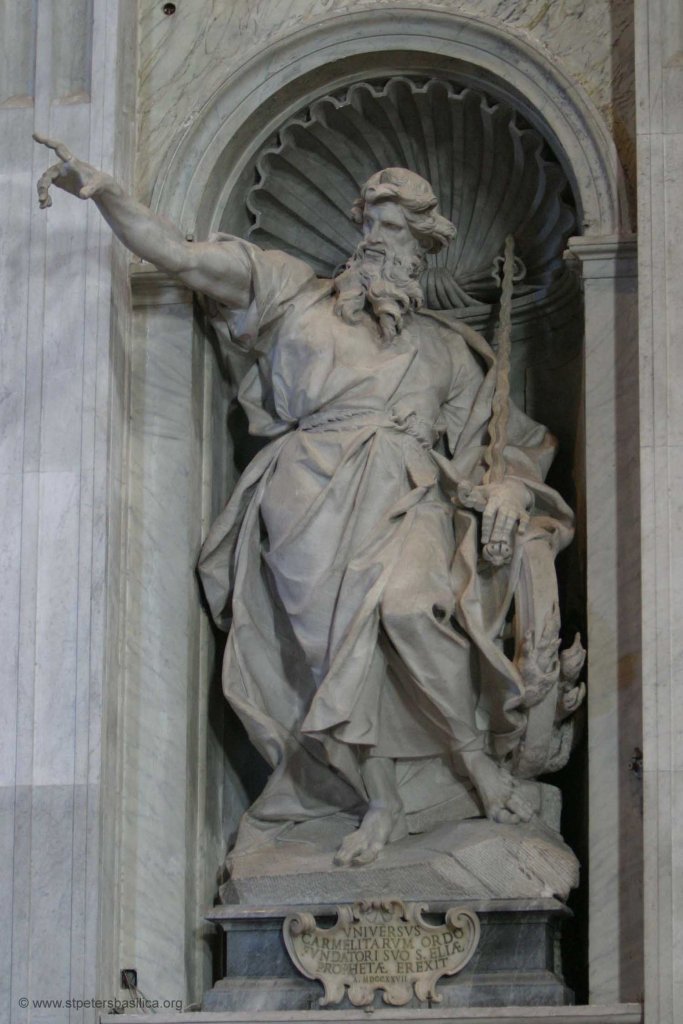
Statue of Elijah pointing, by Agostino Cornacchini (1727) at St Peter’s Basilica, Vatican City

Following the new wine

Click here to watch the video of this 28-minute message on Facebook (the message starts about 29 minutes into the recording). Note that this is an active sermon – worth watching, rather than just reading. I don’t have an audio recording of this message. Or read the text summary below.

Matthew 9 tells the story of Jesus calling Matthew: “As Jesus went on from there, he saw a man named Matthew sitting at the tax collector’s booth. “Follow me,” he told him, and Matthew got up and followed him.” And Genesis 12 tells the story of God calling Abram: “Go from your country, your people and your father’s household to the land I will show you.” Go! Follow me! These calls have nuclear power to move people – Matthew got up and followed Jesus, Abram packed and moved into the unknown.

Jesus is calling you and me today – Follow me! Go! – but to where? Where do we go? Where do we follow?

Matthew 9:16-17 gives us invaluable insights into what Jesus calls us to, in the metaphor of new wine in new wineskins:

“No one sews a patch of unshrunk cloth on an old garment, for the patch will pull away from the garment, making the tear worse. Neither do people pour new wine into old wineskins. If they do, the skins will burst; the wine will run out and the wineskins will be ruined. No, they pour new wine into new wineskins, and both are preserved.”

Although the metaphor is a bit obscure, at very least we can take from this that there are challenges in mixing the old and new. Jesus leans strongly in favour of the ‘new’ – new wine and new wineskins are what we’re after. A few verses earlier (v13) he gives another clue about where we are following him to, when he quotes Hosea, “I desire mercy, not sacrifice”. Mercy represents love for people, while sacrifice represents religion. Jesus is saying – indeed God is saying – I don’t want your religion, I want your love for people. This is the ‘new’ teaching – or rather an old teaching renewed – that Jesus gives us. And the whole of Matthew 9 illustrates this with examples.

Come along with me – follow me! – as we briefly consider the seven stories that illustrate following the new wine in Matthew 9:

  1. The chapter opens with a paralysed man, brought to Jesus by his faith-filled friends. Jesus sees their faith and says, “Take heart, son; your sins are forgiven.” The teachers of the law are outraged by Jesus’ presumption of having authority to forgive sins – they’re not interested in the man, only in their theology. Jesus responds strongly and heals the man as evidence of his authority to proclaim forgiveness of sins. Jesus’ love for this physically and spiritually broken man takes precedence over the teachers’ petty theology.
  2. In verses 10-13, Jesus attends a party hosted by Matthew, who is now following Jesus. Matthew’s friends are tax collectors and sinners – ‘bad people’. The Pharisees – another religious group – are disgusted and ask Jesus’ disciples, “Why does your teacher eat with tax collectors and sinners?” They are not concerned with the humanity of Matthew and his fallen friends – they are concerned only with religious piety and ‘rightness’. They dehumanise these broken people. Jesus confronts them, “It is not the healthy who need a doctor, but those who are ill… For I have not come to call he righteous, but sinners.” Jesus’ love for sinners, for bad people, takes priority over everything.
  3. In verses 14-17, while still at the same dinner party, the disciples of John the Baptist come and ask Jesus, “How is that we and the Pharisees fast often, but your disciples do not fast?” Their use of ‘often’ (we fast often) betrays the religious pride. Their interest is in religious observance and spiritual discipline. But Jesus dismisses their concerns, asking “How can the guests of the bridegroom mourn while he is with them?” He has little interest in fasting or other religious piety – he is more interested in spending time engaging with people. It is in this immediate context that he speaks about new wine – he is not interested in religious and theological precision and rightness; he is much more interested in human relationships, fellowship, compassion and love.
  4. In verses 20-22, while still at the same party, a synagogue leader tells Jesus that his daughter has died and asks if Jesus can come and help. Jesus leaves immediately, as his compassion for this young girls outweighs his fellowship with Matthew and his friends. On the way to the house, a woman who has been bleeding (menstruating) heavily for 12 years touches his cloak and is healed by Jesus’ power. Her faith is strong: “If I only touch his cloak, I will be healed.” Jesus stops and speaks with her, he proclaims healing and wholeness and salvation. We imagine he took hold of her hand as he lifted her up onto her feet. While in the other stories there are crowds of noisy people around, here there is silence. Men and women keep menstruation quiet and private – it is not public. And in those days, women were considered unclean during their period. For Jesus to engage, speak, touch her was to make him unclean. He didn’t care about that – he cared just for her.
  5. Reaching the house of the synagogue leader, there is a noisy crowd outside. They mock Jesus when he says the girl is just sleeping. He goes up to her room and takes her by the hand. Touching a dead person makes one unclean, but Jesus doesn’t care about that – he cares only for the girl. She is revived and gets up.
  6. Briefly, Jesus continues on his way and heals two blind people, “According to your faith let it be done to you”. He sternly warns them not to tell anyone about him healing them. He is not interested in recognition – he cares only about their sight.
  7. And then he encounters a demon-possessed man (perhaps today a schizophrenic). He drives out the demon. The Pharisees cannot recognise Jesus’ compassion for this man’s wholeness and well-being; they say, “It is by the prince of demons that he drives out demons”.

Jesus quoted Hosea, “I desire mercy, not sacrifice”. Jesus tells about the new wine – his people-centred gospel of love and inclusion – that is incompatible with the old wineskins of religiosity, piety, self-righteousness. He is all about people: “I have not come to call the righteous, but sinners”.

So, as we follow Jesus, as we answer his call to ‘Go!’, we must put people before religion, relationships before theology, acceptance before judgement, inclusion before exclusion, love before judgment. This is the new wine of Jesus’ Gospel that should be poured into the new wineskins of our hearts and churches.

Featured image from https://www.wholelifechallenge.com/weekly-challenge-8-reach/

Light in the darkness

Click here to listen to the audio recording of this 18-minute message. Or watch the video on Facebook here (the message starts about 23 minutes into the video).

The story of Jesus’ transfiguration on the mountain top, in front of Peter, James and John, is well known to most Christians – in our church we celebrate this event at least once a year just before Lent starts (Matthew 17:1-9).

But this year I noticed for the first time the narratives about Jesus’ death on either side of the transfiguration story. In Matthew 16:21-23, Jesus tells his disciples that he will shortly be killed. Peter challenges him for this negative comment, and Jesus in turn rebukes Peter with strong words, “Get behind me, Satan!” How devastated Peter must have felt, both hearing about Jesus’ fate and hearing Jesus’ stinging rebuke.

And shortly after the transfiguration, in Matthew 17:22-23, Jesus repeats this statement, “The Son of Man is going to be delivered into the hands of men. And they will kill him.” The disciples were filled with grief at these words. What dark encounters to have immediately before and after the transfiguration.

In addition to hearing these words, the disciples hear other difficult-to-swallow messages. In Matthew 16:24-28, Jesus tells his disciples that if they want to follow him, they must deny themselves and take up their cross and lose their life. A hard teaching – they thought they were going to journey with their saviour towards the Eternal Life that Jesus so often spoken about. But instead, they hear these hard words.

And after the transfiguration, they go out to heal people and cast out demons (Matthew 17:14-20). But there is one child they cannot save. Jesus comes and heals the body immediately. They ask Jesus why they couldn’t drive out the demon, and Jesus responds “Because you have so little faith.” Ouch! Tough, harsh words from their Lord.

It is like there are these tall walls on their left and their right, before and after the transfiguration, that block out the sun and that undermine and disrupt the disciples’ faith. Almost like they are at the bottom of a chimney tower, with walls all around that reach up into the sky, so that no light gets down.

And yet is it is in this very space – in this dark place – that the transfiguration takes place. It is here, in this darkness, that the light of Christ, his dazzling divine nature, is revealed to Peter, James and John.

Here is an important lesson: It is often in the darkest spiritual times that we we have the brightest encounters with God.

It is clear from Matthew 17 that Jesus goes immediately into the transfiguration – he wastes no time. It is as if this is exactly why he brought them up the mountain – so that in the midst of their darkness, they could encounter his light. And they hear the voice of God speaking, “This is my son, whom I love; with him I am well pleased. Listen to him!”

Here are hope and courage and spiritual resources to sustain the disciples, in the midst of spiritual testing.

Have a look back at Exodus 24:12, where Moses is invited to go up the mountain to meet with the Lord and to receive the Ten Commandments. God says to him, “Come up to me on the mountain and stay here.” What a remarkable invitation! To be not only invited up the mountain to meet with God, but also to stay there with God. And Moses stayed there 40 days and 40 nights. All around the mountain, the Israelites saw a storm, thunder and lightning, dark clouds – it was terrifying. But Moses was safe in the light of God within the darkness of the cloud, just staying with God.

During the period of Lent, which kicks off on Wednesday this week, many of us will experience an intensification of spiritual attack. We will be working to deepen our faith, to nurture our spiritual life, to strip down the outer layers of excess, to step away from sin and get down to a more fundamental and authentic relationship with God. But in this very time, when we are trying so hard to grow spiritually, Satan attacks us the most. We experience increased difficulties, challenges, disruptions, criticisms, failures, hardships, losses. These are the dark walls of the chimney tower rising up around us.

It is in these times that we are most in need of the light of Christ. Peter, having recounted his experience on the mountain top, provides us with some helpful advice (2 Peter 1:19):

We also have the prophetic message as something completely reliable, and you will do well to pay attention to it, as to a light shining in a dark place, until the day dawns and the morning star rises in your hearts.

‘The light shining in the dark place’ and the ‘morning star rising in our hearts’. This is the transfiguration of Christ taking place within us as we seek to follow Christ, even when the world is dark around us, even when our faith seems weakest, even when we feel besieged by evil. This is where we encounter the transfigured Christ.

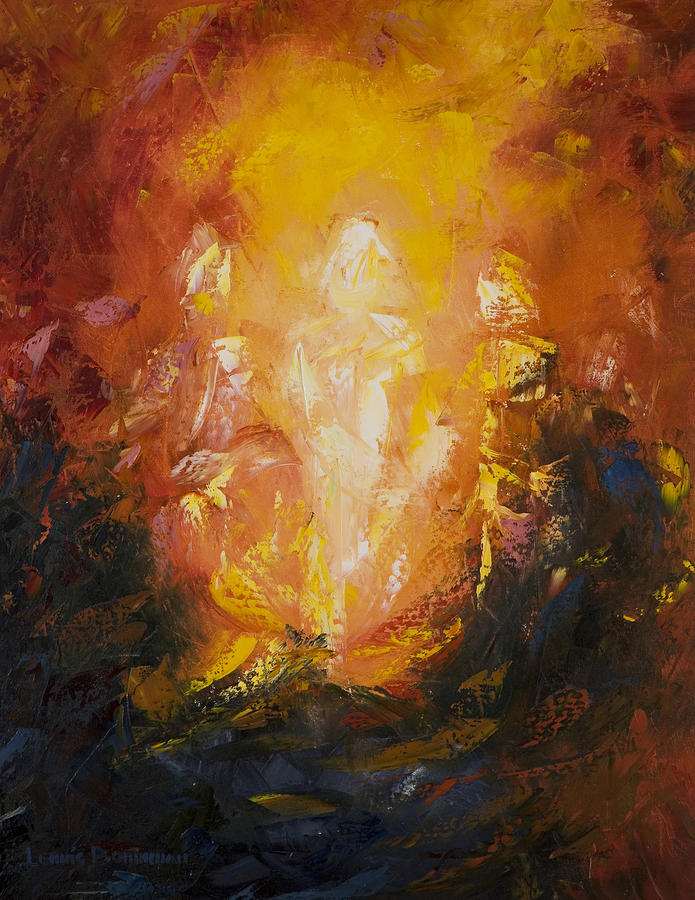
“Transfiguration” by Lewis Bowman, from https://fineartamerica.com/featured/transfiguration-lewis-bowman.html