Today we read about Jesus’ bris or circumcision, eight days after he was born, in Luke 2:21-40. We meet two incredible people of great faith in the temple: Simeon and Anna. Both immediately recognise Jesus (remember he’s just eight days old) as the Messiah, the long-awaited one.
Given that New Year is almost upon us, I thought it might be useful to see what we can take from this passage to inform our New Year’s resolutions for 2021. Or rather, to inform our resolve for 2021. (‘Resolve’ has far greater strength of determination and commitment that a mere ‘New Year’s resolution’, which most of us probably break on 2 January!)
Let us be resolute in our to devotion to Christ. Simeon is described as a righteous and devout man, filled with the Spirit of God, while Anna is described as an 84-year-old prophet, who virtually lived in the temple, worshipping, praying and fasting. Both of them embody a deep commitment to devotion to God. We can be determined to walk in their footsteps, through our devotion to Christ.
Let us resolve to live out salvation for all of humankind. Simeon says, in vv 30-32, “My eyes have seen your salvation, which you have prepared in the sight of all nations: a light for revelation to the Gentiles, and the glory of your people Israel.” Initially, the salvation that would come through Jesus was thought of as being only or primarily for the Jewish people – indeed Jesus’ ministry was mostly to Jews. But there is a growing awareness (with deep roots in the First Testament) that the salvation that comes through Christ is for the whole world. We can live this out in the way we live, work and speak. And at this time, in how we handle the challenges of Covid.
Let us resolve work always for peace. In vv 34-35, Simeon recognises that Jesus’ life and ministry will not result only in peace and joy; there will be those who oppose him, there will be conflict, and eventually there will be death. But Jesus’ ministry is one of peace-building, love, forgiveness and reconciliation. Let us live out such a deep commitment in our daily lives. And let us also resolve to pray for the world, which is marred by so much discord, conflict and violence.
May 2021, which will continue to have its major Covid-related and other challenges, be a year in which we are more intentional in our resolve to be devoted to God, to live out his inclusive salvation and to work for peace.
During Advent (the four Sundays leading up to Christmas) we have been preparing ourselves for the coming of Christ into this world – God in human form – Emmanuel – God with us. Today, that advent – ‘the arrival of a notable person or thing’ – has come to fruition. We are not waiting for God to come to us; God is here with us. Christ is born!
I’m sharing two messages today – one that I preached last night, based on John 1, and one that I preached this morning, based on Luke 2. Both are about the coming of God into the world, but from different perspectives:
John presents to us the grand narrative about the coming of Christ into this world:
“In the beginning was the Word, and the Word was with God, and the Word was God … Through him all things were made … In him was life, and that life was the light of all humanity … The Word became flesh and made his dwelling among us … We have seen his glory!” (John 1:1-14)
Here we meet ‘The Word’ – the very Word of God, the thoughts of God, the knowledge of God, the power of God – who is the second person of the Trinity (Father, Son and Spirit). This Word is the foundation of the cosmos. He was there from before the beginning of time and space, working in partnership with Father and Spirit in the creation of everything that is. He is the very source of the fundamental elements of our existence: life and light – making all things possible.
And then, at a point in time and space, this Word transitioned from eternity, from infinity, from perfection, into this human world – the Word became flesh and “moved into our neighbourhood” (the Message). God became one of us, bringing life and light into our immediate vicinity. We could see him, touch him, speak with him.
God continues to live among us, in our neighbourhood. The Word made flesh. He makes his dwelling among us in this world.
And he makes his dwelling in you, in me, in every person who will allow him. Perhaps he has already set up his dwelling place – pitched his tent – in every person, and is just waiting for an invitation to move in. His space is there, ready and waiting, but just needing us to answer the knock on the door, the subtle invitation, the quiet whisper.
Luke presents to us a more domestic narrative about the coming of Christ into the world:
“Joseph went up from the town of Nazareth in Galilee to Bethlem to register with Mary who was pledged to be married to him and was expecting a child. While they were there, the time came for the baby to be born, and she gave birth to her firstborn, a son. She wrapped him in cloths and placed him in a manger, because there was no guest room available for them. And there were shepherds living out in the fields nearby, keeping watch over their flocks at night.” (Luke 2:1-20)
Luke presents the coming of Christ as a family story, set against the political landscape. Rome – a colonial oppressor in Israel – required everyone to travel to their home town for a census. Mary – a teenager – pregnant and as-yet unwed – travels with Joseph. But they are unable to find a place to stay, and settle into what may have been a barn or cave or a corner of a house, with the animals. And there she gave birth to her son, Jesus. Such a simple way to tell us that God the Son had just entered this world – ‘and she gave birth to her firstborn’. No fanfare, no witnesses, no family support, not even a decent place to stay. In that place, God came into this world.
And then it is to the shepherds that God reveals this good news. They’re out looking after their sheep and the sky fills with angels who sing out, “Glory to God in the highest heaven, and on earth peace to those on whom his favour rests”. It is these shepherds to go to visit Mary and Joseph and the infant Jesus. (The Maji appear in Matthew’s version and Mark and John don’t describe Jesus’ birth at all.)
We learn something of the humility of God from Luke’s narrative. It is mostly so underplayed. Only the shepherds see the angels, no-one else. In the first Testament, God is typically portrayed as great, awesome, powerful, the Creator of all. John’s narrative similarly presents us with ‘the Word’ – the cosmic Christ. But here we see God presented to us as a newborn – the most vulnerable and helpless of all humans, utterly dependent on his caregivers for his survival.
And we learn something of God’s willingness to work through the ordinary, and particularly through ‘the poor’ – those who are displaced, marginalised, labourers, homeless, hungry. We will see this again and again in Luke’s gospel particularly, but indeed in all the narratives about Jesus’ life and ministry. God leans towards those on the edges.
And so God is waiting to work in you and in me, to be born in us today. It doesn’t matter how old or young you are, how educated or illiterate you are, how gifted or ordinary you are, how powerful or weak you are, how well-adjusted or dysfunctional you are, how rich or poor you are. God wants to be born in you and to grow up in you.
And so, if you have been skirting the edges of a commitment to Jesus or if you have made a commitment to him but are iffy in how you live that out day-by-day, perhaps this Christmas is the time when you want to say YES to the Son of God, and to allow the Word to move into that tent that he has already pitched in your heart. Perhaps this Christmas is the moment when you say YES to the birth of Jesus in your heart, and when you say YES to nurturing him as he grows in you in wisdom and stature and in favour with God and people. Perhaps now is the time to say YES to God.
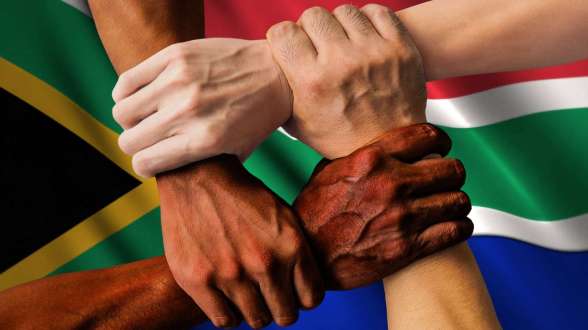
Today (16 December) in South Africa we celebrate Reconciliation Day, a day on which we remind ourselves of the great need for us to reconcile with each other, after generations and generations of racial oppression and exclusion. We still have a long way to go with this!
In 2 Corinthians 5:16-20, Paul writes at length about reconciliation. He explains that God has reconciled us to Godself; that God has been working all along to reconcile the whole of humanity – indeed, the whole of creation – to Godself; and that God has now entrusted this ministry of reconciliation to us:
So from now on we regard no one from a worldly point of view. Though we once regarded Christ in this way, we do so no longer. Therefore, if anyone is in Christ, the new creation has come: The old has gone, the new is here! All this is from God, who reconciled us to himself through Christ and gave us the ministry of reconciliation: that God was reconciling the world to himself in Christ, not counting people’s sins against them. And he has committed to us the message of reconciliation. We are therefore Christ’s ambassadors, as though God were making his appeal through us. We implore you on Christ’s behalf: Be reconciled to God.
Given that God has done so much to reconcile us to God’s self and given that we are given this great commission to carry out in Christ’s footsteps, how sad it is that there is still so much division among Christians! I do not refer only to divisions between denominations, but also divisions within a local parish, between members of the same local church. Such divisions are completely out of step with everything that God has been doing with humanity since the Fall. We are called to work for relational reconciliation among ourselves in the church.
Paul then goes on in Galatians 3:26-29 to emphasise that the work of Christ has been not only to towards relational reconciliation, but also towards structural or systemic reconciliation:
So in Christ Jesus you are all children of God through faith, for all of you who were baptized into Christ have clothed yourselves with Christ. There is neither Jew nor Gentile, neither slave nor free, nor is there male and female, for you are all one in Christ Jesus. If you belong to Christ, then you are Abraham’s seed, and heirs according to the promise.
These categories that Paul writes about – Jew/Gentile, slave/free, male/female – are the classic sociological topics of race, class and gender. These are the systemic and structural lines according to which most societies are still divided. Employment, poverty, inequality, social exclusion, crime, agency, violence, salaries and so on all run along the lines of race, class and gender – those very things that Paul says should have disappeared in Christ. Yet in the so-called ‘Christian world’, these lines run deep into the earth.
As followers of Christ, we are called to work to undermine and subvert and dismantle these lines. To stand up against racism, classism and sexism or patriarchy. Not to perpetuate them!
And Paul then goes still further in Ephesians 5:21 to emphasise that this reconciliation should be not only in church and the world, but also in our intimate relationships. Within our households, we need to work towards domestic reconciliation and harmony:
Submit to one another out of reverence for Christ.
Such a simple verse! Christians tend to emphasise the next line (wives submit to your husbands), but Paul’s headline for this passage is that we all must submit to each other: husbands to their wives, wives to their husbands, children to their parents and parents to their children. When we are all submitting to each other, out of reverence for Christ, who has reconciled us to God, we will be united and harmonious. Mutual submission to one another builds reconciliation, dismantles inequality and fosters unity.
Let us reflect deeply on the reconciliation that God has already worked for us between us and God, and in grateful response to that, work for relational, structural and domestic reconciliation.
Today is the first Sunday in Advent, a season in which we look forward to the coming of Christ into the world – historically 2,000 years ago (which we celebrate at Christmas), in this very moment (Christ is continually coming into the world) and one day in the near or distant future (when Christ comes again). Today we reflect on the last of these – Jesus’ second coming.
Our reading is Isaiah 64:1-9, which opens with these powerful words, “Oh, that you would rend the heavens and come down!” While this sounds like a joyful call for Christ to return, the passage is filled with caution and a call for critical self-reflection.
Let me summarise the flow of thought. Initially, there is a call for Christ to come down, to make the mountains tremble, to set fire to the world, to cause the nations to quake and to make his name known to his enemies. This passage seems to work from the assumption that there are clear enemies of God, and implicitly that we are in the right:
Oh, that you would rend the heavens and come down, that the mountains would tremble before you! As when fire sets twigs ablaze and causes water to boil, come down to make your name known to your enemies and cause the nations to quake before you! For when you did awesome things that we did not expect, you came down, and the mountains trembled before you. (Isaiah 64:1-3)
Second, there is a similarly smug and self-satisfied view that God is inevitably on our side – that we are right, and everyone else is wrong, because we wait for Christ, we gladly do right, and we remember his ways. There is a complacency that we are right and thus God is for us – a complacency that easy slides into arrogance – an arrogance that easily slides into hatred and judgement of everyone else:
Since ancient times no-one has heard, no ear has perceived, no eye has seen any God besides you, who acts on behalf of those who wait for him. You come to the help of those who gladly do right, who remember your ways. (Isaiah 64:4-5a)
But third, it seems that Isaiah pauses and reflects. He becomes self-critical, as he writes, “But…” That ‘but’ initiates a series of recognitions that there is little difference between ‘us’ and ‘them’. He faces up to our continued sin, our uncleanness, that even the best we do is like filthy rags, that we are shrivelled like a leaf, that the wind of our sins will sweep us away, and that we neglect to call on God’s name or to strive towards him. Isaiah recognises that, as a result, God hides his face from us and gives us over to our sin. And so he says, “How then can we be saved?”:
But when we continued to sin against them, you were angry. How then can we be saved? All of us have become like one who is unclean, and all our righteous acts are like filthy rags; we all shrivel up like a leaf, and like the wind our sins sweep us away. No-one calls on your name or strives to lay hold of you; for you have hidden your face from us and have given us over to our sins. (Isaiah 64:5b-7)
And then, out of this stepping down, stepping back, looking within, critically self-reflecting, challenging himself and his religious community, Isaiah comes to some important realisations. He starts the next passage with, “Yet”, signalling that he has recognised something new. He discovers afresh that God is our father and we all are his children. That God is the potter and we are but clay in his hands. That God is merciful and does not store up anger against his children. That God sees us as we pray. And that we all are God’s people, all the work of his hand.
This last line is perhaps the most the important of all – having started by dividing the world into right and wrong, good and bad, saved and lost; and then realising that we also are wrong, bad and lost – he realises that God is for everyone. God desires to save everyone. God longs to reconcile with all of us. And that we can be reconciled only through the work of Christ, not by us being ‘more right’ than anyone else:
Yet you, LORD, are our Father. We are the clay, you are the potter; we are all the work of your hand. Do not be angry beyond measure, LORD; do not remember our sins for ever. Oh, look upon us we pray, for we are all your people. (Isaiah 64:8-9)
As much as we long for Christ to return – for the rending of the heavens and the coming down of Christ – let us recognise that we are little different from anyone else. We are as dependent on Christ for our salvation as anyone else, because we are as sinful as anyone else. That when we become smug about our salvation or about how spiritual or righteous we think we are, we are actually moving away from God, not towards him.
And so let us be cautious, humble, critically self-reflective and watchful. As Jesus says at the end of Mark 13:24-37,
Click here to listen to the audio of this 35-minute message. Or watch the YouTube video below, or read the text summary after that. This is a longer-than-usual message, because this is such an important topic, that is so seldom spoken about. So, while 35 minutes is quite a long time, I urge you to set aside some time – particularly today, Women’s Day – to listen to this message.
Today – 9 August – is Women’s Day in South Africa. It’s a day when we celebrate women. But it is also a day when we confront the profound and relentless violence against and subordination of women in our society. The church must, on this day, give particular attention to its role in perpetuating, supporting and even advancing such patriarchal and misogynistic views and behaviours. My own church – the Anglican Church of Southern African – must take responsibility for our role in advancing violence against and oppression of women. And men, like me, must do the same.
So, in this message, I unpack four passages of the Bible – three in the Genesis creation story and one in the writings of Paul – that are often used to support patriarchy. I invite you to read the texts and see what they actually say and to critique how they have been used. Of course, the Bible was written in patriarchal times by people who held patriarchal views. But we are invited to read through their views to see the mind of God on the issues of gender inequality in the world.
This is an important and substantial topic, hence this is a rather lengthy message. I urge you to engage with it, as I think it will help to lay a foundation for thinking about gender relations in the world, in the church, in the workplace and in our homes.
Genesis 1:27-28 tells us that both women and men are equally created in God’s image. It also tells us that they were both – as a couple, as a partnership – given authority to rule over the earth. There is no hint that the man is more created in God’s image than the woman, that he is important or more powerful than the woman. The man is not given dominion over the woman; instead both the woman and the man are given conjoint dominion over everything else. This is a picture of unity, equality and power-sharing between man and woman – a picture that is very much at odds with how life is lived in many homes today.
Genesis 2:18-23is part of the second creation story, where God recognises that it is not good for man to be alone and decides to create a ‘helper’ for him. Initially, God looks among the animals, but realising that none of these will do, God creates woman. The word ‘helper’ is often used to imply woman’s supportive, helping, subordinate role. But in v18 God recognises that man is somehow inadequate or deficient – unable to be alone – he is incomplete and needs a partner to make him whole. Therefore God creates a woman. The woman is there to help him be a whole person – this is by no means a subordinate role.
Moreover, she is created from his rib, suggesting that they are equal – they stand side-by-side, joined at the rib – the midpoint between the head and the foot. God did not take Adam’s toe and create Eve’s collarbone so that Adam could stand on her head! Instead, they are created as the same, as equal, as partners. It reaffirms Genesis 1 – they are equal partners.
Genesis 3:16-19tells of God’s cursing of man and woman for their sin. v16 has a line that says “and he [your husband] will rule over you”. Many male theologians and scholars and ministers have used this verse to construct a theology that God’s divine plan for human relations post-fall is that men (husbands) exercise authority over women (wives). This is a profound perversion of the scriptures, because this is just one line out of several lines of curses, including that women will experience pain in childbirth (which humanity has constantly worked to reduce and to reduce maternal mortality).
In addition to hers, there is a lengthy curse against the man (72 words to the man, compared with just 31 to the woman – the man’s curse is more than double the length of the woman’s!). God says that he will suffer and struggle to produce crops from the earth. And yet men have never accepted this as God’s divine plan for them! Men have worked, since they left Eden, to ease the burden of producing crops, through the use of slaves, animals, machines, genetic modification and most recently artificial intelligence. If the curse against men is not part of God’s divine order, why is the curse against women? It is simply patriarchy and misogyny at work!
Overall, the creation story across Genesis 1-3, there is an overriding narrative of equality between woman and man. Even in the fall, both woman and man eat the apple and both woman and man are cursed. Everything is equal, parallel. Indeed, if there was any hint of gender inequality, it would be in favour of woman – she was God’s second attempt at creating a human (we are usually better the second time round) and her curse is shorter than man’s. But indeed, the dominant and pervasive narrative is one of equality and partnership between gender. This is God’s vision for gender.
So, we do need to look also at the New Testament, and particularly to the writings of Paul. It is true that Paul was raised in a patriarchal society and household. He is certainly a patriarch and probably also a misogynist. He does write that men are the head over women, that women must be silent in church, etc. He clearly writes about male domination over women. This is how he was raised. There are, however, NO passages where Paul advocates or endorses, even tacitly, violence against women or the oppression of women. And just because Paul was a patriarch, does not mean God is a patriarch.
Paul grapples with gender issues. He writes “there is neither male nor female, for you are all one in Christ” (Galatians 3:28). He has some sense that in God’s eyes, there is no gender; but in his own thinking, he still sees and supports gender inequality. What we seem to be seeing in Paul’s writings is a developing insight into God’s view on gender equality, emerging and receding.
1 Corinthians 7:2b-5 presents to us a profoundly egalitarian view of gender relationships from the pen of Paul. It shows a perfect equality between women and men, equal exercising of power over one’s body, equal self-giving of oneself to one’s partner. It is an image of a very modern marriage. It is completely out of step with the traditional passages we quote from Paul on ‘wives must submit to their husbands’. If men are going to quote Paul on gender, let us quote ALL of Paul on gender, and recognise that here is a man whose views on gender are uneven. And this unevenness is best explained as Paul’s growing understanding of God’s view of gender equality.
In light of these challenges about God’s views – and Scriptures views – on gender equality, I suggest two principles that should inform and shape how we interpret scripture:
First, we need to look at the whole of scripture when we formulate a position on something, like gender relations. We need to look at the whole body, and we need to understand the underlying mind of God, which we see most clearly expressed in the mind of Christ, which we best gain insight into in the Gospel narratives.
Second, we need to separate custom from teaching, description from prescription. Just before the Bible writers believed the earth was flat and that the sky was a bowl over the earth, does not mean that the earth is actually flat and that there is actually a bowl in the sky. Even though they express this view in the Bible, e.g., in the Psalms, does not mean it is true or that God believes this. We are inclined to bring our cultural beliefs and impose them onto scripture – gender is a good example of this. Instead, we are required to bring God’s mind, expressed in the scriptures, and use these to sanctify and transform society. When it comes to gender, we impose our preconceived patriarchal beliefs on scripture, even though scripture advocates a far more egalitarian view on gender.
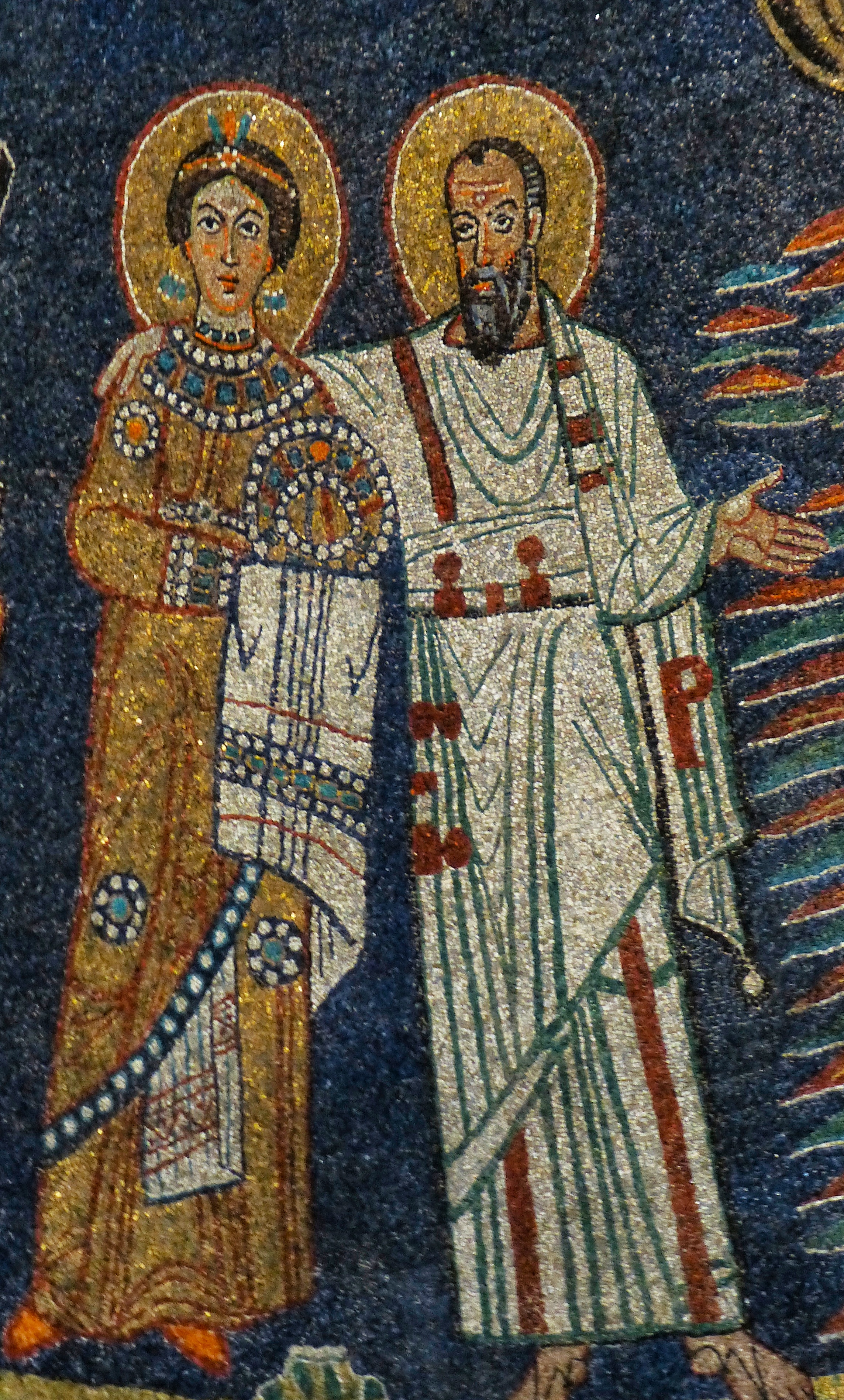
Featured image of St Praxedes and St Paul, presented as equal co-workers for Christ, in the Basilica Santa Prassede, Rome, from here
This is the order Jesus gives for Christian life: we find the treasure, this fills us with joy, so we sell all our possessions (which are worth a fraction of the treasure), and we acquire (take ownership) of the treasure (Mat 13:44). The treasure is there at the start and the end; the joy is the immediate consequence of finding the treasure; and the sacrifice of possessions is really no sacrifice at all. This is the Christian life. Let’s find our joy in Christ!
Therefore, I urge you, brothers and sisters, in view of God’s mercy, to offer your bodies as a living sacrifice, holy and pleasing to God—this is your true and proper worship. Do not conform to the pattern of this world, but be transformed by the renewing of your mind.
This passage offers us two sets of verbs:
Offer, sacrifice, worship – which speak to giving ourselves to God
Transform, renew – which speak to an inward-focused process
The passage also offers us two nouns:
Our bodies – which speaks to the embodied being that we are, crafted from clay and in-breathed by God’s Spirit
Our minds – which speaks to the immaterial being that we are, mind, emotion, thought, spirit
Together, these two verbs and these two nouns call us towards a complete offering of ourselves – a surrender, a relinquishment – to God.
In Matthew 10:7-14, Jesus sends out his 12 disciples on their first solo mission, and his instructions seem to be grounded in this message:
Be audacious!
Jesus is not saying, be arrogant, insolent, obnoxious, offensive, dogmatic or judgemental. But he is saying, be brave, be courageous, be reckless, jump in the deep end!
Here’s what we are to do:
We proclaim the good news that God is present in the midst of human life. God is near, right here, present, engaged.
We heal, cleanse, raise and cast out illnesses in all its manifestations, at both personal and social levels. Healing is, in Jesus’ understanding and practice, not only physical, but also relational and social.
We are generous in our investment in the lives of others – freely we have received, freely we give. We don’t hold back, we don’t over think, we don’t over risk manage.
We don’t take provisions with us, we don’t over plan, we don’t pamper ourselves. We simply go – a bit reckless.
We don’t take from the people we go to. We don’t go to enrich ourselves. We go to give.
We find people who are receptive to what we have to offer, and we spend time with them. And if people are not receptive, we just move on, shake the dust off our feet. It is almost blasé – if people want to listen, we talk with them; if they don’t, we don’t worry, we just move on.
Be audacious, be courageous, be reckless, be blasé. Don’t worry, don’t over plan, don’t over think. Jump in! Be brave!
I appreciate that this topic will be controversial for many. I really encourage you to watch this message please and not just read it, particularly if you find the title problematic. At least, just listen to what I have to say, even if you decide you don’t agree with it.
But, very briefly, the main points are:
Jesus died for ALL of humanity – for the whole world – and would thus say, without equivocation, ‘All lives matter‘.
But Jesus would also confront us, saying that we do not live our lives as if all lives mattered.
Jesus’ ministry consistently and deliberately positions himself with those who are vulnerable, oppressed, poor, or marginalised: women, Samaritans, lepers, prostitutes, menstruating women, the dead.
Throughout his ministry – throughout the Gospels – Jesus enacts the message that Black lives matter, Women’s lives matter, Immigrants’ lives matter, Children’s lives matter, etc.
Jesus is not saying the lives of the poor matter more than other people’s lives; but that their lives do not matter less than other people’s lives.
In the new heaven and the new earth, all lives will actually matter in people’s lives experience. But in today’s society, this is not true. Today, all lives are not equal and not equally valued. And in this times, Jesus would be saying: Women’s lives matter, Children’s lives matter, Immigrant lives matter, LGBTQI lives matter, Black lives matter.
John 3:16 may be the most recognisable and widely-known verse in the Christian Bible:
For God so loved the world that he gave his one and only Son, that whoever believes in him shall not perish but have eternal life. (NIV)
For God so loved the world, that he gave his only begotten Son, that whosoever believeth in him should not perish, but have everlasting life. (KJV)
Let’s break this verse down into its parts:
For God – It all starts with God, like in Genesis 1:1 “In the beginning, God…”
so loved – This is the first use of ‘love’ in John’s Gospel, and it becomes a central word in his writing. This points to the extent of God’s love – God loved so much – extravagant, risky, inclusive, radical, transformative, saturating!
the world (kosmos) – God’s love is radically inclusive. God loves the whole world. In Greek, the kosmos. There is no-one and no-thing that is beyond the extravagant love of God.
that he gave – Out of this infinite love, God gives. He gives his Son. But this is not a giving, like one might give someone a cracker – the cracker is passive and is merely given. Here, God gives his Son, who is active – the Son participates in the giving, chooses to be given, gives himself.
his one and only Son, – God the Father gives God the Son, enabled by God the Spirit. The Son is God’s one and only, God’s beloved, God’s own heart. This is the profound self-giving of God’s self to the world.
that whoever – Jesus has already said God loves “the world”, which is radically inclusive of the entire collective of creation. Now Jesus brings this inclusivity down to the individual – whoever or whosoever. The Son gives himself to every individual– to you Martha, to you Stephen, to you Bongani, to you…
believes in him – The Greek for ‘believe’ can equally be translated ‘trust’. Believe too easily becomes ‘cognitive assent’, too easily becomes affirming a list of propositional statements about the Son. But Jesus wants more than just this – he wants us to trust him, to put our trust in him, to entrust ourselves to him. The ‘in’ in Greek is actually ‘into’, so we can confidently say, “whoever entrusts themselves into him”.
should not perish – Although we will all die, sooner or later, we shall not all perish or be destroyed. We have little choice about dying, but we do have a choice about perishing.
but have everlasting life. – And that choice is Life, with a capital L. The everlastingness of Life is not just about it continuing for a long time (eternal), but also to the quality of the Life, which can be enjoyed at this very moment. Jesus offers us Life: Life everlasting, Life abundant, Life to the fullest, Life eternal, Life in relationship with God.
For God so loved the world that he gave his one and only Son, that whoever believes in him shall not perish but have eternal life.











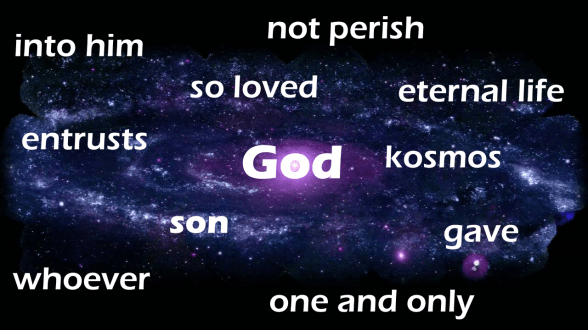
 Featured background image of the Andromeda Galaxy, M31, from
  Reflections of God's Love