Today is the Wednesday of Holy Week. In tonight’s reading, from John 13:21-30, we read the catastrophic narrative of Judas’ decision to betray Jesus. Judas makes a conscious decision to betray his Lord, and thereafter Satan enters him, and then he goes into the night, into the dark. He makes a choice to turn away from the light. He abandons his belief in the light, ceases to walk in the light (choosing rather to walk in the dark) and relinquishes his sonship of God – all the things we reflected on last night in the message ‘Into the light‘. It is a tragic story, as when Judas finally realises what he has done, he can find no forgiveness and takes his own life. There is a cautionary tale in this – to believe in the light, to walk in the light and to become children of light.
Watch the video of this message at https://fb.watch/4AvYOqTk25/. The reading starts at about 20 minutes into the recording, while the sermon starts at about 31 minutes and runs for 14 minutes.
Today (25 March) we celebrate the Festival of the Annunciation to the Blessed Virgin Mary. Today is exactly nine months before Christmas Day, and on this day we celebrate the conception of Jesus in Mary’s womb. As it is written in Luke 1:30-33:
“Do not be afraid, Mary; you have found favor with God. You will conceive and give birth to a son, and you are to call him Jesus. He will be great and will be called the Son of the Most High. The Lord God will give him the throne of his father David, and he will reign over Jacob’s descendants forever; his kingdom will never end.”
While the Western (Catholic and Protestant) churches celebrate Christmas as the high point of the church calendar, the real miracle of Christmas takes place at the conception, nine months before. It is at this moment that God incarnates into human form. Mary is thus referred to as the ‘Mother of God’ or the Theotokos (or God bearer) because she carries and gives birth to God. It is not that she creates God! But rather that she bears God in her womb.
What is conceived in Mary is, from conception, a hybrid of human and divine natures in the one person of Jesus. This is a mystery, hard to fathom – the nature of Jesus Christ. But whatever it is, and however we understand Christ’s divine and human natures, it starts at his conception, not at his birth.
Let me suggest three reasons why this rather mysterious and mystical notion is important:
The conception demonstrates the enormity of God’s emptying out of God’s self on behalf of humankind (which we read about in Philippians 2) – we refer to this emptying out as ‘kenosis’. Typically, we think of God’s kenosis in the birth of Christ, but really it is in his conception. God – the omnipotent, eternal, omnipresent and all powerful God – folds down into a single human cell, then an embryo and then a foetus. The willingness of God to become so small is quite overwhelming – God pouring out God’s self for humanity.
The conception is a profound example of God’s choice to work in partnership with humans. We see this choice from the beginning of creation, when God entrusts creation to Adam and Eve. But here it is particularly profound. While others could assist in taking care of a newborn, only the mother can take care of an unborn. God the son was, during gestation, utterly and solely dependent on the young woman Mary. God was truly at the hands of this one person. God trusted her and entrusted God’s self to her.
And, drawing on Eastern Orthodox theology, in the conception, God inserts God’s DNA (so to speak, metaphorically) into human DNA. In so doing, God begins to change and save human nature itself. For Orthodox Christians, the conception is the foundation of salvation, because the very fabric of human nature is infused with the presence of the divine, and God begins (or continues and deepens) the work saving not just individual humans, but the nature of humanity.
Let us not let this momentous day slip by unnoticed. Let us give thanks to God for his incarnation at the moment of conception. And let us give thanks to Mary for being willing to bear God in her womb.
John 12:23-28 narrates Jesus’ thoughts about his journey towards the cross.
Regarding his own death he shares:
Jesus describes his crucifixion as his “glorification”. He recognises that his journey to and through the cross will culminate in his glorification. So he ironically uses these terms interchangeably.
Jesus makes sense of his journey through the metaphor of ‘one for many’: if a single seed refuses to die, it remains one seed; but if it dies, it produces many seeds. In other words, through the the death of one man (himself) there is life for many (salvation of humankind).
Jesus is genuinely troubled, disturbed, in dread of this path that he has been called to follow. The journey to the cross is not easy for him. He wishes there could be an easier route. Let us not be glib in our perception of Jesus’ mission.
Yet he resolves himself to his mission, his reason for coming and to the glory of God.
In the midst of this narrative, Jesus calls us to follow this same path:
If we want to serve him, he says, we must follow him and be where he is. And where he is at that moment is on the journey towards the cross. That is where we must follow him.
For sure, when we follow him, there will be glory – just as for him. Our Father will honour us if we serve Christ. But that is in the future. For now, we are called to a present path of suffering.
He cautions us to not hang tightly to this life, to be in love with this life. If we do, we will lose it. Rather, we must almost hate this life, by comparison, and rather invest in the life that is yet to come.
Many churches are teaching that Jesus’ desire for us is for our wealth, happiness, success, possessions and power. But there is no hint of such teaching from Jesus in John 12. Rather, we are to spurn such trappings of this life, and journey with him on his path.
During these last days of Lent, Jesus is calling us to journey alongside him towards the cross. Let us immerse ourselves in his journey. Let us walk close beside him. Let us accept the path of humility, service, laying ourselves down, suffering and dying to self and to this life.
We can liken our relationship with God to a marriage. There are many passages in scripture that do this. God’s covenant with us is much the same as a marriage covenant or contract. When we reflect on this similarity, we can imagine the very best of what a marriage can be as reflecting a good relationship with God.
However, as in marriage, people sometimes commit adultery against God. We go off to other gods to have our needs met. We seek fulfilment outside of the marriage. Indeed, we can think of all of our sin (not only sexual sin) as adultery in our marriage to God. We read about this in Jeremiah 3:6-10:
During the reign of King Josiah, the LORD said to me, “Have you seen what faithless Israel has done? She has gone up on every high hill and under every spreading tree and has committed adultery there. I thought that after she had done all this she would return to me but she did not, and her unfaithful sister Judah saw it. I gave faithless Israel her certificate of divorce and sent her away because of all her adulteries. Yet I saw that her unfaithful sister Judah had no fear; she also went out and committed adultery. Because Israel’s immorality mattered so little to her, she defiled the land and committed adultery with stone and wood. In spite of all this, her unfaithful sister Judah did not return to me with all her heart, but only in pretense,” declares the LORD.
Here, both Israel and Judah sought fulfilment from other Gods, which the Lord describes as adultery. And although Judah did return God, it was not whole-hearted, but only in pretence – a charade. God knows the inner working of our hearts. A sham marriage is no marriage at all.
The result of this adultery and half-hearted fakery is that God divorces her. It is hard to imagine a worse fate than to be divorced by God!
But God’s capacity forgive and reach out is infinite. God says in Jeremiah 3:11-14a:
The LORD said to me, “… Go, proclaim this message toward the north: “ ‘Return, faithless Israel,’ declares the LORD, ‘I will frown on you no longer, for I am faithful,’ declares the LORD, ‘I will not be angry forever. Only acknowledge your guilt— you have rebelled against the LORD your God, you have scattered your favors to foreign gods under every spreading tree, and have not obeyed me,’ ” declares the LORD. “Return, faithless people,” declares the LORD, “for I am your husband. I will choose you…”
We read a similar story in Hosea, in which God instructs Hosea to marry an adulterous and promiscuous wife. Hosea obeys and, of course, it goes badly. But then God instructs Hosea to reconcile with his wife:
The LORD said to me, “Go, show your love to your wife again, though she is loved by another man and is an adulteress. Love her as the LORD loves the Israelites, though they turn to other gods and love the sacred raisin cakes.” So I bought her for fifteen shekels of silver and about a homer and a lethek of barley. Then I told her, “You are to live with me many days; you must not be a prostitute or be intimate with any man, and I will behave the same way toward you.” (Hosea 3:1-3)
As we continue our journey through Lent, nurturing on our relationship with God and repenting of our sin, let us renew our marriage vows with God and to live as a faithful, monogamous and whole-hearted spouse.
Our Old Testament readings over Lent provide us with highlighted of the long story of God’s salvation of humanity. I thought that today we should look at all of these readings – the five Old Testament Sunday Lent readings, and today’s New Testament reading.
I summarise the development of God’s work for salvation as follows:
God’s unconditional covenant with humanity
Genesis 9 (God’s rainbow covenant)
‘Covenant’ is mentioned seven times
God promises never to destroy humanity with a flood
The rainbow reminds God of this covenant God has made with us
This covenant is entirely God’s doing and initiative, and unconditional for all humanity
God’s everlasting covenant, plus circumcision
Genesis 17 (God’s covenant of circumcision)
‘Covenant’ is mentioned 10 times
In three of these God says the covenant is everlasting
However, now the covenant has conditions:
Abraham must walk before God faithfully and blamelessly (v1), and
Males must be circumcised.
Males who are not circumcised fall outside God’s covenant (v14)
God’s external law, which humanity must obey
Exodus 20 (God’s 10 commandments)
God now sets external laws by which we must abide
Now the responsibility for maintaining a right relationship with God is entirely humanity’s
Paul’s problem with this approach is that we inevitably break the law and thus fall out of favour with God
The solution of the Law alienates us from God
Punishment for sin, but grace for salvation
Numbers 21 (God’s bronze snake)
But now we see a shift in God’s engagement with humanity
Still, law is important, and those who sin were bitten by poisonous snakes
But God instructs Moses to make a bronze snake which is lifted up
Those who look to this snake are saved/healed
This is a sign of grace – we look to God and God saves
The is a foreshadowing of the cross – we look up to Jesus on the cross, who saves
God’s internal law; God’s choice to forgive
Jeremiah 31 (God’s law written on our hearts)
God says he is now setting out a new law that replaces the old – we see God shifting
This new law is written in our hearts – not on tablets or paper
And God chooses to forgive, out of God’s own initiative (v34b)
Christ wins once-for-all salvation through faith
Romans 2-4 (God’s salvation by grace through faith)
Now, after Christ, salvation is by grace – it is won by Christ for us
We can add nothing to the salvation he has made possible
God chooses to forgive us, and indeed has already forgiven us and our descendants already – this is grace (a free gift)
We receive this grace through faith – we simply open our hearts and receive what is already available to us
We don’t earn our salvation – Christ has already done that – we merely receive it
There are three summary messages from today’s teaching:
God has always been working for our salvation, since the creation – and continues to do so today
God’s ways of working with humanity shift over time – God is not a stone – God is a person who adjusts their style of interacting with us
Christ has fully accomplished our salvation – we can and need add nothing to it – we are invited merely to receive it
Today is surely a watershed moment for the world: 20 January 2021, the end of Donald Trump’s administration. Whether or not one is an American, this change of administration will surely impact the world in one way or another.
This is not a sermon about America or American politics, however. Rather it is a sermon about what defines a Christian. When we look at the American right and left, who are so profoundly divided at this time, and yet who both comprise large numbers of Christians who believe that their politics is aligned with their Christian faith, we must ask, What does it mean to be a Christian? How can Christians, who follow the same book of teachings, be so polarised when it comes to their beliefs, practices and policies?
Perhaps one of the reasons is the weight that different groups of Christians give to different parts of the Bible. While we (are exhorted to) believe that “all Scripture [that is, the whole of the Bible] is God-breathed and is useful for teaching, rebuking, correcting and training in righteousness” (2 Timothy 3:16), if we base our Christian beliefs, practices and policies on the first Testament (the Old Testament) more than on the Gospels, or even on the rest of the second Testament more than on the Gospels, then something is wrong.
The Gospels present to us the very life, ministry and teaching of God the Son. These are not subsequent interpretations of Christ’s ministry, but Christ’s ministry itself. If we want to see God, we must look at his Son; and we get his Son in the Gospels. Jesus Christ’s life, as recorded in the Gospels, must be the template for Christian belief, practice and policy. And all the rest of the Bible must be interpreted through the Gospels.
Ironically, our reading today is not from the Gospels, but from Paul’s letter, where he writes about the central message we get from the Gospels: live a life of love.
Be kind and compassionate to one another, forgiving each other, just as in Christ God forgave you. Follow God’s example, therefore, as dearly loved children and live a life of love, just as Christ loved us and gave himself up for us as a fragrant offering and sacrifice to God. (Ephesians 4:32-5:2)
The life of a Christian must be rooted in love. This passage is not about love for other Christians, but love for all humanity. Paul emphasises the love that God had for us before we were saved – the love that led to God’s forgiveness of us and of Christ’s offering of himself as a sacrifice to God – these are about God’s love for us before we were saved, and thus the example is for how we love the whole world.
Love is the foundation of Christian life. Indeed, these verses are part of a larger passage which opens as follows:
So I tell you this, and insist on it in the Lord, that you must no longer live as the Gentiles do, in the futility of their thinking. They are darkened in their understanding and separated from the life of God because of the ignorance that is in them due to the hardening of their hearts. (Ephesians 4:17-18)
In other words, Paul sees this ‘life of love’ as constituting a fundamental difference between Christian life and non-Christian life. Our love for others is what is supposed to define us as Christians and differentiate us from everyone else. Indeed, Christ himself gives us this great command:
A new command I give you: Love one another. As I have loved you, so you must love one another. By this everyone will know that you are my disciples, if you love one another. (John 13:34-35)
This love for other people (and indeed for the whole of creation) is fundamental to what it means to be Christian. It is only after all this, that Paul then says, “But among you there must not be even a hint of sexual immorality” (Ephesians 5:3) and then goes on to talk about morality. Morality is important, but the life of love is even more important. When we place morality above love, we are out of step with Christ, who consistently placed love above everything else. If you are placing morality above love, you must go back to the Gospels and see how Jesus lived, what he said and how he related to people.
What is most important and definitive in the life of Christ is the life of love, which is a love that is radical and inclusive. It is this kind of love that is supposed to inform our beliefs (how we understand God, ourselves and the world), our practices (how we life our life moment by moment) and our policies (or politics).
We pray for the people of America and their new president. We pray for a drawing closer together of the American people, a reduction in polarisation and anger, and a greater rooting of life in the Gospel message of love for one another. And we pray also for ourselves and our nation, which has its own challenges.
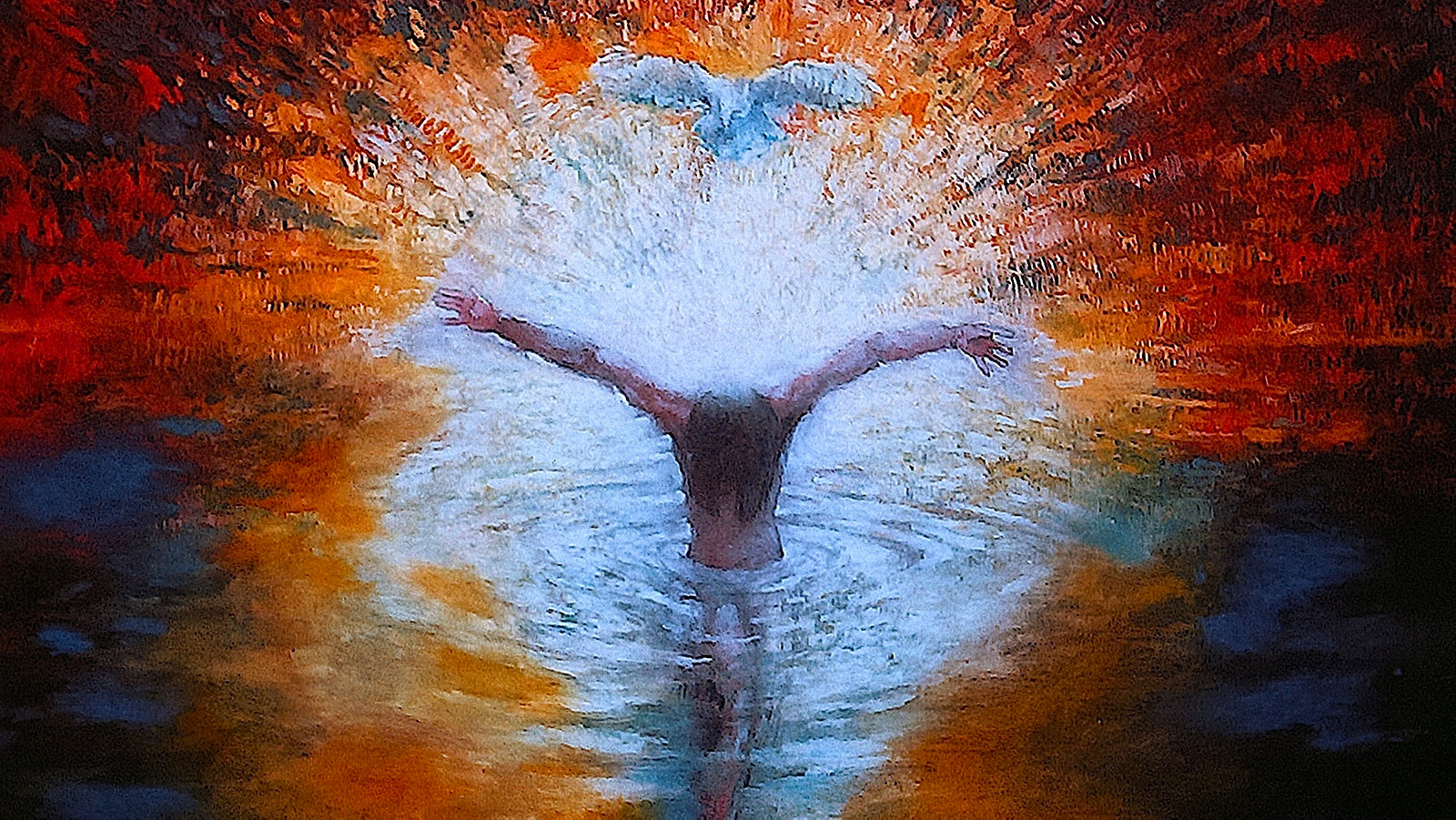
Today we commemorate and celebrate Jesus’ baptism by John in the river Jordan. Mark 1:10 tells us that “as Jesus was coming up out of the water” the Spirit descended “on him like a dove”. Jesus’ ministry starts with him being filled will the Spirit. Surely, if the Spirit is important for his life and ministry, the Spirit must be important for ours also.
Indeed, all of our readings for today speak about the work of the Spirit. Genesis 1:2 tells us that when God was creating the heavens and the earth, “the Spirit of God was hovering over the waters”. Holy Spirit was there, partnering with God in creation. And Psalm 29:3 echoes these words: “the voice of the Lord is over the waters … the Lord thunders over the mighty waters” – suggesting that the Spirit and the Lord are one and the same God. Holy Spirit is active in creation.
In Acts 19:1-7, Paul met up with some of John’s disciples and asks them if they received the Holy Spirit when they believed. They say they did not – indeed, they did not even know there was a Holy Spirit. Paul lays his hands on them and “the Holy Spirit came on them and they spoke in tongues and prophesied”. Much as we see in the story of Pentecost in Acts 2, Holy Spirit equips people for ministry.
Clearly, the Spirit is essential for creation or creativity and for ministry. Luke 4:1 tells us that after his baptism, Jesus was “full of the Holy Spirit” and that it was the Spirit who led him into the wilderness, where he was tempted. If Jesus needed to be filled with the Spirit, how much more do we need the filling of the Spirit? Paul is emphatic in Ephesians 5:18: “Be filled with the Spirit”.
Hopefully you are convinced that we need to be filled with the Spirit. If so, the question is ‘how?’ How are we to be filled with the Spirit?
Let me start by affirming that if you believe in Jesus – if you are a Christian – then Holy Spirit is already living in you. Paul makes this clear in 1 Corinthians 6:19: “Do you not know that your bodies are temples of the Holy Spirit, who is in you, whom you have received from God?” You cannot become a Christian without the working of the Spirit. So if you are a Christian, you already have the Spirit in you, whether you know it or not. Being filled with the Spirit then is something additional to this. (Remember that Jesus was already the Son of God when he was filled with the Spirit.)
How can we be filled with the Spirit? There is no formula for being filled with the Spirit. I offer some suggestions based on my own experience and the experiences I’ve heard from or seen in others:
Say a prayer asking Holy Spirit to fill you.
Ask someone to lay hands on you and pray for you to be filled with the Spirit.
Say a prayer in which you tell the Spirit that you surrender to the Spirit.
Bearing in mind that the Spirit is already in you, but that the Spirit might be shackled or chained, thus prevented from working fully, say a prayer in which you you unchain, unshackle and free-up the Spirit to work in you.
Identify specific areas of your life (e.g., your finances, marriage, mental health, sexuality) that you are keeping back from God and invite the Spirit to fill these areas of your life.
Do a walking prayer, saying “Holy Spirit fill me” as you breathe in and “I surrender to you” as you breathe out.
Or anything else that works for you…
I encourage you to seek the infilling of the Spirit. Not as a once-off thing, but as a regular thing. Being filled with the Spirit is not an event, but an ongoing way of life, in which we keep in step with the Spirit, like breathing. When we are filled with the Spirit, our faith will grow and flourish, our prayer life will deepen, we’ll more easily understand the Bible, and our ministry will strengthen and expand. This is what living in the Spirit is about.
Covid-19 has been spreading at an alarming rate in recent weeks. We have more new cases and more deaths than we had at the height of the first wave back in July and August 2020. And we hear of whole families infected with Covid and even dying of Covid. We ought to be greatly concerned about Covid. Let us think of Covid as the enemy of humanity and an agent of the devil. Covid does everything that is the antithesis of God and works against God’s vision for humanity.
The Amalekites came and attacked the Israelites at Rephidim. Moses said to Joshua, “Choose some of our men and go out to fight the Amalekites. Tomorrow I will stand on top of the hill with the staff of God in my hands.” So Joshua fought the Amalekites as Moses had ordered, and Moses, Aaron and Hur went to the top of the hill. As long as Moses held up his hands, the Israelites were winning, but whenever he lowered his hands, the Amalekites were winning. When Moses’ hands grew tired, they took a stone and put it under him and he sat on it. Aaron and Hur held his hands up—one on one side, one on the other—so that his hands remained steady till sunset. So Joshua overcame the Amalekite army with the sword.
Let us think of the Amalekites as Covid – our common enemy. Everyone is working to fight off this enemy:
Joshua and his soldiers are like those who are fighting Covid directly – frontline health workers, those developing vaccines and the President and his team.
Moses, together with Aaron and Hur, are up on the hilltop praying for Joshua and his team as they battle the enemy. Let us imagine that we are Moses, Aaron and Hur.
We can and ought to be praying against Covid. Prayer is not just a psychological thing that we do. It is real engagement with God and has a real impact on the real world. Prayer is hard – Moses struggles to keep his hands above his head holding the staff of God. We have to persist, to persevere in prayer.
And as Moses struggles, Aaron and Hur come alongside him. They help him to sit and then each help him hold up his arms, so that Moses can continue his work of prayer. Aaron and Hur work together to support Moses, who prays on behalf of Joshua.
In a similar way, we need each to do our part in supporting our collective efforts against Covid. These are quite simple: wear a mask, maintain physical distancing and avoid large gatherings. When we each do our part, we make a collective difference and contribute to the common good of all humanity.
And finally, let us take heart that God is present also in this collaborative effort: Aaron and Hur work to support Moses as he prays to God to enable Joshua and his team to fight off the enemy. There is no ‘let go and let God’ in this narrative. Each member of Israel had a role to play – each did their part. Together, working collaboratively, working in partnership with God, they were able to win the battle.
Dear friends, let us pray for God’s salvation and let us each do our part to support and protect each other, so that we win the battle against Covid.
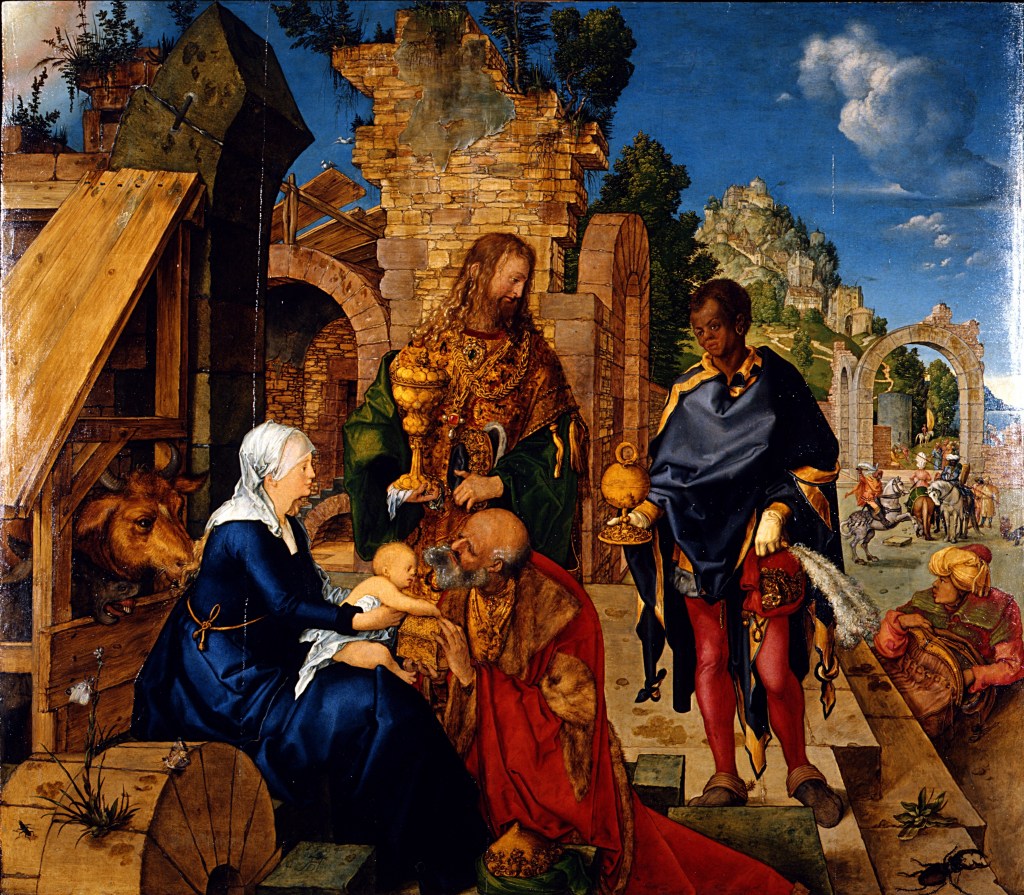
Today we celebrate Epiphany – the revelation or revealing of Jesus Christ to the non-Jewish world, specifically, to the Magi. Traditionally, these were the three wise men or the three kings. The readings set for today (for Epiphany) tell the narrative of a great opening up (or revealing or understanding) of God’s salvation for all humankind.
We start in Isaiah with several prophecies of the nations (Gentiles, non-Jews) coming recognise the special call of Israel to be a light to the world. For example, Isaiah 59:19 says, “From the west, people will fear the name of the Lord, and from the rising of the sun [that is, from the east], they will revere his glory”. In Isaiah 60:3, we read, “Nations will come to your light and kings to the brightness of your dawn”. And Isaiah 60:6 seems to prophesy the coming of the Magi (the traditional ‘three kings’ or ‘wise men’), “All from Sheba will come, bearing gold and incense and proclaiming the praise of the Lord.”
In the times of the First Testament, God had chosen to work with the Jewish people. They were his chosen people – the people of the covenant. But throughout that Testament, we see references, like those in Isaiah, to Israel leading everyone towards God. They were to be a priestly nation who would mediate God to the world.
Then, in Matthew 2:1, we read, “After Jesus was born in Bethlehem … Magi from the east came to Jerusalem and asked, ‘Where is the one who has been born king of the Jews? We saw his star when it rose and have come to worship him’.” When they found Jesus, “they bowed down and worshipped him” and “presented him with gifts of gold, frankincense and myrrh” (Matthew 2:11), in fulfilment of the prophecy in Isaiah 60:6.
The importance of the Magi is twofold. First, they recognise Jesus as a king – not merely as a child. He was a person of great significance. And secondly, because they came from the east (probably somewhere in Persia or even further east) and were not Jewish, they represent the gentile nations. Their visit to Jesus and their recognition of him as King is the fulfilment of the First Testament prophecy, that the Messiah of the Jewish people would be a Messiah for all people. This is the epiphany – the revelation of Jesus to those outside of the Jewish faith.
Jesus’ ministry, as recorded in the Gospels, was primarily to the Jewish people. Jesus says as much (e.g., Matthew 10:5-6). However, there are numerous examples of Jesus reaching beyond the Jewish people to Gentiles. Still, the Good News that Jesus preached was primarily good news for Jews.
The outworking of the fulfilled prophecy comes with Paul and is explained very clearly in his letter to the Ephesians. Speaking to the Gentiles, Paul says “you were separate from Christ, excluded from citizenship in Israel and foreigners to the covenants of the promise, without hope and without God in the world” (Ephesians 2:12). Paul is reiterating the First Testament position, that only the Jewish people were God’s chosen.
But Paul then shares his “insight into the mystery of Christ, which was not made known to people in other generations as it has now been revealed by the Spirit of God’s holy apostles and prophets” (Ephesians 3:4-5). And what is this mystery? It is that “through the gospel the Gentiles are heirs together with Israel, members together of one body, and sharers together in the promise of Christ Jesus” (Ephesians 3:6).
Paul proclaims the great opening up of the Gospel message to all people, as was prophesied in the First Testament and according to the sign of the magi from the East. God’s chosen people are no longer only the Jewish nation, but anyone who believes in Jesus Christ. “In him and through faith in him, we may approach God, with freedom and confidence” (Ephesians 3:12). “The barrier, the dividing wall of hostility” (Ephesians 2:14) has been destroyed. The doors to the Kingdom of God have been flung wide open and all are welcome to enter!
What does this mean for us today? It means that our church doors must also be flung wide open so that all feel welcome to enter. There should be no barriers to people coming to Christ and coming to church. Every person, no matter who or what they are, should feel that they are welcome, loved and included when they meet us. We should be generous and inclusive.
If we are honest, we will admit that Christians can be some of the most judgemental, critical and exclusionary people on earth. And often also hypocrites – saying one thing but doing another. Christians frequently do not put into practice the open and inclusive Gospel that Jesus proclaimed, which was prophesied in the First Testament, and which we see unfolding throughout the Second Testament.
Jesus’ ministry was one of radical inclusion. He seems to go out of his way to embrace those who the world would regard as sinners and marginalised – prostitutes, tax collectors, Roman oppressors, lepers, demon possessed people, women, Samaritans, the dead and dying, and so on. Jesus repeatedly positions himself with those who one might think could not be the ‘chosen people’. He does this show, unequivocally, that the Gospel is a generous and inclusive message and that doors to the Kingdom of God are wide open.
And thanks be to God for that! Because this is what enables most of us – who are Gentile – to be included among God’s chosen people. Let us then walk in the footsteps of Jesus and of Paul, in the way we as individuals engage with people around us – always welcoming, always generous, warm, kind, tolerant, inclusive. And let us as a church – the parish of St Stephen – similarly be a church with wide open doors that welcomes anyone and everyone into the presence of God.













 Reflections of God's Love